
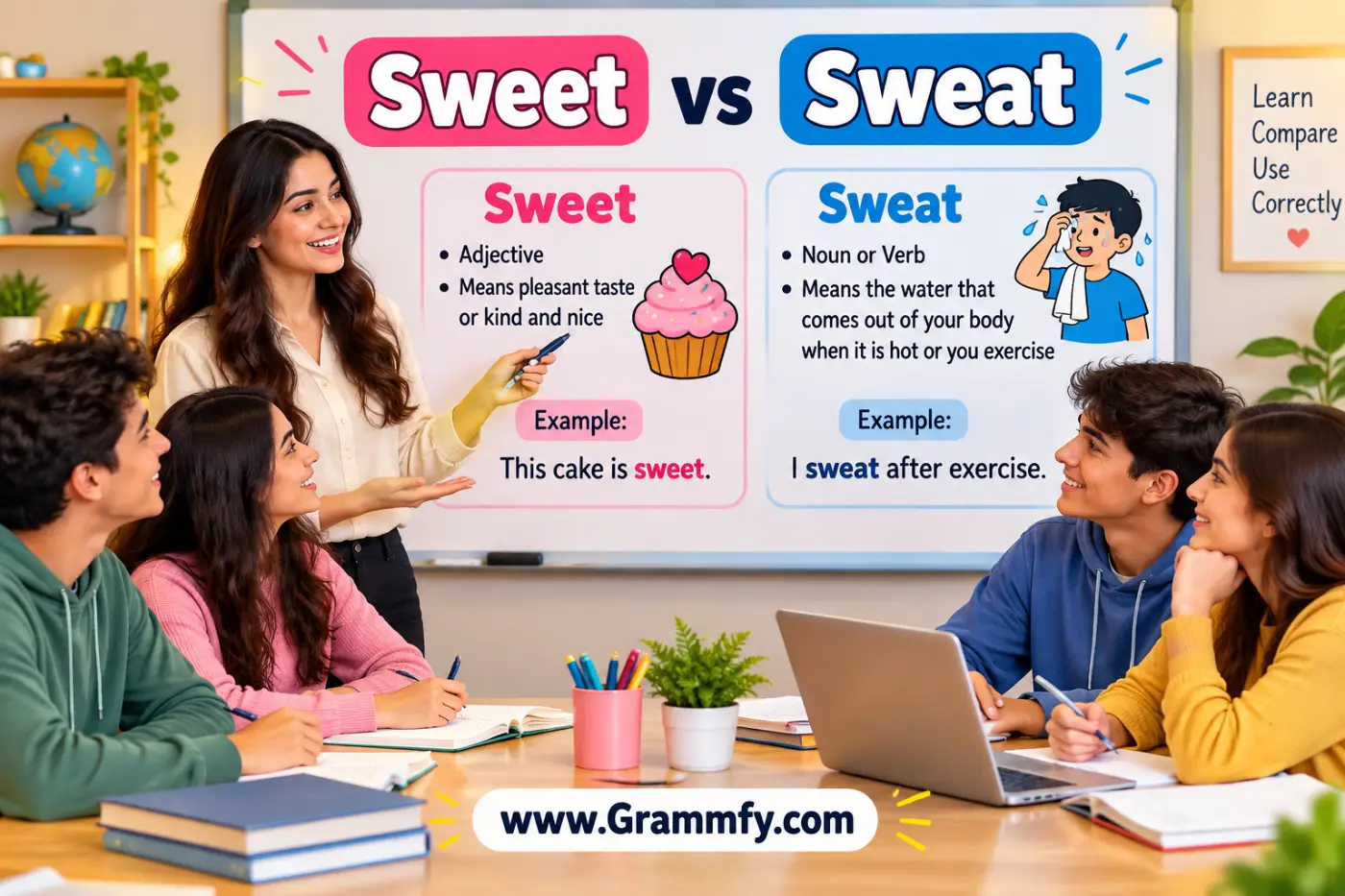
Have you ever typed a quick text and stopped because you weren’t sure whether to write Sweet vs Sweat? These two words look and sound somewhat similar, but they have completely different meanings. One can describe sugar, kindness, or something pleasant. The other is connected to moisture produced by your body, usually when you’re hot, active, nervous, or stressed.
Sweet usually describes something pleasant, sugary, kind, or attractive. Sweat is mainly a noun or verb related to perspiration or working hard.
Quick answer: Sweet means pleasant, sugary, kind, or enjoyable, while sweat means the moisture your body produces or the act of producing it. They are not interchangeable.
The difference becomes much easier once you look at their meanings, origins, common phrases, and real-life uses. This guide explains Sweet vs Sweat, including examples for texting, school, work, emails, resumes, and everyday conversations.
These words are easy to mix up, so read our guide to the difference between Inter vs Intra to see their meanings and examples side by side.
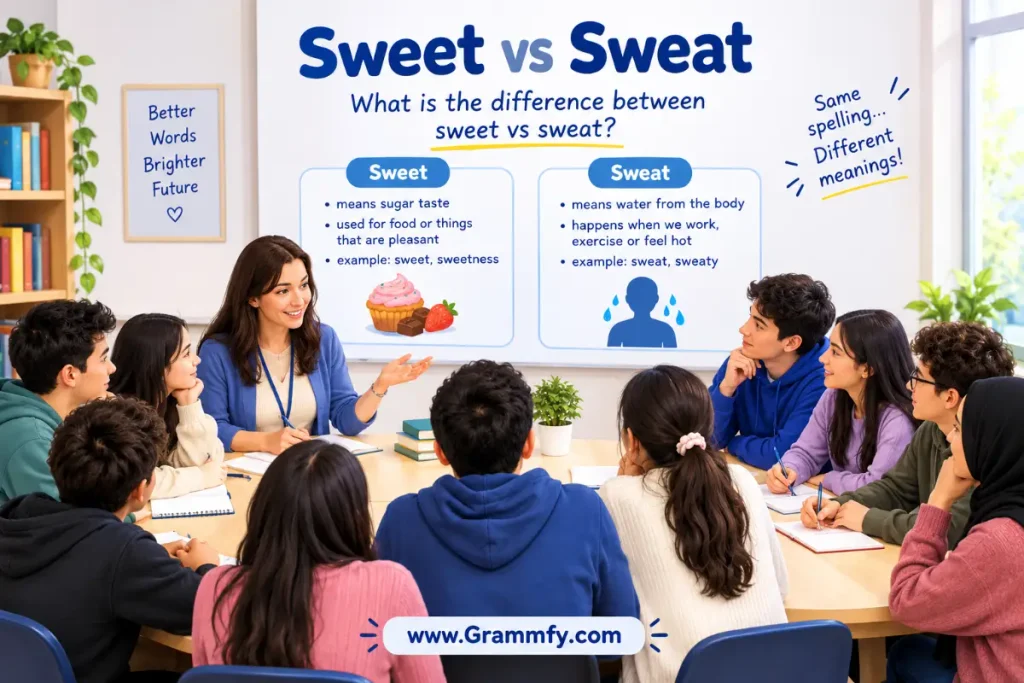
What is the difference between sweet vs sweat?
The simplest difference is meaning.
Sweet is an adjective most of the time. It can describe a pleasant taste, a kind person, a nice action, or something enjoyable. It can also be a noun or adverb in certain expressions.
Sweat is usually a noun or verb. As a noun, it means the salty liquid produced by your skin. As a verb, it means to produce sweat or, in some expressions, to worry or work very hard.
| Word | Main meaning | Part of speech | Example |
|---|---|---|---|
| Sweet | Pleasant or sugary | Adjective | This cake is sweet. |
| Sweet | Kind or caring | Adjective | That was a sweet thing to do. |
| Sweat | Liquid produced by the body | Noun | Sweat covered his forehead. |
| Sweat | To produce perspiration | Verb | I sweat a lot when I run. |
| Sweat | To worry or stress | Verb | Don’t sweat the small stuff. |
So, if you’re talking about taste, kindness, or something pleasant, choose sweet.
If you’re talking about perspiration, exercise, heat, or hard work, choose sweat.
Where do sweet and sweat come from?
Understanding word origins can make confusing words easier to remember.
Where does sweet come from?
Sweet has a very old history in English. It comes from Old English swēte, which referred to something having a pleasant taste or smell. Related forms appear in other Germanic languages.
Over time, its meaning expanded beyond food and taste. English speakers began using sweet to describe people, voices, sounds, actions, experiences, and even situations.
For example:
- sweet fruit
- a sweet voice
- a sweet child
- a sweet gesture
- sweet music
- sweet memories
Today, sweet can describe both physical qualities and emotional qualities.
Where does sweat come from?
Sweat also has an Old English history. It comes from the Old English word swāt, meaning perspiration. The related verb developed from the same basic idea.
Its central meaning has remained fairly stable: the moisture produced by the body.
However, English has developed several figurative uses. For example, someone can sweat over a difficult project, meaning they work hard on it. Someone can also sweat the details, meaning they worry excessively about small things.
The two words may look similar, but their histories and meanings developed separately.
Sweet vs Sweat: how do you remember the difference?
A simple memory trick can help.
Think of sweet when you see something that you might taste, enjoy, or appreciate.
Think of sweat when you imagine exercise, heat, or hard work.
Remember sweet with “sugar”
A sugary dessert is sweet.
- The chocolate cake is very sweet.
A kind action can also be sweet.
- That was a sweet message from my friend.
Remember sweat with “exercise”
When you run, your body may produce sweat.
- I started to sweat after running two miles.
The key idea is:
Sweet = pleasant or sugary.
Sweat = perspiration or hard work.
Master synonym and related-word list
Because sweet and sweat have different meanings, their synonyms also belong to different groups. The following table gives useful alternatives and related terms.
Simple words
| Word | Meaning | Tone | Example |
|---|---|---|---|
| Sweet | Pleasant or sugary | Everyday | The tea is sweet. |
| Sugary | Containing a lot of sugar | Everyday | This drink is sugary. |
| Kind | Caring and helpful | Everyday | She is kind to everyone. |
| Nice | Pleasant or friendly | Casual | He gave me a nice gift. |
| Sweat | Body moisture | Everyday | Sweat ran down his face. |
| Perspire | Produce sweat | Neutral | People perspire in hot weather. |
| Moisture | Small amount of liquid | Neutral | Moisture appeared on his skin. |
Everyday alternatives
| Word | Meaning | Tone | Example |
|---|---|---|---|
| Lovely | Very pleasant or attractive | Everyday | She has a lovely smile. |
| Pleasant | Enjoyable or agreeable | Neutral | We had a pleasant afternoon. |
| Delicious | Very good to taste | Everyday | The soup is delicious. |
| Tasty | Good in flavor | Casual | These tacos are tasty. |
| Friendly | Warm and welcoming | Everyday | He is friendly to new students. |
| Perspiration | Sweat from the body | Neutral | Excessive perspiration can be uncomfortable. |
| Exertion | Physical or mental effort | Neutral | The exercise required great exertion. |
| Effort | Energy used to do something | Everyday | Her effort paid off. |
Formal words
| Word | Meaning | Tone | Example |
|---|---|---|---|
| Agreeable | Pleasant or acceptable | Formal | The room had an agreeable temperature. |
| Delightful | Very pleasant | Formal | It was a delightful experience. |
| Pleasant-tasting | Having a good taste | Formal | The fruit was pleasant-tasting. |
| Perspiration | Sweat | Formal | Perspiration increased during exercise. |
| Exertion | Physical or mental effort | Formal | Heavy exertion may increase sweating. |
| Labor | Hard work | Formal | The project required months of labor. |
| Strain | Difficult effort or pressure | Formal | The task placed strain on the team. |
Casual and slang expressions
| Word or phrase | Meaning | Tone | Example |
|---|---|---|---|
| Cute | Attractive or endearing | Casual | That’s a cute puppy. |
| Awesome | Very good | Casual | That’s an awesome idea. |
| Sugar | Sweet food or ingredient | Everyday | Add a little sugar. |
| Sweaty | Covered in sweat | Casual | I got sweaty at the gym. |
| Sweat it | Worry about something | Casual | Don’t sweat it. |
| Work up a sweat | Exercise enough to sweat | Casual | Let’s work up a sweat. |
| Sweat over | Work hard on something | Casual | She sweated over the assignment. |
Not every word above is a direct dictionary synonym. Some are related words or expressions that help you describe the same general idea more precisely.
Sweet synonyms by intensity
The word sweet can have different levels of strength depending on what you’re describing.
Mild
These words suggest something pleasant without strong emotion:
- nice
- pleasant
- agreeable
- friendly
Example:
- The restaurant has a pleasant atmosphere.
Strong
These words suggest a stronger positive reaction:
- lovely
- delightful
- wonderful
- delicious
Example:
- The homemade pie was delicious.
Emotional
When describing a person’s behavior, you might use:
- kind
- caring
- thoughtful
- affectionate
- gentle
Example:
- It was thoughtful of Maya to check on her friend.
Choosing the right word depends on what kind of “sweetness” you mean.
Sweat-related words by intensity
Sweat can also be described in different ways.
Light sweating
Use words such as:
- perspire
- moisture
- dampness
Example:
- His forehead was slightly damp after the walk.
Heavy sweating
Use phrases such as:
- sweat heavily
- perspire heavily
- drenched in sweat
- soaked with sweat
Example:
- The players were drenched in sweat after the match.
Figurative stress
English also uses sweat in expressions about worry and effort.
Examples include:
- Don’t sweat it.
- Don’t sweat the small stuff.
- sweat over a problem
- sweat the details
- work up a sweat
These expressions aren’t about sweetness at all.

Sweet vs Sweat by part of speech
Knowing the grammar of each word makes the distinction even clearer.
How to use sweet as an adjective
The most common use of sweet is as an adjective.
It can describe:
- food
- drinks
- smells
- sounds
- people
- actions
- experiences
Examples:
- The strawberries are sweet.
- She has a sweet voice.
- That was a sweet gesture.
How to use sweet as a noun
Sweet can be a noun, especially in British English, where it can mean a piece of candy.
- The children were given sweets after dinner.
In American English, candy is usually more common for this meaning.
How to use sweat as a noun
As a noun, sweat refers to the liquid produced by the body.
There was sweat on his forehead.
Her shirt was covered in sweat.
How to use sweat as a verb
As a verb, sweat means to produce sweat.
I sweat a lot during summer.
It can also describe worrying:
Don’t sweat the small stuff.
This difference in grammar gives you another useful clue.
Sweet vs Sweat in a resume
A resume usually isn’t the place to use sweet unless you’re describing a very specific product, flavor, or experience.
Instead, use professional words such as:
- effective
- positive
- thoughtful
- successful
- collaborative
- professional
For example, don’t write:
- I have a sweet communication style.
A better professional sentence would be:
- I have a friendly and professional communication style.
Sweat is also uncommon in a resume unless your job or experience specifically involves physical activity.
For example:
- The training program required significant physical exertion.
This sounds more professional than:
- The training program made us sweat a lot.
Sweet vs Sweat in an essay
In an essay, sweet is useful when you’re describing taste, personality, memories, or sensory details.
Example:
- The sweet smell of fresh bread filled the kitchen.
For formal writing about physical activity, sweat is perfectly correct when you actually mean perspiration.
Example:
- After several hours of exercise, the athletes were covered in sweat.
For figurative writing, you might write:
- The students sweated over the difficult examination.
However, worked hard on may sound clearer in formal academic writing.
Sweet vs Sweat in an email
In a casual email, sweet can describe a kind action or pleasant surprise.
That was such a sweet thing to do. Thank you!
But in a professional email, kind, thoughtful, or appreciated may be better.
Thank you for your thoughtful message.
Use sweat when the topic involves physical activity or when you’re using a familiar expression.
I wouldn’t sweat the small details yet. We can review them tomorrow.
For a formal email, you could replace the expression with:
I wouldn’t worry about the small details yet.
Sweet vs Sweat in texting
Texting is where sweet is especially common.
You might write:
- That’s so sweet!
This can mean “That’s very kind” or “That’s adorable.”
You can also use sweat in casual expressions:
- Don’t sweat it!
Here, sweat it means don’t worry about it.
Another example:
- I’m sweating after that workout.
The context makes the meaning clear.
Sweet vs Sweat in everyday speaking
In everyday conversation, both words are common, but they appear in very different situations.
Use sweet for:
- food
- drinks
- kind behavior
- cute things
- pleasant experiences
Use sweat for:
- exercise
- hot weather
- physical work
- nervousness
- worry
- effort
Examples:
- This coffee is too sweet.
- Your sister is really sweet.
- I’m starting to sweat.
- We worked up a sweat at the gym.
12 original examples of sweet and sweat
Here are realistic examples that show the difference.
- The lemonade is too sweet for me.
- That was a sweet message from your brother.
- These apples are naturally sweet.
- She gave her teacher a sweet thank-you note.
- I began to sweat while carrying the boxes upstairs.
- The runners were covered in sweat after the race.
- It’s so hot that everyone is sweating.
- Don’t sweat the small mistakes in your first draft.
- The dessert has a sweet vanilla flavor.
- He gave his grandmother a sweet smile.
- We worked up a sweat during practice.
- She was sweating over the final details of the project.
Notice that sweet focuses on pleasant qualities, while sweat focuses on perspiration, effort, or worry.
Sweet vs sugary — what’s the difference?
- Sweet and sugary are close, but they’re not always interchangeable.
Sweet simply means having a taste that contains or resembles sugar.
- The mango is sweet.
Sugary often emphasizes a high amount of sugar.
- This cereal is very sugary.
The distinction matters because something can taste sweet without the speaker focusing on how much sugar it contains.
You can also use sweet for people and actions:
She is very sweet.
You generally wouldn’t say:
She is very sugary.
That would sound unusual unless you’re being playful or metaphorical.
Sweet vs kind — what’s the difference?
When describing a person, sweet and kind can overlap.
Kind focuses on good behavior toward others.
He was kind to the new student.
Sweet often adds an emotional sense of warmth, affection, or endearment.
He was sweet to the new student.
The second sentence may sound warmer or more personal.
In formal writing, kind is usually the safer choice.
In casual conversation, sweet is very natural.
Sweat vs perspiration — what’s the difference?
Sweat is the everyday word.
- I was covered in sweat.
Perspiration is more formal.
- Excessive perspiration can occur during intense exercise.
For normal conversation, sweat usually sounds more natural. In scientific, medical, or formal contexts, perspiration may be preferred.
Sweat vs moisture — what’s the difference?
Moisture is a broad word for a small amount of liquid or wetness.
Sweat specifically refers to fluid produced by the body’s sweat glands.
So:
- There was moisture on the window.
doesn’t mean the same thing as:
- There was sweat on his forehead.
If you know the liquid is produced by the body, sweat is more precise.
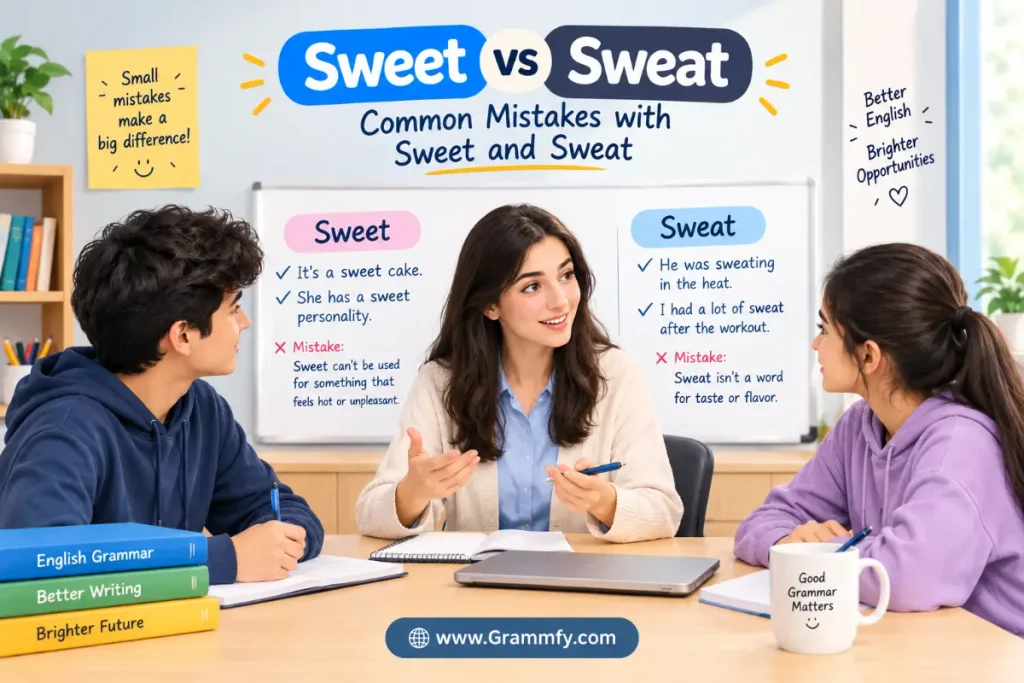
Common mistakes with sweet and sweat
Because the words look similar, spelling mistakes are common.
Mistake 1: Using sweat for taste
Incorrect:
- This cake is very sweat.
Correct:
- This cake is very sweet.
If you’re talking about flavor, use sweet.
Mistake 2: Using sweet for perspiration
Incorrect:
- I was covered in sweet after running.
Correct:
- I was covered in sweat after running.
If you’re talking about body moisture, use sweat.
Mistake 3: Confusing “Don’t sweat it”
Some learners may think this expression has something to do with physical sweating.
It doesn’t.
- Don’t sweat it.
means:
- Don’t worry about it.
It’s a casual expression.
Mistake 4: Confusing “sweet” with “sweaty”
These words are very different.
Sweet means pleasant, sugary, or kind.
Sweaty means covered with or producing sweat.
Compare:
- She is sweet.
with:
- She is sweaty after her workout.
The first describes personality or behavior. The second describes physical condition.
When should you NOT use sweet?
Don’t use sweet when you specifically mean perspiration, physical effort, or body moisture.
For example:
- I was sweet after the workout.
This is incorrect if you mean that you were sweating.
Say:
- I was sweaty after the workout.
Likewise, don’t use sweet to describe the act of producing perspiration.
- I sweet when I run.
Correct:
- I sweat when I run.
When should you NOT use sweat?
Don’t use sweat when you’re describing taste or kindness.
For example:
- The cookies are sweat.
Correct:
- The cookies are sweet.
And:
- That was a sweat thing to do.
Correct:
- That was a sweet thing to do.
The surrounding meaning is a strong clue.
Sweet and sweat in common expressions
Learning common expressions can help you recognize each word quickly.
“Sweet tooth”
A sweet tooth means a strong liking for sweet foods.
I have a sweet tooth, so I love chocolate.
“Sweet dreams”
Sweet dreams is a common phrase used when wishing someone a pleasant night’s sleep.
Good night. Sweet dreams!
“Sweetheart”
Sweetheart can be an affectionate term for someone you love or care about.
Thanks, sweetheart.
“Don’t sweat it”
This means don’t worry about it.
Don’t sweat it. We still have plenty of time.
“Sweat the small stuff”
This means to worry too much about minor problems.
Try not to sweat the small stuff.
“Work up a sweat”
This means to exercise or work hard enough to begin sweating.
We worked up a sweat during the training session.
Antonyms of sweet and sweat
The antonyms depend on the meaning you’re using.
Antonyms of sweet
For taste:
- bitter
- sour
- salty
- unsweetened
Example:
- The coffee is bitter rather than sweet.
For personality:
- unkind
- cruel
- harsh
- unfriendly
Example:
- His response was harsh rather than sweet.
Antonyms of sweat
There isn’t one perfect opposite for sweat in every situation.
Depending on context, you might use:
- dry
- cool
- rest
- relax
For example:
- After resting in the air conditioning, his skin became dry.
These are contextual opposites rather than exact dictionary antonyms.
US vs UK usage
There is an interesting regional difference involving sweet.
In both American and British English, sweet commonly means sugary, pleasant, or kind.
However, in British English, sweet can also mean candy as a noun.
- The children bought some sweets.
In American English, people usually say:
- The children bought some candy.
The word sweat has essentially the same core meaning in both varieties of English.
The phrase Don’t sweat it is also widely understood in American and British English, although exact frequency can vary by region and context.
Quick tips for choosing the right word
When you’re unsure, ask yourself what you’re describing.
Are you talking about taste?
Use sweet.
- The watermelon is sweet.
Are you describing someone’s kindness?
Use sweet.
- That was very sweet of you.
Are you talking about body moisture?
Use sweat.
- Sweat covered his face.
Are you talking about producing body moisture?
Use sweat as a verb.
- I sweat a lot in summer.
Are you talking about worry?
Use sweat in expressions such as:
- Don’t sweat it.
Are you talking about hard physical work?
Use sweat.
- They sweated for hours to finish the job.
A simple rule works most of the time:
Sweet is about pleasant things. Sweat is about perspiration, effort, or worry.
How can you avoid confusing sweet and sweat?
Focus on the vowel sound and meaning instead of spelling alone.
Sweet is connected to ideas like:
- sugar
- candy
- kindness
- pleasantness
- affection
Sweat is connected to ideas like:
- exercise
- heat
- perspiration
- effort
- stress
When proofreading, look at the whole sentence.
For example:
- The ice cream is very ___.
The sentence is about taste, so sweet is correct.
- I started to ___ after running.
The sentence is about physical activity, so sweat is correct.
This context-based approach is more reliable than trying to memorize the spelling by itself.
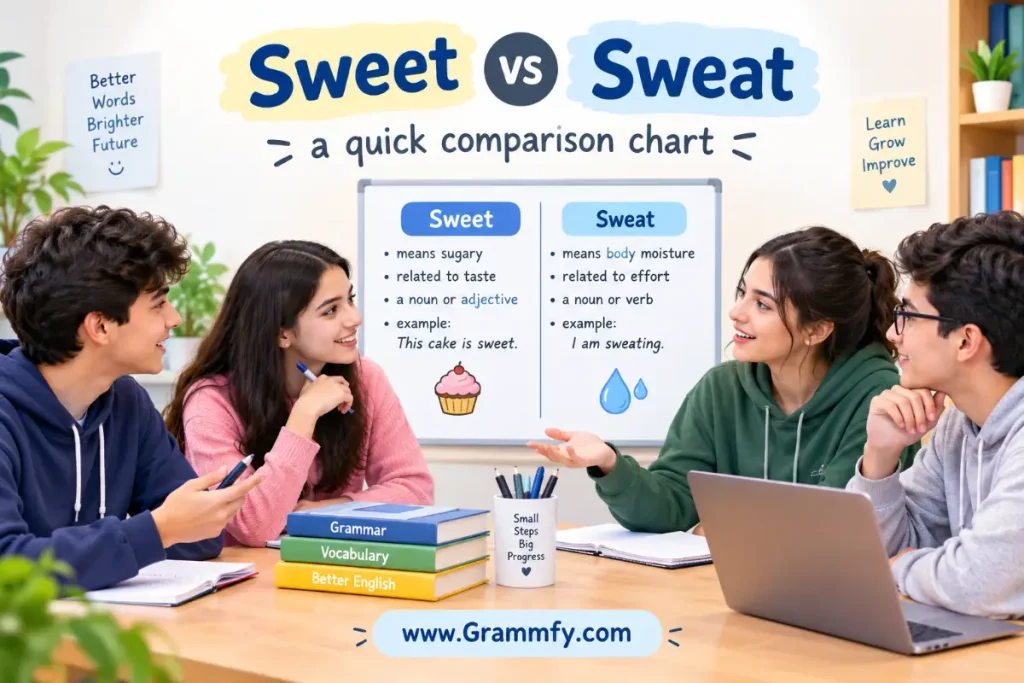
Sweet vs Sweat: a quick comparison chart
| Feature | Sweet | Sweat |
|---|---|---|
| Main meaning | Pleasant, sugary, or kind | Perspiration or hard effort |
| Common part of speech | Adjective | Noun and verb |
| Taste | Yes | No |
| Kindness | Yes | No |
| Body moisture | No | Yes |
| Exercise | Usually no | Yes |
| Worry | No | Yes, in expressions |
| Example | The cake is sweet. | I began to sweat. |
| Common phrase | Sweet dreams | Don’t sweat it |
| British noun meaning | Candy | No major difference |
Conclusion
The easiest way to remember Sweet vs Sweat is to connect each word with its main idea. Sweet describes something sugary, pleasant, kind, or enjoyable. Sweat refers to perspiration and can also describe hard work or worry in informal expressions.
Pay attention to the part of speech, too. You can say that food is sweet, that someone is sweet, or that a gesture was sweet. You can also say that you sweat during exercise or that sweat covered your face.
If you see these words in a sentence, don’t rely only on their similar spelling. Look at the meaning of the sentence first. With a little practice, choosing the correct word becomes easy.
Frequently Asked Questions
What is the difference between sweet and sweat?
Sweet means pleasant, sugary, or kind, while sweat means perspiration or the act of producing it. They have different meanings and grammatical uses.
Is it sweet or sweat after exercise?
Sweat is correct when you mean the liquid produced by your body after exercise. For example, “I was covered in sweat.”
Is “Don’t sweat it” a correct expression?
Yes, “Don’t sweat it” is a common informal expression meaning “Don’t worry about it.” It isn’t referring to physical perspiration.
Is candy called sweets or sweet in American English?
American English usually uses candy for this meaning, while British English commonly uses sweets. The adjective sweet is used in both varieties.
What’s another way to say sweet?
Depending on the meaning, alternatives include pleasant, sugary, delicious, kind, lovely, thoughtful, and friendly. The best choice depends on whether you’re describing taste, personality, or an experience.
What’s another word for sweat?
Common alternatives include perspiration and perspire. “Perspiration” is a noun, while “perspire” is a verb.
How can I remember Sweet vs Sweat?
Think of sweet when you think of sugar, pleasant things, or kindness. Think of sweat when you think of exercise, heat, perspiration, or hard work.
