
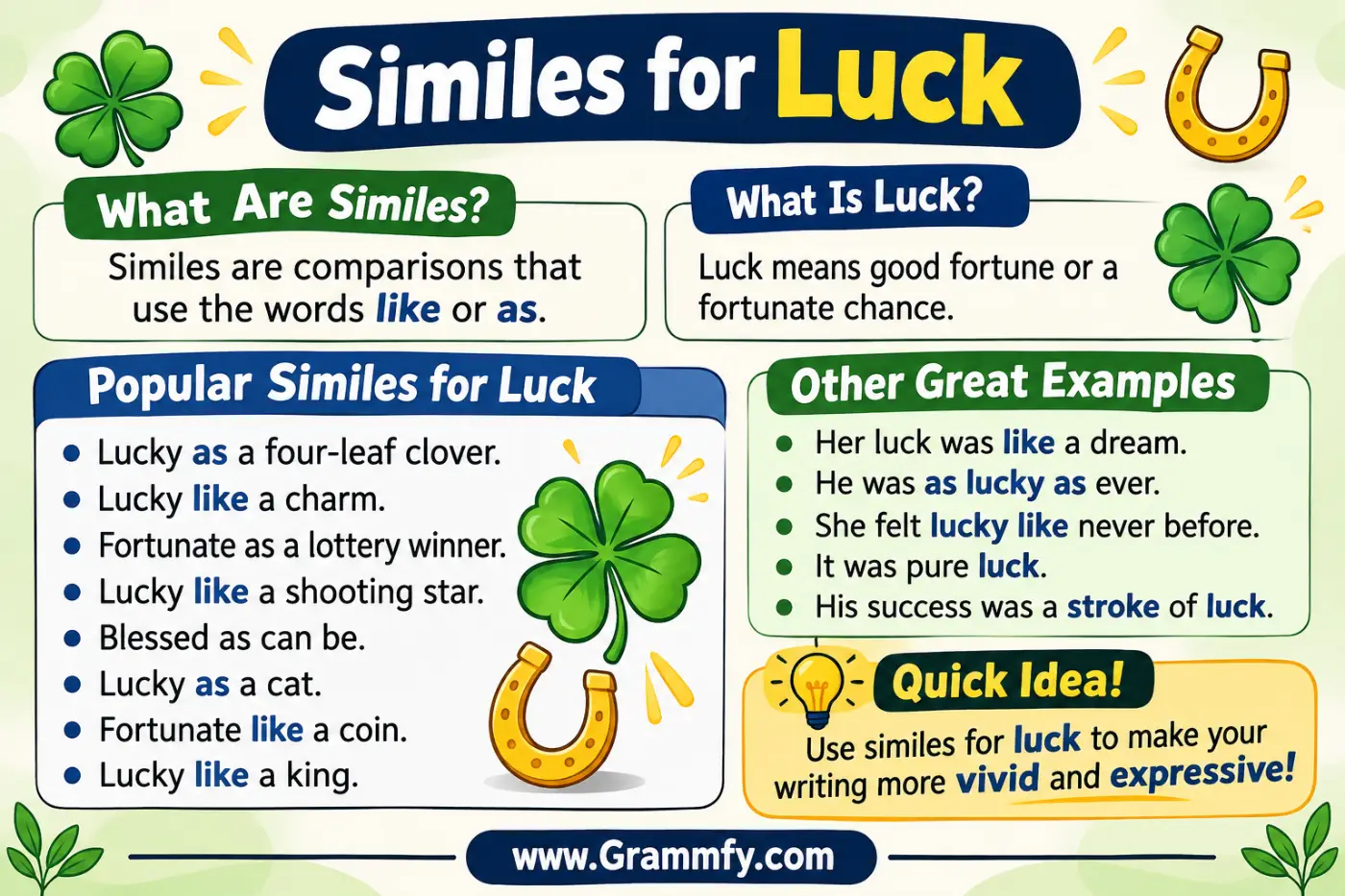
Have you ever wanted to describe someone who always seems to win, find money, or get the perfect opportunity at the right moment? You might call that person lucky, but sometimes a simple comparison makes the description more interesting. Similes for Luck help you express good fortune, unexpected success, and fortunate moments in a creative way. For example, you could say, “She was as lucky as a four-leaf clover in a field of grass.”
Similes make ordinary descriptions more colorful. Instead of saying someone has good luck, you can compare their fortune to a winning lottery ticket, a lucky charm, or a bright star. These comparisons help readers picture how fortunate someone feels.
Writers use these expressions in stories, poems, essays, everyday conversations, and social media posts. They can also describe unexpected opportunities, lucky escapes, and moments when everything seems to go right.
A simile for luck compares good or bad fortune to a familiar person, object, event, or experience, usually with the words “like” or “as.” For example, “His luck was like a golden ticket” suggests that he had an excellent opportunity.
In this guide, you’ll discover creative comparisons, meanings, related words, examples, and practical writing tips. You’ll also learn how to choose an expression that fits your situation without making your writing sound forced.
Need a more vivid way to describe wonderful? Explore our guide to creative wonderful similes and examples for fresh ideas and examples.
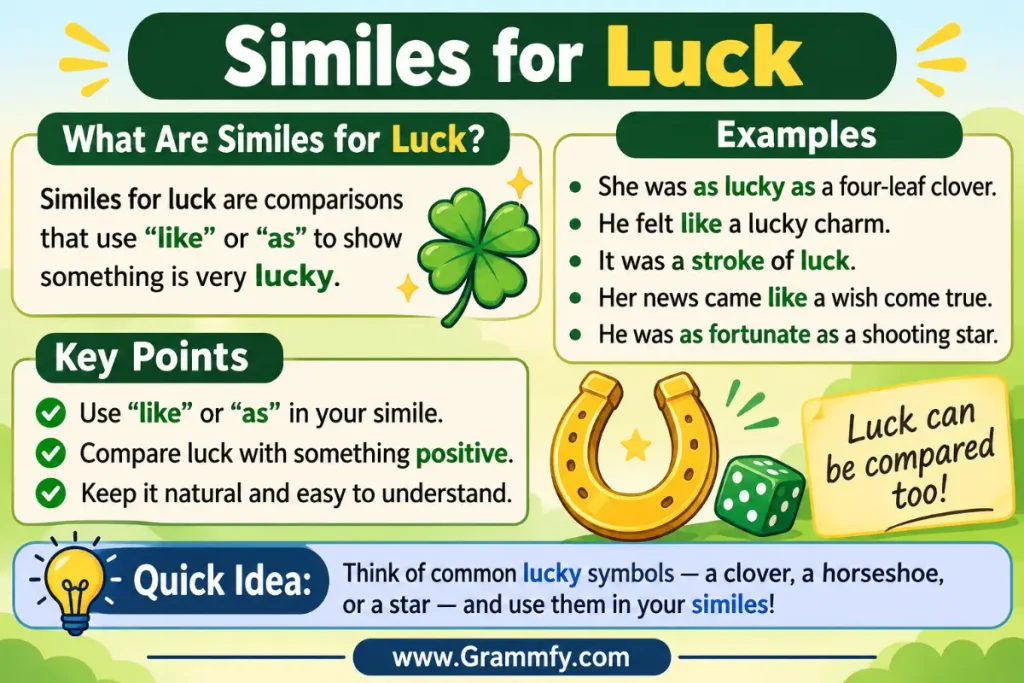
What Are Similes for Luck?
A simile is a figure of speech that compares two different things using words such as “like” or “as.” It helps readers understand an idea by connecting it to something familiar.
A simile about luck describes how fortunate, unfortunate, or unexpectedly successful someone is by comparing their experience with another thing.
For example:
- He was as lucky as a four-leaf clover.
- Her opportunity appeared like a gift from the universe.
- My brother’s luck was like a winning lottery ticket.
- The lost wallet returned like a small miracle.
Each sentence creates a picture of good fortune instead of simply using the word “lucky.”
Why Do Writers Use Comparisons About Luck?
Writers use these expressions for several reasons:
- To make descriptions interesting: A creative comparison makes a simple sentence more memorable.
- To express strong feelings: It can show excitement, relief, gratitude, or surprise.
- To create mental pictures: Readers can imagine a lucky charm, a golden ticket, or a bright star.
- To improve storytelling: A comparison can make a character’s fortunate experience more entertaining.
- To avoid repetition: Different expressions help writers describe good fortune without using “lucky” repeatedly.
For example, compare these sentences:
- Simple: Jake was very lucky.
- Creative: Jake was as lucky as someone who found a treasure chest in their backyard.
The second sentence gives readers a clearer picture of Jake’s good fortune.
What Is the Origin of the Word Luck?
The word luck has an interesting history. It entered English during the late Middle Ages, probably through Middle Dutch luc or a related Germanic word. It referred to fortune, chance, or the way events happened.
Over time, people began using the word for both positive and negative outcomes.
Today, luck usually describes events that happen by chance rather than through someone’s direct control.
For example:
- Winning a prize through a random draw is good luck.
- Finding your lost keys just before leaving is a lucky break.
- Missing a bus that later breaks down might be considered a fortunate accident.
- Losing a competition because of an unexpected event can feel like bad luck.
What Does Luck Mean in Plain English?
Luck means the chance of something good or bad happening without someone fully controlling the result.
It can describe:
- Good fortune: Something positive happens unexpectedly.
- Bad fortune: An unwanted event happens by chance.
- Opportunity: A favorable situation appears.
- Chance: An outcome depends on circumstances rather than a planned result.
For example, finding a $20 bill on the sidewalk is a lucky experience. However, working hard to earn a promotion is mainly an achievement, even if good timing also helps.
Luck and effort can work together, but they aren’t exactly the same thing.
What Are the Best Similes for Luck?
Here are some original comparisons you can use in creative writing, conversations, and everyday descriptions.
| No. | Simile | Meaning |
|---|---|---|
| 1 | As lucky as a four-leaf clover | Extremely fortunate |
| 2 | Like finding gold at the end of a rainbow | Experiencing an unexpected reward |
| 3 | As lucky as a winner holding the golden ticket | Having an excellent opportunity |
| 4 | Like a star shining on a clear night | Experiencing a fortunate moment |
| 5 | As lucky as someone who finds a treasure chest | Receiving an unexpected benefit |
| 6 | Like catching sunshine in a bottle | Experiencing something wonderful |
| 7 | As fortunate as a traveler finding shelter in a storm | Finding help at the perfect time |
| 8 | Like winning a prize without entering | Receiving an unexpected reward |
| 9 | As lucky as a coin landing on the right side | Getting the desired result |
| 10 | Like a wish coming true overnight | Experiencing sudden good fortune |
| 11 | As lucky as a bird finding a golden nest | Enjoying an unexpected blessing |
| 12 | Like opening a door to a hidden garden | Discovering a wonderful opportunity |
| 13 | As lucky as someone finding money in an old coat | Receiving a pleasant surprise |
| 14 | Like being in the right place at the right time | Having perfect timing |
| 15 | As lucky as a sailor finding a safe harbor | Escaping danger successfully |
| 16 | Like a rainbow appearing after a storm | Finding happiness after difficulty |
| 17 | As lucky as a player making the final winning shot | Achieving success at the perfect moment |
| 18 | Like discovering a shortcut on a long journey | Finding an unexpected advantage |
| 19 | As lucky as a bee finding a field of flowers | Finding exactly what is needed |
| 20 | Like receiving a gift from an unexpected friend | Getting an unplanned benefit |
Short Similes for Luck
Short expressions work well in captions, poems, quick conversations, and short stories.
- As lucky as a clover.
- Like a golden ticket.
- As fortunate as a king.
- Like a shining star.
- As lucky as a winner.
- Like a dream come true.
- As blessed as a sunny morning.
- Like finding hidden treasure.
- As fortunate as a traveler.
- Like a lucky charm.
- As bright as a lucky star.
- Like a gift from fate.
Quick idea: Choose a short comparison when you want your sentence to sound natural and easy to remember.
Funny Similes for Luck
Humorous comparisons are useful when describing someone who seems to get everything without trying.
- As lucky as a cat with nine lives.
- Like finding pizza in the fridge after a long day.
- As lucky as someone who gets an extra day off.
- Like winning a raffle without buying a ticket.
- As lucky as a student whose homework disappears on the due date.
- Like finding the last cookie in the jar.
- As fortunate as someone who misses traffic by one second.
- Like getting free food when you’re starving.
- As lucky as a person who always finds an empty parking space.
- Like discovering that the exam has been postponed.
These comparisons add humor without making the meaning difficult to understand.
Romantic Similes for Luck
Sometimes good fortune comes through meeting someone special. These comparisons can describe love, relationships, and meaningful connections.
- Like finding a rare flower in a quiet garden.
- As lucky as a heart finding its missing piece.
- Like a beautiful sunrise after a lonely night.
- As fortunate as two stars meeting in the same sky.
- Like receiving a love letter on a difficult day.
- As lucky as finding a home in someone’s heart.
- Like a wish turning into a warm embrace.
- As fortunate as a traveler finding their way home.
Use these expressions in love letters, romantic poems, and personal messages.
Similes for Unexpected Good Luck
These comparisons describe situations in which something positive happens without warning.
- Like finding a diamond in the sand.
- As lucky as someone discovering a hidden treasure.
- Like receiving good news out of nowhere.
- As fortunate as a lost traveler finding a clear road.
- Like a flower blooming in an unexpected place.
- As lucky as finding an open seat on a crowded train.
- Like a door opening when every other door seems closed.
- As fortunate as finding an umbrella just before the rain.
These expressions are especially useful when describing surprise opportunities and lucky escapes.
What Words Are Similar to Lucky and Fortunate?
The following words can help you describe good fortune in different ways. Some are direct synonyms of lucky, while others describe positive opportunities, favorable circumstances, or unexpected success.
Master Synonym List: 30 Words Related to Luck
| Word | Meaning | Tone | Example |
|---|---|---|---|
| Lucky | Having good fortune | Simple | I was lucky to find my keys. |
| Fortunate | Experiencing a positive outcome | Everyday | We were fortunate to arrive early. |
| Favored | Receiving special advantages | Everyday | The team seemed favored to win. |
| Successful | Achieving a desired result | Everyday | He had a successful year. |
| Promising | Showing signs of a good outcome | Everyday | It was a promising opportunity. |
| Advantageous | Providing a useful benefit | Formal | The timing was advantageous. |
| Favorable | Likely to produce a good result | Formal | The weather was favorable. |
| Prosperous | Enjoying success and wealth | Formal | They had a prosperous year. |
| Auspicious | Suggesting future success | Formal | It was an auspicious beginning. |
| Opportune | Happening at the right time | Formal | She made an opportune decision. |
| Charitable | Generous or giving | Everyday | A charitable neighbor helped us. |
| Golden | Especially valuable or favorable | Everyday | This is a golden opportunity. |
| Rewarding | Producing satisfaction or benefits | Everyday | It was a rewarding experience. |
| Thriving | Growing or succeeding well | Everyday | The business is thriving. |
| Happy-go-lucky | Relaxed and carefree | Informal | He is a happy-go-lucky person. |
| Charmed | Seemingly protected by good fortune | Everyday | She seems to have a charmed life. |
| Blessedly | In a fortunate or welcome way | Everyday | The rain blessedly stopped. |
| Serene | Calm and peaceful | Everyday | We enjoyed a serene afternoon. |
| Magical | Seeming wonderful or extraordinary | Everyday | It was a magical evening. |
| Golden-hearted | Kind and generous | Informal | Her golden-hearted friend helped her. |
| Lucky break | An unexpected helpful opportunity | Informal | He got a lucky break at work. |
| Stroke of luck | A sudden fortunate event | Everyday | Meeting her was a stroke of luck. |
Important: These words aren’t interchangeable in every sentence. For example, serendipitous describes a fortunate unexpected discovery, while prosperous usually describes long-term success.
Simple Words for Describing Good Luck
Simple vocabulary is best when you want everyone to understand your meaning immediately.
- Lucky
- Happy
- Blessed
- Successful
- Fortunate
- Good
- Wonderful
- Rewarding
Example: “I was fortunate to receive a scholarship.”
Everyday Words for Describing Good Fortune
These words sound natural in regular conversations and general writing.
- Favored
- Golden
- Promising
- Charmed
- Advantageous
- Thriving
- Opportune
- Rewarding
Example: “We found a favorable time to travel.”
Formal Words for Describing Good Fortune
Formal vocabulary works well in academic writing, professional communication, and detailed descriptions.
- Serendipitous
- Fortuitous
- Providential
- Auspicious
- Advantageous
- Prosperous
- Favorable
- Opportune
Example: “The researcher made a fortuitous discovery during the experiment.”
Slang and Informal Expressions for Luck
Informal expressions are common in conversations, texts, and casual social media posts.
- Lucky break
- Jackpot
- On a roll
- Hit the jackpot
- In the money
- Got lucky
- Good vibes
- Pure luck
Example: “You got the last concert ticket? That’s a lucky break!”

How Do Luck-Related Words Change From Mild to Strong?
Not every fortunate experience is equally important. Sometimes someone receives a small benefit. Other times, a lucky event completely changes their life.
Choosing a word based on intensity makes your writing more accurate.
| Intensity | Word or Expression | Meaning | Example |
|---|---|---|---|
| Mild | Favorable | Slightly positive | The conditions were favorable. |
| Mild | Promising | Showing potential | It was a promising start. |
| Mild | Fortunate | Having a good outcome | I was fortunate to arrive early. |
| Moderate | Lucky | Experiencing good fortune | She was lucky to win. |
| Moderate | Blessed | Having something valuable | He feels blessed with his family. |
| Moderate | Charmed | Seemingly enjoying continuous good luck | She has a charmed life. |
| Strong | Serendipitous | Unexpectedly fortunate | It was a serendipitous meeting. |
| Strong | Auspicious | Suggesting excellent future possibilities | They celebrated an auspicious beginning. |
| Very strong | Miraculous | Seemingly extraordinary or unbelievable | His recovery seemed miraculous. |
| Very strong | Extraordinary | Far beyond ordinary expectations | They experienced extraordinary good fortune. |
Mild Expressions for Small Lucky Moments
Use mild expressions when something positive happens but isn’t life-changing.
Examples:
- The timing was favorable.
- It was a promising opportunity.
- I was fortunate to get a seat.
- We had a pleasant surprise.
Moderate Expressions for Noticeable Good Fortune
Choose these words when something brings clear benefits.
Examples:
- She was lucky to receive the offer.
- It was a fortunate discovery.
- He seemed to have a charmed life.
- We experienced a wonderful stroke of luck.
Strong Expressions for Extraordinary Fortune
Use stronger expressions when an event feels unusually special.
Examples:
- Their meeting was serendipitous.
- It was a miraculous escape.
- The discovery was extraordinary.
- She received a once-in-a-lifetime opportunity.
Writing tip: Don’t describe every small success as miraculous. Save powerful words for situations that genuinely deserve them.
How Do You Use Luck-Related Words in Different Parts of Speech?
Understanding parts of speech helps you build grammatically correct sentences.
Nouns That Describe Luck
Nouns name fortune, chance, or favorable events.
| Noun | Meaning | Example |
|---|---|---|
| Luck | Fortune or chance | Luck was on our side. |
| Fortune | A person’s circumstances or success | Fortune favored the team. |
| Chance | Possibility of an outcome | She got another chance. |
| Opportunity | A favorable situation | This opportunity came unexpectedly. |
| Blessing | Something valuable or welcome | His family was a blessing. |
| Windfall | Unexpected financial gain | The refund was a windfall. |
| Break | An unexpected advantage | She got a lucky break. |
Adjectives That Describe a Lucky Person
Adjectives describe people, objects, situations, or experiences.
- Lucky
- Fortunate
- Blessed
- Charmed
- Favored
- Auspicious
- Serendipitous
- Fortuitous
- Prosperous
Examples:
- He is a lucky person.
- We had a fortunate meeting.
- It was an auspicious occasion.
- She made a serendipitous discovery.
Adverbs That Describe Good Fortune
Adverbs explain how something happens.
| Adverb | Meaning | Example |
|---|---|---|
| Fortunately | In a fortunate way | Fortunately, nobody was injured. |
| Luckily | As a result of good fortune | Luckily, I brought an umbrella. |
| Providentially | In a seemingly timely or helpful way | Providentially, help arrived. |
| Unexpectedly | Without being planned | Unexpectedly, we won the prize. |
| Thankfully | In a way that expresses relief or gratitude | Thankfully, the road was clear. |
Verbs Related to Good Fortune
These verbs describe actions or events that create positive outcomes.
- Succeed
- Prosper
- Benefit
- Gain
- Win
- Thrive
- Flourish
- Discover
Examples:
- Their business began to flourish.
- She managed to win the competition.
- We benefited from the unexpected change.
- The small company continued to thrive.
What Is the Difference Between Luck and Fortune?
Luck and fortune are closely related, but they can create slightly different impressions.
| Luck | Fortune |
|---|---|
| Common in everyday speech | Can sound more formal |
| Often refers to chance | Can describe a wider situation or outcome |
| Used for good and bad events | Also used for good and bad circumstances |
| Sounds casual and direct | Can sound more literary or serious |
Examples:
- “I had good luck finding a parking space.”
- “The family enjoyed good fortune for many years.”
Use luck for ordinary situations and fortune when you want a broader or slightly more formal expression.
Serendipitous vs. Fortuitous: What’s the Difference?
Both words describe unexpected events that can lead to positive results. However, their meanings have a small difference.
| Serendipitous | Fortuitous |
|---|---|
| Often describes a fortunate discovery | Describes a favorable event happening by chance |
| Can suggest discovering something useful without searching for it | Focuses on an accidental or unexpected occurrence |
| Often has a positive sense | Can describe chance events more broadly |
| Example: Finding a useful book by accident | Example: Meeting a helpful person unexpectedly |
Examples:
- Their serendipitous meeting led to a lasting friendship.
- A fortuitous change in the schedule gave us more time.
Remember: Serendipity often involves discovering something valuable unexpectedly. Fortuity focuses on the role of chance.
Lucky vs. Blessed: Which Word Should You Choose?
Both words can describe positive experiences, but they carry different feelings.
| Lucky | Blessed |
|---|---|
| Focuses on chance or fortune | Often expresses gratitude |
| Can describe random events | Can describe valuable things in life |
| Common in casual conversations | Often sounds warmer or more personal |
| Example: I was lucky to win. | Example: I feel blessed to have a loving family. |
For example:
- “I was lucky to get the job.”
- “I’m blessed to have supportive coworkers.”
The first sentence focuses on the fortunate result. The second expresses appreciation for something valuable.
US vs. UK English: Are There Regional Differences in Luck Expressions?
The basic meaning of luck is the same in American and British English. However, some expressions are more common in certain regions or social settings.
Common American English Expressions
American speakers commonly use:
- Good luck!
- Lucky break
- Hit the jackpot
- Got lucky
- On a roll
- Stroke of luck
Example: “I got a lucky break when the company offered me another interview.”
Common British English Expressions
British speakers also use many of the same expressions, including:
- Good luck!
- Stroke of luck
- Just my luck
- As luck would have it
- Fortunate
- A bit of luck
Example: “As luck would have it, we arrived just before the shop closed.”
Are Similes Different in the US and UK?
There is no major grammatical difference. A comparison such as “as lucky as a four-leaf clover” can be understood in both countries.
However, cultural references may differ.
For example:
- American audiences may recognize references to lottery tickets and jackpot prizes.
- British audiences may be more familiar with expressions such as “a bit of luck” and “just my luck.”
Choose comparisons your readers can understand easily, regardless of where they live.
Which Simile or Luck Expression Works Best in Different Types of Writing?
The right comparison depends on your audience, purpose, and writing style. A phrase that sounds natural in a text message might feel too casual in a professional essay.
What Should You Use in a Resume?
A resume should focus on skills, achievements, and results. Calling yourself lucky isn’t usually the strongest way to describe professional success.
Instead, use words that show your contribution.
Good choices:
- Successful
- Accomplished
- Advantageous
- Favorable
- Rewarding
- Proven
Example:
“Identified a favorable opportunity that helped improve the team’s performance.”
Another example:
“Successfully managed a project that increased customer satisfaction.”
Resume tip: Show what you achieved instead of suggesting that luck was responsible for your success.
What Should You Use in an Essay?
Essays often need clear explanations and meaningful comparisons.
Useful expressions include:
- Fortunate
- Serendipitous
- Fortuitous
- Auspicious
- Favorable
- Providential
Example:
“The scientist’s discovery was serendipitous because it happened while researching an unrelated problem.”
You can also use a simile in a descriptive essay:
“Finding the missing document was like discovering a hidden treasure.”
What Should You Use in Text Messages?
Text messages usually sound better with short, friendly expressions.
Try these:
- You’re so lucky!
- What a lucky break!
- That’s pure luck!
- You hit the jackpot!
- As lucky as ever!
- Right place, right time!
Example:
“Wow! You got free tickets? You’re as lucky as someone who wins a prize without entering!”
What Should You Use in Professional Emails?
Professional emails should sound polite, natural, and respectful.
Good choices include:
- Fortunately
- Favorable
- Fortunate
- Beneficial
- Opportune
- Successful
Examples:
“Fortunately, we were able to complete the project before the deadline.”
“We appreciate the opportunity to work with your team.”
Avoid overly casual phrases such as “hit the jackpot” in formal business communication unless the relationship and tone make them appropriate.
What Should You Use in Everyday Speaking?
Everyday conversations allow more flexibility.
You can use simple comparisons and familiar expressions.
Examples:
- I was lucky to catch the bus.
- It was like finding money on the street.
- We were in the right place at the right time.
- She seems to have a lucky charm.
- What a stroke of luck!
Speaking tip: Use expressions that sound natural when spoken aloud. Complicated vocabulary isn’t always better.
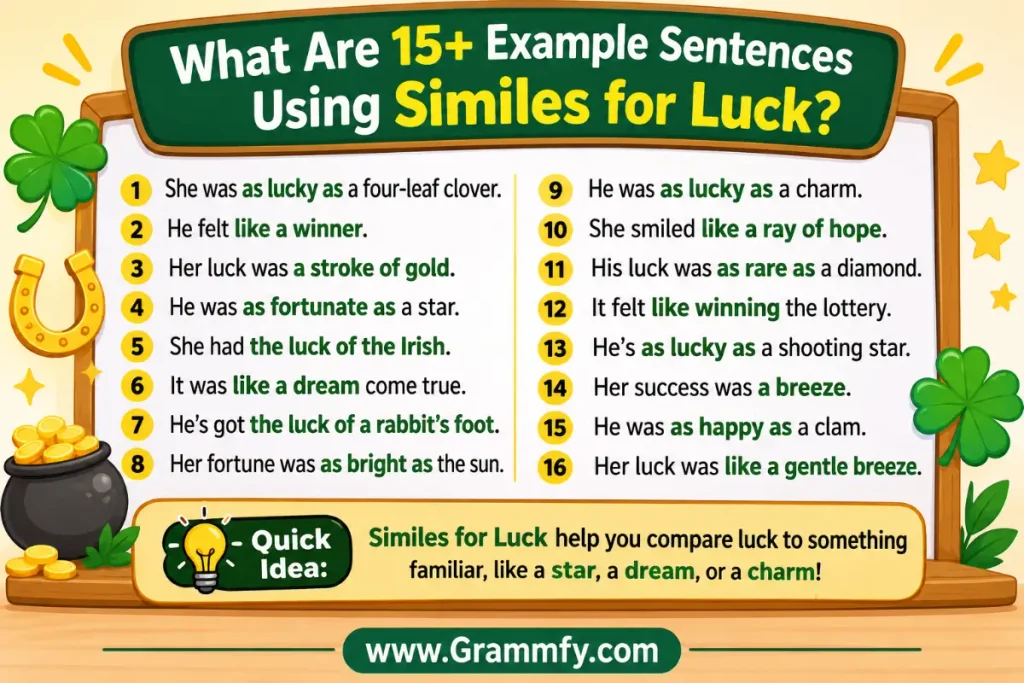
What Are 15+ Example Sentences Using Similes for Luck?
Seeing comparisons in complete sentences makes it easier to understand how they work.
Here are original examples from everyday situations.
1. Finding a Job
“After months of searching, finding the perfect job was like discovering a golden ticket.”
This comparison shows how valuable and exciting the opportunity felt.
2. Winning a Competition
“Emma was as lucky as a four-leaf clover when she won the final round.”
The comparison emphasizes her good fortune.
3. Meeting Someone Special
“Meeting Daniel at the airport was like finding a rare flower in a busy garden.”
It describes an unexpected and meaningful meeting.
4. Getting a Scholarship
“Receiving the scholarship felt like opening a door to a hidden world of opportunities.”
This sentence describes an opportunity that could change someone’s future.
5. Finding Lost Money
“Finding a $50 bill in his old jacket was like discovering buried treasure.”
The comparison makes an ordinary surprise sound exciting.
6. Avoiding an Accident
“She was as lucky as a sailor finding a safe harbor during a storm.”
This expression highlights relief after escaping danger.
7. Getting Free Tickets
“Winning two concert tickets was like receiving a gift from the universe.”
It describes an unexpected reward.
8. Passing an Exam
“Getting the final question right was like hitting the winning shot at the last second.”
The comparison shows how important that moment felt.
9. Finding an Empty Parking Space
“Finding an empty parking space near the entrance was like winning a small lottery.”
This humorous comparison describes an everyday lucky moment.
10. Receiving Unexpected Help
“The stranger’s kindness arrived like sunshine after a week of rain.”
This comparison shows how welcome the help was.
11. Finding a New Home
“Discovering the perfect apartment within our budget was like finding a diamond in the sand.”
It describes an opportunity that seemed rare and valuable.
12. Escaping a Difficult Situation
“He was as lucky as a cat with nine lives when he avoided the falling branch.”
This expression adds humor while describing a lucky escape.
13. Getting a Promotion
“Her promotion came like a golden opportunity at the perfect moment.”
It shows that the positive event happened at an ideal time.
14. Finding a Missing Document
“Finding the missing paper was like spotting a shining star in a dark sky.”
This comparison communicates relief and happiness.
15. Winning a Prize
“Mark was as lucky as someone who found a winning lottery ticket on the sidewalk.”
It emphasizes an unexpectedly wonderful result.
16. Making a New Friend
“Meeting my new best friend was like finding a treasure chest in an ordinary garden.”
It describes a meaningful relationship that appeared unexpectedly.
17. Getting Home Before the Storm
“We reached home just before the rain started, like travelers finding shelter at the last moment.”
This example shows how good timing can feel like good fortune.
18. Receiving Good News
“The phone call arrived like a ray of sunshine on a cloudy afternoon.”
It expresses happiness after receiving unexpected positive news.
Notice how each example connects an abstract idea to a familiar experience. That’s what makes a good simile memorable.
What Are the Common Mistakes When Writing About Luck?
Even a creative comparison can become confusing if you use it incorrectly.
Here are some mistakes to avoid.
1. Using a Metaphor Instead of a Simile
A simile uses comparison words such as “like” or “as.” A metaphor describes something directly as something else.
Examples:
- Simile: His luck was like a golden ticket.
- Metaphor: His luck was a golden ticket.
Both can be effective, but they are different figures of speech.
2. Making Comparisons That Don’t Make Sense
A comparison should help readers understand the meaning.
Unclear: “She was as lucky as a heavy cloud.”
Better: “She was as lucky as someone finding a wallet full of cash.”
The second example connects luck with an understandable positive experience.
3. Repeating the Same Comparison
Using “four-leaf clover” in every paragraph can make writing boring.
Try different images:
- A golden ticket
- A hidden treasure
- A shining star
- A winning lottery ticket
- A safe harbor
Variety keeps your descriptions fresh.
4. Confusing Luck With Hard Work
Not every success happens because of luck.
For example:
- Winning a random prize involves luck.
- Studying for months to pass an exam involves effort.
- Finding an unexpected job opportunity may involve both.
Use the word that accurately describes the situation.
5. Using Formal Words in Casual Conversations
Words such as providential and auspicious can sound unnatural in ordinary texts.
Instead of:
“That was a providential discovery!”
Try:
“Wow, that was a lucky find!”
Match your vocabulary to the situation.
6. Using Too Many Comparisons in One Sentence
A sentence becomes confusing when it contains several unrelated images.
Unclear: “He was like a golden ticket, a shining star, and a four-leaf clover.”
Better: “He was as lucky as someone holding a winning ticket.”
One strong comparison is usually enough.
7. Using a Comparison That Sounds Too Extreme
Not every positive event is a miracle.
For example, finding a parking space might be a lucky break, but calling it a miraculous event could sound exaggerated.
Choose the strength of your expression carefully.
When Should You NOT Use a Simile About Luck?
Although creative comparisons make writing interesting, some situations require direct and accurate language.
Avoid using them in these situations:
- Scientific reports: Explain the actual cause of an event rather than describing it as magic or fortune.
- Legal documents: Use precise facts instead of figurative language.
- Technical instructions: Readers need clear directions, not creative comparisons.
- Professional resumes: Focus on achievements and measurable results.
- Serious emergencies: Avoid humorous expressions when someone needs clear information.
- Academic definitions: Explain the meaning directly before adding creative examples.
For example:
Too informal: “The patient was as lucky as a cat with nine lives.”
More appropriate: “The patient survived the accident without serious injuries.”
Creative writing is useful, but clarity should always come first.
What Are the Opposite Words of Lucky?
Antonyms are words with opposite or contrasting meanings.
If you want to describe unfortunate events, these words can help.
| Antonym | Meaning | Example |
|---|---|---|
| Unlucky | Experiencing bad fortune | He was unlucky in the competition. |
| Unfortunate | Having an undesirable outcome | It was an unfortunate accident. |
| Unfavored | Not receiving an advantage | The team was unfavored to win. |
| Ill-fated | Likely to end badly | It was an ill-fated journey. |
| Unsuccessful | Failing to achieve a goal | Their first attempt was unsuccessful. |
| Disadvantaged | Facing unfavorable conditions | The group was disadvantaged. |
| Cursed | Seemingly affected by repeated bad fortune | He joked that his team was cursed. |
| Hapless | Unfortunate or unlucky | The hapless traveler lost his luggage. |
| Jinxed | Believed to attract bad luck | The player felt jinxed. |
| Adverse | Unfavorable or harmful | They faced adverse conditions. |
Similes That Describe Bad Luck
You can also use comparisons to describe unfortunate experiences.
- As unlucky as a player missing the winning shot.
- Like walking into a storm without an umbrella.
- As unfortunate as a traveler missing the last train.
- Like dropping your phone into a puddle.
- As unlucky as a person losing their keys twice in one day.
- Like finding a hole in your pocket after losing your money.
- As unfortunate as arriving after the doors have closed.
- Like getting caught in the rain with no shelter.
These expressions are useful for humorous stories, fictional characters, and descriptions of difficult situations.
How Can You Choose the Best Simile for Luck?
Choosing the right comparison isn’t about finding the fanciest words. It’s about expressing the situation clearly.
Follow these practical tips.
1. Understand the Situation First
Ask yourself what kind of fortune you’re describing.
Is it:
- A small unexpected benefit?
- A major opportunity?
- A lucky escape?
- A wonderful discovery?
- A successful outcome?
For example, finding a forgotten $5 bill doesn’t need the same expression as receiving a life-changing scholarship.
2. Think About Your Audience
Choose familiar comparisons that your readers can understand.
A four-leaf clover is a widely recognized symbol of good luck. A complicated cultural reference may not work for everyone.
3. Match the Feeling
Different comparisons create different emotions.
| Feeling | Suitable Comparison |
|---|---|
| Happiness | Like a wish coming true |
| Relief | Like finding shelter in a storm |
| Surprise | Like discovering hidden treasure |
| Success | Like holding a golden ticket |
| Love | Like finding a missing piece |
| Humor | Like winning a prize without entering |
| Hope | Like seeing a rainbow after rain |
4. Choose the Right Level of Intensity
Use simple language for small moments and stronger expressions for extraordinary events.
For example:
- Small benefit: “I was fortunate to find a seat.”
- Unexpected success: “It was a stroke of luck.”
- Extraordinary discovery: “The discovery was serendipitous.”
5. Avoid Forced Comparisons
A simile should fit naturally into your sentence.
Read it aloud. If it sounds strange or distracts from your message, choose another comparison.
6. Use Original Images
You don’t always need traditional comparisons.
Think about familiar experiences:
- Finding the last available seat.
- Receiving unexpected good news.
- Meeting a helpful stranger.
- Discovering an opportunity while doing something unrelated.
These everyday experiences can inspire fresh descriptions.
7. Keep the Meaning Clear
Your readers shouldn’t have to guess what the comparison means.
For example:
“His luck was like finding a treasure chest in the backyard.”
This immediately suggests unexpected good fortune.
8. Don’t Overuse Lucky Expressions
Use a variety of words and sentence structures.
Instead of repeating “lucky” throughout a paragraph, try:
- Fortunate
- Favorable
- Blessed
- Serendipitous
- A lucky break
- A stroke of luck
The best comparison is one that makes your meaning clearer, not one that simply makes your sentence longer.
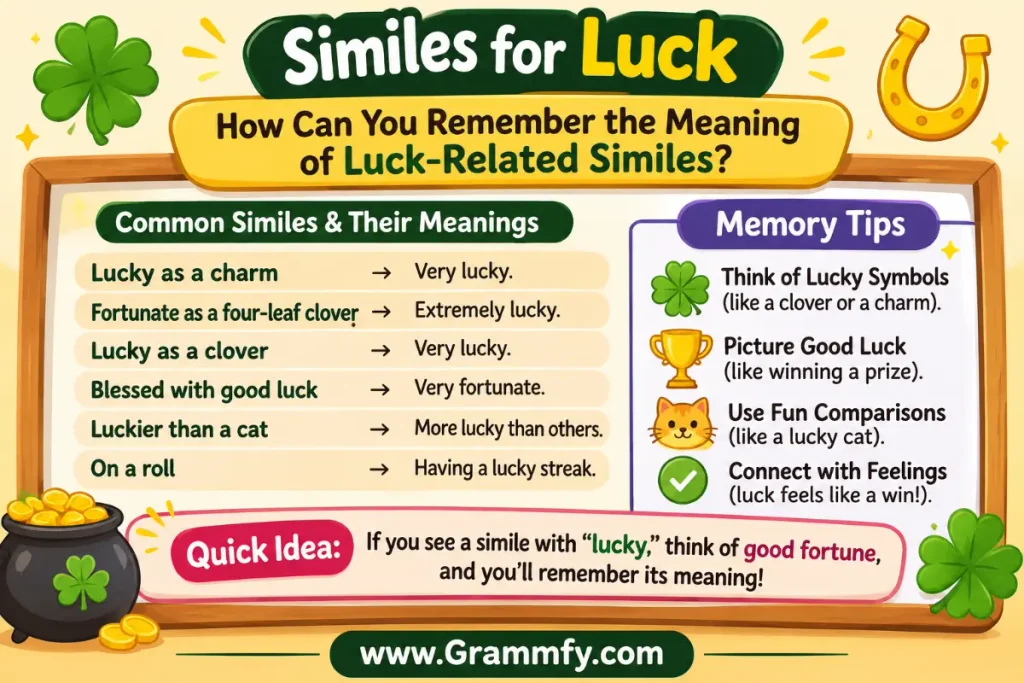
How Can You Remember the Meaning of Luck-Related Similes?
A simple memory trick can help you choose comparisons more easily.
Connect the image to the feeling:
- Four-leaf clover: Traditional good fortune.
- Golden ticket: A valuable opportunity.
- Hidden treasure: An unexpected reward.
- Rainbow after a storm: Happiness after difficulty.
- Safe harbor: Escaping danger.
- Winning lottery ticket: An unusually fortunate outcome.
- Shining star: Hope and positive circumstances.
You can also remember three useful expressions:
- Stroke of luck: An unexpected fortunate event.
- Lucky break: A helpful opportunity.
- Right place at the right time: Perfect timing.
These expressions are easy to use in everyday English and help you describe different types of good fortune.
Conclusion: Make Your Writing More Colorful With Luck Comparisons
Good fortune can appear in many forms, from finding something valuable to receiving an unexpected opportunity. The right comparison helps readers understand why a moment feels special. Similes for Luck make descriptions more vivid by connecting abstract ideas to familiar experiences, such as discovering hidden treasure, finding a four-leaf clover, or holding a golden ticket. Remember that the best expression depends on your situation, audience, and writing style. Use simple comparisons in everyday conversations and more thoughtful expressions in essays, stories, and poems. Don’t force complicated words into ordinary sentences. Instead, choose a comparison that feels natural and communicates your meaning clearly. A little creativity can turn an ordinary sentence into something readers remember.
Frequently Asked Questions
1. What are the best similes for luck?
Some of the best comparisons include “as lucky as a four-leaf clover,” “like finding hidden treasure,” and “as lucky as someone holding a golden ticket.” They describe unexpected good fortune in simple, memorable ways.
2. What’s another way to say someone is very lucky?
You can say someone is fortunate, blessed, charmed, or exceptionally lucky. Informal expressions include “on a roll,” “hit the jackpot,” and “got a lucky break.”
3. What is a simile for someone who always has good luck?
“As lucky as a four-leaf clover” is a popular comparison for someone who seems to experience good fortune regularly. You can also say, “She has a charmed life.”
4. How do you describe unexpected good luck?
You can describe unexpected good fortune as a stroke of luck, a lucky break, or a serendipitous event. For example, “Finding my lost wallet was like discovering hidden treasure.”
5. What is a funny simile for being lucky?
“As lucky as someone who wins a prize without entering” is a humorous comparison. You can also say, “He’s as lucky as a person who always finds the last cookie.”
6. What is the difference between luck and fortune?
Luck usually describes chance events or unexpected outcomes, while fortune can describe a wider set of circumstances or someone’s general success. Both words can refer to good or bad experiences.
7. How can I use similes for luck in a sentence?
Compare someone’s fortunate experience with something familiar using “like” or “as.” For example, “Finding the perfect apartment was like discovering a hidden treasure.”

Tylerbrooks is a US-based English grammar writer and contributor at Grammfy. He writes helpful articles about grammar, spelling, commonly confused words, and vocabulary. His goal is to explain English topics in simple language with clear examples and practical tips. Through his articles, he helps readers improve their writing and everyday English skills.