
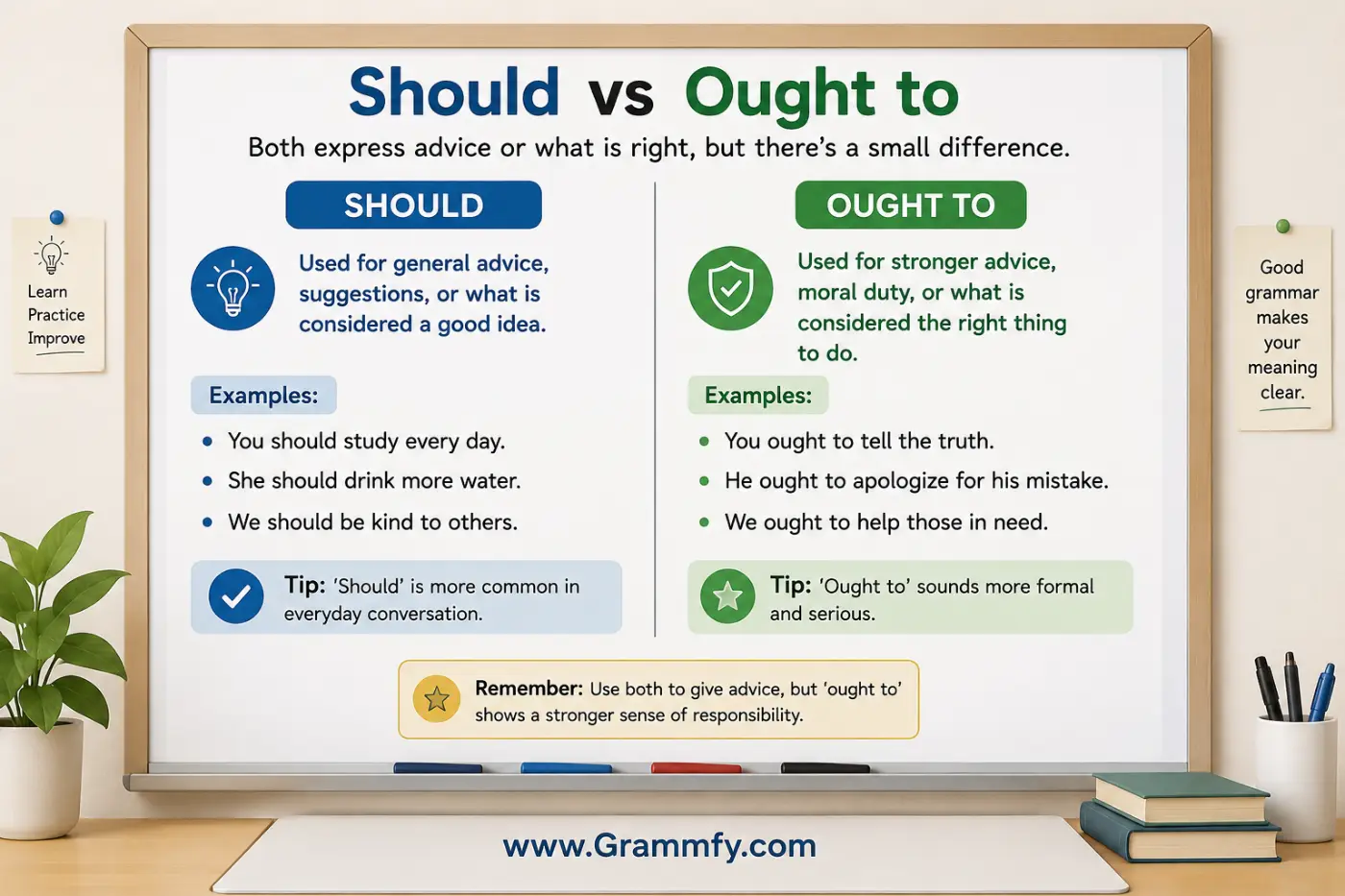
When you’re writing an email, finishing an essay, or sending a quick text, you may wonder whether should vs ought to is the better choice. Both expressions are used to give advice, talk about what is expected, or say what you think is the right thing to do. In many sentences, they can mean almost the same thing.
Answer Box: Should and ought to both commonly express advice, expectation, or what is considered right or sensible. Should is much more common in modern everyday English, while ought to can sound slightly more formal or old-fashioned.
The difference is usually not about basic meaning. It’s more about tone, frequency, and the structure of the sentence. For example, “You should get some rest” and “You ought to get some rest” both give advice. The first sounds more natural in most everyday situations.
This guide explains where these words came from, how their meanings work, which alternatives fit different situations, and how to choose between them in resumes, essays, emails, texts, and conversations. You’ll also see real examples, common mistakes, regional notes, and quick rules you can remember.
The Could vs Can rule connects closely with other grammar rules that explain how we express ability, possibility, and polite requests.
What is the basic difference between “Should vs Ought to”?
Should and ought to are modal expressions that often communicate advice, duty, expectation, or a likely result.
The main difference is usage and tone.
Should is more common. It’s flexible, natural, and widely used in American English.
Ought to has nearly the same basic meaning in many positive sentences, but it can sound more formal, careful, or less conversational.
| Expression | Main use | Example |
|---|---|---|
| should | Advice | You should study tonight. |
| ought to | Advice | You ought to study tonight. |
| should | Expectation | She should arrive soon. |
| ought to | Expectation | She ought to arrive soon. |
| should | Moral duty | We should help them. |
| ought to | Moral duty | We ought to help them. |
In everyday American English, should is usually the easier choice.
Are “Should vs Ought” to to interchangeable?
Often, yes.
You should apologize.
You ought to apologize.
Both tell someone that an apology is the right or sensible action.
But they don’t always feel identical.
Should is neutral and common.
Ought to can put slightly more emphasis on what is proper, expected, or morally right.
Compare:
You should call your mother.
You ought to call your mother.
The first is ordinary advice. The second can sound a little stronger or more like a moral expectation.
What does should mean in plain English?
Should usually means that something is advisable, expected, or the right thing to do.
It can express several ideas.
Should for advice
You should drink more water.
The speaker thinks drinking more water is a good idea.
Should for responsibility
We should help our neighbors.
The speaker believes helping is the right thing to do.
Should for expectation
The bus should arrive soon.
The speaker expects the bus to arrive soon.
Should for probability
That should be enough food for everyone.
The speaker believes the amount will probably be enough.
Should for recommendations
You should try the new restaurant.
The speaker recommends it.
The meaning depends on context, but the basic idea is often “this is a good, proper, or expected thing.”
What does ought to mean in plain English?
Ought to has many of the same meanings as should.
It can express advice:
You ought to get some sleep.
It can express responsibility:
We ought to respect other people.
This can express expectation:
The package ought to arrive tomorrow.
It can express what seems logically likely:
The answer ought to be easy to find.
In simple terms, ought to often means “should”.
The biggest practical difference is that ought to is less common in casual American speech.
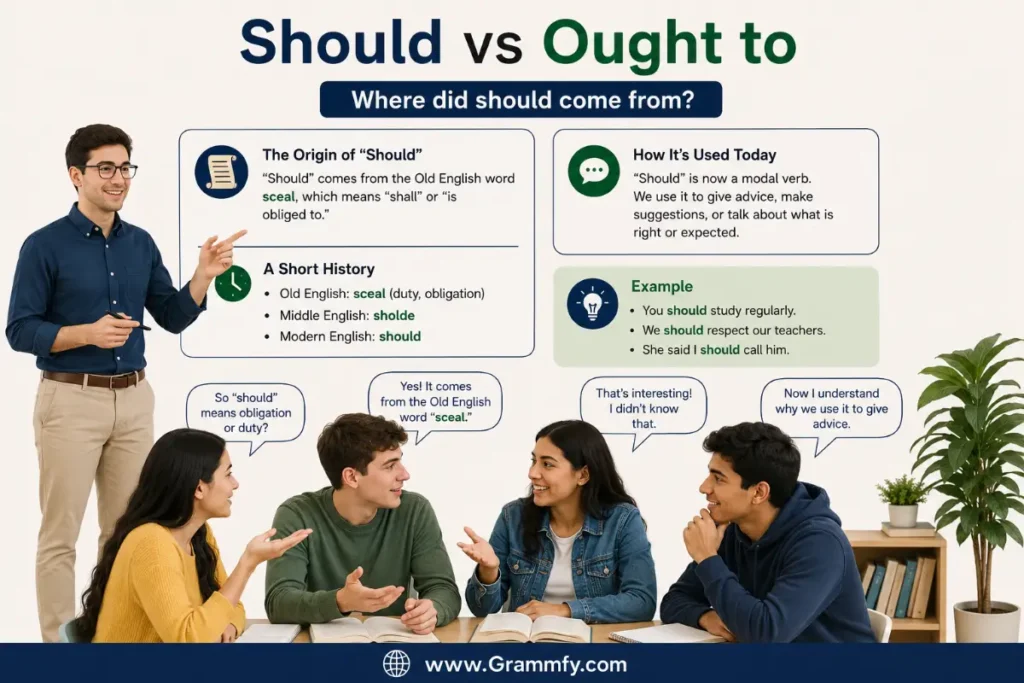
Where did should come from?
Should developed from the Old English verb sceolde, which was connected to shall and ideas of obligation, duty, and necessity.
Over time, its uses expanded.
Today, should can describe:
- advice
- duty
- expectation
- probability
- recommendations
- appropriate behavior
- hypothetical situations
- conditions
Its older connection to obligation is still visible in sentences such as:
You should keep your promise.
That sentence suggests a moral or social responsibility.
Modern should, however, is often much softer than a strict command.
Compare:
You must wear a helmet.
with:
You should wear a helmet.
Must sounds like a requirement. Should sounds like strong advice or a recommendation.
Where did ought to come from?
Ought comes from an older form related to owe.
Historically, the word was connected with the idea of having a duty or obligation.
That connection is still easy to see in sentences like:
We ought to keep our promises.
The sentence suggests that we have a responsibility to do so.
Over time, ought to became a way to express advice, expectation, and what is considered proper.
Although it remains grammatically correct, it is less frequent in everyday American English than should.
Should vs Ought to: which sounds more natural?
In most everyday situations, should sounds more natural.
| Sentence | Naturalness in everyday US English |
|---|---|
| You should call her. | Very natural |
| You ought to call her. | Correct, but less common |
| We should leave now. | Very natural |
| We ought to leave now. | Correct, slightly more formal |
| You should study. | Very natural |
| You ought to study. | Correct, somewhat less conversational |
This doesn’t mean ought to is wrong.
It simply means that most American speakers are more likely to choose should.
Should vs Ought to: what’s the difference in tone?
The difference is subtle.
Should is usually:
- neutral
- common
- conversational
- flexible
- natural in writing and speech
Ought to is often:
- more formal
- slightly old-fashioned
- more deliberate
- associated with duty or expectation
- less common in casual speech
For example:
You should respect your parents.
This sounds normal.
You ought to respect your parents.
This can sound more serious or moral.
Neither sentence is grammatically wrong.
When should you use should for advice?
Use should when you want to recommend an action.
Everyday advice
You should get some rest.
Study advice
You should review your notes before the test.
Health-related general advice
You should talk to a qualified professional if you’re concerned.
Travel advice
You should arrive at the airport early.
Work advice
You should check the report before sending it.
Should is one of the most useful English words for giving recommendations without sounding like you’re giving an absolute command.
When can ought to give advice?
Ought to can also introduce advice.
You ought to check the instructions first.
You ought to save a copy of the document.
You ought to call your friend.
The meaning is close to should.
However, in ordinary American conversation, the first versions are usually more natural:
You should check the instructions first.
You should save a copy of the document.
You should call your friend.
Should vs Ought to to for moral responsibility
Both can express a sense of duty.
We should help people who need assistance.
We ought to help people who need assistance.
The second sentence can sound more strongly connected to a moral responsibility.
This doesn’t mean ought to is always stronger. Context and tone matter.
Consider:
You should tell the truth.
This is already a strong moral recommendation.
So replacing should with ought to doesn’t automatically make the statement more forceful.
Should vs Ought to to for expectations
Both expressions can describe something that is expected to happen.
The train should arrive at 8:00.
The train ought to arrive at 8:00.
Both mean that the speaker expects the train to arrive around that time.
The first is more common in everyday American English.
More examples
The package should arrive tomorrow.
The package ought to arrive tomorrow.
She should be home by now.
She ought to be home by now.
The meeting should finish before noon.
The meeting ought to finish before noon.
The meaning is very similar.
Can Should vs Ought to express probability?
Yes. Both can express what the speaker considers likely.
The answer should be correct.
The answer ought to be correct.
The speaker expects the answer to be correct.
This use is different from a strict prediction with will.
Compare:
The package will arrive tomorrow.
This sounds more certain.
The package should arrive tomorrow.
This expresses an expectation, but there is still room for uncertainty.
The package might arrive tomorrow.
This expresses a weaker possibility.
Should vs Ought to vs must: what’s the difference?
These three expressions can all relate to obligation, but their strength differs.
| Expression | Basic idea | Strength |
|---|---|---|
| might | Possible | Low |
| could | Possible option | Low/Medium |
| should | Good idea or expected | Medium |
| ought to | Right or expected | Medium |
| must | Required | Strong |
Compare:
You might study tonight.
Maybe it would be useful.
You should study tonight.
It’s a good idea.
You ought to study tonight.
It’s advisable and may sound slightly more duty-focused.
You must study tonight.
This sounds like a requirement.
This distinction is important. Don’t use must when you only want to offer gentle advice.
What are the synonyms for Should vs Ought to?
Because these words have several meanings, their alternatives depend on context.
Here is a broad list of related words and expressions.
Simple alternatives
| Word or phrase | Meaning | Tone | Example |
|---|---|---|---|
| recommend | Suggest something | Neutral | I recommend leaving early. |
| advise | Tell someone what is wise | Neutral | I advise you to check it. |
| suggest | Offer an idea | Neutral | I suggest taking notes. |
| need to | Be necessary | Neutral | You need to leave soon. |
| have to | Be required | Neutral | You have to wear a badge. |
| must | Be required | Strong | You must stop here. |
| could | Suggest an option | Neutral | You could try again. |
| might want to | Give gentle advice | Casual | You might want to check. |
Everyday alternatives
| Word or phrase | Meaning | Tone | Example |
|---|---|---|---|
| you’d better | Strong advice/warning | Casual | You’d better hurry. |
| why don’t you | Suggest an action | Casual | Why don’t you call her? |
| you could | Offer an option | Friendly | You could ask Tom. |
| you might want to | Gentle recommendation | Casual | You might want to save it. |
| it’s a good idea to | Recommend | Everyday | It’s a good idea to plan ahead. |
| it’s best to | Recommend the safest choice | Neutral | It’s best to wait. |
| it’s worth | Suggest something useful | Everyday | It’s worth checking. |
| I’d recommend | Personal recommendation | Neutral | I’d recommend booking early. |
Formal alternatives
| Word or phrase | Meaning | Tone | Example |
|---|---|---|---|
| it is advisable to | Recommended | Formal | It is advisable to review the terms. |
| it is recommended that | Official recommendation | Formal | It is recommended that users update passwords. |
| it is appropriate to | Suitable or proper | Formal | It is appropriate to respond promptly. |
| it is preferable to | Better choice | Formal | It is preferable to arrive early. |
| are expected to | Required or anticipated | Formal | Employees are expected to comply. |
| are encouraged to | Invited to do something | Formal | Students are encouraged to participate. |
| are advised to | Given formal advice | Formal | Visitors are advised to arrive early. |
| are required to | Officially necessary | Formal/Strong | Applicants are required to provide ID. |
Casual or conversational alternatives
English has many conversational ways to give advice without using either modal.
| Expression | Meaning | Example |
|---|---|---|
| you might want to | Gentle advice | You might want to call her. |
| you could | Possible choice | You could try restarting it. |
| why not | Suggestion | Why not ask your teacher? |
| why don’t you | Suggestion | Why don’t you take a break? |
| I’d say | Personal advice | I’d say you should wait. |
| I’d probably | Personal recommendation | I’d probably leave early. |
| if I were you | Advice based on imagined situation | If I were you, I’d wait. |
| I’d recommend | Recommendation | I’d recommend checking twice. |
Synonyms by intensity: mild to strong
Advice can range from a soft suggestion to a firm requirement.
| Intensity | Expression | Example |
|---|---|---|
| Very mild | Maybe you could | Maybe you could ask her. |
| Mild | You might want to | You might want to save it. |
| Mild | You could | You could try again. |
| Moderate | You should | You should check it. |
| Moderate | You ought to | You ought to check it. |
| Strong | You’d better | You’d better check it. |
| Strong | You need to | You need to check it. |
| Very strong | You must | You must check it. |
| Required | You are required to | You are required to check it. |
The choice should match the situation.
For example, telling a friend:
You might want to bring an umbrella.
sounds friendly.
Telling someone:
You must bring an umbrella.
sounds much stronger.
What are the parts of speech involved?
Should is a modal auxiliary verb.
It comes before the base form of a verb:
You should study.
She should leave.
They should wait.
It does not take to before the main verb.
Correct:
You should study.
Incorrect:
You should to study.
Ought is also a modal-like auxiliary, but it normally takes to before the main verb.
You ought to study.
She ought to leave.
They ought to wait.
This difference in structure is one of the easiest ways to avoid errors.
| Correct structure | Example |
|---|---|
| should + base verb | You should go. |
| ought to + base verb | You ought to go. |
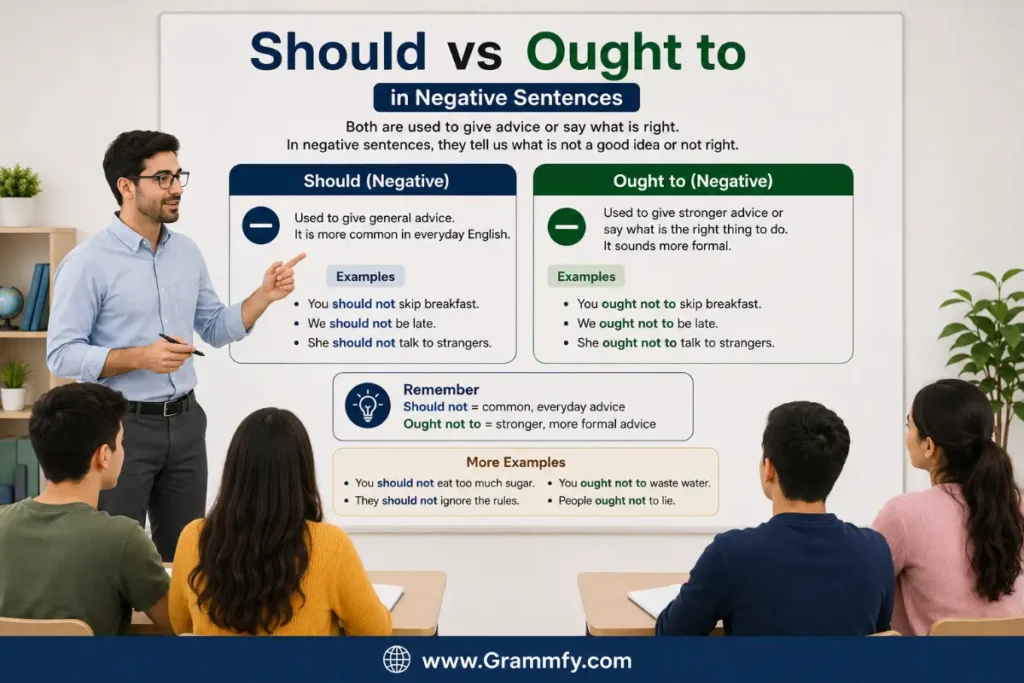
Should vs Ought to in negative sentences
Negative forms are an important difference.
Should not
The most common negative form is:
You should not smoke.
The contraction is:
You shouldn’t smoke.
This means the speaker advises against smoking.
Ought not to
The negative form of ought to is:
You ought not to smoke.
This is grammatically correct, but it sounds formal and is much less common in everyday American English.
You may also see:
You oughtn’t to smoke.
This contraction exists, but it is uncommon in modern American usage.
For most everyday writing and speech, shouldn’t is much more natural.
How do you form questions with Should vs Ought to?
Questions with should are common.
Should I call her?
Should we leave now?
Should he apologize?
These are natural and useful.
Questions with ought to are possible but less common.
Ought I to call her?
Ought we to leave now?
These sound formal or old-fashioned to many American English speakers.
Because of this, should is usually the better choice for questions.
A more natural alternative
Instead of:
Ought I to call her?
Most speakers would say:
Should I call her?
Or:
Do you think I should call her?
Should vs Ought to in the past
When talking about past advice or regret, English usually uses should have + past participle.
You should have called me.
This means calling me would have been the better choice in the past.
Ought to can also appear in this structure:
You ought to have called me.
It is grammatical but less common.
The same pattern works for expectations:
The package should have arrived by now.
The package ought to have arrived by now.
Again, should have is much more common.
Should vs Ought to for regrets
Should have is particularly common when talking about something that was advisable but didn’t happen.
I should have studied harder.
We should have left earlier.
She should have told the truth.
These sentences often express regret.
The corresponding ought to have versions are possible:
I ought to have studied harder.
We ought to have left earlier.
But they can sound more formal.
For everyday American English, should have is usually the natural choice.
Should vs Ought to for recommendations
Both can make recommendations.
You should visit the museum.
You ought to visit the museum.
The first is more neutral.
The second can sound more enthusiastic or like a stronger recommendation depending on context.
For example:
You should try this pizza.
Sounds like a normal recommendation.
You ought to try this pizza.
Can sound more emphatic, almost like the speaker thinks you’re missing out.
Which word is better for a resume “Should vs Ought to”?
Should and ought to usually aren’t the strongest choices for describing qualifications on a resume.
A resume should focus on accomplishments and skills.
Instead of:
I should be able to manage a team.
Write:
Managed a team of eight employees.
Instead of:
I ought to be able to use Excel.
Write:
Advanced Excel skills.
Instead of:
I should be able to meet deadlines.
Write:
Consistently met project deadlines.
Why?
Resume writing benefits from confidence and evidence.
Words such as:
- managed
- created
- led
- developed
- analyzed
- improved
- organized
- increased
- reduced
- trained
are often stronger than modal expressions.
If you genuinely need to discuss expectations in a resume-related sentence, should is more natural than ought to, but an action verb is usually better.
Which word works best in an essay “Should vs Ought to”?
For most essays, should is the more natural choice.
Example:
Schools should teach students basic financial skills.
This makes a clear argument.
Ought to is also possible:
Schools ought to teach students basic financial skills.
The second can sound more formal or morally focused.
In argumentative writing, either can work. Choose according to your voice.
Academic caution
Don’t use should for every claim.
When suggesting something:
Governments should invest in public transportation.
If you’re describing a possibility:
Public transportation can reduce traffic in some areas.
When you’re describing uncertainty:
The policy may reduce traffic.
Each modal communicates something different.
Which word is better for texting “Should vs Ought to”?
Should wins easily in casual texting.
You should watch this movie.
Should I call him?
We should leave soon.
Ought to may sound unusually formal:
You ought to watch this movie.
It’s correct, but many friends would find should more natural.
In a casual conversation, choose the expression that sounds like something you would actually say.
Which word works best in an email “Should vs Ought to”?
For most professional emails, should is a safe choice.
You should receive the documents by Friday.
We should be able to finish the project next week.
You should contact the billing department.
Ought to can sound more formal than necessary.
Instead of:
You ought to contact the billing department.
A professional email would normally use:
You should contact the billing department.
Or, for a softer recommendation:
You may want to contact the billing department.
Which word is best when speaking “Should vs Ought to”?
In ordinary American conversation, should is much more common.
You should try it.
Should we go?
I should leave soon.
Ought to appears in speech, but it is less frequent.
You may hear it when someone is emphasizing duty:
We ought to help them.
Or when the speaker has a more formal or traditional speaking style:
You ought to be more careful.
Still, should is the default choice for most speakers.
What are 15 real-life examples of “Should vs Ought to”?
1. Giving study advice
You should review your vocabulary before the quiz.
This recommends an action.
2. Giving moral advice
We ought to treat people with respect.
This emphasizes responsibility.
3. Talking about an expected arrival
The bus should arrive in ten minutes.
The speaker expects it soon.
4. Talking about a likely result
This solution should solve the problem.
The speaker expects it to work.
5. Making a recommendation
You should visit the science museum.
This is a friendly suggestion.
6. Talking about responsibility
Parents should teach children how to handle money.
This expresses a general recommendation or responsibility.
7. Expressing a social duty
We ought to help our neighbors when we can.
This has a duty-focused tone.
8. Giving workplace advice
You should save a copy before closing the file.
The speaker recommends a practical action.
9. Discussing an expected result
The package should arrive tomorrow.
The speaker expects delivery.
10. Making a decision
Should I accept the offer?
The speaker asks for advice.
11. Giving a warning
You should be careful on that road.
The speaker recommends caution.
12. Discussing a plan
We should leave before traffic gets heavy.
This recommends an action.
13. Expressing regret
I should have called earlier.
The speaker thinks calling earlier would have been better.
14. Expressing moral regret
We ought to have told them the truth.
This emphasizes what the speaker believes was the right thing to do.
15. Giving professional advice
You should read the agreement carefully before signing it.
This is neutral and appropriate for professional communication.
16. Talking about an expected outcome
The results should be available next week.
The speaker expects them to be available.
17. Giving friendly advice
You should bring a jacket.
This is a simple recommendation.
18. Expressing duty
Citizens ought to respect the law.
The statement has a formal, duty-focused tone.
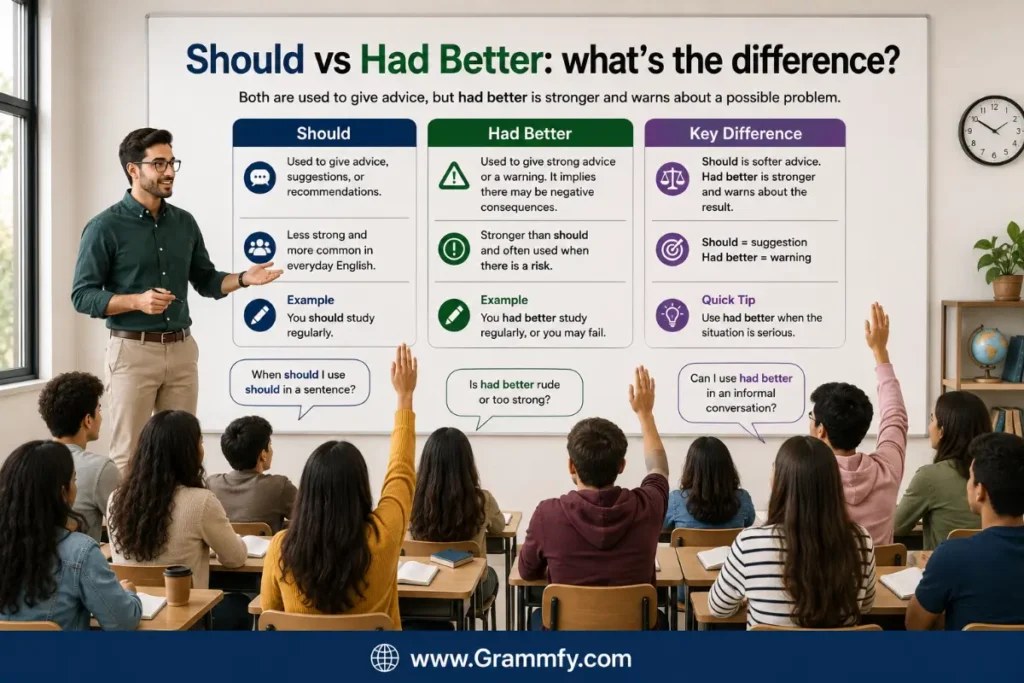
Should vs had better: what’s the difference?
Had better gives stronger advice than should.
Compare:
You should leave now.
This is advice.
You’d better leave now.
This can suggest a warning or a negative consequence if the person doesn’t leave.
For example:
You should charge your phone.
Friendly advice.
You’d better charge your phone before the trip.
This may imply that having a dead phone would cause a problem.
So don’t automatically replace should with had better.
Should vs need to: what’s the difference?
Need to usually expresses necessity.
You need to submit the form today.
This sounds more necessary.
Should generally expresses advice or expectation.
You should submit the form today.
This sounds like a recommendation.
Compare:
| Expression | Meaning |
|---|---|
| You could submit it today. | One possible option |
| You should submit it today. | Recommended |
| You need to submit it today. | Necessary |
| You must submit it today. | Strong requirement |
Understanding this scale helps you choose the right level of force.
Should vs must: when is each better?
Use should when something is recommended.
Use must when something is required.
You should wear comfortable shoes.
Advice.
You must wear a helmet.
Requirement.
In workplace policies, laws, instructions, or strict rules, must is often appropriate.
In personal recommendations, should is usually better.
Should vs could: what’s the difference?
Could often presents an option.
You could take the train.
This means taking the train is one possible choice.
Should recommends that option.
You should take the train.
The speaker thinks taking the train is the better choice.
Compare:
| Sentence | Meaning |
|---|---|
| You could call him. | Calling is one option. |
| You should call him. | Calling is recommended. |
| You might call him. | Calling is a possibility. |
| You must call him. | Calling is required. |
Should vs would: what’s the difference?
These words are sometimes confused because both appear in conditional sentences.
Should often gives advice:
You should talk to your teacher.
Would often describes a hypothetical result or preference:
I would talk to my teacher if I were you.
The second sentence can also function as advice, but the structure is different.
Another example:
You should take an umbrella.
Recommendation.
I would take an umbrella.
Personal choice or hypothetical recommendation.
Common mistakes with “Should vs Ought to”
Mistake 1: Adding “to” after should
Incorrect:
You should to study.
Correct:
You should study.
Should is followed directly by the base verb.
Mistake 2: Forgetting “to” after ought
Incorrect:
You ought study.
Correct:
You ought to study.
The standard structure is:
ought to + base verb
Mistake 3: Treating ought to as more correct
Some learners think ought to is grammatically superior to should.
It isn’t.
Both are correct.
Should is simply more common in modern everyday English.
Mistake 4: Using must when you mean advice
You must try this restaurant.
This sounds very strong.
If you’re simply recommending it:
You should try this restaurant.
Mistake 5: Using ought to in every formal sentence
Formal writing doesn’t require ought to.
In many situations, should is clearer and more natural.
Mistake 6: Using should when you mean ability
I should speak Spanish.
This normally does not mean “I have the ability to speak Spanish.”
If you mean ability:
I can speak Spanish.
If you mean expected future ability:
I should be able to speak Spanish by then.
That distinction is important.
Mistake 7: Confusing advice with expectation
You should be home by 8.
This could mean the speaker expects you to be home by 8.
But:
You should be home by now.
usually expresses an expectation.
Context controls the meaning.
When should you NOT use should?
Don’t use should if you mean definite ability.
Instead of:
I should swim.
say:
I can swim.
Don’t use should when something is a strict requirement unless the context clearly allows a softer instruction.
Instead of:
Employees should wear safety equipment.
if wearing it is mandatory, use:
Employees must wear safety equipment.
The wrong modal can change the force of a rule.
When should you NOT use ought to?
Avoid ought to when you’re trying to sound natural in very casual American conversation and should would be simpler.
Instead of:
Ought we to order pizza?
say:
Should we order pizza?
Instead of:
You ought to check your email.
you can usually say:
You should check your email.
Again, ought to is not incorrect. It’s simply less common.
What are the antonyms of “Should vs Ought to”?
The opposite depends on the meaning.
If should means a recommendation, possible opposites include:
- shouldn’t
- should not
- shouldn’t be necessary
- don’t need to
Example:
You should call him.
Opposite advice:
You shouldn’t call him.
If should means expectation, an opposite could involve uncertainty or lack of expectation:
The package should arrive today.
Opposing idea:
The package probably won’t arrive today.
There isn’t one perfect antonym for every use.
“Should vs Ought to” in US and UK English
Both forms exist in American and British English.
However, frequency and style can differ.
In American English, should is strongly preferred in everyday conversation.
You should call her.
Should we leave?
British English also uses should very often, but ought to may appear somewhat more naturally in some contexts.
For example:
We ought to do something about this.
This is perfectly understandable in both varieties, but American speakers may be more likely to say:
We should do something about this.
Neither form is exclusively American or British.
The difference is mainly about frequency, style, and personal preference.
How should you choose between Should vs Ought to ?
Use this quick decision process.
Ask: Am I giving advice?
Use should in most cases.
You should take a break.
Ask: Am I talking about duty?
Both work.
We should help.
We ought to help.
Choose ought to if you want a slightly more duty-focused tone.
Ask: Am I talking about an expectation?
Both can work.
She should arrive soon.
She ought to arrive soon.
Should is more common.
Ask: Am I asking for advice?
Use should.
Should I call him?
This is much more natural than most versions with ought to.
Ask: Am I writing casually?
Choose should.
Ask: Am I writing formally?
Either can work, but don’t assume ought to is automatically better.
Choose the expression that communicates your exact meaning clearly.
Quick tips for choosing the right expression “Should vs Ought to”
- Use should as your default for advice.
- Use ought to when you want a slightly more formal or duty-focused tone.
- Use should in most everyday questions.
- Remember: should + base verb.
- Remember: ought to + base verb.
- Use shouldn’t for common negative advice.
- Use ought not to only when that formal style fits.
- Use must for requirements.
- Use could for possible options.
- Use might want to for gentle advice.
- Use need to for necessity.
- Use can for ability, not advice.
- Don’t choose a word just because it sounds more formal.
- In American English, should is usually the more natural everyday option.
- Always consider context and tone.
A quick cheat sheet for “Should vs Ought to”
| If you mean… | Use | Example |
|---|---|---|
| Advice | should | You should rest. |
| Formal advice | ought to can work | You ought to rest. |
| Moral responsibility | Either | We should help. |
| Strong requirement | must | You must leave. |
| Possibility | might/may/could | It might rain. |
| Expected result | should/ought to | It should arrive soon. |
| Casual question about advice | should | Should I call? |
| Past regret | should have | I should have called. |
| Ability | can | I can drive. |
| Possible option | could | You could wait. |
Should vs Ought to: a practical test
If you’re still unsure, replace ought to with should.
If the meaning remains natural, should is usually the safer everyday choice.
You ought to study.
→ You should study.
Natural.
The train ought to arrive soon.
→ The train should arrive soon.
Natural.
Ought I to call her?
→ Should I call her?
The second is much more natural for most American speakers.
This doesn’t mean you should remove ought to from your vocabulary. It is useful for understanding books, formal writing, speeches, and speakers who prefer that expression.

Conclusion
The key to should vs ought to is recognizing that both can express advice, responsibility, and expectation, while should is the more common choice in modern everyday English. Use should when you want a natural, neutral way to recommend something, ask what action is best, or describe an expected result. Use ought to when you want a similar meaning with a slightly more formal, traditional, or duty-focused feel. Remember the grammar patterns: should + base verb and ought to + base verb. If you’re writing a text, email, essay, or everyday message, should will usually be the safest choice. Once you pay attention to meaning and tone, choosing between the two becomes much easier.
Frequently Asked Questions
Is “should vs ought to” a difference in meaning or tone?
It is mainly a difference in usage and tone. Both often express advice, duty, or expectation, but should is more common and conversational.
Is ought to more formal than should?
Yes, ought to can sound more formal, traditional, or duty-focused than should. However, the difference is usually subtle.
Can I use should and ought to in the same sentence?
Usually, you can replace one with the other when they express advice or expectation. For example, “You should leave” and “You ought to leave” have very similar meanings.
What’s another way to say “you should”?
You can say you ought to, you could, you might want to, it’s a good idea to, I’d recommend, or you’d better, depending on how strong or casual you want the advice to sound.
Should I use ought to in formal writing?
You can, but you don’t have to. Should is perfectly appropriate in formal writing and is often clearer and more natural.
Why do people say “should” instead of “ought to”?
Should is shorter, more common, and more natural in everyday American English. Ought to remains correct but is less frequent in casual conversation.
Which is stronger, should or ought to?
Neither is automatically stronger. Both can express advice or expectation, although ought to can sometimes sound more duty-focused because of its traditional association with obligation.
