
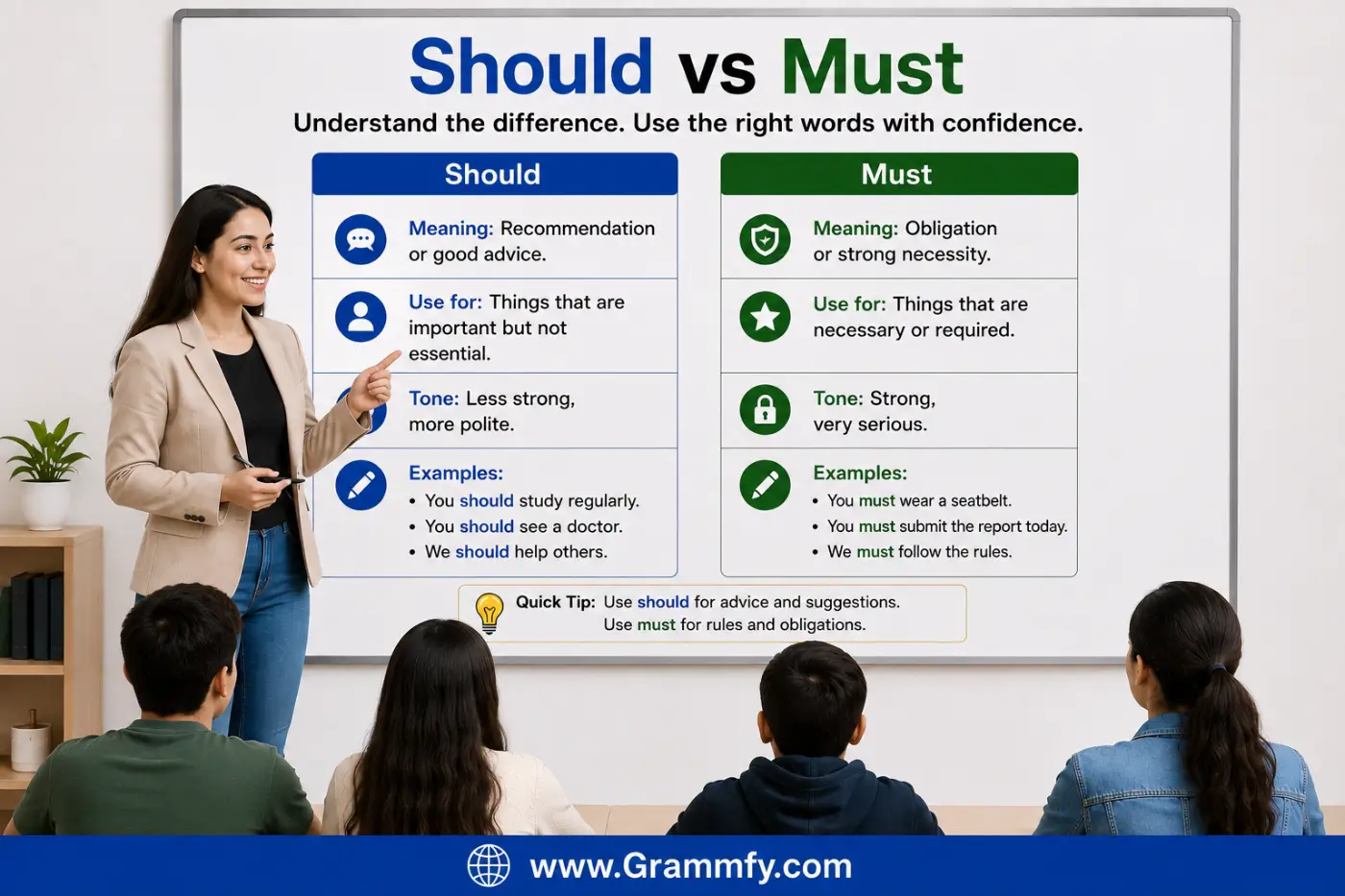
When you’re writing an email, finishing an essay, or sending a quick text, should vs must can be confusing. Both words express what is expected, necessary, or important, but they don’t have the same strength. Choosing the right one can change the meaning of your sentence.
Answer box: Should usually gives advice, recommendations, or an expectation. Must expresses a strong requirement, necessity, or rule.
For example, “You should call your mother” is advice. “You must wear a seat belt” expresses a requirement. The difference is mainly about strength, obligation, and expectation.
This guide explains the plain-English meaning and origins of both words, their grammar patterns, synonyms, levels of intensity, US and UK usage, and the best choices for essays, resumes, emails, texting, and everyday speech. You’ll also see real examples, common mistakes, and quick rules to help you choose confidently.
“The rules explained in our Should vs Ought to article connect closely with the grammar discussed here.”
What Does Should Mean in Plain English?
Should is a modal auxiliary verb used to express advice, recommendation, expectation, duty, or something that is considered the right thing to do.
In simple English, should often means:
“This is a good idea.”
or:
“This is what is expected.”
For example:
You should get some rest.
The speaker is giving advice. The person isn’t necessarily required to rest.
Other examples include:
- You should study before the test.
- We should leave early.
- She should talk to her teacher.
- You should check your email.
- They should arrive soon.
The strength of should depends on the context. It can be gentle advice, a strong recommendation, or an expectation.
Should for Advice
This is one of the most common uses.
You should drink more water.
The speaker recommends it. They aren’t necessarily giving an official order.
You should apologize.
This is stronger because the speaker believes apologizing is the right thing to do, but it still isn’t automatically a formal requirement.
Should for Expectations
Should can also describe something that is expected to happen.
The bus should arrive in ten minutes.
This doesn’t mean the bus is required to arrive in ten minutes. It means the speaker expects it to arrive around that time.
Another example:
Sarah should be home by now.
The speaker expects Sarah to be home.
Should for Responsibility
Should can express a sense of duty.
We should help people who need support.
This describes a moral or social responsibility rather than a strict rule.
Students should respect their teachers.
This sounds like a general expectation or recommendation.
What Does Must Mean in Plain English?
Must is a modal auxiliary verb used to express strong necessity, obligation, rules, or a very strong conclusion.
In simple English, must often means:
“This is necessary.”
or:
“This is required.”
Examples:
- You must wear a helmet.
- Employees must follow the rules.
- You must submit the form today.
- Visitors must show identification.
- We must leave now.
The word usually sounds stronger than should.
If someone says:
You should wear a helmet.
They are giving advice.
If they say:
You must wear a helmet.
They are saying the helmet is required.
Must for Rules
Must is common in rules and instructions.
Visitors must sign in.
Employees must wear identification badges.
Passengers must remain seated.
These sentences communicate requirements.
Must for Strong Necessity
Must can also describe something that is necessary.
I must finish this report tonight.
The speaker feels that finishing it is necessary.
We must find a solution.
This communicates urgency or strong necessity.
Must for Strong Conclusions
Must has another important use. It can express a logical conclusion.
She must be tired after working all night.
This doesn’t mean someone ordered her to be tired. It means the speaker strongly believes she is tired.
Similarly:
You must be hungry.
The speaker is making a strong guess based on the situation.
This meaning is very different from the obligation meaning of must.
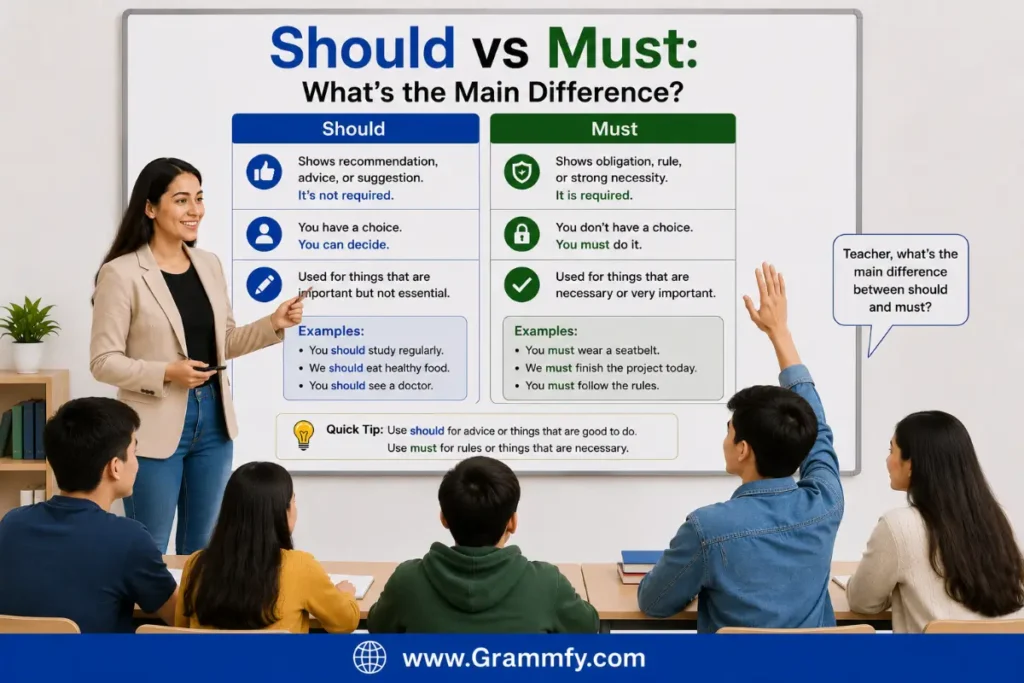
Should vs Must: What’s the Main Difference?
The easiest way to understand should vs must is to think about the level of obligation.
| Word | Main meaning | Strength | Example |
|---|---|---|---|
| Should | Advice or recommendation | Moderate | You should study. |
| Should | Expectation | Moderate | He should arrive soon. |
| Should | Responsibility | Moderate | We should help. |
| Must | Requirement | Strong | You must wear a helmet. |
| Must | Necessity | Strong | I must leave now. |
| Must | Strong conclusion | Strong inference | She must be tired. |
A useful shortcut is:
Should = recommended.
Must = required or necessary.
But remember that context matters. Should can sometimes express a strong moral duty, and must can express logical certainty rather than an actual rule.
Where Did Should Come From?
The word should developed from an older form related to shall. In earlier stages of English, the relationship between these words was more closely tied to ideas of duty, obligation, and future action.
Over time, should developed several modern uses.
Today, English speakers use it for:
- advice
- recommendations
- expectations
- probability
- moral duty
- conditional situations
- criticism or regret in some structures
For example:
You should study more.
Advice.
The package should arrive tomorrow.
Expectation.
You should have told me.
Criticism or regret about a past action.
Because of these different uses, should doesn’t always mean exactly the same thing.
Where Did Must Come From?
Must has a long history in English and developed from an older verb form connected with necessity and obligation.
Its modern meaning remains strongly connected to necessity.
Today, must is commonly used for:
- rules
- requirements
- strong obligations
- urgent necessity
- logical conclusions
For example:
You must wear a seat belt.
Requirement.
I must remember to call her.
Personal necessity.
They must be at home.
Strong conclusion based on evidence.
This makes must especially useful when the speaker wants to communicate a high level of certainty or necessity.
Should vs Must for Advice
Advice is one of the clearest areas where the two words differ.
Using Should for Advice
You should get more sleep.
This is advice.
The speaker thinks getting more sleep is a good idea.
Using Must for Advice
You must get more sleep.
This sounds much stronger.
It may suggest that getting more sleep is absolutely necessary.
The speaker could be emphasizing urgency rather than simply offering a suggestion.
Compare:
| Sentence | Meaning |
|---|---|
| You should rest. | Rest is recommended. |
| You must rest. | Rest is necessary. |
If you’re talking to a friend, should often sounds more natural when you simply want to give advice.
Should vs Must for Rules
Rules usually need stronger language.
Students must wear their uniforms.
This means wearing a uniform is required.
Students should wear their uniforms.
This sounds more like a recommendation or expectation. It doesn’t communicate the same strict requirement.
For official rules, instructions, and regulations, must is often the clearer choice.
Examples:
- Employees must wash their hands.
- Drivers must stop at a red light.
- Visitors must register at the front desk.
- Students must submit their assignments before Friday.
These sentences tell people what they are required to do.
Should vs Must for Expectations
Should is often better when you’re talking about what you expect.
The train should arrive at 8:00.
This means the speaker expects the train to arrive at that time.
Using must changes the meaning:
The train must arrive at 8:00.
Now it sounds like there is a strict requirement for the train to arrive at that time, or the speaker is emphasizing necessity.
If you simply mean “I expect this to happen,” should is usually more natural.
Should vs Must for Personal Decisions
Both words can describe personal decisions, but they communicate different levels of pressure.
I should finish my homework tonight.
The speaker believes finishing it is the right thing to do.
I must finish my homework tonight.
The speaker sees finishing it as necessary or urgent.
The second sentence shows stronger determination or obligation.
Another example:
I should call my doctor.
This sounds like advice to yourself.
I must call my doctor.
This sounds more urgent or necessary.
Should vs Must for Moral Responsibility
Should is common when expressing moral advice or social responsibility.
We should help people in need.
This presents helping others as the right thing to do.
Must makes the statement much stronger:
We must protect children from harm.
This can express a serious moral responsibility or urgent necessity.
Neither word is automatically correct. The writer chooses based on the strength of the message.
Should vs Must for Workplace Communication
Workplace communication often requires careful control of tone.
Compare:
You should send the report by Friday.
This sounds like a recommendation or expected deadline.
You must send the report by Friday.
This sounds like a firm requirement.
If you’re a manager giving an official instruction, must may be appropriate.
If you’re offering guidance to a coworker, should may be better.
For example:
You should double-check the numbers before sending the report.
This sounds helpful.
You must double-check the numbers before sending the report.
This sounds like a strict instruction.
Should vs Must for School Rules
Schools use both words, but they have different effects.
Recommendation
Students should read for 20 minutes every day.
This encourages a useful habit.
Requirement
Students must complete the reading assignment by Friday.
This establishes a requirement.
Teachers can use should for advice and must for rules.
Should vs Must for Safety
Safety instructions often use must because they communicate requirements.
You must wear a seat belt.
Visitors must wear protective equipment.
Workers must follow safety procedures.
Using should makes the message softer:
You should wear a seat belt.
This sounds like advice rather than a strict rule.
In an official safety notice, that difference matters.
Should vs Must for Health Advice
In everyday health advice, should is often used for recommendations.
You should get enough sleep.
You should talk to a healthcare professional if you’re concerned.
You should drink enough water.
Must can communicate stronger necessity:
You must take this seriously.
You must follow the safety instructions.
The choice depends on whether you’re making a recommendation or describing something as essential.
Should vs Must in Conditional Sentences
Should can appear in formal conditional sentences.
For example:
Should you have any questions, please contact us.
This means:
If you have any questions, please contact us.
This structure is more formal and is common in business writing.
Must can also appear in conditional situations, but the meaning is different.
If you want to enter, you must show your ID.
Here, must communicates a requirement.
So:
Should you need help, call me.
means a possible condition.
While:
If you need help, you must call me.
communicates a requirement.
Should vs Must for Past Situations
Neither should nor must works exactly like a simple past verb.
For past advice or criticism, English commonly uses:
should have + past participle
Examples:
You should have called me.
She should have studied.
We should have left earlier.
These sentences often express regret, criticism, or a better choice in the past.
For past obligation, English often uses:
had to + base verb
Examples:
I had to leave early.
She had to work late.
We had to cancel the meeting.
This is important because must doesn’t normally have a simple past form meaning “was required to.”
Must vs Had To: What’s Different?
This is a useful comparison because learners often try to use must for every time period.
| Situation | Natural form | Example |
|---|---|---|
| Present obligation | Must | I must leave now. |
| Past obligation | Had to | I had to leave early yesterday. |
| Future obligation | Must / will have to | I must leave tomorrow. |
| General requirement | Must | Visitors must sign in. |
For example:
I must finish this today.
Present necessity.
I had to finish it yesterday.
Past necessity.
The meaning is similar, but the time changes the grammar.
Should vs Ought To
Ought to is one of the closest alternatives to should.
Compare:
You should apologize.
You ought to apologize.
Both express advice or duty.
However, should is much more common in everyday American English.
Ought to can sound slightly more formal, traditional, or emphatic.
| Should | Ought to |
|---|---|
| Very common | Less common |
| Natural in everyday English | Somewhat formal |
| Advice | Advice or duty |
| You should go. | You ought to go. |
For most learners, should is the easier and more natural choice.
Should vs Have To
Have to is often similar to must because both can express obligation.
Compare:
You must wear a uniform.
You have to wear a uniform.
Both can mean wearing a uniform is required.
However, must can sound more formal or direct, while have to is extremely common in everyday speech.
Now compare them with should:
You should wear a uniform.
This sounds like advice or an expectation.
You have to wear a uniform.
This means the uniform is required.
You must wear a uniform.
This also means it is required, often with a stronger or more formal tone.
Should vs Need To
Need to expresses necessity.
You need to finish the report.
This sounds stronger than:
You should finish the report.
But the exact strength depends on context.
| Expression | General meaning |
|---|---|
| Should | Good idea or recommendation |
| Need to | Necessary |
| Must | Strong requirement or necessity |
For example:
You should call the bank.
speaker recommends it.
You need to call the bank.
The speaker believes it is necessary.
You must call the bank.
speaker gives a very strong instruction or emphasizes urgency.
Should vs Have Got To
Have got to is informal and often expresses strong necessity.
I’ve got to leave now.
This is similar to:
I have to leave now.
It is much stronger than:
I should leave now.
The first two suggest necessity. The third suggests that leaving is probably the right choice.
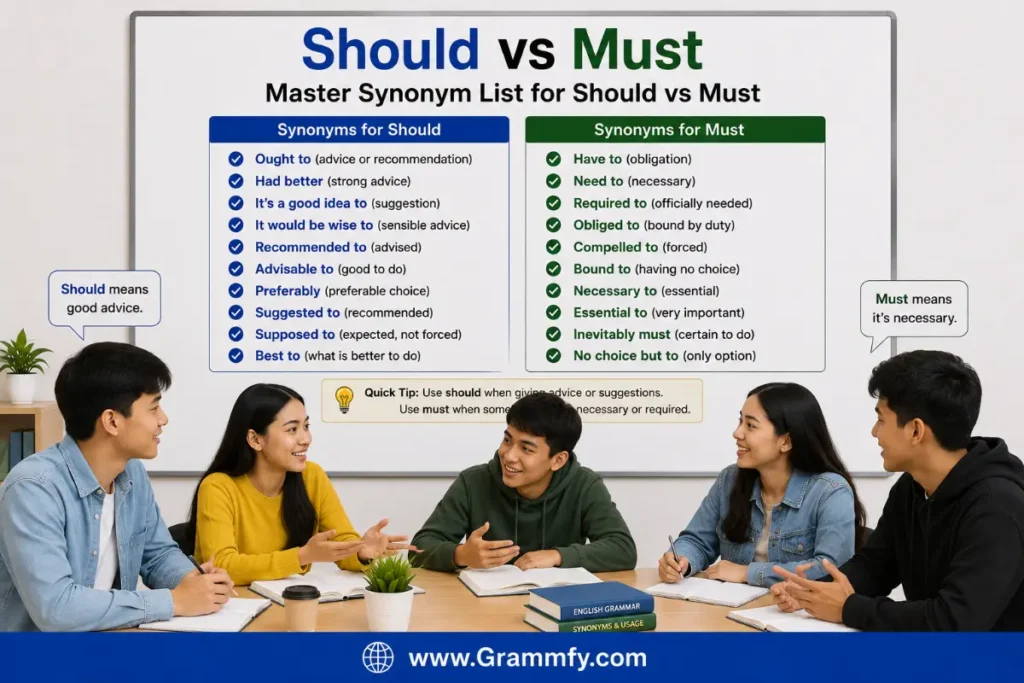
Master Synonym List for Should vs Must
There isn’t one perfect synonym for either modal verb. The best alternative depends on whether you’re expressing advice, obligation, expectation, necessity, or certainty.
Simple Alternatives
| Word or phrase | Meaning | Tone | Example |
|---|---|---|---|
| Should | Good idea or recommendation | Neutral | You should rest. |
| Ought to | Good or right thing to do | Neutral/Formal | You ought to rest. |
| Need to | Necessary | Neutral | You need to rest. |
| Have to | Required | Neutral | You have to go. |
| Must | Required or necessary | Strong | You must go. |
| May | Permission or possibility | Formal/Neutral | You may leave. |
| Might | Possible | Neutral | It might rain. |
| Could | Possible option | Neutral | You could try again. |
Everyday Alternatives
| Word or phrase | Meaning | Tone | Example |
|---|---|---|---|
| Have to | Be required to | Everyday | I have to work. |
| Need to | Be necessary | Everyday | I need to study. |
| Better | Strong advice | Casual | You’d better leave. |
| Have got to | Strong necessity | Casual | I’ve got to go. |
| Be supposed to | Be expected to | Everyday | You’re supposed to call. |
| Be expected to | Be required or anticipated | Neutral | You’re expected to arrive early. |
| Probably should | Likely good choice | Casual | You probably should call. |
| Really need to | Strong necessity | Casual | You really need to listen. |
Formal Alternatives
| Word or phrase | Meaning | Tone | Example |
|---|---|---|---|
| Be required to | Be officially obligated | Formal | Staff are required to sign in. |
| Be obligated to | Have a duty | Formal | Members are obligated to comply. |
| Be expected to | Be officially or socially expected | Formal | Employees are expected to respond. |
| Be necessary to | Be essential | Formal | It is necessary to verify the data. |
| Be essential to | Be extremely important | Formal | It is essential to follow the procedure. |
| Be advisable to | Be recommended | Formal | It is advisable to check the details. |
| Be recommended to | Receive a recommendation | Formal | Users are recommended to update the software. |
| Be imperative to | Be extremely necessary | Very formal | It is imperative to act quickly. |
Casual Alternatives
| Word or phrase | Meaning | Tone | Example |
|---|---|---|---|
| Better | Strong advice | Casual | You’d better hurry. |
| Gotta | Have to | Very casual | I gotta go. |
| Need to | Be necessary | Casual | I need to leave. |
| Have got to | Must | Casual | I’ve got to run. |
| Supposed to | Expected to | Casual | You’re supposed to wait. |
| Should probably | Likely good idea | Casual | You should probably call. |
| Really ought to | Strong recommendation | Casual | You really ought to apologize. |
| Have no choice but to | No practical alternative | Strong | We have no choice but to wait. |
Should vs Must: Synonyms by Intensity
Different expressions communicate different levels of pressure.
Mild Advice
These usually sound gentle:
- might want to
- could
- perhaps
- may want to
- should consider
- it would be a good idea to
Example:
You might want to check your spelling.
This is a gentle suggestion.
Moderate Advice
These are more direct:
- should
- ought to
- probably should
- are advised to
- are encouraged to
Example:
You should check your spelling before submitting the essay.
The speaker clearly recommends the action.
Strong Necessity
These communicate a higher level of obligation:
- need to
- have to
- must
- are required to
- are obligated to
Example:
You must submit the form by Friday.
This communicates a requirement.
Very Strong or Urgent Language
These expressions can sound forceful:
- absolutely must
- have no choice but to
- it is essential to
- it is imperative to
- are strictly required to
Example:
All visitors are strictly required to show identification.
This is appropriate for a formal rule, but it may sound too strong for casual conversation.
Should vs Must by Part of Speech
Should and must are both modal auxiliary verbs.
They are followed by the base form of a verb.
Correct:
You should study.
You must study.
Incorrect:
You should studies.
You must studies.
Incorrect:
You should to study.
You must to study.
Correct:
You should study.
You must study.
They don’t change according to the subject.
You say:
- I should
- he should
- she should
- they should
And:
- I must
- he must
- she must
- they must
You don’t add -s to either modal.
Should vs Must in Negative Sentences
Negative forms are especially important because shouldn’t and mustn’t have very different meanings.
Shouldn’t Means “Not Recommended”
You shouldn’t stay up all night.
This means staying up all night is a bad idea or not advisable.
You shouldn’t ignore the warning.
This gives advice against an action.
Mustn’t Means “Not Allowed”
You mustn’t smoke here.
This means smoking is prohibited.
You mustn’t touch this button.
This is a strong prohibition.
The difference is critical.
| Form | Meaning | Example |
|---|---|---|
| Shouldn’t | Not advisable | You shouldn’t skip breakfast. |
| Mustn’t | Prohibited | You mustn’t enter this room. |
A common mistake is treating mustn’t as simply a stronger version of shouldn’t. It isn’t.
Must Not vs Don’t Have To
Another major grammar trap is the difference between must not and don’t have to.
Must Not
You must not touch the machine.
This means:
It is prohibited.
Don’t Have To
You don’t have to touch the machine.
This means:
It is not necessary.
These meanings are almost opposite.
| Expression | Meaning |
|---|---|
| You must not go. | You are prohibited from going. |
| You don’t have to go. | Going is optional. |
This distinction is extremely important in everyday English.
Common Mistakes With Should and Must
Mistake 1: Treating Should and Must as Identical
Incorrect understanding:
You should wear a helmet = You must wear a helmet.
These sentences don’t have the same strength.
Should usually recommends.
Must usually requires.
Mistake 2: Using Must for Every Recommendation
If you’re giving friendly advice, must may sound too strong.
Instead of:
You must try this restaurant.
You can say:
You should try this restaurant.
Unless you genuinely want to emphasize that trying it is essential, should sounds more natural.
Mistake 3: Confusing Mustn’t With Don’t Have To
Remember:
Mustn’t = prohibited.
Don’t have to = not necessary.
For example:
You mustn’t bring food inside.
Food is not allowed.
You don’t have to bring food.
Bringing food is optional.
Mistake 4: Using Must for Past Obligation
Instead of:
Yesterday, I must finish the report.
Use:
Yesterday, I had to finish the report.
Had to normally expresses past necessity.
Mistake 5: Adding “To” After Should
Incorrect:
You should to study.
Correct:
You should study.
Mistake 6: Adding “To” After Must
Incorrect:
You must to leave.
Correct:
You must leave.
Mistake 7: Adding -S
Incorrect:
She shoulds study.
Correct:
She should study.
Incorrect:
He musts leave.
Correct:
He must leave.
When Should You NOT Use Should?
Don’t use should when you need to communicate a strict legal, safety, or organizational requirement.
For example:
Employees must wear safety equipment.
is clearer than:
Employees should wear safety equipment.
The second may sound like a recommendation rather than a rule.
Also avoid should if you mean something is absolutely certain or unavoidable.
The package must be here somewhere.
can express a strong conclusion.
The package should be here somewhere.
usually expresses expectation, not certainty.
When Should You NOT Use Must?
Don’t use must simply to give a casual suggestion unless you intentionally want a strong tone.
For example:
You must watch this movie!
can be perfectly natural when someone is excited. It means “I strongly recommend this.”
But in another context:
You must call your friend.
may sound like an order.
If you only want to offer gentle advice:
You should call your friend.
is safer.
US vs UK Usage
The basic meanings of should and must are similar in American and British English.
Both varieties commonly use should for advice:
You should see a doctor.
Both use must for strong requirements:
You must wear a seat belt.
However, everyday British English often uses have to in places where formal writing may use must. American English also uses have to very frequently.
For example:
I have to leave now.
is natural in both varieties.
There is no need to learn completely different rules for American and British English. Focus on the meaning and strength of the modal verb.
Best Word for Resume Writing
A resume should communicate qualifications clearly and confidently.
Use Should Carefully
A sentence such as:
I should be able to manage a large team.
sounds uncertain.
That may weaken your application.
Instead, use direct language:
I can manage large teams.
Or:
Experienced in managing large teams.
Use Must for Requirements
If you’re describing a job requirement:
Candidates must have three years of experience.
This is appropriate for a job advertisement.
For your own resume, avoid unnecessary must statements about your skills. State your qualifications directly.
Best Word for Essay Writing
Use Should for Recommendations
Schools should provide students with more reading opportunities.
This makes a recommendation.
Use Must for Strong Arguments
Governments must protect citizens from serious environmental risks.
This expresses a stronger position.
Academic writers should choose the word that matches the strength of their evidence.
If you’re making a recommendation:
should
may be appropriate.
If you’re arguing that an action is essential:
must
may be appropriate.
Don’t use must simply to make an argument sound more powerful. The claim should match the evidence.
Best Word for Email Writing
Should in Emails
Use should when offering advice or discussing expectations.
You should receive the confirmation email shortly.
This means you expect the email to arrive.
You should review the attached document.
This sounds like a recommendation.
Must in Emails
Use must when communicating a firm requirement.
All forms must be completed before Friday.
This clearly communicates an obligation.
For polite workplace communication, avoid using must when a softer recommendation is all you mean.
Best Word for Texting
Text messages are usually informal.
Should is natural for advice:
You should come with us!
Must can be used for excitement or strong recommendations:
You must see this!
Here, must doesn’t necessarily mean an actual requirement. It can simply show strong enthusiasm.
For example:
You must try this pizza.
usually means:
I strongly recommend trying this pizza.
Context and tone matter.
Best Word for Everyday Speaking
In normal conversation, should is very common.
I should go home.
You should try it.
We should leave soon.
Must is also common, especially for urgency, rules, or strong conclusions.
I must remember that.
You must be tired.
You must wear a helmet here.
In casual speech, have to is often used instead of must for everyday obligations:
I have to go.
This is extremely natural.
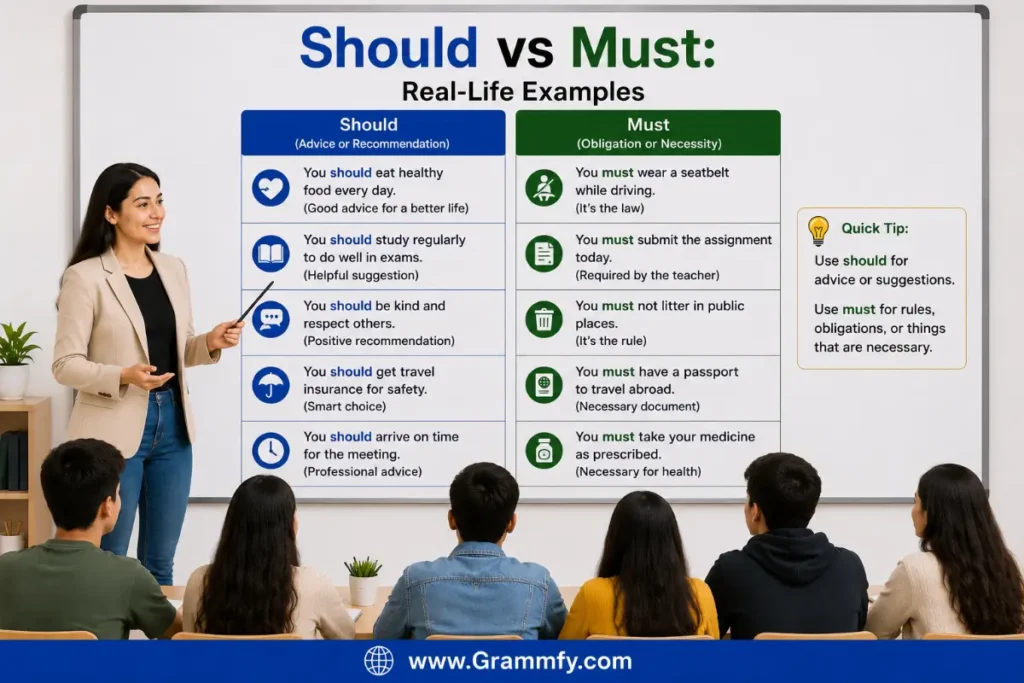
Should vs Must: Real-Life Examples
Example 1: Studying
You should study for the test.
The speaker recommends studying.
You must study for the test.
The speaker emphasizes that studying is necessary.
Example 2: Workplace Deadline
You should finish the report today.
This sounds like an expectation or recommendation.
You must finish the report today.
This sounds like a firm requirement.
Example 3: Safety
You should wear a helmet.
Advice.
You must wear a helmet.
Requirement.
Example 4: Personal Choice
I should call my sister.
The speaker thinks calling is a good idea.
I must call my sister.
The speaker feels calling is necessary or urgent.
Example 5: Weather
It should rain tomorrow.
The speaker expects rain.
It must rain tomorrow.
This sounds unnatural if the speaker simply means “I expect rain.” Must is better used for a strong logical conclusion or necessity.
Example 6: Logical Conclusion
He must be at work.
The speaker strongly concludes that he is at work.
He should be at work.
The speaker expects him to be at work, but sounds less certain.
Example 7: Advice to a Friend
You should talk to her.
The speaker recommends talking.
You must talk to her.
The speaker strongly insists on it.
Example 8: School Rule
Students must submit the form.
This is a requirement.
Students should submit the form.
This sounds like a recommendation or expectation.
Example 9: Travel
We should leave by six.
The speaker thinks leaving by six is a good idea.
We must leave by six.
The speaker believes leaving by six is necessary.
Example 10: Personal Health
You should get some rest.
Gentle advice.
You must get some rest.
Strong concern or urgency.
Example 11: Professional Advice
You should check the figures again.
Recommendation.
You must check the figures again.
Strong instruction.
Example 12: Strong Conclusion
They must be home by now.
The speaker strongly believes they are home.
They should be home by now.
The speaker expects them to be home.
Should vs Must: Two Important Nuance Comparisons
Should vs Need To — What’s Different?
Both can communicate that an action is important, but need to usually sounds more necessary.
| Should | Need to |
|---|---|
| Recommendation | Necessity |
| Softer | Stronger |
| Good idea | Required for a reason |
| You should study. | You need to study. |
For example:
You should save your work.
This is advice.
You need to save your work.
This suggests there is a practical reason or risk if you don’t.
Must vs Have To — What’s Different?
Both can express obligation, but the source of the obligation can feel different.
I must finish this project.
This can sound like a personal decision, strong internal pressure, or formal obligation.
I have to finish this project.
This often sounds like an external requirement.
For example:
I must remember to call my mother.
This is a personal necessity.
I have to attend the meeting because my manager requires it.
This clearly suggests an external requirement.
In everyday speech, however, the two can overlap considerably.
Antonyms of Should and Must
The opposite depends on the meaning.
For should, possible opposites include:
- shouldn’t
- shouldn’t need to
- don’t need to
- don’t have to
Example:
You should call him.
Opposite idea:
You shouldn’t call him.
For must, possible opposites include:
- mustn’t
- cannot
- don’t have to
But be careful: mustn’t and don’t have to are not the same.
You mustn’t go.
You are prohibited from going.
You don’t have to go.
Going is optional.
Quick Tips for Choosing the Right Word
Ask yourself these questions before choosing the modal.
Is it advice?
Use should.
You should check your work.
Is it a strict requirement?
Use must.
You must check in before entering.
Is it an expectation?
Usually use should.
The package should arrive today.
Is it a strong conclusion?
Use must.
She must be busy.
Is it a past obligation?
Use had to.
I had to work yesterday.
Is it a prohibition?
Use mustn’t.
You mustn’t touch that.
Is something optional?
Use don’t have to.
You don’t have to stay.
Do you want a softer recommendation?
Use should.
Do you want to communicate necessity?
Use must or have to, depending on the context.
Should vs Must: Quick Decision Guide
| Ask yourself… | Choose |
|---|---|
| Am I giving advice? | Should |
| Am I making a recommendation? | Should |
| Am I describing an expectation? | Should |
| Is something required? | Must |
| Is something necessary? | Must |
| Am I making a strong logical conclusion? | Must |
| Am I describing past necessity? | Had to |
| Is something prohibited? | Mustn’t |
| Is something optional? | Don’t have to |
| Do I want a softer tone? | Should |
| Do I want a stronger tone? | Must |
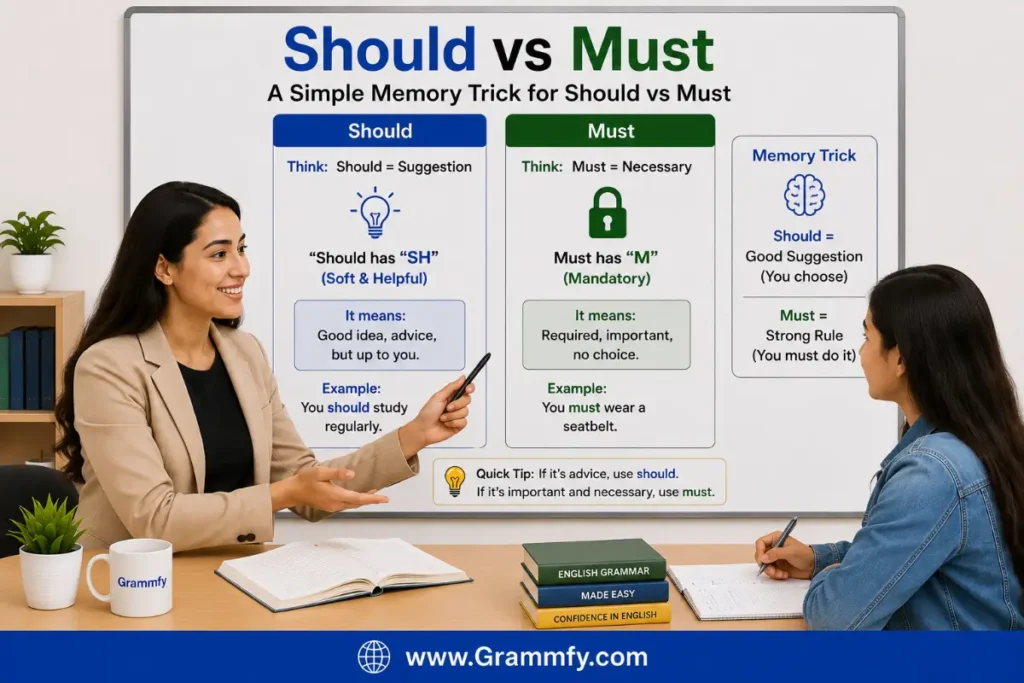
A Simple Memory Trick for Should vs Must
Think of a traffic light.
Should is like a yellow light. It tells you to think, consider, or take care.
Must is like a red light or an official rule. It tells you that something is required.
For example:
You should slow down.
This is advice.
You must stop at the red light.
This is a rule.
Another simple memory line is:
Should suggests. Must requires.
When you see should, ask:
“Is this a recommendation or expectation?”
When you see must, ask:
“Is this necessary, required, or strongly concluded?”
That quick test will solve many grammar questions.
Conclusion
The key to should vs must is understanding the strength of the message. Should is generally used for advice, recommendations, expectations, and responsibilities. It leaves more room for choice. Must communicates stronger necessity, obligation, rules, or firm conclusions. It often tells the reader that something is required or essential.
Context also matters. In everyday conversation, should can make advice sound friendly, while must can add urgency or authority. In formal writing, both are useful when their level of certainty matches the evidence. Also remember that mustn’t means something is forbidden, while don’t have to means something isn’t necessary.
Once you focus on the purpose of the sentence instead of memorizing isolated rules, choosing the right modal becomes much easier. Practice with real situations, and you’ll quickly develop a natural sense of which word fits best.
Frequently Asked Questions
What is the difference between should and must?
Should usually expresses advice, recommendation, or expectation, while must expresses strong necessity, obligation, or a firm rule. For example, “You should study” is advice, while “You must submit the assignment” is a requirement.
Is must stronger than should?
Yes, must generally expresses a stronger obligation than should. “You should call her” recommends an action, while “You must call her” presents it as necessary or very important.
Can I use should instead of must?
Sometimes, but the meaning becomes weaker. If something is officially required, must is usually clearer; if you’re simply recommending it, should is more appropriate.
What’s another way to say should?
Common alternatives include “ought to,” “need to,” “could,” “might want to,” and “it would be a good idea to,” depending on the meaning. Not all of these have the same level of strength.
Is must the same as have to?
Must and have to can both express obligation, but they aren’t always identical in tone or use. “Have to” is especially common in everyday speech, while “must” can sound more direct, formal, or urgent.
Should I use must or should in an email?
Use should for advice or a softer recommendation and must for a firm requirement. For example, “You should review the file” is softer than “You must review the file.”
What is the difference between mustn’t and don’t have to?
Mustn’t means something is prohibited, while don’t have to means something is not necessary. “You mustn’t enter” means entry is forbidden, while “You don’t have to enter” means entry is optional.
