
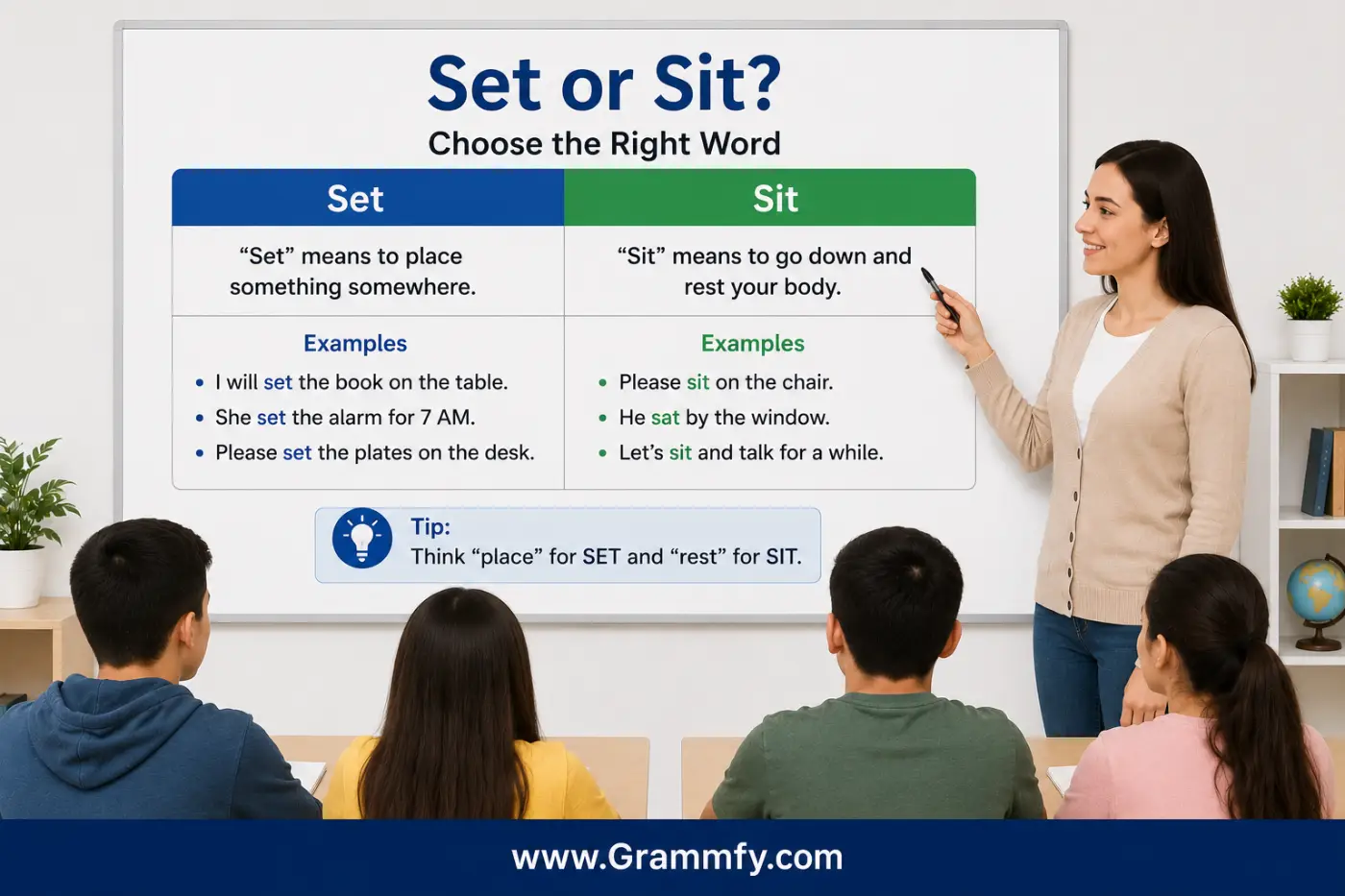
When you’re writing an email, essay, text, or even a quick note, you may stop and wonder whether to write set or sit. These two short verbs are easy to confuse because they can appear in similar sentences. The key difference is what happens to a person or object.
Answer Box: Sit means to be in a seated position or to move into that position. Set usually means to put, place, or position something somewhere.
For example, you can sit on a chair, but you set a book on a table. You sit down yourself, while you set something down. Once you understand who or what is doing the action, the choice becomes much easier.
This guide explains the plain-English meanings, word origins, grammar patterns, synonyms, examples, common mistakes, regional differences, and the best choice for different types of writing. You’ll also learn a few simple memory tricks that can help you avoid this common verb mix-up.
Still unsure about similar English words? Our guide to [less then vs less than] can help.
What is the difference between Set or Sit?
The basic difference is simple:
- Sit usually describes a person or animal being in a seated position.
- Set usually describes placing or putting something somewhere.
Compare these examples:
Please sit in this chair.
Please set the bag on this chair.
In the first sentence, a person is taking a seated position.
In the second sentence, someone is placing an object.
A useful question is:
Is a person or animal taking a seated position?
If yes, sit is usually the right verb.
Are you putting or placing something somewhere?
If yes, set is usually the right verb.
| Verb | Basic meaning | Example |
|---|---|---|
| Sit | Be in or move into a seated position | Sit on the sofa. |
| Set | Put or place something somewhere | Set the keys on the table. |
What does sit mean in plain English?
Sit means to rest your body on a chair, seat, bench, floor, or another surface while your upper body is supported in an upright or resting position.
Examples include:
Please sit here.
She sat beside me.
The dog is sitting by the door.
We sat on the grass.
The verb can describe either the act of moving into a seated position or being in that position.
For example:
Sit down.
This is an instruction to move into a seated position.
But:
I am sitting down.
This describes your current position.
The verb sit can also have other meanings. A person can sit for an exam, sit on a committee, or sit quietly and wait.
What does set mean in plain English?
Set has many meanings, but one of its most common meanings is to put, place, or position something somewhere.
Examples:
Set the glass on the table.
She set her phone beside the laptop.
He set the box near the door.
In each sentence, an object is being placed somewhere.
Unlike sit, set usually takes a direct object when it has this meaning.
That means you can ask:
What did you set?
For example:
I set the book on the desk.
The book is the object receiving the action.

Why are Set or Sit so easy to confuse?
The confusion comes partly from their similar sounds and related meanings.
Both verbs can appear around furniture and locations:
Sit on the chair.
Set the book on the chair.
They can also appear with words such as:
- down
- up
- here
- there
- beside
- near
- on
- in
For example:
Sit down.
Set it down.
The small difference in the sentence can completely change the meaning.
Another reason is that set has a complicated verb system. Unlike many English verbs, set stays the same in its basic, past, and past participle forms.
Today: set
Yesterday: set
Have: set
By contrast:
Today: sit
Yesterday: sat
Have: sat
That difference is important when writing about past events.
What is the origin of sit?
Sit is an old English verb with Germanic roots. Related forms appear in several Germanic languages, showing how long the idea of being seated has been part of the language.
Its core meaning has remained fairly stable: being in a seated or resting position.
Modern English uses sit in both physical and figurative ways.
Physical:
She sat on the bench.
Figurative:
The committee will sit tomorrow.
The vase sits on the shelf.
The last example doesn’t mean the vase has legs or can physically sit like a person. English sometimes uses sit to describe an object resting in a particular place.
What is the origin of set?
Set is also an old Germanic English verb. It has developed a very large number of meanings over the centuries.
The basic idea of placing or positioning something remains one of its most useful meanings.
For example:
Set the plate on the table.
From this basic idea, English developed many other uses:
- set a clock
- set a goal
- set a rule
- set a date
- set a record
- set a table
- set a trap
- set a price
Because set has so many meanings, it is one of the most flexible verbs in English.
How do you use sit in the present tense?
The present forms of sit are:
| Subject | Form |
|---|---|
| I | sit |
| You | sit |
| We | sit |
| They | sit |
| He | sits |
| She | sits |
| It | sits |
Examples:
I sit near the window.
They sit together at lunch.
She sits in the front row.
With he, she, or it, add -s:
He sits here every morning.
How do you use sit in the past tense?
The simple past form of sit is sat.
I sat on the sofa.
She sat beside her friend.
We sat outside for an hour.
This is one of the most important forms to remember.
Do not write:
I sit on the chair yesterday. ❌
Write:
I sat on the chair yesterday. ✅
The present form is sit, while the simple past is sat.
What are the forms of sit?
Here is the basic verb pattern:
| Form | Verb |
|---|---|
| Base form | sit |
| Third person | sits |
| Past | sat |
| Past participle | sat |
| -ing form | sitting |
Examples:
I sit here every day.
She sits near the window.
He sat there yesterday.
We have sat here before.
They are sitting outside.
Notice the spelling of sitting.
It has a double t:
sitting
Not:
siting ❌
How do you use set in the present tense?
The base form is set.
Examples:
I set the alarm every night.
She sets the table for dinner.
They set the boxes near the door.
With he, she, or it, the form becomes sets.
He sets the timer before cooking.
Unlike sit, the past form doesn’t change.
How do you use set in the past tense?
The past form of set is also set.
I set the book on the desk yesterday.
She set the alarm last night.
They set the table before dinner.
This can feel unusual because many English verbs change in the past:
sit → sat
But:
set → set
The context tells you whether the action happened in the past.
What are the forms of set?
| Form | Verb |
|---|---|
| Base form | set |
| Third person | sets |
| Past | set |
| Past participle | set |
| -ing form | setting |
Examples:
I set the cup down.
She sets the table every evening.
He set the bag beside the door.
We have set the date.
They are setting up the room.
Notice that setting has a double t.
What is the easiest memory trick for Set or Sit?
Try this:
Sit = yourself
Set = something
This isn’t a rule that covers every meaning, but it works very well for the common meanings.
For example:
I sit in the chair.
The person is sitting.
I set the book in the chair.
The person is placing an object.
Another useful memory trick is:
You sit. You set something.
Examples:
Sit on the couch.
Set the remote on the couch.
If you’re still unsure, ask:
What am I placing?
If you can answer that question, set is often the correct choice.
When should you use sit?
Use sit when a person or animal is:
- taking a seated position
- already in a seated position
- staying in a particular seated place
- waiting in a seated position
- attending something as a participant
Examples:
Please sit here.
The children sat on the floor.
The cat is sitting on the window ledge.
I sat next to my brother.
She sat quietly during the meeting.
When should you use set?
Use set when you mean:
- put
- place
- position
- arrange
- establish
- adjust
- prepare
- fix at a particular level
Examples:
Set the keys on the counter.
Set the alarm for 7 a.m.
She set the table for dinner.
They set a new goal.
He set the temperature to 70 degrees.
This is why set is much broader than simply “put something somewhere.”
Can an object sit?
Yes. In English, sit can sometimes describe an object that rests or remains in a particular place.
For example:
The book is sitting on the table.
The car has been sitting in the garage all week.
A large vase sits near the entrance.
This does not mean the object literally sits like a person.
It means the object is located or resting somewhere.
This is an important nuance because the simple rule “people sit, objects are set” isn’t always enough.
Compare:
She sat the baby on the chair.
In some varieties of English, especially certain regional forms, sit can be used transitively to mean “place someone in a seated position.” However, standard American English more commonly uses:
She seated the baby on the chair.
or:
She put the baby in the chair.
This is one reason context matters.
Can you say set down?
Yes. Set down commonly means to put or place something on a surface.
Examples:
Set the box down carefully.
Please set your phone down.
She set the glass down on the table.
The object receives the action.
This is different from:
Sit down.
Here, the person moves into a seated position.
Compare:
| Phrase | Meaning |
|---|---|
| Sit down | Move into a seated position |
| Set down | Put something onto a surface |
Sit down vs set down: what’s the difference?
These phrases are often confused because they differ by only one letter.
Sit down
Please sit down.
The person is being asked to take a seated position.
Set down
Please set the bag down.
The bag is being placed somewhere.
A quick test:
Who is moving?
If the person is moving into a seated position, use sit.
If an object is being placed somewhere, use set.
Sit vs seat: what’s the difference?
Sit and seat are closely related but have different grammatical jobs.
The word sit means to take or be in a seated position.
Please sit here.
Seat can mean to provide a place for someone to sit or to put someone into a seat.
The host seated the guests.
You can also use seat as a noun:
My seat is near the window.
Compare:
| Sit | Seat |
|---|---|
| Verb for being seated | Verb for placing someone in a seat |
| I sit here. | She seated me here. |
| Focuses on the person sitting | Focuses on arranging the person’s seat |
Sit vs lie: what’s the difference?
Another common comparison involves body position.
Sit means the body is in a seated position.
I sat on the couch.
Lie means to rest in a flat or horizontal position.
I lay on the couch.
This distinction is especially important when describing body position.
Compare:
Sit on the chair.
Lie on the bed.
A chair is normally associated with sitting, while a bed is normally associated with lying down.

Set vs put: what’s the difference?
Set and put can sometimes mean nearly the same thing.
Set the book on the table.
Put the book on the table.
Both are natural.
However, put is more general.
You can put almost anything somewhere:
Put your coat here.
Put the keys in your bag.
Set often suggests placing something deliberately or carefully.
Set the glass on the table.
In many everyday situations, put is the more common choice.
What are synonyms for sit?
Because sit has several meanings, its synonyms depend on context.
Simple synonyms
| Word | Meaning | Tone | Example |
|---|---|---|---|
| Rest | Stay in a resting position | Neutral | Rest on the chair. |
| Stay | Remain in one place | Simple | Stay here. |
| Wait | Remain until something happens | Everyday | Wait here. |
| Recline | Lean back while resting | Formal | Recline in the chair. |
| Perch | Sit lightly or on an edge | Descriptive | The bird perched on the branch. |
Everyday alternatives
| Word | Meaning | Tone | Example |
|---|---|---|---|
| Hang around | Stay somewhere | Casual | We hung around outside. |
| Lounge | Relax while resting | Casual | They lounged on the sofa. |
| Rest | Relax physically | Everyday | I rested on the bench. |
| Stay | Remain somewhere | Everyday | Stay in your seat. |
| Wait | Remain until something happens | Everyday | Wait here for me. |
Formal or descriptive alternatives
| Word | Meaning | Tone | Example |
|---|---|---|---|
| Recline | Rest in a leaned-back position | Formal | He reclined in the chair. |
| Remain seated | Continue sitting | Formal | Please remain seated. |
| Be seated | Sit down or be sitting | Formal | Please be seated. |
| Perch | Sit lightly or on an edge | Descriptive | She perched on the stool. |
| Settle | Become comfortably positioned | Neutral | He settled into the chair. |
Informal alternatives
| Word | Meaning | Tone | Example |
|---|---|---|---|
| Chill | Relax | Slang | We’re just chilling on the couch. |
| Hang out | Spend time casually | Casual | Let’s hang out here. |
| Lounge | Relax comfortably | Casual | We lounged around all afternoon. |
| Crash | Rest or sleep casually | Slang | I’m going to crash on the couch. |
| Plop down | Sit down heavily or casually | Informal | He plopped down in the chair. |
Not every synonym is a direct replacement. Crash, for example, does not simply mean “sit.” It describes resting or sleeping casually, often on a sofa or similar surface.
What are synonyms for set?
The common “place something somewhere” meaning of set has many alternatives.
| Word | Meaning | Tone | Example |
|---|---|---|---|
| Put | Place something | Everyday | Put the book here. |
| Place | Put carefully | Neutral | Place the glass on the table. |
| Position | Put in a particular location | Formal | Position the chair near the wall. |
| Arrange | Organize in a certain way | Neutral | Arrange the books by size. |
| Lay | Put something down | Neutral | Lay the paper on the desk. |
| Locate | Place or identify a position | Formal | Locate the device near the door. |
| Position | Place precisely | Formal | Position the camera correctly. |
| Install | Put equipment in place | Technical | Install the unit on the wall. |
| Establish | Create or determine | Formal | Establish a new policy. |
| Adjust | Change to a desired level | Neutral | Adjust the temperature. |
The correct synonym depends on what set means in your sentence.
What are synonyms by intensity?
The verb set doesn’t usually express intensity in the same way adjectives do, but its alternatives can show how deliberately something is positioned.
Simple
- put
- place
- leave
Put the bag here.
More precise
- position
- arrange
- place carefully
- align
Position the screen at eye level.
Strong or deliberate
- establish
- fix
- determine
- secure
The committee established a new deadline.
For sit, intensity can describe how someone takes a seat:
Neutral
sit
rest
Relaxed
lounge
recline
Sudden or informal
drop into a chair
plop down
The choice changes the feeling of the sentence.
What are common Set or Sit mistakes?
Mistake 1: “Set down” when you mean yourself
Incorrect:
I set down on the chair. ❌
Correct:
I sat down on the chair. ✅
If you are taking a seated position, use sat for the past tense.
Mistake 2: “Sit the book down”
In standard American English, the common phrase is:
Set the book down. ✅
Not:
Sit the book down. ❌
The book is an object being placed.
Mistake 3: Using sat with an object
Incorrect:
She sat the cup on the table.
In standard American English, use:
She set the cup on the table.
Mistake 4: Forgetting the past form of sit
Incorrect:
Yesterday, I sit on the bench.
Correct:
Yesterday, I sat on the bench.
Mistake 5: Changing set to sat
Incorrect:
Yesterday, I sat the book on the desk.
Correct:
Yesterday, I set the book on the desk.
The past form of set remains set.
When should you not use set?
Don’t use set simply because a sentence mentions a chair, sofa, or table.
Look at the action.
I sat on the sofa.
The person is taking a seated position.
But:
I set my laptop on the sofa.
The laptop is being placed.
The furniture itself does not determine the verb. The action does.
When should you not use sit?
Don’t use sit when you mean “put something somewhere” in standard American English.
Incorrect:
Sit the phone on the desk.
Better:
Set the phone on the desk.
Likewise:
Set the plates on the table.
Not:
Sit the plates on the table.
What are the US and UK differences?
The basic distinction between sit and set is shared across American and British English.
However, some regional varieties of English use sit transitively in ways that may sound unusual to American speakers.
For example, a regional speaker may say:
Sit the child in the chair.
Standard American English more commonly uses:
Put the child in the chair.
or:
Seat the child in the chair.
The standard rule for American English remains useful:
Sit = take or be in a seated position.
Set = put or place something.
There can also be differences in how people use related verbs such as lay, lie, set, and sit in regional speech. For formal or professional writing, standard forms are the safest choice.
What is the best choice for a resume “Set or Sit”?
A resume usually needs clear action verbs.
Instead of using sit or set when a stronger verb is available, choose a precise action word.
For example:
Set project deadlines and tracked weekly progress.
This works because set means established or determined.
You could also write:
Established project deadlines and tracked weekly progress.
That’s often stronger for a resume.
If you’re describing a physical arrangement:
Set up equipment for daily training sessions.
Here, set up is a useful professional phrase.
What is the best choice for an essay Set or Sit?
In formal essays, choose the verb that clearly describes the action.
Examples:
The researcher set the samples on a clean surface.
The participants sat in separate rooms.
The committee set a new standard.
Avoid using a regional or informal form if your audience expects standard written English.
If the sentence feels confusing, replace the verb with a clearer alternative such as:
- placed
- remained seated
- established
- positioned
- arranged
What is the best choice for texting Set or Sit?
Texting is usually more relaxed, but the basic distinction still matters.
Sit here.
Set your bag here.
I sat on the couch.
I set my phone down.
Short sentences can actually make the difference easier to see.
What is the best choice for emails Set or Sit?
For professional emails, use standard forms.
Please sit in the waiting area.
Please set the documents on my desk.
I sat with the client for an hour.
We set the meeting for Monday.
If you want a more formal alternative to sit, use:
Please remain seated.
If you want a more precise alternative to set, use:
Please place the documents on my desk.
What is the best choice when speaking Set or Sit?
In everyday American English, sit and set are both common.
You might say:
Sit down and relax.
or:
Set your bag over there.
In fast speech, the words can sometimes sound less distinct. That’s why understanding the sentence structure is more useful than relying only on pronunciation.
What are 15 original examples of sit?
1. Classroom
The students sat quietly while the teacher explained the lesson.
2. Restaurant
We sat near the window.
3. Office
Please sit in the waiting area.
4. Living room
I sat on the couch after work.
5. Park
They sat under a large tree.
6. Bus
She sat beside her friend.
7. Meeting
Everyone sat around the conference table.
8. Pet
The dog sat near the door.
9. Waiting
I sat there for twenty minutes.
10. Relaxing
He sat quietly and read his book.
11. Classroom instruction
The teacher asked the students to sit down.
12. Travel
We sat together during the flight.
13. Family
My grandparents sat on the front porch.
14. Sports
Several fans sat behind the goal.
15. Everyday conversation
Come in and sit wherever you’d like.
Each sentence describes a person or animal taking, holding, or remaining in a seated position.
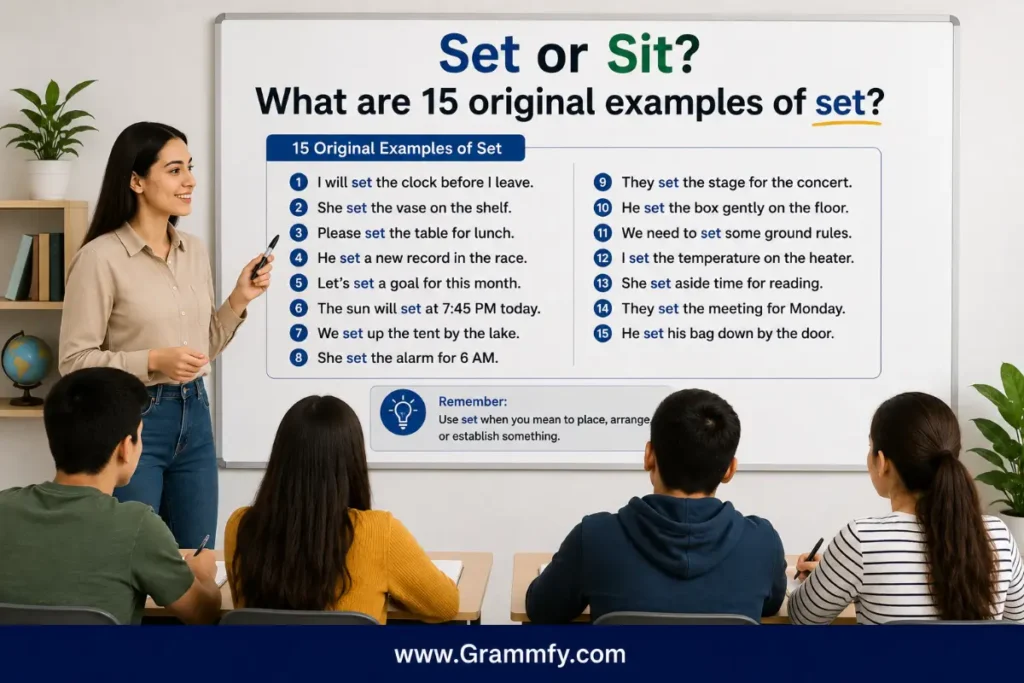
What are 15 original examples of set?
1. Book
Set the book on the shelf.
2. Phone
She set her phone beside the computer.
3. Glass
He set the glass on the counter.
4. Bag
I set my bag near the door.
5. Table
We set the table before dinner.
6. Alarm
She set the alarm for six o’clock.
7. Goal
The team set a new goal.
8. Price
The store set the price at $40.
9. Date
They set the meeting date for Friday.
10. Rule
The school set a new rule.
11. Timer
Set the timer for ten minutes.
12. Camera
He set the camera on a tripod.
13. Record
The athlete set a new record.
14. Standard
The organization set a higher standard.
15. Temperature
Set the oven to 350 degrees.
These examples show why set is much broader than simply “put.”
What does set up mean?
Set up is a phrasal verb with several meanings.
It can mean to prepare something:
We set up the room for the meeting.
This can mean to install or arrange equipment:
She set up the computer.
It can mean to organize something:
They set up a new business.
This can also mean to arrange a meeting:
I set up an appointment for Monday.
The meaning comes from context.
What does sit down mean?
Sit down means to move from a standing or other position into a seated position.
Examples:
Please sit down.
We sat down for dinner.
She sat down beside me.
The phrase is extremely common in everyday English.
Don’t confuse it with set down, which usually means to put an object somewhere.
What does set aside mean?
Set aside means to put something away, reserve it, or save it for a particular purpose.
Examples:
Set aside some money for emergencies.
She set aside the documents.
We set aside two hours for the meeting.
The meaning is no longer simply physical placement. It can also describe planning or saving.
What does sit around mean?
Sit around means to remain somewhere without doing much, often while waiting or relaxing.
Examples:
We sat around and talked.
Don’t just sit around all day.
They sat around waiting for the bus.
This is an informal phrasal verb.
What does set out mean?
Set out can mean several things.
It can mean to begin a journey:
We set out early in the morning.
It can mean to arrange or display something:
She set out the plates.
The phrase can also mean to explain or present something:
The report sets out the main goals.
This is another example of how flexible set is.
What does sit back mean?
Sit back means to lean back and relax or observe something without taking immediate action.
Examples:
Sit back and enjoy the show.
He sat back and watched the discussion.
It can also suggest allowing events to happen without becoming directly involved.
What are quick tips for choosing Set or Sit?
Use these tips whenever you’re unsure.
Tip 1: Think about the subject
If a person or animal is taking a seated position, sit is likely.
She sat down.
If an object is being placed, set is likely.
She set the bag down.
Tip 2: Look for an object
Set often has a direct object:
Set the book on the desk.
Sit normally does not take an object in standard American English when it means “be seated”:
Sit on the chair.
Tip 3: Remember the past forms
sit → sat
set → set
This one fact prevents many mistakes.
Tip 4: Remember “sit yourself, set something”
This is a useful shortcut for everyday writing.
Sit yourself down.
Set something down.
Tip 5: Check the meaning of the sentence
Don’t choose the word only because it sounds familiar.
Ask:
Is someone sitting?
or:
Is someone placing something?
That usually gives you the answer.
What are the antonyms of sit and set?
The opposite depends on the meaning.
For sit, possible opposites include:
- stand
- rise
- get up
- move
Example:
Sit down.
Opposite:
Stand up.
For set meaning “place,” possible contrasting actions include:
- remove
- take away
- pick up
- lift
- move
Example:
Set the book on the desk.
Contrasting action:
Pick the book up from the desk.
Because both verbs have many meanings, their opposites change with context.
How can you avoid repeating ?
If you’re writing a long article or essay, you don’t always need to repeat the same verb.
For sit, depending on the context, you can use:
- remain seated
- rest
- wait
- recline
- lounge
- perch
- settle into a chair
For set, you can use:
- place
- put
- position
- arrange
- establish
- adjust
- fix
- install
However, don’t replace a simple verb just to make the sentence sound more complicated. Sit and set are often the clearest choices.
What is the simplest rule for Set or Sit?
?
Remember this:
Sit = take a seat.
Set = put something somewhere.
Examples:
I sit in the chair.
I set the book on the chair.
Past tense:
I sat in the chair.
I set the book on the chair.
If you remember only one thing, remember the difference between sat and set in the past tense.

Conclusion
Understanding set or sit comes down to identifying the action in the sentence. Sit usually describes a person or animal taking or remaining in a seated position, while set commonly means putting or positioning something somewhere. Their past forms also make the difference easier to remember: sit becomes sat, but set stays set. You can sit on a chair, but you set a book on a chair. You can sit down after work, but you set your phone down before relaxing. Keep the simple rule “sit yourself, set something” in mind, and check whether the sentence involves a seated position or an object being placed. With a little practice, these two verbs become much easier to use correctly.
Frequently Asked Questions
Is set or sit correct in English?
Both are correct English verbs, but they have different meanings. Use sit for a seated position and set when you mean put, place, position, or establish something.
Should I say sit down or set down?
Say “sit down” when a person is taking a seat and “set down” when someone is placing an object. For example, “Sit down on the chair” but “Set the bag down.”
What’s another way to say set?
Common alternatives include put, place, position, arrange, establish, and adjust. The best alternative depends on what set means in the sentence.
What’s the past tense of sit?
The past tense of sit is sat. For example, “I sat on the bench yesterday.”
Is the past tense of set sat?
No, the past tense of set is set. For example, “I set the book on the desk yesterday.”
Can an object sit on a table?
Yes, objects can be described as sitting somewhere when they are resting or located there. For example, “A vase sits on the table” is natural English.
How do I remember set and sit?
Think “sit yourself, set something.” If you’re taking a seat, use sit; if you’re placing an object, use set.
