
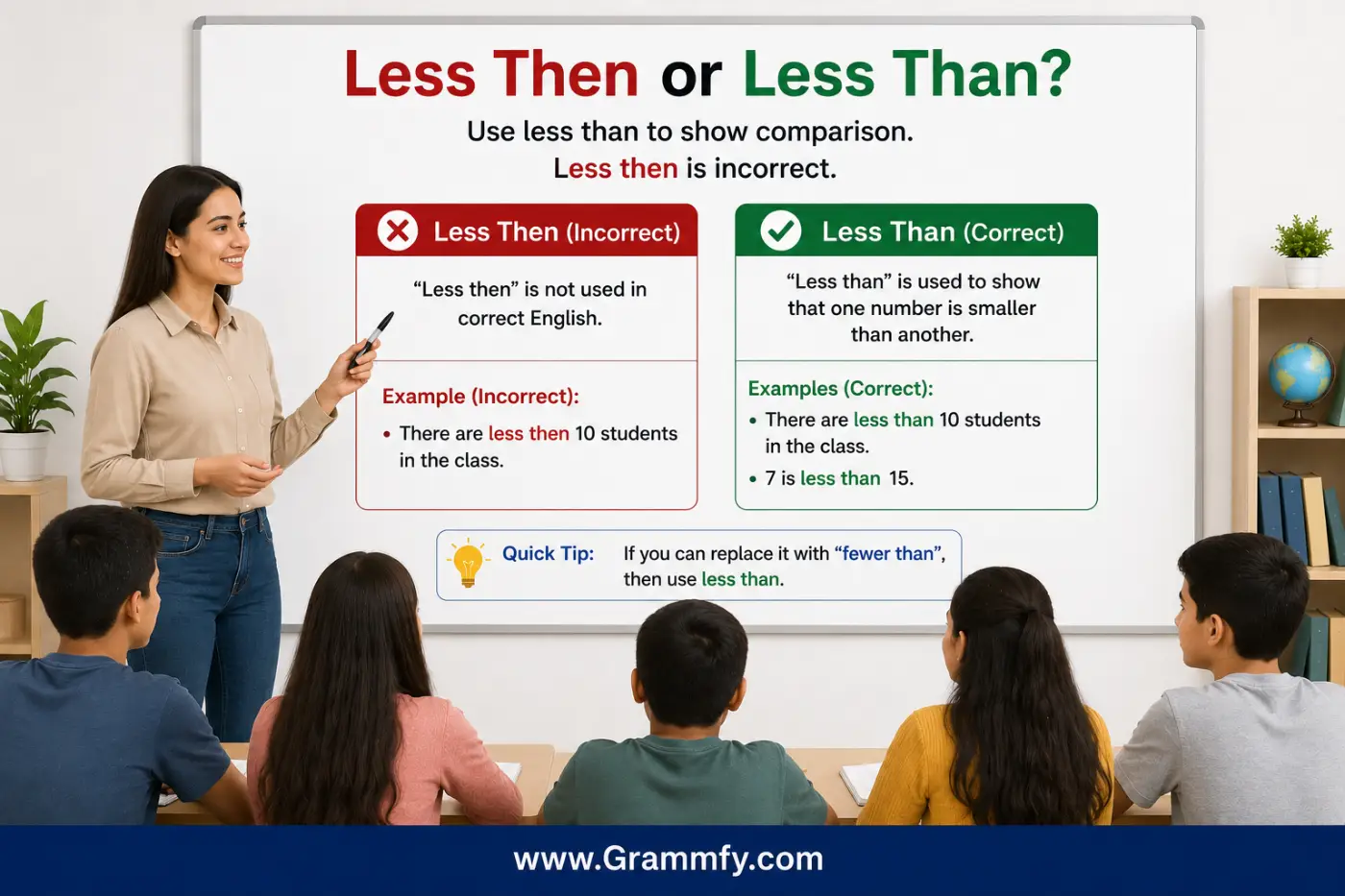
Have you ever typed a sentence in an email, essay, text, or work report and paused over less then vs less than? These two phrases sound very similar, so it’s easy to mix them up. However, they have completely different grammatical jobs.
The correct phrase for comparisons is less than. It means a smaller amount, number, degree, or value. Then is mainly used when talking about time, sequence, or what happens next.
Answer Box: Less than is correct when making a comparison. Then usually refers to time or sequence, so “less then” is incorrect for standard comparisons.
For example, you can write, “The package arrived in less than five days.” You should not write, “The package arrived in less then five days.” The first sentence compares the amount of time with five days.
This guide explains the difference between less then vs less than, their meanings and origins, common sentence patterns, synonyms, examples, grammar rules, regional usage, common mistakes, and the best wording for essays, resumes, emails, texts, and everyday speech.
For more examples of tricky plurals, see [excel or excell].

Is Less Then vs Less Than than correct?
Less than is the correct phrase when you mean a smaller amount or a lower number.
The meeting lasted less than an hour. ✅
The meeting lasted less then an hour. ❌
The confusion comes from the similar sounds of then and than.
The easiest way to remember the difference is:
- Than = comparison
- Then = time or sequence
So when you compare two amounts, values, sizes, or degrees, use than.
| Phrase | Main use | Example |
|---|---|---|
| less than | Comparison | It costs less than $20. |
| less then | Usually incorrect for comparison | It costs less then $20. ❌ |
| then | Time or sequence | We ate dinner, then watched a movie. |
| than | Comparison | She is taller than me. |
What does less than mean in plain English?
Less than means a smaller amount, number, degree, or value compared with something else.
For example:
I have less than $10.
This means the amount is below $10.
Another example:
The trip takes less than two hours.
This means the trip takes fewer than two hours.
You can use less than with:
- money
- time
- distance
- weight
- measurements
- percentages
- ages
- quantities
- degrees
- abstract ideas
Examples:
The box weighs less than five pounds.
She is less than 20 years old.
The project took less than a week.
The temperature fell to less than 10 degrees.
What does then mean in plain English?
Then usually refers to time, sequence, or a result.
For example:
We finished dinner and then went home.
Here, then means “after that.”
You can also use it to describe a result:
If you finish your homework, then you can play.
Here, then connects a condition with a result.
Another example is:
Back then, people wrote more letters.
Here, then refers to a particular time in the past.
So then does not normally belong in a comparison such as:
less than five dollars
more than ten minutes
taller than his brother
faster than the old car
Why are than and then confused?
The words than and then are close in spelling and pronunciation.
They differ by only one letter:
than
then
That small difference can cause frequent typing and spelling mistakes.
The good news is that their meanings are very different.
Than compares
She is older than her brother.
The test was easier than I expected.
This costs less than $50.
Then shows sequence or time
First, read the instructions. Then, answer the questions.
We went home and then had dinner.
Back then, I lived in Chicago.
A simple meaning check can help you choose the right word.
What is the origin of less?
The word less has very old Germanic roots. It has been part of English for centuries and has long expressed the idea of a smaller amount or lower degree.
Today, less can describe both physical and abstract quantities.
For example:
less water
less money
less time
less stress
less noise
less effort
The basic idea remains the same: a smaller amount or degree.
What is the origin of than?
Than developed from an older English form related to comparison. Over time, it became the standard word used after comparative forms and expressions.
For example:
bigger than
smaller than
faster than
less than
more than
The word than is therefore strongly connected with comparison.
When you see a comparative idea, than is often the word you need.
What is the origin of then?
Then also has a long history in English. Its main meanings developed around time, sequence, and consequences.
Modern examples include:
First we studied, then we took the test.
I was younger then.
If you agree, then we can begin.
These uses explain why then doesn’t belong in most numerical comparisons.
How do you remember Less Then vs Less Than?
Use this simple trick:
THAN = comparison
Think:
less than
more than
bigger than
faster than
older than
All of these compare two things.
For then, think:
THEN = time or next
Examples:
First this, then that.
We ate, then left.
Back then.
This makes the distinction easier to remember.

Less than vs then: what is the difference?
The two words perform different grammatical functions.
| Word | Function | Example |
|---|---|---|
| than | Makes a comparison | He is younger than me. |
| then | Shows sequence | He ate, then left. |
Now compare these sentences:
The class lasted less than an hour.
This compares the class length with one hour.
The class ended, then the students left.
This shows what happened next.
The meanings are completely different.
Why is less than used with numbers?
Less than tells the reader that a value falls below another value.
Examples:
less than 100
less than 50%
less than $25
less than three miles
less than ten minutes
The expression is especially common in:
- mathematics
- science
- statistics
- business
- academic writing
- instructions
- reports
For example:
The machine uses less than 500 watts of power.
This tells us that its power consumption is below 500 watts.
How is less than used with time?
Less than is very common when discussing time.
Examples:
The meeting lasted less than an hour.
I’ll be there in less than ten minutes.
The task took less than three days.
The package arrived in less than a week.
In each sentence, than introduces the comparison point.
A useful pattern is:
less than + amount of time
Examples:
less than five minutes
less than two hours
less than a month
less than a year
How is less than used with money?
You can use less than to describe a price or amount of money.
Examples:
The book costs less than $15.
I spent less than $50.
The repair should cost less than $100.
We need less than $1,000 to complete the project.
Again, the word is than, not then.
How is less than used with age?
Less than can describe age.
Examples:
Children less than five years old need adult supervision.
The company has been operating for less than ten years.
The building is less than 50 years old.
However, when talking about people’s ages, under is often more natural in everyday English:
Children under five need adult supervision.
Both can be correct depending on the sentence and context.
How is less than used with measurements?
Measurements commonly use less than.
Examples:
The package weighs less than two kilograms.
The road is less than five miles long.
The table is less than one meter wide.
The temperature is less than 20 degrees.
The liquid contains less than one percent alcohol.
This construction is common in technical and informational writing.
How is less than used in mathematics?
In mathematics, less than means that one number has a lower value than another.
For example:
4 is less than 7.
The symbol is:
<
So:
4 < 7
means:
4 is less than 7.
Similarly:
10 < 15
means:
10 is less than 15.
The word than is essential when you write the comparison in words.
Less than vs fewer than: what’s the difference?
This is another common grammar question.
Traditionally, fewer is used with countable plural nouns, while less is commonly used with uncountable nouns.
Fewer
fewer than five students
fewer than ten cars
fewer than 20 people
Less
less than five dollars
less than two hours
less than one kilogram
less than enough time
However, everyday English sometimes uses less with quantities that are understood as amounts rather than individual items.
For example:
The store has less than 20 employees.
This is common and widely understood, although traditional style guides may prefer fewer than 20 employees.
Less than vs under: what’s the difference?
Less than and under can often express the same idea.
The ticket costs less than $50.
The ticket costs under $50.
Both mean the price is below $50.
Under is often shorter and more conversational.
Less than can sound more precise or formal, especially in technical writing.
Compare:
| Less than | Under |
|---|---|
| More explicit comparison | Shorter |
| Common in formal writing | Common in everyday speech |
| Often used in data | Often used in casual descriptions |
For an academic report:
The temperature remained less than 10°C.
For everyday speech:
The temperature stayed under 10°C.
Both can work.
Less than vs below: what’s the difference?
Below can also mean lower than a particular number or level.
The temperature fell below 10 degrees.
The temperature fell to less than 10 degrees.
These are similar.
However, below is especially common with:
- levels
- temperatures
- standards
- limits
- positions
- measurements
Examples:
below average
below the limit
below zero
below the standard
Less than is often more directly numerical.
Less than vs fewer than: quick comparison
| Expression | Common use | Example |
|---|---|---|
| less than | Amount or degree | less than $20 |
| fewer than | Countable items | fewer than 20 books |
| under | Below a limit | under $20 |
| below | Lower than a level | below 20 degrees |
Knowing these alternatives can help you vary your writing without changing the meaning.
What are synonyms for less than?
Because less than is a comparison phrase, its alternatives depend on the sentence.
Simple alternatives
| Word or phrase | Meaning | Tone | Example |
|---|---|---|---|
| Under | Below a limit | Simple | Under $20 |
| Below | Lower than | Simple | Below 10°C |
| Fewer than | Smaller number | Neutral | Fewer than 10 people |
| Not as much as | Smaller amount | Everyday | Not as much as $50 |
| Not as many as | Smaller number | Everyday | Not as many as 20 students |
Everyday alternatives
| Word or phrase | Meaning | Tone | Example |
|---|---|---|---|
| Under | Below | Everyday | It costs under $30. |
| Below | Lower than | Everyday | The score was below 50. |
| Smaller than | Lower in size or amount | Everyday | The group is smaller than ours. |
| Lower than | At a lower level | Everyday | The price is lower than before. |
| Fewer than | A smaller number | Neutral | Fewer than ten people came. |
| Not as much as | A smaller amount | Conversational | It took not as much as an hour. |
Formal alternatives
| Word or phrase | Meaning | Tone | Example |
|---|---|---|---|
| Below | At a lower level | Formal | Below the required limit |
| Fewer than | A smaller count | Formal | Fewer than 100 participants |
| Under | Below a threshold | Neutral/Formal | Under the legal limit |
| Lower than | At a lower level | Formal | Lower than the previous figure |
| Inferior to | Lower in quality | Formal | Inferior to the original model |
| Subordinate to | Lower in rank or position | Formal | Subordinate to the main authority |
Informal alternatives
| Word or phrase | Meaning | Tone | Example |
|---|---|---|---|
| Under | Below | Casual | It costs under $10. |
| Not even | Below a stated amount | Casual | It took not even an hour. |
| Barely under | Just below | Casual | It’s barely under $100. |
| A bit under | Slightly below | Casual | It’s a bit under five pounds. |
| Way under | Far below | Informal | The price is way under $50. |
Not all of these alternatives can replace less than in every sentence. Always consider the exact meaning.
What are synonyms by intensity?
Comparisons can show a small or large difference.
Mild difference
Use:
- slightly less than
- a little less than
- somewhat less than
- just under
- slightly below
Examples:
The price is slightly less than $100.
The temperature is just under 20 degrees.
Moderate difference
Use:
- noticeably less than
- considerably less than
- significantly less than
- substantially below
Examples:
The new model costs significantly less than the old one.
Strong difference
Use:
- far less than
- much less than
- dramatically less than
- well below
- considerably below
Examples:
The new system uses far less energy than the previous model.
These expressions help you show how large the difference is.
What are alternatives by part of speech?
Less than is a comparative phrase rather than a single word, so its alternatives can appear in different grammatical forms.
Prepositional or comparison phrases
- under
- below
- beneath
- fewer than
- within a lower range than
Comparative adjectives
- smaller
- lower
- shorter
- lighter
- younger
- cheaper
- weaker
For example:
The new car is cheaper than the old one.
Comparative adverbs
- less frequently
- less quickly
- less often
- less carefully
For example:
He visits the office less often than before.
The best replacement depends on what exactly you’re comparing.
What is the best wording for a resume “Less Then vs Less Than”?
A resume often benefits from precise numerical comparisons.
Instead of:
Completed the project in less than six months.
you can write:
Completed the project in five months.
Specific numbers are usually stronger.
However, less than works well when the exact number isn’t important:
Reduced processing time to less than two hours.
Or:
Kept project costs below $50,000.
Both are professional.
Good resume alternatives
Depending on your sentence, consider:
- under
- below
- fewer than
- reduced to
- decreased by
- lowered to
- within
For example:
Reduced customer wait times to less than 10 minutes.
This is clear and measurable.
What is the best wording for an essay “Less Then vs Less Than”?
Less than is an excellent choice for formal essays.
Examples:
The study involved less than 100 participants.
The process took less than two years.
Students spent less than one hour completing the task.
For academic writing, avoid overly casual alternatives such as way under.
Instead of:
The cost was way under the original estimate.
write:
The cost was significantly below the original estimate.
What is the best wording for texting “Less Then vs Less Than”?
Texting often favors short alternatives.
Instead of:
It costs less than $20.
you might write:
It’s under $20.
Both are correct.
If you’re texting casually:
I’ll be there in less than 10.
or:
I’ll be there in under 10.
The second is shorter and common in casual messages.
What is the best wording for an email “Less Then vs Less Than”?
In professional emails, less than is clear and safe.
The project should take less than two weeks.
The total cost will be less than $5,000.
We received fewer than 50 applications.
You can also use under when the tone is less formal:
The project should take under two weeks.
Both options can work.
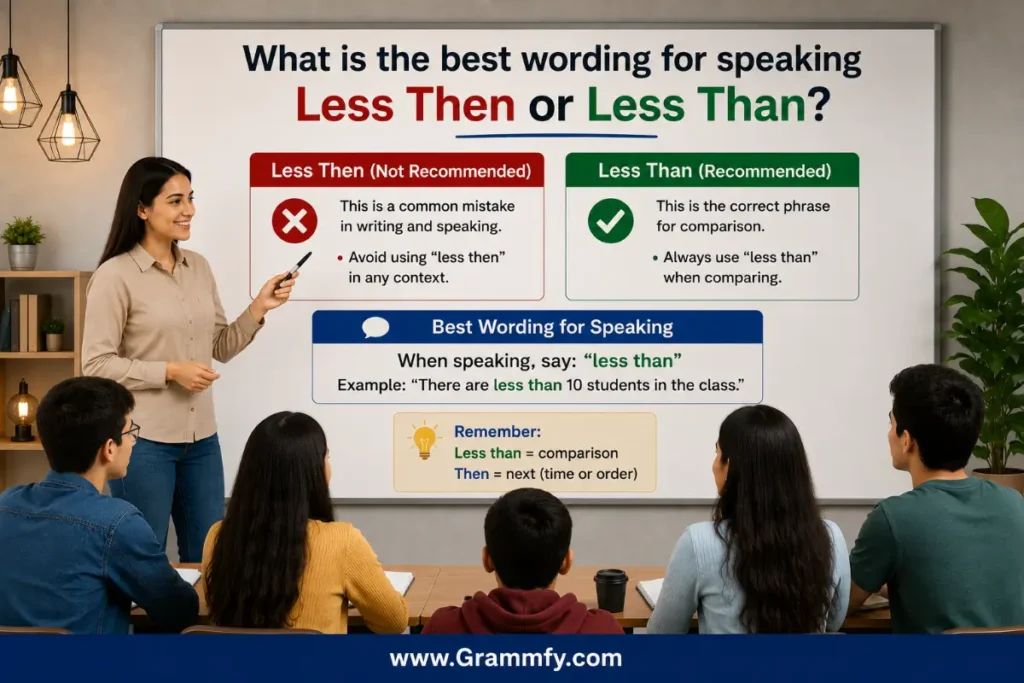
What is the best wording for speaking “Less Then vs Less Than”?
In everyday American English, less than and under are both common.
For example:
It costs less than $30.
or:
It costs under $30.
For a quick conversation, under can sound more natural.
For a precise explanation, less than may be clearer.
What are 15 examples of less than?
1. Time
The movie is less than two hours long.
2. Money
The shirt costs less than $25.
3. Distance
The school is less than three miles away.
4. Age
The building is less than 50 years old.
5. Weight
The package weighs less than five kilograms.
6. Temperature
The temperature dropped to less than 10 degrees.
7. Percentage
Less than 20% of the students were absent.
8. Quantity
We have less than enough food for everyone.
9. Frequency
He visits less than once a month.
10. Speed
The car was traveling at less than 40 miles per hour.
11. Cost
The repair should require less than $500.
12. Duration
The interview lasted less than 30 minutes.
13. Amount
She drank less than one glass of water.
14. Degree
The problem is less than serious enough to require immediate action.
This sentence is awkward, so a better version is:
The problem is less serious than we expected.
This shows why choosing the right construction matters.
15. Academic writing
Less than half of the participants completed the survey.
Each example uses than because the phrase introduces a comparison.
What are examples where then is correct?
To understand the difference, look at sentences where then belongs.
Sequence
First, wash the vegetables. Then, cut them into small pieces.
Time
I lived there back then.
Result
If you’re ready, then we can begin.
Next action
Finish your work, then take a break.
Past reference
Things were different then.
These sentences have nothing to do with numerical comparison.
What are common mistakes with less then?
Mistake 1: Using then for a comparison
Incorrect:
It costs less then $50.
Correct:
It costs less than $50.
Mistake 2: Using then after a comparative adjective
Incorrect:
She is less then five years old.
Correct:
She is less than five years old.
Mistake 3: Confusing more than and more then
Incorrect:
There were more then 100 people.
Correct:
There were more than 100 people.
This is the same than/then issue.
Mistake 4: Confusing better then and better than
Incorrect:
This option is better then the first one.
Correct:
This option is better than the first one.
The word than is used for comparisons.
Mistake 5: Using less then in academic writing
Incorrect:
Less then 30% of respondents agreed.
Correct:
Less than 30% of respondents agreed.
Always check than when the sentence compares numbers or amounts.
When should you use then instead?
Use then when you mean:
- after that
- at that time
- next
- in that case
- as a result
Examples:
We ate dinner, then watched TV.
Back then, I was a student.
If that’s true, then we need to investigate.
A quick test is to replace then with after that.
If the sentence still makes sense, then may be correct.
For example:
We finished work, then went home.
We finished work, after that went home.
The second sentence needs adjustment, but the meaning shows the sequence.
Can then be used in a comparison?
Yes, but not as the comparison word.
For example:
If the price is lower, then we can buy it.
Here, then shows the result of the condition.
The comparison is:
lower
The result is:
then we can buy it
So don’t assume every sentence containing a comparison must use than everywhere.
What are the antonyms of less than?
The opposite comparison is generally expressed with:
- more than
- greater than
- above
- over
- higher than
- greater in number than
- greater in amount than
Examples:
The price is more than $50.
The temperature is above 20 degrees.
She is older than her brother.
The group contains more than 100 people.
The exact opposite depends on the sentence.
Less than vs more than: what’s the difference?
These are direct opposites in many contexts.
| Less than | More than |
|---|---|
| Below a comparison point | Above a comparison point |
| Smaller amount | Larger amount |
| Lower value | Higher value |
| Under a number | Over a number |
Examples:
The project cost less than $1,000.
The project cost more than $1,000.
The first means the cost was below $1,000.
The second means it was above $1,000.
Less than vs less: what’s the difference?
Less can stand alone, while less than introduces a comparison.
For example:
I need less money.
This means the speaker needs a smaller amount.
But:
I need less money than you.
Now there is a direct comparison.
Another example:
She talks less.
No comparison is stated.
She talks less than her brother.
The phrase now compares her amount of talking with her brother’s.
Less than vs fewer than: when should you choose each?
Traditional grammar gives this simple rule:
Less → uncountable amounts
Fewer → countable items
Examples:
less water
less time
less money
fewer books
fewer students
fewer cars
When a number is directly stated, fewer than is often preferred with countable nouns:
Fewer than 20 students attended.
But less than is also widely used in certain contexts, especially when the number is treated as a total amount or measurement.
How can you choose the right phrase quickly?
Use this four-step check.
Step 1: Are you comparing?
If yes, use than.
less than
more than
bigger than
faster than
Step 2: Are you talking about time or sequence?
If yes, use then.
First this, then that.
Step 3: Can you replace then with “after that”?
If yes, then is probably correct.
We finished dinner, then left.
Step 4: Can you replace than with “compared with”?
If yes, than is probably correct.
The price is less than $50.
You are comparing the price with $50.
A quick editing checklist
Before publishing your sentence, ask:
- Am I making a comparison?
- Am I talking about a smaller amount?
- Am I comparing two numbers?
- Am I comparing two sizes?
- Am I comparing two prices?
- Am I talking about time?
- Am I describing what happens next?
- Could than replace the comparison point?
- Could then mean “after that”?
- Am I writing less than or accidentally typing less then?
If you’re comparing, choose than.
If you’re showing sequence or time, choose then.
What should you remember about “Less Then vs Less Than”?
The most important rule is:
Less than = comparison
Then = time or sequence
For example:
The job takes less than two hours.
But:
We finished the job, then went home.
The words look similar, but their functions are different.
Another useful memory trick is:
Than compares. Then continues.
When you see a number, amount, size, age, distance, or value after the phrase, less than is usually the correct choice.

Conclusion
Choosing between less then or less than becomes easy once you focus on the job each word performs. Use less than when you compare an amount, number, value, size, time, or degree with another point. Use then when you talk about what happens next, refer to a past time, or show a result. A simple memory trick is “than compares, then continues.” You can also use alternatives such as under, below, fewer than, or lower than when they fit the context. Before submitting an email, essay, resume, or report, take a quick look at every than/then comparison. This small spelling check can make your writing clearer and more professional.
Frequently Asked Questions
Is less then or less than correct?
Less than is correct when you are making a comparison. Then is normally used for time, sequence, or a result.
Why do people write less then instead of less than?
People often confuse then and than because they look and sound similar. Remember that than is used for comparisons, while then usually refers to time or sequence.
What’s another way to say less than?
Common alternatives include under, below, fewer than, lower than, and not as much as. The best option depends on what you’re comparing.
Is less than the same as under?
Less than and under can often have the same meaning when describing a limit or amount. For example, “less than $20” and “under $20” both indicate a price below $20.
Should I use less than or fewer than?
Use less than with many uncountable amounts and fewer than with countable plural items. For example, “less than $20” but “fewer than 20 students.”
Can I use then for comparisons?
No, not normally. Use than for comparisons, as in “less than,” “more than,” and “better than.”
How can I remember less than and then?
Than compares, while then usually shows time or sequence. Think “less than $10” for comparisons and “first this, then that” for order.
