
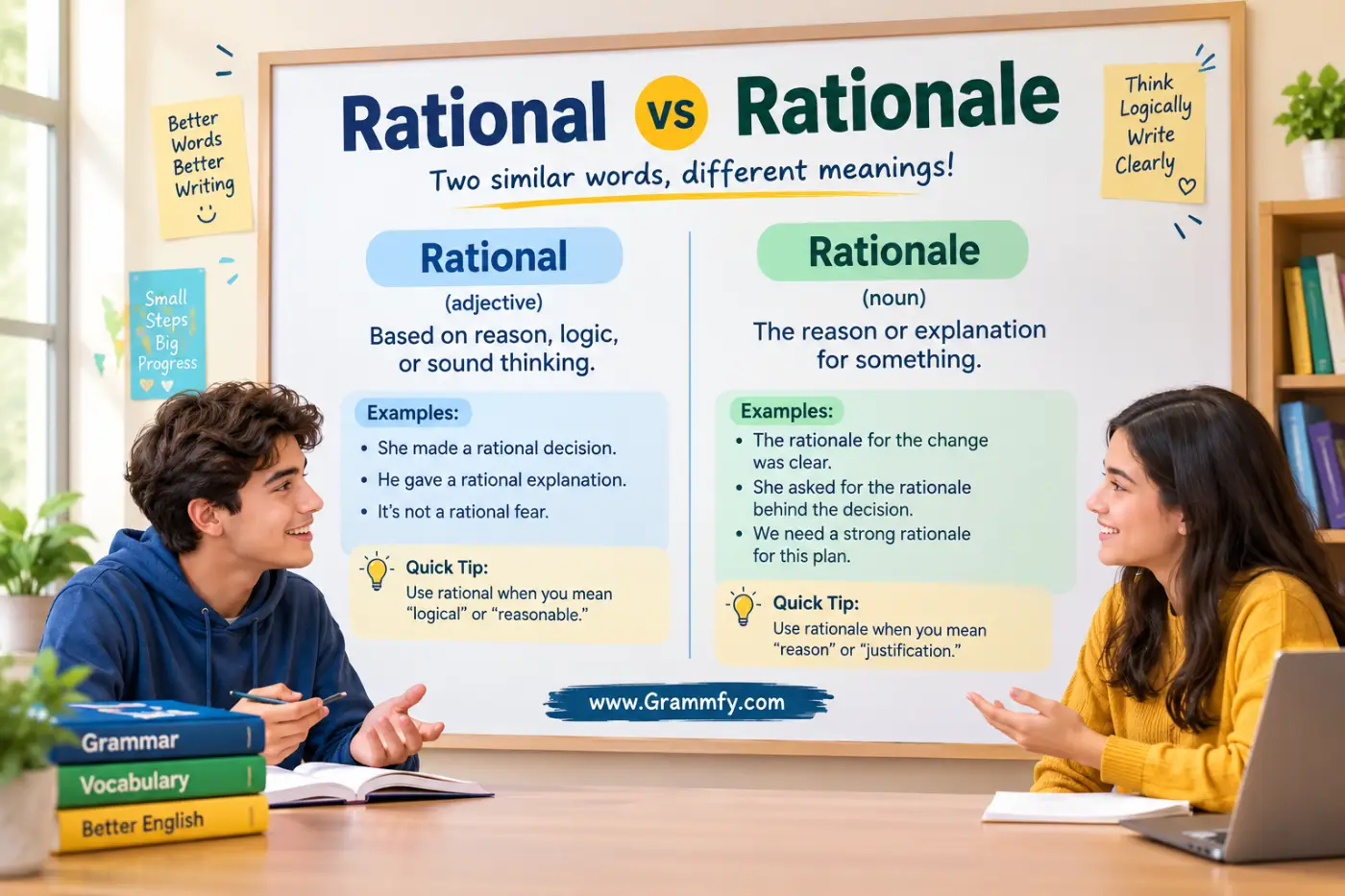
When you’re writing an email, essay, resume, or text, you may pause over Rational vs Rationale. The two words look and sound similar, but they have different meanings and grammatical roles. Using the wrong one can make an otherwise clear sentence confusing.
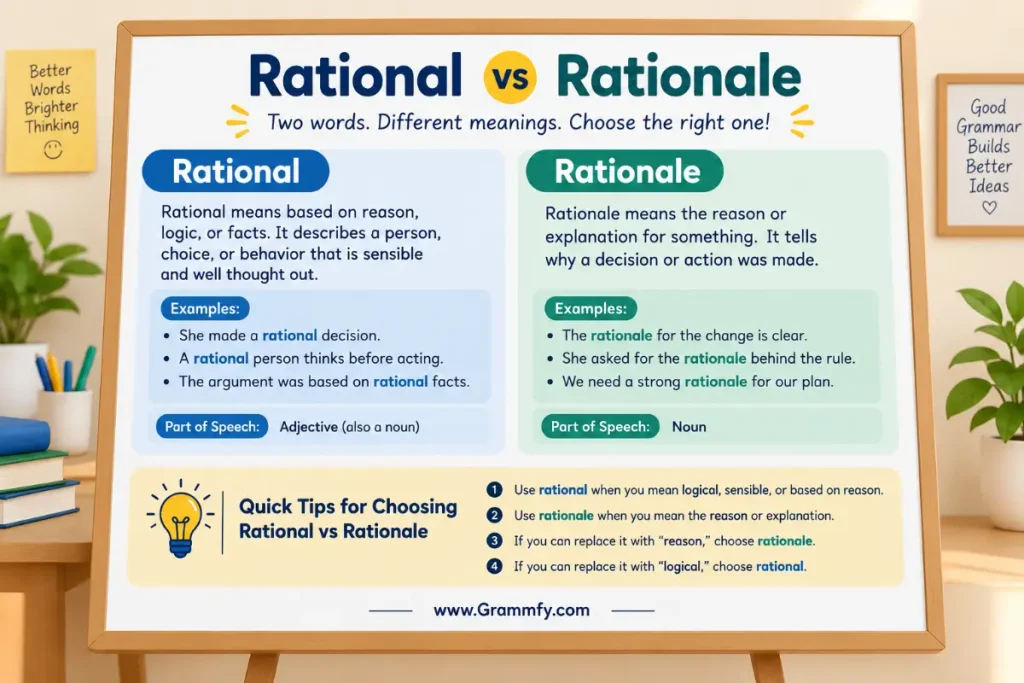
Rational is an adjective. It describes a person, idea, decision, or action that is based on reason, logic, or careful thought. Rationale is a noun. It means the reason or explanation behind a decision, plan, method, or action.
- Answer: Rational describes something based on reason or logic, while rationale means the reason or explanation behind a decision or action.
The difference becomes much easier once you connect each word to its job in a sentence. This guide covers their meanings, origins, synonyms, intensity, examples, common mistakes, context-specific usage, and simple ways to remember the difference.
These words are easy to mix up, so read our guide to the difference between Constant vs Consistent to see their meanings and examples side by side.
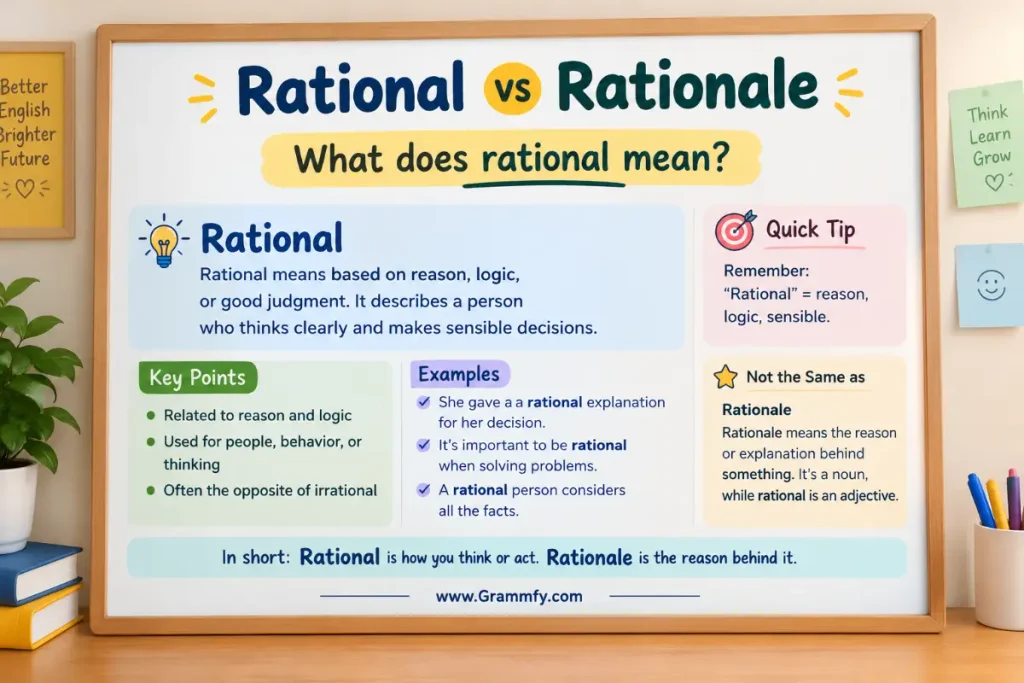
What does rational mean?
Rational is an adjective that means based on reason, logic, facts, or sensible thinking.
It can describe a person who thinks carefully before making a decision. It can also describe a choice, argument, explanation, plan, or action.
For example:
- She made a rational decision after reviewing the evidence.
Here, rational describes the decision. The decision was based on careful thought rather than impulse.
You can also say:
- a rational argument
- a rational explanation
- a rational person
- a rational choice
- a rational approach
- a rational response
- a rational plan
- a rational conclusion
The word does not necessarily mean that everyone agrees with the decision. It means that the decision has a reasonable basis.
What does rationale mean?
Rationale is a noun meaning the reason, explanation, or logical basis for something.
For example:
- The manager explained the rationale behind the new policy.
The rationale is the explanation for why the policy was created.
You can think of it as answering the question:
“Why was this decision or action taken?”
For example:
- The rationale for the change was to reduce costs.
The phrase the rationale for the change means the reason behind the change.
Rational vs Rationale: what is the difference?
The easiest distinction is grammatical:
| Word | Part of speech | Meaning | Example |
|---|---|---|---|
| Rational | Adjective | Based on reason or logic | She made a rational choice. |
| Rationale | Noun | Reason or explanation behind something | She explained the rationale for the choice. |
A useful memory trick is:
Rational = reasonable
Rationale = reason
If you are describing what something is like, you may need rational.
If you are naming the reason behind something, you probably need rationale.
Compare these two sentences
- The decision was rational.
This says the decision was logical or reasonable.
- The rationale for the decision was clear.
This says the reason behind the decision was clear.
The words are related, but they cannot simply replace each other.
Where do Rational vs Rationale come from?
The two words share a historical connection with reason and calculation, which explains why they look so similar.
The origin of rational
Rational comes from Latin rationalis, meaning related to reason or reasoning. It developed through French and entered English with meanings connected to reason, logic, and the ability to think.
Over time, rational became widely used to describe decisions, arguments, behavior, and ideas that are guided by reason rather than emotion or impulse.
That is why we can describe someone as: “a rational thinker”
or a decision as: “a rational choice”
The origin of rationale
Rationale is related to the Latin rationale, connected with reasoning or an account of reasons. English later adopted the word to refer to the underlying reason or explanation for something.
Today, it is especially common in professional, academic, legal, medical, business, and technical writing.
For example:
- The report explains the rationale for the proposed changes.
In simple English, this means:
- The report explains why the proposed changes are being made.
How do you use rational in a sentence?
Use rational before or after a noun when you want to describe something as logical, sensible, or reason-based.
Examples:
- He gave a rational explanation.
- We need a rational approach to the problem.
- Her response was rational and calm.
- It was a rational decision based on the available information.
The word often describes a thought process or result.
Rational before a noun
When rational comes before a noun, it works as an adjective.
Examples:
- rational decision
- rational argument
- rational explanation
- rational response
- rational strategy
- rational solution
Example:
The team developed a rational strategy for dealing with the problem.
Rational after a linking verb
You can also use rational after verbs such as is, was, seems, appears, and remains.
Examples:
- His argument is rational.
- Her explanation seems rational.
- Their response was rational.
- The plan appears rational.
How do you use rationale in a sentence?
Use rationale as a noun when you mean the reason or explanation behind something.
Common structures include:
- the rationale for something
- the rationale behind something
- explain the rationale
- provide a rationale
- give a rationale
- understand the rationale
Examples:
- The teacher explained the rationale behind the assignment.
- We need to understand the rationale for this decision.
- The report provides a clear rationale for the recommendation.
- She gave a detailed rationale for changing the schedule.
Why is “rationale” often followed by “for”?
The structure rationale for is very common.
For example:
What is the rationale for this policy?
It means:
- What is the reason for this policy?
You can also use rationale behind: “What is the rationale behind this decision”?
Both structures are common and understandable.
Rational vs Rationale: which one is an adjective?
Rational is the adjective.
It describes a noun:
- a rational decision
- a rational argument
- a rational person
- Rationale is a noun:
The rationale was convincing.
We discussed the rationale.
This grammatical distinction is one of the fastest ways to choose the correct word.
What are the best synonyms for rational?
The best synonym depends on exactly what you mean. Some words emphasize logic, while others emphasize good judgment, calmness, or practicality.
Simple synonyms for rational
| Word | Meaning | Tone | Example |
|---|---|---|---|
| Reasonable | Fair and sensible | Simple | That seems like a reasonable choice. |
| Sensible | Showing good judgment | Simple | She made a sensible decision. |
| Logical | Based on clear reasoning | Simple | His explanation was logical. |
| Wise | Showing good judgment | Simple | It was a wise decision. |
| Sound | Based on good reasoning | Neutral | They made a sound choice. |
| Practical | Focused on what works | Simple | We need a practical solution. |
| Thoughtful | Carefully considered | Neutral | She gave a thoughtful response. |
Everyday synonyms for rational
| Word | Meaning | Tone | Example |
|---|---|---|---|
| Sensible | Practical and reasonable | Everyday | That’s a sensible plan. |
| Logical | Easy to understand through reason | Everyday | Your conclusion is logical. |
| Practical | Likely to work in real life | Everyday | That’s a practical approach. |
| Level-headed | Calm and sensible | Informal | He’s very level-headed. |
| Clear-headed | Able to think clearly | Informal | She stayed clear-headed under pressure. |
| Wise | Showing good judgment | Everyday | Moving early was a wise choice. |
| Fair | Reasonable and just | Everyday | That’s a fair decision. |
| Balanced | Considering different sides | Neutral | She offered a balanced opinion. |
Formal synonyms for rational
| Word | Meaning | Tone | Example |
|---|---|---|---|
| Reasoned | Based on careful reasoning | Formal | The report presents a reasoned argument. |
| Logical | Based on sound reasoning | Formal-neutral | The conclusion is logical. |
| Cogent | Clear and convincing | Formal | He presented a cogent argument. |
| Judicious | Showing careful judgment | Formal | The board took a judicious approach. |
| Reasonable | Supported by good judgment | Formal-neutral | The proposal is reasonable. |
| Analytical | Based on detailed examination | Formal | She took an analytical approach. |
| Objective | Based on facts rather than personal feelings | Formal | The review should remain objective. |
| Deliberate | Carefully considered | Formal | The decision was deliberate. |
Slang and casual alternatives for rational
There are fewer exact slang equivalents because rational is already a fairly neutral word. In casual speech, people may say:
| Word | Meaning | Tone | Example |
|---|---|---|---|
| Level-headed | Calm and sensible | Casual | She’s pretty level-headed. |
| Clear-headed | Thinking clearly | Casual | Try to stay clear-headed. |
| Down-to-earth | Practical and realistic | Casual | He’s very down-to-earth. |
| Sound | Sensible or reliable | Casual | That’s a sound idea. |
| Fair | Reasonable | Casual | That’s fair. |
| Smart | Sensible or intelligent | Casual | That was a smart move. |
Some of these words overlap with rational, but none is a perfect replacement in every sentence.
What are the best synonyms for rationale?
Because rationale is a noun, its synonyms should also normally function as nouns.
Simple synonyms for rationale
| Word | Meaning | Tone | Example |
|---|---|---|---|
| Reason | Why something happened or was done | Simple | What was the reason for the change? |
| Explanation | Information that makes something clear | Simple | She gave an explanation. |
| Cause | Something that produces an effect | Simple | We need to identify the cause. |
| Basis | The main support for an idea | Neutral | What is the basis for the decision? |
| Purpose | The intended reason for something | Simple | What is the purpose of this rule? |
| Motive | A reason for an action | Neutral | The police investigated his motive. |
Everyday synonyms for rationale
| Word | Meaning | Tone | Example |
|---|---|---|---|
| Reason | Explanation for something | Everyday | What’s the reason for the change? |
| Explanation | Account of why something happened | Everyday | Her explanation made sense. |
| Thinking | Ideas behind a decision | Casual | I understand your thinking. |
| Purpose | Intended goal | Everyday | What’s the purpose of the change? |
| Logic | Reasoning behind an idea | Everyday | I don’t understand the logic behind it. |
| Basis | Foundation for a decision | Neutral | What was the basis for the decision? |
Formal synonyms for rationale
| Word | Meaning | Tone | Example |
|---|---|---|---|
| Justification | Reason that supports a decision or action | Formal | The report provides a justification for the policy. |
| Reasoning | Process of thinking used to reach a conclusion | Formal | The reasoning behind the decision was clear. |
| Basis | Foundation supporting an idea | Formal | The recommendation has a strong basis. |
| Grounds | Reasons supporting an action or conclusion | Formal | The decision was made on legal grounds. |
| Justification | Evidence or reasoning used to defend something | Formal | The proposal needs further justification. |
| Foundation | Underlying support for an idea | Formal | The theory has a strong foundation. |
There are not many true slang synonyms for rationale. In casual conversation, people are much more likely to say reason, thinking, or why.
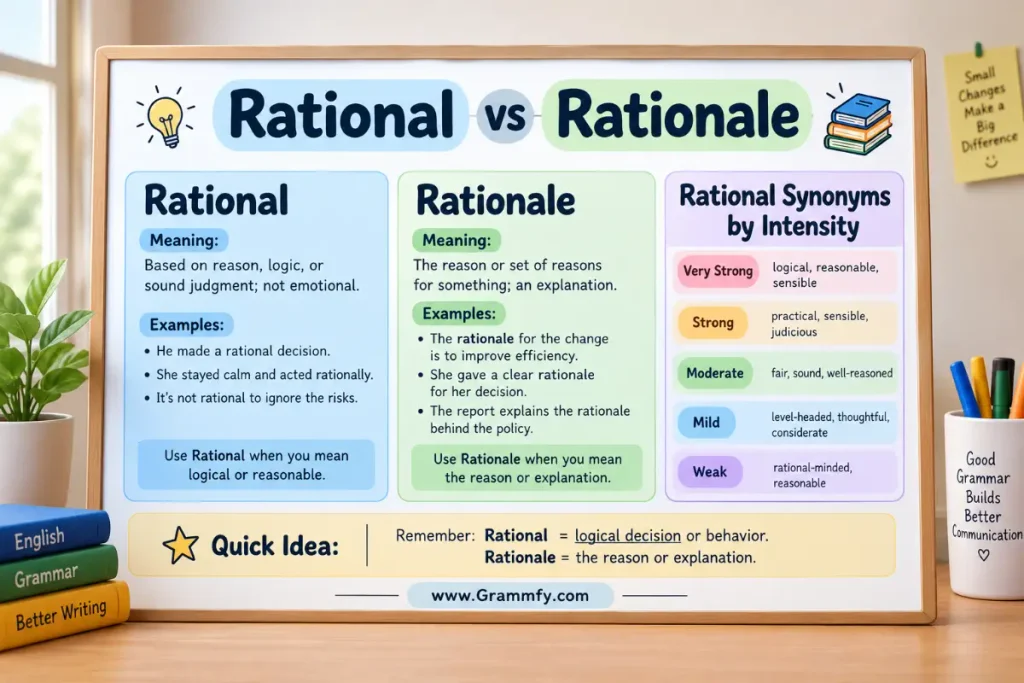
Rational synonyms by intensity
Not every synonym carries the same strength.
A useful scale is:
reasonable → sensible → sound → logical → well-reasoned → judicious → highly rational
Mild level
Words such as reasonable, sensible, and fair often show that a decision makes sense without praising it strongly.
- It was a reasonable response.
This doesn’t say the response was brilliant. It simply says it made sense.
Moderate level
Words such as sound, logical, and practical suggest stronger support.
- The committee made a sound decision.
This suggests that the decision was well supported.
Strong level
Words such as well-reasoned, judicious, and carefully considered suggest that the decision was made after thoughtful analysis.
- She presented a well-reasoned argument.
This tells the reader more than simply saying the argument was rational.
Rationale synonyms by intensity
The intensity of rationale synonyms is slightly different because they focus on the strength of the explanation.
Basic
- reason
- explanation
- purpose
Example:
The reason for the change was simple.
Moderate
- basis
- reasoning
- logic
Example:
The reasoning behind the decision was clear.
Strong or formal
- justification
- grounds
- well-supported basis
Example:
The report provides a strong justification for the recommendation.
Be careful with justification. It can suggest that someone is defending or proving that an action was appropriate, while rationale can simply explain why the action was chosen.
Rational vs reasonable: what’s the difference?
- Rational and reasonable are close, but they aren’t always interchangeable.
Rational often emphasizes logic and reasoning.
Reasonable can emphasize fairness, practicality, or what most people would consider sensible.
| Rational | Reasonable |
|---|---|
| Focuses on logic | Focuses on good judgment or fairness |
| Often used with arguments and decisions | Very common in everyday language |
| Can sound analytical | Often sounds more natural and conversational |
Compare:
- His conclusion was rational.
This focuses on the reasoning behind the conclusion.
- His request was reasonable.
This suggests that the request was fair or sensible.
Rational vs logical: what’s the difference?
These words are also close.
Logical usually focuses on whether reasoning follows clearly from facts or premises.
Rational is broader. It can describe a person, decision, behavior, plan, or choice that is guided by reason.
For example:
- Her argument is logical.
The structure of the argument makes sense.
- Her decision was rational.
The decision was based on sensible reasoning.
A decision can be rational even when it involves personal preferences. A person can reasonably choose one restaurant over another without having a formal logical argument.
Rationale vs reason: what’s the difference?
Reason is much more common and works in everyday English.
Rationale is more formal and often refers to the reasoning or explanation supporting a decision, policy, method, or recommendation.
Compare:
- What is the reason for the change?
- What is the rationale for the change?
Both are correct. The first sounds more natural in everyday conversation. The second sounds more professional or analytical.
When should you use rationale?
Use rationale when you’re discussing:
- business decisions
- policies
- academic methods
- research choices
- professional recommendations
- project plans
- organizational changes
- technical decisions
Example:
“The report explains the rationale behind the new hiring policy”.
What is the best word for a resume Rational vs Rationale?
On a resume, rational can be useful when describing decision-making, analytical thinking, or problem-solving.
Examples:
- Used rational analysis to identify operational problems.
- Applied logical reasoning to improve workflow efficiency.
However, rationale is less common on a resume unless you’re describing documentation or a formal decision-making process.
Instead of:
- Provided the rationale for every task.
You might write: “Documented the reasoning behind key project decisions”.
That sounds more natural and specific.
Resume example
Weak: “Made rational decisions at wor.
Stronger: “Used data and careful analysis to make informed business decisions”.
The stronger version demonstrates the skill instead of simply labeling it.
What is the best word for an essay Rational vs Rationale?
Both words can be useful in academic writing.
Use rational to describe arguments, decisions, approaches, or conclusions.
- The author presents a rational argument based on historical evidence.
Use rationale when discussing why a researcher, writer, or organization chose a particular approach.
- The study explains the rationale for selecting this research method.
Rationale is especially common in academic assignments where you need to explain why you selected a method, topic, source, or approach.
Academic example
- The rationale for using interviews was to collect detailed responses from participants.
This means the reason for choosing interviews was to collect detailed responses.
What is the best word for texting Rational vs Rationale?
In casual texting, reason is usually more natural than rationale.
Instead of: “What’s the rationale behind that”?
A friend might say: “Why did you do that”?
Or:
- What’s the reason?
Rational is still normal in casual conversation, although words such as sensible or reasonable may sound more natural.
For example:
- That’s not a rational choice.
Or:
- That’s not a very sensible choice.
The second sounds less formal.
What is the best word for email Rational vs Rationale?
In professional emails, rationale can be a useful word when you need to discuss the reason behind a decision.
For example:
- Could you please explain the rationale for the proposed change?
This sounds professional and neutral.
For a less formal email, use reason: “Could you please explain the reason for the proposed change”?
Both are correct. The first sounds more formal and analytical.
Email example
We understand the rationale behind the schedule change, but we’d like to discuss another option.
This works well in business communication.
What is the best word for speaking Rational vs Rationale?
In everyday speech, reason is usually the most natural word.
You might say: “What’s the reason for the change”?
Rather than: “What’s the rationale for the change”?
The second is not wrong. It simply sounds more formal.
For rational, everyday alternatives include:
- sensible
- reasonable
- logical
- practical
For example:
- That’s a reasonable decision.
This often sounds more natural in conversation than: “That’s a rational decision”.
15+ original examples using rational
- She made a rational decision after comparing the costs.
- His response was calm and rational.
- We need a rational solution to the problem.
- The manager offered a rational explanation for the delay.
- It is rational to save money before making a large purchase.
- Her argument was rational and supported by evidence.
- The team took a rational approach to the project.
- He remained rational during the disagreement.
- They reached a rational conclusion after reviewing the data.
- A rational buyer compares several options before spending a large amount.
- The proposal seems rational given the current budget.
- She gave a rational response instead of reacting emotionally.
- The scientist used a rational method to test the idea.
- His choice was rational because it reduced unnecessary costs.
- The committee wanted a rational basis for its recommendation.
- A rational plan should account for both risks and benefits.
- The student presented a rational argument in the essay.
- It was rational to postpone the purchase until the price dropped.
15+ original examples using rationale
- The manager explained the rationale for the new schedule.
- We need to understand the rationale behind this policy.
- The report provides a clear rationale for the recommendation.
- She explained the rationale for choosing the cheaper option.
- The teacher discussed the rationale behind the assignment.
- The company published the rationale for changing its pricing policy.
- The researcher explained the rationale for using this method.
- The committee asked for a stronger rationale before approving the proposal.
- His rationale for leaving early was understandable.
- The document outlines the rationale behind the project.
- We discussed the rationale for each major decision.
- The proposal lacks a clear rationale.
- The lawyer presented the rationale for the legal strategy.
- The team documented its rationale for selecting the software.
- Her rationale was based on cost, time, and expected results.
- The report gives readers enough information to understand the rationale.
- The board requested a written rationale for the decision.
- The rationale for the change became clearer after the meeting.
How can you remember Rational vs Rationale?
Use the reason test.
If you can replace the word with reasonable or logical, choose rational. “It was a rational decision”.
You could say: “It was a reasonable decision”.
If you can replace the word with reason or explanation, choose rationale. “She explained the rationale for the decision.
You could say: “She explained the reason for the decision”.
This test works in most everyday situations.
Another memory trick
Think:
Rational = describes
Rationale = explains
A rational person thinks logically.
A rationale explains why something was done.
What common mistakes should you avoid?
Mistake 1: Using rationale as an adjective
Incorrect:
- She made a rationale decision.
Correct:
- She made a rational decision.
Rationale is a noun, so it doesn’t normally describe the decision directly.
Mistake 2: Using rational when you mean reason
Incorrect:
- The rational for the decision was unclear.
Correct:
- The rationale for the decision was unclear.
Here, you need a noun meaning “reason,” so rationale is correct.
Mistake 3: Confusing rationale with rationality
Rationality is a noun referring to the quality or state of being rational.
Compare:
- rational = adjective
- rationale = reason or explanation
- rationality = quality of being rational
Examples:
- His decision was rational.
- He explained the rationale for his decision.
- The debate focused on the rationality of the decision.
Mistake 4: Using rationale when reason sounds better
Although rationale is correct in many professional situations, it can sound unnecessarily formal in casual conversation.
Instead of:
- What is the rationale for buying this?
You can simply say: “Why are you buying this”?
Clear writing isn’t always about choosing the most formal word.
Mistake 5: Assuming rational means emotionless
A rational person can still have emotions.
Being rational means using reason and judgment when making a decision. It does not mean having no feelings.
For example:
- She was upset, but she made a rational decision.
The sentence is perfectly possible because emotions and reason can exist together.
Mistake 6: Assuming rational always means correct
A rational decision can still turn out to be wrong.
Someone may make a reasonable decision based on the information available at the time and later discover that the information was incomplete.
For example:
- Given the information available, the decision was rational, even though the result was disappointing.
This distinction matters in serious writing.
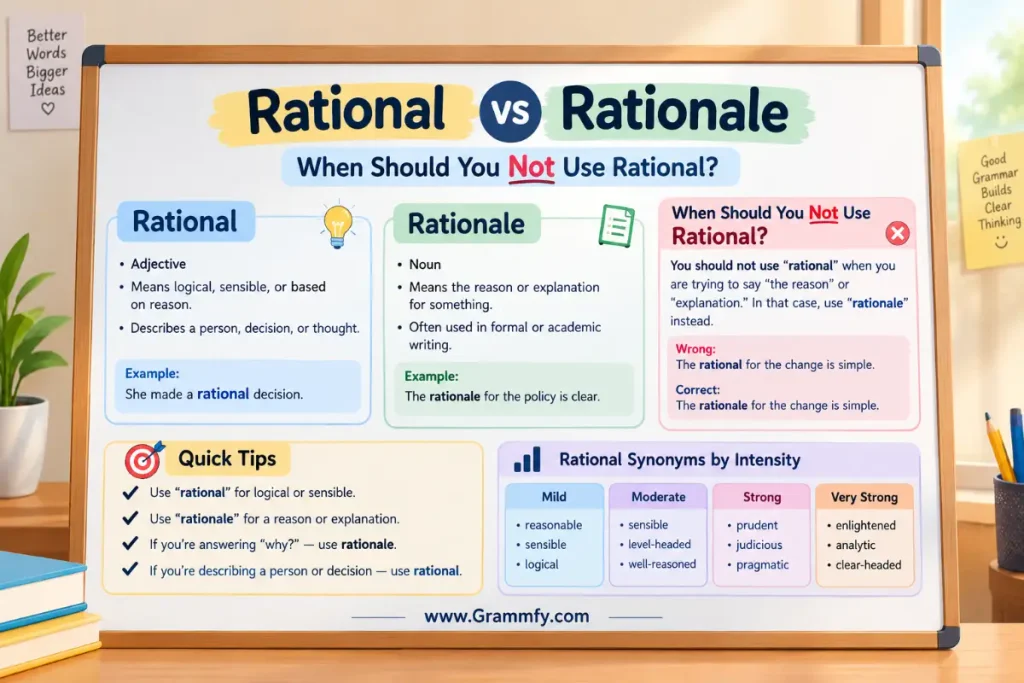
When should you not use rational?
Avoid rational when you actually mean another quality.
If you mean fair
Use fair or reasonable.
- The price is reasonable.
Not every fair decision is primarily about logic.
If you mean practical
Use practical.
- We need a practical solution.
This emphasizes whether the solution can work in real life.
If you mean emotionally calm
Use:
- calm
- composed
- level-headed
A calm person isn’t automatically rational.
If you mean correct
Use:
- correct
- accurate
- valid
A rational argument can still contain incorrect information if its starting assumptions are wrong.
When should you not use rationale?
Avoid rationale when you simply need a natural word for everyday communication.
Instead of:
- What is the rationale for your choice of restaurant?
Say:
- Why did you choose this restaurant?
In a casual conversation, reason or why is usually clearer.
- Also avoid using rationale when you actually mean purpose.
Compare:
The purpose of the meeting is to discuss the new plan.
This focuses on what the meeting is intended to accomplish. The rationale for the meeting is that the team needs to discuss the new plan.
This focuses on why the meeting is necessary.
What are the antonyms of rational?
Common opposites include:
- irrational
- unreasonable
- illogical
- impractical
- impulsive
- senseless
- absurd
- emotional
The best choice depends on the meaning.
Irrational
This is the most direct opposite.
- His fear was irrational.
Illogical
Use this when reasoning does not make sense.
- The conclusion was illogical.
Unreasonable
Use this when something is not sensible, fair, or acceptable.
- The demand was unreasonable.
Impulsive
Use this when someone acts suddenly without careful thought.
- It was an impulsive decision.
These words are related but not identical.
What are the antonyms of rationale?
Because rationale means a reason or explanation, its opposites are less direct.
Depending on the context, you might use:
- lack of reason
- absence of justification
- confusion
- inconsistency
- unsupported claim
For example:
- The proposal was rejected because it lacked a clear rationale.
You don’t usually need a single opposite noun for rationale. Saying that something has no clear reason or no justification is often more natural.
Rational vs rationale in business writing
Business writing frequently uses both words.
Consider:
- The company made a rational decision based on market data.
Here, rational describes the decision.
Now compare:
- The company explained the rationale for the decision.
Here, rationale identifies the explanation.
For example:
- The board made a rational decision after reviewing the financial data. It later published the rationale for the decision.
This uses both words correctly and clearly.
Rational vs rationale in academic writing
Academic writing often requires you to explain why you selected a method or reached a conclusion.
For example:
The researcher used interviews because they provided detailed responses.
You could make the sentence more formal: “The rationale for using interviews was their ability to provide detailed responses”.
Here, rationale is appropriate because the sentence focuses on the reason for a methodological choice.
When describing the reasoning itself: “The researcher used a rational approach to evaluate the evidence”.
The adjective rational describes the approach.
Rational vs rationale in technical writing
Technical documents often use rationale when explaining why a design, process, or system was selected.
For example:
The document explains the rationale for selecting the new database system.
You can use rational to describe the decision: “The team made a rational choice based on performance and cost”.
If you’re writing technical instructions for a broad audience, reason may still be preferable because it is simpler.
Rational vs rationale in legal writing
Rationale is common in legal and policy discussions because documents often need to explain the reasoning behind rules or decisions.
For example:
- The court discussed the rationale behind the rule.
Rational can describe a decision or basis: “The court considered whether the decision was rational”.
Legal writing can be technical, so the exact meaning depends on the context. Don’t treat rational as automatically meaning legally valid or correct.
Which word sounds more formal Rational vs Rationale?
Rationale generally sounds more formal than reason.
Rational is neutral. It can be used in both everyday and formal English.
Compare:
- What’s the reason for this change?
This is natural and simple.
- What’s the rationale for this change?
This sounds more professional or analytical.
Likewise: “That’s a rational choice”.
This is neutral. “That’s a sensible choice”.
This may sound more natural in casual speech.
Can rational describe a person?
Yes.
You can say: “She is a rational person”.
This means she tends to think logically and make decisions based on reason.
You can also use:
- rational thinker
- rational decision-maker
- rational approach
- rational judgment
However, be careful when labeling a person rational or irrational. Such labels can sound judgmental depending on the situation.
Instead of:
- You’re being irrational.
A softer option might be: “I don’t think that decision is reasonable”.
The second sentence focuses on the decision rather than attacking the person.
Can rationale be plural?
Yes. The plural is rationales, although the plural form is less common than the singular.
For example:
- The report provides several rationales for the proposed changes.
However, in many cases, reasons or justifications may sound more natural.
Can you say “a rationale”?
Yes.
Because rationale is a countable noun when referring to a particular explanation, you can use a or the.
Examples:
- We need a clear rationale for the proposal.
- The committee rejected the plan because it lacked a convincing rationale.
- She provided a detailed rationale for her decision.
Can you say “the rationale behind”?
Yes.
This is a common construction:
- the rationale behind the decision
- the rationale behind the policy
- the rationale behind the strategy
You can also use:
“the rationale for the decision”
Both are standard.
Can you say “rationale of”?
Sometimes rationale of is grammatically possible, but rationale for and rationale behind are generally more natural.
Prefer:
- the rationale for the policy
or:
- the rationale behind the policy
rather than:
- the rationale of the policy
Quick comparison table
| Feature | Rational | Rationale |
|---|---|---|
| Part of speech | Adjective | Noun |
| Basic meaning | Based on reason | Reason or explanation |
| Simple synonym | Reasonable | Reason |
| Describes a person? | Yes | No |
| Describes a decision? | Yes | No |
| Refers to a reason? | No | Yes |
| Common phrase | rational decision | rationale for the decision |
| Common in academic writing? | Yes | Yes |
| Common in casual speech? | Yes | Less common |
| Formality | Neutral | More formal |
A quick “which word should I use?” guide
Choose rational if:
- you’re describing a decision
- you’re describing an argument
- you’re describing someone’s thinking
- you’re describing a response
- you mean logical
- you mean reasonable
- you mean based on evidence or reason
Choose rationale if:
- you’re naming a reason
- you’re explaining why something happened
- you’re discussing the reason behind a policy
- you’re explaining why a method was selected
- you’re documenting the reasoning behind a decision
- you mean explanation or justification
10 quick sentence pairs to test yourself
- Pair 1
The decision was rational. The rationale for the decision was clear.
- Pair 2
She gave a rational response. She explained the rationale behind her response.
- Pair 3
We need a rational plan. We need to understand the rationale for the plan.
- Pair 4
His argument is rational. His rationale is easy to understand.
- Pair 5
The manager took a rational approach. The manager explained the rationale for that approach.
- Pair 6
The choice seems rational. The rationale behind the choice makes sense.
- Pair 7
They reached a rational conclusion. They provided a rationale for their conclusion.
- Pair 8
Her behavior was rational. She explained the rationale for her actions.
- Pair 9
The proposal appears rational. The proposal lacks a clear rationale.
- Pair 10
The team made a rational decision. The team documented its rationale.
These pairs show how the adjective and noun can appear together while performing different jobs.
How can you make your writing more precise?
Instead of automatically choosing rational, ask what kind of quality you mean.
If you mean:
- based on facts → objective
- based on logic → logical
- fair → reasonable or fair
- likely to work → practical
- carefully considered → thoughtful or deliberate
- well supported → sound or well-reasoned
- calm under pressure → level-headed
- correct → accurate
- free from personal bias → objective
Likewise, if you mean the reason behind something, ask whether reason, purpose, basis, justification, or rationale is most accurate.
Precise vocabulary makes your writing stronger than simply choosing the most formal word.
Quick tips for choosing Rational vs Rationale
- Remember rational = adjective.
- Remember rationale = noun.
- Replace rational with reasonable to test the sentence.
- Replace rationale with reason to test the sentence.
- Use rational decision when describing the decision.
- Use rationale for the decision when explaining why it was made.
- Use reason in casual conversation when rationale feels too formal.
- Use rationale in reports when you need to explain the basis of a decision.
- Don’t use rationale as an adjective.
- Don’t use rational when you mean “reason.”
- Don’t assume rational means “correct.”
- Don’t assume rational means “without emotion.”
- Choose logical when the focus is the structure of an argument.
- Choose practical when the focus is whether something will work.
- Choose reasonable when the focus is fairness or good judgment.
A final memory trick
If you only remember one rule, remember this:
Rational = reasonable.
Rationale = reason.
For example:
- It was a rational choice.
Ask yourself: Was the choice reasonable? Yes.
Then:
- What was the rationale for the choice?
Ask yourself: What was the reason? That’s the rationale.
This simple connection can help you avoid the most common mistake between these two words.
Conclusion
The key difference in Rational vs Rationale is their grammatical role. Rational is an adjective used to describe something based on reason, logic, or sensible judgment. Rationale is a noun that names the reason, explanation, or logical basis behind a decision, policy, method, or action. When you’re unsure, try replacing rational with “reasonable” and rationale with “reason.” If the replacement works, you’ve probably chosen the right word. In casual writing, reason is often simpler than rationale, while professional and academic writing may benefit from the more precise term. Once you connect each word to its job, the difference becomes easy to spot.
Frequently Asked Questions
Is rational the same as rationale?
No, they are different parts of speech. Rational is an adjective meaning reasonable or logical, while rationale is a noun meaning the reason or explanation behind something.
What is the difference between rational and rationale?
Rational describes something based on reason, while rationale refers to the reason or explanation supporting a decision, action, or idea.
What’s another way to say rationale?
Common alternatives include reason, explanation, basis, reasoning, purpose, and justification. The best choice depends on the exact meaning and level of formality.
Can I use rationale in a casual conversation?
Yes, but reason is usually more natural in casual conversation. Rationale tends to sound more formal or professional.
Is rationale a noun or adjective?
Rationale is a noun. It refers to the reason, explanation, or logical basis behind something.
Can rational describe a person?
Yes. A rational person is someone who tends to think logically and make decisions based on reason rather than impulse.
What is the opposite of rational?
The most direct opposite is irrational. Depending on the context, illogical, unreasonable, impulsive, or impractical may also work.

Tylerbrooks is a US-based English grammar writer and contributor at Grammfy. He writes helpful articles about grammar, spelling, commonly confused words, and vocabulary. His goal is to explain English topics in simple language with clear examples and practical tips. Through his articles, he helps readers improve their writing and everyday English skills.