
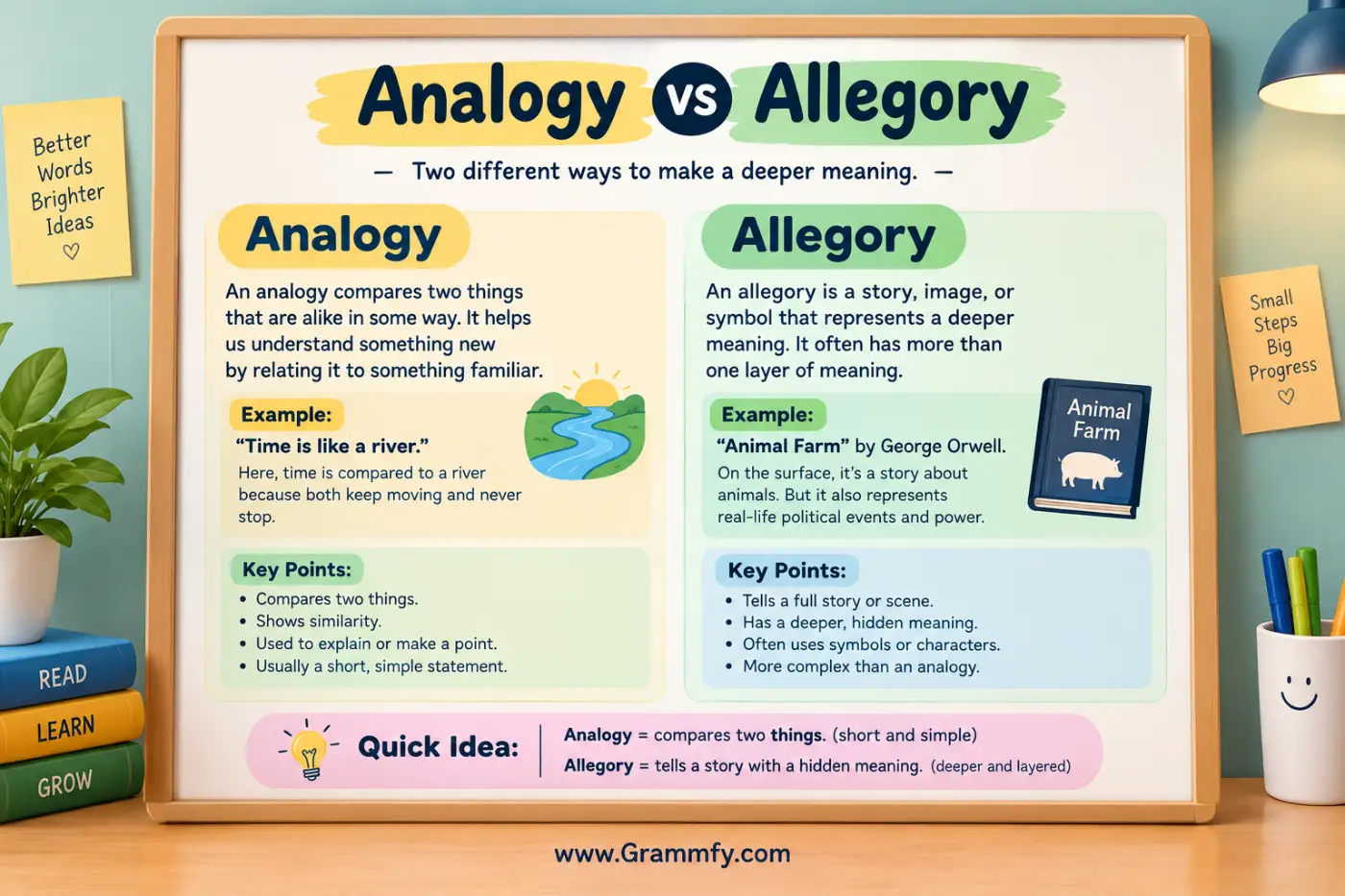
You’re writing an essay and want to explain a difficult idea clearly. You might use a comparison, a story, or a familiar situation to make your point easier to understand. That’s where Analogy vs Allegory can get confusing. Both help readers understand ideas, but they work in very different ways.
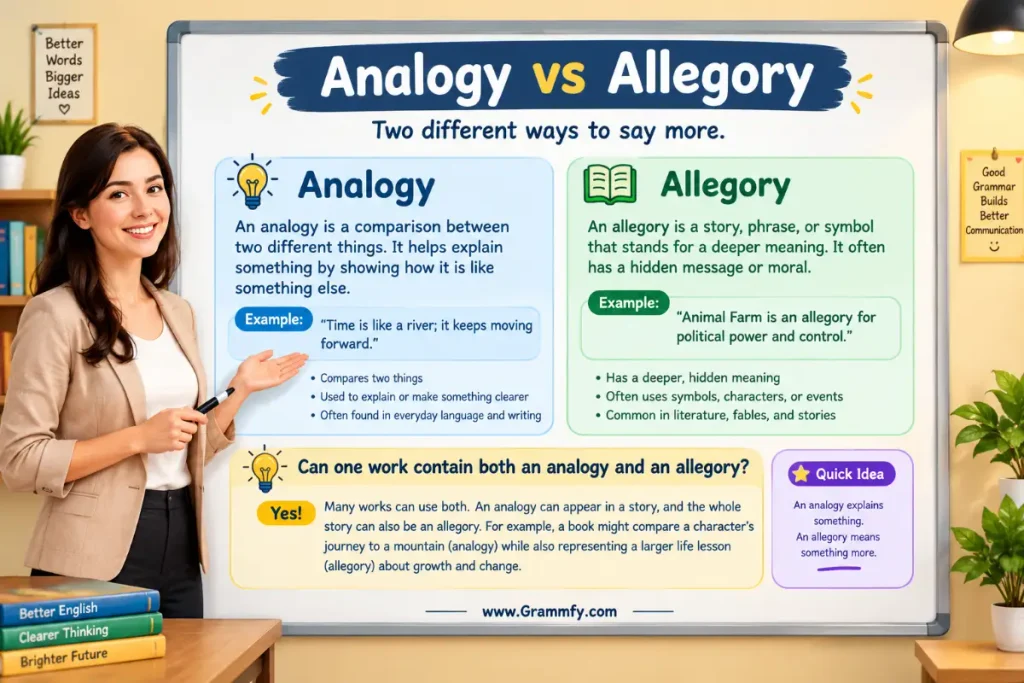
An analogy explains one idea by comparing it with another idea that has a similar relationship or structure. An allegory uses characters, events, objects, or an entire story to represent deeper ideas, often about morality, politics, society, or human behavior.
- Answer box: An analogy is a comparison used to explain or clarify an idea. An allegory is a story or extended representation in which people, events, or objects stand for deeper meanings.
In this guide, you’ll learn the plain-English difference, word origins, related terms, examples, common mistakes, context-specific choices, and simple ways to remember which one to use.
These words are easy to mix up, so read our guide to the difference between Rational vs Rationale to see their meanings and examples side by side.
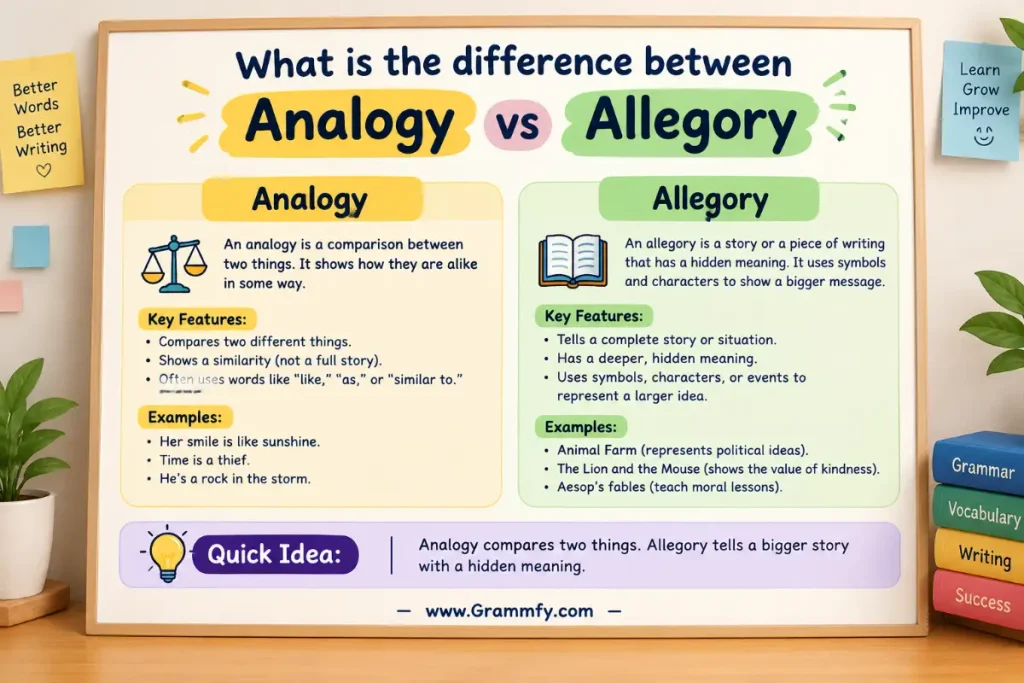
What is the difference between Analogy vs Allegory?
The simplest difference is purpose and scale.
An analogy usually makes an idea easier to understand by comparing it with something familiar. It can be one sentence, a short comparison, or a longer explanation.
An allegory is usually more developed. It uses a story, image, character, event, or series of symbols to communicate another meaning.
| Feature | Analogy | Allegory |
|---|---|---|
| Main purpose | Explain or clarify | Represent a deeper idea |
| Typical form | Comparison | Story, narrative, artwork, or extended representation |
| Length | Often short | Often extended |
| Meaning | Usually stated or easy to identify | Often symbolic or layered |
| Common subjects | Science, education, writing, conversation | Morality, politics, religion, society, human nature |
| Key question | “How is this similar?” | “What does this represent?” |
| Example | “The heart is like a pump.” | A story where animals represent different human groups |
| Reader’s task | Understand the comparison | Interpret the deeper meaning |
So, if a teacher says, “Think of your memory like a filing cabinet,” that’s an analogy. The teacher is using something familiar to explain something less familiar.
If a novel tells a complete story in which a journey represents a person’s spiritual growth, that can be an allegory.
What does analogy mean in plain English?
An analogy is a comparison between two things that are different but share a useful similarity.
The goal is usually to help someone understand an unfamiliar idea.
For example:
- Learning a language is like building a house. You need a strong foundation before you can add more complicated parts.
Learning a language and building a house aren’t literally the same thing. The comparison works because both can be built step by step.
An analogy can also explain relationships: “A teacher is to a classroom what a coach is to a team”.
The people and settings are different, but the relationship is similar. Both guide and support a group.
How does an analogy work?
A useful analogy normally has three parts:
- The idea you want to explain
- The familiar idea you compare it with
- The shared feature that makes the comparison useful
For example:
- A computer’s memory is like a desk. A larger desk gives you more room to work with information at once.
The computer and desk are different, but the comparison helps explain the idea of available working space.
An analogy doesn’t have to prove that two things are identical. It only needs to show a meaningful similarity.
What does allegory mean in plain English?
An allegory is a story, picture, or extended representation that communicates another meaning through characters, events, settings, or symbols.
The surface story may be about animals, travelers, kings, families, or imaginary places. Underneath that story, the writer may be discussing human behavior, morality, power, freedom, greed, fear, or another abstract subject.
A simple way to think about allegory is: ‘The story says one thing on the surface while representing something deeper underneath”.
For example, imagine a story about a group of animals who fight over control of their farm. If the animals and their actions represent ideas about political power and society, the story can function as an allegory.
Allegory is therefore closely connected to symbolism, but the two terms aren’t exactly interchangeable.
A symbol can be one object or image. An allegory can build meaning across an entire story.
Where did the words analogy and allegory come from?
Understanding the origins of the words makes the distinction easier to remember.
Where does “analogy” come from?
Analogy comes from the Greek word analogia, associated with proportion, correspondence, or a relationship between things.
That history fits its modern meaning. An analogy focuses on a relationship or similarity between two things.
When you say: “A seed is to a plant what an idea is to a project”.
You’re comparing relationships. A seed can develop into a plant, while an idea can develop into a project.
Where does “allegory” come from?
Allegory comes through Latin and Greek forms related to the idea of speaking about something through another form of expression.
That also fits its modern use. An allegory communicates a deeper idea indirectly through a story, representation, or symbolic structure.
A simple memory trick
Remember:
- Analogy = comparison for explanation
- Allegory = representation through a larger story or image
If you’re comparing two things to explain something, think analogy.
If a whole story or representation carries another meaning, think allegory.
What are the main types of analogy?
Analogies can appear in several forms. They don’t all look like “A is like B.”
Direct comparison
This is the easiest type to recognize.
- The brain is like a computer.
The comparison gives readers a familiar way to think about the brain.
Relationship analogy
This compares relationships rather than just objects.
A teacher is to a student what a coach is to an athlete.
The important feature is the relationship between the people.
Cause-and-effect analogy
This compares similar patterns of action and result.
- Ignoring small grammar mistakes is like ignoring a loose screw on a bicycle. A small problem can become bigger if you never fix it.
Functional analogy
This compares things that perform similar jobs.
The roots of a plant are like an anchor because they help keep the plant in place.
Structural analogy
This compares the way two systems are organized.
A company’s departments can be compared to sections of an orchestra. Each has a different role, but they need to work together.
These forms all serve the same broad purpose: making an unfamiliar idea easier to understand.
What are the main forms of allegory?
Allegory can also appear in different forms.
Literary allegory
A writer creates a story whose characters and events represent deeper concepts.
The surface story may be entertaining, while the underlying meaning invites interpretation.
Moral allegory
A story may represent ideas about good behavior, temptation, responsibility, honesty, or other moral questions.
For example, a character who repeatedly chooses short-term rewards over long-term responsibility might represent the dangers of selfishness.
Political allegory
A story can use fictional leaders, nations, animals, or conflicts to comment on political systems or power.
The meaning depends on the details of the work and the interpretation supported by its context.
Religious or spiritual allegory
Some works use journeys, characters, battles, or other events to represent spiritual ideas.
Visual allegory
Paintings, sculptures, cartoons, and other visual works can also use people or objects to represent abstract ideas.
A figure holding scales, for example, may represent justice. A complete artwork can develop a larger symbolic message from several such elements.
Master synonym and related-term list
There isn’t a single perfect synonym for analogy or allegory. Some words below are close alternatives, while others describe related techniques. The distinction matters because replacing one term with another can change the meaning.
Simple and everyday terms
| Word | Meaning | Tone | Example |
|---|---|---|---|
| Comparison | Looking at similarities or differences | Everyday | The writer makes a comparison between school and work. |
| Similarity | A feature two things share | Everyday | The similarity makes the analogy easy to understand. |
| Parallel | A meaningful similarity between situations | Everyday | There’s a clear parallel between the two events. |
| Example | Something used to explain an idea | Simple | The teacher gave an example to explain the rule. |
| Illustration | Something that makes an idea clearer | Simple | The story is an illustration of courage. |
| Representation | Something that stands for another idea | Everyday | The character is a representation of fear. |
| Story | A narrative involving people or events | Everyday | The story has a deeper meaning. |
| Symbol | Something that represents another idea | Everyday | The dove is often used as a symbol of peace. |
Formal and academic terms
| Word | Meaning | Tone | Example |
|---|---|---|---|
| Correspondence | A similarity between relationships or structures | Formal | The essay identifies a correspondence between the systems. |
| Parallelism | The use of parallel ideas or structures | Formal | The author uses parallelism to connect the two situations. |
| Metaphor | A comparison that describes one thing in terms of another | Formal/General | The writer calls time a thief. |
| Simile | A comparison using “like” or “as” | Formal/General | She compares his voice to thunder. |
| Symbolism | The use of symbols to express ideas | Formal | The novel contains strong symbolism. |
| Emblem | An object or image representing an idea | Formal | The dove serves as an emblem of peace. |
| Personification | Giving human qualities to nonhuman things | Formal | The storm is given human emotions. |
| Parable | A short story designed to teach a lesson | Formal/Literary | The teacher tells a parable about kindness. |
| Fable | A short teaching story, often involving animals | Literary | The fable teaches a lesson about greed. |
| Narrative | A structured story or account | Formal | The narrative carries a symbolic message. |
More specialized terms
| Word | Meaning | Tone | Example |
|---|---|---|---|
| Extended metaphor | A metaphor developed across several lines or passages | Literary | The poem develops an extended metaphor about a journey. |
| Symbolic narrative | A story using events or characters to express deeper ideas | Literary | The novel can be read as a symbolic narrative. |
| Parabolic story | A story designed to communicate a lesson or meaning | Literary | The text has the structure of a parabolic story. |
| Trope | A recurring figurative or rhetorical device | Academic | The writer uses a familiar literary trope. |
| Motif | A repeated element connected to a theme | Literary | Water becomes a recurring motif. |
| Archetype | A recognizable recurring character or pattern | Literary | The hero follows a familiar archetype. |
| Figurative expression | Language that communicates beyond literal meaning | General/Academic | The phrase is a figurative expression. |
| Allegorical narrative | A narrative that represents deeper ideas | Literary | The novel uses an allegorical narrative. |
Informal and conversational terms
English doesn’t have many true slang synonyms for analogy or allegory. Instead, speakers often use casual phrases such as:
| Word or phrase | Meaning | Tone | Example |
|---|---|---|---|
| Comparison | Putting two things side by side | Casual | That comparison makes the idea easier. |
| Parallel | A similar situation | Casual | There’s a parallel here. |
| Picture | A way of helping someone imagine an idea | Casual | Think of it as a picture of how the system works. |
| Stand-in | Something representing something else | Informal | The character is a stand-in for authority. |
| Symbol | An object representing an idea | Everyday | The object works as a symbol. |
| Story with a message | A narrative carrying a lesson or idea | Casual | It’s basically a story with a message. |
These terms are useful, but don’t treat every word in the tables as a direct synonym. Metaphor, simile, fable, parable, symbolism, and allegory overlap, but each has its own meaning.
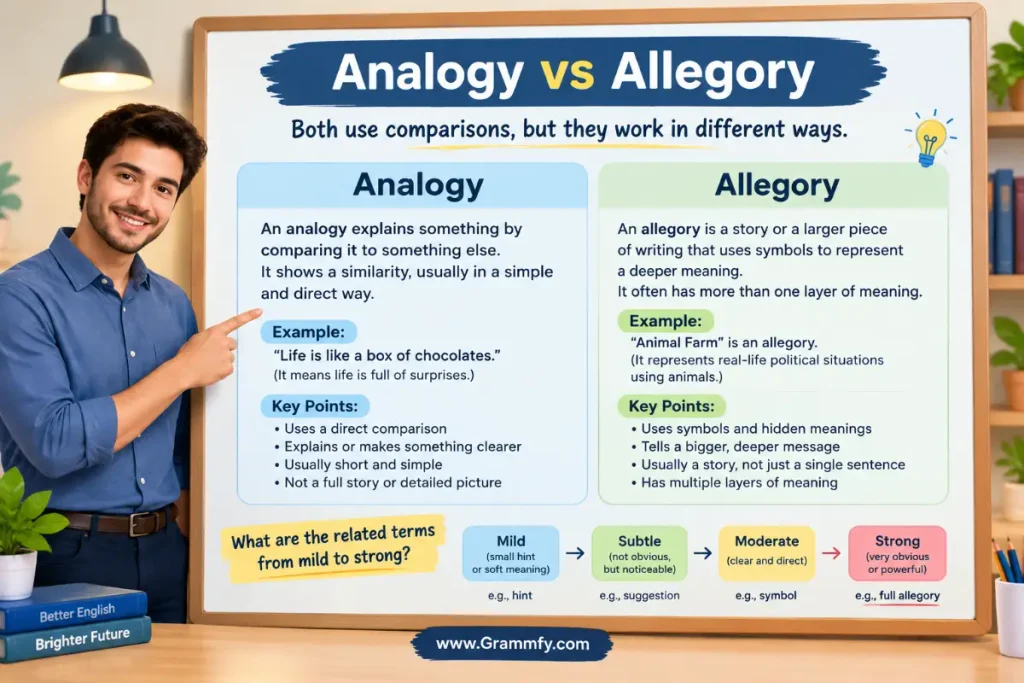
What are the related terms from mild to strong?
The strength of a comparison or symbolic message can vary.
Mild comparison
Words such as similarity, comparison, and parallel usually describe a basic connection.
There’s a similarity between the two situations.
This doesn’t necessarily suggest a deep literary meaning.
Clear explanatory comparison
Analogy is stronger when the comparison is deliberately used to explain an idea.
The writer uses an analogy between a garden and personal growth.
The comparison has a teaching purpose.
Figurative comparison
Simile and metaphor can create vivid comparisons.
- Her smile was like sunshine.
- Her smile was sunshine.
The second example is a metaphor, while the first is a simile.
Extended symbolic meaning
An allegory can carry a much broader meaning because the representation may continue throughout an entire story.
That makes allegory more structurally developed than a simple comparison.
How are analogy, metaphor, simile, and allegory different?
These terms are often mixed together, but they aren’t interchangeable.
| Device | Main function | Typical size | Example |
|---|---|---|---|
| Analogy | Explains through similarity | Sentence to extended explanation | Learning is like building a house. |
| Simile | Creates a comparison | Usually short | The clouds were like cotton. |
| Metaphor | Identifies one thing with another figuratively | Usually short or extended | Time is a thief. |
| Allegory | Represents deeper ideas through a story or extended representation | Often large | A fictional society represents real social problems. |
The key is what the comparison is doing.
A metaphor can be vivid and artistic. An analogy is usually explanatory. An allegory builds a larger symbolic structure.
Analogy vs metaphor — what’s different?
An analogy and metaphor can look similar, but their goals often differ.
Analogy
An analogy usually explains a relationship or idea.
“The immune system is like a security team because it detects and responds to threats”.
The comparison helps explain how the immune system works.
Metaphor
A metaphor can make a statement more vivid.
The city is a sleeping giant.
The goal may be artistic rather than instructional.
A metaphor can be part of an analogy, and an analogy can contain metaphors. The categories can overlap.
Allegory vs symbolism — what’s different?
Symbolism is a technique. Allegory is often a larger structure built from symbolic meaning.
A single object can be symbolic.
For example, a locked door might symbolize an obstacle.
An allegorical story could use many objects, characters, and events together to represent a larger idea.
Think of it this way:
- Symbolism: one or more elements carry additional meaning.
- Allegory: an extended representation uses elements of a story or artwork to communicate another meaning.
Not every symbolic story is necessarily a full allegory.
What are examples of Analogy vs Allegory in real situations?
The easiest way to understand the difference is to see it in action.
Example 1: School
Analogy:
- Studying for an exam is like training for a sport. Regular practice prepares you for the final performance.
This is an analogy because the comparison explains why practice matters.
Allegory:
Imagine a story about students climbing a mountain. Each student chooses a different path, faces different obstacles, and reaches different points. The mountain journey represents personal growth and education.
That could function as an allegory because the story itself carries a deeper meaning.
Example 2: Work
Analogy:
- A good team is like a puzzle. Every person has a different role, but the pieces need to fit together.
This explains teamwork through comparison.
Allegory:
Imagine a fictional company where every department is represented by a different animal. The animals compete for control while the company slowly falls apart. The story could represent problems involving power, cooperation, and leadership.
Example 3: Technology
Analogy:
- A password is like a key. It gives the right person access to something protected.
This makes a technical concept easier to understand.
Allegory:
A science-fiction story might portray a city where citizens carry digital keys that determine what information they are allowed to see. The fictional system could represent real-world questions about privacy, freedom, and control.
Example 4: Personal growth
Analogy:
- Building confidence is like learning to ride a bike. You may feel uncertain at first, but practice makes the process easier.
The comparison explains a personal experience.
Allegory:
A story about a traveler crossing a difficult forest could represent a person’s journey through fear and self-doubt.
Example 5: Writing
Analogy:
- Editing an essay is like cleaning a window. Removing unnecessary words can make the main idea easier to see.
The comparison teaches a writing principle.
Allegory:
A novel might describe a town where every citizen must speak only one approved sentence. The fictional rule could represent restrictions on free expression.
10+ original examples of analogies
Here are practical examples you can use to recognize an analogy:
- A strong introduction is like a doorway: it invites the reader into the rest of the article.
- Your vocabulary is like a toolbox: the more useful words you have, the more precisely you can express an idea.
- Grammar is like a road map: it helps readers understand where each part of a sentence is going.
- A deadline is like a finish line: it gives a project a clear stopping point.
- Memory is like a garden: information needs attention and repetition to stay strong.
- A budget is like a container: once it reaches its limit, you can’t keep adding expenses without making changes.
- A thesis is like an anchor: it keeps an essay focused.
- Good communication is like a bridge: it connects people who may begin on different sides of an issue.
- Learning pronunciation is like learning a rhythm: repeated listening and practice help you recognize the pattern.
- A paragraph is like a small room: every sentence should have a reason to be there.
- Research is like putting together a puzzle: individual facts become more meaningful when they fit together.
- A good example is like a flashlight: it makes an abstract idea easier to see.
Each example uses a comparison to make an idea clearer.
10+ examples of allegorical ideas
Allegory can be harder to identify because the deeper meaning depends on the complete work.
Here are original examples:
- A kingdom where citizens are forbidden to ask questions could represent the dangers of censorship.
- A village where everyone wears the same mask could represent pressure to conform.
- A ship whose captain refuses to change direction despite warnings could represent stubborn leadership.
- A garden that flourishes when everyone shares water could represent cooperation.
- A forest where paths disappear whenever people lie could represent the consequences of dishonesty.
- A city divided by an invisible wall could represent social division.
- A character carrying a heavy stone everywhere could represent guilt.
- A group of birds fighting over one nest could represent competition for power.
- A traveler choosing between a comfortable road and a difficult but honest path could represent moral choices.
- A school where students are never allowed to make mistakes could represent the harm caused by unrealistic expectations.
- A fictional nation that slowly loses its history could represent the importance of cultural memory.
- A clock that controls every person’s daily movement could represent excessive control over individual freedom.
These are examples of allegorical possibilities rather than claims that one fixed interpretation is always correct. Context matters.
Which word should you use in an essay?
Use “analogy” in an essay when you explain an idea through comparison
An analogy works well in explanatory and argumentative writing.
Example:
- The author uses an analogy between a healthy ecosystem and a balanced community.
You can then explain the shared relationship.
Use “allegory” when discussing a work with deeper symbolic meaning
Example:
- The story can be read as an allegory about the struggle between freedom and control.
Here, you’re describing the larger meaning of the story.
Use “metaphor” when discussing figurative language
Example:
- The writer uses a metaphor that describes time as a thief.
Don’t call every metaphor an allegory.
Which word works best on a resume?
A resume rarely needs the word allegory unless you’re applying for a role involving literature, creative writing, art, or cultural analysis.
Analogy may appear in a skills or academic context.
For example:
“Used analogies to explain complex technical concepts to new team members”.
This communicates a practical communication skill.
For a general resume, simpler words such as explained, clarified, communicated, or translated complex ideas may sound more natural.
Which word works best in an email?
In a professional email, analogy is usually more useful than allegory.
For example:
- To put this in simple terms, think of the new process as a checklist.
You don’t even need to use the word “analogy.”
If you do:
- I used an analogy during the presentation to explain the new workflow.
That’s clear and natural.
“Allegory” is uncommon in ordinary business emails because most workplace messages aren’t discussing symbolic narratives.
Which word works best in texting?
Texting usually favors simple language.
Instead of saying: That is an analogy illustrating the situation”.
You might write: “It’s basically like comparing one thing to another”.
If you’re discussing a book or movie, however, allegory can be completely natural: “I think the whole movie is an allegory for growing up”.
The best choice depends on the subject, not just the level of formality.
Which word works best when speaking?
In conversation, analogy is useful when you’re explaining something complicated.
For example:
- Think of your brain like a search engine. The more organized the information is, the easier it is to find.
When discussing literature, you might say: “I think the story works as an allegory about power”.
Both words are natural when used in the right context.
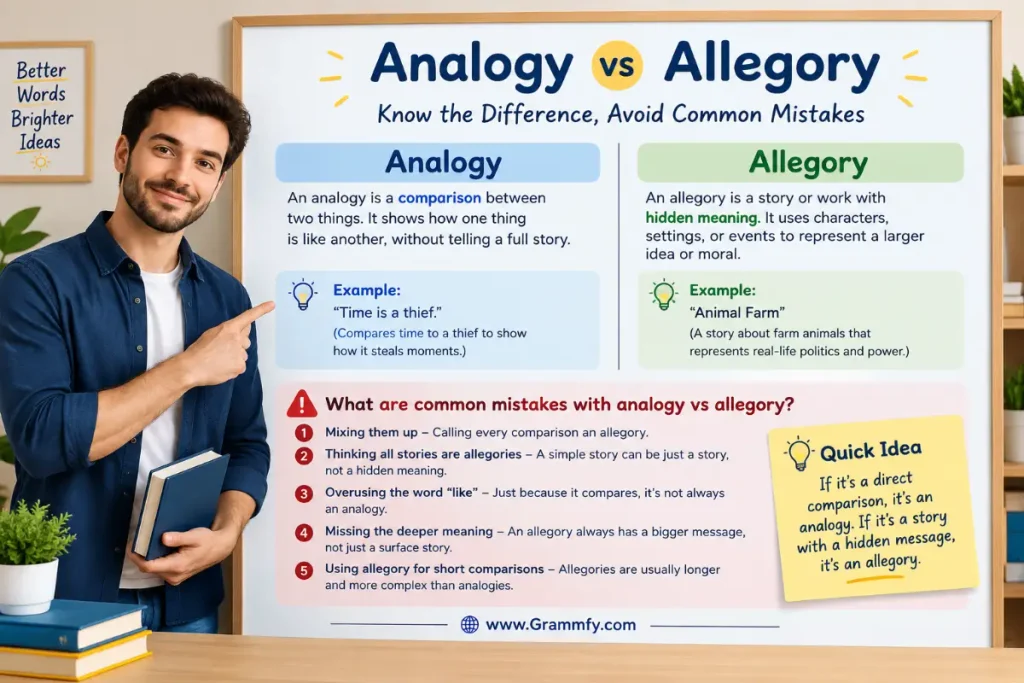
What are common mistakes with analogy vs allegory?
Mistake 1: Treating them as exact synonyms
An analogy and an allegory can both involve comparison or representation, but they’re not the same thing.
Better:
Use analogy for an explanatory comparison.
Use allegory for an extended symbolic representation.
Mistake 2: Calling every symbol an allegory
A single symbol doesn’t automatically create an allegory.
A rose might symbolize love. That alone doesn’t make an entire story an allegory.
Mistake 3: Calling every metaphor an analogy
Metaphor and analogy overlap, but an analogy usually has an explanatory relationship.
- “The classroom was a zoo.”
That’s a metaphor.
- “Managing the classroom is like managing a busy airport because both require organization and clear directions.”
That’s an analogy.
Mistake 4: Assuming every allegory has only one meaning
Literary works can support multiple interpretations.
It’s better to explain the evidence for your interpretation than to claim that every detail has one guaranteed meaning.
Mistake 5: Using “allegory” when you mean “example”
An example simply illustrates a point.
An allegory represents something deeper.
These aren’t interchangeable.
Mistake 6: Making an analogy too complicated
A comparison should clarify rather than create another puzzle.
If your analogy requires five paragraphs to explain, consider whether a direct explanation would work better.
Mistake 7: Forcing a comparison
Not every similarity is useful.
A good analogy highlights a meaningful relationship. A weak analogy focuses on a superficial resemblance.
When should you NOT use an analogy?
Avoid an analogy when precision is more important than explanation.
For example, scientific or legal writing may require exact definitions. A comparison can help a beginner understand the idea, but it shouldn’t replace the technical definition when accuracy matters.
Don’t use an analogy simply to make an argument sound convincing. The comparison needs to be relevant.
For example:
- “Running a company is exactly like playing a video game.”
This may be interesting, but it oversimplifies a complex activity.
A better version would identify the specific similarity: ““Managing a company’s limited resources is somewhat like managing resources in a strategy game.”
Now the comparison is narrower and easier to evaluate.
When should you NOT call something an allegory?
Don’t label a work an allegory simply because you notice a possible symbol.
Ask:
- Does the work have a sustained second level of meaning?
- Do multiple elements support that interpretation?
- Does the interpretation fit the text or artwork?
- Is there evidence for the reading?
- Are you distinguishing interpretation from confirmed authorial intent?
If the answer is mostly no, terms such as symbol, metaphor, theme, or motif may be more accurate.
What are the antonyms of analogy vs allegory?
Neither word has a perfect one-word antonym.
Still, several concepts provide useful contrasts.
Contrasts with analogy
- Literal statement
- Direct explanation
- Exact definition
- Factual description
- Plain statement
An analogy compares. A literal explanation states the information directly.
Contrasts with allegory
- Literal narrative
- Straightforward account
- Direct representation
- Non-symbolic description
- Explicit statement
These aren’t strict dictionary antonyms, but they describe communication without an extended symbolic layer.
How do US and UK English differ here?
There is no major US-versus-UK difference in the basic meanings or spellings of analogy and allegory.
American and British English use both words in essentially the same way.
The main variation you’ll notice is more likely to come from educational style, literary traditions, or individual writing preferences rather than a different definition.
For example:
- The novel is an allegory about power.
This sentence is natural in both American and British English.
Likewise: “The teacher used an analogy to explain the concept”.
The meaning remains the same.
How can you remember the difference between “Analogy vs Allegory” quickly?
Use this three-step test.
Step 1: Is it mainly a comparison?
If yes, analogy is probably the word you want.
- “This process is like a traffic system.”
Step 2: Is it a larger story or representation?
If yes, consider allegory.
- “The entire fictional city represents a society struggling with control.”
Step 3: Are you discussing one symbolic object?
You may actually need symbol or symbolism.
- “The broken chain symbolizes freedom.”
This three-part test prevents many common errors.
Analogy vs Allegory: a quick side-by-side guide
| Question | Analogy | Allegory |
|---|---|---|
| Is it a comparison? | Usually | Sometimes, indirectly |
| Is it usually explanatory? | Yes | Not necessarily |
| Does it usually involve a story? | No | Often |
| Can it be one sentence? | Yes | Usually less likely |
| Can it contain symbolism? | Sometimes | Commonly |
| Does it have a deeper second meaning? | Not necessarily | Usually |
| Is it common in teaching? | Very common | Less common |
| Is it common in literary analysis? | Yes | Very common |
| Does context matter? | Yes | Very strongly |
| Main question | “What is this like?” | “What does this represent?” |
Quick tips for choosing the right word
- Choose analogy when you’re explaining something unfamiliar through something familiar.
- Choose allegory when a story or representation carries a deeper meaning.
- Choose metaphor for a figurative comparison.
- Choose simile when the comparison uses “like” or “as.”
- Choose symbol for an object, image, or element representing another idea.
- Choose symbolism when discussing the use of symbols as a technique.
- Choose parable for a short teaching story, especially one designed to communicate a moral or spiritual lesson.
- Choose fable for a short instructional story, often involving animals.
- Choose example when something simply demonstrates an idea.
- Don’t use a complicated literary term when a simple word communicates the idea better.
A simple decision chart
Are you explaining an idea by comparing it with something familiar?
→ Use analogy.
Are you analyzing a story whose characters and events represent deeper ideas?
→ Consider allegory.
Are you discussing one object that represents an idea?
→ Use symbol or symbolism.
Are you comparing something using “like” or “as”?
→ Consider simile.
Are you describing one thing as another for figurative effect?
→ Consider metaphor.
Are you discussing a short story with a lesson?
→ Consider parable or fable, depending on the work.
Why does the difference matter in academic writing?
Using the right term makes your analysis more precise.
Imagine you’re writing about a novel. You say: “The author uses an analogy about freedom.”
Your reader may expect a comparison that explains freedom.
But if the entire story represents a struggle between freedom and control, allegory may be the more appropriate term.
Similarly, saying: “The door is an allegory for freedom”
may be too broad if only one door carries the symbolic meaning. In that case, symbol may be more precise.
Good academic writing isn’t about choosing the most complicated word. It’s about choosing the word that accurately describes what the text is doing.
How can writers use analogy effectively?
A strong analogy should be relevant, clear, and limited.
Keep the shared feature obvious
If readers have to guess why two things are being compared, the analogy may not help.
Weak:
- A computer is like a forest.
There isn’t enough information.
Stronger: A computer’s file system is like a library because both organize information so people can find what they need.
Now the shared feature is clear.
Don’t stretch the analogy too far
Every analogy has limits.
A computer isn’t actually a library. The comparison only helps explain organization.
Good writers make that boundary clear when necessary.
Choose familiar comparisons
If you’re explaining a technical concept to beginners, compare it with something they already understand.
The more familiar the comparison, the less mental effort the reader needs.
How can writers use allegory effectively?
An allegory works best when the deeper meaning is supported by the whole structure.
Writers can use:
- Characters
- Settings
- Conflicts
- Objects
- Journeys
- Rules
- Repeated events
- Names
- Outcomes
The elements can work together to create a second layer of meaning.
However, writers don’t always need to explain every symbol. Sometimes allowing readers to interpret the story is part of the artistic experience.
Can one work contain both an analogy and an allegory?
Yes.
A story can function as an allegory while also containing individual analogies.
For example, an allegorical novel might include a conversation where one character explains a complicated idea through an analogy.
The two devices aren’t mutually exclusive.
Think of them as tools that can operate at different levels:
- Analogy: often works at the explanation level.
- Allegory: often works at the whole-story or representation level.
Conclusion
Understanding Analogy vs Allegory becomes much easier when you focus on what each device is designed to do. An analogy compares two things to make an idea clearer. It often appears in teaching, essays, conversations, presentations, and explanations. An allegory works on a broader level, using a story, character, event, object, or artwork to represent a deeper idea.
The two can overlap with other literary devices such as metaphor, simile, symbolism, parable, and fable, but they aren’t interchangeable. When you’re unsure, ask one simple question: Am I using a comparison to explain something, or am I interpreting a larger representation with a deeper meaning? That distinction will usually point you toward the right term.
Frequently Asked Questions
What is the difference between analogy and allegory?
An analogy compares two things to explain an idea, while an allegory uses a story or extended representation to communicate a deeper meaning.
Is an allegory a type of analogy?
Not exactly. An allegory and an analogy can both involve comparison, but an allegory usually operates through an extended symbolic story or representation.
Can a metaphor be an analogy?
Yes, a metaphor can be part of an analogy, but the terms aren’t identical. An analogy usually develops a useful relationship or comparison for explanation.
What’s another way to say analogy?
Depending on context, you can use words such as comparison, parallel, illustration, or correspondence. The best choice depends on whether you’re explaining, describing, or analyzing a relationship.
Is an allegory the same as symbolism?
No. Symbolism is the use of symbols to communicate additional meaning, while an allegory is often a larger narrative or representation built around deeper symbolic meaning.
How do I use analogy in a sentence?
You can say, “The teacher used an analogy to explain how the system works.” The word refers to the comparison used to make the idea clearer.
Is Analogy vs Allegory important for an essay?
Yes, especially in literary or academic writing. Choosing the correct term helps you accurately explain whether you’re discussing a comparison, a symbol, or a larger symbolic narrative.

Tylerbrooks is a US-based English grammar writer and contributor at Grammfy. He writes helpful articles about grammar, spelling, commonly confused words, and vocabulary. His goal is to explain English topics in simple language with clear examples and practical tips. Through his articles, he helps readers improve their writing and everyday English skills.