

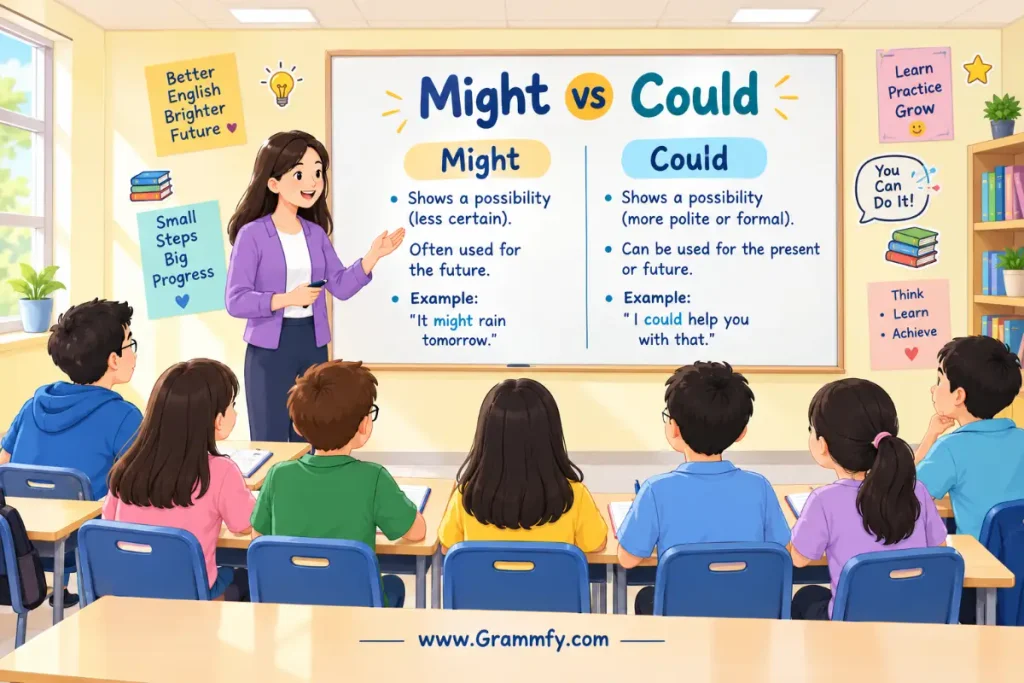
You’re writing a text, email, essay, or work message, and you pause over one sentence: “It ___ rain later.” Should you use might vs could? Both words can talk about possibility, so choosing the right one can feel confusing.
The good news is that the difference is easier than it first appears. Might often presents something as a possible outcome with a sense of uncertainty. Could can also express possibility, but it has several other jobs, including talking about ability, conditions, and possible choices.
Answer box: Use might when you want to show that something is possible but uncertain. Use could for possibility too, but also for past ability, conditional situations, and possible options.
This guide explains their meanings, origins, strength, grammar, common contexts, synonyms, mistakes, and real-life examples. By the end, you’ll know which modal verb fits your sentence and why.
For more examples of correct grammar, check out might or would.

What does Might mean in simple English?
Might is a modal verb that usually shows possibility. It tells the reader that something is possible, but the speaker isn’t certain that it will happen.
For example:
- It might rain tonight.
- Sarah might join us later.
- I might order pizza for dinner.
- The package might arrive tomorrow.
In each sentence, the event is possible. However, the speaker doesn’t present it as a sure thing.
Compare these:
- It will rain tonight. → The speaker expects it to happen.
- It may rain tonight. → Rain is possible.
- It might rain tonight. → Rain is possible, with a cautious or uncertain tone.
Might can also appear when someone is making a suggestion or talking about a possibility in a polite way:
- You might want to check your email.
- You might find this book helpful.
- We might try the new restaurant.
Here, might doesn’t simply mean “maybe.” It can soften advice or make a suggestion sound less direct.
What does Could mean in simple English?
Could has several meanings, which is why it can be more flexible than might.
One important use is possibility:
- It could rain tonight.
- The answer could be correct.
- We could arrive before noon.
Here, could means that the situation is possible.
But could can also describe ability, especially ability in the past:
- When I was younger, I could run five miles.
- She could read when she was four.
- We could see the mountains from our house.
It can also describe a conditional possibility:
- We could go to the beach if the weather improves.
- You could save money by cooking at home.
- He could win if he practices more.
Finally, could can suggest an option:
- We could watch a movie.
- You could call him tomorrow.
- They could take the train instead.
So, when you see could, don’t automatically replace it with might. Look at what the sentence is trying to express.
Might vs Could: What is the main difference?
The simplest distinction is this:
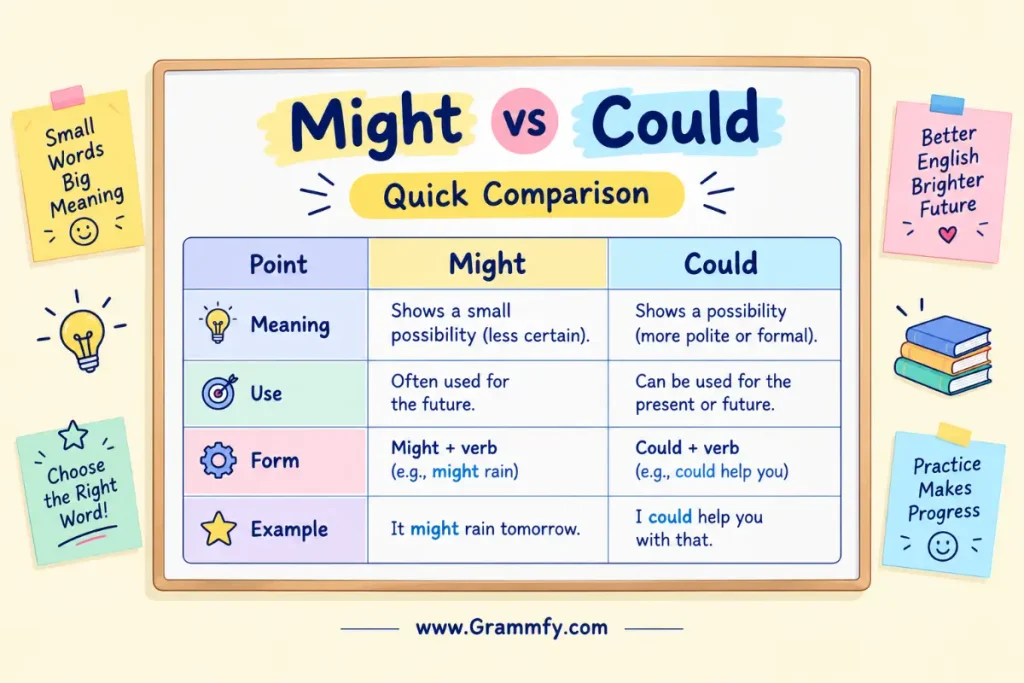
| Word | Main idea | Common uses |
|---|---|---|
| Might | Something is possible but uncertain | Possibility, cautious suggestions |
| Could | Something is possible, available, or possible under certain conditions | Possibility, ability, options, conditionals |
When both words express possibility, they can often be used in the same sentence.
For example:
- It might snow tomorrow.
- It could snow tomorrow.
Both sentences say snow is possible.
However, the speaker may create a slightly different impression.
Might often focuses on uncertainty:
It might snow tomorrow.
The speaker isn’t sure.
Could often focuses on possibility:
It could snow tomorrow.
Snow is one possible outcome.
The difference is not always a strict percentage of certainty. Native speakers don’t normally calculate possibility as exact numbers. Context, tone, and the rest of the sentence matter.
Why do Might vs Could have these meanings?
Understanding where these words came from can make their modern uses easier to remember.
Where did might come from?
Might developed from an older form related to may. Historically, it was associated with the past form of may. Over time, English speakers also used it to express a weaker or more uncertain possibility.
That is why you may notice a connection between:
- may → might
- can → could
- will → would
- shall → should
These relationships come from older patterns in English grammar. Modern English, however, does not always use these pairs as simple past forms.
For example:
He may come.
does not simply become:
He might come.
because you moved the sentence into the past. Might has developed its own uses for present and future possibility.
Where did could come from?
Could developed from the older past form of can. Its original connection to ability is still easy to see:
I can swim.
Past:
I could swim when I was five.
But could later developed other functions, including polite requests, conditional situations, and possibility.
That explains why one small word can appear in very different sentences:
- I could swim at age six. → past ability
- I could help you. → possible action
- It could rain. → possibility
- Could you help me? → polite request
The history explains the connection, but context tells you which meaning is active today.
What are the main meanings of Might?
Might has fewer major jobs than could, but its uses are still important.
Might for present possibility
Use might when something is possible now or around the present time.
- He might be at home.
- She might know the answer.
- They might be busy.
The speaker isn’t certain.
Might for future possibility
This is one of its most common uses.
- We might travel next month.
- I might buy a new laptop.
- The meeting might finish early.
The event could happen, but there is no guarantee.
Might for cautious suggestions
Might can make advice softer.
- You might want to save a copy.
- You might try restarting the computer.
- You might want to read the instructions first.
This doesn’t necessarily mean the action is uncertain. The word makes the suggestion less forceful.
Might in reported speech
Might can also appear when reporting what someone thought was possible.
- She said she might visit us.
- He told me he might be late.
- They said they might cancel the meeting.
What are the main meanings of Could?
- Could has a much wider range of meanings.
- Could for possibility
- This could be the right answer.
- The problem could get worse.
- We could finish today.
- Could for past ability
- I could ride a bike at age five.
- He could speak French as a child.
- She could run very fast in high school.
- Could for conditional situations
- We could go if you want.
- I could help if I had more time.
- They could win if they play well.
- Could for suggestions
- You could ask your teacher.
- We could meet after work.
- She could try another approach.
- Could for polite requests
- Could you open the window?
- Could you send me the file?
- Could I borrow your pen?
This is an important difference. Might normally cannot replace could in these polite request patterns.
What are the best synonyms for Might vs Could?
There isn’t one perfect synonym for every use of a modal verb. The best replacement depends on the meaning and tone.
The table below groups useful alternatives and related expressions.
| Word or phrase | Meaning | Tone | Example |
|---|---|---|---|
| maybe | Possible | Everyday | Maybe she’ll come. |
| perhaps | Possible | Neutral/Formal | Perhaps he’ll call. |
| possibly | May happen | Neutral/Formal | She will possibly join us. |
| potentially | Has possible potential | Formal | The plan could potentially work. |
| conceivably | Could reasonably happen | Formal | It could conceivably happen. |
| likely | Probably true | Neutral | He’s likely to arrive soon. |
| probably | More likely than not | Everyday | She’ll probably come. |
| perhaps | Maybe | Neutral | Perhaps we should wait. |
| may | Possible | Neutral/Formal | It may rain. |
| might | Possible, uncertain | Neutral | It might rain. |
| could | Possible | Neutral | It could rain. |
| can | Possible in some situations | Neutral | Mistakes can happen. |
| possibly could | Possible action | Neutral | We possibly could finish today. |
| be able to | Have ability | Neutral | She will be able to help. |
| be capable of | Have ability | Formal | He is capable of doing it. |
| be in a position to | Have the opportunity/ability | Formal | We may be in a position to help. |
| have the option to | Have a choice | Neutral | You have the option to cancel. |
| have the chance to | Have an opportunity | Everyday | We have a chance to win. |
| have the possibility of | Something can happen | Formal | There is a possibility of rain. |
| be possible | Can happen | Neutral | It is possible. |
| be feasible | Can realistically be done | Formal | The plan is feasible. |
| be plausible | Seem reasonably possible | Formal | Her explanation is plausible. |
Some of these expressions are true synonyms only in particular contexts. For example, be able to can replace could when could means ability, but not when could means possibility.
Which alternatives show weak versus strong possibility?
The strength of a possibility can change depending on the word you choose.
A useful general scale is:
unlikely → might → may → could → likely → probably → almost certain
However, this isn’t a strict grammar rule. Could does not always mean that something is more likely than might.
For example:
It might rain.
This sounds uncertain.
It could rain.
This also sounds uncertain.
But:
It will probably rain.
This suggests a stronger expectation.
And:
It will rain.
This presents the event as certain or expected.
Mild possibility
Useful choices include:
- might
- may
- perhaps
- maybe
- possibly
Examples:
- She might call.
- Maybe he’ll come.
- Perhaps they’re busy.
- It is possibly the right answer.
Moderate possibility
Useful choices include:
- could
- may well
- likely
- have a chance
Examples:
- This could work.
- She may well agree.
- He is likely to win.
- We have a chance.
Stronger expectation
Useful choices include:
- probably
- very likely
- almost certainly
- is expected to
Examples:
- She’ll probably arrive soon.
- They’re very likely to accept.
- He’ll almost certainly notice.
- The price is expected to rise.
The key lesson is that might and could should not be treated as fixed points on a certainty scale.
How do Might vs Could differ by part of speech?
Might and could are both modal auxiliary verbs. They don’t behave like ordinary verbs.
They normally come before the base form of another verb:
- might go
- might rain
- could help
- could work
Not:
- might goes
- could helps
- might went
- could worked
Correct modal structure
Use:
subject + modal + base verb
Examples:
- She might come.
- He could help.
- They might leave.
- We could finish.
Negative forms
The negative forms are:
- might not
- couldn’t
Examples:
- She might not come.
- It might not work.
- He couldn’t swim.
- We couldn’t find the address.
Be careful with couldn’t. It normally means inability or impossibility, not simply the opposite of every use of could.
Might vs Could in a resume: Which one works best?
A resume usually describes skills, experience, achievements, and responsibilities. Could is often useful when describing past ability, but both words may be wrong if you are trying to state a definite skill.
Weak:
I might manage customer complaints.
This sounds uncertain about your own ability.
Better:
I can manage customer complaints professionally.
For past ability:
I could handle customer complaints independently.
But a resume often sounds stronger when you give a specific achievement:
Managed customer complaints and resolved more than 50 cases each month.
Use modal verbs carefully on a resume. If you actually have the skill, don’t make yourself sound unsure.
Might vs Could in an essay: Which one should you use?
Academic writing often needs careful claims rather than absolute statements.
Might can work well when you want to present an uncertain explanation:
The decline might be related to changes in consumer behavior.
Could is also useful when discussing possible causes or outcomes:
Changes in consumer behavior could explain the decline.
The second sentence presents the explanation as one possible cause.
For formal essays, also consider:
- may
- possibly
- potentially
- could
- might
- is likely to
Example:
Poor sleep may affect concentration.
Another:
Poor sleep could affect concentration.
Another:
Poor sleep might affect concentration.
All three can be grammatical. Your choice depends on the exact level of caution and the surrounding evidence.
Might vs Could in texting: Which sounds natural?
In texting, both are common.
Use might when you’re unsure about what will happen:
I might be late.
Use could when discussing an option:
We could meet at 7.
You can also use both in casual conversation:
It might rain, so we could stay home.
This is a useful example because each modal has a different job.
Might describes the uncertain weather.
Could describes an available option.
Might vs Could in an email: Which is more polite?
Both can make communication softer, but they are used differently.
- For suggestions:
You might want to review the attached document.
- For possible actions:
We could schedule another meeting.
- For polite requests:
Could you send me the updated file?
Notice that could is especially useful for polite requests.
You would not normally write:
Might you send me the file?
That construction exists, but it sounds unusually formal or old-fashioned in modern everyday American English.
Might vs Could in speaking: Which sounds more natural?
Both are very common in spoken English.
- Use might for uncertainty:
I might go out tonight.
- Use could for options:
We could go to the mall instead.
- Use could for past ability:
I could swim when I was six.
Native speakers choose between them based on the meaning they want, not simply because one is “more correct.”
What are some real-life examples of Might vs Could?
Here are examples from everyday situations.
Weather
It might rain this afternoon.
You aren’t sure whether rain will happen.
It could rain this afternoon.
Rain is one possible outcome.
Travel
We might travel to Chicago this summer.
The plan is uncertain.
We could take the train instead of driving.
The train is an available option.
Work
The manager might approve the request.
Approval is uncertain.
The manager could approve the request if we provide more details.
Approval is a conditional possibility.
School
Emma might miss class tomorrow.
You don’t know whether she will attend.
Emma could ask the teacher for extra help.
Asking the teacher is one possible action.
Health and habits
Drinking more water might help.
This presents the result cautiously.
Regular exercise could improve your energy levels.
This presents an outcome as a possibility.
Technology
The update might fix the problem.
You aren’t sure.
The update could fix the problem, but we need to test it.
The fix is one possible result.
Family plans
Dad might cook dinner tonight.
You’re uncertain about his plan.
We could order dinner instead.
Ordering is an alternative.
Money
The price might increase next month.
The increase is uncertain.
You could save money by buying the annual plan.
This gives a possible way to save.
Sports
Our team might win tonight.
The result is uncertain.
Our team could win if we play well.
The sentence connects the possibility to a condition.
Everyday decisions
I might buy those shoes.
You haven’t decided.
I could buy them online.
Buying online is an option.
might vs could: What’s different when both mean possibility?
The distinction becomes clearer when you put the words side by side.
| Sentence | Main focus |
|---|---|
| It might snow. | The speaker is uncertain about snow. |
| It could snow. | Snow is one possible outcome. |
| She might come. | Her arrival is uncertain. |
| She could come. | Her arrival is possible. |
| We might stay home. | We haven’t decided. |
| We could stay home. | Staying home is one option. |
In many situations, both are correct.
The difference is often about what the speaker is emphasizing.
Might frequently sounds more tentative.
Could frequently highlights possibility, opportunity, or an alternative.
Don’t turn this into a rigid rule such as “might always means less likely than could.” Real English is more flexible.
Might vs may: What’s the difference?
May and might are closely related. Both can express possibility.
Compare:
She may come tonight.
She might come tonight.
Both mean that her arrival is possible.
Might often sounds more tentative or cautious:
The plan might work.
May can sound slightly more formal:
The results may vary.
There is also a major difference in everyday permission.
May I leave early?
This is a traditional polite request for permission.
Might is not normally used this way in everyday American English.
Could vs can: What’s the difference?
Can commonly expresses present ability or general possibility.
I can swim.
Accidents can happen.
Could can express past ability:
I could swim when I was five.
It can also express a more tentative possibility:
It could happen.
And it can introduce an option:
We could leave early.
So could has meanings that can does not always share in the same way.
Could vs would: Why aren’t they interchangeable?
These two words often appear in conditional sentences, but they perform different jobs.
Could usually describes possibility or ability:
If I had more time, I could help.
This means helping would be possible.
Would usually describes the expected or imagined result:
If I had more time, I would help.
This means helping is the result I would choose or expect.
Compare:
If we left now, we could arrive before noon.
Possible result.
If we left now, we would arrive before noon.
Expected result.
The difference is subtle but important.

What are common mistakes with Might vs Could?
Mistake 1: Treating might as the past of may every time
It’s true that might has a historical connection to may, but modern usage is more flexible.
Incorrect thinking:
“Might always means that something happened in the past.”
It doesn’t.
Correct:
She might come tomorrow.
This sentence refers to the future.
Mistake 2: Thinking could always means past ability
Could can describe past ability:
I could read at age four.
But it can also express present or future possibility:
It could rain tomorrow.
And it can suggest an option:
We could take a taxi.
Mistake 3: Using could when you mean certainty
He could be at home.
This means being at home is possible.
If you are certain:
He is at home.
Don’t use a modal of possibility when your meaning is definite.
Mistake 4: Using might for a definite plan
I might attend the meeting tomorrow.
This says your attendance is uncertain.
If you’ve already decided:
I will attend the meeting tomorrow.
Mistake 5: Adding “to” after the modal
Modal verbs take the base form without to.
Wrong:
She might to come.
Correct:
She might come.
Wrong:
We could to leave.
Correct:
We could leave.
Mistake 6: Adding -s to the main verb
Wrong:
He might goes home.
Correct:
He might go home.
Wrong:
She could helps us.
Correct:
She could help us.
Mistake 7: Using could for every possible situation
Could is flexible, but it isn’t always the best choice.
For example:
You might want to check your work.
This sounds like a gentle suggestion.
You could check your work.
This sounds more like one option.
Both can work, but the tone changes.
Mistake 8: Assuming might and could have exact certainty levels
English doesn’t work like a mathematical probability chart.
Don’t assume:
might = 20%
could = 50%
Speakers don’t use these words that mechanically. Context changes the meaning.
When should you not use might?
Avoid might when you need to express definite ability.
Weak:
I might speak Spanish.
If you mean that you have the skill:
I can speak Spanish.
Avoid it when the event is certain:
The train will arrive at 8:00.
Not:
The train might arrive at 8:00.
unless the arrival time is genuinely uncertain.
Also avoid might when you are asking for a normal polite request. In most modern American English, could is much more natural:
Could you help me?
When should you not use could?
Don’t use could when you specifically mean that something is certain.
She could be the winner.
This means she is a possible winner.
If she has already won:
She is the winner.
Also be careful when describing ability.
I could drive.
Depending on context, this can mean past ability or a possible action. If you mean present ability, can is usually clearer:
I can drive.
What are the antonyms of Might vs Could?
Because might and could can have several meanings, their opposites depend on context.
For possibility, useful contrasting expressions include:
- certainly
- definitely
- surely
- undoubtedly
- must
- will
- cannot
- can’t
- impossible
Examples:
She might be home.
She is definitely home.
It could happen.
It cannot happen.
But remember that couldn’t can have more than one meaning:
I couldn’t swim.
This can mean lack of ability.
That couldn’t be true.
This can mean impossibility.
What are 20+ useful expressions related to possibility?
If you’re writing an essay, article, email, or report, you don’t need to repeat might and could constantly. You can vary your language.
Here are useful expressions:
- may
- might
- could
- perhaps
- maybe
- possibly
- potentially
- conceivably
- likely
- probably
- very likely
- may well
- is likely to
- is possible
- is possible that
- there is a chance
- there is a possibility
- have a chance
- stand a chance
- have the potential to
- have the option to
- have the opportunity to
- be able to
- be capable of
- be in a position to
- be feasible
- be plausible
- be an option
- be a possibility
- have a shot at
These aren’t interchangeable in every sentence. Choose the expression based on whether you’re talking about uncertainty, ability, opportunity, or probability.
How can you choose the right word quickly?
Use this simple decision process.
Step 1: Are you talking about uncertainty?
If yes, consider might.
I might go.
You aren’t sure.
Step 2: Are you talking about possibility?
If yes, might or could may work.
It might rain.
It could rain.
Both are possible.
Step 3: Are you talking about an option?
Use could.
We could take the bus.
You’re presenting an alternative.
Step 4: Are you talking about past ability?
Use could.
I could swim when I was six.
Step 5: Are you making a conditional statement?
Could often works well.
We could finish early if everyone helps.
Step 6: Are you making a cautious suggestion?
Might can sound natural.
You might want to check that number.
Step 7: Are you asking for help politely?
Use could.
Could you help me?
This is one of the easiest ways to separate their uses.
Quick comparison chart
| Situation | Best choice | Example |
|---|---|---|
| Uncertain future event | Might | I might go tomorrow. |
| Possible event | Might/Could | It might/could rain. |
| Possible option | Could | We could take a taxi. |
| Past ability | Could | I could swim at six. |
| Conditional possibility | Could | We could win if we practice. |
| Gentle suggestion | Might | You might try again. |
| Polite request | Could | Could you help me? |
| Definite future | Will | I will call tomorrow. |
| Present ability | Can | I can help. |
| Strong probability | Probably | She’ll probably come. |
Can Might vs Could appear together?
Yes, they can appear in the same sentence when they have different functions.
For example:
It might rain, so we could stay inside.
Here, might describes an uncertain possibility. Could presents a possible response.
Another example:
She might be busy, so we could email her instead.
Again, the two words aren’t competing. They are doing different jobs.
This is a useful way to understand modal verbs: don’t compare the words in isolation. Compare the meaning each word creates in the sentence.
Can Might vs Could be used with passive voice?
Yes.
With might:
The package might be delivered tomorrow.
With could:
The package could be delivered tomorrow.
The structure is:
modal + be + past participle
Examples:
- might be delayed
- might be canceled
- could be improved
- could be changed
These forms are common in business, academic, and professional writing.
Can Might vs Could be used with perfect forms?
Yes. Both can appear before have + past participle when discussing possible past situations.
With might:
She might have forgotten the appointment.
This means forgetting is one possible explanation.
With could:
She could have forgotten the appointment.
This also presents forgetting as a possible explanation.
But could have can also mean that something was possible but did not happen:
We could have won the game.
This can suggest that winning was possible, but the team didn’t win.
That extra meaning is another reason could is more flexible than might.
What does “might have” mean?
Might have + past participle usually describes a possible past event.
Examples:
- He might have missed the bus.
- She might have left already.
- They might have misunderstood the instructions.
You are making a guess about something in the past.
What does “could have” mean?
Could have + past participle can express either past possibility or an unrealized possibility.
For past possibility:
He could have taken the wrong road.
This suggests that taking the wrong road is one possible explanation.
For an unrealized opportunity:
You could have called me.
This can mean calling was possible, but you didn’t do it.
That second meaning can carry criticism or regret depending on tone.
Which word sounds more cautious?
Might often sounds more cautious, especially when you’re making a prediction or suggestion.
Compare:
This might solve the problem.
This could solve the problem.
Both are cautious. The first can sound more tentative. The second often sounds like you’re identifying one possible solution.
Still, don’t treat this as an absolute rule. In natural English, could can also sound highly uncertain.
Which word is more useful for choices?
Could is usually better when you’re presenting choices or alternatives.
For example:
We could eat at home.
We could order takeout.
We could go to a restaurant.
The speaker is listing possible choices.
Using might changes the focus:
We might eat at home.
This suggests the speaker isn’t sure what will happen.
So remember:
could = possible option
might = uncertain possibility
This simple contrast works well in many everyday situations.
Which word should English learners remember first?
If you’re learning English, remember the core meanings instead of trying to memorize every rule.
Remember might
Think:
“Maybe this will happen.”
Examples:
I might go.
She might call.
It might rain.
Remember could
Think:
“This is possible, available, or was possible.”
Examples:
It could rain.
We could leave early.
I could swim when I was six.
Could you help me?
Once you know these core ideas, the more advanced uses become easier.
Conclusion
The main lesson in might vs could is that both words can express possibility, but they don’t have exactly the same range of uses. Might is especially useful when you want to show uncertainty or make a cautious suggestion. Could is more flexible and can describe possibility, past ability, choices, conditional outcomes, and polite requests.
When you’re unsure, look at the purpose of the sentence. If you’re saying “maybe this will happen,” might is often a natural choice. If you’re presenting an option, describing what was possible, or asking someone politely to do something, could is usually better. With practice, these small differences become much easier to notice and use naturally.
Frequently Asked Questions
What is the difference between might and could?
Might usually emphasizes uncertain possibility, while could can express possibility, ability, conditional situations, and options. When both express possibility, they can often be used interchangeably with a slight change in focus or tone.
Is might weaker than could?
Might often sounds more tentative, but could isn’t automatically stronger. Both words can describe uncertain possibilities, and context determines how strong the possibility sounds.
Can I say “it might happen” and “it could happen”?
Yes, both are correct. It might happen emphasizes uncertainty, while it could happen presents the event as one possible outcome.
Can I use could for past ability?
Yes. Could commonly describes general ability in the past, such as “I could swim when I was six.” For a specific successful event in the past, English often uses was able to instead.
What’s another way to say “might”?
Common alternatives include may, perhaps, maybe, possibly, and could, depending on the sentence. For example, “She might come” can become “Perhaps she’ll come.”
Is could more polite than can?
Could is often more polite or less direct than can when making a request. “Could you help me?” usually sounds softer than “Can you help me?”
How do I know whether to use might or could?
Ask what you mean first. Use might when the main idea is uncertainty, and consider could when you’re describing a possibility, option, past ability, or conditional result.
