

When you’re writing an email, answering a teacher’s question, or sending a quick text, you may stop and wonder whether to write may vs can. Both words are common modal verbs, and both can talk about possibility or permission. But they don’t always mean the same thing.
The easiest rule is this: can usually focuses on ability, while may usually focuses on permission or possibility. For example, “I can swim” means I have the ability to swim. “May I leave?” asks for permission.
Answer Box: Can usually expresses ability or possibility, while may commonly expresses permission or possibility. In modern American English, can is also widely used for informal permission.
The difference becomes clearer when you look at the situation, the level of formality, and what you want to say. This guide explains their meanings, history, synonyms, common mistakes, regional differences, and the best choice for texts, emails, essays, resumes, and everyday speech.
Looking for another easy grammar explanation? See [might or could].
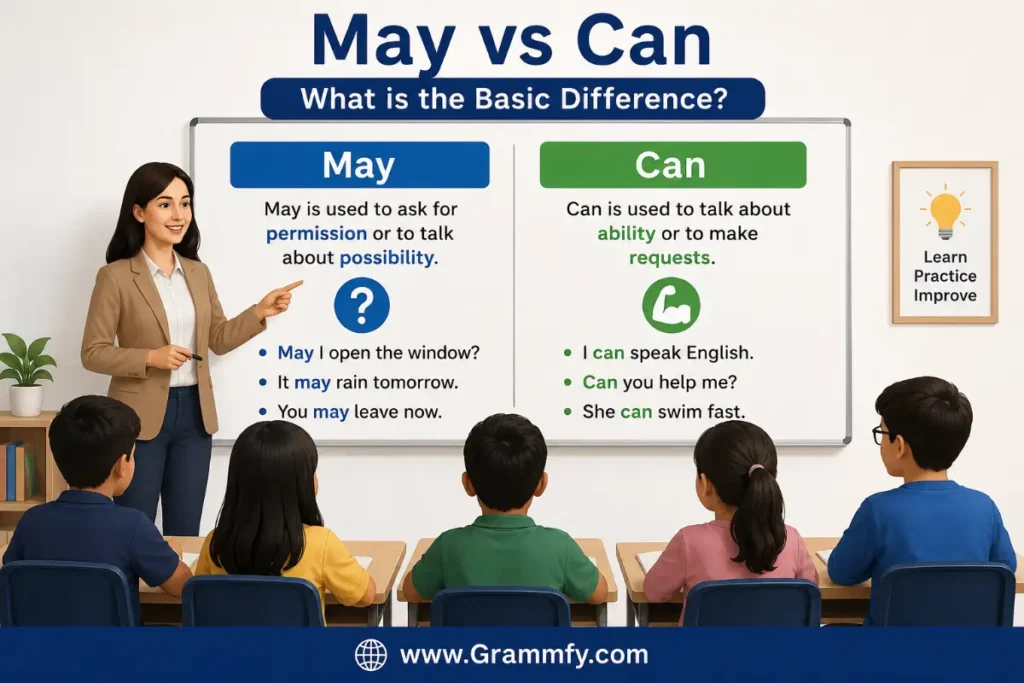
What is the basic difference between May vs Can?
The main difference is the idea behind each modal verb.
Can most often means that someone has the ability or opportunity to do something. It can also describe something that is possible or give permission in casual English.
May most often expresses permission or possibility. It sounds more formal than can when asking for permission.
| Word | Main meaning | Example |
|---|---|---|
| can | Ability | I can drive. |
| can | Possibility | It can get very cold here. |
| can | Informal permission | You can use my laptop. |
| may | Permission | May I ask a question? |
| may | Possibility | It may rain tonight. |
| may | Formal or polite permission | You may begin the test. |
Compare these sentences:
- I can speak Spanish. → I have the ability.
- I may speak Spanish at the meeting. → It is possible that I will speak Spanish.
- May I speak Spanish at the meeting? → I am asking for permission.
- You can speak Spanish here. → You have permission or are allowed to do so.
So, context matters.
When should you use can?
Use can when you’re talking about ability, general possibility, or informal permission.
Can for ability
This is one of the most common uses.
- I can swim.
- She can solve difficult problems.
- We can finish the project today.
- My brother can play the guitar.
- They can speak three languages.
Here, can means “be able to.”
A useful test is to replace can with be able to.
I can drive.
I am able to drive.
The meaning stays almost the same.
Can for general possibility
Can can describe something that is possible in general.
- Winters can be harsh in this area.
- Learning a new language can take time.
- Mistakes can happen.
- Too much screen time can cause problems.
- This road can become crowded after 5 p.m.
These sentences aren’t usually predicting one specific event. They describe what can happen under certain conditions.
Can for informal permission
In everyday American English, can is normal when giving or asking for permission.
- Can I borrow your pen?
- Can I sit here?
- You can use my charger.
- Can we leave early?
- You can take a break now.
This usage is completely natural in casual conversation.
When should you use may?
Use may mainly for permission and possibility.
May for permission
May is traditionally associated with permission.
- May I come in?
- May I ask a question?
- May I use your phone?
- You may leave now.
- Students may use calculators during this section.
This use is especially common in formal situations.
For example, a teacher might say:
You may begin the exam.
A customer might ask:
May I speak with the manager?
The sentences sound polite and formal.
May for possibility
May can also mean that something is possible.
- It may rain this afternoon.
- She may arrive late.
- We may visit Chicago next month.
- The package may arrive tomorrow.
- He may know the answer.
Here, may doesn’t mean permission. It means “perhaps” or “possibly.”
Compare:
She may come to the party.
This means it is possible that she will come.
May she come to the party?
This asks whether she has permission to come.
The word stays the same, but the sentence structure and context change the meaning.
Where did May vs Can come from?
Understanding the history of these words can make their modern meanings easier to remember.
The origin of can
Can comes from Old English cunnan, which meant “to know,” “to know how,” or “to be able.”
Over time, the idea of knowing how to do something became closely connected with having the ability to do it.
That is why can still commonly expresses ability:
I can cook.
The older idea is similar to:
I know how to cook.
The modern verb developed beyond ability and eventually became useful for possibility and permission too.
The origin of may
May comes from Old English magan, a verb connected with having power, strength, or ability.
Over time, its meaning developed toward possibility and permission.
This explains why may has several related uses today:
- possibility: It may happen.
- permission: You may enter.
- formal permission: May I leave?
The meanings have changed over centuries, but their connection to possibility and authority remains visible.
May vs Can: which one is more formal?
May is generally more formal when you’re talking about permission.
Compare:
| Casual | More formal |
|---|---|
| Can I come in? | May I come in? |
| Can I ask a question? | May I ask a question? |
| Can we leave now? | May we leave now? |
| You can begin. | You may begin. |
However, formal doesn’t always mean better.
If you’re texting a friend, Can I come over? sounds natural.
If you’re speaking to a teacher, customer, official, or someone in a formal setting, May I come in? may sound more respectful.
Modern American English accepts can for permission in most everyday situations.
Is it wrong to say “Can I?” instead of “May I?”
No. Can I? is not generally considered wrong in modern American English when you’re asking for permission.
For example:
Can I use your computer?
This is natural and correct in everyday conversation.
Some traditional grammar advice says:
“Can” means ability, while “may” means permission.
That rule is useful for learning the difference, but it doesn’t fully describe modern English.
Native speakers have used can for permission for a very long time. Today, Can I…? is common and widely accepted.
Use may when you want a more formal or traditional tone.
May vs Can for permission: what’s the difference?
The difference is mainly tone, not basic communicative purpose.
| Sentence | Meaning | Tone |
|---|---|---|
| Can I leave early? | Is it okay if I leave? | Natural, casual |
| May I leave early? | Is it okay if I leave? | Formal, polite |
| You can leave early. | You have permission. | Neutral |
| You may leave early. | You have permission. | Formal |
Both forms can communicate permission.
The choice depends on the situation.
In everyday conversation
Use can freely.
Can I get another slice of pizza?
In formal writing
May can sound more appropriate.
Employees may request flexible working hours.
In official rules
May is often useful.
Visitors may enter the building after 9 a.m.
May vs Can for possibility: what’s different?
This is an important distinction.
May can express a specific uncertain possibility:
Sarah may call tonight.
This means the speaker thinks Sarah might call.
Can can express general or theoretical possibility:
Sarah can call tonight.
This usually sounds like Sarah has the ability or opportunity to call tonight. It doesn’t naturally communicate the same uncertainty as may.
Compare:
| Sentence | Likely meaning |
|---|---|
| It may snow tonight. | Snow is possible tonight. |
| It can snow here in winter. | Snow is possible here generally. |
| He may be at home. | Perhaps he is at home. |
| He can be at home by 6. | He is capable of arriving home by 6. |
This distinction helps prevent many mistakes.
Can you use can for future possibility?
Yes, but the meaning matters.
Can works well for general future conditions:
It can get very hot here in July.
This means hot weather is possible in general.
For one uncertain future event, may is often better:
It may get hot tomorrow.
Here, the speaker is making a prediction about a particular future situation.
Compare:
- Traffic can be heavy on Fridays. → General possibility.
- Traffic may be heavy this Friday. → Specific possibility.
What are the synonyms for May vs Can?
There isn’t one perfect synonym for either word because their meanings change by context. A word that replaces can for ability may not work for can used as permission.
Here is a broad synonym and related-expression list.
Simple synonyms and related expressions
| Word or phrase | Meaning | Tone | Example |
|---|---|---|---|
| able to | Have the ability | Neutral | She is able to drive. |
| might | Possible | Neutral | He might come. |
| perhaps | Maybe | Neutral | Perhaps she will call. |
| maybe | Possibly | Casual | Maybe he’ll join us. |
| allowed to | Have permission | Neutral | You are allowed to enter. |
| permitted to | Have permission | Formal | Visitors are permitted to enter. |
| possible | Able to happen | Neutral | It is possible. |
| possibly | Perhaps | Neutral/Formal | She could possibly help. |
Everyday alternatives
| Word or phrase | Meaning | Tone | Example |
|---|---|---|---|
| could | Possible or able | Everyday | We could leave now. |
| might | Possible | Everyday | It might rain. |
| be able to | Have ability | Everyday | I will be able to help. |
| get to | Have the chance/opportunity | Casual | I get to work from home. |
| be allowed to | Have permission | Everyday | You are allowed to park here. |
| be free to | Have permission or freedom | Everyday | You’re free to leave. |
| have permission to | Be permitted | Neutral | I have permission to use it. |
| have the chance to | Have an opportunity | Everyday | We have a chance to win. |
Formal alternatives
| Word or phrase | Meaning | Tone | Example |
|---|---|---|---|
| be permitted to | Have official permission | Formal | Guests are permitted to enter. |
| be authorized to | Have official approval | Formal | Staff are authorized to sign. |
| be entitled to | Have a right | Formal | Members are entitled to benefits. |
| be capable of | Have the ability | Formal | The system is capable of processing data. |
| be in a position to | Have the ability or opportunity | Formal | We are in a position to help. |
| be possible | Could happen | Formal | A delay is possible. |
| it is possible that | Possible situation | Formal | It is possible that costs will rise. |
| it is permissible to | Allowed | Very formal | It is permissible to enter. |
Casual or conversational alternatives
English doesn’t have many true slang replacements for may and can, but casual speech often uses shorter expressions.
| Word or phrase | Meaning | Tone | Example |
|---|---|---|---|
| maybe | Possibly | Casual | Maybe I’ll go. |
| could | Possible option | Casual/Neutral | We could order pizza. |
| be able to | Can | Neutral | I’ll be able to help. |
| get a chance to | Have an opportunity | Casual | I got a chance to talk to her. |
| be okay to | Be permitted | Casual | Is it okay to leave? |
| be allowed to | Have permission | Casual/Neutral | Are we allowed to sit here? |
Synonyms by intensity: mild to strong
Some alternatives express a weaker or stronger sense of possibility.
| Level | Expression | Example |
|---|---|---|
| Mild | perhaps | Perhaps he will come. |
| Mild | maybe | Maybe she knows. |
| Mild | might | He might call. |
| Medium | may | He may call. |
| Medium | could | He could call. |
| Stronger possibility | likely | He is likely to call. |
| Strong | probably | He will probably call. |
| Very strong | almost certainly | He will almost certainly call. |
| Certain | will | He will call. |
These aren’t perfect substitutes in every sentence.
For example:
It may rain.
and
It will rain.
do not communicate the same level of certainty.
May leaves the outcome uncertain. Will presents it as expected or certain.
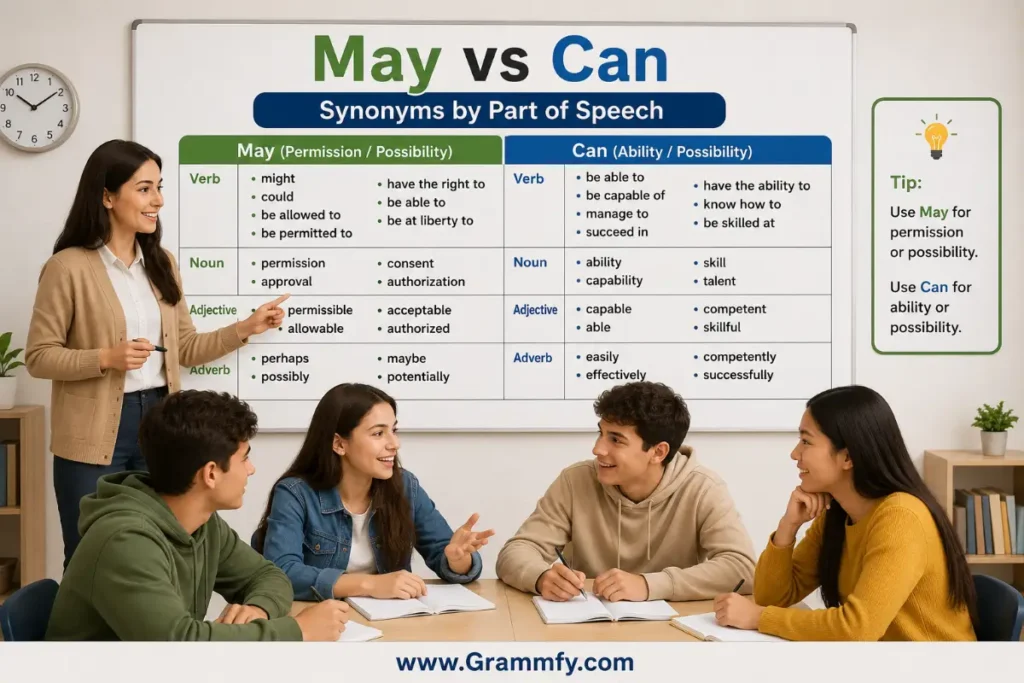
Synonyms by part of speech
The alternatives also change depending on how the word functions.
Modal verbs
These can express ability, possibility, permission, or related meanings:
- can
- could
- may
- might
- will
- would
- shall
- should
- must
They don’t all mean the same thing, so don’t swap them automatically.
Adverbs
These can express possibility:
- maybe
- perhaps
- possibly
- probably
- certainly
- definitely
Example:
Perhaps he will come.
Adjectives
These describe possibility or ability:
- possible
- likely
- capable
- able
- permissible
Example:
The plan is possible.
Phrases
Longer expressions can replace a modal idea:
- be able to
- be allowed to
- be permitted to
- have permission to
- have the ability to
- have the opportunity to
- be capable of
- be likely to
Which word should you use in a resume May vs Can?
A resume usually benefits from strong, direct language.
Don’t rely heavily on can when a stronger action verb is available.
Instead of:
Can manage a team of 10 employees.
Write:
Managed a team of 10 employees.
Instead of:
Can communicate with customers effectively.
Write:
Communicated effectively with customers.
However, can can still be useful when describing a current ability:
Can work independently and meet tight deadlines.
For professional writing, specific action verbs are often stronger than modal verbs.
Better resume examples
- Can analyze large datasets. → Analyze large datasets.
- Can train new employees. → Train and mentor new employees.
- Can solve customer problems. → Resolve customer problems efficiently.
- Can create detailed reports. → Create detailed reports.
A resume should show what you do, not simply what you are capable of doing.
Which word is better for an essay May vs Can?
For academic writing, choose based on meaning rather than formality alone.
Use can for ability or general possibility:
Regular exercise can improve overall fitness.
Use may for uncertainty or a cautious claim:
Regular exercise may improve sleep quality in some adults.
This distinction is important in academic writing because writers often need to avoid claiming that something is always true.
Compare:
This method can reduce costs.
This suggests the method has the ability or potential to reduce costs.
This method may reduce costs.
This sounds more cautious. The reduction is possible, but not guaranteed.
Essay tip
When making a broad claim, ask:
Am I describing what is generally possible, or am I saying something might happen in this specific case?
- General possibility → can
- Specific uncertain possibility → may
Which word works best in an email May vs Can?
The answer depends on your audience.
Casual email
Can I take Friday off?
Natural and friendly.
Professional email
May I request Friday off?
More formal.
But many professional American emails would use an even more natural structure:
Could I take Friday off?
Could often sounds polite without being as formal as may.
Formal request
May I request an extension until Friday?
This works well when you want a respectful, formal tone.
Which word should you use in texting May vs Can?
Use can for everyday permission.
Can I call you later?
Can you send me the file?
You can come over after 7.
May can sound formal in a casual text:
May I call you later?
This isn’t grammatically wrong, but it may sound unusually formal between friends.
For casual texting, natural language usually wins.
Which word is best when speaking May vs Can?
In normal American conversation, can is extremely common.
Can I get some water?
Can you help me?
I can do it.
Use may when you want a formal, respectful, or official tone.
May I speak with you for a moment?
You may begin.
The setting matters more than a strict rule.
What are 12 real-life examples of May vs Can?
Here are examples from school, work, travel, family life, and everyday conversation.
1. Talking about ability
I can finish the report before lunch.
The speaker has the ability or opportunity to finish it.
2. Asking a friend for permission
Can I borrow your headphones?
This is an ordinary casual request.
3. Asking formally
May I speak with the director?
The speaker wants to sound respectful and formal.
4. Giving permission
You can use my desk while I’m away.
This is a natural everyday way to give permission.
5. Giving formal permission
You may enter the examination room now.
This sounds official.
6. Describing general possibility
Snow can make roads dangerous.
This describes something that can happen under certain conditions.
7. Describing uncertain possibility
The roads may be dangerous after the storm.
The speaker isn’t certain, but the situation is possible.
8. Discussing a future plan
We may visit New York next summer.
The plan is possible but not definite.
9. Describing a skill
Maria can design websites.
This means she has the ability.
10. Talking about a general problem
Poor lighting can make reading difficult.
This describes a possible effect in general.
11. Making a cautious prediction
The company may announce changes next month.
The announcement is possible, but the speaker isn’t certain.
12. Giving a rule
Employees may use the conference room after 3 p.m.
This communicates official permission.
13. Asking at school
Can I submit my assignment tomorrow?
Natural in everyday American English.
14. Giving a warning
Too much rain can cause flooding.
This describes a general possibility.
15. Expressing uncertainty
She may already know about the problem.
The speaker isn’t sure.
Can vs could: what’s the difference?
Could is closely related to can, but it has several uses.
Can often expresses present ability:
I can swim.
Could can express past ability:
I could swim when I was five.
It can also make a request sound more polite:
Could you help me?
And it can express possibility:
We could take the train.
So don’t treat could as simply a more formal version of can.
| Can | Could |
|---|---|
| Present ability | Past ability |
| Informal permission | Polite request |
| General possibility | Possible option |
| Direct request | Softer request |
May vs might: what’s the difference?
May and might both express possibility.
She may come tonight.
She might come tonight.
Both mean that her arrival is possible.
In many modern contexts, the difference is small. Might can sometimes sound more uncertain or less likely, but native speakers don’t always make a strict distinction.
Compare:
It may rain tomorrow.
It might rain tomorrow.
Both are natural.
For permission, however, may is the standard choice.
May I leave?
You normally wouldn’t say:
Might I leave?
That construction exists, but it sounds unusually formal or old-fashioned in most everyday American English.
May vs could: which sounds more polite?
Both can make a request polite, but they do it differently.
May I ask a question?
This is formal and respectful.
Could I ask a question?
This is polite but often more conversational.
For many everyday professional situations, could is a very natural middle ground.
| Expression | Typical tone |
|---|---|
| Can I ask? | Casual |
| Could I ask? | Polite, natural |
| May I ask? | Formal, respectful |
Common mistakes with May vs Can
Mistake 1: Using may for ability
Incorrect:
I may swim very well.
If you mean that you have the skill, use can.
Correct:
I can swim very well.
If you mean swimming is possible for you at some future time, may could have a different meaning, but context would need to make that clear.
Mistake 2: Thinking can is always wrong for permission
This is an outdated idea in modern English.
Can I sit here?
This is normal.
Use may if you want a more formal tone:
May I sit here?
Mistake 3: Using can for a specific uncertain prediction
It can rain tomorrow.
This can sound awkward if you’re trying to make a specific prediction.
Better:
It may rain tomorrow.
Use can for general possibility:
It can rain heavily here in spring.
Mistake 4: Confusing ability with permission
Consider:
You can drive.
Depending on context, this could mean:
- You know how to drive.
- You are allowed to drive.
Context determines the intended meaning.
If you want to make permission completely clear:
You are allowed to drive.
Mistake 5: Using may when you mean “maybe” but the sentence is about ability
I may finish the project today.
This means perhaps I will finish it.
It does not mean:
I am able to finish the project today.
For ability, say:
I can finish the project today.
Mistake 6: Overusing may to sound intelligent
Some writers use may everywhere because they think it sounds more professional.
That’s unnecessary.
May you send me the file?
This is not the normal way to make a professional request.
Better:
Can you send me the file?
or:
Could you send me the file?
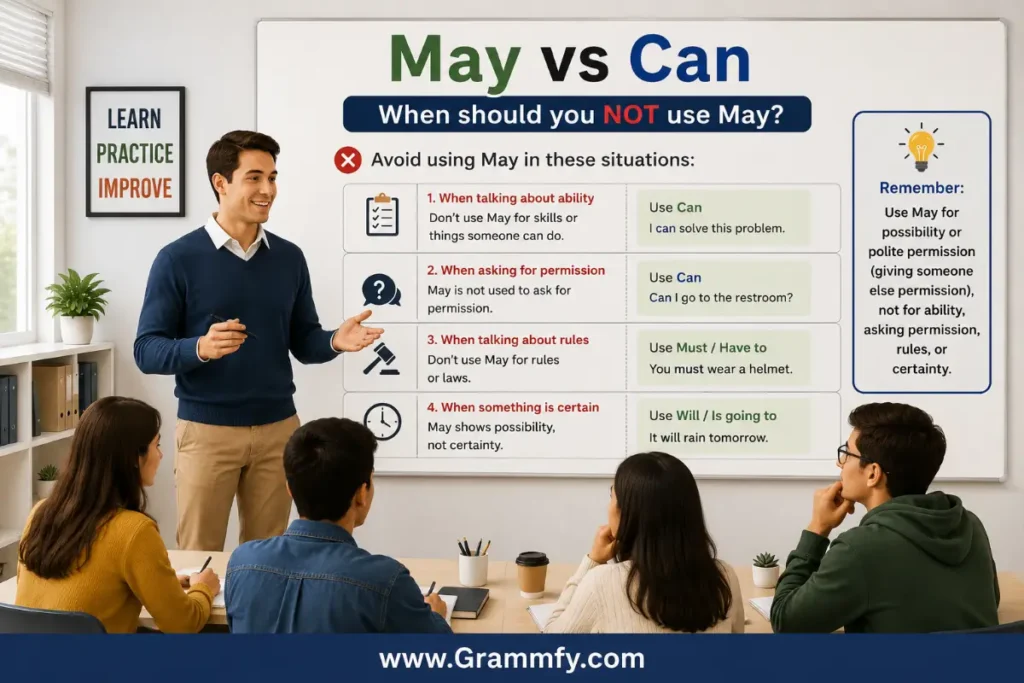
When should you NOT use may?
Avoid may when your intended meaning is clearly present ability.
Instead of:
I may speak French.
if you mean you have the skill, write:
I can speak French.
Also avoid overly formal may in relaxed conversations if it makes your sentence sound unnatural.
May I borrow your phone charger, bro?
Grammatically possible, but the tone is unusual.
A natural version is:
Can I borrow your charger?
When should you NOT use can?
Avoid can when you need to clearly express a specific uncertain possibility.
Instead of:
John can be at home tonight.
if you mean you’re unsure whether John will be home, use:
John may be at home tonight.
If you mean John has the ability or opportunity to be home by a certain time, can may work:
John can be home by eight.
The surrounding meaning changes everything.
What are the antonyms of May vs Can?
Because may and can have several meanings, their opposites also depend on context.
Antonyms for ability
| Positive | Opposite |
|---|---|
| can | cannot |
| be able to | be unable to |
| capable | incapable |
Examples:
I can swim.
I cannot swim.
She is able to attend.
She is unable to attend.
Antonyms for permission
| Permission | Opposite |
|---|---|
| may | may not |
| can | cannot |
| allowed to | not allowed to |
| permitted to | prohibited from |
Examples:
You may enter.
You may not enter.
For official rules, must not can also communicate prohibition:
Visitors must not enter this area.
How do regional differences affect May vs Can?
American and British English both use can and may, but everyday preferences can differ slightly.
In both varieties, may is associated with formal permission and possibility.
Can is common for ability in both.
For permission, everyday American English strongly accepts:
Can I…?
British English also uses Can I…? frequently in ordinary conversation.
The traditional “Can I means ability, may I means permission” rule is therefore better understood as a style and usage guideline, not a complete description of modern English.
Formal writing, school settings, and official rules may still favor may for permission.
Which word sounds more polite May vs Can?
There isn’t one universal answer.
May I…? sounds more formal.
Could I…? sounds polite and conversational.
Can I…? sounds casual and direct.
Think of them as points on a tone scale:
Can I…? → casual
Could I…? → polite and natural
May I…? → formal
The best choice depends on your relationship with the listener and the setting.
How do you choose between May vs Can quickly?
Use these questions.
Step 1: Are you talking about ability?
Use can.
I can solve this problem.
Step 2: Are you asking for permission?
Use can for casual English or may for formal English.
Can I leave?
May I leave?
Step 3: Are you giving permission?
Both can work.
You can leave.
You may leave.
The second is more formal.
Step 4: Are you describing general possibility?
Can often works.
Mistakes can happen.
Step 5: Are you describing one uncertain possibility?
May often works.
Mistakes may happen during the transition.
Step 6: Does the sentence sound too formal?
If you’re talking to a friend, can may sound more natural.
Step 7: Is this an official rule?
May is often a good choice.
Visitors may park here after 6 p.m.
Quick comparison chart: May vs Can
| Situation | Best choice | Example |
|---|---|---|
| Present ability | can | I can cook. |
| General possibility | can | It can get cold here. |
| Casual permission | can | Can I leave? |
| Formal permission | may | May I leave? |
| Formal rule | may | Guests may enter. |
| Specific uncertain possibility | may | She may arrive late. |
| Casual prediction | might/may | It may rain. |
| Professional request | could/may | Could I ask a question? |
| Resume ability | can or strong action verb | Can analyze data. |
| Academic uncertainty | may | The results may vary. |
A simple memory trick for May vs Can
Remember:
CAN = capability
If you’re asking whether someone is able to do something, think can.
I can drive.
MAY = maybe or permission
If something is uncertain, or you’re asking for formal permission, think may.
It may rain.
May I enter?
This isn’t a rule for every possible sentence, but it’s a useful starting point.
Can you say “May you…”?
Usually, may you has a different function from may I.
For example:
May you have a wonderful day.
This can be used as a wish or blessing, though it is less common in casual American English.
Don’t use may you as a normal substitute for can you when making a request.
Instead of:
May you send me the report?
say:
Can you send me the report?
or:
Could you send me the report?
Can you say “You may” and “You can”?
Yes. Both can give permission.
You can start now.
You may start now.
The difference is mainly tone.
You can start now sounds normal and conversational.
You may start now sounds more formal, official, or authoritative.
That’s why teachers, officials, and written rules may use may.
How do May vs Can work in negative sentences?
Both have negative forms, but their meanings depend on context.
Cannot or can’t
Cannot often means lack of ability or permission.
I can’t swim.
Ability.
You can’t park here.
Permission or rule.
May not
May not can mean lack of permission:
You may not enter this room.
It can also express uncertainty:
She may not come.
These two sentences have completely different meanings.
You may not enter = You are not permitted to enter.
She may not come = Perhaps she won’t come.
Context is essential.
How do May vs Can work in questions?
Can questions
Can commonly asks about ability or permission.
Can you drive?
Ability.
Can I leave?
Permission.
Can we finish this today?
Possibility or ability, depending on context.
May questions
May usually asks for permission.
May I leave?
May I ask a question?
It can also appear in more formal constructions involving possibility, but permission is the most useful everyday rule.
What should you use in formal rules and notices?
May is often the better choice.
Examples:
Customers may request a refund within 30 days.
Employees may work remotely on Fridays.
Visitors may enter through the main gate.
This style makes the permission clear and sounds appropriate for policies and notices.
For prohibition:
Visitors may not enter this area.
But if a rule is strict, must not may be stronger:
Visitors must not enter this area.
What should you use in customer service writing?
Customer service writing usually aims for polite, clear, and friendly language.
Can is often natural:
You can contact our support team at any time.
May can work in formal policies:
Customers may request a replacement within 30 days.
For a polite question, could is often a strong choice:
Could you provide your order number?
So don’t force may into every professional sentence.
How should teachers explain May vs Can to students?
A simple classroom explanation works best:
- Can often means “be able to.”
- Can can also ask for casual permission.
- May often asks for or gives formal permission.
- May can express possibility.
- Can can express general possibility.
- Context determines the exact meaning.
A teacher could use this mini-example:
I can swim. → ability
Can I swim here? → casual permission
May I swim here? → formal permission
It may rain. → possibility
It can rain here in spring. → general possibility
This gives students a practical framework instead of an overly strict rule.
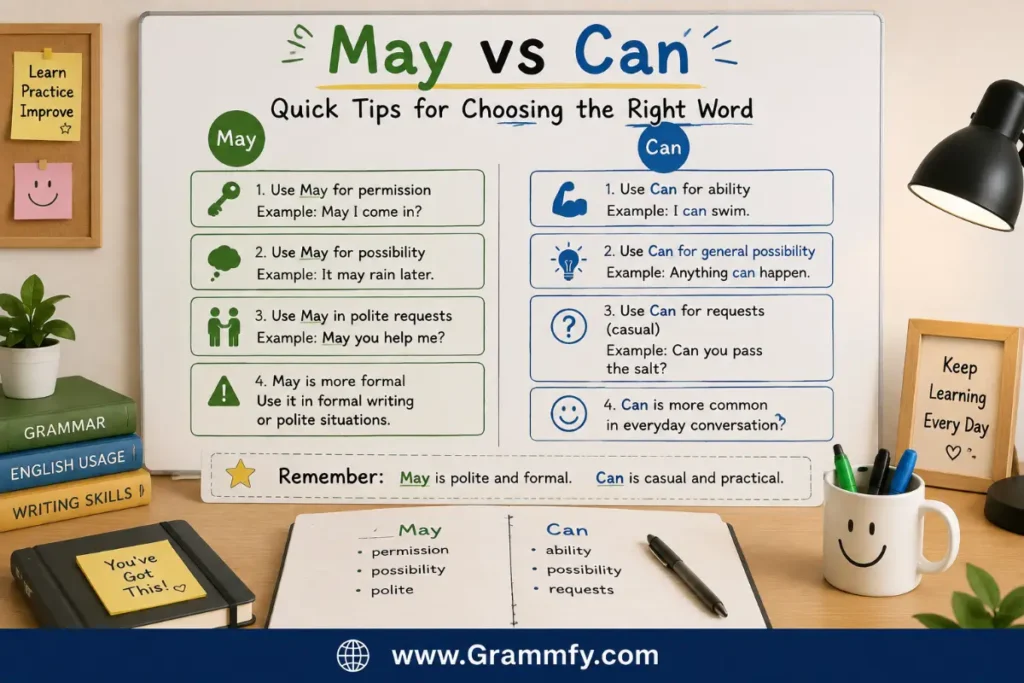
Quick tips for choosing the right word “May vs Can”
- Use can for present ability.
- Use can for general possibility.
- Use can for casual permission.
- Use may for formal permission.
- Use may for uncertain possibility.
- Use could for many polite requests.
- Don’t assume can is incorrect for permission.
- Don’t use may when you clearly mean ability.
- Check whether you’re describing a general possibility or one specific possibility.
- Consider your audience before choosing a formal expression.
- In a resume, replace weak “can” statements with strong action verbs when possible.
- In academic writing, may can help show uncertainty.
- In official rules, may often clearly communicates permission.
- In casual texting, can usually sounds more natural.
- Read the whole sentence before deciding.
May vs Can: a final side-by-side test
Try these pairs.
Ability
We can speak Japanese.
I have the ability.
I may speak Japanese.
Perhaps I will speak Japanese, or I have permission in a particular context. It doesn’t normally mean that I possess the skill.
Permission
Can I open the window?
Casual permission request.
May I open the window?
More formal permission request.
General possibility
Driving at night can be dangerous.
This can happen generally.
Driving at night may be dangerous tonight.
The speaker is describing a possibility in a specific situation.
Future uncertainty
She may come tomorrow.
Perhaps she will come.
She can come tomorrow.
She is available or able to come.
This last pair is especially useful because both sentences are grammatically correct but communicate different ideas.
Conclusion
Understanding may vs can becomes much easier when you focus on meaning instead of memorizing one strict rule. Use can for ability, general possibility, and casual permission. Use may for formal permission and uncertain possibility. In modern American English, Can I…? is perfectly natural when asking for permission, while May I…? gives the request a more formal tone. The same idea applies to writing: choose the modal that matches your meaning and your audience. When you’re unsure, ask yourself one simple question: Am I talking about ability, permission, or possibility? Once you identify that purpose, the right word usually becomes clear. Practice with real sentences, and the distinction will soon feel natural.
Frequently Asked Questions
Is can or may correct for asking permission?
Both can be correct. Can is common in everyday American English, while may sounds more formal and traditional when asking for permission.
Is it grammatically wrong to say “Can I?”
No, Can I? is standard modern English for casual permission requests. May I? is simply more formal.
When should I use may instead of can?
Use may when you want to express a specific possibility or ask for permission in a formal setting. For example, “She may arrive late” expresses possibility, while “May I leave?” asks for permission.
Does may vs can matter in formal writing?
Yes, especially when tone and meaning matter. May can make permission sound more formal, while can is often clearer for ability.
What’s another way to say “can”?
Depending on the meaning, you can use be able to, be capable of, be allowed to, could, or have permission to. The correct alternative depends on whether can means ability, possibility, or permission.
Can may and can both express possibility?
Yes, but they often express different types of possibility. May commonly describes a specific uncertain event, while can often describes a general possibility or something that is possible under certain conditions.
Which is more polite: “Can I?” or “May I?”
May I? is more formal, while Can I? is more casual and natural. Could I? is also a very common polite option in everyday professional English.
