
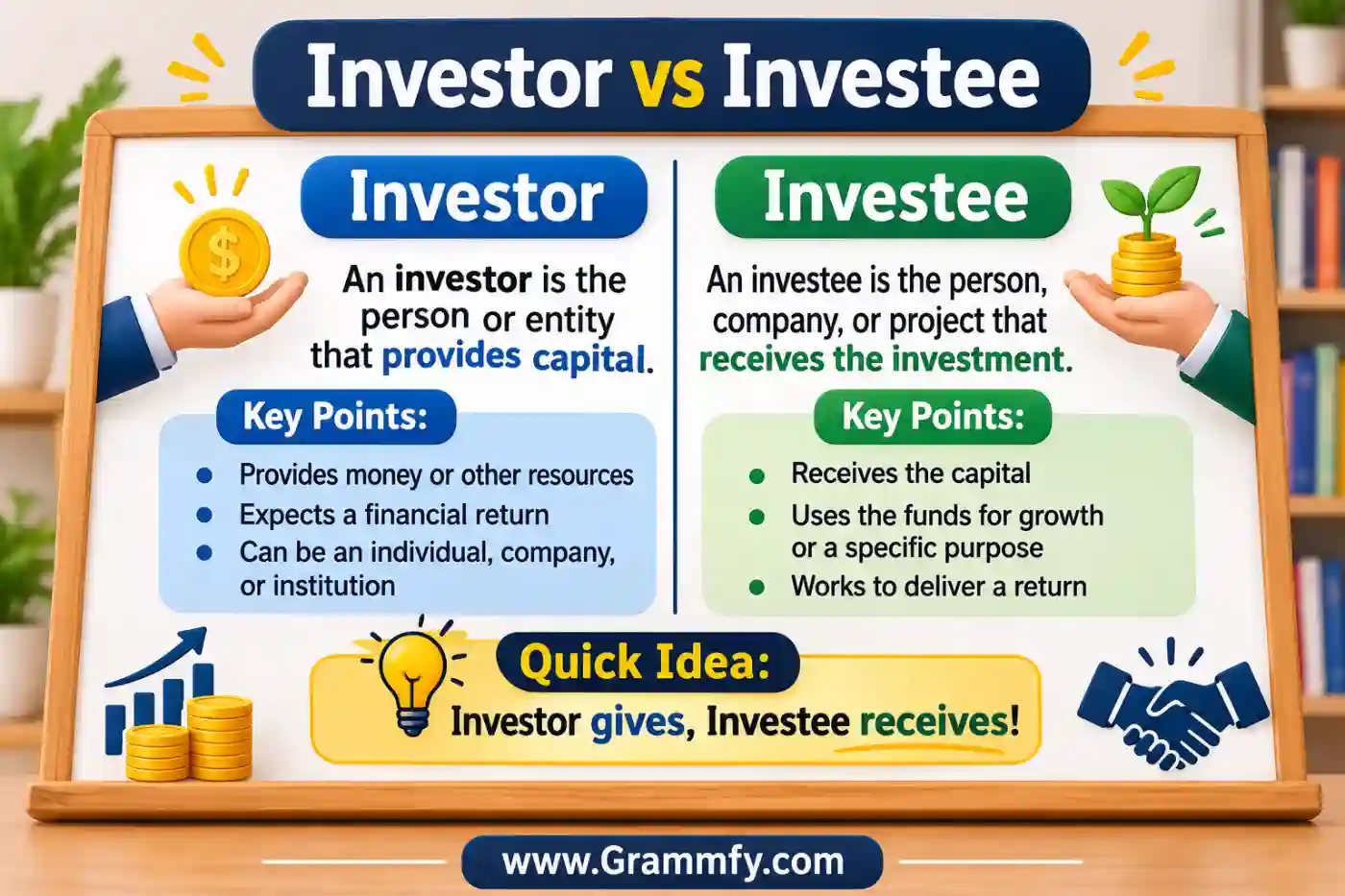
Understanding the difference between investor vs investee becomes simple when you look at who gives the money and who gets it. An investor puts money into a business or project, hoping to earn a profit or financial return. An investee, on the other hand, is the person, company, fund, or organization that receives the investment and uses it to support its goals or activities.
The difference between an investor and an investee comes down to one simple question: who provides the money, and who receives it? An investor puts money into a business, project, or financial asset. An investee is the person, company, or organization that receives that investment.
Knowing which is which helps you read financial deals and business news without second-guessing yourself. Both terms are common in banking, corporate finance, private equity, and everyday business conversations. However, each has a specific meaning, and neither should be used as a replacement for the other.
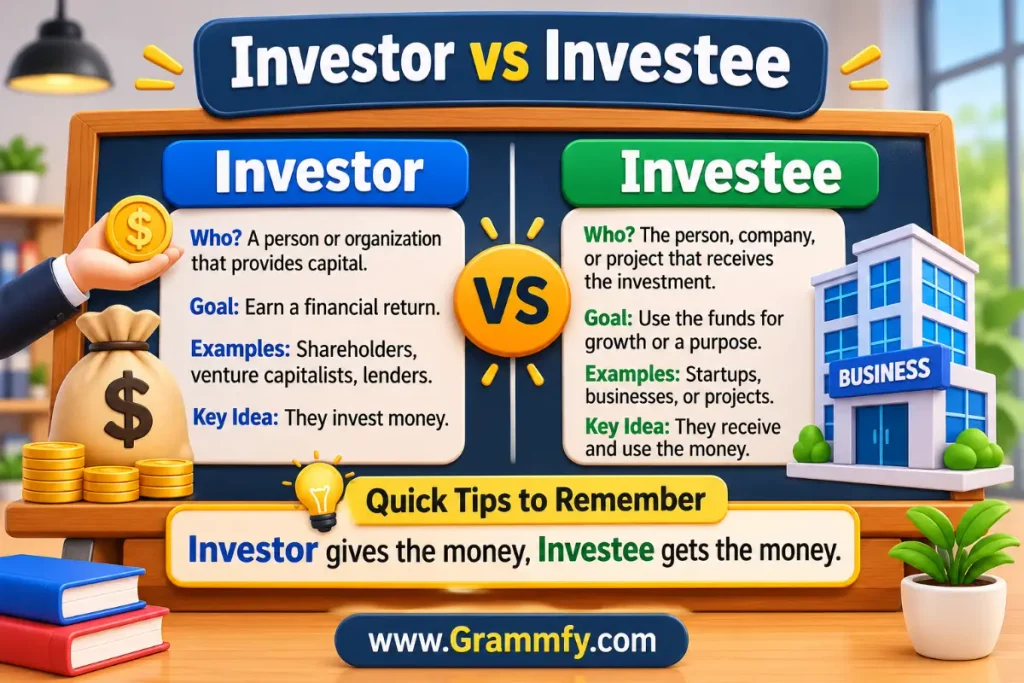
Investor vs Investee: An investor provides money or capital to earn a possible return, while an investee receives that capital and uses it for business growth, operations, or another agreed purpose.
English spelling can be tricky, especially when a word sounds right but its written form is incorrect. Explore more common spelling mistakes to learn the correct forms and avoid errors in everyday writing. These simple guides will help you improve your spelling and communicate more clearly.
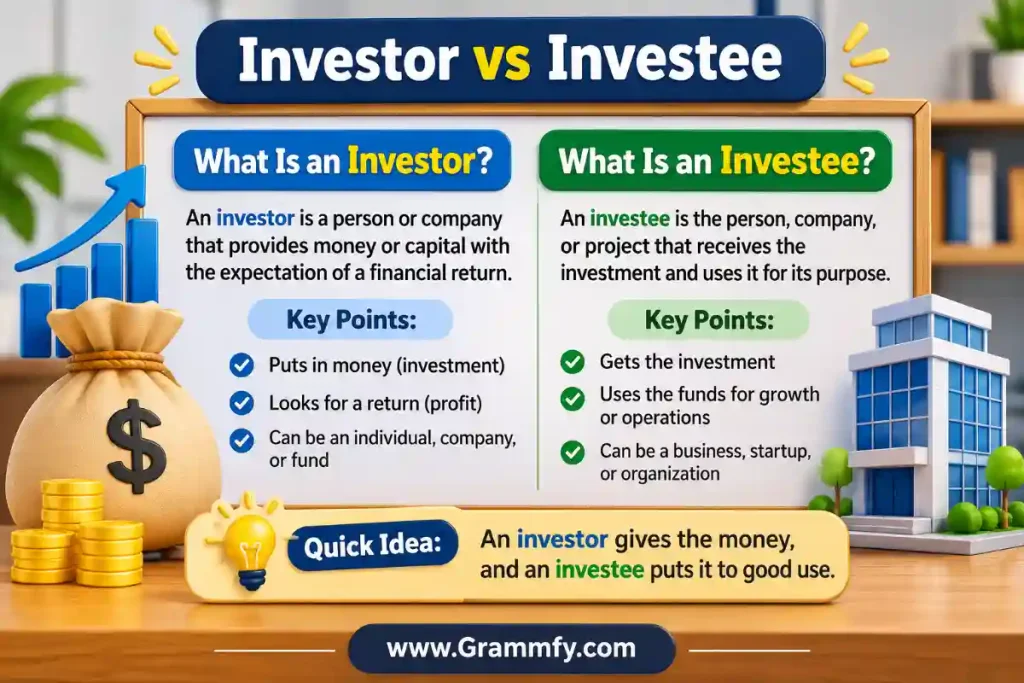
What Is an Investor?
An investor is a person, company, institution, or organization that puts money into something with the goal of earning a financial return. That return may come from interest, dividends, business profits, rental income, or an increase in the value of an asset.
Investors can support businesses at different stages. Some provide money to new companies that are just getting started. Others buy shares in established businesses or purchase government bonds. Some invest in property, mutual funds, or private projects.
At its core, investing means putting money at risk for a potential payoff.
For example, imagine Sarah has $20,000 and decides to invest it in a small clothing company. She expects the business to grow and hopes to receive a return on her money. In this situation, Sarah is the investor.
What Does an Investor Do?
An investor’s responsibilities depend on the type of investment. A person who buys company shares may have very little involvement in daily operations. Someone who funds a small startup may offer advice, contacts, and business support.
Types of Investors
Investors come in several forms. Their differences usually depend on how much money they provide, where they invest, and how involved they are.
| Type | Meaning | Example |
|---|---|---|
| Individual investor | A person who invests personal money | Someone buying company shares |
| Institutional investor | An organization that invests large amounts of money | A pension fund |
| Angel investor | An individual who funds early-stage businesses | A business owner supporting a startup |
| Venture capitalist | An investor who funds businesses with high growth potential | A venture capital firm |
| Retail investor | An individual who buys financial products for personal use | Someone investing through a brokerage account |
| Foreign investor | A person or organization investing in another country | A US company funding a project in Canada |
| Strategic investor | An investor seeking financial and business advantages | A technology company investing in a software startup |
| Private equity investor | An investor who provides capital to privately held companies | A private equity firm purchasing a business |
One fund or person can fit more than one label—for instance, a big institution can also act as a private equity buyer.
Investor Examples in Everyday Business
Consider these situations:
- A person buys 100 shares of a public company. That person is an investor.
- A bank purchases government bonds to earn interest. The bank acts as an investor.
- A wealthy individual provides startup funding to a new restaurant. That individual is an investor.
- A company purchases commercial property to earn rental income. The company is an investor.
- A pension fund invests in several businesses to support its long-term financial goals. The fund is an institutional investor.
In each case, the investor commits money in the hope of receiving some financial benefit.
What Is an Investee?
An investee is a person, business, company, fund, or organization that receives an investment from another party. It may use the money to expand operations, purchase equipment, hire employees, develop products, or support other financial activities.
An investee can be a newly established startup or a large company that already has a strong market position. The term describes its relationship with an investor, not its size or financial condition.
For example, suppose David invests $50,000 in a technology startup. The startup receives his money to develop a new application. David is the investor, while the technology startup is the investee.
The investee doesn’t always receive cash directly. An investment may involve shares, assets, funding commitments, or other forms of financial support.
What Does an Investee Do?
An investee receives capital and uses it according to the terms of the investment agreement. Its responsibilities often depend on the funding arrangement.
Types of Investees
An investee can take several forms depending on the investment arrangement.
| Type | Meaning | Example |
|---|---|---|
| Startup company | A new business receiving early funding | A newly launched software company |
| Established business | An operating company receiving additional capital | A manufacturing company |
| Public company | A listed business receiving investment through share purchases | A company listed on the stock market |
| Private company | A privately owned business receiving funding | A family-owned company |
| Investment fund | A fund receiving capital from another investor | A private investment fund |
| Real estate project | A property development receiving funding | A residential construction project |
| Nonprofit organization | An organization receiving investment or financial support | A social enterprise project |
A business can receive investments from multiple sources. It may also act as an investor in another company at the same time.
Investor vs Investee: What Is the Main Difference?
The main difference is the direction of the investment. An investor supplies capital, while an investee receives it.
Although both terms describe parties involved in the same financial arrangement, they have different responsibilities and interests.
| Basis | Investor | Investee |
|---|---|---|
| Basic meaning | Provides investment | Receives investment |
| Main role | Supplies capital | Uses received capital |
| Financial position | Commits money or assets | Obtains money or assets |
| Main objective | Earns a possible return | Uses funding for an agreed purpose |
| Financial risk | Faces the risk of losing invested money | Faces business or project risks |
| Ownership | May receive an ownership interest | May provide an ownership interest |
| Responsibilities | Evaluates opportunities and monitors performance | Manages funds and meets agreed conditions |
| Decision-making | May have voting or management rights | Usually manages its own operations |
| Examples | Shareholder, venture capitalist, investment fund | Startup, company, investment project |
| Expected benefit | Profit, interest, dividends, or appreciation | Access to capital and potential growth |
How Does an Investor-Investee Relationship Work?
An investor-investee relationship begins when one party provides capital and another party accepts it under agreed conditions.
The relationship may be simple, such as buying company shares, or more complex, such as funding a private business through a detailed investment agreement.
Here is how a typical investment arrangement works.
Step 1: The Investee Needs Capital
A business may need money to start operations, develop a product, purchase equipment, or enter a new market.
Instead of relying only on its own resources, it looks for outside funding.
For example, a small food company wants $100,000 to build a production facility.
Step 2: The Investor Reviews the Opportunity
A potential investor studies the business before committing money.
The review may include:
- The company’s business plan.
- Current financial statements.
- Expected revenue and expenses.
- Market demand.
- Existing debts.
- Competition.
- Management experience.
- Possible risks and returns.
This process helps the investor decide whether the opportunity is suitable.
Step 3: Both Parties Agree on the Terms
If the investor wants to move forward, both parties discuss the conditions.
These may include the investment amount, ownership percentage, voting rights, reporting requirements, and other responsibilities.
The terms depend on the type of investment.
Step 4: The Investment Is Provided
Once the agreement is completed, the investor transfers the money or other agreed assets.
The receiving business becomes the investee in that relationship.
For example, the investor transfers $100,000 to the food company in exchange for a 15% ownership interest.
Step 5: The Investee Uses the Funds
The business uses the investment according to its plans and the agreement.
It may purchase machinery, hire workers, improve its facilities, or develop new products.
Step 6: The Investor Monitors Performance
The investor may review reports, financial statements, and business updates.
Some investors remain involved in major decisions, while others take a passive role.
Step 7: The Investment Produces an Outcome
The investment may succeed, produce limited returns, or lose value.
If the business grows, the investor may benefit from an increase in ownership value or other agreed returns.
The investee may benefit from improved operations and stronger financial resources.
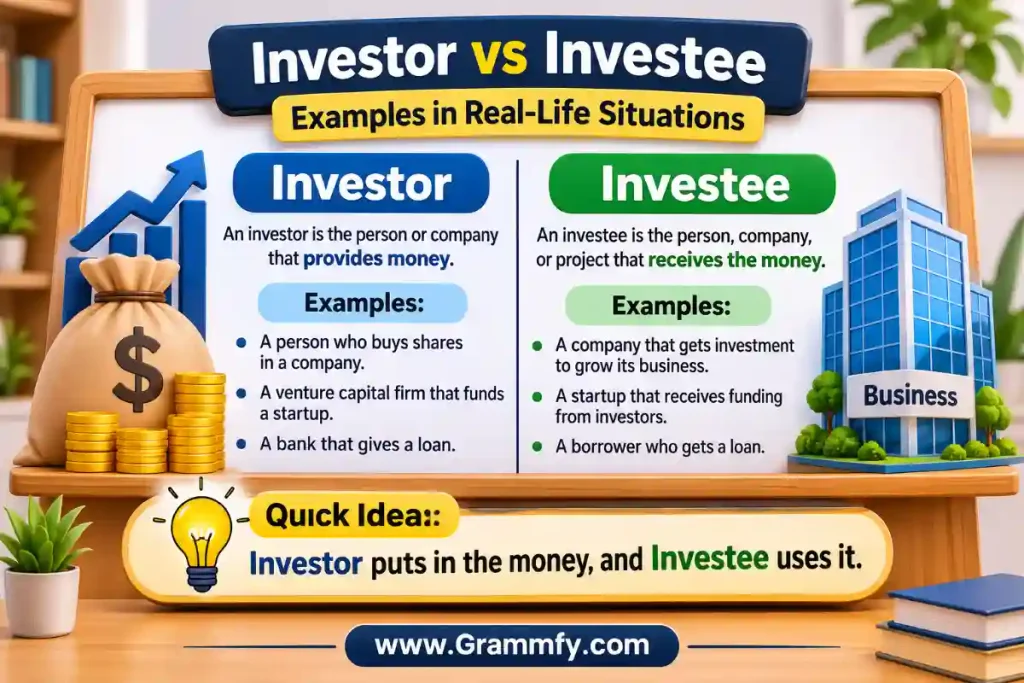
Investor vs Investee Examples in Real-Life Situations
Here is how those roles look in practice:
Example 1: A Startup Receives Funding
A technology startup needs $200,000 to develop a mobile application. A private investor agrees to provide the money in exchange for an ownership stake.
- Investor: The person providing $200,000.
- Investee: The technology startup receiving the funding.
The startup uses the money to hire developers and improve the application.
Example 2: A Company Buys Shares
A person purchases 50 shares of a public company through a brokerage account.
- Investor: The person purchasing the shares.
- Investee: The company whose shares are purchased.
The investor may benefit if the share price rises or if the company pays dividends.
Example 3: A Real Estate Project
A property developer needs funding to construct an apartment building. An investment firm provides the required capital.
- Investor: The investment firm.
- Investee: The property development company or investment vehicle receiving the funds.
The project may generate returns through property sales or rental income.
Example 4: A Small Business Expansion
A local bakery wants to open a second branch. A family member invests $30,000 to help finance the expansion.
- Investor: The family member.
- Investee: The bakery business.
The bakery uses the funds for rent, equipment, furniture, and initial supplies.
Example 5: A Foreign Investment
A company based in the United States invests in a manufacturing business in Germany.
- Investor: The US-based company.
- Investee: The German manufacturing business.
The arrangement may support production, technology development, or international expansion.
Example 6: A Private Equity Deal
A private equity firm purchases a significant ownership interest in a privately held company.
- Investor: The private equity firm.
- Investee: The company receiving the investment.
The firm may work with company management to improve performance and increase business value.
Example 7: A Government Bond Purchase
An individual purchases government bonds to earn interest over time.
- Investor: The individual purchasing the bonds.
- Issuer or recipient of the investment: The government.
In this example, the government is the recipient of the funding. The exact legal terminology may depend on the bond structure.
Example 8: An Investment Fund
An investment fund receives capital from a larger financial institution.
- Investor: The institution providing capital.
- Investee: The investment fund receiving it.
The fund may then use the money to purchase shares, bonds, or other assets.
Example 9: A Business Receives Equipment
A manufacturing company receives machinery as part of an agreed investment arrangement.
- Investor: The party providing the machinery.
- Investee: The company receiving the equipment.
An investment doesn’t always have to involve a direct cash payment.
Example 10: A New Restaurant Opens
A restaurant owner wants to open a new location but needs additional funding. A business partner provides $75,000 in exchange for an ownership share.
- Investor: The business partner.
- Investee: The restaurant business.
The restaurant uses the funding for kitchen equipment, interior work, and staff recruitment.
Word Origin and Plain-English Meaning of Investor vs Investee
Understanding the origin of these terms can make them easier to remember.
Both words come from the verb invest, which refers to putting money, time, or resources into something with the expectation of gaining a benefit.
Where Does the Word Investor Come From?
The word investor comes from the verb invest and the suffix -or.
The suffix -or commonly identifies a person or entity that performs an action.
For example:
- Creator: Someone who creates something.
- Donor: Someone who donates money or resources.
- Operator: Someone who operates a system or business.
- Investor: Someone who invests money or resources.
The word invest has roots in the Latin word investire, meaning to clothe or surround. Its financial meaning developed over time and became associated with committing money or resources to gain a future benefit.
In modern English, an investor is someone who puts capital into an investment opportunity.
Where Does the Word Investee Come From?
The word investee also comes from invest, but it uses the suffix -ee.
The suffix -ee often describes the person or entity receiving an action.
Consider these examples:
- Employee: A person employed by someone.
- Trainee: A person receiving training.
- Nominee: A person nominated for something.
- Investee: A person or organization receiving an investment.
This word structure provides a useful memory clue. The investor performs the action of investing, while the investee receives the investment.
Why Do These Words Look Similar?
Both words share the same root because they describe opposite sides of one financial activity.
The difference comes from their endings:
- -or: Often identifies the person performing an action.
- -ee: Often identifies the person receiving an action.
It isn’t a hard rule for every word in English, though it works well here.
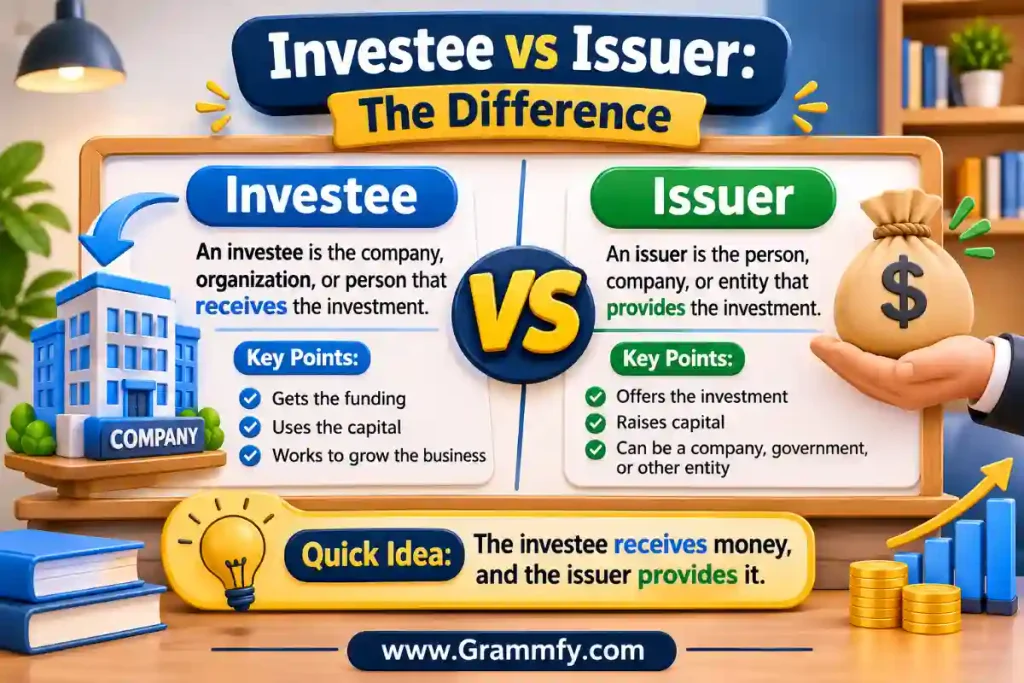
Investee vs Issuer: The Difference
An investee is an entity that receives investment capital. An issuer is an organization that creates and offers financial securities, such as shares or bonds.
These terms sometimes describe the same company, but they focus on different roles.
| Investee | Issuer |
|---|---|
| Receives an investment | Issues financial securities |
| Describes the recipient’s relationship with an investor | Describes the organization offering securities |
| Common in investment reporting | Common in securities markets |
Example:
A company sells new shares to raise money. It is the issuer of those shares and may also be the investee receiving the investment.
The terms aren’t interchangeable in every financial situation.
Investor vs Lender:The Difference
An investor provides capital with the expectation of earning a return. A lender provides money under an agreement that generally requires repayment, often with interest.
The key difference is the financial arrangement.
| Investor | Lender |
|---|---|
| May receive ownership or financial returns | Usually receives repayment with interest |
| May face the risk of losing invested capital | Faces the risk that the borrower won’t repay |
| Can provide equity or other forms of investment | Provides a loan |
| May benefit from business growth | Usually receives agreed interest payments |
Example:
A person purchases shares in a company. That person is an investor.
If the same person gives the company a loan under a repayment agreement, they act as a lender in that transaction.
A person can be both an investor and a lender, depending on the arrangement.
Common Mistakes When Using Investor vs Investee
These terms are easy to mix up because they appear in the same financial discussion. However, using one in place of the other can change the meaning of a sentence.
Here are common mistakes to avoid.
1. Calling the Money Provider an Investee
Incorrect: “The investee transferred $50,000 to the startup.”
Correct: “The investor transferred $50,000 to the startup.”
The investor provides the capital. The investee receives it.
2. Calling the Receiving Company an Investor
Incorrect: “The investor company received funding from a private equity firm.”
Correct: “The investee company received funding from a private equity firm.”
The company receiving the funding is the investee in this arrangement.
3. Assuming Every Investor Owns a Business
Not every investor owns part of a company.
Someone who purchases bonds, deposits money into certain investment products, or invests in property may be an investor without owning shares in a business.
4. Assuming Every Investee Is a Startup
An investee doesn’t have to be a new company.
Established businesses, public companies, private organizations, and investment funds can all receive investment capital.
5. Assuming an Investment Always Produces Profit
Investors don’t receive guaranteed profits from every investment.
A company may lose money, its share price may fall, or a project may fail. The investor may lose part or all of the money committed.
6. Using Investee When Borrower Is More Accurate
A company receiving a loan is usually called a borrower, not automatically an investee.
The word investee is more suitable when the funding is structured as an investment.
7. Treating Investor vs Investee as Permanent Labels
A company can be an investee in one financial relationship and an investor in another.
For example, Company A receives funding from Company B. Later, Company A invests in Company C.
Company A is an investee in the first arrangement and an investor in the second.
What Are the Synonyms and Related Terms for Investor?
The right word depends on the deal and how formal you want to be.
The following table groups useful alternatives by tone and context.
| Word | Meaning | Tone | Example |
|---|---|---|---|
| Funder | Someone who provides money | Simple | The funder supported the project. |
| Backer | Someone who financially supports an idea or business | Everyday | The startup found a new backer. |
| Financier | Someone involved in providing or arranging finance | Formal | The financier reviewed the proposal. |
| Shareholder | Someone who owns company shares | Formal | The shareholder attended the annual meeting. |
| Stakeholder | A person or group with an interest in a business | Formal | Each stakeholder reviewed the plan. |
| Capital provider | A party supplying investment capital | Formal | The capital provider approved the funding. |
| Venture capitalist | An investor funding high-growth businesses | Formal | A venture capitalist supported the startup. |
| Contributor | Someone who provides money or resources | Simple | Each contributor helped fund the project. |
| Financial backer | Someone supporting a project with money | Everyday | The financial backer approved the deal. |
| Funding partner | A party helping provide capital | Formal | The funding partner joined the project. |
What Are the Synonyms and Related Terms for Investee?
The word investee has fewer direct synonyms because it describes a specific financial relationship.
In many cases, a short phrase is clearer than a single replacement word.
| Word or Phrase | Meaning | Tone | Example |
|---|---|---|---|
| Recipient | Someone who receives something | Simple | The recipient received the funds. |
| Receiving company | A company receiving an investment | Everyday | The receiving company expanded production. |
| Portfolio company | A company held within an investment portfolio | Formal | The portfolio company reported higher sales. |
| Funded organization | An organization receiving financial resources | Formal | The funded organization hired new employees. |
| Beneficiary | A party receiving a benefit | Formal | The beneficiary received financial support. |
| Capital recipient | An entity receiving investment capital | Formal | The capital recipient used the funds for expansion. |
| Investment target | A business or asset selected for investment | Formal | The investment target passed the initial review. |
| Fund recipient | A person or organization receiving money | Simple | The fund recipient signed the agreement. |
US vs UK English: Is There Any Difference?
There is no major spelling difference between American and British English for investor and investee.
Both forms are used in the United States and the United Kingdom.
| Term | US English | UK English |
|---|---|---|
| Investor | Investor | Investor |
| Investee | Investee | Investee |
| Investment | Investment | Investment |
| Investing | Investing | Investing |
| Invested | Invested | Invested |
The meaning also stays the same.
An investor provides capital, while an investee receives it. Both terms appear in financial reports, business documents, and investment discussions in both countries.
The main difference is usage frequency. Investor is common in everyday financial conversations, while investee is more specialized and often appears in accounting, corporate finance, and investment reporting.
Quick Tips to Remember the Difference Between Investor vs Investee
If you often mix up these terms, use these simple memory tricks.
1. Remember the Suffixes
The endings provide a helpful clue:
- Investor: The party performing the investment action.
- Investee: The party receiving the investment.
The suffix -or often identifies the person performing an action, while -ee often identifies the person receiving it.
2. Ask Who Gives the Money
If someone provides money to a business, that person or organization is the investor.
If a business receives the money, it is the investee.
3. Think About a Startup
Imagine a startup receiving $40,000 from a business owner.
- Business owner = Investor.
- Startup = Investee.
This simple example works for many investment situations.
4. Remember the Direction
Think of the relationship as two separate actions:
- The investor sends or commits capital.
- The investee receives and uses that capital.
The direction of the money usually tells you which term to choose.
5. Replace Technical Words When Needed
If you’re writing for beginners, try using simpler descriptions.
Instead of:
“The investee received capital from the investor.”
You can write:
“The company received money from the person funding it.”
Both sentences communicate the same basic relationship.
Conclusion: Understanding the Two Financial Roles
Investor vs investee describes two sides of the same financial relationship. An investor provides capital with the expectation of a financial benefit while an investee receives that investment and uses it according to the transaction’s terms. Both are legitimate terms, but they aren’t interchangeable because they identify different roles.
These roles are important in startup funding, stock markets, private equity, real estate, and corporate finance. They can also change depending on the transaction. A company that receives funding from one party may invest in another business later.
Frequently Asked Questions
What is the difference between an investor and an investee?
An investor provides capital, while an investee receives that capital. The investor hopes to earn a return, and the investee uses the funding for an agreed purpose.
Can a company be both an investor and an investee?
Yes, a company can hold both roles in different financial arrangements. It may receive funding from one business while investing its own money in another company.
Is an investee always a company?
No, an investee can be an individual, organization, investment fund, or business project. The term describes the party receiving an investment.
What is another word for an investor?
Common alternatives include funder, backer, financier, capital provider, and financial supporter. The best choice depends on the type of financial relationship.
What’s another way to say investee?
You can use phrases such as funding recipient, receiving company, funded business, or capital recipient. These expressions are helpful when writing for readers who aren’t familiar with financial terminology.
Does an investor always own part of an investee?
No, an investor doesn’t always receive ownership. Some investments involve debt securities or other financial arrangements that don’t provide company ownership.
Is an investor the same as a lender?
No, an investor provides capital in exchange for a possible financial return, while a lender provides money under a repayment agreement. Some people may act as both, depending on the transaction.

Tylerbrooks is a US-based English grammar writer and contributor at Grammfy. He writes helpful articles about grammar, spelling, commonly confused words, and vocabulary. His goal is to explain English topics in simple language with clear examples and practical tips. Through his articles, he helps readers improve their writing and everyday English skills.