
Have you ever written a quick message to encourage a friend and paused between two spellings? You might wonder whether to write cheer vs chear. Both look similar, and the difference is only one letter. However, choosing the wrong spelling can make your writing look careless.
The confusion between these words is understandable because English has many words with unusual spelling patterns. Some words use -ear, while others use -eer. When typing quickly, it’s easy to mix them up, especially if you’re unsure which spelling is accepted.
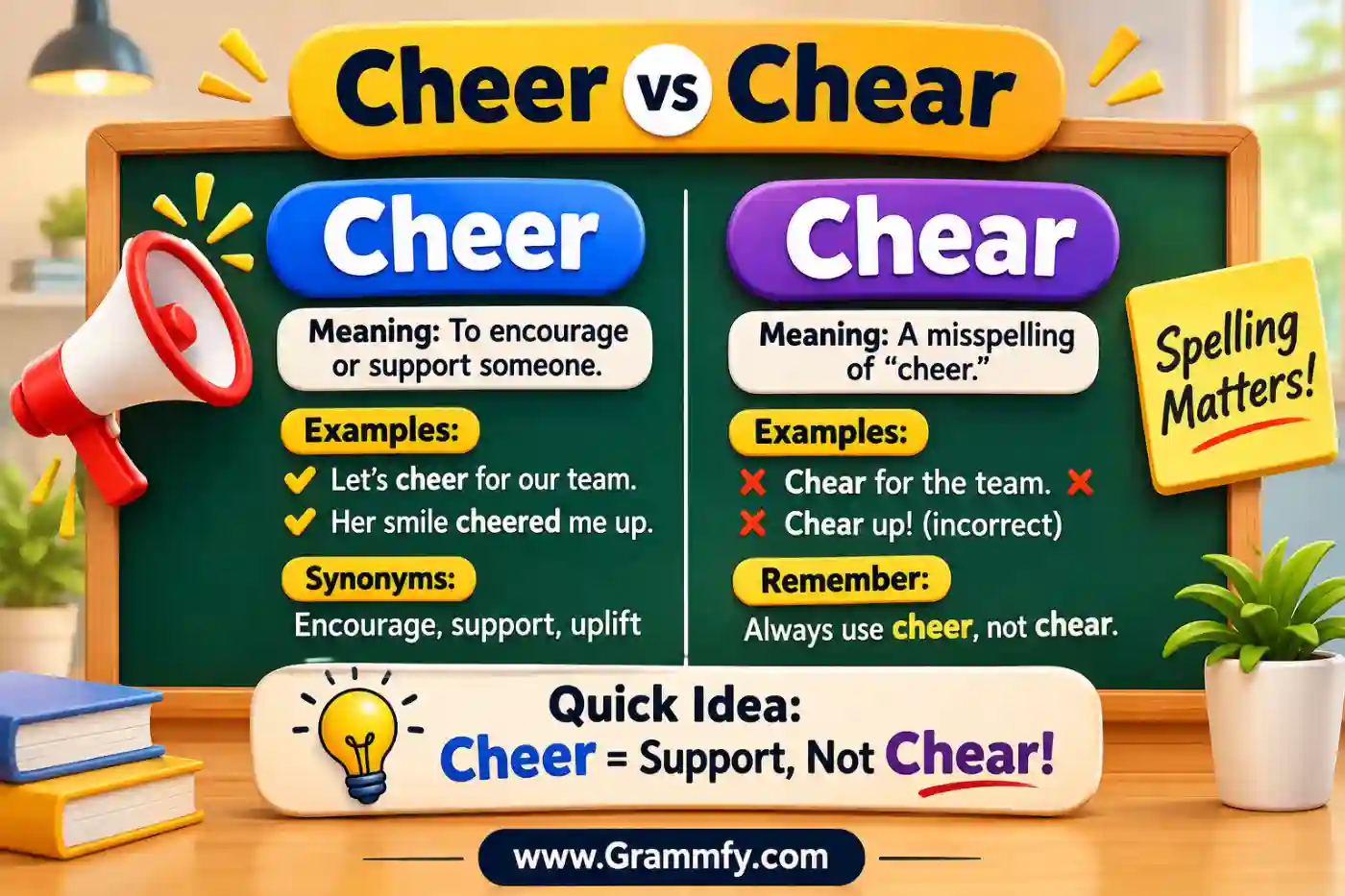
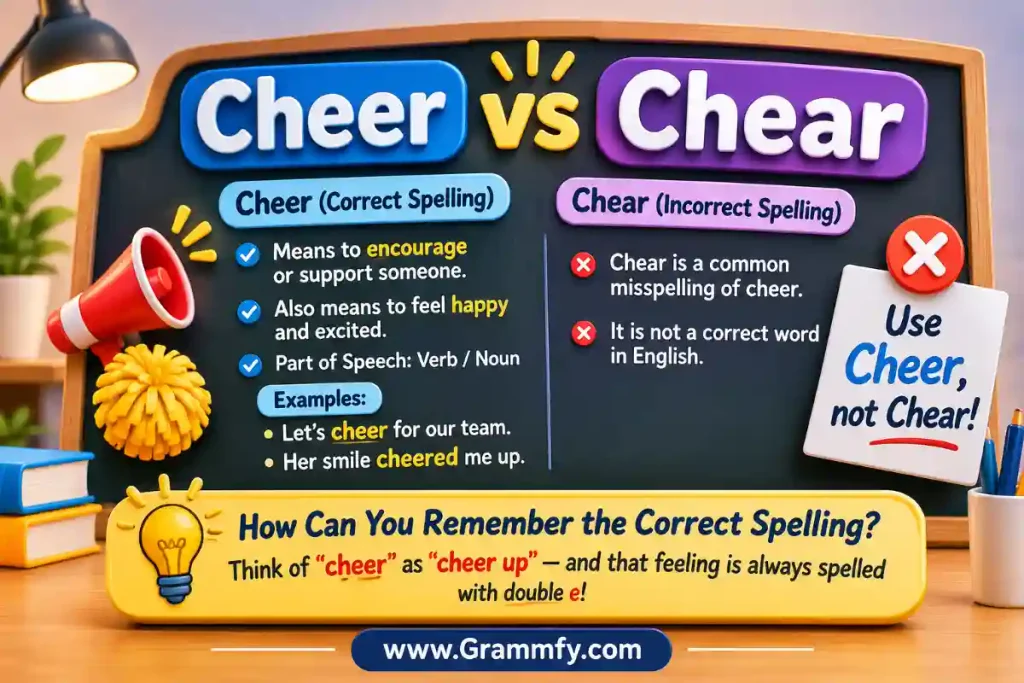
The good news is that there’s a simple answer. Cheer is the correct modern English spelling. Chear is generally considered a misspelling and isn’t accepted as the standard spelling in modern everyday English.
Some English words, such as investor and investee, are easy to confuse because they belong to the same topic but describe different roles. Explore more commonly confused words to understand their meanings and correct usage. These helpful comparisons will make it easier to choose the right word and write with confidence.
The Difference Between Cheer vs Chear
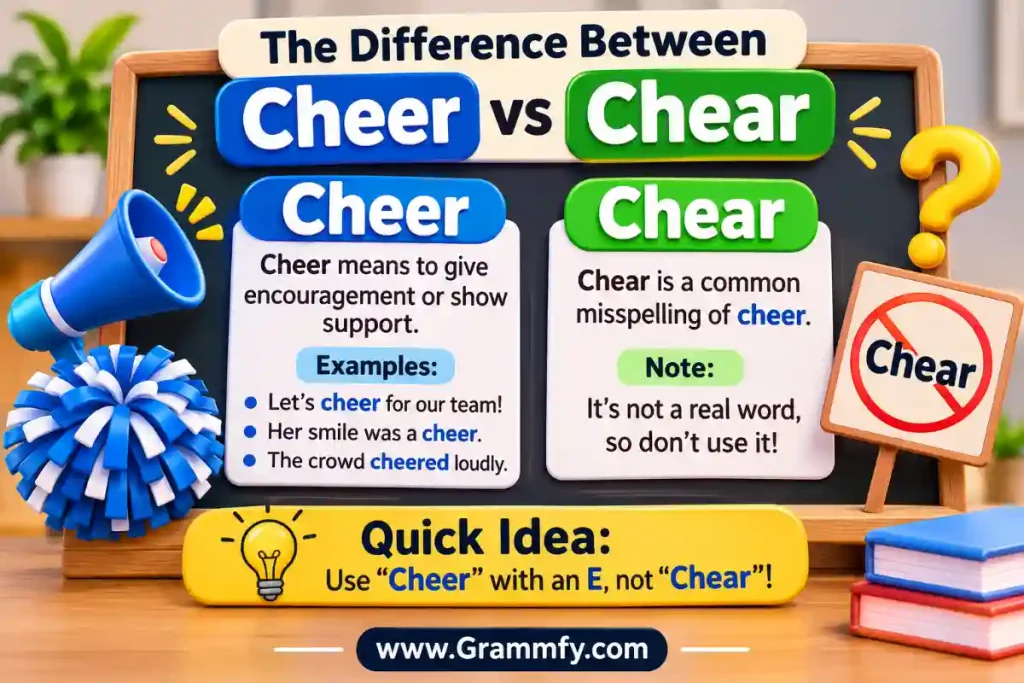
The main difference is that cheer is the standard English word, while chear is a nonstandard spelling that should generally be avoided.
- Cheer: A correct word that can mean happiness, encouragement, support, or a loud expression of approval.
- Chear: An incorrect spelling in modern standard English. Use cheer instead.
For example:
- Correct: Her friends came to cheer her up.
- Incorrect: Her friends came to chear her up.
Remember that the correct spelling has two consecutive e letters before the final r.
Is Cheer or Chear the Correct Spelling?
Cheer is the correct spelling in modern American and British English. You should use it in professional writing, school assignments, everyday conversations, and online communication.
The spelling chear may appear in historical texts, unusual names, or old spelling variations, but it isn’t the standard form for modern writing.
Here are a few examples:
- The crowd began to cheer when the team scored.
- A little encouragement can bring cheer to someone’s day.
- My family always cheers me on when I face a challenge.
- Her cheerful personality makes everyone feel welcome.
In each example, the correct spelling uses cheer, not chear.
What Does Cheer Mean?
The word cheer has several meanings depending on how it’s used. It can function as both a noun and a verb.
1. Cheer as a noun
As a noun, it refers to happiness, encouragement, or a loud expression of support.
Examples:
- The children’s laughter brought cheer to the room.
- We heard a loud cheer from the football crowd.
- Her kind words gave me the cheer I needed.
- The holiday decorations added festive cheer to the house.
2. Cheer as a verb
As a verb, it means to encourage someone, show support, or express excitement by shouting.
Examples:
- The fans cheered for their favorite team.
- I called my friend to cheer her up.
- Everyone cheered when the winner was announced.
- His parents always cheer him on during competitions.
3. Cheer in common expressions
The word also appears in several everyday expressions.
| Expression | Meaning | Example |
|---|---|---|
| Cheer up | Become happier | Cheer up! Things will get better. |
| Cheer on | Encourage someone | We cheered on our school team. |
| Good cheer | Happiness and positive feelings | The party was full of good cheer. |
| Three cheers | A way to celebrate someone | Three cheers for the winning team! |
| Bring cheer | Make someone happier | Her visit brought cheer to everyone. |
| Cheer someone up | Help someone feel better | A funny movie cheered him up. |
These expressions are useful in everyday conversations, friendly messages, and informal writing.
Where Did Cheer vs Chear Come From?
Understanding a word’s history can make its spelling easier to remember.
The modern word cheer has a long history. According to its etymology, it appeared in English around the year 1200. Its earlier forms came from Anglo-French chere and Old French chiere, meaning face, expression, or countenance. These forms can be traced to Late Latin cara, meaning face. Etymology, Origin & Meaning+1
Over time, its meaning changed.
Here’s a simple look at how the word developed:
- Around 1200: It referred mainly to someone’s face or expression.
- By the mid-13th century: It began describing a person’s mood, feelings, or state of mind.
- Around the 14th century: Its positive meaning became associated with happiness and good spirits.
- By the early 15th century: The verb developed the meaning of encouraging someone through words or actions.
- Around 1720: The meaning of a shouted expression of support or approval was recorded.
The older spelling chear is recorded as an obsolete spelling of the same word. It isn’t a separate modern English word with a different meaning. Etymology, Origin & Meaning+1
This history explains why you might see both forms in older writing, even though only one is appropriate for normal modern use.
What Are the Best Synonyms for Cheer?
Choosing a suitable synonym depends on the meaning you want to express. Sometimes you’re talking about happiness. In other situations, you mean encouragement, applause, or excitement.
Here are 16 useful alternatives grouped by tone and context.
Simple synonyms
These words are easy to understand and work well in everyday communication.
| Word | Meaning | Tone | Example |
|---|---|---|---|
| Joy | A feeling of great happiness | Simple | Her success filled us with joy. |
| Happy | Feeling pleased or satisfied | Simple | Everyone was happy with the result. |
| Support | Help or encouragement | Simple | My family gives me support. |
| Smile | An expression of happiness | Simple | His message brought a smile to my face. |
Everyday synonyms
These alternatives sound natural in conversations, messages, and general writing.
Formal synonyms
These words are useful in academic writing, professional communication, and formal situations.
| Word | Meaning | Tone | Example |
|---|---|---|---|
| Commend | Express approval or praise | Formal | The manager commended his hard work. |
| Acclaim | Publicly praise someone | Formal | Critics acclaimed the performance. |
| Applause | Approval expressed through clapping | Formal | The speech received warm applause. |
| Reassure | Make someone feel less worried | Formal | The supervisor reassured the employees. |
Slang and informal alternatives
These expressions are more relaxed and work best in casual conversations.
| Word | Meaning | Tone | Example |
|---|---|---|---|
| Hype | Create excitement or enthusiasm | Slang | Her friends hyped her up before the match. |
| Boost | Improve someone’s confidence or mood | Informal | That compliment gave me a confidence boost. |
| Root for | Support someone or something | Informal | I’m rooting for our school team. |
| Pump up | Make someone feel excited or motivated | Informal | The coach pumped up the players. |
Is Cheer vs Chear Different in American and British English?
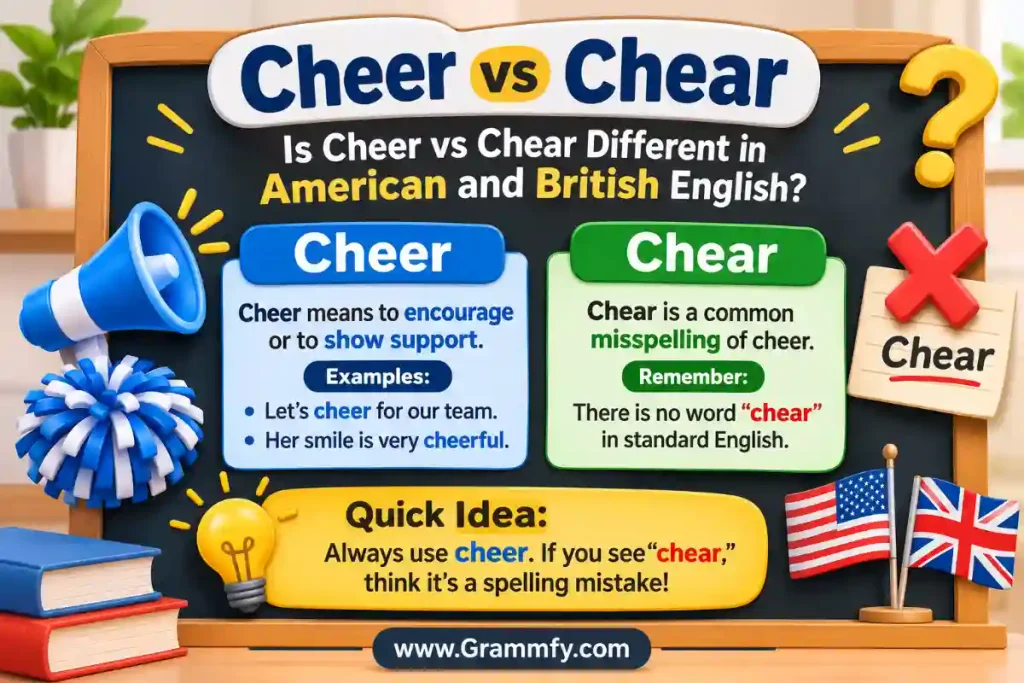
No major spelling difference exists between American and British English for this word. Both varieties use cheer as the standard modern spelling.
However, some expressions and conversational habits vary by region.
| Context | American English | British English |
|---|---|---|
| Correct spelling | Cheer | Cheer |
| Past tense | Cheered | Cheered |
| Present participle | Cheering | Cheering |
| Person who supports a team | Cheerleader | Cheerleader |
| Informal farewell or toast | Cheers | Cheers |
American English examples
- The students cheered when the teacher announced the results.
- Let’s cheer for our basketball team.
- I need something to cheer me up after work.
British English examples
- The supporters cheered loudly at the stadium.
- Her friends gave her three cheers.
- Cheers for helping me with the project.
One interesting regional difference is the use of cheers. In British English, it is commonly used as an informal way to say thank you or goodbye. It can also be used when making a toast. The expression is also understood in other English-speaking regions.
Neither American nor British standard spelling uses chear in ordinary modern writing.
Which Word Should You Use in Different Writing Situations?
The correct spelling is only part of good writing. You should also choose the right form and expression for your situation.
1. Which spelling should you use on a resume?
Use cheer when describing encouragement, team spirit, or a positive workplace environment.
However, a resume usually benefits from stronger, more specific action words.
Examples:
- Encouraged team members to meet project deadlines.
- Supported new employees during their training.
- Promoted a positive and cooperative work environment.
Avoid writing chear in a resume. Also, don’t use overly casual expressions such as “hyped everyone up” unless the role specifically calls for informal language.
2. How should you use cheer in an essay?
In an essay, use the word when discussing happiness, emotional support, celebration, or public approval.
Examples:
- The community came together to cheer for the young athletes.
- Small acts of kindness can bring cheer to people facing difficult times.
- The announcement was welcomed with cheers from the audience.
If you’re writing an academic essay, choose precise alternatives when needed. Words such as encouragement, approval, and enthusiasm may communicate your point more clearly.
3. Can you use cheer in a text message?
Yes! It’s a natural word for friendly and informal messages.
Examples:
- Hope this message cheers you up!
- I’m cheering for you tomorrow.
- You did amazing! Keep going!
- Sending some good cheer your way.
You can also use the expression “cheer up” when trying to improve someone’s mood. Just make sure your message sounds supportive rather than dismissive.
4. How should you use cheer in an email?
The word works well in friendly professional emails, especially when congratulating someone or offering encouragement.
Examples:
- Congratulations on completing the project! Your hard work deserves a cheer.
- We’re all cheering you on as you begin your new role.
- Your positive attitude brings cheer to the entire team.
For formal business emails, avoid exaggerated expressions. Keep your message respectful and natural.
5. How do you use cheer when speaking?
In spoken English, the word is common when expressing excitement, supporting someone, or talking about happiness.
Examples:
- We cheered when our team won.
- Let’s cheer them on!
- Her visit really cheered me up.
The pronunciation is the same in ordinary American and British English, although accents can affect the exact vowel sound.
What Are 12 Examples of Cheer in Real-Life Situations?
Examples make spelling rules easier to remember. Here are 12 original sentences showing how the word works in different situations.
| Situation | Example sentence |
|---|---|
| Sports | The fans began to cheer when the players entered the field. |
| School | Her classmates cheered after she won the spelling competition. |
| Workplace | The manager’s positive words brought cheer to the office. |
| Friendship | I called my best friend to cheer him up after a difficult day. |
| Family | Everyone gathered to cheer for my younger brother. |
| Celebration | The room was filled with laughter and holiday cheer. |
| Music | The audience erupted into cheers after the final song. |
| Travel | The friendly welcome brought cheer after a long journey. |
| Education | Teachers should encourage students instead of discouraging them. |
| Competition | Our coach told us to cheer on every player. |
| Community | Volunteers brought cheer to families during the holiday season. |
| Personal growth | Her success gave me the encouragement to follow my dreams. |
Cheer vs Other Similar Words: The Difference
Sometimes the confusion isn’t about spelling. It comes from choosing between words that have related meanings.
Here are some useful comparisons to help you understand when to use each word.
1. Cheer vs Cheers
Both words are correct, but they have different uses.
| Cheer | Cheers |
|---|---|
| Can mean happiness or encouragement | Often means applause, a toast, or an informal thank-you |
| Can be a noun or verb | Commonly used as a plural noun or interjection |
| She gave a loud cheer. | Cheers for your help! |
Remember: Use cheer for general encouragement or happiness. Use cheers when expressing thanks, making a toast, or describing multiple shouts of support.
2. Cheer vs Cheerful
These words share the same root, but they have different grammatical roles.
| Cheer | Cheerful |
|---|---|
| Noun or verb | Adjective |
| Means happiness or encouragement | Describes someone or something that feels happy |
| Her words brought cheer. | She has a cheerful personality. |
Remember: Use cheer to describe happiness or encouragement. Use cheerful to describe a person, place, or situation.
3. Cheer vs Encourage
These words can have similar meanings, but they aren’t always interchangeable.
| Cheer | Encourage |
|---|---|
| Can mean shouting to show support | Means giving someone confidence or motivation |
| Often used in celebrations and sports | Used in personal, educational, and professional situations |
| We cheered for our team. | We encouraged our team to keep practicing. |
Remember: You can cheer for someone by shouting or showing support. You encourage someone by helping them feel confident enough to continue.
4. Cheer vs Applaud
Both words can express approval, but they describe different actions.
| Cheer | Applaud |
|---|---|
| May involve shouting or expressing excitement | Usually means clapping to show approval |
| The crowd cheered loudly. | The crowd applauded the speaker. |
Remember: Applause usually involves clapping, while cheering can involve shouting, clapping, or other expressions of excitement.
The Most Common Spelling Mistakes
English spelling can be tricky because similar sounds don’t always follow the same spelling patterns. The confusion between the correct word and its obsolete variation is one example.
Here are some mistakes worth avoiding.
1. Using the wrong vowel combination
The most obvious mistake is replacing the second e with a.
- Incorrect: The crowd gave a loud chear.
- Correct: The crowd gave a loud cheer.
The correct modern spelling contains ee, not ea.
2. Assuming both spellings are interchangeable
Some people believe that because an older spelling exists, both versions are acceptable today.
That’s not how modern spelling works. Historical variations don’t automatically become accepted alternatives in present-day English.
Use the established modern spelling in your writing.
3. Mixing up cheer and cheerful
These words are related, but they don’t perform the same grammatical job.
- Incorrect: She is full of cheerfully.
- Correct: She is full of cheerfulness.
- Correct: She is cheerful.
Choose the form that fits the sentence.
4. Using cheer when you mean cheering
The word changes depending on whether you’re describing an action happening now.
- Incorrect: The fans are cheer for their team.
- Correct: The fans are cheering for their team.
Use the base form after certain verbs and the -ing form after forms of be when describing an ongoing action.
5. Overusing cheer in formal writing
Although the word is perfectly acceptable in professional writing, repeating it too often can make your sentences sound less natural.
Instead, choose a more precise word when the meaning calls for it.
For example:
- Repetitive: The manager gave us cheer and cheered our work.
- Better: The manager praised our work and encouraged the team.
Good writing isn’t about using the same word everywhere. It’s about expressing your meaning clearly.
Antonyms of Cheer
Antonyms are words with opposite or contrasting meanings. The best opposite depends on whether you’re talking about happiness, encouragement, or public approval.
Here are some useful options:
| Antonym | Meaning | Example |
|---|---|---|
| Sadness | A feeling of unhappiness | The news filled her with sadness. |
| Gloom | A state of darkness or unhappiness | The rainy weather created a sense of gloom. |
| Despair | A complete loss of hope | He refused to give in to despair. |
| Discouragement | A loss of confidence or motivation | Constant criticism caused discouragement. |
| Disapproval | A negative opinion or judgment | The proposal received disapproval. |
| Booing | Shouting to show dislike | The crowd responded with booing. |
| Misery | Extreme unhappiness | He struggled through a period of misery. |
Remember that these words aren’t direct opposites in every sentence. For example, sadness contrasts with happiness, while disapproval contrasts with approval.
How Can You Remember the Correct Spelling?
A simple memory trick can help you avoid spelling mistakes without memorizing complicated rules.
1. Remember the double E
The correct word contains two e letters together.
Think of it this way:
- Cheer = Correct
- Chear = Obsolete spelling
Whenever you write this word, check the two vowels before the final r.
2. Connect cheer with cheerful
Think about the related word cheerful. Both words share the same beginning and spelling pattern.
Examples:
- Cheer
- Cheerful
- Cheerfully
- Cheerfulness
- Cheering
Once you remember the base spelling, these related words become easier to write.
3. Think about encouragement
Imagine a crowd supporting its favorite team.
People shout, clap, and encourage the players. That action is called cheering.
Connect that familiar situation with the correct spelling.
4. Read your sentence aloud
Reading your sentence can help you notice awkward wording, but remember that pronunciation alone won’t identify this spelling mistake. Both forms may look similar and have the same historical pronunciation.
Always check the written form when you’re unsure.
5. Use a spelling checker
A reliable spelling checker can identify many typing mistakes before you publish or send your work.
However, don’t depend on automatic corrections alone. Learning the correct spelling helps you catch mistakes even when a tool misses them.
Quick Tips for Choosing the Right Word
Keep these simple points in mind whenever you encounter this spelling question:
- Use cheer: When talking about happiness, encouragement, or a shout of support.
- Avoid chear: It’s an obsolete spelling, not the standard modern form.
- Use cheerful: When describing someone or something with a happy attitude.
- Use cheering: When someone is currently showing support or excitement.
- Use cheers: When making a toast, saying an informal thank-you, or describing multiple expressions of support.
- Use encourage: When you mean giving someone confidence or motivation.
- Use applause: When describing approval expressed through clapping.
A quick spelling check before submitting an assignment, email, or article can save you from an unnecessary mistake.
Conclusion: Choose the Correct Spelling Every Time
English spelling becomes easier when you understand the history and meaning behind words. The difference between Cheer vs Chear is straightforward once you know that one is the accepted modern spelling and the other is an obsolete variation.
Use cheer when expressing happiness, supporting someone, or describing a loud reaction from a crowd. You can also use related forms such as cheerful, cheering, and cheers depending on your sentence.
Although you may encounter chear in historical writing, it doesn’t belong in ordinary modern communication. Remember the double E, check your sentence, and choose the established spelling. A small spelling habit can make your emails, essays, and everyday messages clearer and more confident.
Frequently Asked Questions
1. Is cheer or chear correct?
Cheer is the correct modern English spelling. Chear is an obsolete spelling and shouldn’t be used in ordinary contemporary writing.
2. Is chear a real English word?
Chear is a historical spelling that appeared in older English texts. However, it isn’t a standard modern English spelling, so use cheer instead.
3. Why do people confuse cheer and chear?
People confuse these spellings because they look similar and contain familiar English vowel combinations. The difference is only one letter, which makes typing mistakes easy.
4. What is the plural of cheer?
The plural form of the noun is cheers. For example, the audience gave three loud cheers after the performance.
5. What’s another way to say cheer?
Depending on the meaning, alternatives include joy, encouragement, applause, support, enthusiasm, and celebration. Choose the word that best matches your sentence.
6. Is cheer used as a noun or a verb?
Cheer can be both a noun and a verb. As a noun, it means happiness or a shout of support. As a verb, it means to encourage someone or express excitement.
7. Is cheer spelled differently in the UK and US?
No. Both American and British English use cheer as the standard spelling. The obsolete form chear isn’t the accepted modern spelling in either variety.

Tylerbrooks is a US-based English grammar writer and contributor at Grammfy. He writes helpful articles about grammar, spelling, commonly confused words, and vocabulary. His goal is to explain English topics in simple language with clear examples and practical tips. Through his articles, he helps readers improve their writing and everyday English skills.