
Have you ever written an email, school essay, or professional report and wondered whether to use holistic or wholistic? Both words look correct at first glance. They also sound exactly the same when spoken. However, their spelling, history, and acceptance in formal writing can make the choice confusing.
The confusion usually comes from the word whole. Since holistic describes something that considers the entire system rather than just separate parts, adding a W might seem logical. That’s why some writers use wholistic when discussing health, education, personal growth, or business strategies.
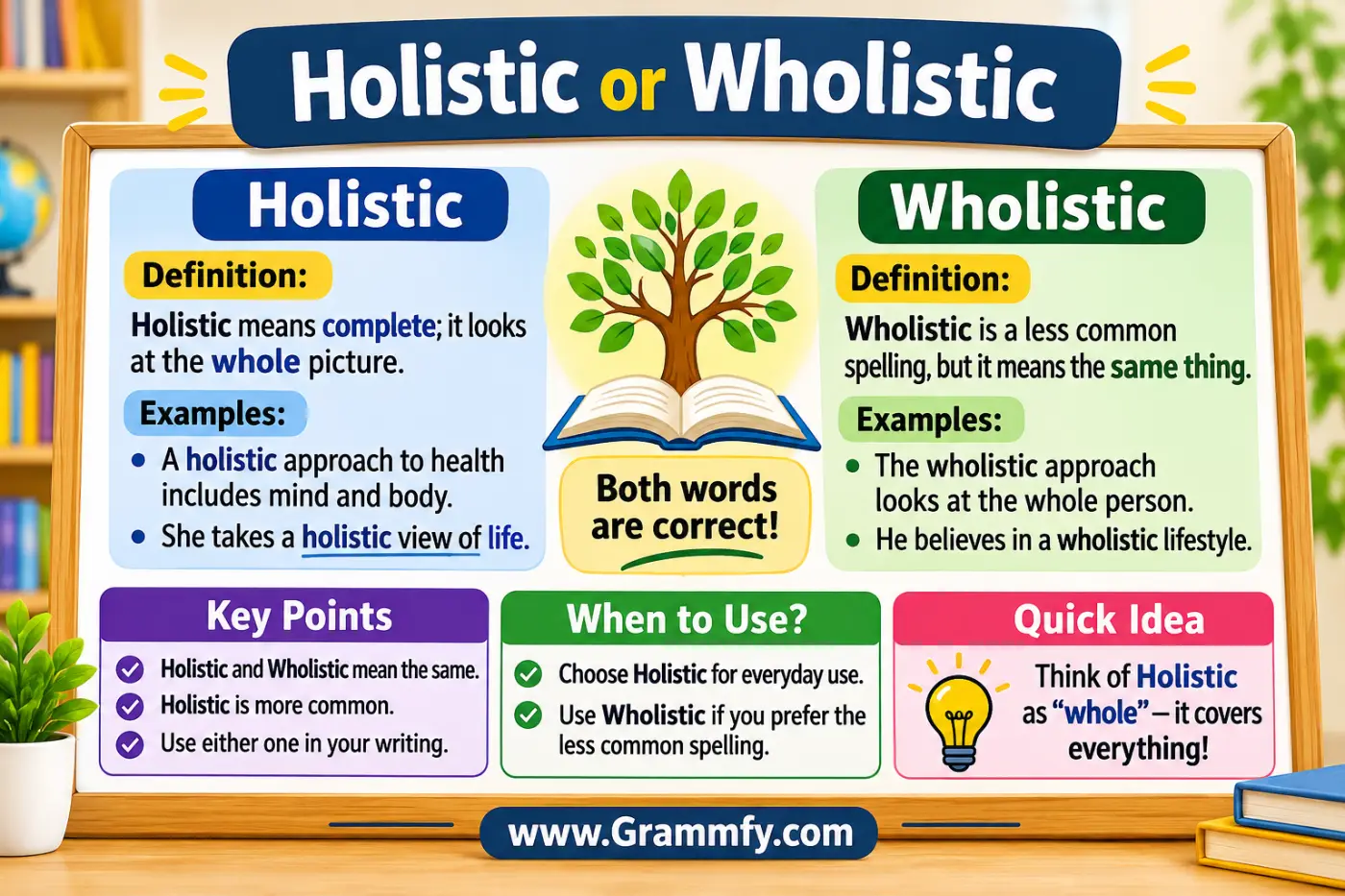
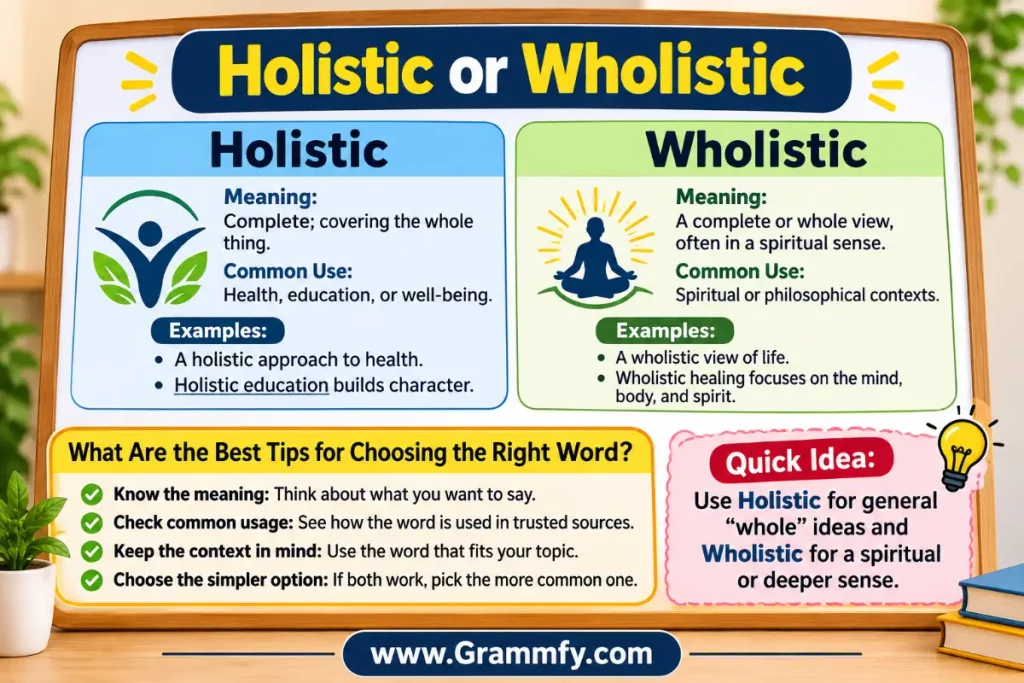
Holistic is the standard and widely preferred spelling. Wholistic is a recognized but much less common variant that generally carries the same meaning. For professional, academic, and everyday writing, holistic is usually the safest choice.
Understanding the difference helps you avoid spelling mistakes and choose words that communicate your ideas clearly. This guide explains their meanings, origins, synonyms, examples, and common usage mistakes. You’ll also learn which alternatives work best in emails, essays, resumes, and everyday conversations.
If you enjoy figurative language, you’ll also like our guide to Rain Similes.
What Does Holistic or Wholistic Mean?
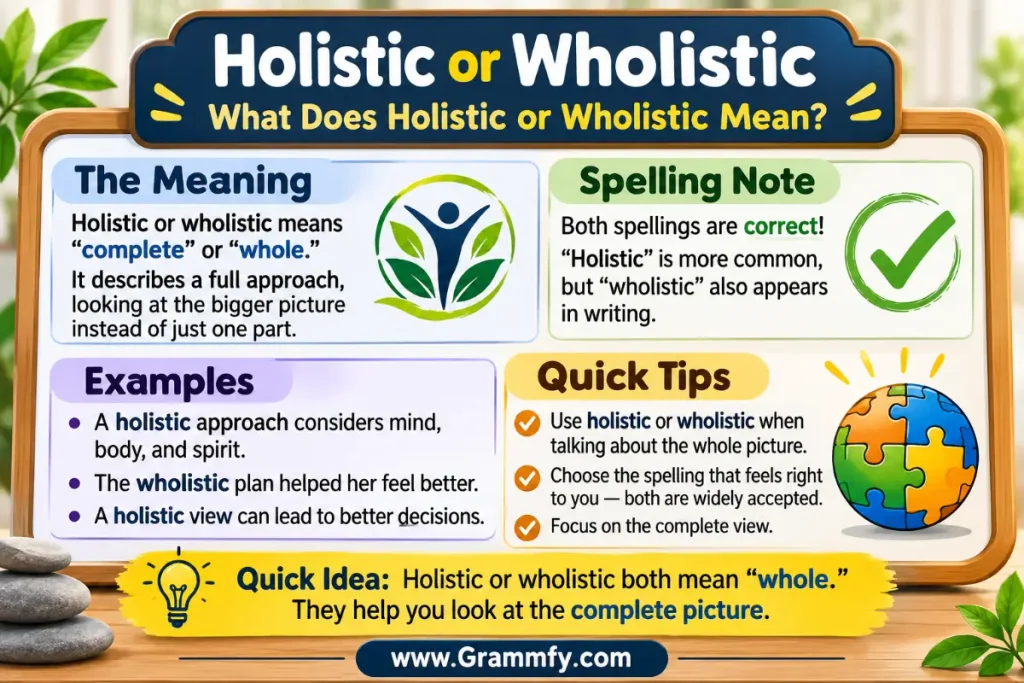
The phrase holistic describes an approach that considers an entire person, situation, or system instead of examining only one part. It focuses on how different elements connect and influence one another.
For example, a doctor who considers a patient’s sleep, diet, stress, lifestyle, and physical symptoms takes a broader approach than someone who looks only at one symptom.
The same idea applies outside healthcare. A teacher might consider a student’s emotional needs, learning habits, family environment, and academic performance. A business manager may examine employees, customers, finances, and company culture before making a decision.
Here are the main ideas behind the word:
- Whole-person thinking: Considering someone’s physical, emotional, and mental needs together.
- Connected elements: Understanding how different parts affect one another.
- Complete perspective: Looking beyond one small detail or isolated problem.
- Balanced approach: Taking several important factors into account before reaching a conclusion.
- Long-term understanding: Considering wider effects rather than focusing only on immediate results.
What Does Holistic Mean in Different Fields?
The meaning stays connected to the idea of wholeness, but its application changes depending on the subject.
| Field | Meaning | Example |
|---|---|---|
| Healthcare | Considering the whole person’s health | A doctor considers sleep, diet, and stress. |
| Education | Supporting different areas of student development | A school focuses on academic and emotional growth. |
| Business | Examining the organization as a connected system | A manager reviews staff, customers, and finances. |
| Psychology | Understanding a person’s experiences and circumstances | A counselor considers relationships and behavior. |
| Personal development | Improving different areas of life together | Someone works on confidence, health, and relationships. |
| Environmental science | Studying ecosystems and their connections | Researchers examine animals, plants, and climate. |
| Technology | Considering how different components work together | A developer reviews the entire software system. |
| Nutrition | Looking at eating habits and overall well-being | A nutritionist considers diet, lifestyle, and activity. |
The central idea is simple: don’t judge the entire situation by examining only one small part.
What Is the Origin of Holistic and Wholistic?
Understanding a word’s history makes its spelling easier to remember. These two forms have an interesting connection with the Greek language and the English word whole.
Where Did the Word Holistic Come From?
The word holistic developed from holism, a term introduced by South African statesman and philosopher Jan Christian Smuts in his 1926 book Holism and Evolution.
Smuts used holism to explain how nature creates complete systems from individual elements. His idea was that a whole can have qualities that cannot be fully understood by studying its separate parts.
The word comes from the Greek element holos, meaning whole or entire. The suffix -istic helps form the adjective.
Its development can be understood like this:
- Holos: An ancient Greek word meaning whole or entire.
- Holism: A philosophical idea about understanding complete systems.
- Holistic: An adjective describing something connected with that approach.
The word later became common in fields such as medicine, education, psychology, and environmental studies.
Where Did the Word Wholistic Come From?
The alternative spelling appeared later, around 1941. It developed through a connection between holistic and the English word whole.
Writers could easily see that holistic described the whole of something. Adding a W therefore seemed like a natural spelling choice.
This process is sometimes called folk etymology. It happens when people reshape a word’s spelling or form because they associate it with another familiar word.
The alternative form has continued to appear in English writing, especially in discussions about wellness, health, and personal development.
However, its history does not make it the preferred spelling. The original form remains much more widely used.
Why Does the Difference in Origin Matter?
The history explains why both forms exist, but it doesn’t mean they have equal standing in modern writing.
- Holistic comes from the Greek-based term holism.
- Wholistic developed later through an association with the English word whole.
- Both generally communicate the idea of considering something in its entirety.
- Modern dictionaries recognize wholistic as a variant, but holistic remains the established form.
Remember that a word’s spelling does not always follow the spelling of the familiar word it resembles.
Which Spelling Should You Use: Holistic or Wholistic?
If you’re unsure which form belongs in your writing, choose holistic. It is the standard spelling used in most professional, academic, medical, and general publications.
Wholistic is not simply an invented combination of letters. Some dictionaries list it as a variant spelling. However, it appears much less frequently and may be marked as an error by spelling and grammar tools.
The following comparison makes the choice easier.
| Feature | Holistic | Wholistic |
|---|---|---|
| Spelling | Standard | Variant |
| Meaning | Considering the whole system | Generally the same |
| Pronunciation | Same | Same |
| Origin | From holism and Greek holos | Later form influenced by whole |
| Frequency | Very common | Much less common |
| Academic writing | Preferred | Usually avoided |
| Professional writing | Recommended | Less suitable |
| Dictionary recognition | Widely recognized | Recognized as a variant in some dictionaries |
| Spell-check acceptance | Commonly accepted | May be flagged |
Is Wholistic a Real Word or a Spelling Mistake?
Wholistic is a real recorded variant, not just a random spelling error. Dictionaries such as Collins and Dictionary.com recognize it as an alternative form of holistic.
However, recognition does not mean that every style guide recommends using it.
Some editors consider it a nonstandard variant and prefer the original spelling. Others accept it but still recommend the more familiar form.
For example:
- Preferred: The school follows a holistic approach to student development.
- Less common: The school follows a wholistic approach to student development.
Both sentences communicate the same basic idea, but the first is the better choice for formal writing.
Does the W Change the Pronunciation?
No. Both forms are pronounced the same way in ordinary English.
The W in wholistic does not create a separate sound. Adding that letter changes the written form, not the usual pronunciation.
This is why readers may not notice which spelling someone uses during a conversation.
For written communication, however, spelling still matters. A reader may recognize the less common form as a variant, but another reader may assume it is a typo.
What Are the Best Synonyms for Holistic?
A synonym is a word or expression with a similar meaning. However, not every alternative works in every sentence.
Some words describe completeness, while others emphasize cooperation, balance, or a broad perspective. Choosing the right one depends on what you want to communicate.
The following list includes 30 useful alternatives, grouped by tone and formality.
1. Simple Synonyms
These words are suitable for basic explanations, school assignments, and everyday writing.
| Word | Meaning | Tone | Example |
|---|---|---|---|
| Whole | Including every part | Simple | We need to understand the whole problem. |
| Complete | Having all necessary parts | Simple | She developed a complete learning plan. |
| Full | Containing all important elements | Simple | The team received a full explanation. |
| Entire | Covering everything | Simple | He reviewed the entire process. |
| Total | Including all parts or amounts | Simple | The total system needs improvement. |
| Overall | Considering everything together | Simple | Her overall progress was impressive. |
| General | Considering a wider subject | Simple | We discussed the general situation. |
| Broad | Covering many areas | Simple | The course offers a broad perspective. |
2. Everyday Synonyms
These alternatives sound natural in conversations, emails, and general articles.
| Word | Meaning | Tone | Example |
|---|---|---|---|
| Balanced | Giving attention to different needs | Everyday | She follows a balanced routine. |
| Inclusive | Considering different people or elements | Everyday | The school created an inclusive program. |
| Connected | Having relationships between parts | Everyday | The team needs a connected strategy. |
| Combined | Bringing different elements together | Everyday | They developed a combined solution. |
| Integrated | Joining parts into one system | Everyday | The company introduced an integrated plan. |
| All-around | Covering several important areas | Everyday | He received all-around support. |
| Extensive | Covering a large range | Everyday | The report provides extensive information. |
| Thorough | Considering details carefully | Everyday | We need a thorough review. |
3. Formal Synonyms
Use these words in academic writing, business reports, research papers, and professional documents.
| Word | Meaning | Tone | Example |
|---|---|---|---|
| Comprehensive | Covering all important aspects | Formal | Researchers completed a comprehensive review. |
| All-encompassing | Including nearly everything | Formal | The policy provides an all-encompassing framework. |
| Systemic | Relating to an entire system | Formal | The organization needs systemic improvements. |
| Multidimensional | Involving several different aspects | Formal | The study takes a multidimensional approach. |
| Interconnected | Having closely related parts | Formal | The report examines interconnected factors. |
| Unified | Working together as one | Formal | The department developed a unified strategy. |
| Cohesive | Forming a connected whole | Formal | The project needs a cohesive structure. |
4. Slang and Casual Alternatives
These expressions are more conversational than formal synonyms. They’re useful in informal writing, texts, and everyday speech.
| Word or Phrase | Meaning | Tone | Example |
|---|---|---|---|
| Big-picture | Looking at the wider situation | Casual | Let’s focus on the big-picture issue. |
| All-around | Covering several areas | Casual | We need all-around support. |
| Across-the-board | Affecting every area | Casual | The changes improved results across the board. |
| From top to bottom | Covering the entire organization | Casual | We reviewed the company from top to bottom. |
| Whole-picture | Considering the complete situation | Informal | I want to see the whole picture first. |
| End-to-end | Covering a complete process | Workplace casual | The team manages the project end-to-end. |
| The full package | Offering many useful qualities | Informal | This program offers the full package. |
Important: These expressions are related alternatives, not perfect replacements. For example, systemic refers to an entire system, while balanced emphasizes fairness or proportion. Always check the meaning before substituting a word.
Which Synonyms Are Best From Mild to Strong?
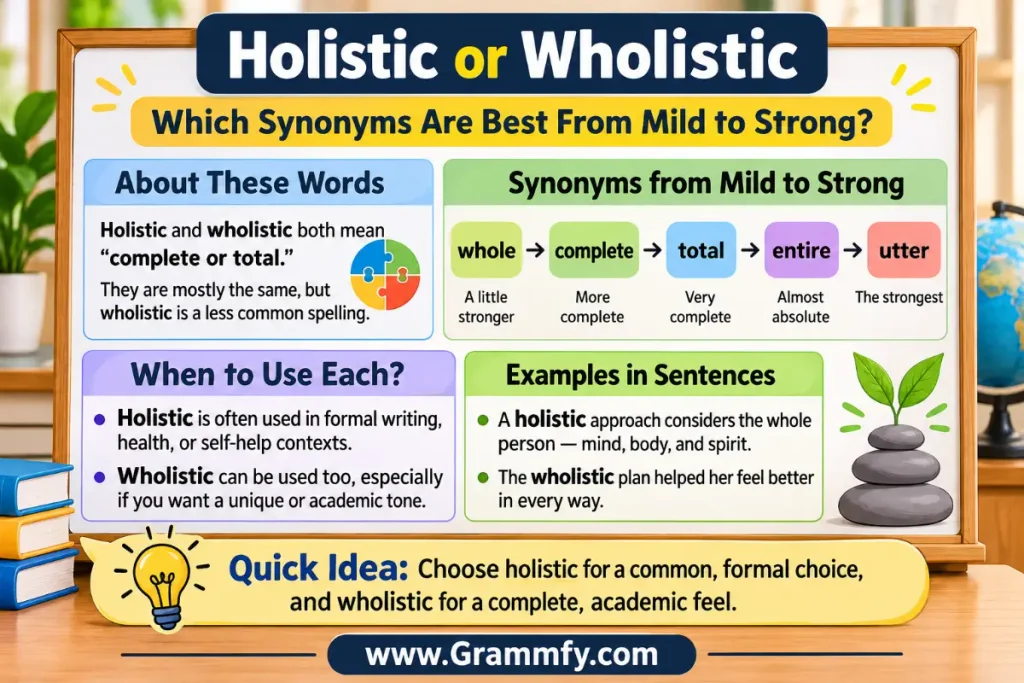
Sometimes, you need a word that communicates a particular level of completeness. A mild alternative may describe a wider view, while a stronger expression may suggest that nearly every relevant detail is included.
Here is a useful progression.
| Level | Word | Meaning | Example |
|---|---|---|---|
| 1. Mild | Broad | Covering a wider subject | We need a broad discussion. |
| 2. Mild | General | Considering the main subject | She gave a general overview. |
| 3. Moderate | Overall | Considering the complete situation | The overall result was positive. |
| 4. Moderate | Inclusive | Giving attention to different elements | They created an inclusive policy. |
| 5. Moderate | Balanced | Considering different needs fairly | He follows a balanced approach. |
| 6. Strong | Integrated | Combining related parts | The company adopted an integrated system. |
| 7. Strong | Comprehensive | Covering all important aspects | The report provides a comprehensive analysis. |
| 8. Very strong | All-encompassing | Including almost every relevant aspect | The proposal offers an all-encompassing solution. |
How Do You Choose the Right Intensity?
Think about the amount of coverage you want to describe.
- Use broad when something covers a large subject but may not include every detail.
- Choose overall when discussing the general result or complete situation.
- Pick balanced when different needs or priorities receive appropriate attention.
- Use integrated when separate elements work together.
- Select comprehensive when a subject receives detailed and wide-ranging attention.
- Choose all-encompassing when you want to emphasize extremely wide coverage.
These levels are practical writing choices, not fixed dictionary rankings. A comprehensive report, for example, may be more detailed than an all-encompassing strategy.
What Are the Different Parts of Speech?
Understanding parts of speech helps you use related forms correctly.
The main word is an adjective, but English also has related nouns and adverbs.
1. Holistic (Adjective)
An adjective describes a noun. Holistic tells readers that something considers a complete person, system, or situation.
Examples:
- The doctor recommended a holistic treatment plan.
- Our school introduced a holistic education program.
- She believes in a holistic approach to personal growth.
- The organization needs a holistic business strategy.
2. Holistically (Adverb)
The adverb holistically explains how someone approaches or examines a subject.
Examples:
- The counselor evaluates each student holistically.
- We need to examine the problem holistically.
- The company manages its resources holistically.
- Researchers studied the ecosystem holistically.
3. Holism (Noun)
Holism is the principle or philosophy that a complete system should be understood through its relationships and organization, not just by examining individual parts.
Examples:
- Holism plays an important role in some approaches to medicine.
- The research explores holism in environmental science.
- Her philosophy is based on the idea of holism.
4. Wholistic and Wholistically
These are alternative forms associated with the same general idea.
Examples:
- The center promotes wholistic wellness.
- They discussed wholistic methods of education.
For standard writing, prefer holistic and holistically.
There is no commonly used standard verb form of holistic. Instead of creating one, rewrite the sentence using a suitable verb such as consider, integrate, examine, or combine.
Is There a Difference in US and UK English?
Writers sometimes assume that wholistic is the British spelling and holistic is the American spelling. That assumption is misleading.
Unlike words such as color and colour or organize and organise, this pair does not represent a regular American-versus-British spelling difference.
Both varieties generally favor holistic.
| Region | Preferred Form | Alternative Form |
|---|---|---|
| United States | Holistic | Wholistic is less common |
| United Kingdom | Holistic | Wholistic is recognized as a variant |
| Canada | Holistic | Wholistic may appear occasionally |
| Australia | Holistic | Wholistic is less common |
| New Zealand | Holistic | Wholistic is less common |
| International English | Holistic | Wholistic is a less familiar alternative |
Collins also lists wholistic as a variant spelling, rather than presenting it as a separate regional form.
Which Form Should International Writers Choose?
If your readers come from different English-speaking countries, holistic is the most reliable option.
It is familiar to readers in the United States, United Kingdom, Australia, Canada, and other English-speaking regions.
Consider these examples:
- US business report: The company needs a holistic growth strategy.
- UK school report: Teachers support holistic student development.
- Australian health article: The clinic promotes holistic wellness.
- Canadian research paper: Researchers examined the issue using a holistic framework.
One standard spelling makes your writing easier to understand across different regions.
What Is the Best Word to Use in Different Writing Situations?
A word may be correct but still sound unnatural in a particular setting. Your audience, purpose, and writing style should guide your choice.
Here are five common situations and the alternatives that work best.
1. Which Word Works Best in a Resume?
A resume should use clear, professional language. Employers want to understand your skills, responsibilities, and achievements without reading complicated expressions.
Holistic can work when describing a broad management, planning, or problem-solving approach. However, words such as comprehensive, integrated, and strategic may communicate your abilities more directly.
Examples:
- Developed a comprehensive training program for new employees.
- Created an integrated strategy to improve team performance.
- Used a balanced approach to manage customer relationships.
- Led a broad review of company operations.
- Coordinated an all-around employee development initiative.
Resume tip: Choose a specific word that describes what you actually did. Don’t use holistic simply because it sounds professional.
2. Which Word Works Best in an Essay?
Academic writing often discusses ideas that involve several connected factors. Holistic is useful when explaining a broad approach to a subject.
It works particularly well in essays about education, public health, psychology, environmental science, and social development.
Examples:
- A holistic understanding of education includes academic and emotional development.
- Environmental protection requires a comprehensive approach.
- The research examines interconnected social and economic factors.
- A multidimensional perspective helps explain the issue.
- Students benefit from an integrated learning environment.
When writing an academic argument, explain what makes the approach complete. Simply adding holistic to a sentence does not make the argument more convincing.
3. Which Word Works Best in Texting?
Text messages usually sound more natural when they use simple expressions.
You don’t need a formal adjective every time you want to describe a complete situation.
Examples:
- Let’s look at the whole picture before deciding.
- I want a balanced plan for next month.
- We should consider everything first.
- I need a complete explanation.
- Let’s take a big-picture approach.
Holistic is still appropriate in a casual message when discussing wellness, lifestyle, or personal development.
For example:
“I’ve started following a more holistic approach to my daily routine.”
The important thing is to match your language to the conversation.
4. Which Word Works Best in an Email?
Professional emails should be polite, direct, and easy to understand.
Holistic is appropriate when you’re discussing a plan that considers several connected areas. Comprehensive is often better when you mean a detailed review or explanation.
Examples:
- We recommend a holistic approach to improving employee well-being.
- Please provide a comprehensive overview of the project.
- Our team is developing an integrated solution.
- I would appreciate a broader review of the current strategy.
- The proposed changes should support a balanced working environment.
Avoid using wholistic in formal business communication when the standard form is available.
5. Which Word Works Best in Speaking?
In everyday conversations, you can use either holistic or a simpler expression, depending on your audience.
For example, when talking to a friend, you might say:
“I want to look at the whole picture before making a decision.”
In a professional discussion, you could say:
“We need a holistic approach to solve this issue.”
Other natural alternatives include:
- Let’s consider everything.
- We need a broader perspective.
- All the important factors are connected.
- We should look at the complete situation.
- The different parts need to work together.
The best spoken expression is the one your listener understands immediately.
What Are 12 Original Example Sentences?
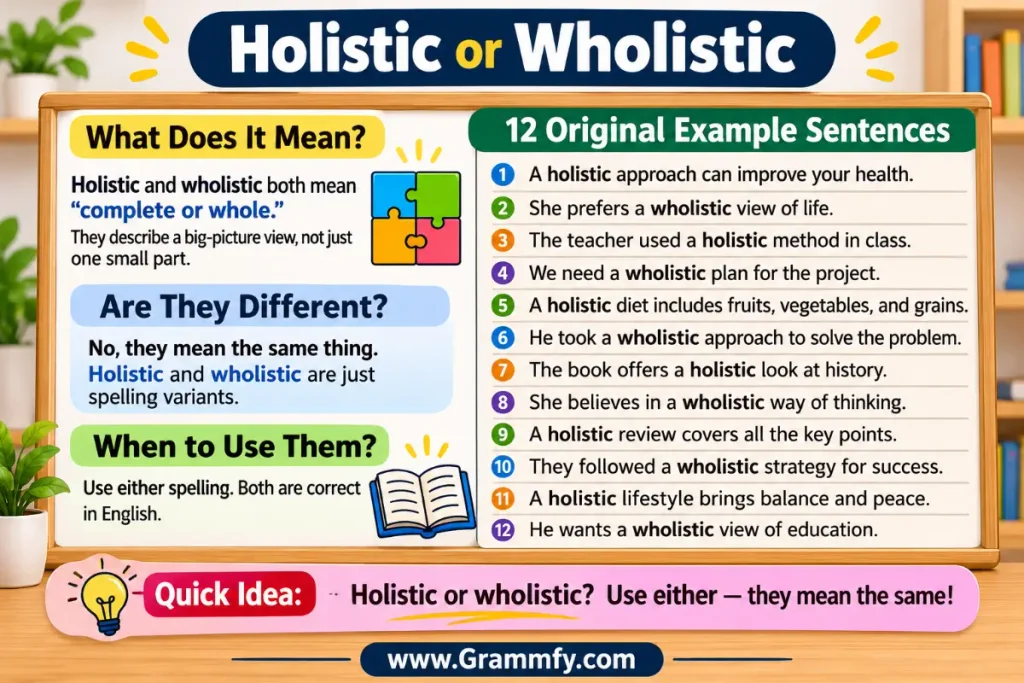
Examples make spelling and meaning easier to remember. The following sentences show how the standard word works in different situations.
- Healthcare: The doctor recommended a holistic approach that considered the patient’s diet, sleep, and emotional well-being.
- Education: Our school introduced a holistic learning program to support students’ academic and personal development.
- Business: The manager developed a holistic strategy to improve customer satisfaction and employee performance.
- Personal growth: She believes that a holistic lifestyle includes physical health, mental strength, and meaningful relationships.
- Environmental protection: Scientists suggested a holistic solution that considered wildlife, pollution, and climate conditions.
- Psychology: The counselor used a holistic perspective to understand the teenager’s behavior and family circumstances.
- Nutrition: A holistic nutrition plan considers eating habits, physical activity, sleep, and individual needs.
- Technology: The developers adopted an integrated approach to improve the entire software system.
- Community development: The organization created a comprehensive program to address housing, education, and employment challenges.
- Workplace: A holistic employee support system can consider professional development, mental well-being, and workplace relationships.
- Research: The researchers examined the issue from a holistic perspective rather than focusing on one isolated factor.
- Daily life: Taking a holistic approach helped him create a healthier balance between work, family, and personal interests.
How Can You Learn From These Examples?
Notice that the adjective usually appears before a noun, such as approach, strategy, program, perspective, or lifestyle.
It can also describe a method or system that connects several elements.
You can use this simple pattern:
Holistic + noun
Examples:
- Holistic approach
- Holistic education
- Holistic healthcare
- Holistic development
- Holistic treatment
- Holistic strategy
- Holistic perspective
- Holistic wellness
This pattern helps you create natural sentences without forcing the word into places where it doesn’t belong.
Holistic vs. Comprehensive: What’s the Difference?
Both words describe approaches that consider more than one small detail. However, they emphasize different things.
Holistic focuses on the relationships between parts and how they work together.
Comprehensive emphasizes coverage. It describes something that includes all or nearly all important information, details, or areas.
| Feature | Holistic | Comprehensive |
|---|---|---|
| Main idea | Understanding the whole system | Covering all important details |
| Main focus | Relationships between parts | Breadth and completeness |
| Common use | Health, education, systems | Reports, reviews, plans |
| Emphasis | Connection and interaction | Thorough coverage |
| Example | Holistic healthcare | Comprehensive medical report |
Examples:
- The hospital follows a holistic approach to patient care.
- The hospital prepared a comprehensive report about patient safety.
The first sentence describes a way of treating people. The second describes a detailed document.
Use holistic when relationships matter. Use comprehensive when complete coverage matters.
Holistic vs. Integrated: What’s the Difference?
These words are closely related, but they are not interchangeable in every situation.
Integrated describes separate elements that have been joined into one working system.
Holistic describes a perspective that considers the complete system and its relationships.
| Feature | Holistic | Integrated |
|---|---|---|
| Main focus | The complete system | Joined or combined parts |
| Meaning | Considering the whole | Bringing elements together |
| Common use | Healthcare, education, philosophy | Business, technology, education |
| Example | Holistic student development | Integrated learning system |
Examples:
- The school takes a holistic approach to student development.
- The school uses an integrated learning platform.
In the first example, the school considers different aspects of student growth. In the second, different learning tools or subjects work together.
A system can be integrated without necessarily being holistic. Likewise, an approach can be holistic even when it doesn’t involve combining separate tools or departments.
Holistic vs. Balanced: Which One Should You Choose?
Balanced emphasizes fairness, proportion, or giving appropriate attention to different needs.
Holistic emphasizes understanding the entire system and its connections.
| Feature | Holistic | Balanced |
|---|---|---|
| Main idea | Looking at the whole | Maintaining proper proportion |
| Focus | Connected elements | Different needs or priorities |
| Common use | Healthcare and education | Lifestyle and decision-making |
| Example | Holistic treatment plan | Balanced diet |
Examples:
- The therapist uses a holistic method to understand the patient’s condition.
- She follows a balanced routine that includes exercise and rest.
A holistic approach may include balance, but the two words don’t mean exactly the same thing.
What Are the Common Mistakes When Using These Words?
Even experienced writers sometimes confuse similar-looking words. Understanding the following mistakes can help you improve your spelling and sentence structure.
1. Assuming Wholistic Is the Preferred Spelling
The familiar word whole makes the alternative spelling look logical. However, holistic is the established spelling.
Incorrect choice for standard writing:
- The company adopted a wholistic management strategy.
Preferred:
- The company adopted a holistic management strategy.
Wholistic is recognized as a variant, but the standard form is more suitable for most writing situations.
2. Treating the Two Forms as Different Concepts
Some people assume that holistic and wholistic describe completely different ideas.
In general English usage, they carry the same basic meaning.
There may be writers who deliberately use wholistic to emphasize the word whole. However, this is a stylistic preference rather than a widely established distinction.
Don’t assume that adding W creates a separate technical meaning.
3. Thinking Holistic Only Relates to Healthcare
Healthcare is one of the most familiar fields where the word appears, but its meaning is much wider.
It can describe:
- Business management
- Educational development
- Environmental research
- Personal growth
- Social programs
- Technology systems
- Community planning
For example:
“The company needs a holistic strategy for improving its workplace culture.”
This sentence has nothing to do with medical treatment.
4. Using Holistic When You Mean Detailed
Holistic and comprehensive are related, but they emphasize different things.
Consider these examples:
- The researcher used a holistic perspective to understand the problem.
- The researcher prepared a comprehensive report containing all the findings.
The first describes an approach. The second describes the amount of information included.
5. Using It Without Explaining the Connections
A holistic approach should consider relationships between important elements.
For example, saying “We need a holistic solution” without explaining the relevant factors may sound vague.
A clearer sentence would be:
“We need a holistic solution that considers employee training, workplace conditions, and customer needs.”
This version explains what makes the approach broad and connected.
6. Overusing It in Professional Writing
Using the same adjective repeatedly can make an article or report sound unnatural.
Instead of writing:
- A holistic strategy is important.
- Our holistic system supports growth.
- The holistic plan improves results.
Try using more precise alternatives:
- A comprehensive strategy is important.
- Our integrated system supports growth.
- The balanced plan improves results.
Different words help you communicate specific ideas without unnecessary repetition.
7. Confusing Holistic With Alternative Medicine
Holistic medicine often considers a person’s overall well-being rather than focusing only on symptoms.
However, holistic does not automatically mean natural, herbal, or alternative treatment.
A medical approach can consider the whole patient while still using conventional, evidence-based treatments.
The word describes the scope of an approach, not whether a treatment is scientifically proven.
What Are the Antonyms of Holistic?
An antonym is a word with an opposite or contrasting meaning.
Since holistic emphasizes complete systems and connected parts, its opposites often describe narrow, partial, or separated approaches.
| Antonym or Contrasting Word | Meaning | Example |
|---|---|---|
| Partial | Including only some parts | The report provides a partial explanation. |
| Fragmented | Divided into separate pieces | The organization has a fragmented system. |
| Narrow | Limited in scope | The study takes a narrow perspective. |
| Limited | Restricted in coverage | The research has a limited focus. |
| Isolated | Separate from other elements | The team examined an isolated problem. |
| Piecemeal | Done in separate stages or parts | The company adopted a piecemeal solution. |
| Disconnected | Not properly linked | The departments use disconnected systems. |
| Incomplete | Missing important elements | The proposal provides an incomplete explanation. |
Which Opposite Should You Use?
The right antonym depends on your intended meaning.
- Use partial when something includes only some parts.
- Choose fragmented when a system is divided.
- Pick narrow when someone considers only a limited subject.
- Use piecemeal when something is handled in separate stages.
- Choose disconnected when different elements lack proper relationships.
For example, a holistic strategy considers connected factors, while a fragmented strategy may address each problem separately.
What Are the Best Tips for Choosing the Right Word?
Selecting a suitable synonym is not only about finding a word with a similar dictionary meaning. You also need to consider your audience, purpose, and sentence structure.
Here are some practical tips.
1. Identify What You Want to Emphasize
Ask yourself what makes the approach important.
- If you’re discussing the whole system, choose holistic.
- If you’re emphasizing complete coverage, choose comprehensive.
- If you’re describing joined elements, choose integrated.
- If you’re discussing fairness, choose balanced.
- If you’re describing a wide subject, choose broad.
This simple step prevents confusing similar expressions.
2. Consider Your Audience
A school assignment may need simple words, while a research paper may require more precise academic language.
For example:
- Simple: We need to understand the whole situation.
- Everyday: We need a balanced approach.
- Professional: We need a comprehensive strategy.
- Academic: The study examines interconnected factors within the system.
Choose language that your intended readers can understand easily.
3. Check the Sentence Before Replacing the Word
A synonym may change the meaning of your sentence.
For example:
“The school follows a holistic approach to education.”
Replacing holistic with complete may produce:
“The school follows a complete approach to education.”
The second sentence sounds less natural because complete doesn’t communicate the same emphasis on connected aspects of development.
Read the entire sentence after making a substitution.
4. Use the Standard Spelling in Formal Writing
When preparing essays, reports, articles, or professional emails, use holistic.
Although wholistic is recognized as a variant, the standard spelling is more familiar and less likely to distract readers.
5. Avoid Complicated Words When Simple Ones Work
You don’t need an advanced synonym in every sentence.
For example:
- Complicated: The organization developed an all-encompassing operational framework.
- Simpler: The organization developed a complete plan.
Both sentences can work, but the second may be easier for general readers.
6. Don’t Confuse Completeness With Quality
A broad approach isn’t automatically a good approach.
A holistic plan must still consider relevant evidence, practical limitations, and the needs of the people involved.
Adding the word holistic to a sentence does not prove that a plan is effective.
7. Use a Dictionary When You Are Unsure
Reliable dictionaries help you check spelling, definitions, pronunciation, and word forms.
For this pair, Cambridge, Collins, and Dictionary.com are useful references.
Pay attention to whether a dictionary marks a form as standard, alternative, or less common.
8. Read Your Sentence Out Loud
Both spellings sound the same, so pronunciation won’t help you identify the spelling difference.
However, reading your sentence aloud can help you notice awkward wording and unnecessary repetition.
After checking the sound and meaning, review the written form separately.
9. Keep Your Writing Consistent
Choose the established spelling and use it throughout your article or document.
Switching between holistic and wholistic without a clear reason can confuse readers.
Consistency is especially important in academic and professional writing.
10. Focus on Meaning Rather Than Fancy Vocabulary
The best word is not always the longest or most impressive one.
Choose an expression that communicates your point accurately.
Clear writing is more valuable than complicated vocabulary.
Conclusion:
When deciding between Holistic or Wholistic, the safest choice is holistic. It is the established spelling and the form most commonly used in professional, academic, medical, and everyday English. Wholistic is recognized as a less common variant, and both forms generally express the idea of considering something as a complete system rather than examining separate parts.
Remember that holistic comes from the Greek-based word holism, while the alternative spelling developed later through its association with whole. They are pronounced alike, so the main difference appears in writing.
For essays, resumes, emails, and website content, choose holistic unless you have a specific reason to preserve the alternative spelling. When selecting synonyms, consider the meaning you want to express. Words such as comprehensive, integrated, balanced, and interconnected can make your writing more precise. With these simple distinctions, you’ll be able to use the right word confidently.
Frequently Asked Questions
1. Is Holistic or Wholistic the Correct Spelling?
Holistic is the standard and preferred spelling in modern English. Wholistic is a recognized but less common variant that generally has the same meaning.
2. Is Wholistic Considered a Real Word?
Yes, some major dictionaries recognize wholistic as a variant spelling of holistic. However, many editors and writing guides recommend using the standard form in formal documents.
3. Why Is Holistic Spelled Without a W?
Holistic comes from holism, which is based on the Greek word holos, meaning whole or entire. Its original spelling was established before the later alternative form developed.
4. What’s Another Word to Say Instead of Holistic?
Comprehensive, integrated, balanced, inclusive, interconnected, and all-encompassing are useful alternatives. The best choice depends on whether you want to emphasize completeness, relationships, or balance.
5. Are Holistic and Wholistic Pronounced the Same?
Yes, both spellings have the same usual pronunciation in English. The additional W in wholistic does not create a different spoken sound.
6. Can I Use Wholistic in Academic Writing?
You can encounter it as a recognized variant, but holistic is the safer choice for academic writing. It is more widely established and is generally preferred by editors and style-conscious writers.
7. Is Holistic Only Used in Healthcare?
No, holistic is also used in education, business, psychology, environmental science, technology, and personal development. It describes an approach that considers the whole system and the connections between its parts.

Tylerbrooks is a US-based English grammar writer and contributor at Grammfy. He writes helpful articles about grammar, spelling, commonly confused words, and vocabulary. His goal is to explain English topics in simple language with clear examples and practical tips. Through his articles, he helps readers improve their writing and everyday English skills.