
Have you ever written an email, school assignment, or work message and paused over Grately vs Greatly? You may have wanted to explain that someone helped you a lot or that you feel deeply thankful. Both spellings look similar, so it is easy to wonder which one belongs in your sentence.
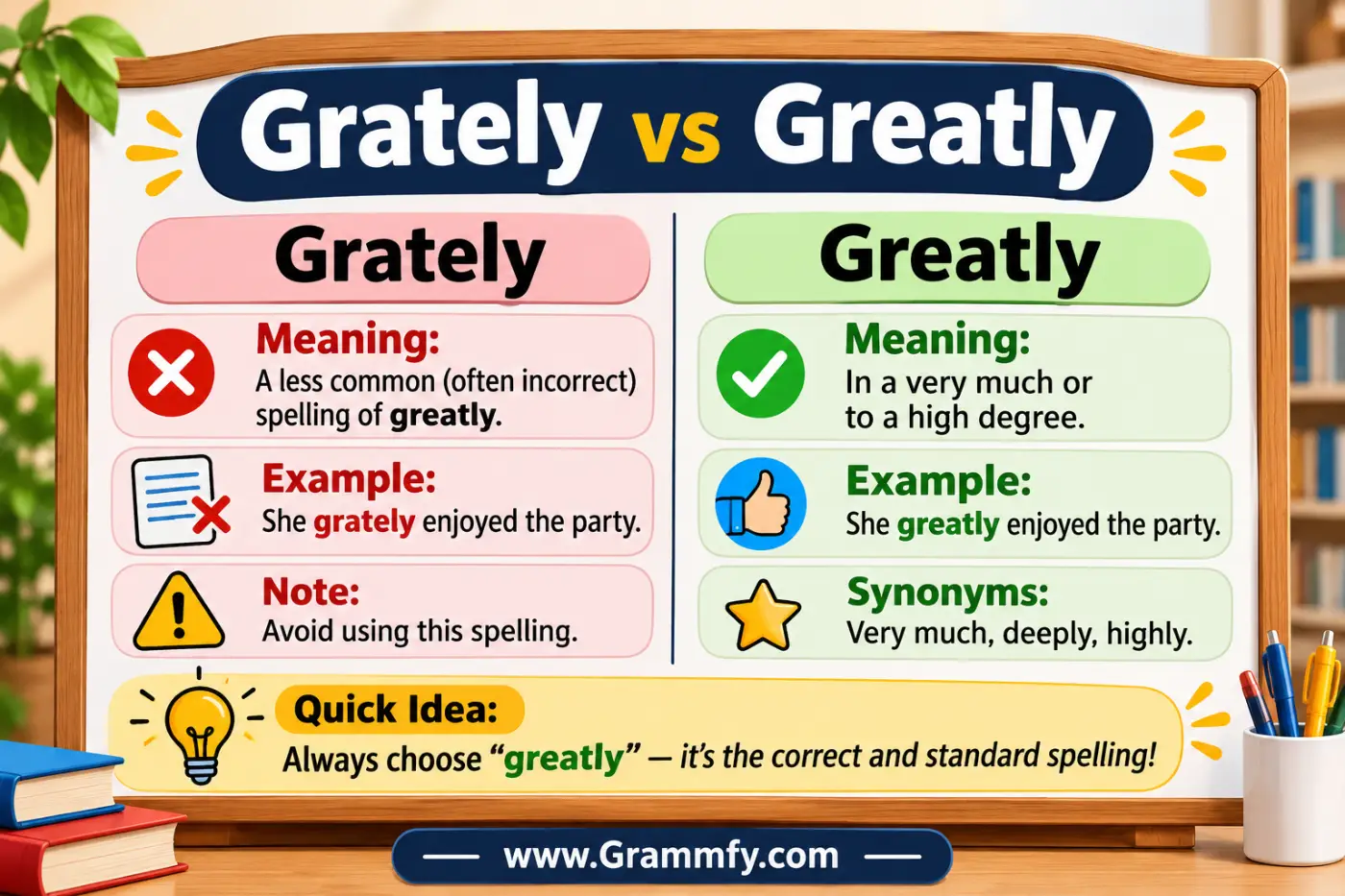
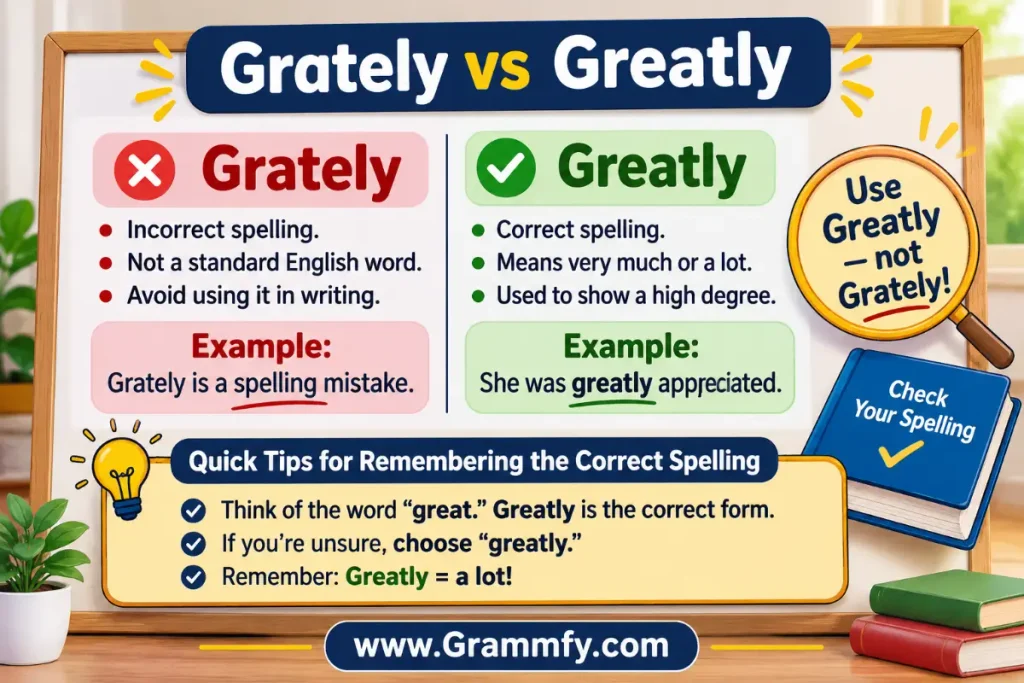
The correct spelling in modern standard English is greatly. It is an adverb that means very much, to a large degree, or considerably. The spelling grately is a common misspelling and is not accepted as the standard form of this word.
Quick answer: Use greatly when you mean very much or to a large extent. Avoid grately in formal and everyday writing because it is an incorrect spelling of the intended word.
This small spelling difference can affect how clear and professional your writing looks. A single letter changes the appearance of the word, even though readers may understand what you meant. Below, you will learn the meanings, word origins, synonyms, examples, common mistakes, and the best alternatives for different writing situations.
English spelling can sometimes be confusing, especially when two words look almost the same. Explore more commonly confused words to understand their correct spellings and meanings. These simple comparisons will help you avoid everyday writing mistakes and improve your English with confidence.
The Difference Between Grately vs Greatly
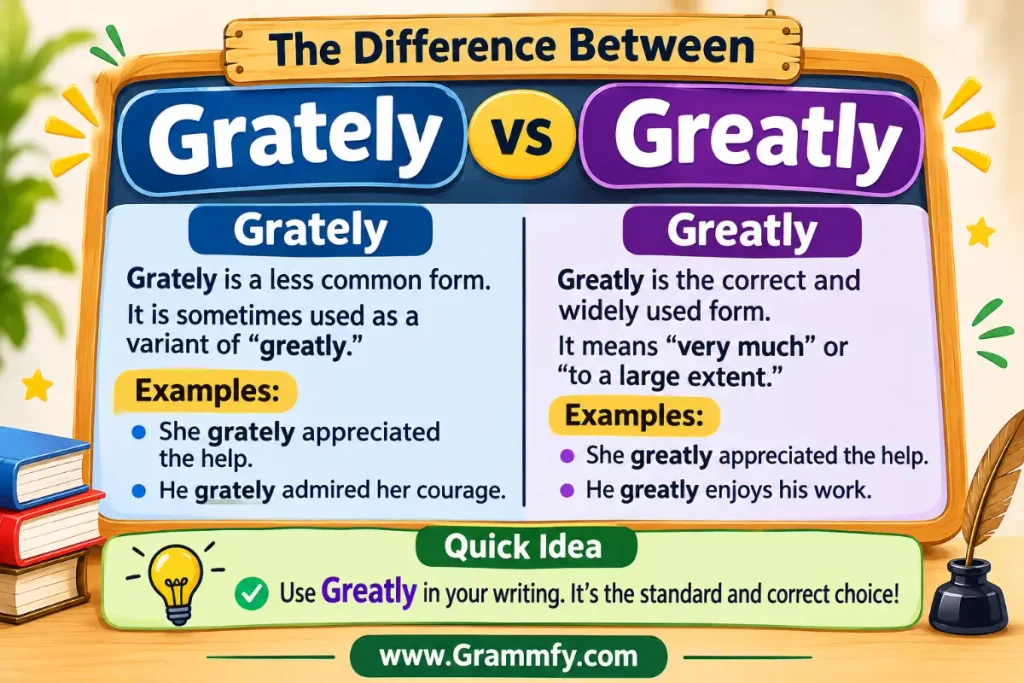
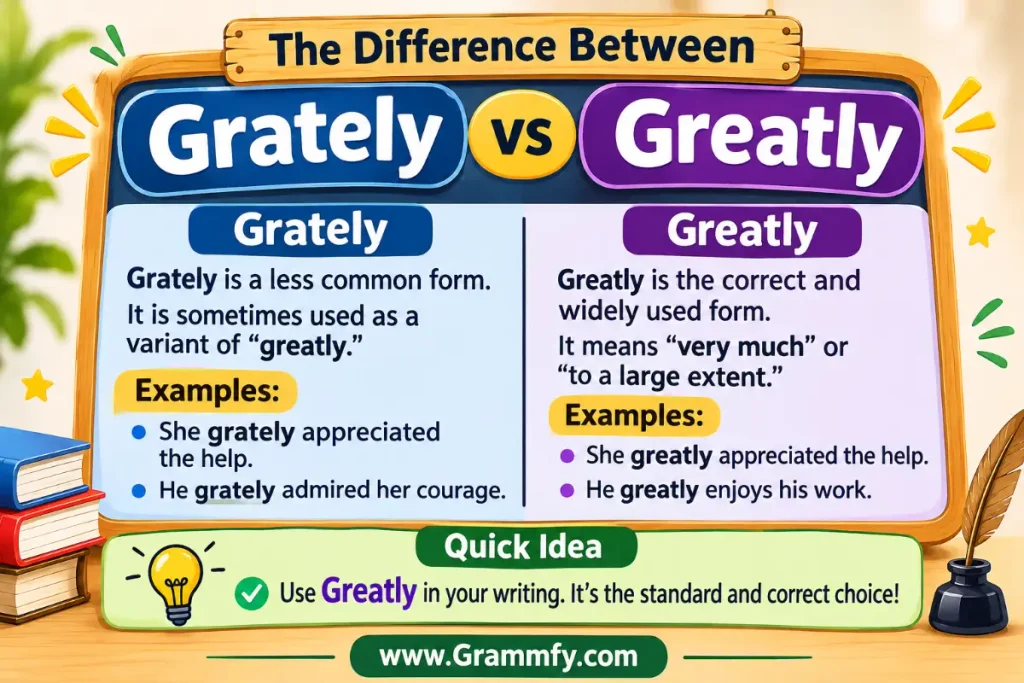
The main difference is spelling. Greatly is the correct English word, while grately is a misspelling that usually appears when someone forgets the second letter in greatly or confuses its spelling with another word.
| Word | Correct spelling? | Meaning | Example |
|---|---|---|---|
| Greatly | Yes | Very much or to a large degree | Your advice greatly helped me. |
| Grately | No, not for this meaning | Common spelling mistake | I grately appreciate your help. |
The second example should use greatly instead.
- Correct: I greatly appreciate your support.
- Incorrect: I grately appreciate your support.
The word greatly describes the degree or extent of an action, feeling, change, or condition. It often appears before a verb or after a linking verb, depending on the sentence.
For example:
- The new system greatly improved our service.
- We greatly enjoyed the visit.
- Her confidence has greatly increased.
- I am greatly pleased with the results.
In each sentence, the adverb explains how much something happened or how strong a feeling was.
Why Do People Confuse These Two Spellings?
There are several reasons people write the wrong version.
- Similar appearance: The two spellings differ by only one letter, so the error can go unnoticed.
- Fast typing: People often type familiar words quickly without checking every letter.
- Unclear pronunciation: In ordinary speech, the spelling difference is not something you can hear.
- Spelling confusion: Writers may remember the sound of the word but forget its exact letter order.
- Autocorrect habits: A device may not always catch a spelling mistake, especially when a typed form resembles a possible word.
The easiest way to avoid the error is to remember that the correct adverb comes from great with the ending -ly.
Greatly Mean in English
Greatly means very much, considerably, or to a large extent. It tells readers how strongly something happens or how much something changes.
It is an adverb, which means it adds information to a verb, adjective, or another adverb.
Consider these examples:
- The new teacher greatly improved the class.
- I greatly respect your opinion.
- The weather has greatly changed.
- Her writing skills have greatly improved.
In the first example, the word describes the extent of the teacher’s effect. In the second, it shows the strength of the speaker’s respect.
Simple Meaning of Greatly
In easy English, greatly means:
- Very much
- A lot
- To a large degree
- Considerably
- By a significant amount
For example, saying “I greatly value your friendship” means that your friendship is very important to you.
The word is useful when you want to show that something has a strong effect or importance. It can make a sentence more precise than using a general word such as a lot.
Part of Speech Is Greatly
Greatly is an adverb. It usually modifies verbs and explains the degree of an action or feeling.
| Part of speech | Word | Example |
|---|---|---|
| Adjective | Great | She did a great job. |
| Adverb | Greatly | She greatly improved her skills. |
| Noun | Greatness | His greatness came from hard work. |
Notice how the word changes according to its role.
- Great: Describes a person, thing, or experience.
- Greatly: Describes the extent of an action or feeling.
- Greatness: Names the quality of being great.
You should not use these forms interchangeably. Each has a different grammatical job.
The Origin of the Word Greatly
Understanding the origin of a word can make its spelling easier to remember. The word greatly comes from the adjective great, followed by the adverb-forming suffix -ly.
The adjective great has a long history in English. It developed from older forms of the word that expressed ideas such as large, important, powerful, or significant.
Over time, English speakers began using great in many situations. It could describe size, quality, importance, ability, or degree.
Adding -ly creates an adverb that describes the extent of something.
How Does the Ending -ly Change the Word?
The suffix -ly often turns an adjective into an adverb.
Examples include:
| Adjective | Adverb | Example |
|---|---|---|
| Quick | Quickly | She quickly finished the task. |
| Careful | Carefully | He carefully checked the form. |
| Slow | Slowly | The car moved slowly. |
| Clear | Clearly | Please explain it clearly. |
| Great | Greatly | The news greatly surprised us. |
This pattern helps explain the spelling of the correct word. Start with great, then add -ly.
The result is greatly, not grately.
Why Is Grately Not the Correct Form?
The spelling grately does not follow the standard formation of the adverb from great. The correct form keeps the complete adjective and adds the suffix.
- Great + ly = greatly
- Grate + ly = grately
The second combination may look possible because grate is a real English word. However, it does not express the meaning of greatly.
For example, grate can mean to shred food into small pieces using a tool. It can also refer to a metal frame or barrier.
That is why the spelling matters. The word you choose must match the meaning you want to communicate.
Synonyms for Greatly
There are many alternatives to greatly. The best choice depends on the sentence, the degree you want to express, and the tone of your writing.
For example, very much works well in everyday conversation, while considerably may sound more suitable in a report. Significantly is useful when you want to highlight an important change.
The following table groups useful alternatives by tone.
Simple Synonyms for Greatly
These words and phrases are easy to understand. They work well in everyday English, school assignments, and casual messages.
| Word or phrase | Meaning | Tone | Example |
|---|---|---|---|
| Very much | To a high degree | Simple | I very much appreciate your help. |
| A lot | To a large amount or degree | Casual | Your advice helped me a lot. |
| So much | To a very high degree | Casual | I enjoyed the event so much. |
| Really | To a strong degree | Everyday | This change really helped us. |
| A great deal | To a large extent | Neutral | The project improved a great deal. |
| Highly | To a high degree | Neutral | She is highly respected. |
| Deeply | Strongly or sincerely | Neutral | We deeply value your support. |
| Far | By a large amount | Neutral | The second option is far better. |
Everyday Synonyms for Greatly
These alternatives sound natural in conversations, emails, and general writing.
| Word or phrase | Meaning | Tone | Example |
|---|---|---|---|
| Considerably | By a noticeable amount | Neutral | Sales increased considerably. |
| Significantly | By an important amount | Neutral | The results improved significantly. |
| Substantially | By a large amount | Neutral | Costs were substantially reduced. |
| Remarkably | In a surprising or noticeable way | Neutral | Her confidence grew remarkably. |
| Extremely | To a very high degree | Strong | The team was extremely helpful. |
| Immensely | To a very great degree | Strong | We enjoyed the experience immensely. |
| Exceptionally | To an unusual or outstanding degree | Neutral | The service was exceptionally good. |
| Noticeably | In a way that can be seen or felt | Neutral | His health improved noticeably. |
Formal Synonyms for Greatly
Use these alternatives in academic writing, business reports, professional emails, and research papers.
| Word or phrase | Meaning | Tone | Example |
|---|---|---|---|
| Markedly | In a clear or noticeable way | Formal | Performance improved markedly. |
| Materially | In an important or meaningful way | Formal | The policy materially changed the process. |
| Profoundly | In a deep or powerful way | Formal | The decision profoundly affected the community. |
| Considerably | To a substantial degree | Formal | The findings differ considerably. |
| Significantly | To an important extent | Formal | The results significantly support the theory. |
| Substantially | By a large or meaningful amount | Formal | The proposal substantially reduces costs. |
| Drastically | In a very large or extreme way | Strong | The company drastically changed its plan. |
| Intensely | With great strength | Formal | The issue was intensely debated. |
Informal and Slang Alternatives
Some casual expressions can replace greatly in relaxed conversations. They are not always suitable for formal writing.
| Word or phrase | Meaning | Tone | Example |
|---|---|---|---|
| Big time | To a very large degree | Slang | You helped me big time. |
| Tons | A very large amount | Casual | I learned tons from the course. |
| Loads | A lot | Informal | She improved loads this year. |
| Heaps | A large amount | Informal | Thanks heaps for your help. |
| A whole lot | Very much | Casual | This means a whole lot to me. |
| Like crazy | Extremely or intensely | Slang | Prices went up like crazy. |
| A bunch | A lot | Casual | We learned a bunch today. |
| Massively | To a very large degree | Informal | The update massively improved the app. |
Not every alternative has the same meaning in every sentence. For example, deeply often describes feelings, while substantially usually describes measurable changes or amounts.
How Do You Use Greatly in Different Sentences?
The word works in several sentence patterns. Knowing these patterns helps you place it naturally.
Greatly Before a Verb
This is one of the most common uses.
Examples:
- I greatly appreciate your patience.
- The new software greatly improved our work.
- Her kindness greatly inspired the children.
- The extra practice greatly helped the students.
Here, the adverb describes the extent of the action.
Greatly After a Linking Verb
You can also use it after linking verbs such as be when it modifies an adjective or participle.
Examples:
- We are greatly pleased with the result.
- The family was greatly relieved.
- She felt greatly encouraged by the feedback.
- The staff were greatly disappointed by the decision.
In these examples, the adverb adds strength to the feeling or condition.
Greatly With Comparative Adjectives
The word can also add emphasis to comparisons.
Examples:
- This version is greatly improved.
- The new design is greatly better than the old one.
- Her performance is greatly superior to last year’s result.
However, some combinations sound unnatural. In everyday English, “much better” is usually more natural than “greatly better.”
Better choices include:
- The new design is much better.
- Her performance is considerably stronger.
- The latest version is significantly improved.
Greatly in Passive Sentences
You may find the word in passive constructions, especially in formal writing.
Examples:
- The proposal was greatly appreciated by the committee.
- The local area was greatly affected by the storm.
- The building was greatly damaged by the fire.
- The project was greatly supported by the community.
The adverb describes the strength or extent of the action or its effect.
Which Word Should You Use in a Resume?
A resume should use clear, professional language. Greatly can work when you describe a meaningful improvement, but it is often better to include a specific result.
For example:
- General: I greatly improved customer satisfaction.
- Stronger: I improved customer satisfaction by 18% over six months.
The second sentence gives a measurable result. Employers can understand the impact more easily.
Better Resume Examples
- Reduced processing time significantly by improving the team’s workflow.
- Greatly improved customer communication through a new support system.
- Substantially increased monthly sales by developing new client relationships.
- Improved staff training and noticeably reduced onboarding delays.
Should You Use Greatly in Every Resume Bullet?
No. Repeating the same adverb can make your resume sound less natural.
Try alternatives such as:
- Significantly increased
- Substantially reduced
- Successfully introduced
- Effectively managed
- Consistently improved
Whenever possible, explain what changed and how much it changed.
Which Word Is Better for an Essay?
In an essay, the best choice depends on your subject and the point you want to make.
Greatly works well in academic writing when you want to describe a strong influence, effect, or change.
Examples:
- Education greatly influences a person’s future opportunities.
- Technology has greatly changed how people communicate.
- Access to clean water greatly affects public health.
- Historical events greatly shaped modern society.
How Can You Make Essay Writing More Precise?
Avoid using greatly when a more specific word explains your point better.
For example:
- General: Social media greatly affects teenagers.
- More precise: Social media significantly influences teenagers’ communication habits.
You can also use profoundly when describing a deep influence, or substantially when discussing a large measurable change.
A good essay does not need complicated vocabulary. It needs accurate words and clear explanations.
Is Greatly Suitable for Professional Emails?
Yes. The word is appropriate for many professional emails, especially when you want to express appreciation or describe an important result.
Examples:
- I greatly appreciate your time and consideration.
- Your feedback has greatly improved the final report.
- We are greatly pleased with the progress.
- The updated process has greatly reduced delays.
Professional Email Alternatives
If you want to avoid repeating the same expression, try:
- I sincerely appreciate your assistance.
- Your feedback was extremely helpful.
- We truly value your contribution.
- Your support made a significant difference.
- I am very grateful for your time.
For a formal thank-you email, greatly appreciate is a natural and widely understood phrase.
Can You Use Greatly in Text Messages?
Yes, but the word may sound slightly formal in a casual text. It depends on your relationship with the reader and the message.
Examples:
- I greatly appreciate you helping me today.
- Your advice helped me a lot.
- I really enjoyed spending time with you.
- Thanks so much for being there.
In a friendly conversation, really, so much, or a lot may sound more relaxed.
Casual Texting Examples
- I really appreciate what you did for me.
- Your message helped me a lot.
- I enjoyed the trip so much.
- Thanks a bunch for your support.
- This means a whole lot to me.
The main goal is to sound natural. Choose words that fit the conversation rather than forcing formal language into a casual message.
How Should You Use Greatly When Speaking?
In spoken English, greatly is correct, but it can sound more formal than everyday alternatives.
For example:
- Formal: I greatly appreciate your help.
- Casual: I really appreciate your help.
- Very casual: Thanks a lot for helping me.
You may hear greatly in presentations, speeches, interviews, and formal conversations.
Examples:
- Your work has greatly benefited our team.
- I greatly value the opportunity to speak with you.
- This experience has greatly influenced my career.
- We greatly enjoyed having you with us.
If you are speaking with friends, simple phrases such as a lot or very much may feel more natural.
12+ Original Example Sentences With Greatly
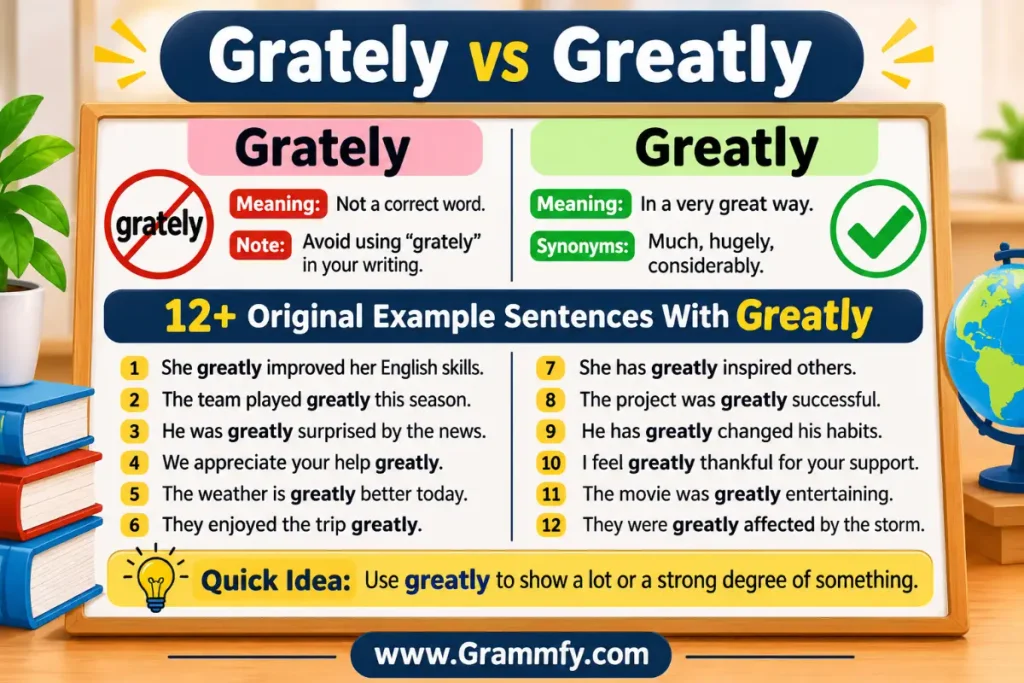
Examples show how a word works in real situations. The following sentences cover school, work, family, health, travel, technology, and everyday communication.
- At work: The new training program greatly improved the team’s performance.
- At school: Regular reading greatly helped Maya develop her vocabulary.
- In an email: I greatly appreciate your quick response to my request.
- In a family conversation: Her kind words greatly comforted her younger brother.
- In business: The company greatly reduced its expenses after reviewing its budget.
- In technology: The latest update greatly improved the app’s speed.
- In health: Daily exercise can greatly benefit your physical well-being.
- In travel: We greatly enjoyed exploring the old streets of the city.
- In education: A supportive teacher can greatly influence a student’s confidence.
- In a community: The donation greatly helped families affected by the flood.
- In personal growth: Learning to manage time greatly improved his daily routine.
- In research: The new findings greatly expanded our understanding of the subject.
- In customer service: Her helpful attitude greatly increased customer satisfaction.
- In writing: Reading each draft aloud greatly improved the clarity of the article.
- In sports: Consistent practice greatly strengthened the players’ teamwork.
What Do These Examples Have in Common?
Each sentence uses the adverb to describe the degree of an action or effect.
Notice that greatly does not name the action itself. Instead, it explains how much the action matters or how strongly it happens.
For instance:
- “The team improved” gives a basic fact.
- “The team greatly improved” emphasizes the size of the improvement.
That extra information makes the second sentence more expressive.
Greatly vs Very Much: Difference
Both expressions can mean to a high degree, but they do not always fit the same sentence.
Greatly is a single adverb that often appears in formal or neutral writing. Very much is a two-word expression that sounds natural in both everyday and formal English.
| Greatly | Very much |
|---|---|
| Often sounds more formal | Often sounds more conversational |
| Common with actions and changes | Common with feelings and preferences |
| Concise | Slightly longer |
| Useful in reports and essays | Useful in speech and everyday writing |
Examples:
- I greatly appreciate your help.
- I appreciate your help very much.
Both sentences are correct. The first sounds slightly more formal, while the second feels more conversational.
Other examples:
- The new system greatly improved efficiency.
- The new system improved efficiency very much.
The first sentence is more natural. In this context, greatly works better because it directly describes the extent of the improvement.
Greatly vs Significantly: Difference
These two words are close in meaning, but significantly often emphasizes importance or a measurable difference.
Greatly can describe a strong feeling, effect, or change. Significantly is especially useful when the size or importance of a change matters.
| Greatly | Significantly |
|---|---|
| Means very much or to a large degree | Means importantly or by a noticeable amount |
| Works with feelings and actions | Common in research, reports, and analysis |
| Broad in use | Often emphasizes importance or measurable change |
Examples:
- I greatly admire her courage.
- The new policy significantly reduced expenses.
The first sentence describes a strong feeling. The second emphasizes an important reduction.
You can sometimes use either word:
- The results improved greatly.
- The results improved significantly.
Both are correct. However, significantly may be more suitable if you are discussing research or measurable data.
Greatly vs Deeply: Which Word Is More Appropriate?
Both words can describe strong feelings or effects, but their focus is different.
Greatly emphasizes degree or amount. Deeply often emphasizes emotional strength, seriousness, or a lasting effect.
| Greatly | Deeply |
|---|---|
| Very much or to a large extent | Strongly or with deep feeling |
| Broad range of uses | Often emotional or personal |
| Useful for changes and results | Useful for respect, gratitude, concern, and influence |
Examples:
- We greatly appreciate your contribution.
- We deeply appreciate your kindness.
Both sentences express gratitude. The second places more emphasis on sincere feeling.
Other examples:
- The decision greatly affected the company.
- The loss deeply affected the family.
The first can describe the overall size of the effect. The second suggests a strong emotional impact.
Common Mistakes When Using Greatly
Even after learning the correct spelling, writers can make mistakes with meaning, placement, and word choice.
1. Writing Grately Instead of Greatly
This is the main spelling error.
- Incorrect: I grately value your advice.
- Correct: I greatly value your advice.
Remember that the correct adverb keeps the complete word great before adding -ly.
2. Using Greatly When You Mean Gratefully
Greatly and gratefully look similar, but they have different meanings.
- Greatly: Very much or to a large degree.
- Gratefully: With gratitude or thankfulness.
Examples:
- I greatly appreciate your support.
- I gratefully accepted the award.
The first describes the degree of appreciation. The second describes how someone accepted something.
3. Using Greatly With an Unnatural Word Combination
Some combinations are grammatically possible but sound awkward.
For example:
- Awkward: The food was greatly delicious.
- Better: The food was extremely delicious.
- Better: The food was delicious.
Use greatly with natural combinations such as greatly appreciate, greatly improve, and greatly affect.
4. Repeating Greatly Too Often
Using the same adverb in every paragraph can make your writing repetitive.
Instead, choose a suitable alternative.
- Greatly improved
- Significantly improved
- Considerably improved
- Noticeably improved
Do not change words just to avoid repetition, though. Make sure the alternative fits the meaning.
5. Using Greatly When a Specific Number Is Better
A measurable result often communicates more than a general adverb.
- General: The company greatly increased its sales.
- Specific: The company increased sales by 25%.
The second example gives readers useful information.
6. Confusing Greatly With Great
Great is an adjective, while greatly is an adverb.
- Correct: She is a great speaker.
- Correct: She greatly impressed the audience.
- Incorrect: She is a greatly speaker.
Use great to describe a noun. Use greatly to describe the extent of an action or condition.
When Should You Avoid Using Greatly?
The word is useful, but it does not belong in every sentence. Sometimes another expression is clearer or more natural.
Avoid it in these situations:
- When you mean gratitude in a specific way: Use gratefully when describing an action done with thanks.
- When a number is available: Give the actual amount or percentage instead of a vague description.
- When the sentence sounds unnatural: Choose a more suitable adverb such as extremely or deeply.
- When you need casual language: Use really, a lot, or very much in relaxed conversations.
- When the meaning is already clear: Do not add an adverb that contributes no useful information.
For example, “The project was greatly successful” sounds awkward. Better choices include “The project was highly successful” or simply “The project was a success.”
Antonyms of Greatly
An antonym is a word with an opposite or contrasting meaning. Since greatly describes a high degree, its alternatives on the opposite side often describe a low degree or limited amount.
| Antonym or contrasting phrase | Meaning | Example |
|---|---|---|
| Slightly | By a small amount | The cost increased slightly. |
| Barely | Almost not | The change barely affected the result. |
| Minimally | To a very small degree | The process was minimally affected. |
| Hardly | Almost not | The new rule hardly changed anything. |
| Marginally | By a small amount | The score improved marginally. |
| Little | To a small degree | The update helped little. |
| Slightly less | By a small lower amount | The new model is slightly less expensive. |
| To a limited extent | Only to a certain degree | The plan worked to a limited extent. |
These words are not exact opposites in every context. Choose one that matches the sentence.
For example, barely and hardly suggest almost no effect, while slightly describes a small but noticeable effect.
Quick Tips for Remembering the Correct Spelling “Grately vs Greatly“
A few simple tricks can help you remember the correct form.
1. Start With Great
The word comes from the adjective great. Add -ly to make the adverb.
– Great + ly = greatly
This is the most useful spelling rule to remember.
2. Remember the Meaning
When you want to say very much or to a large degree, choose greatly.
Examples:
- Greatly appreciate
- Greatly improve
- Greatly influence
- Greatly affect
3. Do Not Mix It Up With Gratefully
Remember the difference:
- Greatly = very much.
- Gratefully = with gratitude.
For example, “I greatly appreciate your help” and “I gratefully accepted the offer” use different adverbs for different purposes.
4. Read the Sentence Aloud
Reading your writing aloud can help you notice awkward word choices. It may not reveal every spelling error, but it can help you check whether the sentence sounds natural.
5. Use a Spelling Check
A dictionary or reliable spell-checking tool can help catch typing errors. Still, review the full sentence because spelling software may not identify every incorrect word choice.
6. Practice With Short Sentences
Write a few examples of your own:
- I greatly value your time.
- The change greatly improved the result.
- We greatly enjoyed the show.
- Her advice greatly helped me.
Using the correct form in different contexts makes it easier to remember.
Conclusion
Choosing the correct spelling makes your writing clearer and more professional. When you mean very much, considerably, or to a large degree, use greatly. The form grately is a common spelling mistake, not the standard adverb. Remember the simple word-building rule: start with great and add -ly. Also, keep greatly separate from gratefully, which describes an action done with gratitude. When you need variety, alternatives such as significantly, deeply, immensely, and considerably can help you express the right degree. With a little practice, you can choose the correct form confidently in emails, essays, reports, and everyday conversations.
Frequently Asked Questions
Is Grately vs Greatly the Correct Spelling?
Greatly is the correct spelling when you mean very much or to a large degree. Grately is a common misspelling and should not be used as the standard form.
What Does Greatly Mean in Simple English?
Greatly means very much, a lot, or to a large extent. For example, “Your support greatly helped me” means your support helped me a lot.
Is Grately a Real English Word?
Grately is not the standard spelling of the adverb meaning very much. It may appear as a typing or spelling error, but use greatly in normal English writing.
What’s Another Way to Say Greatly?
You can use very much, considerably, significantly, substantially, deeply, or immensely. Choose the alternative that best matches your sentence and tone.
What Is the Difference Between Greatly vs Gratefully?
Greatly means very much, while gratefully means with gratitude or thankfulness. For example, you can greatly appreciate someone’s help or gratefully accept their offer.
Can I Use Greatly in Formal Writing?
Yes. Greatly is suitable for essays, reports, professional emails, and academic writing. It works especially well when describing a strong effect, important change, or sincere appreciation.
Is Greatly an Adjective or an Adverb?
Greatly is an adverb. It describes the degree of an action, feeling, or condition, as in “The results greatly improved.”

Tylerbrooks is a US-based English grammar writer and contributor at Grammfy. He writes helpful articles about grammar, spelling, commonly confused words, and vocabulary. His goal is to explain English topics in simple language with clear examples and practical tips. Through his articles, he helps readers improve their writing and everyday English skills.