
Have you ever written an email about your busy schedule and wondered whether to use busyness vs business? These two words look almost identical, sound very similar, and share the same word origin. However, they don’t mean the same thing. Choosing the wrong spelling can make an otherwise clear sentence confusing.
Understanding Busyness vs Business is important when writing professional emails, school assignments, resumes, reports, and everyday messages.
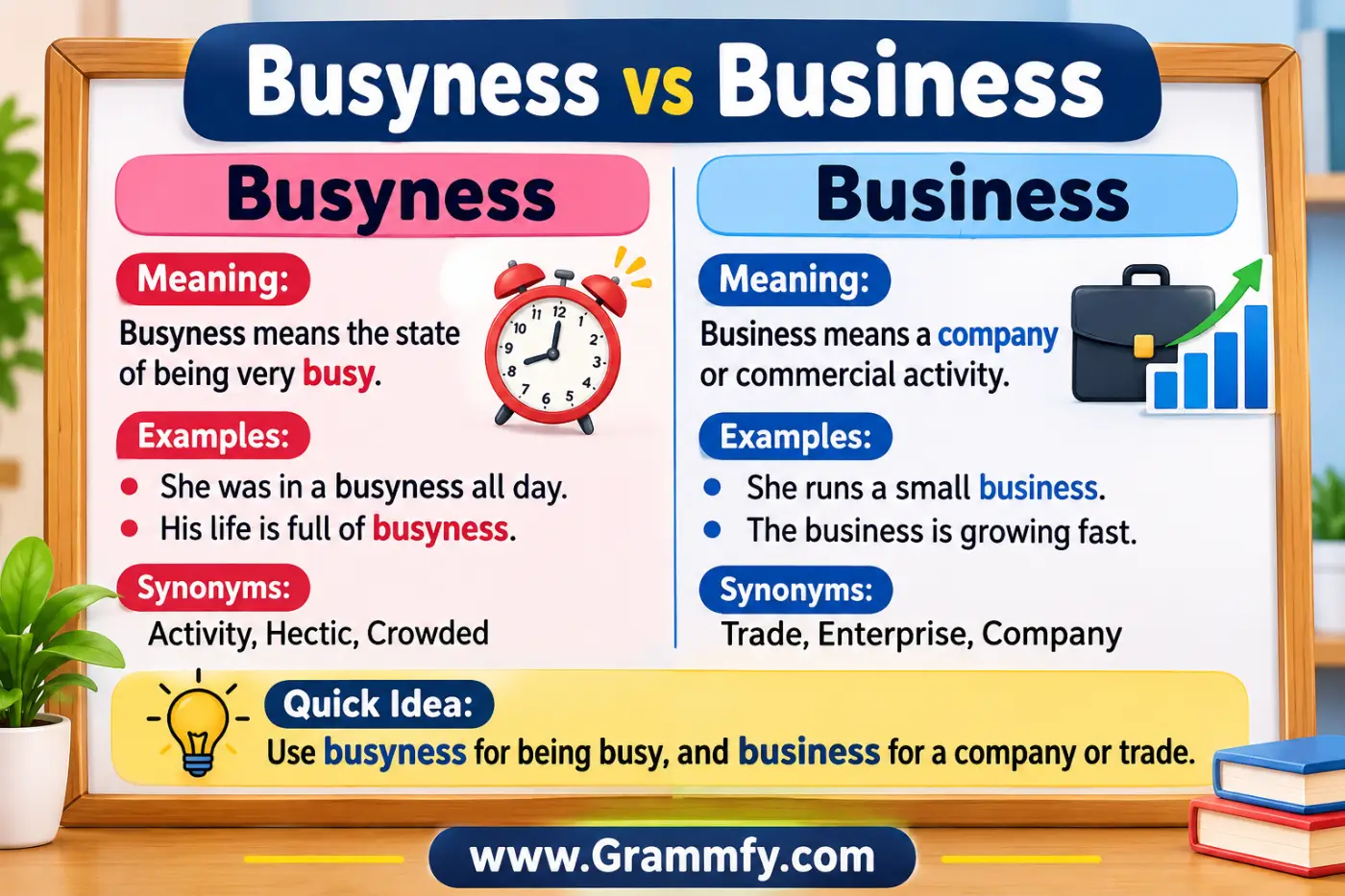
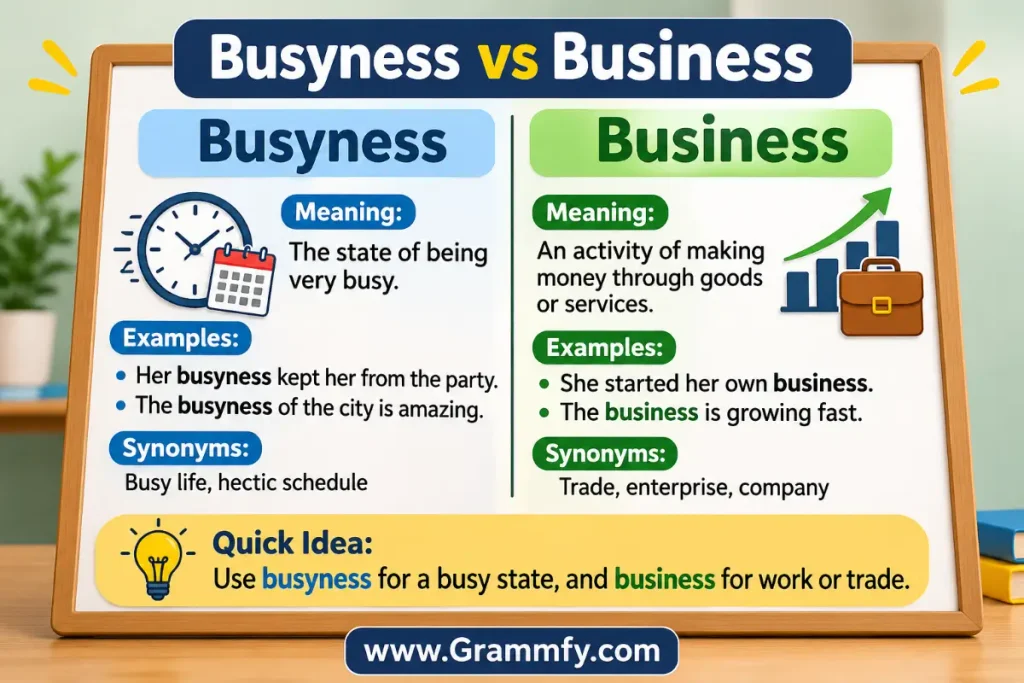
Quick Answer: Busyness means the state of being busy, occupied, or involved in many activities. Business refers to commercial activity, a company, someone’s work, or a matter that needs attention.
In this guide to Busyness vs Business, you’ll learn their meanings, origins, synonyms, pronunciation, grammatical roles, and differences in everyday communication. You’ll also find practical examples, common mistakes, and tips for choosing the correct word in different writing situations.
If you often confuse similar-looking words, check out why offend is the correct spelling instead of affend to avoid this common spelling mistake.
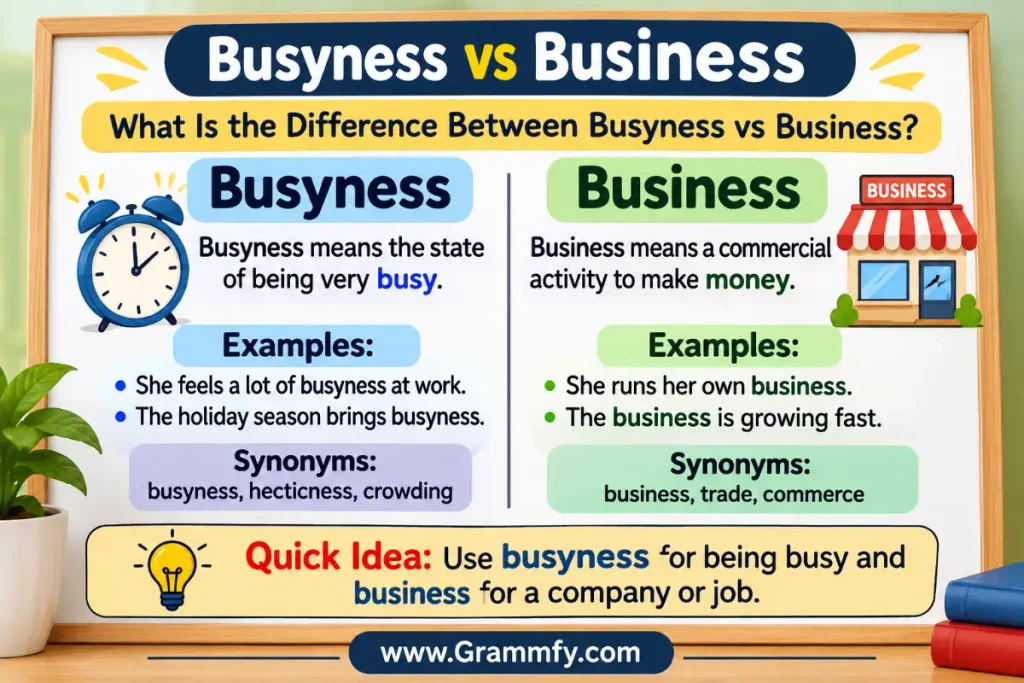
What Is the Difference Between Busyness vs Business?
The main difference is that busyness describes how occupied or active someone or something is, while business refers to work, commercial activities, an organization, or a particular matter.
Although the words share a historical connection, modern English gives them separate meanings.
What Does Busyness Mean?
Busyness is a noun that describes the condition or quality of being busy. It refers to having many activities, responsibilities, tasks, or things that require attention.
The word can describe an individual’s schedule, a crowded place, a busy environment, or a period filled with activity.
For example:
- My busyness increased during the final week of the project.
- The busyness of the shopping district surprised us.
- Despite her busyness, she always makes time for her family.
- The office was full of activity and busyness before the annual meeting.
Important: Busyness is generally an uncountable noun. You normally don’t say a busyness or three busynesses in ordinary English.
Instead, use expressions such as:
- A period of busyness
- A great deal of busyness
- The increasing busyness of the office
- A temporary state of busyness
- The busyness of everyday life
The term can also describe activity that seems excessive or unproductive. For instance, someone might look busy all day without completing meaningful work.
What Does Business Mean?
Business is a noun with several common meanings. It can refer to a company, commercial activity, professional work, someone’s responsibilities, or a particular concern.
Its meaning depends on the surrounding sentence.
Consider these examples:
- My father owns a successful construction business.
- She wants to start her own business next year.
- I have important business to discuss with the manager.
- Running a small business requires patience and planning.
- He travels frequently for business.
Unlike busyness, this word doesn’t simply describe the condition of having many things to do.
It can refer to:
- A company: An organization that sells products or provides services.
- Commercial activity: Buying, selling, and providing goods or services.
- Professional work: Activities connected with someone’s job.
- A responsibility: Something that requires attention or action.
- A personal matter: Something that concerns an individual.
Business can also appear in expressions such as business partner, business meeting, business trip, and business hours.
The important point in Busyness vs Business is that the second word has a much wider range of meanings than simply being occupied.
Where Did Busyness and Business Come From?
Understanding the origins of these words makes their spelling and meanings easier to remember.
Both words developed from the same historical source, but their meanings gradually separated.
What Is the Origin of Busyness?
The word busyness comes from the adjective busy and the suffix -ness.
The suffix -ness is commonly added to adjectives to create nouns that describe a condition, quality, or state.
For example:
| Adjective | Noun | Meaning |
|---|---|---|
| Happy | Happiness | The state of being happy |
| Kind | Kindness | The quality of being kind |
| Dark | Darkness | The condition of being dark |
| Weak | Weakness | The state of being weak |
| Busy | Busyness | The condition of being busy |
This pattern explains why busyness has its particular spelling.
Historical references record the modern word in the nineteenth century, with early evidence dating to around 1849. It became useful because the older word business had developed meanings beyond simply being occupied.
In other words, English needed a clearer way to describe the condition of being busy without confusing it with commercial or professional matters.
What Is the Origin of Business?
Business has a much older history.
It developed from Old English bisignes, associated with care, anxiety, occupation, and being engaged in something. This historical form came from bisig, an earlier form related to the modern adjective busy, together with the suffix -ness.
During Middle English, the word was used for the state of being occupied or engaged in an activity.
Over time, its meaning expanded. It began referring to duties, occupations, matters requiring attention, and eventually commercial activities and trade.
The commercial meaning became established by the eighteenth century.
Today, business can describe a company, professional activity, financial matters, or an individual’s work.
Historical sources also explain why the spelling of the two words can be confusing: business once had a meaning closer to the modern busyness, but the words eventually developed separate uses.
How Does Their Word Origin Help You Remember the Difference?
Their shared history gives you a useful spelling trick.
- Busyness: Busy + ness = the state of being busy.
- Business: The established spelling for a company, trade, work, or matter.
Remember that English spelling doesn’t always follow a perfectly regular pattern. Although business originally developed from the same word family, its modern spelling is different from what you might expect by simply adding -ness to busy.
What Are the Best Synonyms for Busyness and Business?
Synonyms can help you express yourself more clearly, avoid repetition, and choose words that match the tone of your writing.
However, not every synonym works in every situation. Some words describe having many responsibilities, while others refer to commercial work or a company.
The following list groups useful alternatives into simple, everyday, formal, and informal categories.
What Are Simple and Everyday Synonyms?
These words work well in ordinary conversations, emails, and general writing.
| Word | Meaning | Tone | Example |
|---|---|---|---|
| Activity | Something being done | Neutral | The activity increased this morning. |
| Workload | Amount of work assigned | Neutral | My workload is heavy. |
| Work | Tasks or duties | Everyday | I have too much work today. |
| Tasks | Individual pieces of work | Neutral | Several tasks need attention. |
| Occupation | State of being occupied | Neutral | Her occupation with the project continued. |
| Schedule | Planned activities | Everyday | My schedule is full. |
| Rush | A period of intense activity | Informal | We experienced a morning rush. |
| Company | A commercial organization | Neutral | Their company is growing. |
| Firm | A business organization | Professional | She works for a law firm. |
| Trade | Buying and selling | Neutral | International trade supports growth. |
What Are Some Formal Synonyms?
Formal alternatives are useful in reports, academic assignments, professional documents, and business communication.
| Word | Meaning | Tone | Example |
|---|---|---|---|
| Activity | Organized or ongoing action | Formal | The activity continued throughout the quarter. |
| Engagement | Involvement in an activity | Formal | Her engagement with the project was impressive. |
| Occupation | Employment or professional work | Formal | His occupation requires regular travel. |
| Diligence | Careful and persistent effort | Formal | Her diligence improved the results. |
| Industry | Commercial or productive activity | Formal | The industry experienced rapid growth. |
| Enterprise | A business or commercial undertaking | Formal | The enterprise expanded internationally. |
| Commerce | Buying and selling goods or services | Formal | Digital commerce continues to grow. |
| Operations | Activities involved in running an organization | Professional | Daily operations remained stable. |
| Undertaking | A planned activity or project | Formal | The undertaking required careful planning. |
| Commitments | Responsibilities or obligations | Formal | Her commitments increased this month. |
What Are Some Informal and Slang Alternatives?
Informal words are suitable for friendly conversations, casual messages, and relaxed communication.
| Word | Meaning | Tone | Example |
|---|---|---|---|
| Hustle | Energetic work or effort | Informal | She’s focused on her daily hustle. |
| Hecticness | A condition of being hectic | Casual | The hecticness of the week exhausted me. |
| Busyness | A state of being busy | Everyday | The busyness of the season is exhausting. |
| Grind | Continuous hard work | Slang | He’s enjoying the daily grind. |
| Hustling | Working energetically | Informal | They’re hustling to meet the deadline. |
| Biz | Informal shortening of business | Slang | She’s in the entertainment biz. |
| Gig | A job or paid assignment | Informal | I found a weekend gig. |
| Side hustle | An additional income-producing activity | Casual | His side hustle sells handmade products. |
| Chores | Small routine duties | Everyday | Household chores filled my morning. |
| Workload | The amount of assigned work | Neutral | My workload is getting heavier. |
A useful distinction: Words such as company, commerce, and enterprise are alternatives for certain meanings of business. Words such as workload, activity, and hecticness are closer to busyness. They shouldn’t automatically replace each other.
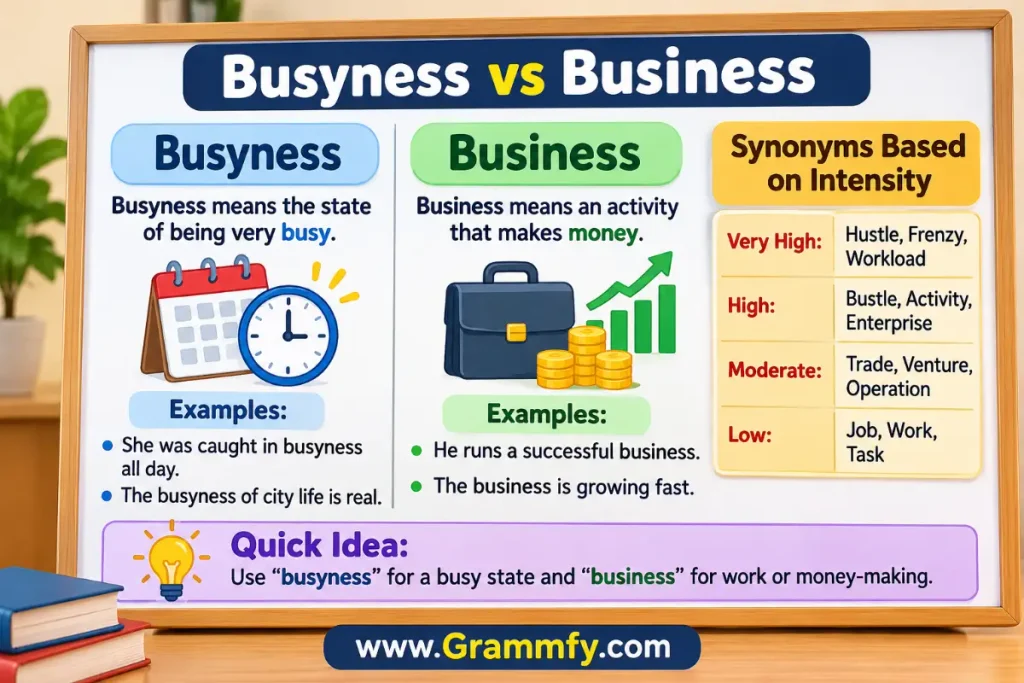
What Are the Best Synonyms Based on Intensity?
For example, saying that someone is slightly occupied creates a different impression from saying that the person is overwhelmed with responsibilities.
Here are alternatives arranged from mild to strong.
Mild Level: A Little Activity
Use these words when someone has a few responsibilities but isn’t under much pressure.
- Occupied: Having something to do.
- Engaged: Involved in an activity.
- Active: Doing something or participating.
- Available: Having time or being free to respond, depending on context.
- Involved: Taking part in a task or activity.
Example: I’m slightly occupied with a few household tasks this afternoon.
Moderate Level: Regular Activity
These words describe a normal schedule with several responsibilities.
- Busy: Having things to do.
- Working: Performing tasks or duties.
- Committed: Having responsibilities or obligations.
- Productive: Completing useful work.
- Industrious: Working hard and consistently.
Example: Our team has been quite busy preparing for the upcoming presentation.
Strong Level: Heavy Activity
Choose these words when someone has many responsibilities or very little free time.
- Hectic: Full of intense activity and pressure.
- Demanding: Requiring considerable time or effort.
- Overloaded: Having more work than can comfortably be handled.
- Swamped: Having too many tasks.
- Overwhelmed: Feeling unable to manage the amount of work or pressure.
Example: I’m completely swamped with deadlines this week.
Very Strong Level: Excessive Activity
These expressions communicate an extreme amount of activity or pressure.
- Overburdened: Carrying too many responsibilities.
- Snowed under: Having far too much work.
- Exhausted: Extremely tired after effort or activity.
- Overextended: Committed beyond available time or resources.
- Frantic: Acting with extreme urgency or stress.
Example: The department became overwhelmed during the holiday shopping season.
Remember: Intensity words describe different aspects of activity. For instance, productive suggests useful results, while hectic suggests pressure and disorder. Being busy doesn’t always mean being productive.
What Are the Different Parts of Speech?
Is Busyness a Noun or an Adjective?
Busyness is a noun. It names a condition or quality rather than describing a person or action.
Examples:
- The busyness of the restaurant increased after noon.
- Her busyness made it difficult to attend the meeting.
- Seasonal busyness affects many retail stores.
- I need a break from the constant busyness of city life.
The adjective form is busy.
Examples:
- She is busy today.
- The office is busy.
- We had a busy weekend.
The adverb form is busily.
Example: The employees worked busily to prepare the conference room.
Is Business a Noun or an Adjective?
Business is primarily used as a noun.
Examples:
- My business serves customers across the country.
- They discussed important business matters.
- His business is growing quickly.
It can also function as a noun modifier before another noun.
Examples:
- Business meeting
- Business partner
- Business account
- Business strategy
- Business owner
The adjective businesslike describes someone or something that is practical, professional, and efficient.
Example: She maintained a businesslike attitude during the negotiations.
Can You Make These Words Plural?
Their plural forms are different.
| Word | Singular | Plural | Example |
|---|---|---|---|
| Busyness | Busyness | Usually uncountable | Her busyness is understandable. |
| Business | Business | Businesses | Several businesses opened downtown. |
You can use businesses when referring to multiple companies or commercial organizations.
For example:
- Local businesses support the community.
- Several businesses closed during the recession.
- Small businesses need reliable customers.
However, when discussing commercial activity in general, business is often uncountable.
Example: Business is improving this year.
Is There a Difference Between American and British English?
No major spelling difference separates these two words in American and British English. Both varieties use busyness for the state of being busy and business for commercial activity, work, companies, or matters requiring attention.
How Are the Words Used in American English?
American English uses both forms in everyday and professional communication.
Examples:
- My busyness has increased since starting a new job.
- She owns a successful online business.
- The business meeting starts at nine.
- I can’t attend because of my busyness this afternoon.
American speakers may also use informal expressions such as biz, hustle, and side hustle.
How Are the Words Used in British English?
British English also recognizes the same spelling distinction.
Examples:
- The busyness of the city makes it an exciting place to live.
- He runs a family business.
- She’s away on business this week.
- The busyness of the holiday season affects local shops.
British English also uses expressions such as small business, business affairs, and business premises.
Are There Any Regional Pronunciation Differences?
Both words are pronounced similarly in American and British English.
- Busyness: /ˈbɪz.i.nəs/
- Business: /ˈbɪz.nəs/
For learners, the safest approach is to focus on the sentence’s meaning rather than trying to identify the word through sound alone.
Which Word Should You Use in Different Writing Situations?
The right choice depends on what you want to communicate. A professional document may require a more specific term, while a casual message can use everyday language.
Which Word Is Better for a Resume?
For a resume, business is useful when discussing commercial organizations, professional experience, or business-related responsibilities.
However, busyness is rarely the best choice when describing your achievements.
Instead, use specific terms that show what you accomplished.
Example:
- Less effective: Managed the busyness of the office.
- Better: Managed daily office operations and coordinated multiple projects.
- Better: Handled a demanding workload while meeting weekly deadlines.
- Better: Supported business development and customer relationships.
A resume should focus on measurable contributions rather than simply describing how occupied you were.
If you want to communicate strong work habits, consider words such as organized, productive, efficient, and results-driven.
Which Word Is Better for an Essay?
In an academic essay, use busyness when discussing the condition of having many activities or responsibilities.
Use business when writing about companies, commerce, professional activity, or an individual’s affairs.
Examples:
- The busyness of modern city life can affect people’s free time.
- Small businesses contribute to local economic growth.
- Excessive busyness may reduce opportunities for relaxation.
- International business creates connections between different markets.
For formal writing, avoid using busyness when a more precise term would improve your point.
For instance, heavy workload may be clearer when discussing employment pressure, while commercial activity may be better when discussing an economy.
Which Word Is Better for Texting?
In text messages, both words are acceptable when used correctly.
Use busyness when explaining why you have limited free time.
Use business when referring to work, a company, or a personal matter.
Examples:
- Sorry for the late reply. My busyness kept me away from my phone.
- I’ll call you after finishing my business meeting.
- I’ve had a lot of work lately.
- I’m busy today, but I’ll message you tomorrow.
You can also use simpler expressions such as I’ve been tied up or I’ve had a hectic day.
These phrases sound natural in friendly conversations.
Which Word Is Better for Professional Emails?
In professional emails, choose the word according to the subject.
Use busyness if you specifically want to describe a period of intense activity.
Use business when discussing professional matters, organizations, meetings, or commercial arrangements.
Examples:
- Due to the busyness of the department, responses may take longer than usual.
- I would like to discuss an important business opportunity.
- Our business meeting has been moved to Thursday.
- Thank you for your patience during this busy period.
In many professional emails, busy schedule, heavy workload, or current commitments sounds more natural than busyness.
Which Word Is Better When Speaking?
In everyday conversation, busy is usually more common than busyness.
People often say:
- I’ve been really busy lately.
- Work has been hectic.
- The shop is full of activity.
- I have a lot of work to finish.
However, busyness is perfectly correct when you want to discuss the general condition of being occupied.
For example: The constant busyness of the office makes it difficult to concentrate.
When discussing a company or professional matters, use business.
Example: My brother wants to start a small business.
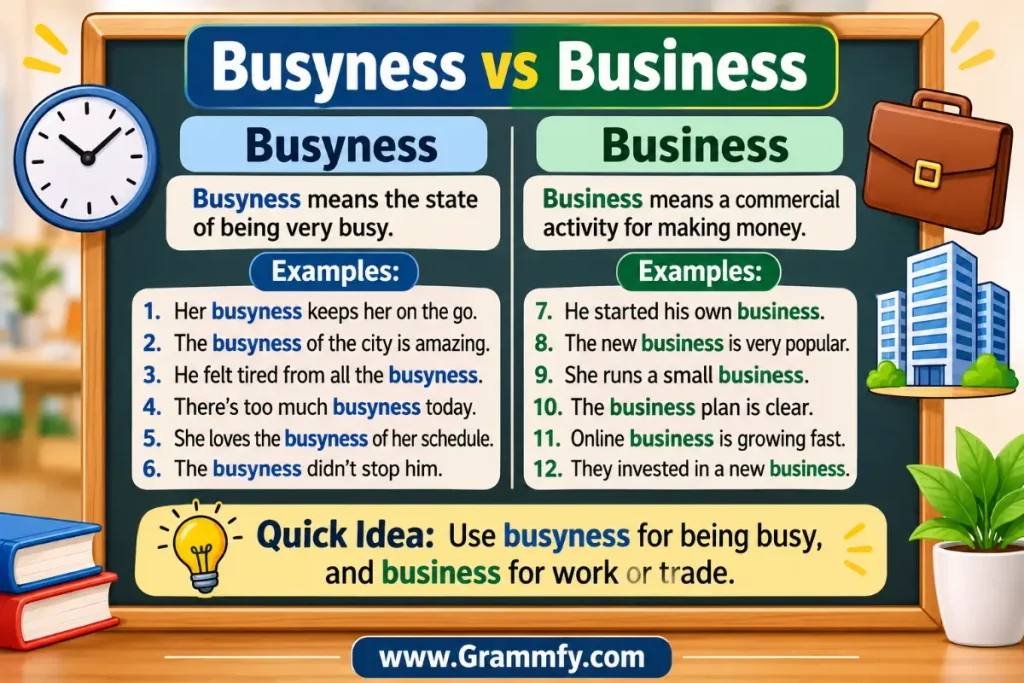
What Are 12 Original Examples of Busyness and Business?
Seeing both words in realistic sentences makes the difference easier to understand.
The following examples cover work, education, family life, travel, shopping, and professional situations.
Examples Using Busyness
- Workplace: The busyness of the office increased when the new project began.
- Education: During exam week, the busyness of student life becomes difficult to manage.
- Family: Despite her busyness, Maria always finds time to visit her parents.
- Shopping: The busyness of the shopping mall made it difficult to find a parking space.
- Travel: I enjoyed the city’s energy, but its constant busyness made me tired.
- Daily routine: The busyness of everyday life sometimes prevents people from enjoying simple moments.
- Seasonal activity: The holiday season brings extra busyness to restaurants and retail stores.
- Personal responsibilities: His busyness increased after he started working on two projects.
Examples Using Business
- Entrepreneurship: Sarah opened her own business after saving money for several years.
- Professional work: My uncle travels overseas for business several times a year.
- Commercial activity: International business connects companies from different countries.
- Personal matters: That’s my personal business, and I prefer to keep it private.
- Workplace meeting: The manager scheduled a business meeting to discuss the new marketing plan.
- Customer service: Good communication helps a business build lasting customer relationships.
- Professional partnership: They became business partners after working together on several projects.
- Small organizations: Local businesses often depend on loyal customers and community support.
What Is the Difference Between Busyness and Similar Words?
Some words appear interchangeable because they describe related ideas. However, their meanings and uses aren’t always identical.
These comparisons can help you select a more accurate expression.
Busyness vs. Business: What’s the Difference in Meaning?
| Feature | Busyness | Business |
|---|---|---|
| Main meaning | State of being busy | Work, trade, company, or matter |
| Part of speech | Noun | Noun |
| Common use | Activity and responsibilities | Professional and commercial matters |
| Example | The busyness exhausted me. | Her business is successful. |
| Plural | Usually uncountable | Businesses when referring to companies |
The key distinction: One describes a condition, while the other identifies an activity, organization, or matter.
Busyness vs. Activity: Which Word Is More Accurate?
Both words can describe situations involving movement or work, but they don’t communicate exactly the same idea.
Busyness focuses on the state of being occupied or having many things happening.
Activity refers to an action, process, or something being done.
Compare these examples:
- The busyness of the office increased before the deadline.
- The activity in the office increased before the deadline.
The first sentence emphasizes the overall condition of being busy. The second focuses on the amount of activity taking place.
Use activity when describing what is happening. Choose busyness when discussing the general state of being occupied.
Business vs. Work: Are They Interchangeable?
These terms are related, but they have different ranges of meaning.
Work refers to tasks, duties, effort, or employment.
Business can refer to work, but it can also describe companies, trade, commercial activity, and matters that concern someone.
Examples:
- I have a lot of work to complete today.
- I own a business that provides digital services.
- She enjoys her work.
- They discussed business opportunities.
You wouldn’t normally replace business with work in every sentence.
For example, small business refers to a commercial organization, not simply a small amount of work.
Business vs. Company: What’s the Difference?
A company is an organization that provides goods or services.
Business has a broader meaning. It can refer to the organization itself, commercial activity, or professional matters.
Examples:
- He started a technology company.
- He started a technology business.
- We discussed business during the meeting.
- The company hired five new employees.
In the first two sentences, the words are close in meaning. In the third, business refers to a subject or professional matter rather than a particular organization.
Busyness vs. Workload: Which One Should You Choose?
Busyness describes a general state of activity.
Workload refers more specifically to the amount of work someone has to complete.
Examples:
- The busyness of the office increased during the holiday season.
- My workload doubled after two employees left.
Use workload when discussing responsibilities, deadlines, and assigned tasks.
Choose busyness when describing a broader condition that may include work, personal activities, and other responsibilities.
What Are the Most Common Mistakes When Using These Words?
Even experienced writers sometimes confuse similar-looking words. The spelling difference is small, but using the wrong form can change the meaning of a sentence.
Here are the mistakes worth avoiding.
Mistake 1: Writing Business When You Mean the State of Being Busy
Incorrect: My business has increased because I have many personal responsibilities.
This sentence may suggest that your commercial activity has increased.
Correct: My busyness has increased because I have many personal responsibilities.
More natural: I’ve been busier because I have many personal responsibilities.
The correct choice depends on whether you’re describing activity or professional work.
Mistake 2: Writing Busyness When You Mean a Company
Incorrect: She wants to open a new busyness.
Correct: She wants to open a new business.
A company is called a business, not a busyness.
This is one of the easiest mistakes to identify because the sentence clearly refers to starting an organization.
Mistake 3: Thinking Busyness Is Always Incorrect
Some writers assume busyness is a spelling mistake because it looks unusual.
That’s not true. It is a recognized English noun that describes the state of being busy.
Example: The busyness of the hospital increased during the winter months.
Although busy schedule may sound more natural in many situations, the noun busyness is still grammatically correct.
Mistake 4: Using Business as a Direct Replacement for Busy
Incorrect: I am business today.
Correct: I am busy today.
Business is a noun, while busy is an adjective.
You can say:
- I am busy.
- I have a busy schedule.
- I have important business to finish.
However, you shouldn’t use business directly to describe how occupied you are.
Mistake 5: Assuming Both Words Have the Same Meaning Because of Their Pronunciation
The words are pronounced similarly, which can make them confusing during conversation.
However, spelling and context determine their written meanings.
For example:
- The busyness of the city attracted tourists.
- The city’s business community welcomed the visitors.
Both sentences are correct, but they communicate different ideas.
When Should You NOT Use Busyness?
Although the word is correct, it isn’t always the clearest option.
Avoid using busyness when:
- You mean a commercial organization. Use business.
- You mean the specific amount of assigned work. Use workload.
- You want to describe someone’s schedule. Use busy schedule.
- You mean useful work that produces results. Consider productivity.
- You mean a specific action. Use activity or the name of the action.
For example, instead of writing, “My busyness is increasing,” you could write, “My workload is increasing” if you’re specifically referring to assigned work.
When Should You NOT Use Business?
Avoid using business when the sentence simply needs an adjective describing someone’s condition.
For example:
- Incorrect: I’m business this afternoon.
- Correct: I’m busy this afternoon.
Also, don’t use business when you mean the general state of having many activities unless the sentence genuinely refers to professional work or another matter.
What Are the Antonyms of Busyness and Business?
Antonyms are words with opposite or contrasting meanings. Learning them can help you understand each term more clearly.
What Are the Opposite Words of Busyness?
Because busyness describes a condition of being occupied, its opposite usually involves having free time or experiencing little activity.
| Antonym | Meaning | Example |
|---|---|---|
| Idleness | A state of doing nothing | Idleness made the afternoon feel long. |
| Leisure | Free time for enjoyment | She enjoys her leisure time. |
| Rest | Time spent relaxing | I need some rest after work. |
| Inactivity | A lack of activity | Inactivity reduced productivity. |
| Stillness | A state without much movement | The stillness of the room was peaceful. |
| Calm | A peaceful condition | The office returned to calm. |
| Free time | Time without responsibilities | I have free time this weekend. |
What Are the Opposite Words of Business?
There isn’t one perfect antonym for every meaning of business. The opposite depends on how the word is being used.
| Business Meaning | Possible Opposite | Example |
|---|---|---|
| Commercial activity | Noncommercial activity | The event was a noncommercial community project. |
| Employment or work | Unemployment | Unemployment increased in the region. |
| Active trading | Inactivity | The market experienced a period of inactivity. |
| Professional engagement | Leisure | He prefers leisure to professional commitments. |
| Commercial organization | No direct opposite | The term depends on the context. |
Be careful when selecting an opposite. Leisure may contrast with work, but it isn’t the direct opposite of a company or organization.
What Are the Best Tips for Choosing the Correct Word?
Remembering a few simple rules can help you avoid confusion whenever these words appear in your writing.
1. Connect Busyness With Busy
The easiest memory trick is to look at the adjective busy.
- Busy = Having many things to do.
- Busyness = The state of having many things to do.
The ending -ness turns the adjective into a noun.
Think of happy becoming happiness or kind becoming kindness.
2. Connect Business With Companies and Work
When discussing organizations, professional activities, trade, or commercial matters, choose business.
Examples:
- A family business
- A business owner
- Business development
- Business opportunities
- International business
These expressions all use the established spelling business.
3. Check the Meaning Before Checking the Spelling
Ask yourself what the sentence is describing.
- Is it describing a state of being occupied? Choose busyness.
- Is it describing a company or commercial activity? Choose business.
- Is it describing someone’s condition? Consider busy.
- Is it describing the amount of assigned work? Consider workload.
This small check can prevent most spelling mistakes.
4. Read the Complete Sentence
Don’t choose a word based only on how it sounds.
For example:
- The busyness of the office surprised me.
- The business of the office surprised me.
The first describes the amount of activity. The second might refer to the office’s professional affairs or commercial work.
Reading the complete sentence helps you understand which meaning fits.
5. Choose Clearer Alternatives When Necessary
Sometimes the best solution isn’t choosing between the two words. Another expression may communicate your meaning more naturally.
Consider these alternatives:
| What You Want to Say | Clearer Expression |
|---|---|
| You have too many tasks | Heavy workload |
| You have limited free time | Busy schedule |
| A place has many people | Crowded environment |
| A company makes money | Profitable business |
| Someone completes useful work | High productivity |
| A person has many responsibilities | Numerous commitments |
Good writing isn’t about choosing complicated words. It’s about making your meaning easy to understand.
Conclusion:
Understanding Busyness vs Business becomes much easier when you focus on what each word describes. Busyness refers to the state of being occupied, active, or involved in many activities. Business refers to companies, commercial work, professional matters, and responsibilities.
Both words are correct, but choosing the right one depends on your sentence. Remember the connection between busy and busyness, and save business for organizations, trade, and work-related matters.
Frequently Asked Questions
Is Busyness a Real and Correct English Word?
Yes, busyness is a correct English noun. It describes the condition or quality of being busy, occupied, or involved in many activities. Although it is less common than business, it is not a spelling mistake.
Is Busyness or Business Correct When Talking About Being Busy?
Busyness is correct when referring to the state of being busy. However, busy or a busy schedule often sounds more natural in everyday conversation.
Why Are Busyness and Business Spelled Differently?
Both words share a historical connection with the Old English word bisig. However, business developed additional meanings related to work, trade, and companies, while busyness became the clearer form for describing the state of being busy.
Can I Use Busyness in a Professional Email?
Yes, you can use busyness in a professional email when discussing a period of intense activity. However, expressions such as busy schedule, heavy workload, and current commitments may sound more natural in many workplace situations.
What’s Another Way to Say Busyness?
Other ways to express busyness include activity, workload, hecticness, occupation, and numerous commitments. The best alternative depends on whether you’re describing general activity, professional responsibilities, or a demanding schedule.
Is Business Countable or Uncountable?
Business can be both countable and uncountable. It is countable when referring to separate companies, as in “three businesses.” It is generally uncountable when referring to commercial activity, as in “Business is improving.”
Which Is Correct: Busyness vs Business in Everyday Writing?
Both are correct, but they have different meanings. Use busyness for the state of being occupied and business for a company, commercial activity, professional work, or a matter that requires attention.

Tylerbrooks is a US-based English grammar writer and contributor at Grammfy. He writes helpful articles about grammar, spelling, commonly confused words, and vocabulary. His goal is to explain English topics in simple language with clear examples and practical tips. Through his articles, he helps readers improve their writing and everyday English skills.