
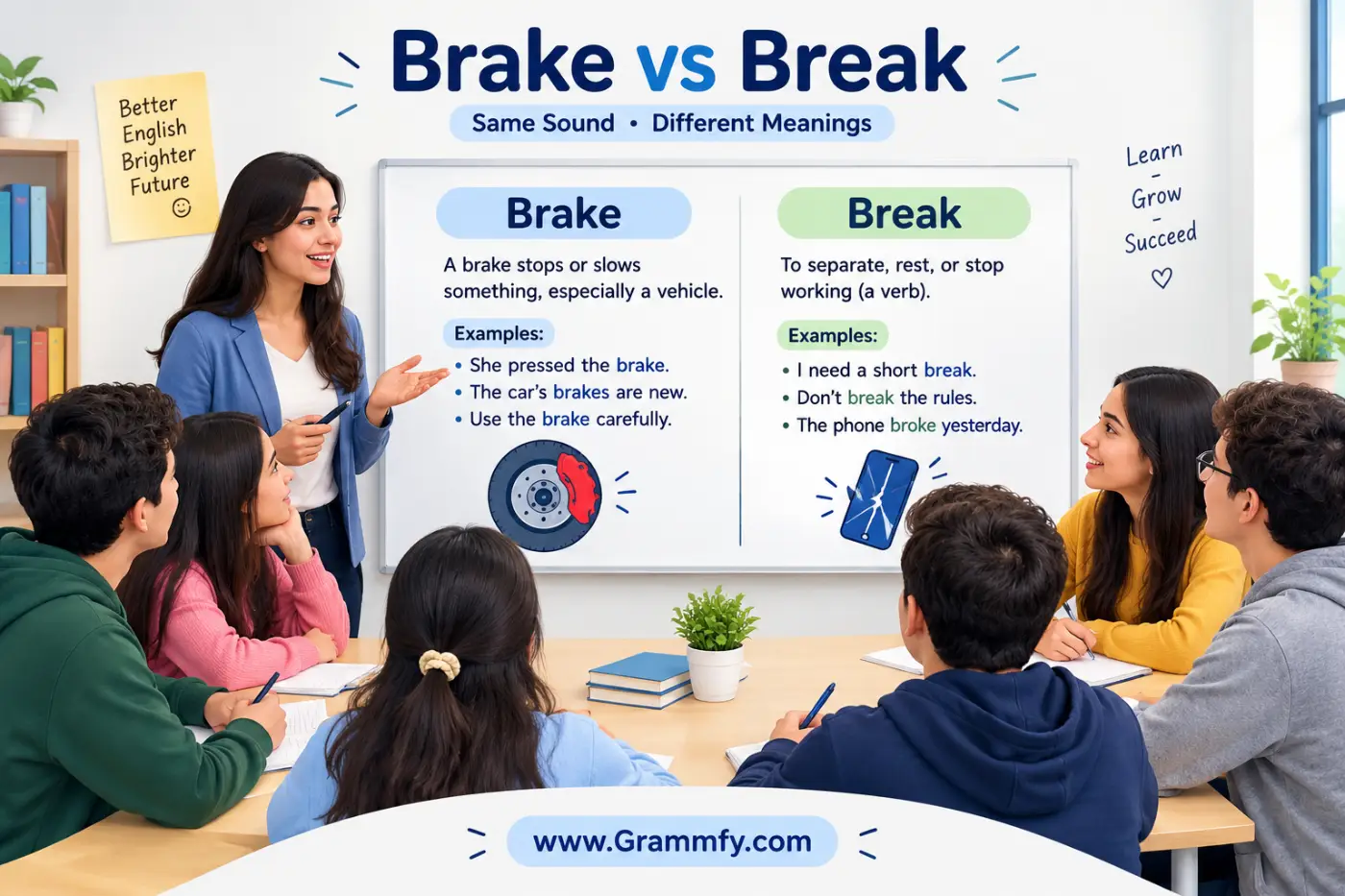
Have you ever typed a sentence and stopped because you weren’t sure whether to write brake vs break? You’re not alone. These two words sound exactly the same in most English accents, but they have completely different meanings. This can cause mistakes in an email, school essay, text message, or even a resume.
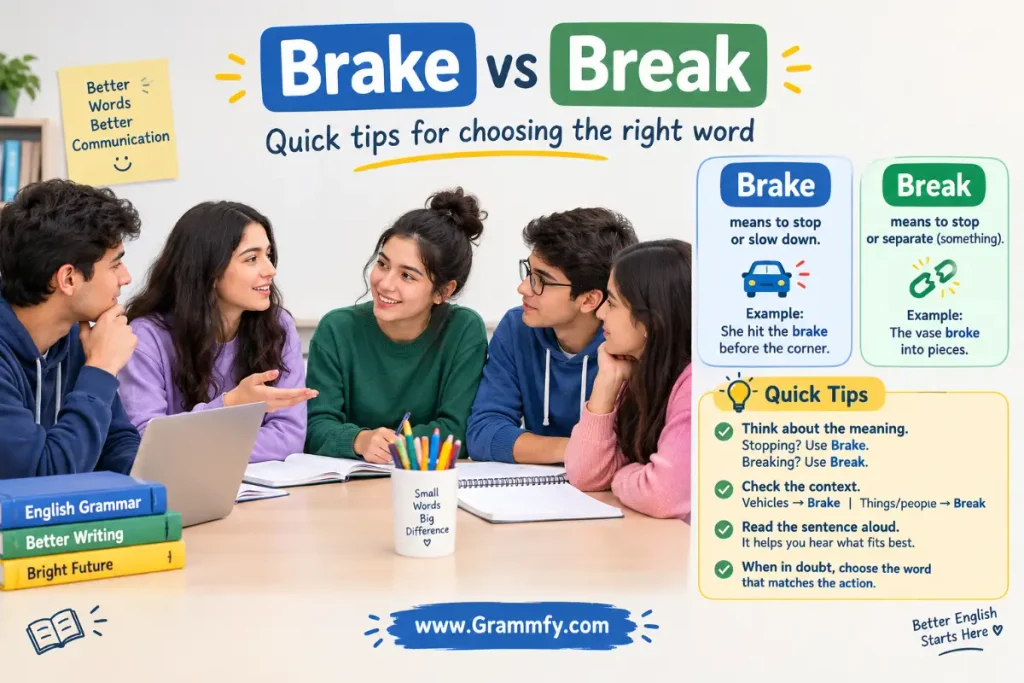
Brake usually relates to stopping or slowing a vehicle or machine. Break has many meanings, including damaging something, separating something, stopping an activity, or violating a rule.
Answer box: Brake is used for a device or action that slows or stops a vehicle or machine. Break means to damage, separate, interrupt, or stop something, depending on the context.
In this guide, you’ll learn the difference between these confusing words, where they came from, how to use them in real sentences, and which word works best in formal and everyday writing. You’ll also get synonym tables, common mistakes, memory tricks, and quick examples.
For another common word-choice problem, see Allude vs Elude.
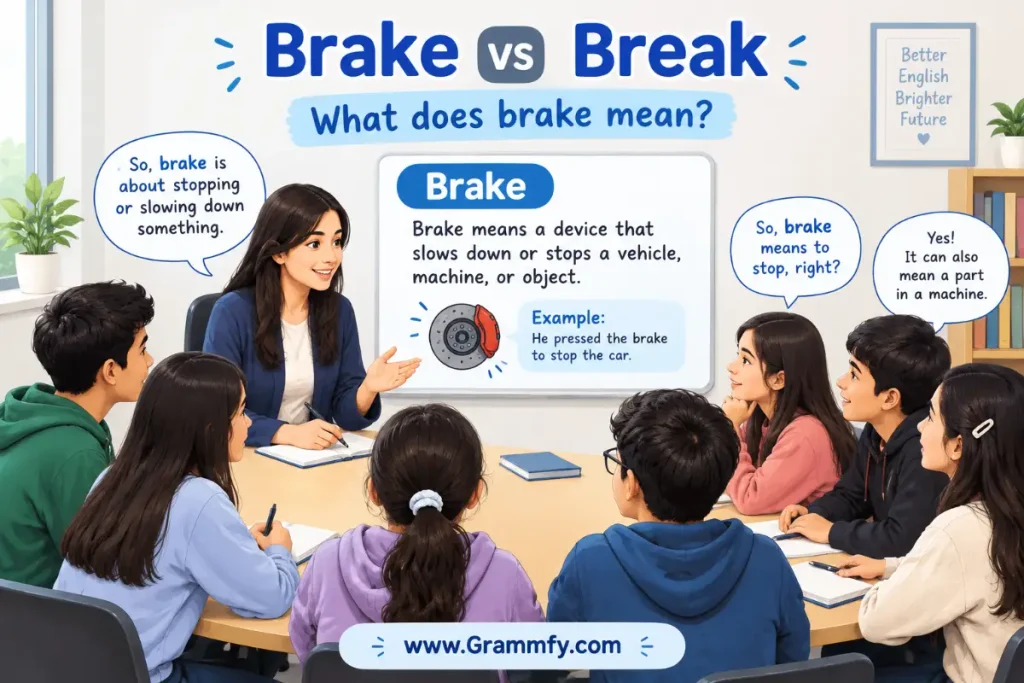
What does brake mean?
Brake can be a noun or a verb.
As a noun, a brake is a device used to slow down or stop a vehicle or machine.
- The car’s brakes need to be checked.
- She pressed the brake pedal.
- The bicycle has hand brakes.
As a verb, brake means to slow down or stop by using a brake.
- The driver braked suddenly.
- Please brake before the turn.
- He braked when he saw the child crossing the road.
The key idea is stopping or slowing through a braking system.
Where does brake come from?
The word brake has a long history connected with controlling motion. It developed from older words related to a device used to restrain or stop movement.
Over time, the meaning became strongly associated with vehicles and machines. Today, when people hear brake, they often think of cars, motorcycles, bicycles, trains, or other moving equipment.
The word can also be used figuratively:
- The high cost put the brakes on the project.
- The company needs to brake its rapid expansion.
These expressions still carry the basic idea of slowing something down.
What does break mean?
Break is much more common than brake, and it has many meanings.
As a verb, it can mean to damage something:
- Don’t break the glass.
- I accidentally broke my phone.
- The child broke the toy.
It can also mean to separate something into pieces:
- Break the chocolate into small pieces.
- She broke the stick in half.
Break can mean to stop or interrupt something:
- Let’s break for lunch.
- The news broke the silence.
- Please don’t break the meeting with unnecessary interruptions.
It can also mean to violate a rule, law, promise, or agreement:
- He broke the law.
- She broke her promise.
- They broke the rules.
Where does break come from?
Break is an old English word with roots in Germanic languages. Its early meanings were connected to splitting, shattering, or forcing something apart.
Its meaning expanded over centuries. Today, break can describe physical damage, emotional pain, interruptions, rules, habits, promises, records, and many other ideas.
That wide range explains why break appears in so many common expressions:
- break a window
- break a promise
- break a habit
- break a record
- break the news
- take a break
- break the rules
- break someone’s heart
The meanings may seem unrelated at first, but they all developed from the central idea of separating, interrupting, or disrupting something.
Brake vs Break: What’s the simple difference?
The easiest way to remember brake vs break is to connect each word with its main idea.
| Word | Main meaning | Example |
|---|---|---|
| Brake | Slow or stop a vehicle or machine | Press the brake. |
| Break | Damage, separate, interrupt, or violate | Don’t break the glass. |
Think about a car:
Brake = stop the car.
Think about a broken cup:
Break = damage the cup.
This simple connection will help in most everyday situations.
Why are Brake vs Break so easy to confuse?
The biggest reason is pronunciation. Brake and break are homophones. That means they have the same pronunciation but different spellings and meanings.
Other common homophones include:
- right / write
- sea / see
- pair / pear
- flour / flower
- hear / here
When you’re speaking, people usually understand the meaning from context. When you’re writing, however, you must choose the correct spelling.
That’s why these words can cause trouble in:
- school assignments
- emails
- text messages
- social media posts
- resumes
- reports
- instructions
A sentence such as “I had to break quickly” can look strange if the writer actually means stopping a car. The intended word is brake.
Brake vs Break: Synonyms and related words
Because the two words have different meanings, their synonyms are also different. The following lists help you build a stronger vocabulary while keeping the meanings clear.
Simple synonyms for brake
| Word | Meaning | Tone | Example |
|---|---|---|---|
| Slow | Move less quickly | Simple | Slow before the corner. |
| Stop | Come to a halt | Simple | Stop the car. |
| Halt | Stop moving | Simple/Formal | The driver halted the vehicle. |
| Slow down | Reduce speed | Everyday | Slow down near the school. |
| Stopper | Something that stops movement | Everyday | The device acts as a stopper. |
Everyday words related to brake
| Word | Meaning | Tone | Example |
|---|---|---|---|
| Slow | Reduce speed | Everyday | Slow the car before the bridge. |
| Decelerate | Reduce speed | Technical | The vehicle began to decelerate. |
| Restrain | Hold back movement | Formal | The system restrains the machine. |
| Control | Manage movement | Everyday | The brakes help control the car. |
| Immobilize | Prevent movement | Formal | The device can immobilize the vehicle. |
| Arrest | Stop movement | Formal/Technical | The mechanism arrests the motion. |
| Check | Slow or control | Formal/Literary | The barrier checked the vehicle’s speed. |
Formal terms related to brake
| Word | Meaning | Tone | Example |
|---|---|---|---|
| Decelerate | Become slower | Technical | The train decelerated before the station. |
| Retard | Slow down movement | Technical/Formal | The system retards the rotation. |
| Restrain | Limit movement | Formal | The mechanism restrains motion. |
| Immobilize | Make unable to move | Formal | The lock immobilized the vehicle. |
| Arrest | Stop or limit movement | Technical | The brake arrests the wheel’s motion. |
| Regulate | Control speed or movement | Formal | The system regulates speed. |
| Inhibit | Prevent or reduce an action | Formal | The mechanism inhibits excessive movement. |
Slang and informal expressions for stopping
English has many informal ways to talk about stopping or slowing down. These aren’t direct synonyms for the mechanical noun brake, but they can express a similar idea in casual speech.
| Word/Phrase | Meaning | Tone | Example |
|---|---|---|---|
| Slow down | Reduce speed | Casual | Slow down, you’re going too fast. |
| Ease off | Reduce pressure or speed | Casual | Ease off the gas. |
| Back off | Reduce intensity | Casual | Back off the speed a little. |
| Take it easy | Slow down or relax | Casual | Take it easy around this bend. |
| Pull up | Stop a vehicle | Casual | Pull up near the entrance. |
| Stop dead | Stop suddenly | Informal | The car stopped dead. |
| Slam on the brakes | Brake suddenly and strongly | Informal | She slammed on the brakes. |
These expressions shouldn’t replace the technical word when you’re describing an actual braking component.
Synonyms by intensity: mild to strong
Words related to stopping can show different levels of force.
Mild slowing
These suggest a small reduction in speed:
- ease off
- slow
- reduce speed
- decelerate
- check
Example:
The driver eased off the accelerator as the road became narrow.
Moderate stopping
These suggest a clear attempt to slow or stop:
- brake
- slow down
- halt
- stop
- restrain
Example:
The driver braked before entering the roundabout.
Strong or sudden stopping
These suggest an urgent or forceful action:
- slam on the brakes
- stop suddenly
- halt abruptly
- immobilize
- bring to a stop
Example:
The driver had to slam on the brakes when a dog ran into the road.
Choosing the right word makes your writing more precise. “Decelerated” sounds technical, while “slammed on the brakes” sounds dramatic and urgent.
Break has many different meanings
Unlike brake, break has a large family of meanings. Learning its common uses is more useful than memorizing one definition.
Break can mean damage
Use break when something becomes damaged or divided because of force.
- I broke the plate.
- The window broke during the storm.
- He broke his watch.
Break can mean separate
Use break when something is divided into pieces or parts.
- Break the bread into pieces.
- She broke the branch.
- The teacher asked us to break into groups.
Break can mean interrupt
Use break when something interrupts an activity, silence, pattern, or situation.
- The loud noise broke the silence.
- A phone call broke my concentration.
- The news broke the calm atmosphere.
Break can mean take a rest
A break is a short period when you stop working or studying.
- We have a ten-minute break.
- I need a break from studying.
- Let’s take a break.
Break can mean violate
Use break with rules, laws, promises, agreements, or commitments.
- Don’t break the law.
- He broke the rules.
- She broke her promise.
Break can mean reveal news
The expression break the news means to tell someone important or difficult information.
- Maya had to break the news to her family.
- The manager broke the news during the meeting.
Break can mean defeat or overcome
In some contexts, break means to overcome resistance or end a difficult situation.
- The team finally broke the defense.
- The rain broke the heat.
- The negotiations broke the deadlock.
Break can mean set a record
When someone performs better than an existing record, they can break a record.
- She broke the school record.
- The athlete broke the world record.
Brake vs Break by part of speech
Understanding grammar can make the difference even easier.
Brake as a noun
A brake is a physical device that slows or stops movement.
Examples:
- The brake is damaged.
- Check the brakes before driving.
- The bicycle’s rear brake isn’t working.
Brake as a verb
Brake means to slow or stop a moving vehicle or machine.
Examples:
- You should brake before the turn.
- She braked quickly.
- The driver is braking now.
Break as a noun
A break can mean a period of rest, an interruption, a fracture, or an opportunity.
Examples:
- Let’s take a break.
- She needs a lunch break.
- The doctor found a break in the bone.
Break as a verb
Break can mean damage, separate, interrupt, violate, or stop something.
Examples:
- Don’t break the glass.
- He broke the rule.
- She broke the habit.
- The storm broke a window.
Brake vs Break in US and UK English
The spelling difference between brake and break is generally the same in American and British English.
Both varieties use:
- brake for a vehicle’s stopping mechanism
- break for damage, interruption, rest, separation, and related meanings
There isn’t a major US-versus-UK spelling change here.
There can be differences in vocabulary for specific vehicle parts or driving terms, but the basic distinction remains unchanged.
For example:
- American English: brake pedal
- British English: brake pedal
Both use brake.
Likewise:
- American English: take a break
- British English: take a break
So if you’re writing for a US audience, the same rule applies.
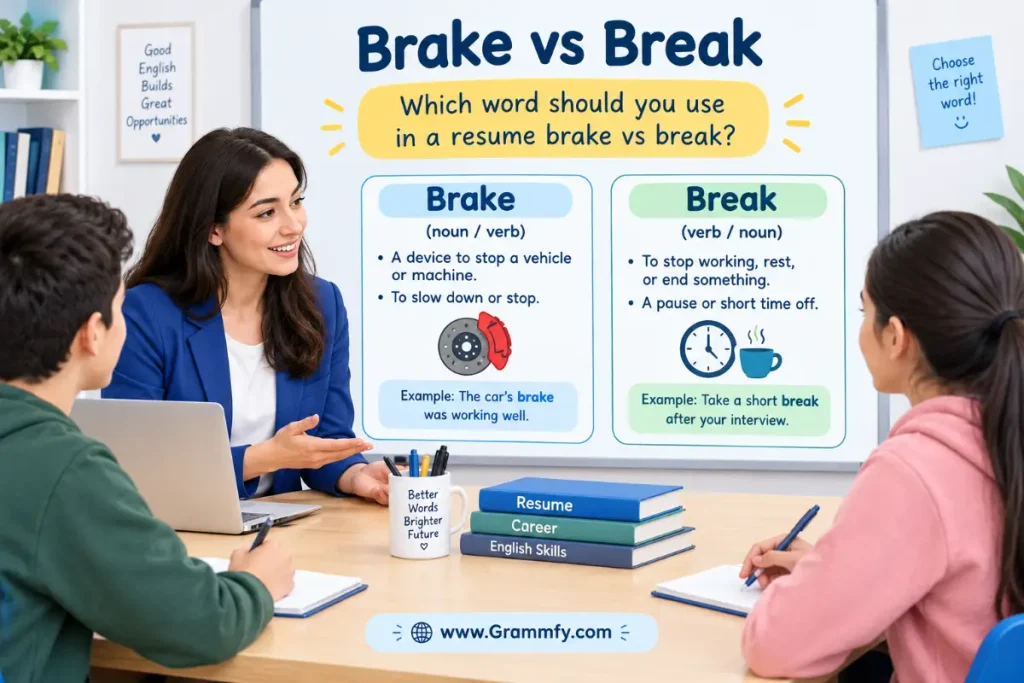
Which word should you use in a resume brake vs break?
Use brake when you’re talking about vehicles or machinery
A resume might mention experience with vehicle maintenance, transportation, or mechanical systems.
Example:
Inspected vehicle brake systems and completed routine safety checks.
Here, brake is correct because the sentence refers to a mechanical system.
Use break when you’re talking about interruptions or rest
A resume may also describe workplace scheduling or procedures.
Example:
- Managed employee lunch break schedules.
- Here, break refers to a period of rest.
Resume tip
Don’t use brake just because the sentence involves stopping something.
If you’re talking about stopping a project, habit, or process, break or another suitable word may be correct.
Correct:
Helped break the cycle of repeated errors.
Incorrect:
Helped brake the cycle of repeated errors.
Which word should you use in an essay Brake vs Break?
Use brake for mechanical stopping
In an essay about cars, transportation, engineering, or safety, use brake when referring to the stopping system.
Example:
A properly maintained brake system is important for road safety.
Use break for broader meanings
In literature, history, science, or general writing, break can describe many different actions.
Examples:
- The discovery helped break an old scientific belief.
- The speech broke years of silence.
- Students should take a short break during long study sessions.
The correct choice depends on the meaning, not on how the word sounds.
Which word should you use in texting Brake vs Break?
Use brake when talking about driving
Texting is informal, but spelling still matters.
Example:
Don’t forget to check the brakes before the trip.
Use break for rest or damage
Examples:
- I need a break from homework.
- Be careful not to break your phone.
A useful texting trick is to think about the meaning before typing the word.
- If you mean stop a car, use brake.
- If you mean rest, damage, separate, interrupt, or violate, use break.
Which word should you use in an email Brake vs Break?
Use brake for vehicle-related information
Example:
The mechanic said the front brakes need replacement.
Use break for workplace interruptions
Example:
I’ll review the report after my lunch break.
You should also watch for phrases such as break time, break room, and take a break. All of these use break.
Which word should you use when speaking Brake vs Break?
When speaking, the problem is less noticeable because the two words sound the same.
You can say:
I had to brake quickly.
And:
I need a break.
Listeners use the surrounding words to understand your meaning.
The real challenge comes when you need to write the word down. That’s when remembering the spelling becomes important.
15 real-life examples of brake vs break
Here are examples from different situations.
1. Driving
- The driver pressed the brake when the traffic light turned red.
- The word refers to the vehicle’s stopping system.
2. Bicycle riding
- My bicycle brakes aren’t working properly.
- This is about a mechanical part.
3. Damaging an object
- Please don’t break the glass.
- The meaning is to damage or shatter it.
4. Taking a rest
- Let’s take a short break before the next lesson.
- Here, break means a rest period.
5. Following the law
- Drivers must not break traffic laws.
- You don’t use brake because the sentence is about violating rules.
6. Making a sudden stop
- She had to brake hard to avoid the accident.
- The word describes slowing a vehicle.
7. Breaking a promise
- He didn’t want to break his promise.
- A promise can be violated, so break is correct.
8. Workplace rest
- Employees get a thirty-minute lunch break.
- The word means a period away from work.
9. Mechanical inspection
- The mechanic inspected the car’s brake pads.
- This refers to a vehicle component.
10. Breaking a habit
- It took her months to break the habit.
- The word means to stop a repeated behavior.
11. School
- We usually have a short break between classes.
- Again, it means rest time.
12. Sudden danger
- The cyclist used the brakes when the dog crossed the road.
- The vehicle’s stopping mechanism is involved.
13. Broken object
- I accidentally broke my favorite mug.
- The mug was damaged.
14. News
- The reporter broke the news early that morning.
- The phrase means the reporter revealed the information.
15. Records
- The runner broke the school record.
- The athlete surpassed the previous record.
Brake vs Break: What’s the difference in driving?
Driving is where the distinction becomes especially easy.
A brake is part of the vehicle.
You can:
- press the brake
- use the brake
- check the brakes
- repair the brakes
- replace the brakes
- brake suddenly
- brake gently
But you can also use break in a driving sentence if the meaning fits.
For example:
Don’t break the speed limit.
Here, break means violate. The sentence has nothing to do with the vehicle’s braking system.
Compare:
| Sentence | Correct word | Why? |
|---|---|---|
| Press the ___ pedal. | brake | It stops the car. |
| Don’t ___ the speed limit. | break | It means violate. |
| The ___ pads are worn. | brake | They are vehicle parts. |
| Take a ___ after driving for two hours. | break | It means rest. |
| I had to ___ suddenly. | brake | It means slow the vehicle. |
Brake vs Break: What’s different from “stop”?
Stop is broader than brake. You can stop a car by braking, but stop doesn’t specifically describe the braking mechanism.
Compare:
- “The driver stopped the car.” This tells us the car came to a stop.
- “The driver braked the car.” This focuses on the action of using the braking system to slow the vehicle.
In many everyday sentences, both may be possible, but they don’t carry exactly the same focus.
- Brake is more specific.
- Stop is more general.
Brake vs Break: What’s different from “halt”?
Halt means to stop, often suddenly or completely. It can sound more formal than stop.
Compare:
The train halted at the station.
The driver braked before the corner.
Halt describes the stopping result or action in general. Brake points to slowing or stopping through a braking action.
For everyday writing, stop is usually more natural. For mechanical or driving contexts, brake is more precise.
Common mistakes with brake
Mistake 1: Using break for a car’s stopping system
Incorrect:
The car’s breaks need repair.
Correct:
The car’s brakes need repair.
The car uses brakes to slow down or stop.
Mistake 2: Writing “break pedal”
Incorrect:
Press the break pedal.
Correct:
Press the brake pedal.
A pedal used to slow a vehicle is a brake pedal.
Mistake 3: Using brake for slowing a habit
Incorrect:
I need to brake this bad habit.
Correct:
I need to break this bad habit.
A habit isn’t a vehicle. You’re trying to stop a repeated behavior, so break is correct.
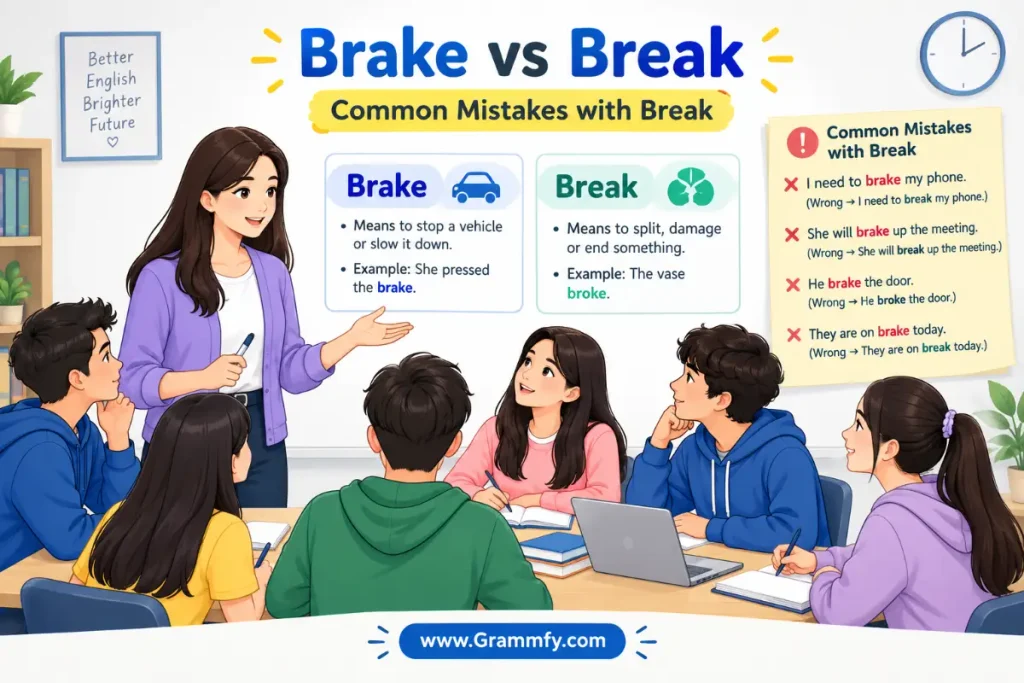
Common mistakes with break
Mistake 1: Using break when you mean a vehicle brake
Incorrect:
She pressed the break.
Correct:
She pressed the brake.
Mistake 2: Confusing “break” with “brake” in traffic
Incorrect:
He breaked suddenly.
Correct:
He braked suddenly.
Notice another important point: the past tense of the verb brake is braked.
The past tense of break is broke.
| Present | Past | Past participle |
|---|---|---|
| brake | braked | braked |
| break | broke | broken |
Examples:
She braked suddenly.
He has braked several times.
She has broken the glass.
When should you NOT use brake?
Don’t use brake when you mean:
- damage something
- violate a rule
- violate a promise
- rest
- interrupt something
- separate something
- stop a habit
- reveal news
- surpass a record
Use break or another suitable word instead.
For example:
- ❌ Brake a promise
- ✅ Break a promise
- ❌ Brake a habit
- ✅ Break a habit
- ❌ Take a brake
- ✅ Take a break
- ❌ Brake the law
- ✅ Break the law
When should you NOT use break?
Don’t use break when you’re specifically talking about a vehicle’s or machine’s braking system.
For example:
❌ The car’s breaks are worn.
✅ The car’s brakes are worn.
Also avoid using break as the verb when you specifically mean using the braking system.
❌ He breaked before the corner.
✅ He braked before the corner.
Antonyms of Brake vs Break
The antonyms depend on which meaning you’re using.
Antonyms related to brake
If brake means slow down, possible opposites include:
- accelerate
- speed up
- increase speed
- advance
Example:
The driver accelerated after leaving the intersection.
Antonyms related to break
If break means damage, an opposite can be:
- repair
- fix
- restore
Example:
She repaired the broken chair.
If break means interrupt, possible opposites include:
- continue
- maintain
- resume
Example:
After lunch, we continued the meeting.
If break means violate a rule, the opposite may be:
- obey
- follow
- respect
Example:
Good drivers follow traffic laws.
Useful phrases with brake
Here are common expressions involving brake:
- brake pedal
- brake light
- brake pad
- brake fluid
- brake system
- emergency brake
- parking brake
- hand brake
- apply the brakes
- press the brakes
- release the brake
- brake suddenly
- brake gently
- brake hard
Examples:
- The brake lights came on.
- The mechanic replaced the brake pads.
- Always apply the brakes carefully on a wet road.
Useful phrases with break
There are many more common phrases with break.
Take a break
Meaning: rest for a short time.
I need to take a break.
Break a habit
Meaning: stop a regular behavior.
She wants to break the habit of staying up late.
Break a promise
Meaning: fail to do what you promised.
Don’t break your promise.
Break the law
Meaning: violate a law.
Anyone who breaks the law may face consequences.
Break the rules
Meaning: violate rules.
Students shouldn’t break the rules.
Break the news
Meaning: tell someone important information.
Who will break the news to him?
Break a record
Meaning: achieve a better result than the previous record.
The swimmer broke the record.
Break the silence
Meaning: end a period of silence.
Her question broke the silence.
Break someone’s heart
Meaning: cause deep emotional pain.
The sad ending broke her heart.
Break down
This phrasal verb has several meanings.
The car broke down.
Here, the car stopped working.
It can also mean to become emotionally overwhelmed:
She broke down in tears.
Break up
This can mean separate or end a relationship.
They decided to break up.
It can also mean divide something into smaller pieces or parts.
Let’s break up the work into smaller tasks.
A quick comparison table about Brake vs Break
| Situation | Correct word | Example |
|---|---|---|
| Car stopping system | Brake | The brake is worn. |
| Slow a vehicle | Brake | Brake before the turn. |
| Bicycle stopping system | Brake | My bike brake needs repair. |
| Rest period | Break | Let’s take a break. |
| Damage something | Break | Don’t break the glass. |
| Violate a rule | Break | Don’t break the rules. |
| Violate a promise | Break | Don’t break your promise. |
| Stop a habit | Break | I want to break this habit. |
| Reveal information | Break | She broke the news. |
| Surpass a record | Break | He broke the record. |
A simple memory trick
Here’s an easy trick for remembering the spelling.
Brake has an “a”
Think:
A = Automobile
Brake is connected to an automobile.
This isn’t a perfect rule because bicycles and other machines also have brakes, but it’s a useful memory aid.
Break has an “e”
Think:
E = Everything else
This isn’t a grammar rule, but it can help you remember that break is the word used for most of the other meanings.
Another trick is to remember the phrase:
Brake the car, break the glass.
The car needs a brake.
The glass can break.
Quick tips for choosing the right word Brake vs Break
Use these questions when you’re unsure.
Ask: Is this about stopping a vehicle?
If yes, choose brake.
Press the brake.
Ask: Is this about a vehicle’s stopping equipment?
If yes, choose brake.
The brakes need repair.
Ask: Do I mean damage?
If yes, choose break.
Don’t break it.
Ask: Do I mean rest?
Choose break.
Let’s take a break.
Ask: Do I mean violate?
Choose break.
Don’t break the rules.
Ask: Do I mean stopping a habit?
Choose break.
I want to break this habit.
Ask: Do I mean interrupting something?
Choose break.
The noise broke my concentration.
A five-second test
When you’re writing quickly, use this test:
Car or machine? → BRAKE
Damage, rest, rule, promise, habit, interruption, record, or news? → BREAK
For example:
The driver pressed the ___.
Car? Brake.
I need a short ___.
Rest? Break.
Don’t ___ the rules.
Violation? Break.
The mechanic checked the ___.
Vehicle part? Brakes.
This test handles most everyday cases.
Why spelling matters even when the words sound the same
Homophones are one of the biggest challenges in English spelling. When you hear brake or break, you can’t tell the spelling from the sound alone.
That’s why context is so important.
Compare these sentences:
The driver had to brake suddenly.
The driver needed a break after the long trip.
Both words sound alike, but the meanings are completely different.
Correct spelling also makes your writing look more professional. A mistake such as “take a brake” may be obvious to readers, especially in formal writing.
If you’re writing a resume, school paper, business email, or website article, choosing the correct word shows attention to detail.
Brake vs Break in common expressions
Some expressions are easy to memorize as fixed phrases.
Common expressions with brake
- hit the brakes
- apply the brakes
- release the brakes
- emergency brake
- parking brake
- brake pedal
- brake lights
- brake pads
Common expressions with break
- take a break
- break a promise
- break a rule
- break the law
- break a habit
- break a record
- break the news
- break the silence
- break someone’s heart
- break down
- break up
- break apart
- break into pieces
Learning these phrases as complete chunks can make the spelling automatic.
Practice: choose brake or break
Try filling in the blanks before looking at the answers.
- Press the ___ before the corner.
- I need a short ___.
- Don’t ___ the glass.
- The mechanic checked the ___ pads.
- She doesn’t want to ___ her promise.
- He had to ___ suddenly.
- We should take a ___ after this lesson.
- Don’t ___ the law.
- The cyclist used the ___ when the dog crossed the road.
- She wants to ___ her bad habit.
- The athlete ___ the school record.
- The noise ___ the silence.
Answers
- brake
- break
- break
- brake
- break
- brake
- break
- break
- brake
- break
- broke
- broke
Notice that some answers use forms of break, such as broke, rather than the base form.
Conclusion
Knowing the difference between Brake vs Break becomes much easier when you focus on meaning instead of sound. Use brake when you’re talking about slowing or stopping a vehicle, bicycle, or machine, or about the equipment that does that job. Use break for the many other common meanings, such as damaging something, taking a rest, violating a rule, stopping a habit, interrupting something, or surpassing a record.
The easiest memory trick is simple: brake the car, break the glass. When you see a sentence, ask what action or object you mean before choosing the spelling. With a little practice, these two homophones will become much easier to use correctly in emails, essays, texts, and everyday writing.
Frequently Asked Questions
What’s the difference between brake and break?
Brake relates to slowing or stopping a vehicle or machine, while break can mean damage, separate, interrupt, rest, or violate something.
Is it “take a brake” or “take a break”?
The correct phrase is take a break. It means to stop working or studying for a short time.
Is it “car breaks” or “car brakes”?
The correct spelling is car brakes when you mean the parts that slow or stop the vehicle.
What’s another way to say brake?
Depending on the context, you can use words such as slow down, stop, halt, decelerate, restrain, or immobilize, although they aren’t exact replacements in every sentence.
What is the past tense of brake?
The past tense of brake is braked. For example, “The driver braked suddenly.”
What is the past tense of break?
The past tense of break is broke, and its past participle is broken. For example, “She broke the cup” and “The cup is broken.”
Why are brake and break confusing?
Brake and break are homophones, so they sound the same in most English accents. Their meanings and spellings, however, are different.
