
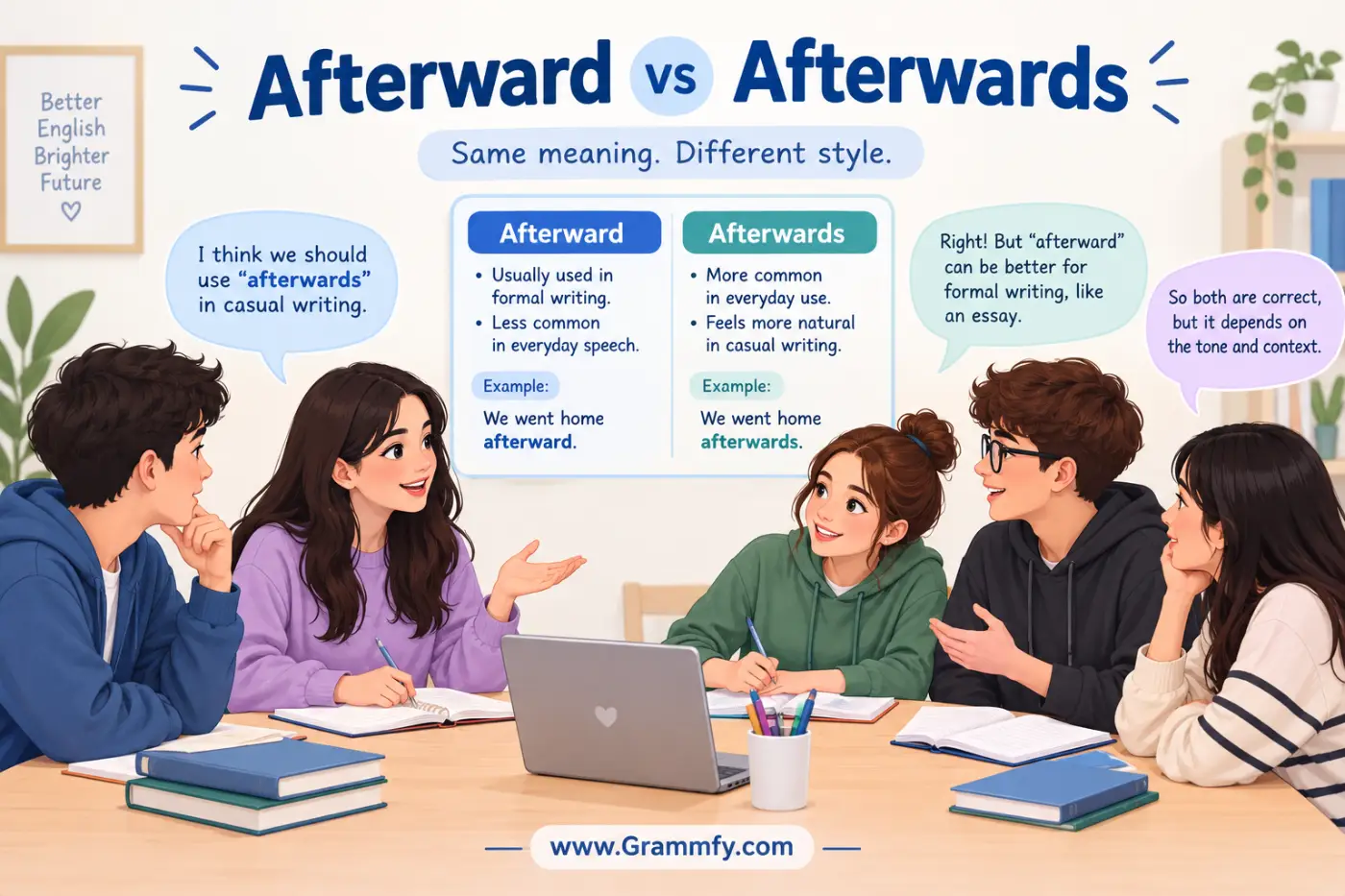
Have you ever finished writing an email, essay, or text and paused over Afterward vs Afterwards? Both forms mean the same basic thing: something happens later, after an earlier event. The main difference is where they are more commonly used.
Afterward is especially common in American English, while afterwards is especially common in British English and other varieties of English. Both are correct, and neither changes the meaning of a sentence.
Answer box: Afterward and afterwards both mean “later” or “after something has happened.” Afterward is more common in US English, while afterwards is more common in UK English.
These words often appear after an action, event, conversation, meal, meeting, or experience. They are useful when you want to show that one thing happened after another. In this guide, you’ll learn their meanings, history, grammar, regional use, synonyms, examples, common mistakes, and the best choice for different types of writing.
These words are easy to mix up, so read our guide to the difference between Brake vs Break to see their meanings and examples side by side.
What does afterward mean?
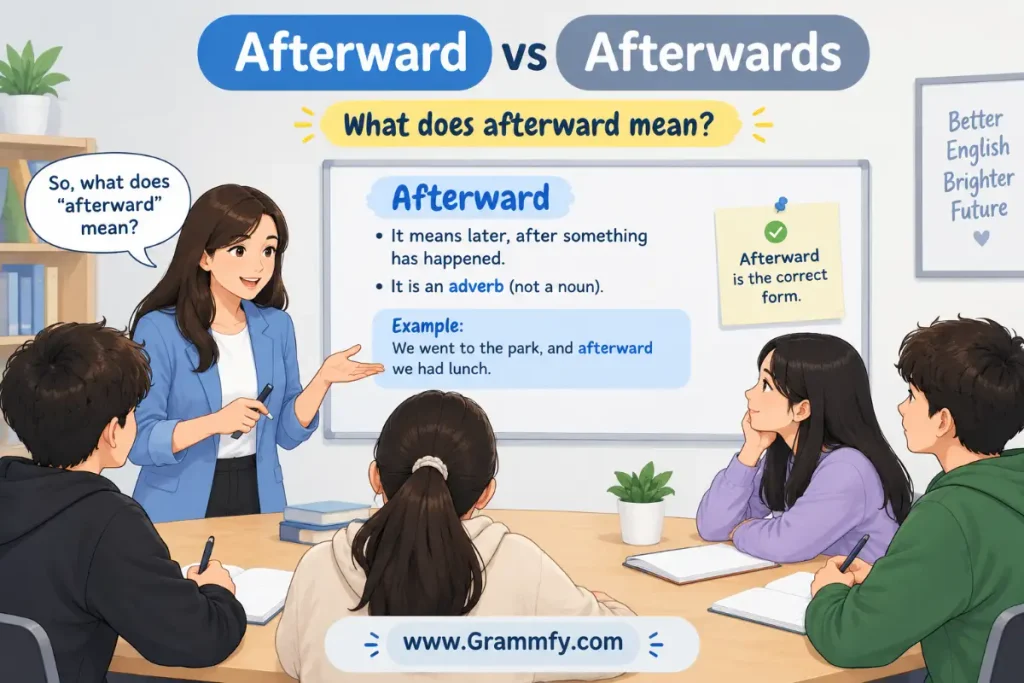
Afterward is an adverb that means at a later time or after something has happened.
For example:
We went to a restaurant afterward.
This means that going to the restaurant happened after another event that was already mentioned or understood.
Here are a few more examples:
- She called me afterward.
- We talked about the problem afterward.
- He felt better afterward.
- I’ll explain everything afterward.
- They went home afterward.
The word doesn’t usually tell you exactly when the later event happened. It simply places it after an earlier event.
Is afterward one word?
Yes. Afterward is normally written as one word.
Correct:
We went for coffee afterward.
Incorrect:
We went for coffee after word.
The spelling afterword is a different word. It means a section added at the end of a book, usually written by the author or another person.
That distinction is important because afterword and afterward can look and sound similar.
What does afterwards mean?
Afterwards is also an adverb. It means later or after that.
For example:
We went for dinner afterwards.
The meaning is the same as:
We went for dinner afterward.
Other examples include:
- She apologized afterwards.
- We discussed it afterwards.
- They left afterwards.
- He regretted it afterwards.
- I’ll call you afterwards.
The extra s doesn’t create a different meaning. It is mainly a difference in regional preference and style.
Afterward vs Afterwards: What’s the basic difference?
The simplest answer is that the two words have the same meaning.
| Word | Meaning | Common use |
|---|---|---|
| Afterward | Later; after that | Especially common in US English |
| Afterwards | Later; after that | Especially common in UK English |
Both can describe something that happens after another event.
Compare:
We had lunch and afterward went shopping.
We had lunch and afterwards went shopping.
Both sentences are correct.
The choice usually depends on the variety of English you’re using and your personal style.
Where did afterward come from?
The word afterward is formed from after + ward.
The ending -ward has historically been used to show direction or movement toward something.
You can see the same pattern in words such as:
- toward
- forward
- backward
- upward
- downward
- afterward
- homeward
In afterward, the idea developed into something like “following that” or “at a time after that.”
Over time, it became a common adverb used to talk about events that happen later.
Where did afterwards come from?
Afterwards developed from the same basic word but includes the -s ending.
The form has a long history in English and became especially established in British usage.
This means the difference isn’t based on two unrelated words. They come from the same general word family and have the same basic meaning.
The important point for modern writers is simple: both forms are standard English.
Is afterward or afterwards more common?
It depends on the variety of English.
In American English, afterward is generally the more common choice.
In British English, afterwards is generally more common.
You’ll also see regional preferences in other English-speaking countries.
For example, a US newspaper or American school textbook may prefer:
- We discussed the issue afterward.
A British publication may naturally write:
- We discussed the issue afterwards.
Neither version is grammatically wrong.
Is afterward American English?
Afterward is strongly associated with American English, but it isn’t exclusive to the United States.
It is completely standard in US writing and speech.
Examples:
- I’ll talk to you afterward.
- We went home afterward.
- She felt tired afterward.
If you’re writing for an American audience, afterward is usually the safest default.
Is afterwards British English?
Afterwards is strongly associated with British English.
For example:
- We went to the pub afterwards.
- She spoke to her teacher afterwards.
- I’ll see you afterwards.
British writers commonly use the form with -s, while American writers often prefer the shorter form.
However, British English can use afterward too. Likewise, American English speakers may use afterwards. These are preferences, not strict grammar rules.
Afterward vs Afterwards in US and UK English
Here’s a quick regional guide.
| Variety | Common preference | Example |
|---|---|---|
| US English | afterward | We talked afterward. |
| UK English | afterwards | We talked afterwards. |
| Canadian English | Both | We talked afterward/afterwards. |
| Australian English | Both, with afterwards common | We talked afterwards. |
| International English | Both | Choose based on audience and style. |
If your website targets American readers, afterward is a natural default. If you’re writing for a British audience, afterwards may sound more natural.
Why do some words have an -s ending?
English has several pairs where regional or historical usage creates slightly different forms.
For example:
- toward / towards
- afterward / afterwards
- forward / forwards
- backward / backwards
These pairs don’t always have different meanings.
The -s can be more common in British English, while the shorter form can be more common in American English.
This is one reason learners may see both versions in books, websites, movies, and conversations.
The presence of the final s doesn’t automatically mean that one word is more formal or more correct.
Is afterward an adverb?
Yes. Afterward is an adverb.
It tells us when something happens.
For example:
- She went home afterward.
The word afterward tells us when she went home.
It can also appear at the beginning or middle of a sentence.
At the beginning
Afterward, we went back to the hotel.
In the middle
We afterward discovered that the door was unlocked.
The second pattern is grammatically possible but often sounds less natural in everyday English.
At the end
We went back to the hotel afterward.
The final position is very common.
Is afterwards an adverb?
Yes. Afterwards is also an adverb.
It performs the same basic job as afterward.
Examples:
- Afterwards, we went home.
- We went home afterwards.
- She felt tired afterwards.
It tells the reader or listener that an action happened later than another event.
Can you use afterward after a noun?
Usually, afterward does not directly modify a noun.
It is an adverb, so it describes an action or situation.
Correct:
We talked afterward.
Not natural:
The afterward meeting was long.
If you want to describe a later event before a noun, use words such as:
- later
- subsequent
- following
- next
For example:
The subsequent meeting was much shorter.
Or:
At the following meeting, we discussed the results.
Can you use afterwards after a noun?
The same rule applies to afterwards.
It works as an adverb, not as a normal adjective.
Correct:
We talked afterwards.
Incorrect:
The afterwards meeting was long.
If you need an adjective, choose a different word.
Synonyms for afterward and afterwards
Both forms have many useful alternatives. The best synonym depends on the sentence and how formal you want to sound.
Simple synonyms
| Word | Meaning | Tone | Example |
|---|---|---|---|
| Later | At a later time | Simple | I’ll call you later. |
| Then | At that time or after that | Simple | We ate and then left. |
| After | Following an event | Simple | We talked after dinner. |
| After that | Following the event just mentioned | Simple | After that, we went home. |
| Next | Following in order | Simple | Next, we went outside. |
| Following | Coming after something | Simple/Formal | Following the meeting, we left. |
Everyday synonyms
| Word | Meaning | Tone | Example |
|---|---|---|---|
| Later on | At a later time | Everyday | I’ll finish it later on. |
| After that | Following that event | Everyday | We went home after that. |
| From then on | Starting at that point | Everyday | From then on, things changed. |
| Subsequently | Afterward; later | Formal | The company subsequently changed its policy. |
| In the meantime | During the time before another event | Everyday | In the meantime, wait here. |
| At a later time | At some future point | Neutral | We’ll discuss it at a later time. |
Formal synonyms
| Word | Meaning | Tone | Example |
|---|---|---|---|
| Subsequently | Later; following an earlier event | Formal | The patient subsequently recovered. |
| Thereafter | From that time onward | Formal | Thereafter, the rules were changed. |
| Following this | After this event | Formal | Following this, the team met again. |
| Subsequently to | After something | Very formal | The action occurred subsequently to the review. |
| At a later stage | At a later point | Formal | The issue was addressed at a later stage. |
| In due course | At the appropriate later time | Formal | The results will be announced in due course. |
| Later | At a future or following time | Neutral | The issue was resolved later. |
Informal and conversational alternatives
| Word/Phrase | Meaning | Tone | Example |
|---|---|---|---|
| Later | At another time | Casual | See you later. |
| Later on | Some time afterward | Casual | We can talk later on. |
| Then | After that | Casual | We ate, then we left. |
| After that | Following an event | Casual | After that, we watched TV. |
| Once that was over | After an event ended | Conversational | Once that was over, we went home. |
| When it was over | After something ended | Conversational | When it was over, everyone left. |
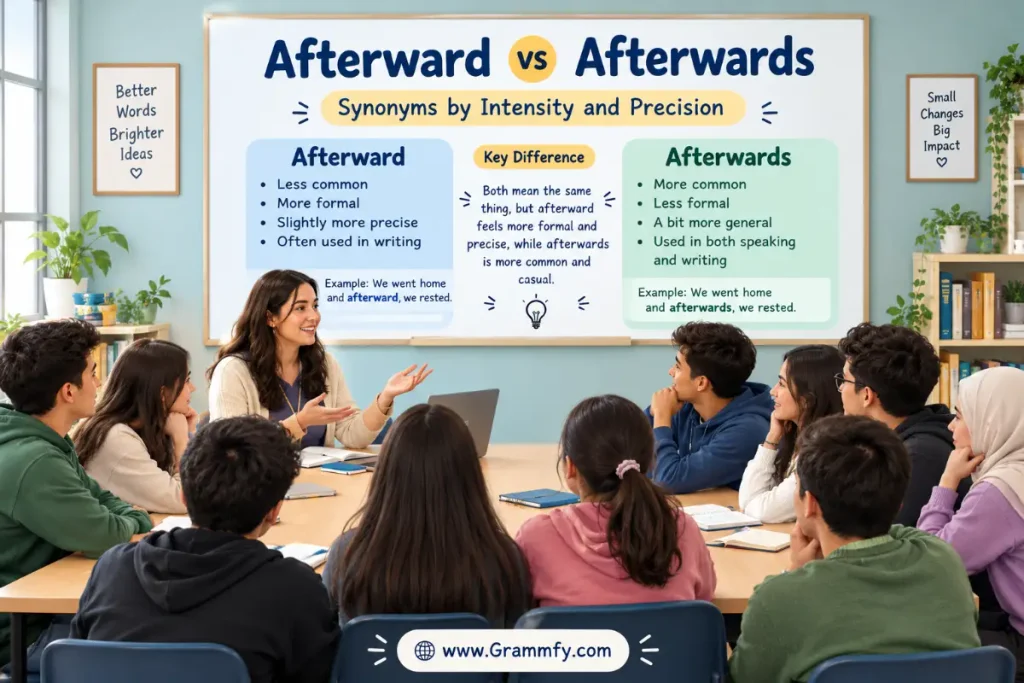
Synonyms by intensity and precision
Not every synonym is an exact replacement.
Very general
Later is the broadest choice.
I’ll call you later.
It doesn’t always clearly connect the later action to a specific earlier event.
Clear sequence
Afterward, afterwards, and after that clearly connect one event to another.
We finished dinner and went for a walk afterward.
Formal sequence
Subsequently is more formal.
The company subsequently changed its policy.
This word often appears in reports, research, legal writing, and professional documents.
Ongoing sequence
Thereafter can suggest that something continued from a particular point onward.
Thereafter, the organization followed a new procedure.
This is not always a direct substitute for afterward.
Afterward vs later: What’s the difference?
Afterward and later are close in meaning, but they aren’t always interchangeable.
Later simply means at a time after now or after another point.
I’ll call you later.
Afterward usually connects a later action to a specific event.
We finished the meeting and talked afterward.
Compare:
| Word | Main idea | Example |
|---|---|---|
| Later | At a later time | I’ll see you later. |
| Afterward | After a specific event | I’ll see you afterward. |
If the earlier event is clear from the sentence or conversation, afterward can be especially useful.
Afterwards vs then: What’s different?
Then has more uses than afterwards.
It can refer to:
- a time in the past
- a sequence
- a consequence
- a condition
For example:
We ate dinner and then watched a movie.
Here, then means the movie came next.
You could also say:
We ate dinner and watched a movie afterward.
Both work, but then emphasizes sequence, while afterward emphasizes the later timing.
Afterward vs subsequently: What’s the difference?
Subsequently is more formal than afterward.
Compare:
She moved to Boston afterward.
She subsequently moved to Boston.
The second sentence sounds more formal and is more likely to appear in a report or academic text.
Use afterward for normal conversation and everyday writing. Use subsequently when a formal tone is appropriate.
Afterward vs thereafter: What’s the difference?
These words are related but not identical.
Afterward usually means later or after that event.
We had a meeting and left afterward.
Thereafter often means from that time onward.
He moved to the city and lived there thereafter.
The second word can suggest an ongoing period after a particular point.
For most everyday writing, afterward is simpler and more natural.
Which word is best for a resume?
Use afterward for a natural US resume
If you’re writing an American resume, afterward is generally the more natural choice.
However, resumes often use concise language, so you may not need either word.
Instead of:
I completed the training and afterward joined the sales team.
You could write:
Completed training and joined the sales team.
This version is shorter and stronger.
When afterward is useful
If the sequence matters, it can help clarify timing.
Completed a six-week training program and worked afterward as a customer support assistant.
Still, check whether removing the word makes the sentence clearer and more concise.
Which word is best for an essay?
Use afterward in American academic writing
If your essay follows American English conventions, afterward is a good choice.
Example:
- The students discussed the experiment afterward and compared their results.
Use afterwards in British academic writing
If your school or university follows British English, afterwards may be preferred.
Example:
- The students discussed the experiment afterwards and compared their results.
The most important rule is consistency. Don’t switch between regional styles without a reason.
Which word is best for texting?
Use either form
Texting is informal, so both are perfectly understandable.
Examples:
- I’ll call you afterward.
- I’ll call you afterwards.
You can also use the simpler later:
I’ll call you later.
In a casual text, the shorter option may sound more natural.
Which word is best for emails?
Choose based on your audience
For a US workplace:
I’ll send the documents afterward.
For a UK workplace:
I’ll send the documents afterwards.
If your company has a style guide, follow it.
The important thing is to avoid treating one form as incorrect when both are standard.
Which word is best in speaking?
Both are natural in speech.
American speakers may more often say:
I’ll tell you afterward.
British speakers may more often say:
I’ll tell you afterwards.
But there is no major communication problem with either version.
If you’re learning American English, afterward is a useful default.
If you’re learning British English, afterwards is a useful default.
15 original examples using afterward
Here are examples from school, work, travel, family life, and everyday situations.
1. After a meeting
We discussed the budget during the meeting and talked about the schedule afterward.
2. After class
The students stayed behind afterward to ask a few questions.
3. After dinner
We went for a short walk afterward.
4. After an exam
I felt relieved afterward because the test wasn’t as difficult as I expected.
5. After a phone call
She sent me the details afterward.
6. After an argument
They apologized to each other afterward.
7. After a trip
We looked through our photos afterward.
8. After a presentation
The teacher gave us feedback afterward.
9. After a job interview
I wrote down the interview questions afterward so I could prepare better next time.
10. After exercise
He usually drinks plenty of water afterward.
11. After a movie
We talked about the ending afterward.
12. After a doctor’s appointment
She picked up her prescription afterward.
13. After a wedding
The family gathered for dinner afterward.
14. After a storm
The workers inspected the roads afterward.
15. After a mistake
He learned an important lesson afterward.
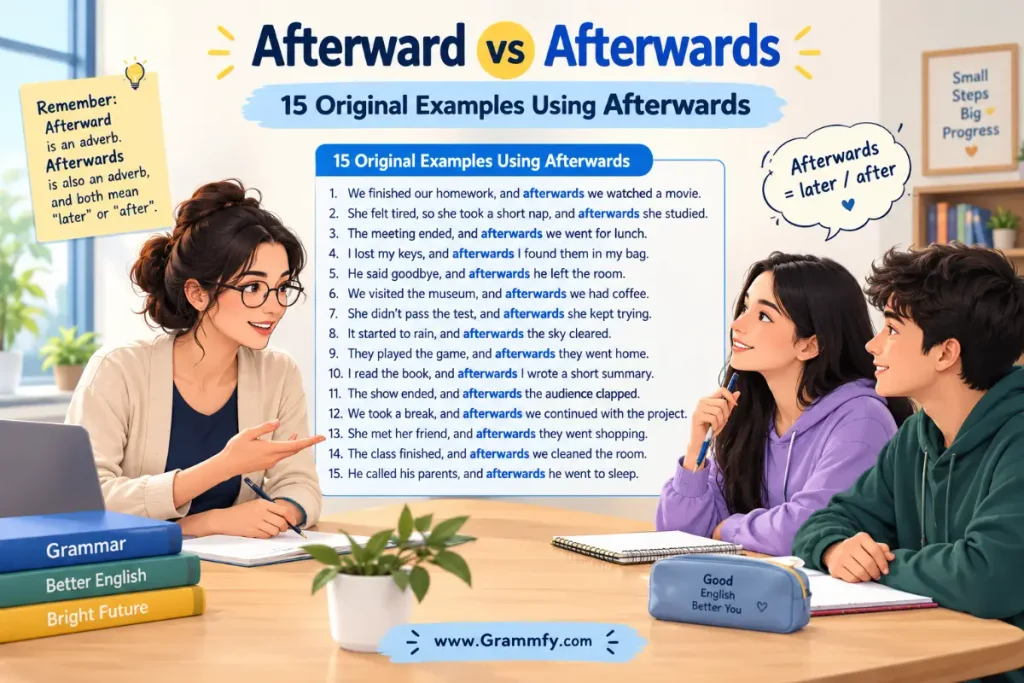
15 original examples using afterwards
The same situations can use afterwards.
1. After a meeting
We discussed the schedule afterwards.
2. After class
The students stayed behind afterwards.
3. After dinner
We went for a walk afterwards.
4. After an exam
She felt much more confident afterwards.
5. After a phone call
I’ll send you the information afterwards.
6. After an argument
They both felt bad afterwards.
7. After a trip
We shared our favorite memories afterwards.
8. After a presentation
The audience asked several questions afterwards.
9. After an interview
I wrote down my thoughts afterwards.
10. After exercise
She usually stretches afterwards.
11. After a movie
We talked about the plot afterwards.
12. After shopping
They stopped for coffee afterwards.
13. After the ceremony
Everyone gathered outside afterwards.
14. After the storm
The city began cleaning the streets afterwards.
15. After the lesson
I’ll explain the difficult part afterwards.
Examples where “later” is better
Sometimes later sounds more natural than either form.
I’ll call you later.
This is a common way to promise contact at another time.
You could say:
I’ll call you afterward.
But that usually suggests a specific event that comes first.
For example:
I’ll call you afterward, once the meeting ends.
Here, the meeting gives afterward a clear reference point.
Examples where “after that” is better
After that can be clearer when you want to explicitly point back to a previous action.
We finished the assignment. After that, we went home.
This is especially useful when the two actions are in separate sentences.
You can also write:
We finished the assignment and went home afterward.
Both are correct. The first version creates a stronger step-by-step sequence.
Common mistakes with afterward and afterwards
Mistake 1: Thinking one form is wrong
Some learners believe that afterwards is incorrect in American English or that afterward is incorrect in British English.
That’s not true.
Both are standard forms.
The main difference is regional preference.
Mistake 2: Treating the -s as a plural ending
The s in afterwards doesn’t mean that the word is plural.
Afterwards is an adverb.
The ending is simply part of the word.
Mistake 3: Writing “after words”
Don’t confuse afterward with after words.
Correct:
We talked afterward.
After words has a literal meaning:
There was a short discussion after the words were read aloud.
Mistake 4: Confusing afterward with afterword
An afterword is a section at the end of a book.
An afterward means later.
Compare:
The author included an afterword at the end of the novel.
We discussed the novel afterward.
These are completely different words.
Mistake 5: Using afterwards when you mean immediately after
Afterward and afterwards don’t necessarily mean immediately after.
We talked about it afterward.
The conversation could have happened five minutes later, an hour later, or another reasonable time after the event.
If you mean immediately after, use:
- immediately afterward
- right afterward
- straight afterward
- directly afterward
Can Afterward be used at the beginning of a sentence?
Yes.
For example:
Afterward, we went back to the hotel.
A comma is commonly used when the introductory adverb comes at the beginning.
You can also write:
Afterward, she called her mother.
This structure is clear and natural.
Can afterward be used at the end of a sentence?
Yes, and this is extremely common.
Examples:
- We went home afterward.
- She apologized afterward.
- I’ll explain everything afterward.
For everyday writing, sentence-final placement is often the easiest and most natural position.
Can afterwards start a sentence?
Yes.
Examples:
- Afterwards, we went to dinner.
- Afterwards, she called her friend.
- Afterwards, everyone returned to work.
This is especially common in British English.
Can you say “immediately afterward”?
Yes.
Immediately afterward means something happened right after another event.
Examples:
- The alarm sounded, and the building was evacuated immediately afterward.
- She called me immediately afterward.
You can also use:
- immediately afterwards
Both forms are correct.
The choice follows the same regional pattern as the basic words.
Can you say “soon afterward”?
Yes.
Soon afterward means a short time later.
Example:
- Soon afterward, the family moved to another city.
This is useful when you don’t want to suggest that the second event happened immediately.
Can you say “shortly afterward”?
Yes.
Shortly afterward means not long after the earlier event.
Example:
- The police arrived shortly afterward.
This phrase is common in news reports and formal writing.
You can also see:
- The police arrived shortly afterwards.
Again, both forms are correct.
Can you say “long afterward”?
Yes.
Long afterward means a long time later.
Example:
- Long afterward, she still remembered the experience.
This is less common in casual conversation but can work well in storytelling or reflective writing.
Afterward and afterwards with “immediately,” “soon,” and “shortly”
These combinations are useful because they show more exact timing.
| Phrase | Meaning | Example |
|---|---|---|
| Immediately afterward | Right after | She called immediately afterward. |
| Soon afterward | A short time later | He moved soon afterward. |
| Shortly afterward | Not long after | They arrived shortly afterward. |
| Much later | A long time after | She understood it much later. |
| Later on | At another later time | We talked about it later on. |
Quick grammar guide
Remember these basic points:
- Afterward = adverb
- Afterwards = adverb
- Both mean later or after that.
- Neither is a noun.
- Neither normally works as an adjective before a noun.
- Both can appear at the beginning or end of a sentence.
- Afterward is especially common in American English.
- Afterwards is especially common in British English.
Quick tips for choosing the right word
Tip 1: Think about your audience
Writing for Americans?
afterward
Writing for British readers?
afterwards
This isn’t an absolute rule, but it’s a useful default.
Tip 2: Stay consistent
Don’t switch randomly between the two forms.
For example, if your article uses afterward throughout, there’s usually no need to suddenly change to afterwards.
Consistency makes writing look more polished.
Tip 3: Use “later” for simple timing
If you’re simply talking about a future time, later may be better.
I’ll finish it later.
Tip 4: Use “after that” for clear sequence
If you want to point directly to a previous event, try:
After that, we went home.
Tip 5: Use “subsequently” for formal writing
In a report or academic paper, subsequently may sound more formal.
The patient subsequently returned for another examination.
Don’t use it just to sound sophisticated, though. If afterward is clear, it is often the better choice.
A quick decision chart
| What do you mean? | Best choice |
|---|---|
| Later, after an event | afterward/afterwards |
| Simple future time | later |
| Clear step in a sequence | after that |
| Formal “later” | subsequently |
| From that time onward | thereafter |
| Immediately after | immediately afterward/afterwards |
| A short time after | soon afterward/afterwards |
| A long time after | much later |
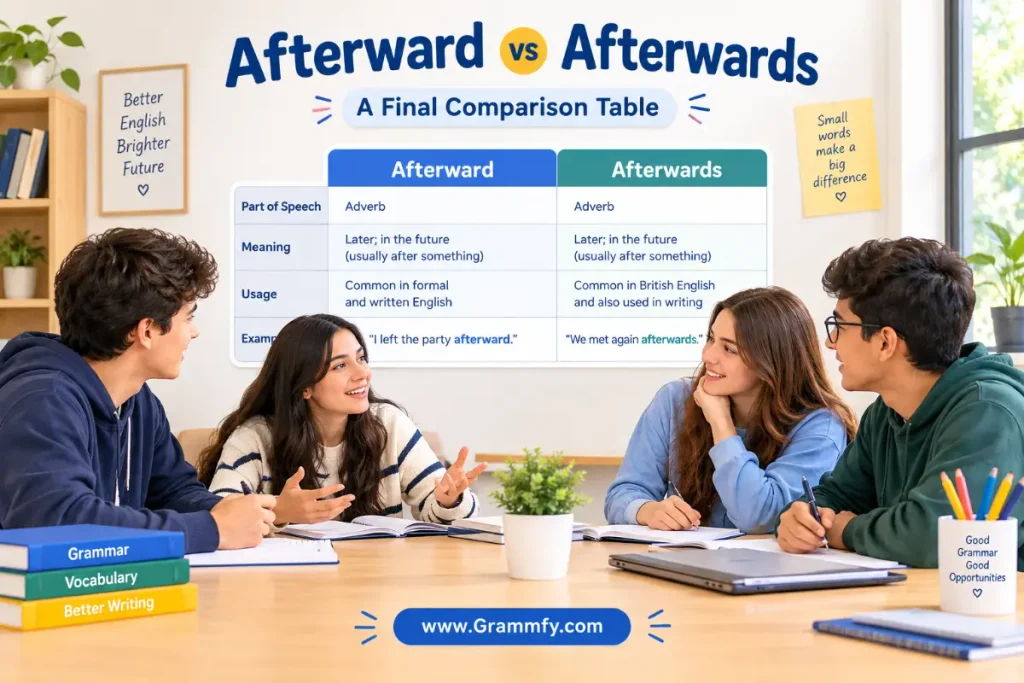
A final comparison table
| Feature | Afterward | Afterwards |
|---|---|---|
| Part of speech | Adverb | Adverb |
| Meaning | Later; after that | Later; after that |
| Main difference | Regional/style preference | Regional/style preference |
| US English | Very common | Also accepted |
| UK English | Accepted | Very common |
| Formality | Neutral | Neutral |
| Meaning changes? | No | No |
| Can start a sentence? | Yes | Yes |
| Can end a sentence? | Yes | Yes |
| Example | We left afterward. | We left afterwards. |
The easiest way to remember the difference
You don’t really need to memorize two separate definitions.
Remember this:
Afterward = later.
Afterwards = later.
The only major question is which regional form fits your audience.
If you’re writing American English, make afterward your default.
If you’re writing British English, afterwards may be your natural choice.
And if you see the other version, don’t assume it’s a mistake. It is a standard form with a different regional preference.
Practice quiz: choose afterward or afterwards
Choose the form that best fits each sentence. In most cases, both may be grammatically correct.
- We went home ___.
- She called me ___.
- The students discussed the test ___.
- I’ll explain it ___.
- They had dinner and went for a walk ___.
- He felt tired ___.
- The manager spoke to the team ___.
- We took pictures ___.
- She regretted the decision ___.
- They cleaned the room ___.
Answers
All ten can use either afterward or afterwards.
For example:
- We went home afterward.
- She called me afterwards.
- The students discussed the test afterward.
- I’ll explain it afterwards.
- They had dinner and went for a walk afterward.
The choice doesn’t change the basic meaning.
If you’re writing American English, you may prefer afterward. If you’re writing British English, you may prefer afterwards.
Practice: choose the best synonym
Sometimes the best answer isn’t either form.
1. “I’ll call you ___.”
Best choice: later
I’ll call you later.
This is a simple promise to call at another time.
2. “We finished dinner and went home ___.”
Best choice: afterward/afterwards
We finished dinner and went home afterward.
The earlier event is clearly dinner.
3. “We finished the first task. ___, we checked the results.”
Best choice: After that
We finished the first task. After that, we checked the results.
The phrase clearly connects the second step to the first.
4. “The company ___ changed its policy.”
Best choice: subsequently
The company subsequently changed its policy.
This sounds appropriate in formal writing.
5. “___, the organization followed the new procedure.”
Best choice: Thereafter
Thereafter, the organization followed the new procedure.
This emphasizes what happened from that point onward.
Conclusion
Afterward vs Afterwards is not a battle between a correct word and an incorrect one. Both are standard English adverbs that mean later or after that. The main difference is regional preference: afterward is especially common in American English, while afterwards is especially common in British English.
For US-focused writing, afterward is a simple and natural default. For UK-focused writing, afterwards may fit better. You can also use alternatives such as later, after that, or subsequently when the context calls for them. The most important thing is to understand the timing and keep your writing consistent. Once you connect these words with the idea of “later,” choosing the right form becomes much easier.
Frequently Asked Questions
Is afterward or afterwards correct?
Both afterward and afterwards are correct. They have the same meaning, but afterward is more common in American English and afterwards is more common in British English.
Is afterward American or British English?
Afterward is especially common in American English. British English commonly uses afterwards, although both forms can be found in British writing.
Is afterwards grammatically correct?
Yes, afterwards is grammatically correct. It is a standard adverb meaning later or after that.
What’s another way to say afterward?
Common alternatives include later, after that, subsequently, thereafter, later on, and following this. The best option depends on the sentence and level of formality.
Can I use afterward at the beginning of a sentence?
Yes, you can begin a sentence with afterward. For example, “Afterward, we went back to the office.”
Is “after word” the same as afterward?
No, afterward means later, while afterword is a section at the end of a book. “After word” is simply the phrase formed by the words after and word.
Should I use afterward or afterwards in American English?
In American English, afterward is usually the better default. Afterwards is still understandable and accepted, but the shorter form is more common in US usage.
