
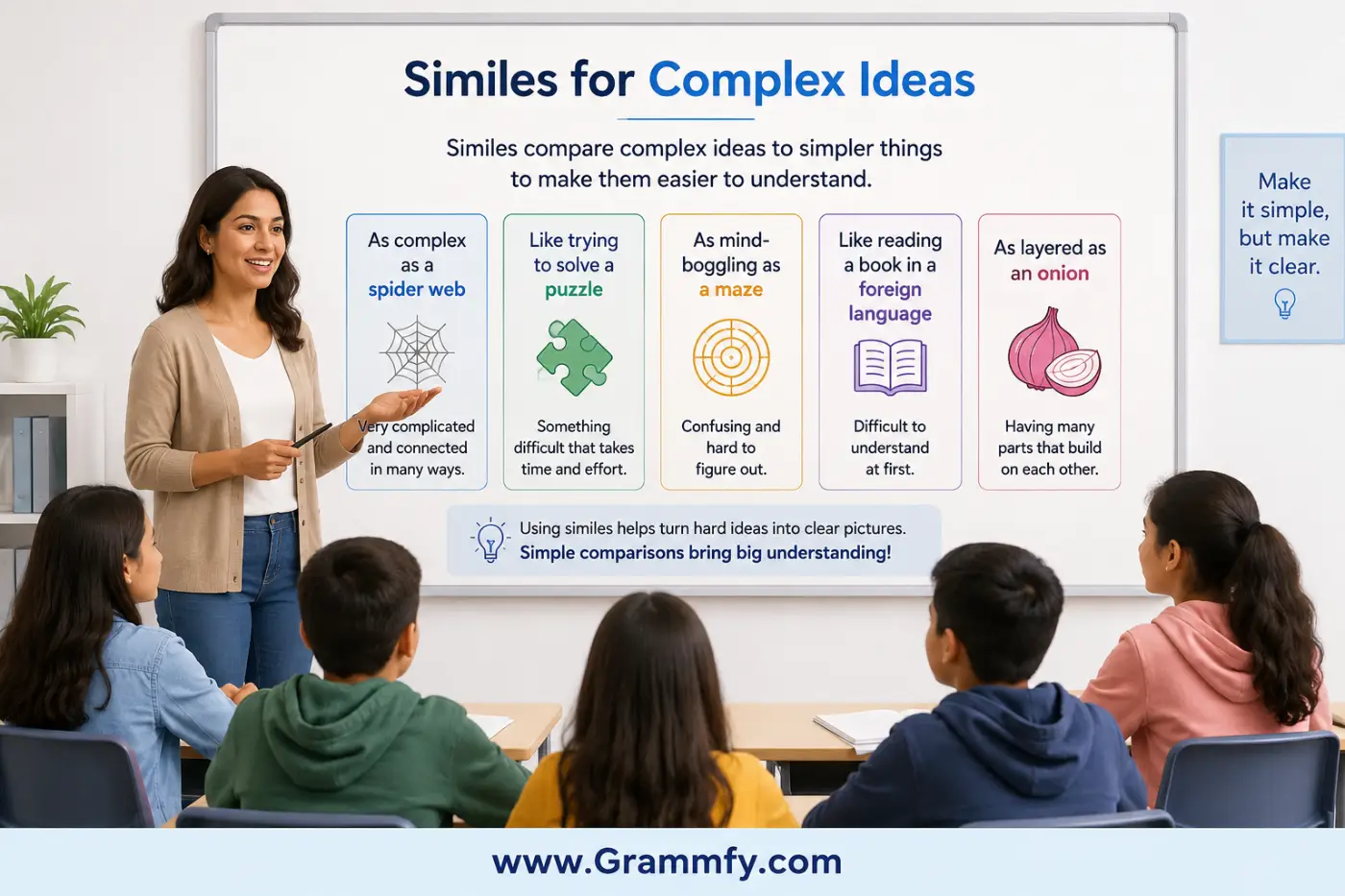
You’re writing an essay, email, presentation, or story, and you need to explain an idea that feels difficult to picture. Maybe you’re trying to describe how the brain works, how society changes, why a friendship matters, or how a complicated problem affects people. Saying “the idea is complicated” may be true, but it doesn’t give your reader a clear mental picture. That’s where similes for complex ideas can help. A simile compares one thing to another using words such as like or as. Instead of explaining every detail at once, you can connect an abstract idea to something familiar, such as a maze, puzzle, web, bridge, puzzle box, or iceberg.
The best similes for complex ideas compare difficult concepts to familiar things, making abstract thoughts easier to picture and understand.
A good comparison doesn’t replace a real explanation. It makes the explanation easier to enter. This guide covers the meaning and origin of complex, useful synonyms, levels of complexity, different parts of speech, context-specific word choices, original examples, close comparisons, common mistakes, and practical ways to create your own comparisons.
You can also explore related examples in [similes for mad emotions].
What does “complex” mean in simple English?
Complex means something that has many connected parts, details, steps, or ideas and may be difficult to understand quickly.
For example:
The human brain is a complex system.
This means the brain has many parts and processes that work together.
Another example:
The instructions were complex.
Here, complex means the instructions were difficult to understand or follow because they had many details.
The word can describe:
- Ideas
- Systems
- Problems
- Machines
- Relationships
- Processes
- Emotions
- Situations
- Arguments
- Designs
- Organizations
A useful way to remember it is:
Simple = easy to understand or has few parts.
Complex = many parts or connections make something harder to understand.
Complex doesn’t always mean bad or confusing. A complicated system can work very well. It simply has many elements that need to be understood together.
Where did the word “complex” come from?
The English word complex comes from Latin roots connected with the idea of weaving or embracing together. The Latin word complexus referred to something intertwined or connected.
That original idea fits the modern meaning surprisingly well.
Think about a piece of fabric. One thread is simple. Many threads crossing and connecting can create something much more complicated.
The same thing happens with ideas.
One fact might be easy:
Exercise uses energy.
But a larger question such as:
How does exercise affect physical health, sleep, mood, hormones, and long-term disease risk?
contains many connected parts.
That is why we call it a complex question.
The word’s history also explains why comparisons involving webs, networks, knots, puzzles, and woven threads work especially well when describing complicated concepts.
What are the best synonyms for complex?
The right synonym depends on what you mean. Sometimes complex means made of many parts. Other times it means difficult to understand.
| Word | Meaning | Tone | Example |
|---|---|---|---|
| Complicated | Difficult because of many parts | Everyday | The instructions are complicated. |
| Difficult | Not easy to understand or do | Everyday | It was a difficult problem. |
| Intricate | Has many small connected details | Formal | The design was intricate. |
| Detailed | Contains many specific points | Neutral | She gave a detailed explanation. |
| Confusing | Hard to understand clearly | Everyday | The directions were confusing. |
| Advanced | More developed or difficult than basic material | Neutral | This is an advanced topic. |
| Multifaceted | Has many different aspects | Formal | The issue is multifaceted. |
| Layered | Has several levels of meaning | Descriptive | The story has a layered message. |
| Nuanced | Has subtle differences or details | Formal | Her argument was nuanced. |
| Sophisticated | Complex in design or thought | Formal | It is a sophisticated system. |
| Knotty | Difficult to solve or understand | Literary/Formal | They faced a knotty problem. |
| Puzzling | Difficult to explain or understand | Everyday | His behavior was puzzling. |
| Esoteric | Understood by a small group with special knowledge | Formal | The book covers esoteric topics. |
| Dense | Contains a lot of information | Neutral | The article is dense but useful. |
| Multifactorial | Caused by several factors | Technical | The issue is multifactorial. |
| Tangled | Difficult because things are mixed together | Descriptive | They faced a tangled problem. |
| Messy | Difficult because many issues overlap | Casual | The situation is messy. |
| Layered | Built from several levels | Descriptive | The character has a layered personality. |
| Intricate | Detailed and complicated | Formal | The pattern is intricate. |
| Challenging | Difficult but possible | Positive | Learning coding can be challenging. |
The differences matter. Complicated can sound negative, while intricate can suggest beauty or skill. Convoluted usually suggests that something is harder than it needs to be. Multifaceted focuses on the number of different sides an issue has.
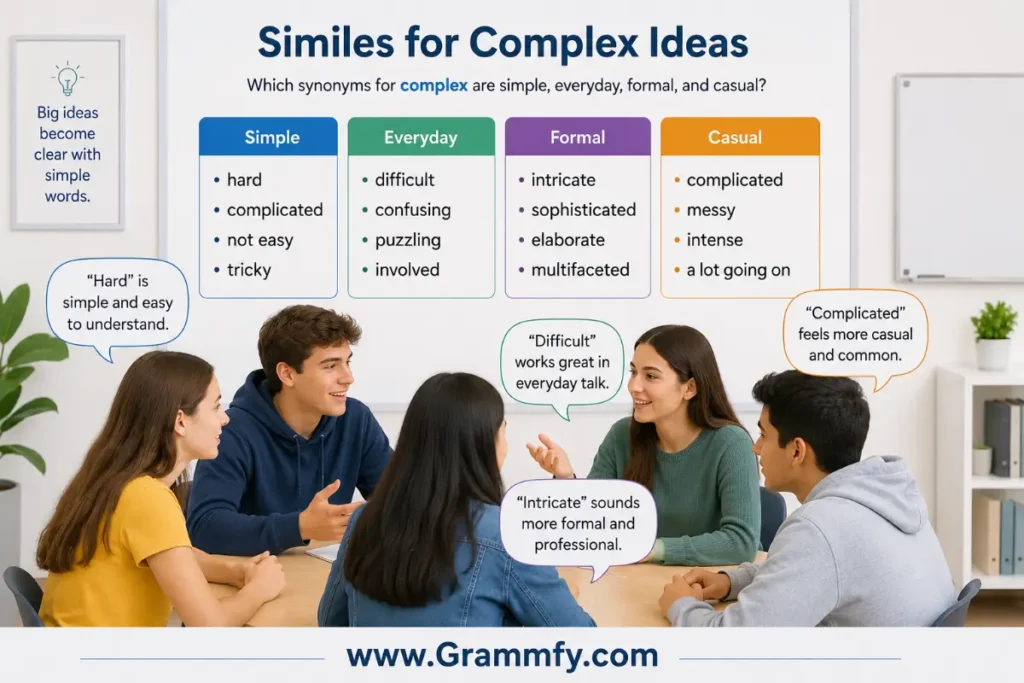
Which synonyms for complex are simple, everyday, formal, and casual?
Vocabulary should match your audience.
Simple choices
Use these when you want easy English:
- Difficult
- Hard
- Complicated
- Detailed
- Confusing
- Challenging
Example:
The problem is difficult because several issues are connected.
Everyday choices
These sound natural in normal conversation:
- Complicated
- Tricky
- Messy
- Hard to understand
- Confusing
- Challenging
Example:
It’s a complicated situation, and we need more information.
Formal choices
These fit academic or professional writing:
- Intricate
- Multifaceted
- Interconnected
- Nuanced
- Sophisticated
- Elaborate
- Multifactorial
Example:
The issue is multifaceted and requires careful analysis.
Casual choices
In informal speech, people may say:
- Tricky
- Messy
- A puzzle
- A lot to unpack
- Hard to figure out
- All over the place
Example:
This problem is messy, but we can figure it out.
Avoid casual expressions in formal academic writing unless they fit the style of your assignment.
Which words describe different levels of complexity?
Not every difficult idea is equally complex.
Mild complexity
These suggest that something has a few details:
- Detailed
- Challenging
- Tricky
- Unfamiliar
Example:
The new software is a little tricky to use.
Moderate complexity
These suggest several connected parts:
- Complicated
- Multifaceted
- Layered
- Interconnected
- Intricate
Example:
Climate policy is a multifaceted issue involving science, economics, and public decisions.
High complexity
These suggest that understanding the subject requires serious thought or specialized knowledge:
- Sophisticated
- Convoluted
- Abstruse
- Esoteric
- Highly technical
- Multifactorial
Example:
The researchers developed a sophisticated model to study the system.
Choose your word carefully. Sophisticated can praise complexity, while convoluted usually criticizes it.
What are the best similes for complex ideas?
The strongest comparisons turn an abstract concept into something readers already understand.
Here are useful original examples:
- A complex idea can be like a maze with many paths leading to the same destination.
- A complicated problem can be like a puzzle missing several pieces.
- A difficult theory can be like a locked box with several keys.
- A complex system can be like a spider web, where every strand connects to another.
- A complicated relationship can be like a knot that becomes tighter when pulled.
- A difficult argument can be like a tangled ball of thread.
- A complex decision can be like standing at a crossroads with dozens of roads ahead.
- A complicated process can be like assembling furniture without seeing the final picture.
- A layered idea can be like an onion, with another layer underneath each one.
- A complicated situation can be like a storm made from many small clouds.
- A complex network can be like a city subway map with lines crossing in every direction.
- A difficult concept can be like a mountain whose peak is hidden by clouds.
- A complicated story can be like a book with several plots unfolding at once.
- A complex emotion can be like a tangled thread of happiness, fear, regret, and hope.
- A difficult question can be like a door with several locks.
The best comparison depends on what makes the idea complex.
When there are many connections, use a web.
If there are many choices, use a crossroads.
If there are many layers, use an onion.
When there are missing pieces, use a puzzle.
If something is hard to solve, use a maze.
What is a good simile for a complicated problem?
A complicated problem often has several causes or possible solutions.
A maze is a strong comparison:
The problem was like a maze, with every solution leading to another question.
A puzzle also works:
The issue was like a puzzle with pieces scattered across different parts of the table.
For a problem with many connected causes:
The situation was like a spider web, where pulling one strand affected every other strand.
For a problem that keeps growing:
The problem was like a small snowball rolling downhill, becoming harder to control with every turn.
Each comparison highlights a different feature.
What is a good simile for a complex idea in an essay?
When writing an essay, clarity matters more than poetic language.
Try:
The issue is like a puzzle because every part affects the final picture.
Or:
The human brain is like an enormous network, with countless connections working together.
Another option:
Understanding the problem is like navigating a maze because each answer leads to another question.
These comparisons work because they explain why something is complex.
Don’t simply write:
The topic is like a complicated thing.
That’s technically a comparison, but it doesn’t give the reader a useful image.
A good simile should answer:
What makes this idea complex?
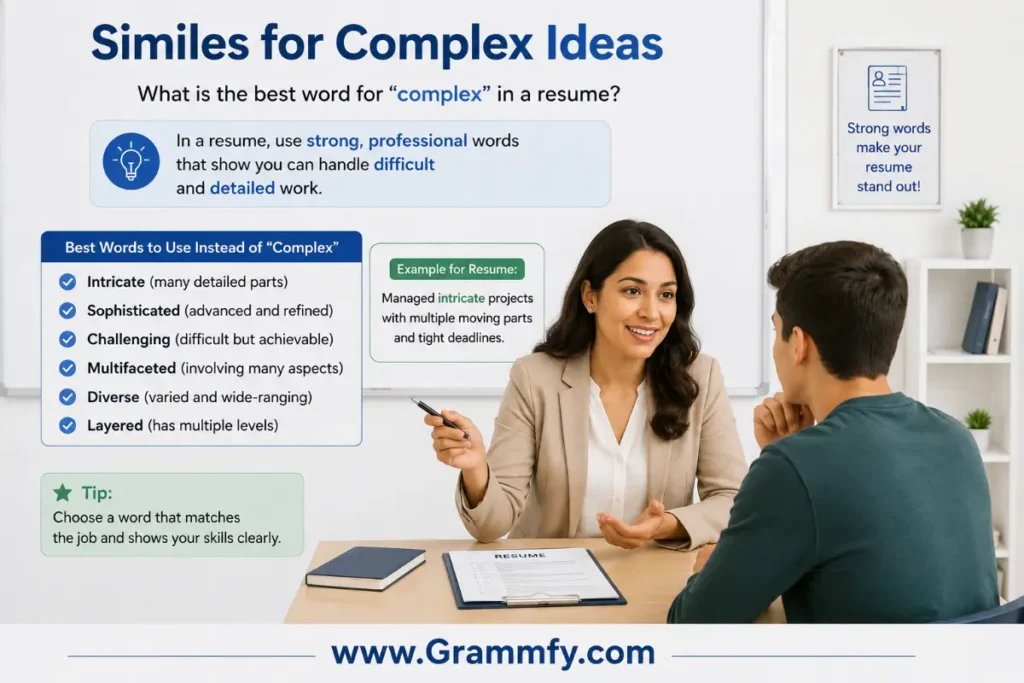
What is the best word for “complex” in a resume?
On a resume, the best word depends on whether you’re describing a skill, task, system, or problem.
Useful choices include:
- Multifaceted
- Advanced
- Sophisticated
- Detailed
- Challenging
- Technical
- Intricate
- Analytical
Examples:
Managed complex customer accounts while maintaining accurate records.
You could also write:
Managed multifaceted customer accounts across multiple departments.
Or:
Solved challenging technical issues for clients.
Avoid saying:
I worked on messy problems.
“Messy” sounds too casual for most resumes.
When describing your ability to handle complexity, focus on what you did:
Analyzed complex data and identified patterns that improved reporting accuracy.
This tells employers more than simply saying you “like complex ideas.”
What is the best word for complex ideas in an essay?
In an academic essay, your word should match the exact meaning.
Choose multifaceted when an issue has several sides:
Climate change is a multifaceted issue involving environmental, economic, and social factors.
Apply nuanced when an idea has subtle differences:
The author presents a nuanced view of social responsibility.
Add intricate when many details fit together:
The novel contains an intricate network of relationships.
Use complicated when the situation is simply difficult:
The legal process can be complicated for people unfamiliar with the system.
Use convoluted when you think the complexity is unnecessary:
The report uses a convoluted explanation that makes the main point difficult to find.
These distinctions can make academic writing much more precise.
What is the best word for complex ideas in texting?
Text messages usually don’t need formal vocabulary.
Instead of:
The situation is multifaceted.
You might say:
It’s complicated.
Or:
There’s a lot going on.
Instead:
It’s a little messy.
Or:
It’s hard to explain.
If you’re talking about an idea:
That topic is pretty complicated.
If you’re talking about a personal situation:
It’s complicated, and I don’t even know where to start.
Simple language often sounds more natural in texting.
What is the best word for complex ideas in an email?
Professional emails need clear, direct language.
Instead of:
This is a convoluted situation.
You might write:
This is a complex issue with several factors to consider.
Or:
The situation involves several interconnected concerns.
If you’re asking someone for help:
Because the issue involves several connected factors, I’d appreciate your guidance.
This sounds professional without making the sentence unnecessarily complicated.
What is the best word for complex ideas when speaking?
In conversation, complicated, difficult, and tricky are usually natural.
Examples:
That’s a complicated question.
It’s a tricky problem to solve.
There’s a lot going on here.
It’s difficult to explain in one sentence.
Formal words such as multifaceted and esoteric are useful when the audience understands them, but they may sound unnatural in everyday conversation.
Good communication isn’t about using the biggest word. It’s about using the word your listener understands.
What Are the Best Similes for Complex Ideas and Systems?
Systems are especially easy to compare with networks.
A spider web
The system was like a spider web, with every part connected to another.
This works when one change affects other parts.
A machine
The organization worked like a machine, with each department handling a different part of the process.
This suggests coordination.
A city
The internet is like a huge city, with countless roads connecting different places.
This works for networks and communication.
A human body
The ecosystem is like a human body, where each part depends on other parts to function properly.
This works for biological or environmental systems.
An orchestra
The team worked like an orchestra, with different people contributing to one result.
This comparison emphasizes coordination rather than difficulty.
What Are the Best Similes for Complex Ideas and Abstract Concepts?
Abstract concepts are difficult because you can’t physically touch them.
Examples include:
- Freedom
- Justice
- Trust
- Time
- Identity
- Responsibility
- Love
- Fear
- Success
- Knowledge
A simile gives these ideas a physical image.
Trust
Trust is like a bridge; it takes time to build and can be difficult to repair after it breaks.
Knowledge
Knowledge is like a map, helping us understand where we are and where we can go.
Time
Time is like a river, always moving forward and never returning to the same place.
Fear
Fear can be like a shadow, following you even when no one else can see it.
Freedom
Freedom is like an open road, offering choices about where to go next.
Responsibility
Responsibility is like carrying a backpack; each duty adds another weight.
These comparisons make abstract ideas easier to discuss.
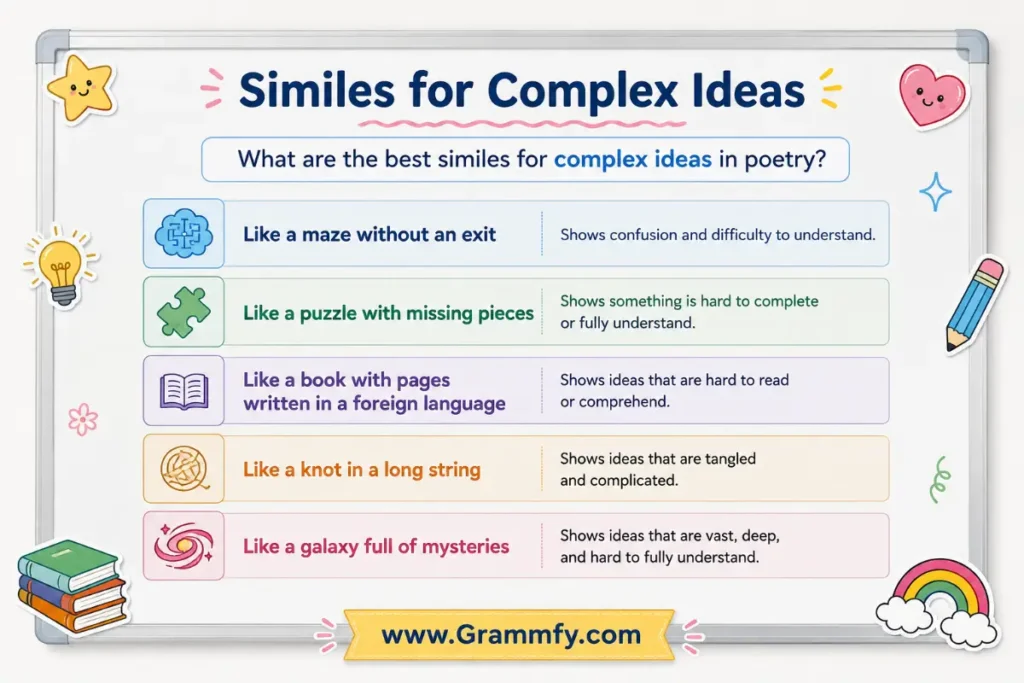
What are the best similes for complex ideas in poetry?
Poetry allows more imaginative comparisons.
Try:
The idea was like a locked garden with paths hidden beneath the vines.
Her thoughts were like waves crossing in different directions.
The truth was like a mirror broken into a hundred pieces.
His memories were like threads woven through an old blanket.
The future was like a road disappearing into fog.
The problem was like a knot tied by invisible hands.
Her emotions were like an ocean carrying several currents at once.
These comparisons work because they don’t simply say “complex.” They create a picture of layers, uncertainty, movement, and connection.
What are 15 original examples of complex ideas?
Here are examples across school, work, relationships, science, and everyday life:
- The problem was like a maze, with every turn creating another question.
- Her thoughts were like a web, with each idea connected to another.
- The scientific theory was like a puzzle with hundreds of pieces.
- Their relationship was like a knot that became tighter after every argument.
- The legal case was like a book with several stories happening at once.
- The economy was like a machine with thousands of gears moving together.
- His emotions were like an ocean with several currents pulling in different directions.
- The decision was like standing at a crossroads with no clear sign.
- The software was like a giant city, with different systems connected by countless roads.
- The mystery was like a locked room with clues hidden in every corner.
- The debate was like a chess game, with every move affecting the next one.
- Her personality was like a book with a different story on every page.
- The project was like building a bridge while people were already crossing it.
- The situation was like a storm made from many small problems.
- Understanding the topic was like climbing a mountain whose summit was hidden by clouds.
These examples show how the same basic idea can be described in different ways.
How can you compare a complex idea to a maze?
A maze is useful when the reader needs to understand confusion, choices, wrong turns, or difficulty finding a solution.
For example:
Understanding the legal system can be like walking through a maze with unfamiliar signs.
This tells the reader that the system has many paths and isn’t easy to navigate.
Another example:
Finding the cause of the problem was like navigating a maze because every answer created another question.
Use a maze when the path is difficult to follow.
Don’t use it simply because something has many parts. If the parts are well organized, a machine or network may be a better comparison.
How can you compare a complex idea to a puzzle?
A puzzle works when different pieces must fit together.
Understanding the human brain is like solving a puzzle with thousands of connected pieces.
This comparison suggests that individual facts matter, but the full picture appears only when they work together.
A puzzle is especially useful for:
- Scientific theories
- Mysteries
- Research
- Problem-solving
- Historical events
- Complex decisions
It also works well in school essays because most readers immediately understand how puzzles work.
Similes for complex ideas can make difficult subjects easier to picture. A strong comparison gives readers a familiar image before they explore the deeper meaning.
How can you compare a complex idea to a web?
A web is ideal when many parts are connected.
The modern economy is like a web, with changes in one area affecting businesses and people somewhere else.
Another example:
The ecosystem is like a spider web, where every strand supports the larger structure.
The web comparison is especially useful for:
- Relationships
- Social systems
- Technology
- Ecosystems
- Communication
- Economics
The key idea is connection.
How can you compare a complex idea to an onion?
An onion is useful when an idea has layers.
The character’s personality was like an onion, with deeper layers revealed over time.
This works well for:
- Literature
- Psychology
- Relationships
- Identity
- Emotions
- History
The comparison suggests that the first thing you see isn’t the whole story.
Complex vs complicated — what’s the difference?
Complex and complicated are close, but they can carry different meanings.
| Complex | Complicated |
|---|---|
| Has many connected parts | Has many parts or steps |
| Can be neutral or positive | Often sounds difficult or negative |
| Suggests depth or interaction | Suggests difficulty or confusion |
| “A complex system” | “Complicated instructions” |
For example:
The human body is complex.
This is not necessarily negative. The body is highly organized but has many interacting systems.
Compare:
The instructions are complicated.
This suggests the instructions are difficult to follow.
A complex thing can be well designed. A complicated thing may simply be hard to deal with.
Complex vs difficult — what’s the difference?
Something can be difficult without being complex.
For example, a simple math problem might be difficult because you don’t know the technique.
Something can also be complex without being difficult if you understand how all its parts work.
| Complex | Difficult |
|---|---|
| Focuses on structure | Focuses on effort |
| Many parts or relationships | Not easy to do or understand |
| Can be neutral | Usually means challenging |
| “A complex system” | “A difficult task” |
This distinction is useful in academic writing.
Complex vs sophisticated — what’s the difference?
Complex describes something with many connected parts.
Sophisticated suggests something is advanced, highly developed, or refined.
For example:
The machine is complex.
This tells us it has many parts.
The machine is sophisticated.
This suggests it uses advanced technology or design.
A sophisticated system can be complex, but the words are not always interchangeable.
When should you NOT use “complex”?
Sometimes “complex” is too vague.
Instead of:
The project was complex.
Tell the reader why:
The project required coordination between five departments and several outside partners.
Instead of:
She has a complex personality.
You could write:
She is confident in public but quiet when discussing personal problems.
Specific details are often more useful than a general adjective.
Also avoid using complex when you really mean confusing.
The instructions were complex.
Could mean the instructions had many steps.
The instructions were confusing.
Means the reader had trouble understanding them.
Those are different problems.
What are the antonyms of complex?
Common opposites include:
- Simple
- Easy
- Basic
- Clear
- Straightforward
- Uncomplicated
- Plain
- Direct
- Simple-minded
- Elementary
Examples:
The system is complex.
Opposite:
The system is simple.
Another:
The explanation was complicated.
Opposite:
The explanation was straightforward.
The best antonym depends on the meaning.
How can you explain a Similes for Complex Ideas more clearly?
A simile helps, but you can also simplify the explanation itself.
Start with the main idea
Tell the reader what the concept is before discussing details.
Break it into parts
Instead of explaining everything in one paragraph, use smaller sections.
Give an example
Readers often understand examples faster than definitions.
Use familiar comparisons
Connect an unfamiliar idea to something people already know.
Avoid unnecessary technical words
If a simple word works, use it.
Show relationships
Explain how one part affects another.
For example, instead of:
The economy is a complex system.
Explain:
The economy is like a machine with many connected gears. When one gear slows down, other gears can be affected too.
Now the reader has a mental model.
How can you create your own simile for a complex idea?
You don’t need to memorize dozens of comparisons. You can build your own.
Step 1: Identify the difficult idea
Example:
A relationship can become complicated.
Step 2: Ask what makes it complicated
Maybe there are:
- Many emotions
- Past experiences
- Conflicting goals
- Unspoken feelings
Step 3: Find something with the same qualities
A tangled knot has many parts connected together.
Step 4: Build the comparison
The relationship was like a knot, with every attempt to fix one problem creating another.
This is much stronger than simply saying:
The relationship was complicated.
Quick tips for choosing the right word
Use these simple rules:
- Choose complex when many connected parts are involved.
- Choose complicated when something is difficult to understand or manage.
- Choose difficult when something requires a lot of effort.
- Choose challenging when the difficulty can be presented positively.
- Choose intricate when many small details fit together.
- Choose multifaceted when an issue has several different sides.
- Choose nuanced when subtle differences matter.
- Choose sophisticated when something is advanced or highly developed.
- Choose convoluted when something is unnecessarily complicated.
- Choose interconnected when parts influence one another.
- Choose layered when an idea has several levels.
- Choose technical when specialized knowledge is required.
- Choose esoteric when only a small group is likely to understand the subject.
- Choose messy only in casual contexts when several problems overlap.
Before creating a simile, ask:
What makes this idea complex?
Is it:
- Too many parts?
- Too many choices?
- Hidden layers?
- Conflicting information?
- Strong connections?
- Unclear paths?
- Several causes?
- Different points of view?
Once you know the reason, choose an image that behaves in the same way.
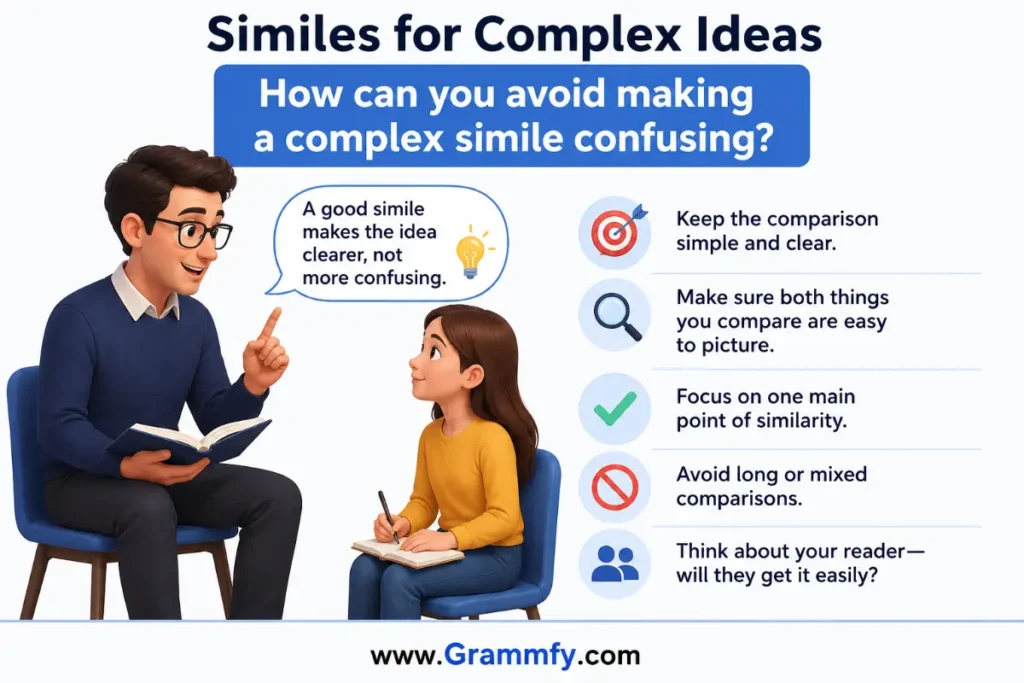
How can you avoid making a complex simile confusing?
Ironically, a simile about a complex idea should not itself be complex.
Keep the comparison simple.
Instead of:
The concept was like a multidimensional labyrinth of interconnected pathways operating through an invisible architectural framework.
Try:
The concept was like a maze, with every path leading to another question.
The second sentence is easier to understand and does a better job.
A useful rule is:
Complex idea + simple comparison = clearer writing.
You don’t need difficult vocabulary to explain a difficult concept.
Conclusion
A difficult concept doesn’t have to sound difficult on the page. A clear comparison can give readers a familiar starting point and help them understand how different parts of an idea fit together. A maze can represent confusing choices, a puzzle can represent missing pieces, a web can show connections, and an onion can represent layers of meaning.
The strongest similes for complex ideas are not simply decorative. They explain something important about the concept. Before choosing one, think about what makes the idea complicated. Then find a familiar object or experience with the same quality. Keep the comparison simple, match it to your audience, and explain the connection when needed. Whether you’re writing an essay, email, story, presentation, or casual message, one clear comparison can turn an abstract thought into something your reader can actually picture.
Frequently Asked Questions
What are some good similes for complex ideas?
Useful comparisons include a maze, puzzle, web, knot, onion, crossroads, or machine. Each image highlights a different kind of complexity.
What’s another way to say complex?
Another way to say complex is complicated, intricate, multifaceted, interconnected, sophisticated, detailed, or challenging, depending on the context.
What is a good simile for a complicated problem?
A complicated problem can be like a maze, especially when there are many possible paths and no obvious solution.
How do you describe a complex idea in an essay?
Use a clear definition, break the idea into smaller parts, and add a familiar comparison. Similes for complex ideas can make abstract concepts easier for readers to visualize.
What is the difference between complex and complicated?
Complex often emphasizes many connected parts, while complicated often emphasizes difficulty or confusion. The two words overlap, but they aren’t always interchangeable.
Can a complex idea be explained with a simple simile?
Yes, and a simple comparison is often the best choice. A puzzle, maze, web, or bridge can give readers an easy mental picture of a difficult concept.
Why do similes help explain difficult ideas?
Similes connect unfamiliar concepts to familiar experiences. This gives readers a mental model they can understand before they deal with the more difficult details.
