
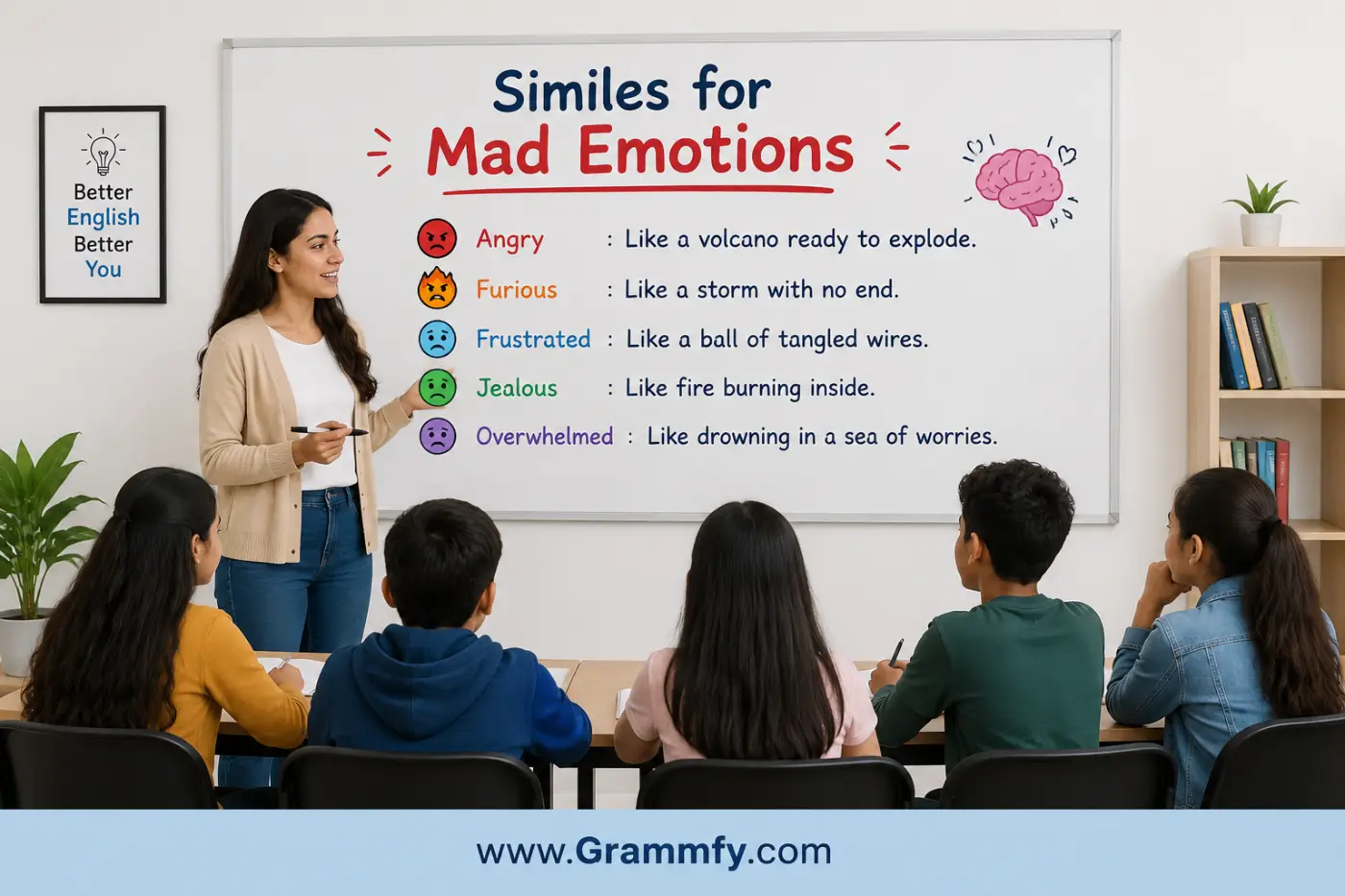
You’re writing an essay, story, text, or social media caption, and you want to describe anger without repeating words like mad, angry, or furious. Saying “She was very angry” tells the reader the emotion, but it doesn’t help them feel the heat of the moment. That’s where similes for mad emotions can make your writing more vivid. A simile compares one thing to another using words such as like or as. Anger can be compared to a raging fire, a boiling pot, a storm, or a volcano ready to erupt.
The best similes for mad emotions compare anger to powerful images such as fire, storms, explosions, boiling water, or wild animals.
The comparison you choose should match the level of anger. Mild irritation needs a softer image, while extreme rage calls for something much stronger. This guide covers the meaning and origin of “mad,” useful synonyms, intensity levels, grammar, context-specific word choices, original examples, close comparisons, common mistakes, and creative ways to describe anger.
If you’re building a collection of useful similes and comparisons, don’t miss [similes for sunsets].
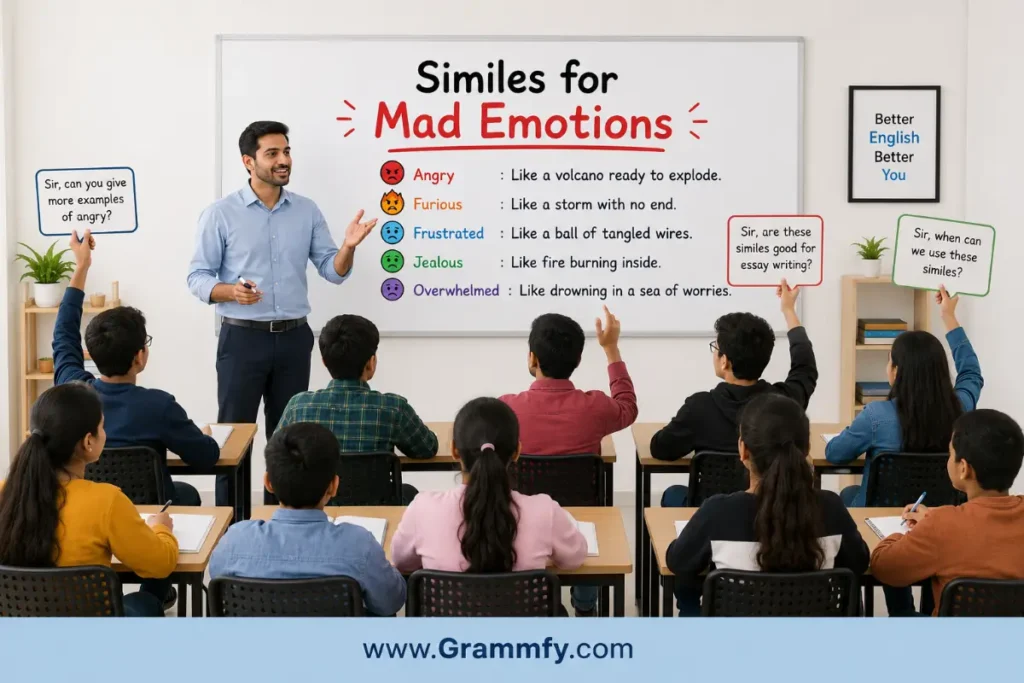
What does “mad” mean in simple English?
In American English, mad commonly means angry or upset.
For example:
She was mad because her brother broke her favorite cup.
Here, mad means angry.
The word can describe different levels of anger:
- Slightly annoyed
- Irritated
- Upset
- Angry
- Furious
- Enraged
However, mad has another important meaning. It can also mean crazy or mentally unstable, especially in older or British English usage.
For example:
That sounds like a mad idea.
Depending on context, this could mean the idea is crazy, wild, or unreasonable.
In modern American everyday speech, though, “I’m mad” usually means “I’m angry.”
That’s why context matters when you choose a synonym or simile.
Where did the word “mad” come from?
The word mad has been used in English for many centuries. It comes from an Old English word related to being mentally disturbed or out of one’s mind.
Over time, the meaning expanded. English speakers began using mad to describe intense excitement, foolish behavior, and eventually anger.
Today, the meaning depends heavily on the variety of English and the sentence.
In American English:
I’m mad at him.
Usually means:
I’m angry with him.
In British English, mad can still strongly carry the meaning of crazy or insane:
That sounds completely mad.
The word can therefore have two major meanings:
- Angry
- Crazy or unreasonable
When writing for a general American audience, “mad” as a synonym for angry is common and natural.
What are the best synonyms for mad?
There are many words for anger, but they aren’t all equally strong. Some sound casual, while others work better in formal writing.
| Word | Meaning | Tone | Example |
|---|---|---|---|
| Annoyed | Slightly angry | Everyday | I was annoyed by the noise. |
| Irritated | Mildly angry or bothered | Neutral | She felt irritated by the delay. |
| Upset | Emotionally disturbed or unhappy | Everyday | He was upset about the decision. |
| Angry | Strong displeasure | Neutral | He was angry about the mistake. |
| Mad | Angry or upset | Casual | She was mad at her brother. |
| Cross | Slightly angry | UK/Regional | Dad was cross about the mess. |
| Agitated | Restless or strongly upset | Formal | The patient appeared agitated. |
| Irrate | Extremely angry | Formal | The customer became irate. |
| Furious | Extremely angry | Strong | She was furious about the accusation. |
| Enraged | Filled with intense anger | Strong | He was enraged by the betrayal. |
| Infuriated | Made extremely angry | Strong | The unfair rule infuriated her. |
| Resentful | Angry about unfair treatment | Neutral | He felt resentful after being ignored. |
| Bitter | Angry because of past hurt | Strong | She remained bitter about the breakup. |
| Livid | Extremely angry | Strong | She was livid when she found out. |
| Wrathful | Full of strong anger | Literary | The king looked wrathful. |
| Vexed | Annoyed or frustrated | Formal/Old-fashioned | He was vexed by the problem. |
| Aggravated | Annoyed or frustrated | Everyday/US | He was aggravated by the traffic. |
| Seething | Quietly but intensely angry | Strong | He was seething with anger. |
| Raging | Showing extreme anger | Strong | She was raging after the argument. |
| Boiling | Extremely angry | Casual | I was boiling after hearing the news. |
| Ticked off | Annoyed or angry | Casual | He was really ticked off. |
| Pissed off | Very angry | Slang/Informal | She was pissed off about the delay. |
The best choice depends on the situation. Annoyed works for mild frustration, while enraged suggests a much stronger emotional reaction.
Which synonyms for mad are mild, medium, and strong?
Not every angry person is furious. Choosing the right intensity makes your writing more accurate.
Mild anger
These words suggest low-level irritation:
- Annoyed
- Bothered
- Irritated
- Vexed
- Displeased
- Frustrated
- Aggravated
Example:
I was annoyed when the bus arrived late.
The person is unhappy, but the situation isn’t necessarily dramatic.
Moderate anger
These words show a stronger emotional reaction:
- Angry
- Mad
- Upset
- Agitated
- Exasperated
- Resentful
- Bitter
Example:
She was angry when her teammate blamed her for the mistake.
Strong anger
These words suggest intense emotion:
- Furious
- Enraged
- Livid
- Infuriated
- Incensed
- Outraged
- Seething
- Raging
- Wrathful
Example:
He was furious when he discovered that someone had lied to him.
Extreme anger
At the highest level, the language can become dramatic:
- Explosive
- Beside himself with rage
- Consumed by anger
- Burning with fury
- Boiling with rage
- Ready to explode
These phrases work especially well in fiction and creative writing.
What are some powerful similes for mad emotions?
A good anger simile makes an invisible emotion visible. Readers can’t literally see anger inside someone’s mind, so comparisons give them something concrete to imagine.
Here are some original examples:
- He was as angry as a volcano ready to erupt.
- Her temper burned like a wildfire.
- He was mad like a storm crashing against the shore.
- She was boiling like a pot left too long on the stove.
- His anger flashed like lightning across the sky.
- She shook like a kettle about to whistle.
- His face turned red like a fire engine.
- Her words came out like sparks from a blazing fire.
- He was as furious as a thunderstorm tearing through the night.
- Her anger grew like flames feeding on dry wood.
- He looked like a pressure cooker ready to explode.
- She was burning like a furnace behind closed doors.
- His temper snapped like a dry branch.
- Her frustration bubbled like boiling water.
- He stormed away like a dark cloud rolling across the sky.
Each comparison emphasizes something different: heat, speed, pressure, noise, danger, or loss of control.
What is a good simile for mild anger?
Mild anger doesn’t need a volcano or explosion. Those images may make a small irritation sound much more serious than it really is.
Try softer comparisons:
He was as irritated as a bee trapped behind a window.
She was annoyed like someone listening to a dripping faucet all night.
His frustration bubbled like water just beginning to boil.
She was as bothered as a reader interrupted during a good book.
He looked as grumpy as a cat disturbed from its nap.
These comparisons work well for everyday situations.
For example:
After waiting for an hour, Maya was as irritated as a cat disturbed from its nap.
The image shows annoyance without suggesting uncontrollable rage.
What is a good simile for extreme anger?
When a character is extremely angry, stronger images can show the intensity.
Try:
He was as furious as a volcano exploding without warning.
Her anger spread like wildfire through a dry forest.
He looked like a storm about to tear through the town.
Her rage burned like a furnace with no way to cool.
He was as enraged as a thundercloud splitting the night with lightning.
Her temper exploded like a firecracker in a closed room.
Strong comparisons are useful in stories, dramatic essays, and descriptions of major conflicts.
What are the best similes for mad emotions in an essay?
A school essay should use imagery that is clear but not overly dramatic.
Good examples include:
His anger rose like a storm gathering over the ocean.
Her frustration boiled like water in a pot.
He was as angry as a fire burning through dry grass.
Her temper flared like a match struck in the dark.
His words came out like sparks from a fire.
These examples make the emotion visible while remaining easy to understand.
When writing a personal essay
I felt my frustration rise like a storm inside me when I realized I had lost the project.
In a narrative essay
His anger spread like wildfire after he heard the accusation.
For a descriptive essay
Her face was red like a flame as she stood beside the broken window.
For an argumentative essay
A direct synonym may be better:
The community was outraged by the unfair policy.
Not every academic sentence needs a simile. Use one when it adds a useful image.
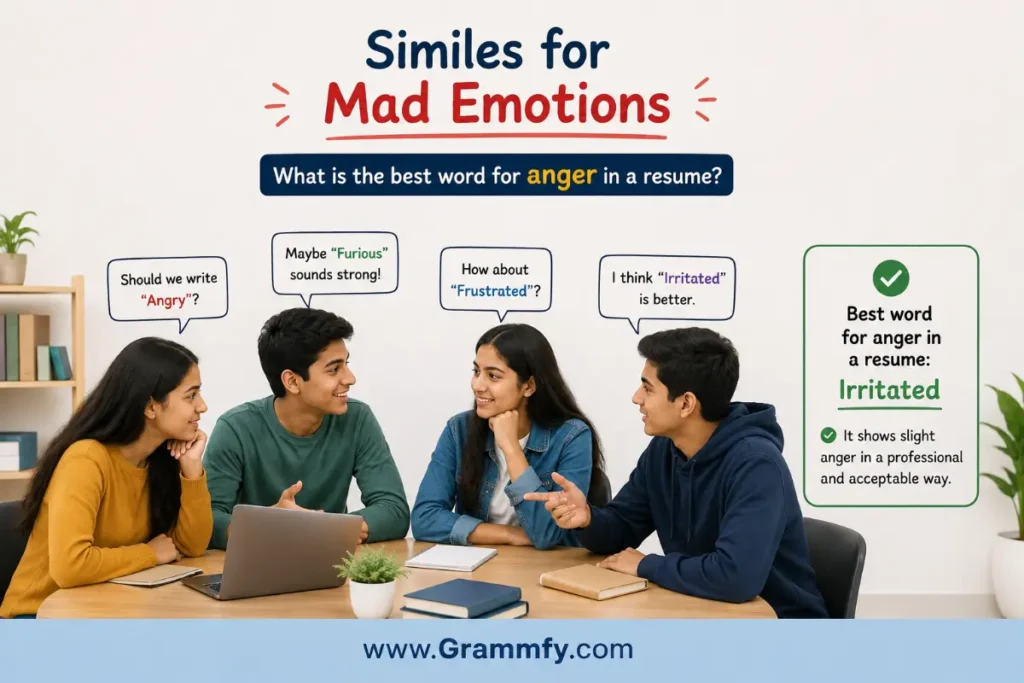
What is the best word for anger in a resume?
A resume usually shouldn’t describe you as mad, furious, or enraged. Those words don’t normally communicate a professional quality.
Instead, describe how you handle difficult situations.
Useful words include:
- Calm
- Patient
- Composed
- Professional
- Resilient
- Level-headed
- Diplomatic
- Solution-focused
- Responsible
- Adaptable
For example:
Maintained a calm and professional attitude during challenging customer interactions.
That’s much stronger for a resume than:
I don’t get mad easily.
If you’re describing conflict-management skills, use professional language rather than emotional slang.
What is the best word for anger in an email?
The right word depends on how formal the email is.
Instead of:
I am really mad about this problem.
A professional email could say:
I’m concerned about this issue and would appreciate a prompt solution.
If the situation is serious:
I’m extremely disappointed with how this matter was handled.
If you need to express strong dissatisfaction:
I’m frustrated by the repeated delays.
Professional communication often works better when you describe the problem and requested action rather than simply announcing your anger.
What is the best word for mad emotions in texting?
Texting is much more flexible. Casual words are common.
You might say:
- Mad
- Annoyed
- Upset
- Frustrated
- Furious
- Ticked off
- Pissed off
- So done
- Seriously annoyed
Examples:
I’m so mad right now.
That honestly ticked me off.
I’m really frustrated with this.
I’m beyond annoyed.
I’m seriously pissed off.
Remember that some expressions, especially “pissed off,” are informal and may not fit every audience.
What is the best word for mad emotions when speaking?
In everyday speech, simple words usually sound most natural.
Use:
- Mad
- Angry
- Annoyed
- Upset
- Frustrated
- Furious
Examples:
I’m really annoyed about what happened.
She was pretty upset after the argument.
He got mad when they canceled the game.
I was furious when I found out.
Formal words such as incensed or enraged are correct, but they can sound more dramatic in casual conversation.
What are the best similes for mad emotions in poetry?
Poetry gives you more freedom to use unusual images.
Try:
His anger was like thunder trapped inside a jar.
Her rage burned like a red sun beneath the clouds.
His temper cracked like ice under heavy footsteps.
Her frustration rose like smoke from a hidden fire.
His fury moved like a storm with nowhere to go.
Her anger was like a match waiting for a spark.
These comparisons don’t just tell readers that someone is angry. They suggest pressure, danger, movement, and emotion.
What are the best similes for anger in a story?
Fiction benefits from comparisons that match the character and scene.
A quiet angry character
His anger sat inside him like a coal that refused to cool.
This suggests controlled anger.
A character losing control
Her temper exploded like a firework in a silent room.
This suggests sudden anger.
A character hiding anger
His smile was calm, but his anger simmered beneath it like a pot beneath a closed lid.
This suggests that the character is pretending everything is fine.
A character becoming increasingly angry
Her frustration grew like dark clouds gathering before a storm.
This suggests rising tension.
A sudden outburst
His words burst out like sparks from a struck match.
This suggests fast, sharp anger.
What are 15 original examples of anger similes?
Here are additional examples you can adapt for essays, stories, and creative writing:
- Her anger spread like wildfire through dry grass.
- He was as mad as a storm trapped inside a small room.
- His frustration simmered like soup left over a low flame.
- She burned with anger like a candle surrounded by dry paper.
- His temper snapped like a rope pulled too hard.
- Her fury flashed like lightning across a dark sky.
- He was as angry as a volcano shaking before an eruption.
- Her words flew like sparks from a roaring fire.
- His anger rolled through him like thunder.
- She looked as furious as a storm cloud ready to burst.
- His frustration climbed like steam inside a sealed kettle.
- Her rage moved through the room like a sudden gust of hot wind.
- He was boiling like water trapped beneath a tight lid.
- Her temper flared like a match in the darkness.
- His anger hung over the room like a heavy storm cloud.
Notice that these examples don’t all describe anger in the same way. Some focus on heat, others on pressure, sound, movement, or danger.
How can you describe anger through body language?
A strong writer doesn’t always need to say “he was angry.” Body language can reveal the emotion.
You might describe:
- Clenched fists
- Tight jaw
- Red face
- Narrowed eyes
- Raised voice
- Shaking hands
- Heavy breathing
- Quick movements
- Pacing
- Staring
- Crossed arms
- Tense shoulders
For example:
He clenched his fists so tightly that his knuckles turned white.
Or:
Her jaw tightened as she stared at the broken screen.
You can then add a simile:
Her anger rose like a storm behind her calm expression.
This combination is powerful because the reader gets both the physical clue and the emotional comparison.
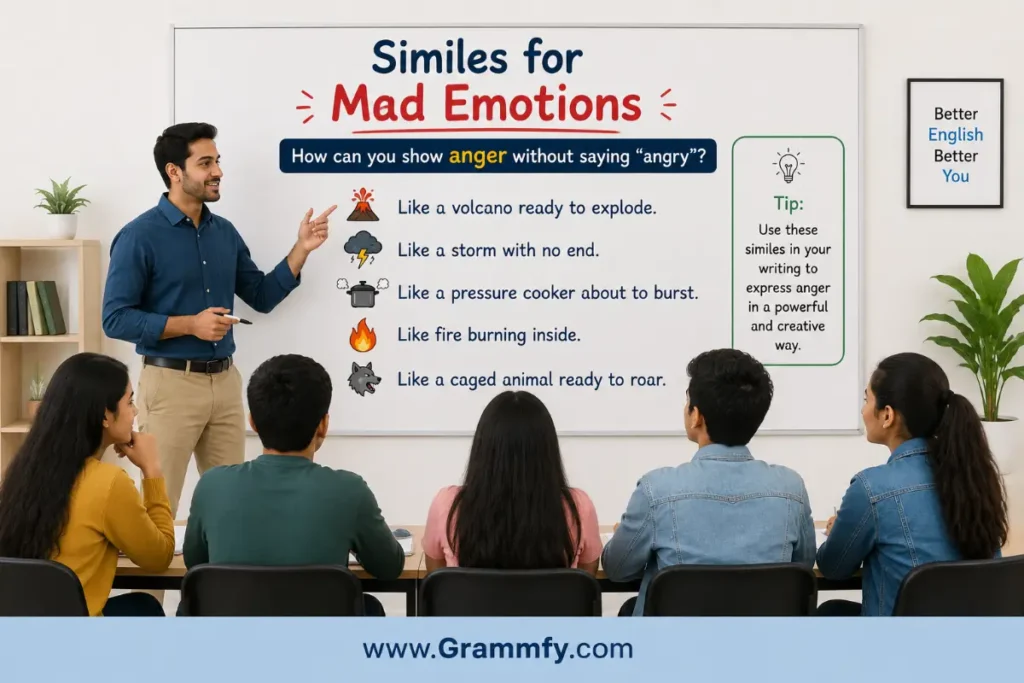
How can you show anger without saying “angry”?
Instead of:
David was angry when he saw the mess.
Show his reaction:
David stared at the broken plates, clenched his fists, and took a slow breath.
Or:
David’s face turned red, and his voice shook as he looked around the room.
You can add a simile:
His frustration boiled like water beneath a tight lid.
This approach is called showing rather than telling.
It makes stories feel more immediate because readers discover the emotion through actions and details.
Anger vs frustration — what’s the difference?
Anger is a broad emotional response to something you dislike, consider unfair, threatening, or wrong.
Frustration often happens when you can’t reach a goal or solve a problem.
| Anger | Frustration |
|---|---|
| Often caused by unfairness, insult, or conflict | Often caused by obstacles or repeated problems |
| Can become intense quickly | May build gradually |
| Can involve aggression | Often involves stress or annoyance |
| “I’m angry at him.” | “I’m frustrated with this problem.” |
For example:
She was frustrated because the computer kept crashing.
If someone insults her afterward:
She became angry when he blamed her for the problem.
The emotions can overlap, but the cause can be different.
Mad vs furious — what’s the difference?
Mad is a common everyday word for anger. Furious is much stronger.
| Mad | Furious |
|---|---|
| Everyday | Strong |
| Can describe mild or moderate anger | Usually describes intense anger |
| Common in conversation | More dramatic |
| “I’m mad about it.” | “I’m furious about it.” |
For example:
I was mad when my friend canceled our plans.
This could mean ordinary disappointment or anger.
I was furious when someone deliberately damaged my car.
The second sentence communicates a much stronger reaction.
Irritated vs annoyed — what’s the difference?
These words are very close.
Irritated often suggests a feeling of being bothered or disturbed.
Annoyed is very common in everyday English and can describe a similar feeling.
Examples:
The constant noise irritated me.
The constant noise annoyed me.
Both are correct.
“Annoyed” is generally more common in casual conversation, while “irritated” can sound slightly more formal or descriptive.
What are common mistakes when using anger similes?
Creative comparisons are useful, but some can weaken your writing.
Mistake 1: Making mild anger sound extreme
If someone is slightly annoyed, don’t automatically write:
He was like a volcano exploding across the city.
That’s too dramatic for a small problem.
Try:
He was as irritated as someone listening to a dripping faucet.
Mistake 2: Using the same fire image repeatedly
Fire is a classic anger comparison, but using it in every paragraph gets repetitive.
Mix your images:
- Storm
- Pressure cooker
- Lightning
- Boiling water
- Wild animal
- Cracked ice
- Dark clouds
- Thunder
Mistake 3: Confusing anger with sadness
Someone can be angry and sad at the same time, but they’re not identical.
She cried after the argument.
This doesn’t automatically mean she was angry.
Look for context.
Mistake 4: Using slang in formal writing
Words like pissed off and ticked off work in casual conversation but may not belong in an academic essay.
Use:
angry
frustrated
upset
outraged
instead.
Mistake 5: Overusing similes
One strong comparison is often enough.
Instead of:
His anger was like fire, like lightning, like thunder, and like a volcano.
Choose one:
His anger burned like a wildfire.
The sentence becomes cleaner and stronger.
What are the antonyms of mad?
If mad means angry, possible opposites include:
- Calm
- Peaceful
- Relaxed
- Content
- Pleased
- Happy
- Satisfied
- Patient
- Gentle
- Composed
- Unbothered
Examples:
She was angry about the delay.
Opposite:
She was calm about the delay.
Another:
He was furious after the argument.
Opposite:
He remained composed after the argument.
The best antonym depends on what aspect of anger you want to reverse.
How can you choose the right anger simile?
Start by asking how strong the emotion is.
Slight irritation
Use:
- Dripping faucet
- Buzzing fly
- Pebble in a shoe
- Interrupted nap
Example:
His annoyance was like a buzzing fly that wouldn’t leave.
Growing frustration
Use:
- Boiling water
- Gathering clouds
- Rising steam
- Tightening rope
Example:
Her frustration was like steam building inside a sealed kettle.
Strong anger
Use:
- Fire
- Thunder
- Lightning
- Storm
- Wildfire
Example:
His anger spread like wildfire.
Extreme rage
Use:
- Volcano
- Explosion
- Hurricane
- Raging fire
- Breaking dam
Example:
Her rage burst like a dam suddenly breaking.
Matching the comparison to the emotion makes your writing more believable.
How can you make anger similes more original?
Instead of using the first comparison that comes to mind, think about what the anger is doing.
Is it:
- Growing?
- Burning?
- Boiling?
- Exploding?
- Spreading?
- Hiding?
- Shaking?
- Building?
- Breaking?
- Flashing?
Then choose an image that behaves in the same way.
For example:
Growing anger:
Her anger grew like dark clouds before a storm.
Hidden anger:
His anger sat beneath his calm voice like fire beneath ashes.
Sudden anger:
Her temper flashed like lightning.
Controlled anger:
His fury simmered like water beneath a closed lid.
Uncontrolled anger:
His rage exploded like a volcano.
This method makes your comparisons more precise.
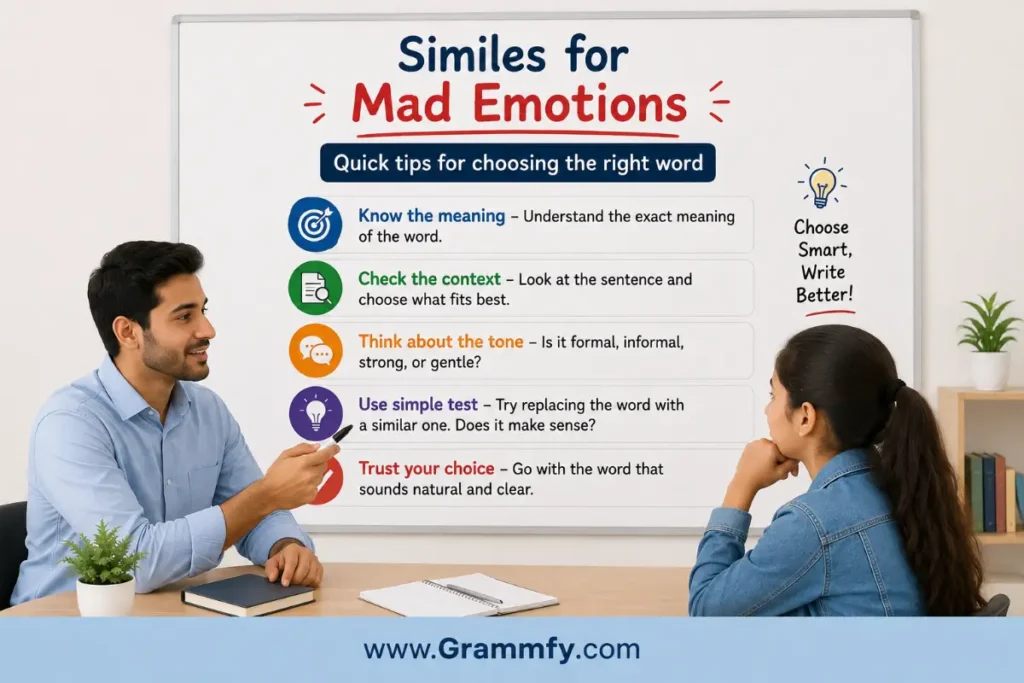
Quick tips for choosing the right word
Use these simple rules when describing anger:
- Choose annoyed for mild irritation.
- Choose irritated when something keeps bothering you.
- Choose frustrated when an obstacle prevents progress.
- Choose upset for emotional distress.
- Choose mad for casual everyday anger.
- Choose angry as the general, neutral word.
- Choose furious for very strong anger.
- Choose enraged for extreme anger.
- Choose outraged when anger comes from something considered deeply wrong or unfair.
- Choose resentful when anger lasts because of past unfair treatment.
- Choose bitter when anger is mixed with lasting hurt.
- Choose seething for strong anger that is being held inside.
- Choose agitated when anger comes with visible restlessness.
- Choose exasperated when repeated problems have worn down your patience.
Before choosing a simile, ask three questions:
- How angry is the person?
- What caused the anger?
- What is the anger doing?
Once you answer those questions, you can choose a comparison that fits instead of using the same “fire” image every time.
Conclusion
Strong descriptions of anger help readers understand more than simply knowing that someone is “mad.” The right comparison can show whether the emotion is quietly building, suddenly exploding, or burning beneath the surface. Fire, storms, boiling water, lightning, and volcanoes are useful images, but quieter comparisons can work just as well for mild frustration.
When choosing similes for mad emotions, first decide how intense the feeling is and what is causing it. A dripping faucet may fit mild annoyance, while a volcano may fit uncontrolled rage. For essays, keep comparisons clear and purposeful. In stories and poetry, you can experiment with more creative images. Most importantly, don’t overload your writing with comparisons. One fresh, well-matched simile can make an angry moment much more powerful and memorable.
Frequently Asked Questions
What are some good similes for mad emotions?
Strong examples include “as angry as a volcano ready to erupt,” “her anger burned like wildfire,” and “his frustration boiled like water in a pot.” The best comparison depends on the intensity of the emotion.
What’s another way to say someone is mad?
You can say someone is angry, annoyed, irritated, upset, frustrated, furious, enraged, or livid, depending on how strong the emotion is.
What is a good simile for extreme anger?
A good comparison is “his rage exploded like a volcano.” It suggests intense emotion that is difficult to control.
Can I use similes for mad emotions in an essay?
Yes, similes for mad emotions can make a narrative or descriptive essay more vivid. Choose a comparison that matches the character’s actual level of anger.
What is the difference between mad and furious?
Mad is a common word for anger, while furious describes a much stronger level of anger. “Furious” should be saved for situations involving intense emotional reactions.
How do you describe anger without saying angry?
Show the person’s body language, actions, voice, and thoughts, then use a comparison such as “her frustration simmered like a pot on low heat.”
What is a good word for mild anger?
Annoyed or irritated usually works well for mild anger. Both describe someone who is bothered without suggesting extreme rage.

1 thought on “Similes for Mad Emotions: Best Powerful Comparisons”