
You’re writing an essay, caption, story, or text about a beautiful evening, and “The sunset was beautiful” suddenly feels too plain. You want your reader to picture the orange sky, glowing clouds, and fading sunlight instead of simply hearing the word beautiful. That’s where similes for sunsets can make your writing stronger. A simile compares one thing with another using words such as like or as. A sunset can become a glowing fire, a golden blanket, a painted canvas, or a quiet goodbye.
The best sunset similes compare the evening sky to familiar things such as fire, gold, paintings, jewels, flowers, or peaceful endings.
The right comparison depends on the mood you want. A fiery sunset can feel bold and dramatic, while a soft pink sky may feel peaceful or romantic. In this guide, you’ll learn the meaning and origin of “sunset,” useful synonyms, different levels of description, context-specific word choices, original examples, common mistakes, and creative comparisons you can use in essays, texts, captions, and stories.
If you’re learning how to use comparisons effectively, take a look at [similes for devoted].
What does “sunset” mean in simple English?
A sunset is the time when the sun appears to move below the horizon at the end of the day.
The word can describe both:
- The event — when the sun disappears below the horizon.
- The colors and scene — the sky and landscape during that time.
For example:
We sat on the beach and watched the sunset.
Here, “sunset” means the evening event.
You can also describe the scene:
The sunset painted the clouds with shades of orange and pink.
In this sentence, the word refers to the beautiful appearance of the sky during the evening.
A sunset can look very different depending on the weather, location, season, and time of year. Clouds may turn pink, orange, red, purple, or gold. Clear skies may create a simple, glowing horizon.
That variety gives writers plenty of material for creative descriptions.
Where did the word “sunset” come from?
The word sunset is a very old English compound. It combines two simple words:
- Sun — the star at the center of our solar system.
- Set — to go down or move below the horizon.
The basic idea is easy to understand: the sun sets.
Old forms of English used similar combinations to describe the sun going down. The word became established as a simple way to describe the end of daylight.
English also has related words such as sunrise, which describes the beginning of the sun’s appearance above the horizon.
These two words form a natural pair:
Sunrise begins the day, while sunset brings daylight toward an end.
Because sunset marks a transition between day and night, writers often use it as a symbol of endings, change, peace, reflection, or new beginnings.
What are the best synonyms for sunset?
There isn’t always a perfect synonym for sunset. Some alternatives describe the event itself, while others describe the evening light or the period around it.
| Word | Meaning | Tone | Example |
|---|---|---|---|
| Dusk | The darker period after sunset | Everyday | We walked home at dusk. |
| Sundown | The time when the sun goes down | Casual | We arrived just before sundown. |
| Evening | The later part of the day | Everyday | The evening was warm and quiet. |
| Afterglow | Light remaining after sunset | Descriptive | A pink afterglow covered the sky. |
| Last light | The final daylight of the day | Literary | They hurried home in the last light. |
| Fading light | Light that is gradually disappearing | Descriptive | We watched the fading light. |
| Day’s end | The closing part of the day | Literary | At day’s end, the village became quiet. |
| Evening light | Light during the evening | Neutral | The evening light filled the room. |
| Horizon glow | Light visible near the horizon | Descriptive | A red horizon glow appeared. |
| Sunset hour | The time around sunset | Neutral | We arrived during sunset hour. |
| Evening colors | Colors visible in the evening sky | Descriptive | The evening colors were stunning. |
| Sky glow | Brightness remaining in the sky | Everyday | The sky glow lasted for several minutes. |
| Crimson sky | A red-colored evening sky | Literary | A crimson sky stretched over the lake. |
| Painted sky | A sky that looks artistically colored | Creative | The painted sky looked unreal. |
| Evening scene | The overall view at sunset | Neutral | The evening scene was peaceful. |
| Closing daylight | The final period of daylight | Formal/Literary | They enjoyed the closing daylight. |
Some of these words are not exact replacements. Dusk, for example, usually refers to the period after the sun has set, while afterglow describes the light that remains in the sky.
Knowing these differences helps you create more accurate descriptions.
Which sunset words are simple, everyday, formal, and creative?
Different situations call for different vocabulary.
Simple words
These are easy for almost any reader:
- Sunset
- Evening
- Dusk
- Sunlight
- Sky
- Evening light
- Sundown
Example:
We watched the sunset from the hill.
Everyday words
These sound natural in conversation:
- Sundown
- Dusk
- Golden hour
- Evening glow
- Evening sky
- Last light
- Afterglow
Example:
Let’s go outside and catch the sunset.
Formal or literary words
These work better in essays, poems, and descriptive writing:
- Twilight
- Nightfall
- Gloaming
- Last light
- Day’s end
- Closing daylight
- Solar descent
Example:
The village became quiet as twilight settled over the valley.
Creative descriptions
These aren’t exact synonyms, but they can create strong imagery:
- Painted sky
- Golden sky
- Crimson horizon
- Fiery horizon
- Glowing canvas
- Sky of fire
- Golden curtain
- Evening masterpiece
Example:
The sky became a glowing canvas as the sun disappeared.
Which sunset descriptions are mild to strong?
The intensity of your description affects the mood.
Mild descriptions
Use these when the scene is pretty but not dramatic:
- Soft
- Warm
- Gentle
- Calm
- Quiet
- Pale
- Subtle
Example:
A soft sunset faded behind the trees.
Medium descriptions
These create stronger visual imagery:
- Glowing
- Golden
- Colorful
- Radiant
- Brilliant
- Vivid
- Luminous
Example:
A radiant sunset spread across the western sky.
Strong descriptions
These create dramatic or emotional imagery:
- Fiery
- Blazing
- Spectacular
- Breathtaking
- Magnificent
- Dazzling
- Explosive
Example:
A fiery sunset turned the entire horizon red and orange.
Be careful with strong adjectives. If every sunset is “breathtaking,” the word can lose its impact.
What are the best Similes for Sunsets?
A strong simile gives the reader something familiar to picture. Here are some original comparisons you can use or adapt.
1. Like a painting
The sunset spread across the sky like a painting made with gold, pink, and orange.
This is one of the easiest comparisons because colorful skies often look artistic.
2. Like a ball of fire
The setting sun looked like a ball of fire sinking behind the mountains.
This works especially well when the sun is bright orange or red.
3. Like melted gold
The sunset poured across the horizon like melted gold.
This comparison creates a warm, rich image.
4. Like a burning ember
The sun glowed like a burning ember before disappearing into the sea.
This is useful for a quieter but still dramatic sunset.
5. Like a golden blanket
The evening light spread over the fields like a golden blanket.
This comparison works well for peaceful countryside scenes.
6. Like a jeweled crown
The clouds looked like a jeweled crown around the setting sun.
This gives the scene a grand and beautiful feeling.
7. Like a watercolor painting
The sky looked like a watercolor painting washed with pink, purple, and orange.
This is especially useful when the colors blend softly.
8. Like a curtain closing
The sunset was like a curtain slowly closing at the end of a beautiful show.
This comparison works well when writing about endings.
9. Like a glowing lantern
The setting sun hung over the horizon like a giant glowing lantern.
This gives the sunset a warm and gentle mood.
10. Like a flame
The western sky burned like a giant flame before darkness arrived.
This creates a dramatic image.
What Are the Best Similes for Sunsets in Essays?
School essays often need clear imagery without becoming too poetic. A good comparison should support your main idea.
Here are some strong choices:
The sunset looked like a painting spread across the evening sky.
The sun sank below the horizon like a glowing coin disappearing into the sea.
Orange clouds floated across the sky like pieces of fire.
The final sunlight covered the fields like a golden blanket.
The sunset faded like the last page of a beautiful story.
These examples can fit descriptive essays, travel writing, personal narratives, and creative assignments.
For a peaceful essay
Try:
The sunset settled over the lake like a soft blanket.
For a dramatic essay
Try:
The sunset burned across the horizon like a wall of fire.
For an emotional essay
Try:
The fading sunset was like a quiet goodbye at the end of a long day.
What Are the Best Similes for Sunsets in Poetry?
Poetry gives you more freedom. You can use unusual comparisons as long as they create a clear image.
Try these:
- Like a flame whispering goodbye
- Like gold spilled across the sea
- Like a rose opening in the sky
- Like fire melting into water
- Like a curtain of crimson silk
- Like a jewel floating above the horizon
- Like a tired star going home
- Like an artist’s final brushstroke
- Like a golden door closing on the day
- Like a glowing ember drifting into darkness
Example:
The sun sank like a golden ember into the quiet sea.
This has a softer poetic mood than:
The sun was like fire.
The second sentence is understandable, but the first creates a more complete picture.
What Are the Best Similes for Sunsets for Instagram Captions?
Captions are usually short, so a compact comparison works best.
Try:
- Golden like a dream.
- The sky was like a painting.
- Sunset glow like melted gold.
- A sky like fire.
- Pink clouds like cotton candy.
- The horizon looked like a golden curtain.
- The sun disappeared like a fading flame.
- Evening looked like a watercolor dream.
- The sky glowed like a lantern.
- A sunset like nature’s masterpiece.
You can also keep the language casual:
This sunset looked like someone painted the whole sky.
That sounds more natural than forcing a poetic phrase into every caption.
What Are the Best Similes for Sunsets for a Romantic Mood?
Romantic descriptions usually work well with warm, gentle images.
Try:
The sunset was like a warm promise painted across the sky.
The evening sky glowed like a rose touched by golden light.
The sun sank below the horizon like a quiet kiss goodbye.
The clouds floated like soft pink dreams above the sea.
The sunset wrapped the horizon like a blanket of gold.
These comparisons focus on warmth, softness, beauty, and emotion.
Avoid making every romantic sunset comparison overly dramatic. A simple image can feel more genuine.
What is the best sunset simile for a peaceful mood?
If you want calmness, use images connected with softness and comfort.
Examples include:
The sunset faded like a soft whisper.
The evening light rested over the lake like a warm blanket.
The sun slipped behind the hills like a tired traveler heading home.
The sky changed colors like a quiet watercolor painting.
The last light floated across the water like a gentle glow.
Words such as soft, quiet, gentle, warm, and peaceful work especially well here.
What is the best sunset simile for a dramatic mood?
Dramatic descriptions need stronger images.
Try:
The sunset burned across the sky like a forest fire.
The clouds glowed like hot coals above the horizon.
The sun looked like a giant fireball sinking into the ocean.
The western sky exploded like a burst of flames.
Red clouds stretched across the horizon like burning ribbons.
These comparisons are stronger because they use images associated with heat, fire, and energy.
Use them when the sky really has bold red, orange, or deep purple colors.
What are 15 original examples of sunset similes?
Here are examples across different situations and moods.
- The sunset looked like a giant painting hanging across the sky.
- The sun glowed like a golden coin above the distant hills.
- Orange clouds burned like embers around the horizon.
- The evening light spread like honey across the fields.
- The sky looked like watercolor brushed across a blue canvas.
- The setting sun sank like a red marble into the ocean.
- The clouds floated like pink cotton above the rooftops.
- The sunset faded like the final note of a song.
- Golden light covered the beach like a warm blanket.
- The horizon glowed like a row of candles in the distance.
- The sun disappeared like a glowing ember beneath the mountains.
- Purple clouds gathered like soft waves across the evening sky.
- The last rays shone like ribbons of gold.
- The sunset opened across the horizon like a flower in bloom.
- The fading light was like a quiet goodbye to the day.
Each sentence creates a slightly different feeling. That’s important because good descriptive writing isn’t only about making something sound beautiful. It should also communicate mood.
How can you describe sunset colors with similes?
Colors are one of the easiest ways to make a sunset description more vivid.
Orange sunset
The sky glowed like a bowl of warm fire.
Red sunset
The horizon looked like a curtain dipped in crimson paint.
Pink sunset
The clouds looked like cotton candy floating across the sky.
Purple sunset
The evening sky spread like lavender ink across the horizon.
Gold sunset
The sunlight flowed like melted gold over the water.
Orange and pink sunset
The clouds looked like strokes of coral and peach paint.
Red and purple sunset
The horizon burned like fading embers beneath a violet sky.
Specific colors make the comparison easier for readers to visualize.
How can you compare a sunset to nature?
Nature-based comparisons often feel natural because sunsets are part of the outdoor world.
Try comparing the evening sky to:
- Flowers
- Fire
- Water
- Mountains
- Leaves
- Birds
- Clouds
- Stars
- The ocean
- Trees
Examples:
The sunset opened like a giant flower above the horizon.
The orange clouds floated like autumn leaves across the sky.
The evening light flowed like a river over the mountains.
The sun glowed like a wildflower of fire against the clouds.
The colors spread like waves across the horizon.
Nature comparisons can work especially well in essays about travel, landscapes, seasons, and outdoor experiences.
How can you compare a sunset to art?
Art is one of the most common ways to describe a beautiful sunset because both involve color, shape, light, and composition.
You can compare a sunset to:
- A painting
- A watercolor
- A masterpiece
- A mural
- A canvas
- A brushstroke
- A photograph
- A sculpture
- A work of art
Examples:
The sunset looked like an artist had painted the entire sky.
The clouds were like brushstrokes across a golden canvas.
The horizon looked like a watercolor masterpiece.
Each cloud appeared like a fresh stroke of pink paint.
One advantage of art comparisons is that readers already understand what paintings look like. The image is easy to picture.
Sunset vs twilight — what’s the difference?
Sunset is the event when the sun goes below the horizon. Twilight is the period of soft light around sunrise or sunset.
| Sunset | Twilight |
|---|---|
| Focuses on the sun going down | Focuses on the remaining light |
| Often includes the visible sun | The sun may already be below the horizon |
| Can be bright and colorful | Usually suggests softer, fading light |
| “We watched the sunset.” | “We walked home at twilight.” |
For example:
The sunset turned the clouds orange.
Then:
Twilight settled over the town as the colors faded.
The two periods are connected, but they aren’t exactly the same.
Sunset vs dusk — what’s the difference?
Dusk usually refers to the darker period after sunset as daylight fades.
We arrived at sunset.
This means you arrived around the time the sun was going down.
We arrived at dusk.
This suggests the sun had already set or was nearly gone and darkness was beginning.
In creative writing, both words can describe beautiful evening scenes, but they create different timing.
Sunset = the sun going down.
Dusk = the growing darkness afterward.
What are common mistakes when writing Similes for Sunsets ?
Creative writing has fewer strict rules than formal writing, but some problems can make a comparison weaker.
Mistake 1: Using a cliché without adding anything
The sunset was like a painting.
This is not wrong, but it is very common.
Make it more specific:
The sunset looked like a watercolor painting washed with coral, gold, and violet.
Now the reader gets more information.
Mistake 2: Mixing unrelated comparisons
Avoid:
The sunset was like a golden painting that roared like a river and floated like a mountain.
The images don’t work together.
Choose one strong idea:
The sunset looked like a golden painting stretched across the horizon.
Mistake 3: Using “as” incorrectly
A simile often uses:
as + adjective + as
Example:
The sunset was as bright as fire.
Or:
like + noun
Example:
The sunset looked like fire.
Both structures can work, but they should sound natural.
Mistake 4: Overloading the sentence with adjectives
The breathtaking, magnificent, stunning, spectacular, gorgeous sunset looked like a beautiful, amazing, magical painting.
This is too much.
A cleaner version:
The sunset looked like a glowing watercolor painting.
Specific imagery is usually stronger than a pile of adjectives.
Mistake 5: Forgetting the mood
A fiery comparison may not fit a peaceful scene.
If your story is calm:
The sunset faded like a soft whisper.
If your story is dramatic:
The horizon burned like a wall of fire.
Match the comparison to the emotion.
What are the antonyms of sunset?
There isn’t one exact opposite of sunset in every context, but the clearest opposite is sunrise.
| Sunset | Sunrise |
|---|---|
| Sun moves below the horizon | Sun appears above the horizon |
| Marks the end of daylight | Marks the beginning of daylight |
| Associated with evening | Associated with morning |
| Often symbolizes endings | Often symbolizes beginnings |
Other contrasting ideas include:
- Day vs night
- Dawn vs dusk
- Sunrise vs sunset
- Beginning vs ending
- Light vs darkness
In literature, sunset can symbolize an ending, while sunrise can symbolize hope, renewal, or a new beginning.
How do you choose the right Similes for Sunsets?
Start with the feeling you want your reader to experience.
If you want beauty
Use:
- Painting
- Jewel
- Flower
- Masterpiece
- Golden canvas
Example:
The sunset looked like a masterpiece painted across the horizon.
If you want warmth
Use:
- Blanket
- Fire
- Lantern
- Gold
- Honey
Example:
The evening light spread like warm honey over the fields.
If you want drama
Use:
- Flame
- Fireball
- Burning coal
- Firestorm
- Exploding colors
Example:
The horizon burned like a wall of fire.
If you want peace
Use:
- Whisper
- Soft blanket
- Gentle wave
- Quiet song
- Fading candle
Example:
The last sunlight faded like a quiet whisper.
If you want romance
Use:
- Rose
- Golden promise
- Warm light
- Soft dream
- Kiss
Example:
The sunset faded like a gentle kiss at the end of the day.
How can you make your sunset writing more original?
Instead of asking, “What is a beautiful thing I can compare the sunset to?” ask a more useful question:
What does this particular sunset remind me of?
Look at the scene.
Is the sun:
- Bright orange?
- Deep red?
- Pale pink?
- Hidden behind clouds?
- Reflecting on water?
- Disappearing behind mountains?
- Surrounded by purple clouds?
- Making the buildings glow?
Then build your comparison from what you actually see.
For example, if the sun reflects on water:
The sunlight scattered across the waves like coins tossed onto blue glass.
If clouds are bright orange:
The clouds glowed like embers floating above the horizon.
If the colors are soft:
The sky blended like watercolor beneath a gentle evening light.
Specific observations make your writing feel less generic.
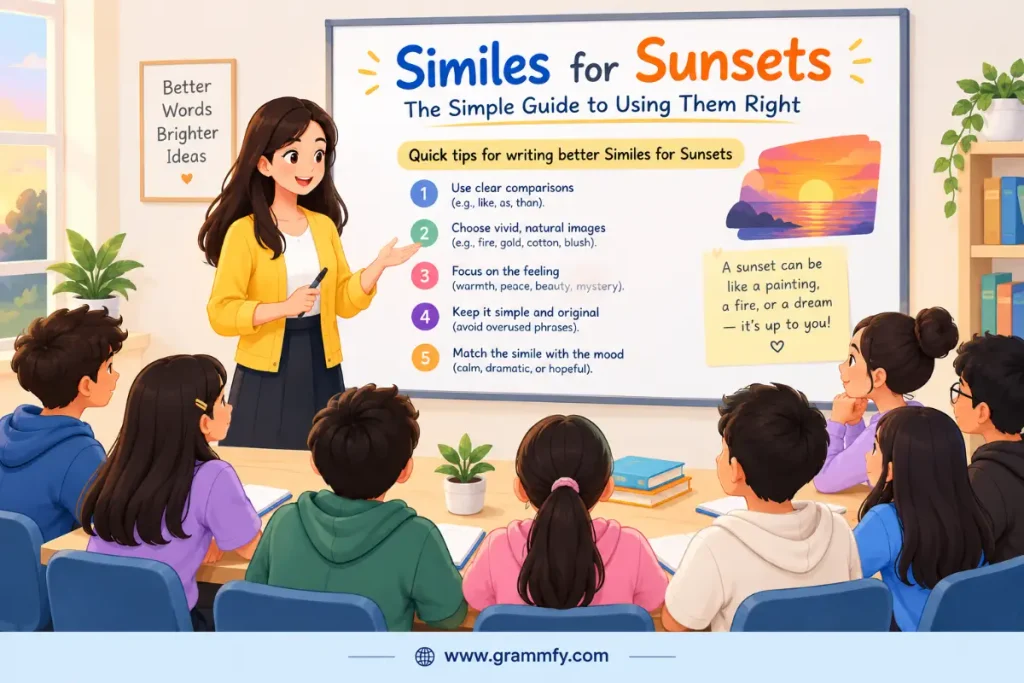
Quick tips for writing better Similes for Sunsets
Keep these rules in mind:
- Compare, don’t just decorate. The image should tell the reader something.
- Use familiar objects. A painting, flame, flower, or blanket is easy to picture.
- Match the mood. Peaceful scenes need softer comparisons.
- Be specific about color. Orange, crimson, pink, gold, and violet create different images.
- Avoid too many adjectives. One strong comparison can do more work.
- Don’t mix unrelated images. Keep one main idea in each sentence.
- Think about the setting. A beach sunset can be described differently from a mountain sunset.
- Use sensory details. Include light, color, warmth, reflection, or movement.
- Keep the audience in mind. A school essay and a social media caption don’t need the same style.
- Show the mood. Ask whether the scene feels peaceful, romantic, dramatic, joyful, or sad.
- Don’t force a rhyme. A clear image matters more than making every word poetic.
- Read the sentence aloud. If it sounds awkward, simplify it.
- Choose originality over exaggeration. A fresh, simple image often works better than “the most breathtaking sunset in the universe.”
Conclusion
The best similes for sunsets turn a simple evening scene into something readers can picture. A sunset can look like melted gold, a watercolor painting, a glowing lantern, a burning ember, or a curtain slowly closing on the day. Each comparison creates a different mood, so the right choice depends on what you want your reader to feel.
For school writing, keep your imagery clear and connected to the scene. Creative writing gives you more freedom to use unusual comparisons, while captions usually work best with short, memorable phrases. Most importantly, look closely at the sunset before choosing your words. Notice its colors, light, movement, and mood. Then choose one familiar image that captures what you actually see. A simple comparison with a clear purpose can make your writing much more vivid.
Frequently Asked Questions
What are good similes for sunsets?
Good comparisons include a sunset like a painting, melted gold, a ball of fire, a glowing lantern, or a golden blanket. The best choice depends on the mood and colors of the scene.
What’s another way to describe a sunset?
You can describe a sunset as a painted sky, golden horizon, fiery evening, glowing afterglow, colorful twilight, or fading daylight.
What is a sunset simile for an essay?
A strong essay comparison is: “The sunset looked like a watercolor painting spread across the evening sky.” It creates a clear image without being too complicated.
Can I use sunset similes in a school essay?
Yes, similes for sunsets can make descriptive and narrative essays more vivid. Keep the comparison clear and make sure it supports the main idea.
What is a good simile for a red sunset?
A red sunset can be compared to burning embers, a wall of fire, crimson paint, or a glowing coal. Choose the comparison that matches how dramatic the sky looks.
What is the difference between sunset and twilight?
Sunset is when the sun goes below the horizon, while twilight is the period of fading light around sunset or sunrise. Twilight usually emphasizes the softer light after the sun is no longer visible.
How can I make a sunset description more poetic?
Use a specific color, a strong image, and a mood. For example, instead of “The sunset was beautiful,” write, “The last golden light flowed across the lake like melted honey.”

1 thought on “Similes for Sunsets: Best Creative Comparisons”