
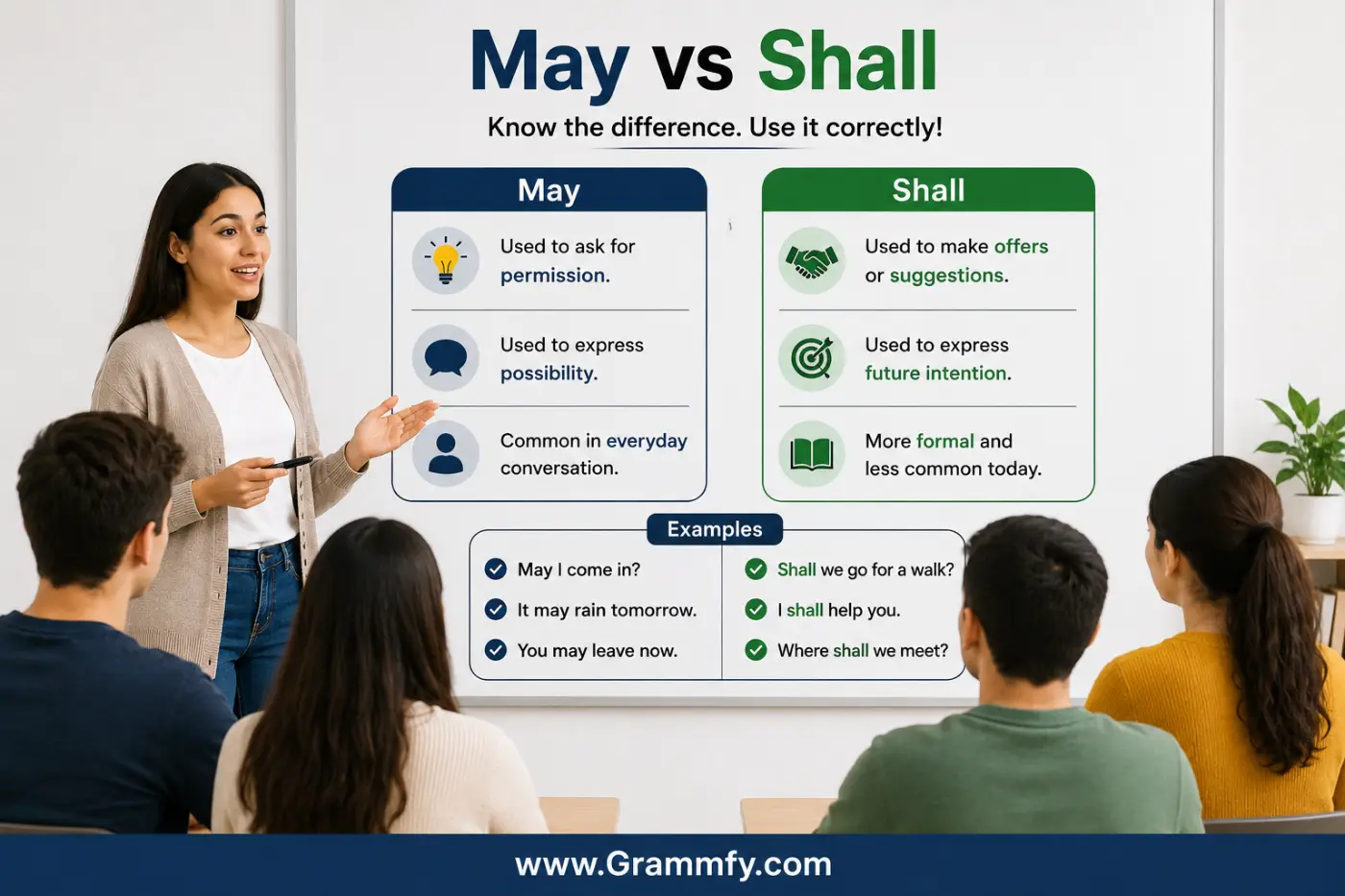
When you’re writing an email, essay, or formal message, you may wonder whether to use May vs Shall. Both are modal verbs, but they do very different jobs. May usually talks about possibility or permission, while shall is mainly used for offers, suggestions, formal rules, and certain future statements.
Answer Box: May expresses possibility or permission, while shall is mainly used for suggestions, offers, obligations, and formal or legal language.
For example, “You may leave now” gives permission, while “Shall we leave now?” makes a suggestion. The words aren’t normally interchangeable, even though both can appear in sentences about future actions.
Understanding the difference is especially useful in formal English. You’ll often see shall in contracts, regulations, official documents, and polite questions. May, on the other hand, is common in everyday English when something is possible or when someone gives permission.
This guide explains their meanings, origins, grammar, synonyms, regional differences, common mistakes, and real-life uses. You’ll also see how to choose the right word for essays, emails, resumes, texts, and conversation.
Build stronger spelling skills with our guide to [may or can].
What do May vs Shall mean in simple English?
The easiest way to understand these two modal verbs is to look at their main functions.
What does may mean?
May commonly expresses:
- possibility
- permission
- uncertainty
- a possible future event
- a formal wish in certain expressions
Examples:
It may rain tonight.
Here, may shows possibility.
You may enter the room.
Here, may gives permission.
She may arrive later.
In this example, the speaker isn’t certain about her arrival.
What does shall mean?
Shall has several uses, but it is less common in everyday American English.
It can express:
- an offer
- a suggestion
- a formal future statement
- a requirement in legal or official language
- a strong intention in some contexts
Examples:
Shall we begin?
This is a suggestion.
Shall I open the window?
This is an offer or polite question.
The tenant shall pay the fee.
In a contract, this normally expresses a requirement.
Quick comparison
| Word | Main use | Example |
|---|---|---|
| May | Possibility | It may rain. |
| May | Permission | You may leave. |
| Shall | Suggestion | Shall we leave? |
| Shall | Offer | Shall I help you? |
| Shall | Formal requirement | The buyer shall pay the fee. |
| Shall | Formal future | We shall return. |
How did the words May vs Shall originate?
Knowing a little about word history can make the difference easier to remember.
Where did may come from?
May comes from Old English magan, which was connected to ideas of having power, ability, or being able to do something.
Over centuries, the word developed several meanings. Modern English mainly uses it for possibility and permission.
For example:
You may leave.
This originally connects with the idea that someone has the authority or ability to allow an action.
Today, however, may is treated as a modal verb with its own grammatical patterns.
Where did shall come from?
Shall comes from Old English sceal, which was connected with ideas such as owing, having to, or being obliged.
That history helps explain why shall can still appear in formal language involving requirements or duties.
For example:
The employee shall follow all safety rules.
In modern contracts, this can mean that following the rules is required.
Over time, shall also became associated with future statements, especially with I and we in traditional English grammar.
When should you use may for possibility?
Use may when something is possible but not certain.
Examples:
The train may arrive late.
Sarah may join us tonight.
Prices may increase next year.
The weather may change soon.
Each sentence describes something that could happen.
The speaker doesn’t claim that the event will definitely happen.
May for present possibility
A sentence can use may to describe something that is possibly true now.
John may be at home.
This means the speaker thinks John is possibly at home.
Other examples:
She may be busy.
They may be waiting outside.
He may know the answer.
The store may be closed.
May for future possibility
May can also describe possible future events.
We may travel next month.
The company may launch a new product.
The teacher may give us a test tomorrow.
The future event isn’t certain.
When should you use may for permission?
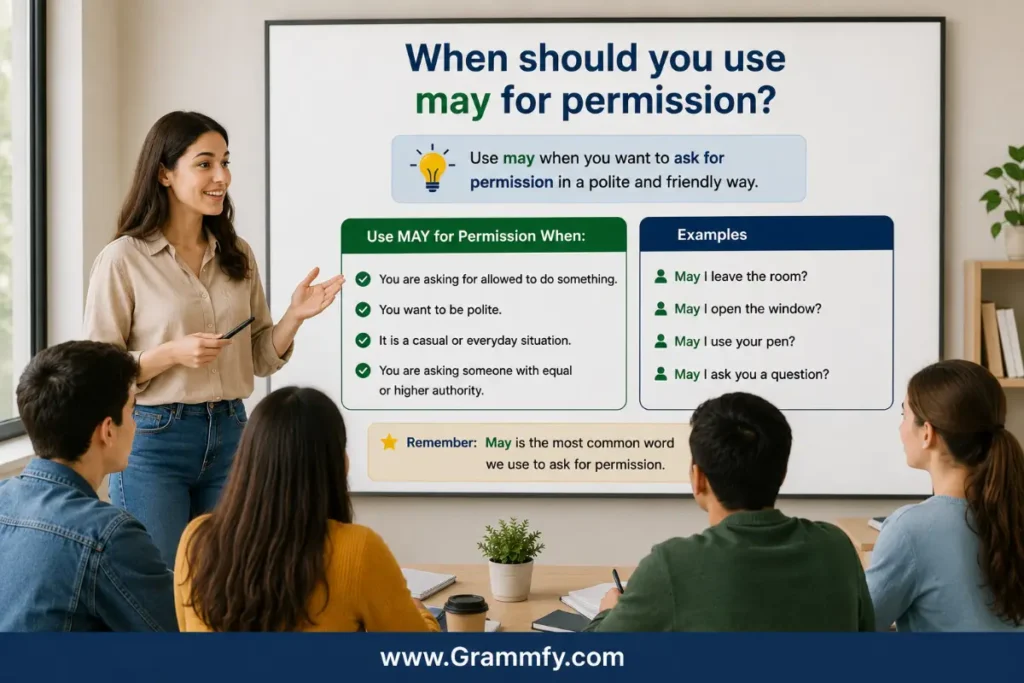
May is a traditional and formal way to ask for or give permission.
Examples:
May I come in?
May I use your phone?
You may leave early today.
Students may use calculators during the test.
The first two examples ask for permission. The last two give permission.
May vs Can for permission
In everyday American English, can is also very common for permission.
Can I borrow your pen?
This is natural and casual.
May I borrow your pen?
This is more formal or polite.
The old rule that “can means ability and may means permission” is too strict for modern English. Native speakers regularly use can for permission.
Still, may remains useful when you want a formal tone.
When should you use shall for suggestions?
One of the most common modern uses of shall is in questions with I or we.
Use it when making a suggestion or asking what someone wants to do.
Examples:
Shall we go?
Shall we start?
Shall we order pizza?
Shall we meet at six?
These questions are not simply about the future. They ask for a decision or suggestion.
What does “Shall we?” mean?
Shall we? is a short way to suggest doing something together.
For example:
The movie is about to start. Shall we?
This means:
Should we go now?
or:
Are we ready to do it?
It can sound polite, friendly, or slightly formal depending on the situation.
When should you use shall for offers?
Shall I…? often introduces an offer to do something.
Examples:
Shall I carry that bag?
Shall I open the door?
Shall I call a taxi?
Shall I help you with your homework?
The speaker is offering to perform an action.
This is different from:
May I help you?
May I help you? asks for permission or offers help politely.
Shall I help you? asks whether the speaker should take action.
Both can be polite, but the focus is different.
When does shall express a formal requirement?
This is one of the most important uses of shall in legal and official writing.
For example:
The tenant shall pay the rent on the first day of each month.
Here, shall establishes a requirement.
Another example:
The applicant shall provide valid identification.
This means providing identification is required.
You’ll often see this style in:
- contracts
- laws
- regulations
- policies
- official rules
- technical specifications
- legal documents
However, legal drafting practices vary. Some modern legal writers prefer clearer words such as must or will because shall can sometimes create ambiguity.
Is shall common in American English?
Shall is correct in American English, but it is less common in everyday conversation than will.
Americans are more likely to say:
Will we go?
or:
Should we go?
than:
Shall we go?
However, Shall we…? is still understood and can sound natural in suggestions.
The phrase:
Shall we begin?
is common in formal meetings, presentations, ceremonies, and polite conversation.
Shall also remains common in legal and official writing.
Is shall more common in British English?
Yes. Shall has traditionally had a stronger role in British English.
British speakers may use:
Shall we go?
Shall I open the window?
more naturally than many American speakers.
Still, will is widely used in British English too.
The difference isn’t as simple as:
British = shall
American = will
Both varieties use both words. The frequency and preferred contexts differ.
May vs Shall: what is the main difference?
The biggest difference is their function.
May usually tells us that something is possible or permitted.
Shall usually asks for a suggestion, makes an offer, or appears in formal statements about duties and future actions.
| Function | May | Shall |
|---|---|---|
| Possibility | ✓ | Rare |
| Permission | ✓ | Rare |
| Suggestion | Rare | ✓ |
| Offer | Rare | ✓ |
| Formal requirement | Sometimes | ✓ |
| Future statement | Sometimes | Traditional/formal |
| Casual conversation | Common | Less common |
| Legal writing | Common | Very common |
This is why you usually can’t replace one with the other.
May vs Shall: are they interchangeable?
No, not in most situations.
Consider:
It may rain.
This means rain is possible.
You cannot naturally replace may with shall:
It shall rain.
That sentence has a completely different tone and meaning. It sounds like a formal prediction, command, or deliberate declaration rather than an ordinary statement of possibility.
Now consider:
Shall we leave?
Replacing shall with may creates:
May we leave?
That asks for permission rather than making a suggestion.
The two questions have different purposes.
May vs Shall for possibility
Use may when you want to show uncertainty or possibility.
The package may arrive tomorrow.
This means arrival is possible.
Shall is not normally used to express ordinary uncertainty.
Incorrect for normal possibility:
The package shall arrive tomorrow.
This sounds like a formal commitment, rule, or definite declaration.
If you simply mean “possibly,” choose may, might, or could.
May vs Shall for permission
May is the natural choice for formal permission.
May I leave early?
Shall doesn’t normally mean “am I allowed to?”
Shall I leave early?
This means something closer to:
Would you like me to leave early?
or:
Should I leave early?
That’s a major difference.
Compare these carefully
| Sentence | Meaning |
|---|---|
| May I leave? | Am I allowed to leave? |
| Shall I leave? | Do you want me to leave? |
| May I help? | Am I permitted to help? |
| Shall I help? | Would you like me to help? |
Changing the modal changes the purpose of the question.
May vs Shall for future actions
Both can appear in sentences connected to the future, but they don’t have the same meaning.
May for possible future action
I may visit London next year.
The visit is possible.
Shall for formal or traditional future meaning
I shall return.
This is a strong or formal future statement.
In modern American English, people normally use will:
I will return.
Shall can make the sentence sound formal, old-fashioned, dramatic, or determined.
What are synonyms and related words for May vs Shall?
Because modal verbs have several meanings, their synonyms depend on the context.
Here is a broad list of useful alternatives.
Simple alternatives
| Word or phrase | Meaning | Tone | Example |
|---|---|---|---|
| can | Permission/ability | Everyday | You can leave now. |
| could | Possible option | Neutral | We could leave now. |
| might | Possibility | Neutral | She might come. |
| maybe | Possibly | Casual | Maybe he’ll come. |
| perhaps | Possibly | Neutral/Formal | Perhaps she’ll join us. |
| will | Future/certainty | Neutral | We will leave soon. |
| should | Advice/expected action | Neutral | We should leave. |
| must | Requirement | Strong | You must leave. |
Everyday alternatives
| Word or phrase | Meaning | Tone | Example |
|---|---|---|---|
| can | Permission | Casual | You can go. |
| could | Possible choice | Everyday | We could eat here. |
| might | Possibility | Everyday | He might call. |
| should we | Suggestion | Everyday | Should we go? |
| do you want to | Suggestion | Casual | Do you want to leave? |
| how about | Suggestion | Casual | How about going now? |
| let’s | Suggestion | Casual | Let’s start. |
| maybe | Possibility | Casual | Maybe we’ll stay. |
Formal alternatives
| Word or phrase | Meaning | Tone | Example |
|---|---|---|---|
| it is possible that | Possibility | Formal | It is possible that prices will rise. |
| perhaps | Possibly | Formal | Perhaps the plan will work. |
| is permitted to | Has permission | Formal | The visitor is permitted to enter. |
| is authorized to | Has official permission | Formal | The manager is authorized to approve it. |
| is required to | Must do something | Formal | The tenant is required to pay. |
| must | Strong requirement | Formal/Direct | Applicants must apply online. |
| will | Future statement | Neutral/Formal | The company will respond. |
| is expected to | Expected future action | Formal | The team is expected to arrive. |
Casual expressions related to suggestions
| Expression | Meaning | Tone | Example |
|---|---|---|---|
| let’s | Suggest doing something | Casual | Let’s go. |
| how about | Suggestion | Casual | How about lunch? |
| why don’t we | Suggestion | Casual | Why don’t we start? |
| do you want to | Invitation/suggestion | Casual | Do you want to leave? |
| should we | Suggestion | Neutral | Should we call her? |
| we could | Possible plan | Casual | We could watch a movie. |
| what if we | Suggestion | Casual | What if we leave now? |
| want to | Informal suggestion | Casual | Want to grab coffee? |
How do possibility words differ in strength?
Words expressing possibility can create different impressions.
| Expression | General impression |
|---|---|
| might | Uncertain possibility |
| may | Possible |
| could | Possible option |
| likely | Reasonably probable |
| probably | More likely than not |
| will probably | Strong expectation |
| will | Strong certainty/prediction |
| must | Strong conclusion or requirement |
These aren’t exact percentages.
For example:
It might rain.
It may rain.
It will probably rain.
The last sentence generally sounds more confident.
What are the parts of speech related to May vs Shall?
May and shall are modal auxiliary verbs.
They don’t behave like ordinary verbs.
After them, use the base form of the main verb.
Correct:
She may come.
We shall begin.
Incorrect:
She may comes.
We shall begins.
You also don’t normally add to after them.
Correct:
He may leave.
We shall return.
Incorrect:
He may to leave.
We shall to return.
Negative forms
The negative form of may is:
may not
Example:
You may not enter.
Shall becomes:
shall not
The contraction shan’t also exists, especially in British English.
Example:
I shan’t be late.
In American English, shan’t is uncommon.
What does “may not” mean?
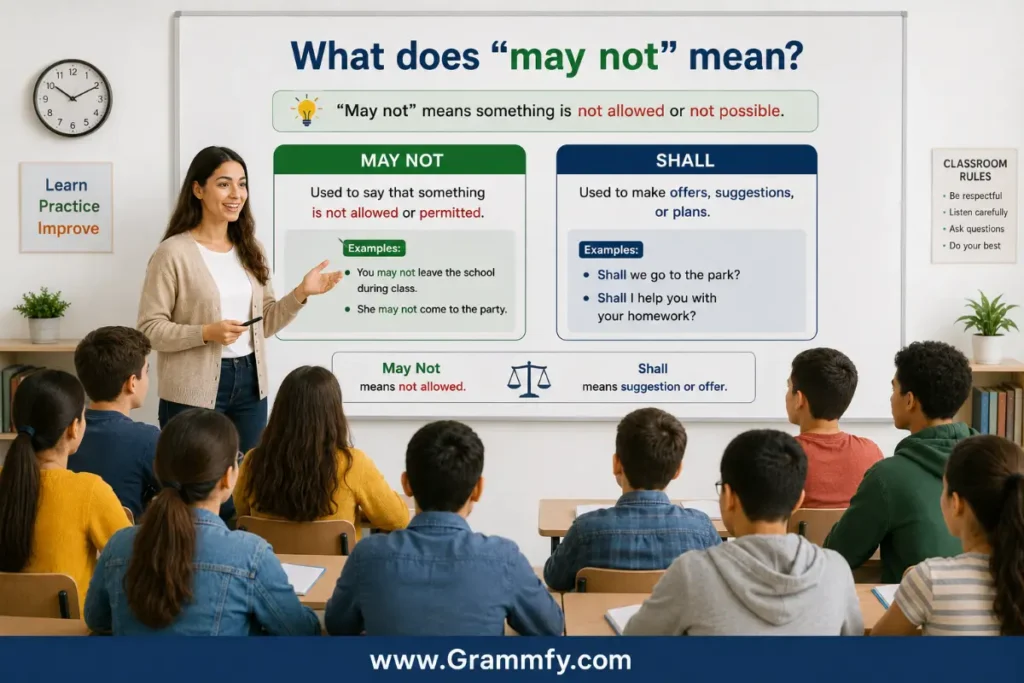
May not can have two different meanings depending on context.
Meaning 1: Possible negative event
She may not come.
This means:
Perhaps she won’t come.
Meaning 2: No permission
You may not enter.
This means:
You are not allowed to enter.
Context is important.
Compare:
He may not attend the meeting.
Possible absence.
Visitors may not enter this area.
Permission is denied.
What does “shall not” mean?
Shall not usually expresses a strong prohibition or formal requirement.
For example:
The tenant shall not damage the property.
This means damaging the property is prohibited under the agreement.
In official rules:
Employees shall not share confidential information.
This establishes a formal restriction.
In everyday English, must not is often clearer:
Employees must not share confidential information.
May vs Shall in legal writing
Legal English is one area where shall deserves special attention.
A contract may say:
The buyer shall pay the full amount within 30 days.
Here, shall is intended to establish a duty.
You may also see:
The company shall provide written notice.
Again, this describes a contractual obligation.
However, modern legal drafting doesn’t always recommend shall because its meaning can become unclear.
Depending on the document, must, will, or is required to may be more direct.
Compare
The applicant shall submit the form.
The applicant must submit the form.
The second sentence is usually easier for general readers to understand.
May vs Shall in academic writing
May is much more common when expressing cautious conclusions.
These results may indicate a connection.
The treatment may improve recovery.
Shall is unusual in ordinary academic claims.
Instead of:
The results shall indicate a connection.
write:
The results may indicate a connection.
or:
The results will indicate a connection.
depending on your intended meaning.
Shall can still appear in formal academic rules or research protocols, but it isn’t normally used simply to express possibility.
Which word should you use in a resume “May vs Shall”?
For a resume, neither word should be overused.
Avoid weak statements such as:
I may be able to lead a team.
This makes your ability sound uncertain.
Use a strong action verb:
Led a team of eight employees.
Similarly:
I shall manage the department.
sounds unnatural on a modern resume.
Better:
Managed the department.
or:
Will manage the department.
if you’re describing a confirmed future responsibility.
Strong resume alternatives
Instead of may:
- managed
- developed
- created
- improved
- organized
- supervised
- analyzed
- led
Instead of shall:
- will manage
- responsible for
- required to
- manages
- oversees
A resume should usually be direct and specific.
Which word works best in an essay “May vs Shall”?
May is useful when you want to make a careful claim.
For example:
Social media may influence how teenagers communicate.
This doesn’t claim that the effect is universal.
Shall is rarely appropriate for this type of sentence.
Instead of:
Social media shall influence communication.
use:
Social media may influence communication.
or:
Social media can influence communication.
depending on your intended meaning.
Which word is better for texting “May vs Shall”?
For casual texting, may can sound slightly formal when it expresses possibility, while shall can sound even more formal.
A friend might write:
I might be late.
or:
Maybe I’ll be late.
Instead of:
I may be late.
And instead of:
Shall we get pizza?
many Americans might write:
Should we get pizza?
or:
Want to get pizza?
That doesn’t make shall wrong. It simply reflects conversational style.
Which word works best in a professional email “May vs Shall”?
May is useful for polite and careful statements.
We may need additional time to complete the project.
For permission:
May I request an extension?
Shall can be appropriate when making a formal suggestion:
Shall we schedule a meeting for Friday?
However, Would you like to…? or Could we…? may sound more natural in many American workplaces.
Which word works best in speaking “May vs Shall”?
The answer depends on what you’re trying to say.
Possibility
Use may:
She may come later.
Suggestion
Use shall:
Shall we start?
Offer
Use shall:
Shall I help?
Casual suggestion
You may prefer:
Should we start?
or:
Do you want to start?
The situation determines the best choice.
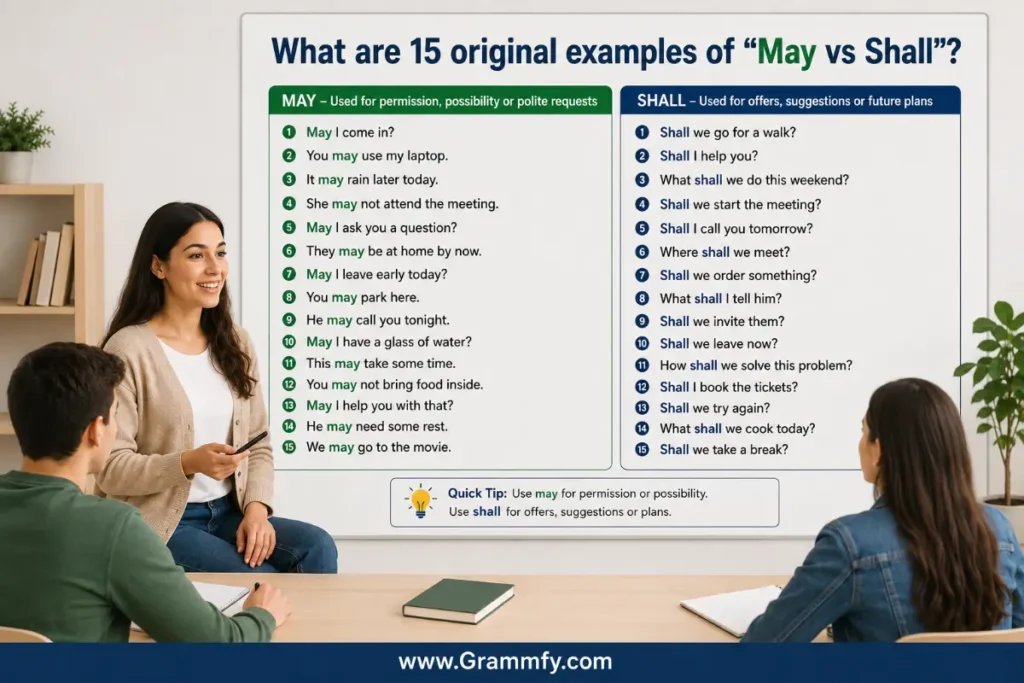
What are 15 original examples of “May vs Shall”?
1. Weather
It may rain before the game starts.
May expresses possibility.
2. School
Students may use a dictionary during the exam.
May gives permission.
3. Office
The meeting may begin late.
The beginning is uncertain.
4. Travel
We may visit Chicago next summer.
The trip is possible.
5. Restaurant
Shall we try the new restaurant?
Shall makes a suggestion.
6. Helping someone
Shall I carry your bag?
Shall introduces an offer.
7. Formal rule
Visitors shall follow all safety instructions.
The statement establishes a formal requirement.
8. Business
The company may change its pricing policy.
The change is possible.
9. Meeting
Shall we discuss the next item?
This asks for agreement about moving forward.
10. Permission
You may use this room until five o’clock.
The speaker gives permission.
11. Future statement
We shall return after lunch.
This sounds formal or traditional.
12. Possible problem
The new software may cause compatibility problems.
The problem is possible.
13. Contract
The supplier shall provide the materials on time.
This expresses a contractual duty.
14. Casual conversation
I may stay home tonight.
The speaker is uncertain about the plan.
15. Formal event
Shall we begin the ceremony?
This politely suggests starting.
16. Classroom
You may ask questions at the end.
The teacher gives permission.
17. Project
The project may require more funding.
The need for funding is possible.
18. Team discussion
Shall we review the final proposal?
This makes a suggestion.
May vs Shall: what’s different in these examples?
Consider these two sentences:
You may leave now.
Shall we leave now?
The first gives permission.
The second suggests leaving.
Now compare:
The project may continue next month.
The project shall continue next month.
The first describes possibility.
The second sounds like a formal commitment or requirement.
The difference comes from the modal’s function, not simply the time of the action.
May vs Should: what’s different?
Should and shall are often confused because their spellings are similar.
But their functions differ.
Should
Usually expresses:
- advice
- expectation
- duty
- probability
Example:
You should study tonight.
This is advice.
Shall
Often expresses:
- suggestion
- offer
- formal requirement
- traditional future meaning
Example:
Shall we study tonight?
This is a suggestion.
Compare:
| Sentence | Meaning |
|---|---|
| You should study. | Advice |
| Shall we study? | Suggestion |
| Shall I study? | Asking whether I should do it |
| You may study. | Permission |
May vs Will: what’s different?
Will usually expresses a future event or strong expectation.
I will call you tomorrow.
This sounds definite.
May expresses possibility.
I may call you tomorrow.
The call is possible but not certain.
Compare:
| Word | Example | Meaning |
|---|---|---|
| may | I may call. | Possible |
| might | I might call. | Possible, tentative |
| will | I will call. | Future/strong commitment |
| shall | I shall call. | Formal/traditional future |
In modern American English, will is much more common than shall for ordinary future statements.
What are common mistakes with “May vs Shall”?
Mistake 1: Using shall for possibility
Incorrect for normal possibility:
It shall rain tomorrow.
Better:
It may rain tomorrow.
Or:
It might rain tomorrow.
Mistake 2: Using may for a suggestion
Incorrect if you mean “Should we…?”
May we go to the restaurant?
This usually asks for permission.
If you’re suggesting a shared action:
Shall we go to the restaurant?
Mistake 3: Confusing “May I?” with “Shall I?”
These questions have different meanings.
May I open the window?
Permission.
Shall I open the window?
Offer or request for direction.
Mistake 4: Assuming shall is the normal future form
Traditional grammar taught special rules involving shall and will, but modern English is much more flexible.
In modern American English:
I will call you.
is much more natural than:
I shall call you.
unless a formal or dramatic style is intended.
Mistake 5: Using shall in casual American conversation
A sentence such as:
Shall we grab some food?
is understandable, but many Americans would naturally say:
Should we get something to eat?
or:
Do you want to get something to eat?
Mistake 6: Treating may and shall as interchangeable
They have different core functions.
You may enter.
means permission.
You shall enter.
sounds like a command or formal declaration.
The meaning changes significantly.
When should you NOT use may?
Don’t use may when you mean a definite future event.
Weak if the event is certain:
The train may arrive at 8:00.
If the timetable confirms it:
The train will arrive at 8:00.
Don’t use may when you mean ability:
She may swim.
If you mean she has the ability:
She can swim.
Don’t use may for a suggestion when you really mean “Should we…?”
May we order pizza?
This sounds like permission.
Shall we order pizza?
This is a suggestion.
When should you NOT use shall?
Avoid shall when ordinary modern English gives you a clearer option.
For example:
I shall send you the file tomorrow.
This is grammatical but formal.
A modern email would normally say:
I will send you the file tomorrow.
For casual suggestions:
Shall we watch a movie?
is correct, but:
Should we watch a movie?
may sound more natural in American conversation.
For requirements intended for a general audience, must is often clearer:
Visitors must wear safety equipment.
rather than:
Visitors shall wear safety equipment.
The second is formal and can be appropriate in regulations, but the first is easier to understand.
What are the antonyms of “May vs Shall”?
There isn’t one direct antonym for either modal in every situation.
May as possibility
Opposite ideas include:
- cannot
- won’t
- definitely won’t
- is impossible
Example:
She may come.
Opposite:
She definitely won’t come.
May as permission
The opposite is often:
may not
or:
must not
Example:
You may enter.
Opposite:
You must not enter.
Shall as a suggestion
There isn’t a simple antonym.
You might reject the suggestion:
No, let’s not.
Shall as a requirement
Possible opposites include:
- must not
- shall not
- is prohibited from
Example:
The employee shall wear a uniform.
Opposite:
The employee shall not wear a uniform.
The exact choice depends on the intended meaning.
How can you quickly choose between “May vs Shall”?
Ask yourself one simple question:
Am I talking about possibility or permission?
If yes, may is probably the right word.
It may happen.
May I leave?
Am I making a suggestion or offer?
If yes, shall may be the right word.
Shall we go?
Shall I help?
Am I writing a formal rule?
Shall may be appropriate.
The applicant shall provide proof of identity.
But consider whether must would be clearer for your readers.
Am I making an ordinary future statement?
Usually use will in modern American English.
I will call tomorrow.
This is generally more natural than:
I shall call tomorrow.
How can you remember the difference Between “May vs Shall”?
Use this simple memory trick:
MAY = possibility or permission
SHALL = suggestion, offer, or formal requirement
Think of these four examples:
It may rain.
Possibility.
May I leave?
Permission.
Shall we leave?
Suggestion.
Shall I help?
Offer.
If you remember these four patterns, you’ll understand most common uses.
Quick reference table for May vs Shall
| If you want to say… | Use | Example |
|---|---|---|
| Something is possible | may | It may happen. |
| Someone has permission | may | You may leave. |
| Ask formal permission | may | May I come in? |
| Make a suggestion | shall | Shall we begin? |
| Make an offer | shall | Shall I help? |
| State a formal requirement | shall | The buyer shall pay. |
| State an ordinary future action | will | I will call. |
| Give advice | should | You should call. |
| Express ability | can | I can help. |
| Express weaker possibility | might | It might rain. |
Which word is more formal?
Both can sound formal, but their formal uses are different.
May sounds formal when it expresses permission:
May I speak with the manager?
Shall sounds formal when used in official rules:
The contractor shall maintain accurate records.
It can also sound formal or traditional in future statements:
We shall overcome this challenge.
In everyday American English, may is more common than shall.
Can shall be used with you and they?
Yes, but the meaning depends on the context.
Traditional grammar sometimes taught special rules for shall and will, especially with different subjects. Modern English does not follow those rules rigidly.
Examples:
You shall receive a response within 30 days.
This can sound like a formal promise, instruction, or official requirement.
They shall report to the office at 9 a.m.
This sounds formal and authoritative.
In ordinary conversation, will is usually more natural:
You will receive a response soon.
They will arrive at nine.
Can may be used with all subjects?
Yes.
May doesn’t change according to the subject.
Correct:
I may go.
You may go.
He may go.
She may go.
We may go.
They may go.
The main verb remains in its base form.
Can shall be used with all subjects?
Yes, grammatically, but some uses are much more natural with I and we.
Traditional and modern examples include:
Shall I call you?
Shall we begin?
These are very common patterns.
Formal documents can use shall with other subjects:
The supplier shall provide the materials.
The customer shall notify the company.
So the subject and context both matter.
May vs Shall in formal rules
Consider these two examples:
Employees may work remotely on Fridays.
This means employees are permitted to work remotely.
Now:
Employees shall work remotely on Fridays.
This sounds like a requirement.
That is a very important difference.
May can grant permission.
Shall can establish an obligation.
Compare:
| Sentence | Meaning |
|---|---|
| Employees may work from home. | Working from home is allowed. |
| Employees shall work from home. | Working from home is required. |
| Employees may not work from home. | Working from home is not allowed. |
| Employees shall not work from home. | Working from home is formally prohibited. |
Quick tips for choosing the right word May vs Shall
- Choose may for possibility.
- Choose may for formal permission.
- Choose shall for suggestions with I/we.
- Choose shall for offers with I.
- Choose shall carefully in legal and official writing.
- Use will for most ordinary future statements in American English.
- Use should for advice.
- Use can for ability or casual permission.
- Use might for a more tentative possibility.
- Don’t use shall when you simply mean “maybe.”
- Don’t use may when you mean “should we?”
- Remember that “May I?” and “Shall I?” ask different questions.
- In casual American speech, alternatives to shall often sound more natural.
- In contracts, check whether shall, must, or will best expresses the intended legal meaning.
- Always consider the tone of your sentence before choosing a modal.
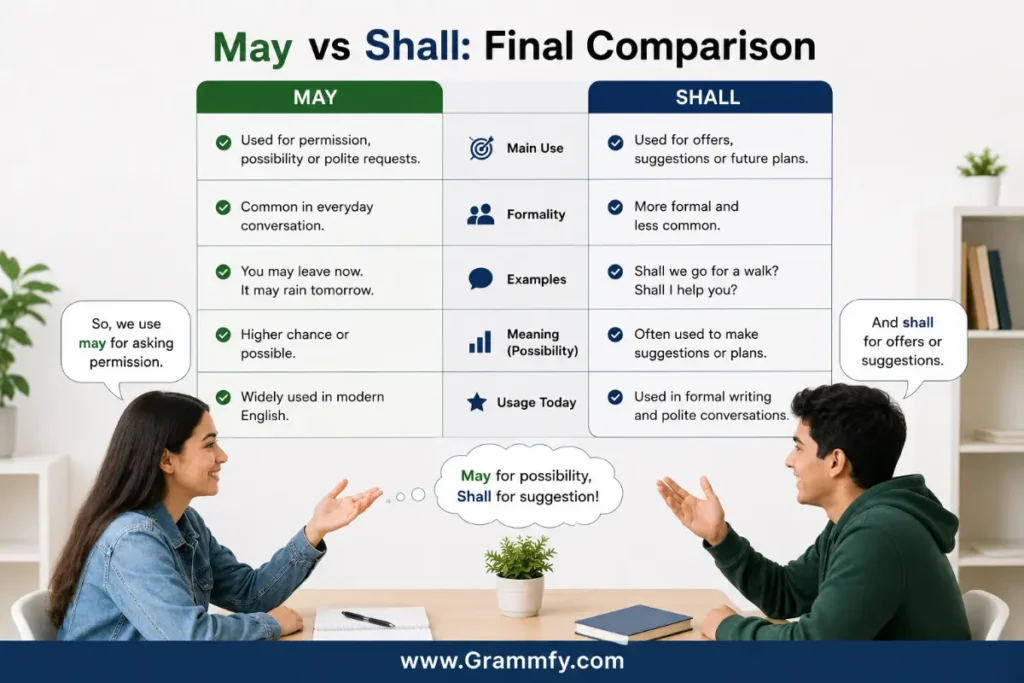
May vs Shall: final comparison
The easiest way to separate these two words is to focus on what the speaker is trying to communicate.
May is about possibility or permission.
It may happen.
You may leave.
May I ask a question?
Shall is commonly about suggestions, offers, or formal requirements.
Shall we begin?
Shall I help?
The tenant shall pay the rent.
When you’re talking about a normal future event in American English, will is usually the better choice:
I will call you tomorrow.
If you’re giving advice, use should:
You should call him.
If you’re talking about ability, use can:
I can help.
Knowing these basic patterns will prevent most mistakes.
Conclusion
The main difference in May vs Shall is their purpose. May is commonly used to express possibility or permission, while shall is often used for suggestions, offers, and formal requirements. For example, “It may rain” describes a possible event, while “Shall we go?” suggests an action. In formal documents, shall can establish a duty, although must is sometimes clearer for modern readers. In everyday American English, shall is less common than will, should, or other conversational alternatives. The best way to choose between these words is to look at the meaning first and the level of formality second. Once you connect may with possibility and permission and shall with suggestions, offers, and formal duties, the distinction becomes much easier to use correctly.
Frequently Asked Questions
What is the difference between may and shall?
May usually expresses possibility or permission, while shall commonly expresses a suggestion, offer, or formal requirement. Their meanings are different even when both appear in future-related sentences.
Can I use may and shall interchangeably?
No, they usually cannot be exchanged without changing the meaning. “May I leave?” asks for permission, while “Shall I leave?” asks whether the speaker should leave.
Is shall still used in American English?
Yes, but it is less common in everyday American conversation. It remains useful in phrases such as “Shall we?” and “Shall I?”, as well as in formal and legal writing.
What’s another way to say “may”?
Depending on the meaning, alternatives include might, could, maybe, perhaps, can, and is permitted to. The best choice depends on whether you mean possibility or permission.
When should I use shall instead of will?
Use shall when making certain suggestions or offers, especially with I and we, or when using formal language. For ordinary future statements, will is usually more natural in modern American English.
Is “may” more formal than “can”?
When asking for permission, may usually sounds more formal than can. For example, “May I leave?” is more formal than “Can I leave?”
Can shall express a requirement?
Yes. In formal or legal writing, shall can express a requirement, as in “The tenant shall pay the rent by the first day of each month.” However, must may be clearer for general readers.
