
Have you ever stopped while writing an email, essay, resume, or text and wondered whether to use Might vs Would? Both words can talk about things that are not happening right now, but they do not mean the same thing. Choosing the wrong one can change the meaning of your sentence.
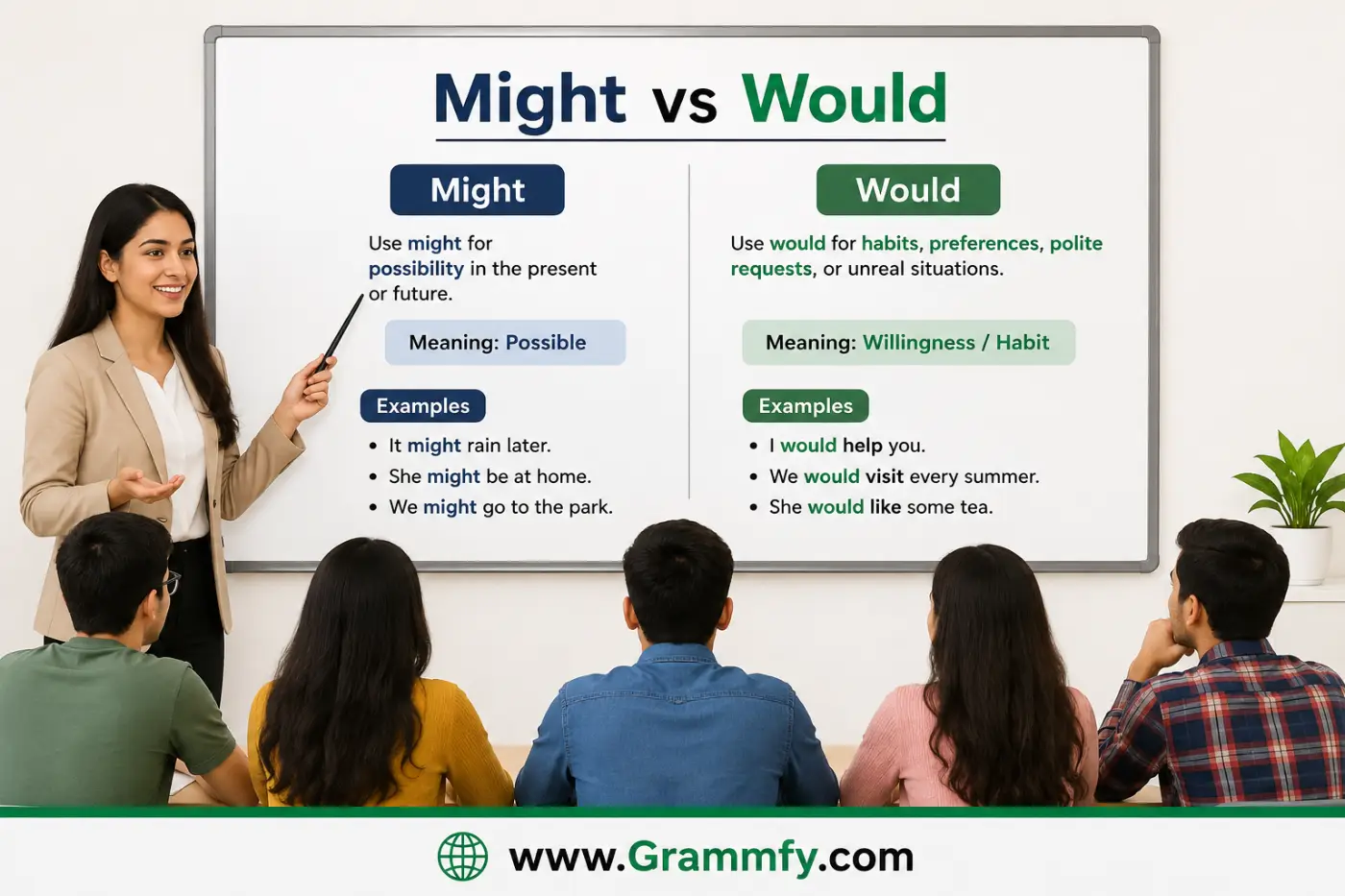
The easiest way to remember might vs would is this: might usually shows possibility, while would often shows a condition, a preference, a repeated past action, or a future idea viewed from the past.
Answer Box: Might usually means something is possible but not certain. Would usually describes what someone wants, expects, imagines, or agrees to do under a certain condition.
In this guide, you’ll learn the difference between these modal verbs, where they came from, how strong they are, which alternatives fit different situations, and how to use them in resumes, essays, emails, texts, and everyday speech. You’ll also see real examples and common mistakes that make the choice easier.
Still confused about would and could? Learn the difference in our simple would or could guide.
What does “might” mean in simple English?
Might is a modal verb that often expresses possibility. When you say something might happen, you are not saying it will definitely happen. You are saying there is a chance.
For example:
- It might rain tonight.
- Sarah might join us later.
- The package might arrive tomorrow.
- I might take a different course next semester.
In each example, the speaker is uncertain.
Compare:
I might go to the party.
This means going to the party is possible, but the speaker has not decided or cannot be sure.
The word can also make a suggestion sound less direct:
You might want to check your email.
This does not mean the person is definitely required to check it. It is a polite suggestion.
Is “might” only used for the future?
No. Might can refer to present, future, or past possibilities depending on the structure.
Present possibility:
He might be at home.
Future possibility:
We might visit Chicago next month.
Past possibility:
She might have forgotten the meeting.
The basic idea stays similar: there is uncertainty.
What does “would” mean in simple English?
Would has several important uses. It commonly appears when talking about conditions, preferences, polite requests, imagined situations, and habits in the past.
For example:
I would help you if I had more time.
The speaker is connecting the action to a condition: having more time.
Another example:
I would like a cup of coffee.
Here, would like means “want” in a polite way.
It can also describe a repeated past habit:
When we were children, we would play outside every evening.
Here, would does not express uncertainty. It tells us that the action happened repeatedly in the past.
Might vs Would: what is the main difference?
The main difference is possibility versus a condition, intention, preference, or expected action.
| Word | Main idea | Example |
|---|---|---|
| Might | Possibility | I might call her tonight. |
| Would | Conditional result | I would call her if I had her number. |
| Might | Uncertainty | He might be busy. |
| Would | Preference | I would rather stay home. |
| Might | Possible future event | They might arrive late. |
| Would | Imagined result | They would arrive earlier if they left now. |
A useful test is to ask yourself:
Am I talking about a possibility?
Use might.
Am I talking about what someone would do, want, prefer, or expect in a situation?
Use would.
That simple test will solve many everyday choices.
Where did “might” come from?
Might has a long history in English. It developed from an older form related to may. In Old English, forms connected with may were used to express ability, possibility, or permission.
Over time, English developed different forms for different meanings and time relationships. Might became strongly associated with weaker or less certain possibility.
That connection still exists today.
Compare:
It may rain.
It might rain.
Both sentences show possibility. In many modern situations, might sounds a little more uncertain, although the difference is not always strict.
The historical relationship between may and might explains why they often appear in similar grammatical positions.
Where did “would” come from?
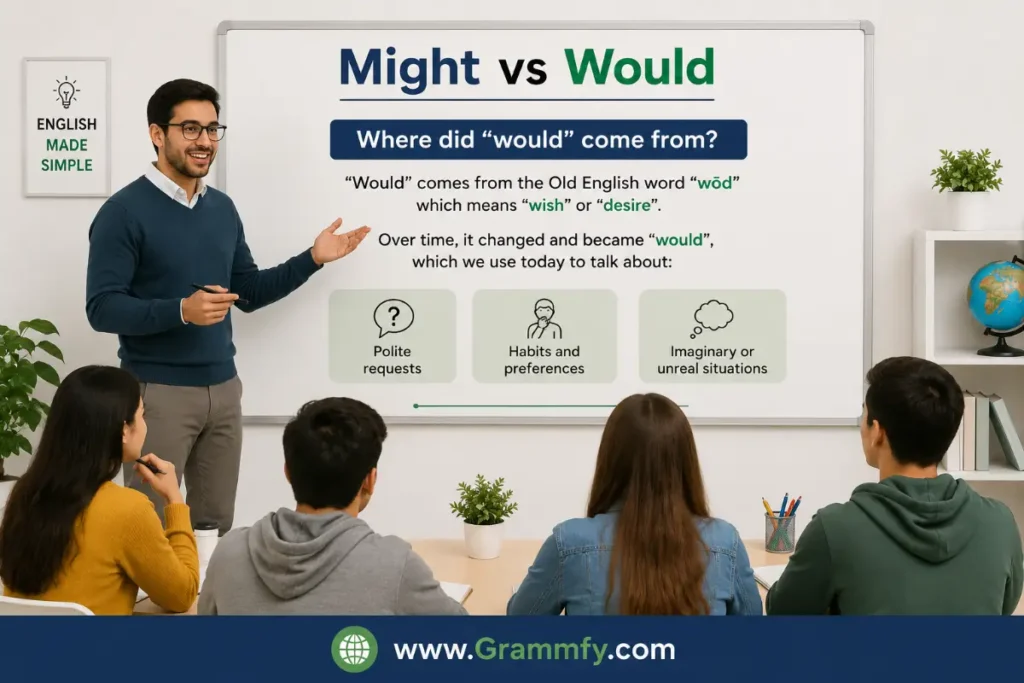
Would comes from the Old English verb willan, which meant “to wish,” “to want,” or “to desire.” It is closely related to the modern word will.
Over centuries, the word developed several grammatical uses. Today, would is especially common for conditional situations, polite expressions, reported speech, and repeated actions in the past.
For example:
I will help you.
can become:
She said she would help me.
This is called the future in the past. At the earlier time, helping was still in the future.
The history of would helps explain why it is closely connected to ideas of intention and expectation.
What are the synonyms for “Might vs Would”?
There is no single perfect synonym for either word. The best alternative depends on the exact meaning and tone.
Simple synonyms and related alternatives
| Word | Meaning | Tone | Example |
|---|---|---|---|
| may | Possibly | Neutral | It may snow tonight. |
| could | Possibly | Neutral | We could leave early. |
| perhaps | Maybe | Neutral | Perhaps she’ll call. |
| maybe | Possibly | Casual | Maybe I’ll go. |
| possibly | It is possible | Neutral | He could possibly help. |
| likely | Probably | Neutral | She is likely to agree. |
| possibly | With some chance | Neutral | They may possibly arrive soon. |
| perhaps | Maybe | Slightly formal | Perhaps we should wait. |
Everyday alternatives
| Word | Meaning | Tone | Example |
|---|---|---|---|
| maybe | Perhaps | Casual | Maybe I’ll text him. |
| probably | More likely than not | Everyday | I’ll probably stay home. |
| could | One possible option | Everyday | We could eat outside. |
| want | Desire | Everyday | I want some tea. |
| prefer | Like one option more | Everyday | I prefer tea. |
| plan to | Intend to do something | Everyday | I plan to study tonight. |
| expect to | Believe something will happen | Everyday | I expect to finish soon. |
| hope to | Want something to happen | Everyday | I hope to visit soon. |
Formal alternatives
| Word | Meaning | Tone | Example |
|---|---|---|---|
| potentially | Possibly | Formal | This could potentially help. |
| conceivably | Possibly imaginable | Formal | The plan could conceivably work. |
| presumably | Probably based on evidence | Formal | She is presumably aware. |
| apparently | Based on what seems true | Formal | He apparently agreed. |
| intend to | Plan to | Formal | We intend to expand. |
| anticipate | Expect | Formal | We anticipate higher demand. |
| prefer to | Choose one option | Formal/neutral | I would prefer to wait. |
| be willing to | Agree to do something | Formal | We are willing to cooperate. |
Casual and conversational alternatives
| Word | Meaning | Tone | Example |
|---|---|---|---|
| maybe | Possibly | Casual | Maybe I’ll come. |
| probably | Likely | Casual | I’ll probably call later. |
| could | One possible choice | Casual | We could grab lunch. |
| might | Possible | Casual/neutral | I might be late. |
| want to | Desire | Casual | I want to leave. |
| feel like | Want or desire | Casual | I feel like staying home. |
| guess | Think without certainty | Casual | I guess she’d agree. |
| I’d rather | Prefer | Casual | I’d rather stay here. |
These alternatives are related to the meanings of the two modal verbs, but they are not always interchangeable. A synonym can change the level of certainty, politeness, or formality.
How strong is “might” compared with other possibility words?
Possibility words can show different levels of confidence. There is no perfect mathematical scale, but this general pattern can help:
Impossible → unlikely → might → could → probably → likely → certain
For example:
It might snow tomorrow.
Speaker sees a real possibility but is not confident.
It will probably snow tomorrow.
The speaker has more confidence.
It will snow tomorrow.
The speaker presents the event as certain.
Remember that context matters. Speakers do not always use these words according to a strict scale.
Might vs may
May and might are often interchangeable when expressing possibility.
She may come later.
She might come later.
Both are correct.
In many situations, might can sound slightly less certain.
Might vs could
Could can also express possibility:
We could win the game.
This can mean winning is one possible outcome.
We might win the game.
This focuses more directly on uncertainty about whether the event will happen.
The difference can be small, so context often determines the best choice.
How does “would” show different meanings?
Would is more flexible than many learners expect. Here are its major uses.
Would for conditional situations
A common pattern is:
If + condition, subject + would + base verb
Example:
If I had enough money, I would buy a new laptop.
The purchase depends on a condition.
Another example:
If she studied more, she would improve her grades.
The improvement is presented as the result of the condition.
Would for polite requests
Would can make a request sound more polite.
Would you open the window?
Would you please send me the file?
These sentences are softer than direct commands such as:
Open the window.
Send me the file.
Would for preferences
Would like is one of the most common expressions in English.
I would like some water.
She would like to speak with the manager.
It is more polite than simply saying:
I want some water.
Would rather for preferences
Another useful structure is:
I would rather stay home.
This means:
I prefer to stay home.
You can compare two options:
I’d rather walk than take the bus.
Would for repeated past actions
Would can describe something that happened regularly in the past.
Every summer, my grandparents would visit us.
After dinner, Dad would read the newspaper.
This use is similar to used to, but it usually works best with repeated actions rather than past states.
When should you use “might” in a resume?
A resume should sound confident, but might can still be useful in the right context.
Avoid using might when describing skills you definitely have.
Weak:
I might manage social media campaigns.
Better:
I manage social media campaigns.
Better still:
I managed social media campaigns for three client accounts.
However, might can appear when discussing possible future outcomes in a cover letter or professional explanation.
For example:
This strategy might improve customer engagement.
That sentence is reasonable because the result is not guaranteed.
Best choice for professional writing
Use might when you want to show uncertainty honestly. Do not use it to weaken a proven skill.
Use stronger language for verified achievements:
Increased website traffic by 35%.
instead of:
Might have increased website traffic.
If the achievement is uncertain, explain the evidence instead of hiding behind a modal verb.
When should you use “would” in a resume?
Would is less common in bullet-point resumes because resumes usually state facts directly.
Instead of:
I would manage customer accounts.
write:
I managed customer accounts.
However, would can be useful in a cover letter:
I would welcome the opportunity to discuss the position.
It is also useful when explaining how you would approach a future responsibility:
I would use data-driven methods to improve campaign performance.
This tells the employer what action you would take under a particular situation.
Which word works best in an essay “Might vs Would”?
In an academic essay, both words can be useful.
Use might when you are discussing a possibility or making a cautious claim.
This change might affect young people’s study habits.
Use would when explaining a hypothetical result.
If schools reduced homework, students would have more free time.
Academic writing often values careful claims. Might can help you avoid presenting an uncertain conclusion as an absolute fact.
Example essay paragraph
Online learning might become more common in the future. If schools invest in better digital tools, students would have more opportunities to study from home. However, this approach would not automatically solve every educational problem.
Notice the difference:
- might become = possible future
- would have = expected result under a condition
- would not solve = hypothetical result
Which word is better for texting “Might vs Would”?
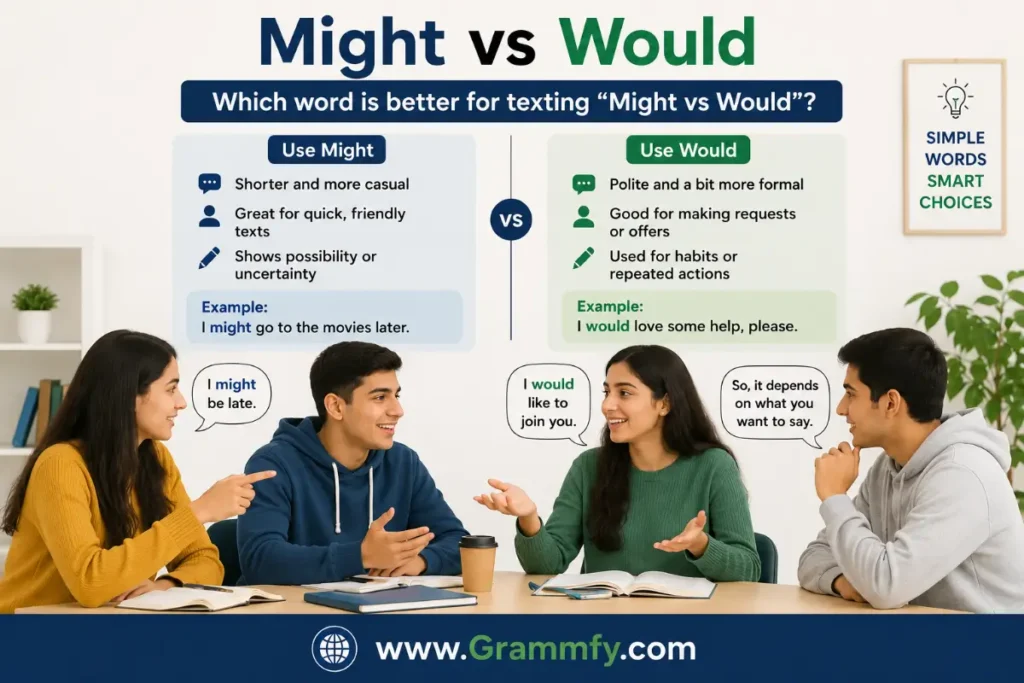
Texting is informal, so both words are common.
Use might when you are unsure:
I might come over later.
Use would when talking about what you prefer or what you would do:
I’d rather stay home tonight.
You can also use contractions with would:
- I’d = I would
- you’d = you would
- he’d = he would
- she’d = she would
- we’d = we would
- they’d = they would
For casual messages, contractions usually sound natural.
Which word is better in an email “Might vs Would”?
The best choice depends on your purpose.
For uncertainty:
I might be able to attend the meeting.
Use For a polite offer:
I would be happy to help.
For a polite request:
Would you be able to send the updated document?
For a conditional statement:
I would approve the proposal if the final numbers are correct.
Professional emails often use would for politeness because it sounds respectful without being overly formal.
Which word is better in speaking “Might vs Would”?
In everyday conversation, both are extremely useful.
Imagine your friend asks:
Are you going to the concert?
You can answer:
I might go.
That means you are not sure.
If your friend asks:
Would you go if I bought the tickets?
You can answer:
Yes, I would.
Now would connects your answer to the condition of your friend buying the tickets.
This is one of the clearest ways to understand the difference.
What are 12 real-life examples of “Might vs Would”?
1. Weather
It might rain this afternoon.
The rain is possible.
2. Weekend plans
I might visit my cousin this weekend.
The plan is not certain.
3. Conditional decision
I would visit my cousin if I had enough time.
The visit depends on having enough time.
4. Polite request
Would you close the door, please?
The speaker is making a polite request.
5. Career decision
I might apply for the marketing job.
The person has not decided for sure.
6. Hypothetical career choice
I would apply if the company offered remote work.
The application depends on a condition.
7. Food preference
I would rather have pasta tonight.
The speaker is expressing a preference.
8. Possible explanation
The computer might be overheating.
The speaker is suggesting one possible reason.
9. Childhood habit
When I was young, I would ride my bike to school.
The action happened repeatedly in the past.
10. Travel plan
We might travel to Boston next month.
The trip is possible but not confirmed.
11. Imagined travel choice
I would travel more often if flights were cheaper.
The speaker connects the action to a condition.
12. Workplace situation
The manager might approve your request.
Approval is possible but uncertain.
The manager would approve your request if you provided more information.
Approval depends on a specific condition.
Might vs could: what’s different?
Might and could can both express possibility, but they can focus on slightly different ideas.
| Might | Could |
|---|---|
| Focuses on possibility | Can focus on possibility or available options |
| I might call her. | I could call her. |
| The call may happen. | Calling is one option. |
| Often sounds uncertain | Can sound more practical or choice-based |
Compare:
I might take the train.
This suggests the speaker has not decided.
I could take the train.
This suggests taking the train is one available option.
Both can be correct. The intended meaning decides the choice.
Would vs used to: what’s different?
Both can describe repeated actions in the past.
When we were kids, we would play outside every evening.
When we were kids, we used to play outside every evening.
Both work.
But used to can also describe past states:
I used to be shy.
You generally would not say:
I would be shy.
unless the sentence has a different meaning.
So, for repeated past actions, would and used to can overlap. For past states, used to is usually the better choice.
Would vs could: what’s different?
These two words are often confused because both can appear in hypothetical situations.
I could help you.
This can mean that helping is possible or that the speaker has the ability to help.
I would help you.
This usually suggests willingness or a hypothetical action, especially when a condition is understood.
For example:
I could help you tomorrow.
= Tomorrow is a possible time when I can help.
I would help you if I weren’t working.
= I am willing to help, but a condition prevents it.
The distinction becomes clearer when you look at the full context.
What are the most common mistakes with “might”?
Mistake 1: Treating might as certainty
Incorrect meaning:
She might come, so she definitely will.
Might does not normally mean definite.
Better:
She might come, so we’ll wait and see.
Mistake 2: Using “might” for a direct conditional result
Weak:
If I had more money, I might buy the house.
This sentence is not grammatically wrong. It simply means buying the house is one possible result.
If the intended meaning is a stronger hypothetical result, use:
If I had more money, I would buy the house.
Mistake 3: Adding “to” after might
Incorrect:
I might to go home.
Correct:
I might go home.
After a modal verb such as might, use the base form of the verb.
What are the most common mistakes with “would”?
Mistake 1: Using would for every future idea
Incorrect:
Tomorrow I would go to school.
If you are simply talking about a real future plan, say:
Tomorrow I will go to school.
Would needs a suitable context, such as a condition, reported speech, politeness, preference, or past habit.
Mistake 2: Using would after every “if”
A common learner mistake is:
If I would have more time, I would study.
For a normal second conditional, use:
If I had more time, I would study.
The if-clause uses the past form, while the result clause uses would.
Mistake 3: Confusing would with will
Compare:
I will call you tonight.
This is a direct future statement.
I would call you if I had your number.
This is conditional.
The condition changes the meaning.
Mistake 4: Using would for past states
Instead of:
When I was young, I would be shy.
say:
When I was young, I used to be shy.
Would works naturally for repeated actions, such as:
When I was young, I would visit my grandmother every Sunday.
When should you NOT use “might”?
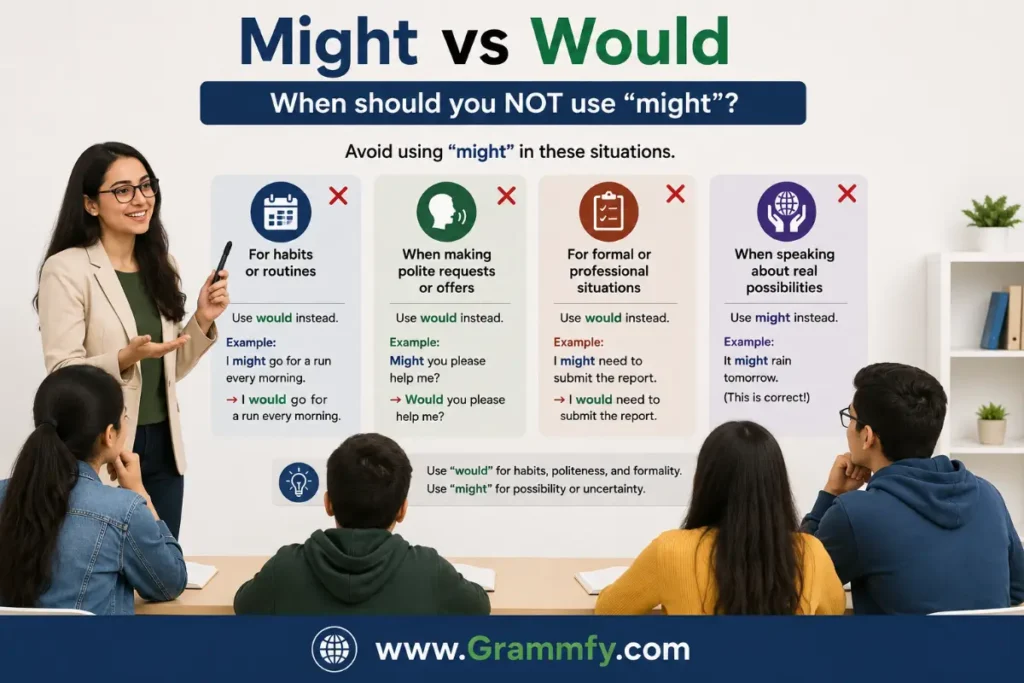
Do not use might when you need to communicate certainty.
Weak:
The meeting might start at 9:00. The schedule is confirmed.
Better:
The meeting starts at 9:00.
Likewise, avoid might when describing a confirmed achievement:
I might have completed the project on Monday.
If you know exactly what happened, say:
I completed the project on Monday.
Use uncertainty words only when uncertainty is actually part of your meaning.
When should you NOT use “would”?
Do not automatically use would for a normal future event.
Incorrect in a straightforward future context:
I would visit my doctor tomorrow.
Better:
I will visit my doctor tomorrow.
However, the original sentence can become correct if there is a condition or another suitable context:
I would visit my doctor tomorrow if I could get an appointment.
The condition makes would appropriate.
What are the antonyms of “Might vs Would”?
The exact antonym depends on the meaning.
For might, useful opposites include:
- definitely
- certainly
- surely
- unquestionably
- definitely will
- must, in some contexts
Example:
She might come.
versus:
She will definitely come.
For would, there is no single opposite because would has many meanings.
Depending on context, contrasts may include:
- will
- won’t
- refuse to
- don’t want to
- never
- cannot
For example:
I would help.
versus:
I won’t help.
The correct opposite depends on the sentence.
How can you choose between “Might vs Would” quickly?
Use these five questions.
1. Am I describing a possibility?
Use might.
We might be late.
2. Am I describing what would happen under a condition?
Use would.
We would be late if we left now.
3. Am I expressing a preference?
Use would.
I’d rather stay home.
4. Am I making a polite request?
Use would.
Would you help me?
5. Am I describing a repeated past action?
Use would.
Every winter, we would visit our grandparents.
A simple memory trick is:
Might = maybe.
Would = under that situation / by choice / politely / repeatedly in the past.
How do “Might vs Would” work together?
Sometimes both words can appear in the same sentence because they have different jobs.
Consider:
If you asked him, he might help you.
Here, might means there is a possibility that he will help.
Now compare:
If you asked him, he would help you.
This suggests a stronger expected result.
Another example:
I might buy the car if the seller would lower the price.
Here, might expresses uncertainty about buying the car. Would describes the seller’s hypothetical willingness to lower the price.
This shows why replacing one modal verb with another can change the sentence.
Can “Might vs Would” appear in reported speech?
Yes.
Might can remain unchanged when reporting a possibility:
Direct:
“I might go home early.”
Reported:
She said she might go home early.
Would is commonly used when reporting a future idea from a past viewpoint:
Direct:
“I will call you.”
Reported:
He said he would call me.
This is one reason would is common in storytelling and news reports.
What does “might have” mean?
Might have + past participle describes a possible past event.
Examples:
She might have missed the bus.
They might have forgotten the appointment.
I might have left my keys at work.
The speaker does not know for certain whether the event happened.
Compare:
She might have missed the bus.
= It is possible that she missed it.
She would have missed the bus if she had left five minutes later.
= Missing the bus is presented as the result of a hypothetical past condition.
That distinction is important.
What does “would have” mean?
Would have + past participle usually describes a hypothetical past result.
Example:
I would have called you, but I lost your number.
The speaker is saying that calling was the intended action, but something prevented it.
Another example:
If I had known about the problem, I would have helped.
The helping did not happen because the condition was not met.
Compare the two:
She might have forgotten.
= Maybe she forgot.
She would have forgotten if nobody had reminded her.
= Forgetting is the hypothetical result of a condition.
“Might vs Would” in polite English
Both words can soften statements, but they do it differently.
Might can make a suggestion less forceful:
You might want to review your introduction.
This is softer than:
You should review your introduction.
Would can make requests and preferences more polite:
Would you mind checking this sentence?
I would appreciate your feedback.
In professional communication, these forms can help you sound respectful without making your message too complicated.
How do regional English varieties affect these words?
Might and would are standard in both American and British English. Their core meanings are largely the same.
There can be differences in frequency and style.
For example, British English may use shall in some formal or traditional contexts where American English commonly uses will. However, this does not create a major difference in the basic use of might and would.
Expressions such as I might, I would, might have, and would have are widely understood across English-speaking regions.
The main issue for learners is not US versus UK English. It is understanding the purpose of the modal verb in the sentence.
Quick comparison table for everyday use
| Situation | Better choice | Example |
|---|---|---|
| Possible event | Might | I might call later. |
| Possible explanation | Might | He might be tired. |
| Polite request | Would | Would you help me? |
| Preference | Would | I’d rather stay home. |
| Hypothetical result | Would | I would go if I could. |
| Past repeated action | Would | We would visit every summer. |
| Uncertain past event | Might have | She might have left. |
| Hypothetical past result | Would have | I would have helped. |
| Possible plan | Might | We might travel. |
| Conditional plan | Would | We would travel if we had money. |
A simple practice exercise
Choose might or would in each sentence.
- I ___ go to the library after class, but I’m not sure.
- If I had more free time, I ___ read more books.
- ___ you please send me the document?
- She ___ be at home right now.
- When we were children, we ___ play outside after school.
- I ___ rather take the train.
- They ___ arrive late because of traffic.
- If he knew the answer, he ___ tell us.
Answers
- might
- would
- Would
- might
- would
- would
- might
- would
The pattern is clear: uncertainty often calls for might, while conditions, preferences, polite requests, and repeated past actions often call for would.
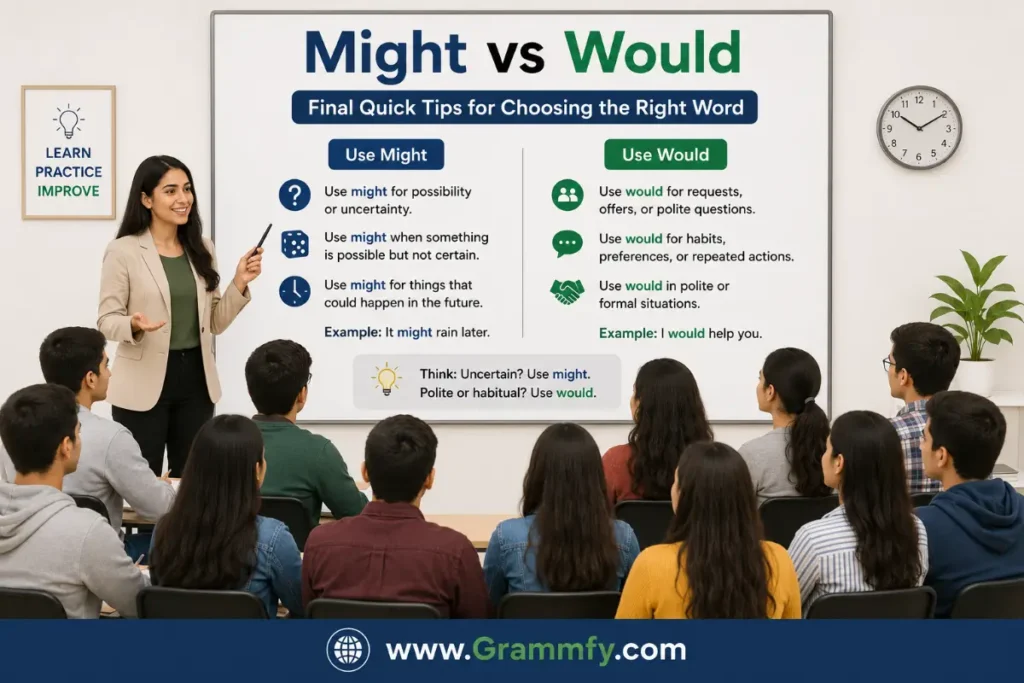
Final quick tips for choosing the right word “Might vs Would”
Keep these rules nearby when you’re writing:
- Use might for an uncertain possibility.
- Use might have for a possible past event.
- Use would for hypothetical results.
- Use would have for hypothetical past results.
- Use would like for polite wants or requests.
- Use would rather for preferences.
- Use would for repeated past actions.
- Use could when you mean an available option or possibility.
- Use may as another common possibility word.
- Don’t use would automatically after every if.
- Don’t use might when something is already confirmed.
- Don’t add to after a modal verb: say “might go,” not “might to go.”
- Check the whole sentence before choosing a modal verb.
The fastest memory trick is still:
Might = maybe.
Would = what happens, what someone prefers, or what someone is willing to do in a certain situation.
Conclusion
Understanding might vs would becomes much easier when you focus on the speaker’s purpose instead of memorizing long grammar rules. Use might when you want to show that something is possible but uncertain. Use would for conditional results, polite requests, preferences, reported future ideas, and repeated actions in the past.
Look at the context before choosing. Ask whether you mean “maybe” or whether you are imagining a situation, describing a preference, or explaining what someone would do. That small habit will prevent many common errors.
With regular practice, these two modal verbs will start to feel natural. Read your sentence aloud, identify the intended meaning, and choose the word that matches it. Might keeps possibility open; would often connects an action to a situation, choice, or expectation.
Frequently Asked Questions
What is the main difference between might and would?
Might usually expresses possibility, while would commonly expresses a conditional action, preference, polite request, or repeated past action. The surrounding context determines the exact meaning.
Can I use might and would in the same sentence?
Yes, you can use both when they have different meanings. For example, “I might go if you would drive me” uses might for possibility and would for willingness.
Is might weaker than may?
Usually, might can sound slightly less certain than may, but the two are often interchangeable when expressing possibility. The difference is often subtle in everyday English.
When should I use would instead of will?
Use would when the situation is conditional, hypothetical, reported from a past viewpoint, polite, or related to a preference or repeated past action. Use will for many direct future statements and decisions.
What’s another way to say might?
Common alternatives include may, could, perhaps, maybe, possibly, and potentially. The best choice depends on how certain or formal you want to sound.
What’s another way to say would?
Depending on the meaning, alternatives include will, used to, prefer to, want to, intend to, and be willing to. These are not exact replacements in every sentence.
Is “I might go” different from “I would go”?
Yes. “I might go” means going is possible but uncertain. “I would go” usually needs a context or condition, such as “I would go if I had time.”
Meta Description: Learn might vs would with simple rules, real examples, synonyms, mistakes, and quick tips to choose the right word every time.
