
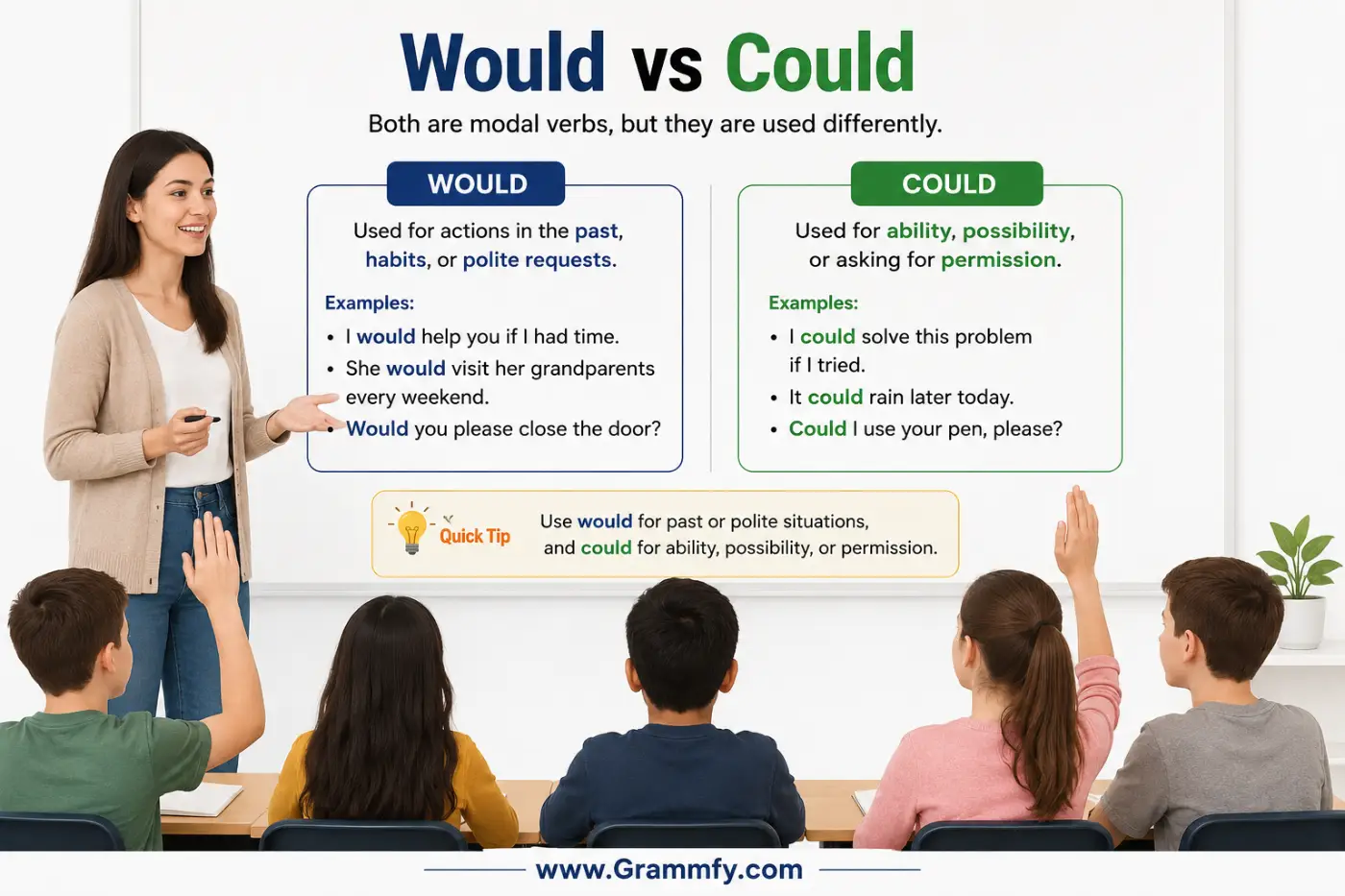
You’re writing an email to your boss, answering a class question, or sending a text to a friend. You want to ask for help, but you’re not sure whether to write, “Would you help me?” or “Could you help me?” Both sound polite, so what’s the difference?The confusion is understandable. Would vs Could are both modal verbs, and both can make requests sound softer. But they don’t communicate exactly the same idea. One often focuses on willingness or preference, while the other often focuses on ability or possibility.
Answer box: Would usually focuses on willingness, preference, or an imagined result. Could usually focuses on ability, possibility, or a polite request for something that may be possible.
Knowing this difference helps you choose more precise words in everyday conversations and professional writing. This guide explains their meanings, origins, grammar, tone, common mistakes, synonyms, and real-world uses.
For more help with English spelling, explore [that’s or thats].
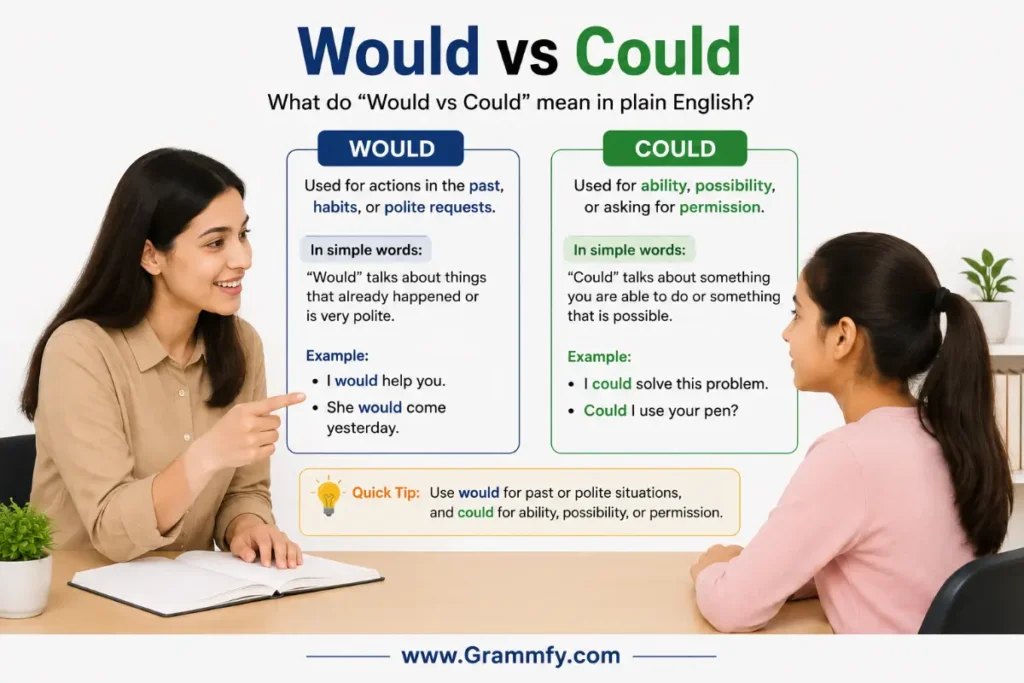
What do “Would vs Could” mean in plain English?
The simplest way to separate the two words is to think about their main ideas.
Would often asks:
- What do you want?
- What would you choose?
- What are you willing to do?
- What might happen in an imagined situation?
Could often asks:
- Are you able to do it?
- Is it possible?
- Is this one option?
- Could this happen?
Consider these two sentences:
Would you help me?
This usually asks whether the person is willing to help.
Could you help me?
This literally asks whether helping is possible or within the person’s ability. In everyday English, though, it is also a very common polite request.
Here’s another comparison:
I would go with you.
This can express a choice, preference, or hypothetical decision.
I could go with you.
This usually means going is possible.
The difference is small in some conversations, but it becomes important when you want your meaning to be exact.
What is the basic difference between “Would vs Could”?
A useful shortcut is:
Would = willingness, preference, or imagined choice.
Could = ability, possibility, or available option.
| Sentence | Main meaning |
|---|---|
| I would help you. | I am willing to help. |
| I could help you. | I am able to help / helping is possible. |
| Would you like coffee? | Asking about preference. |
| Could you bring coffee? | Polite request about an action. |
| What would you do? | Asking about an imagined choice. |
| What could you do? | Asking about possible options. |
| She would come if she could. | Imagined result. |
| She could come tomorrow. | It is possible for her to come. |
The important thing is that would and could are not simply two different ways to say the same thing.
Where did “would” come from?
Would has a long history in English. It developed from an older form connected to will, which comes from Old English willan, meaning “to wish,” “to want,” or “to desire.”
That connection helps explain some modern uses of would.
For example:
I would like some water.
The sentence expresses a desire or preference.
Similarly:
Would you like to join us?
asks about someone’s preference.
Over time, would also became important for hypothetical situations, polite requests, and repeated actions in the past.
Examples include:
I would travel more if I had more time.
and:
When we were kids, we would play outside after school.
So although would often appears to be a simple past form of will, modern English uses it for several purposes.
Where did “could” come from?
Could developed as the past form of can. Can comes from an Old English verb related to knowing or being able to do something.
Its original connection with ability is still very clear today.
I can swim.
means:
I am able to swim.
The past form is:
I could swim when I was five.
But could has expanded beyond past ability. Modern English also uses it for possibility and polite requests.
For example:
It could rain tonight.
This is about possibility, not past ability.
And:
Could you help me?
is a polite request, not a question about whether someone had the ability to help in the past.
How does “would” work in everyday English?
Would has several common uses.
Would for willingness
Use would to express willingness to do something.
I would help if I had more time.
She would stay late to finish the project.
He would do anything for his family.
The word can show that someone is ready or willing to act.
Would for preferences
Use would in expressions such as would like and would rather.
I would like a cup of tea.
I would rather stay home.
These expressions are extremely common.
Would like is a polite way to express a desire.
Would rather means “would prefer.”
For example:
I’d rather walk.
means:
I would prefer to walk.
Would for hypothetical situations
Use would when describing what someone would do under an imagined condition.
I would buy a house if I had enough money.
She would travel more if she had more vacation time.
What would you do if you lost your phone?
The condition may be stated with if, but it doesn’t always have to be.
Which one would you choose?
The listener understands that this is an imagined choice.
Would for repeated past actions
Would can describe actions that happened repeatedly in the past.
Every summer, we would visit our grandparents.
My father would read to me before bed.
This use usually describes repeated actions, not permanent states.
Natural:
When I was young, I would ride my bike every afternoon.
For a past state, used to is often better:
I used to be shy.
rather than:
I would be shy.
How does “could” work in everyday English?
Could also has several major uses.
Could for past ability
This is one of its clearest uses.
I could read simple books when I was six.
She could swim before she started school.
We could see the mountains from our hotel.
Here, could describes something that was possible because of ability or circumstances in the past.
Could for present or future possibility
Could can also describe something that may happen.
It could rain tonight.
We could miss the train.
The price could increase next month.
The event is possible, but not certain.
Compare:
It will rain tonight.
This sounds more certain.
It could rain tonight.
This presents rain as one possibility.
Could for suggestions
Could can introduce an option or suggestion.
We could take the bus.
You could ask your teacher.
We could meet on Saturday.
This does not necessarily mean you will do it. It simply presents an option.
Could for polite requests
Could is extremely common in polite requests.
Could you open the window?
Could you send me the file?
Could you wait here for a minute?
The request is usually softer than a direct command:
Open the window.
“Would vs Could” for polite requests
This is where many learners get stuck.
Both can be polite:
Would you help me?
Could you help me?
In ordinary American English, both are natural. The difference is subtle.
Would you…? focuses more on willingness.
Would you help me move this table?
The speaker is asking whether the person is willing to do it.
Could you…? focuses more on whether the action is possible or whether the person can do it.
Could you help me move this table?
The speaker is politely asking whether the person can help.
In real conversation, these meanings overlap so much that either sentence can work in many situations.
Compare the tone
| Request | Main focus | Typical feeling |
|---|---|---|
| Would you help me? | willingness | polite |
| Could you help me? | possibility/ability | polite |
| Will you help me? | willingness | more direct |
| Can you help me? | ability/possibility | casual |
| Help me. | command | direct |
None of these is automatically rude or formal in every situation. Tone depends on context, voice, relationship, and the exact request.
“Would vs Could” for asking permission
Could is often used to ask whether something is possible or permitted.
Could I leave early today?
This is a polite way to ask for permission.
Would usually doesn’t work the same way:
Would I leave early today?
This normally sounds like a question about a hypothetical choice or expected behavior, not a straightforward request for permission.
For permission, these are common:
- Can I…?
- Could I…?
- May I…? — more formal
Examples:
Could I use your phone?
May I ask a question?
Can I sit here?
“Would vs Could” for offers
Both can appear in offers, but their structures differ.
Would you like…? asks about preference.
Would you like some coffee?
This means:
Do you want some coffee?
Could can present an option:
We could get coffee after work.
This means:
Getting coffee is one possible plan.
So:
Would you like coffee?
asks what someone wants.
Could we get coffee?
asks whether getting coffee is possible or acceptable.
“Would vs Could” for suggestions
Could is especially useful when offering choices.
We could take the train.
You could talk to your teacher.
You could try a different approach.
The speaker is giving an option without saying it is the only or best choice.
Would can also appear when discussing a hypothetical choice:
I would take the train if I were you.
This sounds more like a recommendation based on what the speaker would personally choose.
Compare:
You could take the train.
There are several options, and the train is one possibility.
I would take the train.
The speaker is saying that the train is the choice they would make.
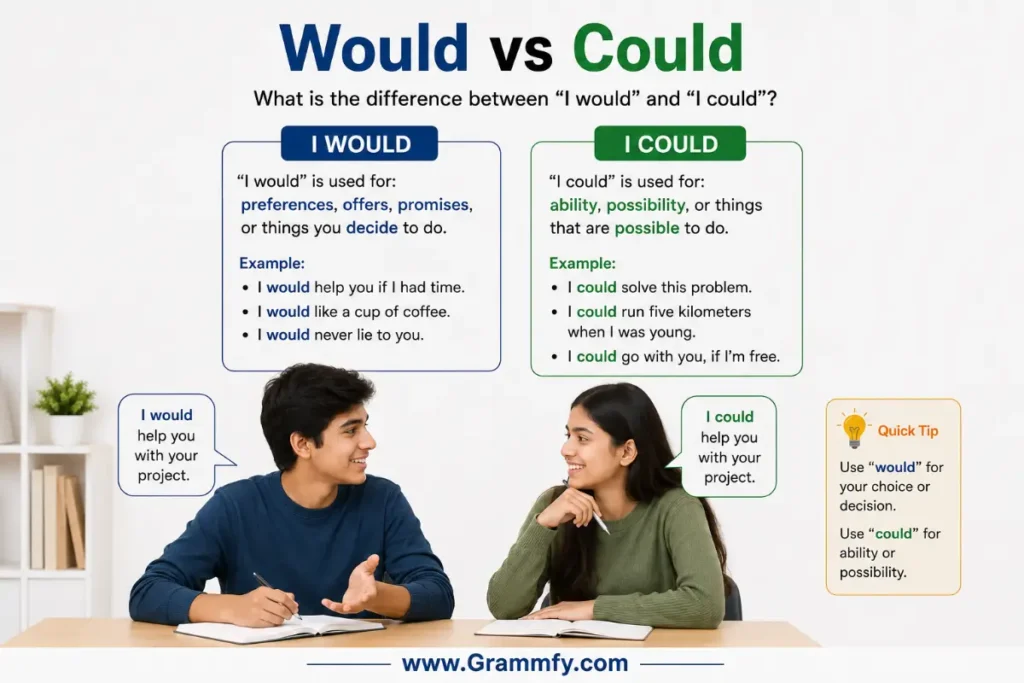
What is the difference between “I would” and “I could”?
This is one of the most useful comparisons to remember.
I would help.
This suggests willingness or a decision.
I could help.
This suggests ability or possibility.
Imagine a coworker asks:
Can anyone stay late?
You say:
I could stay late.
You are saying it is possible for you.
If you say:
I would stay late.
You are emphasizing your willingness or choice.
Now add a condition:
I would stay late if you needed me.
This clearly describes willingness in a hypothetical situation.
But:
I could stay late if you needed me.
This emphasizes that staying late would be possible.
The two sentences can communicate nearly the same practical result, but the focus is different.
What is the difference between “Would vs Could” in questions?
Question forms make the distinction easier to see.
Would asks about preference or willingness
What would you like?
Would you come with us?
What would you do?
Would you rather stay home?
Could asks about ability or possibility
Could you come with us?
What could we do?
Could I borrow your pen?
Could this be the answer?
The contrast between What would you do? and What could you do? is especially useful.
What would you do?
asks for your imagined choice or personal response.
What could you do?
asks about possible actions or available solutions.
Master synonym and related-expression list
Because would and could are modal verbs, they don’t have one perfect synonym in every sentence. Their alternatives depend on whether you’re talking about ability, possibility, preference, willingness, or advice.
Here are useful related expressions grouped by tone.
Simple alternatives
| Word or phrase | Meaning | Tone | Example |
|---|---|---|---|
| can | ability or possibility | Neutral | I can help. |
| will | willingness or future | Neutral | I will help. |
| may | possibility or permission | Neutral/formal | You may leave. |
| might | weaker possibility | Neutral | It might rain. |
| want to | desire | Everyday | I want to go. |
| prefer to | like one option more | Neutral | I prefer to stay. |
| be able to | have the ability | Neutral | I am able to help. |
| be willing to | agree to do something | Neutral | I’m willing to help. |
Everyday alternatives
| Word or phrase | Meaning | Tone | Example |
|---|---|---|---|
| I’d like to | polite desire | Friendly/polite | I’d like to order. |
| I’d rather | preference | Everyday | I’d rather stay home. |
| you can | available option | Casual | You can call later. |
| you could | possible option | Casual | You could call later. |
| you might | possible option | Casual | You might call later. |
| you can try | possible attempt | Everyday | You can try again. |
| maybe | possible | Casual | Maybe we can go. |
| perhaps | possible | Neutral | Perhaps we could wait. |
Formal alternatives
| Word or phrase | Meaning | Tone | Example |
|---|---|---|---|
| may | permission/possibility | Formal | You may proceed. |
| might | possibility | Formal/neutral | This might affect the result. |
| be able to | have capacity | Formal/neutral | We will be able to assist. |
| be willing to | agree to act | Formal/neutral | We are willing to cooperate. |
| be in a position to | have the ability or opportunity | Formal | We are in a position to help. |
| be permitted to | have permission | Formal | Visitors are permitted to enter. |
| be expected to | be required or anticipated | Formal | Employees are expected to attend. |
| it is possible to | possibility | Formal | It is possible to reschedule. |
Casual or slang alternatives
| Word or phrase | Meaning | Tone | Example |
|---|---|---|---|
| can | able to | Casual | I can do it. |
| might | maybe | Casual | We might go. |
| maybe | possible | Casual | Maybe I’ll come. |
| sure | willing/agreeing | Casual | Sure, I can help. |
| no problem | willing to help | Casual | No problem, I’ll do it. |
| I’d be down to | willing to join | Slang | I’d be down to go. |
| I’m up for | willing/interested | Casual | I’m up for dinner. |
| why not | willingness to consider | Casual | Why not try it? |
Some of these expressions are not direct grammatical replacements. They are useful because they communicate similar ideas in particular contexts.
Which alternatives are mild and which are strong?
The choice of modal can affect how strong your statement sounds.
Mild possibility
Use:
- might
- could
- maybe
- perhaps
- may
Examples:
We could leave early.
It might snow tonight.
These don’t say that something will definitely happen.
Moderate possibility
Use:
- could
- may
- likely to
- probably
Example:
She could arrive before noon.
This presents arrival as a realistic possibility.
Strong certainty
Use:
- will
- definitely will
- is certain to
- is going to
Example:
She will arrive before noon.
This is much more certain than:
She could arrive before noon.
Mild suggestion
Use:
- could
- might want to
- you could consider
- perhaps
Example:
You could check the spelling again.
Strong recommendation
Use:
- should
- ought to
- need to
- must
Example:
You should check the spelling again.
Notice that could and should can both give advice, but could usually presents an option, while should gives a stronger recommendation.
Could vs. can — what’s the difference?
Can and could are closely related, but they aren’t always interchangeable.
Can for present ability
I can drive.
This means I have the ability to drive.
Could for past ability
I could drive when I was sixteen.
This describes past ability.
Could for possibility
We could go tomorrow.
This means tomorrow is one possible time.
Could for polite requests
Could you help me?
This is softer than:
Can you help me?
Both are common and natural.
In casual American English, Can you…? is perfectly normal for requests. Could you…? generally sounds a little more polite or less direct.
Would vs. will — what’s the difference?
Would is often connected to will, but they serve different purposes.
We Use will for a future statement:
I will call you tonight.
Use would for a hypothetical result:
I would call you if I had your number.
We Use will for willingness:
I will help you.
Use would for conditional or imagined willingness:
I would help you if I could.
We Use would like for polite preference:
I would like some water.
You wouldn’t normally replace this with:
I will like some water.
That changes the meaning.
Could vs. might — what’s the difference?
Both can express possibility.
It could rain tonight.
It might rain tonight.
In many everyday situations, they are close in meaning.
However, could often presents an event as one possible outcome or option, while might often emphasizes uncertainty.
Compare:
We could take the train.
This means taking the train is an available option.
We might take the train.
This means taking the train is possible, but we’re not sure whether we will.
This distinction is especially useful when discussing plans.
“Would vs Could” — what’s the difference in hypothetical sentences?
Both can appear in hypothetical sentences, but they usually perform different jobs.
Consider:
If I had more money, I would travel more.
Would introduces the imagined result.
Now:
If I had more money, I could travel more.
Could introduces the possibility or ability created by the condition.
The difference is subtle but useful:
If I had more money, I would travel more.
= That is what I would choose or expect to do.
If I had more money, I could travel more.
= Having more money would make more travel possible.
You can even use both in one sentence:
If I had more money, I could travel more, and I would probably visit several countries.
Here, could shows possibility and would shows the imagined choice.
“Would vs Could” for recommendations
Both can appear when giving advice, but their force differs.
You could talk to your teacher.
This presents talking to the teacher as one option.
You should talk to your teacher.
This gives a clearer recommendation.
So if you want to leave the final decision open, could is useful.
If you believe one action is the sensible choice, should is stronger.
Compare these examples
You could apply for the job.
There is an option.
You should apply for the job.
The speaker thinks applying is a good idea.
You must apply for the job.
The speaker says applying is required.
These three sentences create three different levels of pressure.
Which word is best for a resume “Would vs Could”?
Should a resume use “would” or “could”?
A resume usually benefits from direct action verbs rather than modal verbs.
Instead of:
I would manage a team of five employees.
write:
Managed a team of five employees.
Instead of:
I could improve customer satisfaction.
write:
Improved customer satisfaction by 18%.
If you’re describing potential rather than past experience, could can be appropriate:
Could contribute strong data-analysis skills to a growing team.
But even here, a more confident construction may be stronger:
Brings strong data-analysis skills to a growing team.
Would is generally less useful for achievement statements because it can make an action sound hypothetical.
For example:
I would improve the company’s reporting process.
sounds like a future possibility rather than a proven accomplishment.
A resume should clearly separate what you have done from what you might do.
Which word is best for an essay “Would vs Could”?
How should you use would and could in an essay?
Both can be valuable in academic writing.
Use would for hypothetical outcomes:
If schools reduced class sizes, students would receive more individual attention.
Use could for possible benefits:
Smaller classes could give teachers more time to help individual students.
The difference is useful when building an argument.
Would can make the predicted result sound more definite within the hypothetical situation.
Could leaves more room for uncertainty.
Compare:
Better public transportation would reduce traffic.
This makes a stronger prediction.
Better public transportation could reduce traffic.
This presents traffic reduction as a possible benefit.
Neither is automatically better. Choose based on how certain your claim should sound.
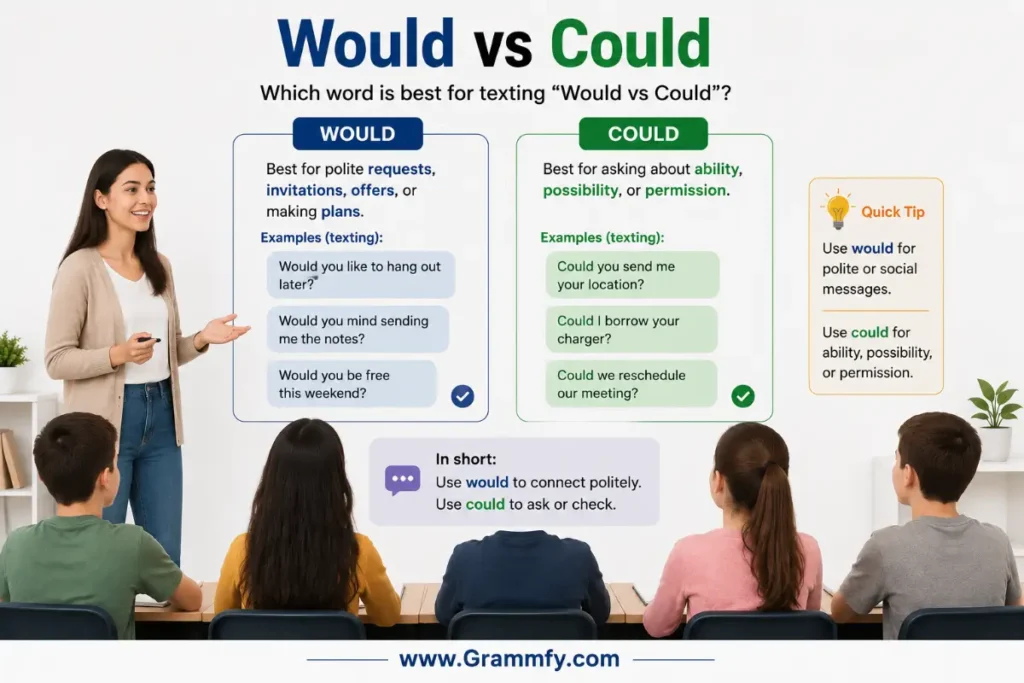
Which word is best for texting “Would vs Could”?
Would or could in a text message?
Both are common.
We Use could when asking whether something is possible:
Could you pick me up at 7?
Use would when asking about willingness or preference:
Would you come with me?
For Showing a Choice or Prefrence , We Use Would Rather :
Would you rather go tonight?
Use could to offer an option:
We could go tomorrow instead.
In casual texting, can is also very common:
Can you pick me up?
That doesn’t mean could is more correct. It simply creates a slightly softer request.
Which word is best for an email “Would vs Could”?
Should I use would or could in a professional email?
Both are excellent for polite workplace requests.
Would can sound especially useful when asking about willingness:
Would you be available for a short meeting tomorrow?
Could can sound natural when asking whether an action is possible:
Could you send me the updated report?
You can also combine them:
Would you be able to send me the updated report?
This is a very polite professional request.
Compare:
Send me the report.
Direct and potentially too blunt.
Can you send me the report?
Friendly and normal.
Could you send me the report?
Polite.
Would you be able to send me the report?
Very polite and professional.
The right choice depends on your relationship with the reader and the level of formality you need.
Which word is best for speaking “Would vs Could”?
What sounds most natural in everyday conversation?
All four of these are common:
- Can you help me?
- Could you help me?
- Will you help me?
- Would you help me?
But they don’t have exactly the same tone.
Can you help me?
Casual and direct.
Could you help me?
Polite and common.
Will you help me?
Direct question about willingness.
Would you help me?
Polite question about willingness.
In ordinary conversation, could is one of the safest choices for a polite request.
What are 10+ real-life examples?
Here are examples from school, work, travel, family life, and everyday conversation.
- Asking a coworker:Could you check this report before I send it?
- Asking about willingness:Would you help me move this desk?
- Making a suggestion:We could meet at the library after class.
- Talking about a hypothetical choice:I would choose the blue car if I were buying one.
- Describing past ability:When I was younger, I could run five miles without stopping.
- Talking about possibility:The flight could be delayed because of the weather.
- Asking about preference:Would you like tea or coffee?
- Offering an option:You could email the teacher if you’re worried.
- Giving a personal recommendation:I would talk to the manager first.
- Asking permission:Could I borrow your calculator?
- Describing an imagined result:If we left now, we would arrive before sunset.
- Describing possible results:If we left now, we could arrive before sunset.
- Talking about a possible plan:We could order pizza tonight.
- Polite workplace request:Would you be able to join the meeting?
- Discussing available choices:We could take the bus, walk, or call a taxi.
- Imagining a decision:What would you do in my situation?
- Asking about possibility:Could this be the right answer?
- Expressing willingness:I would be happy to help.
- Talking about future uncertainty:The package could arrive tomorrow.
- Suggesting a solution:We could restart the computer and try again.
- Expressing a preference:I would rather stay home tonight.
- Discussing potential ability:With more practice, she could become an excellent speaker.
These examples show why context matters. A single word can change the focus from possibility to choice or from ability to willingness.
What are common mistakes with “Would vs Could”?
Mistake 1: Treating “would” and “could” as exact synonyms
They overlap, especially in polite requests, but they aren’t identical.
I would help.
focuses on willingness or choice.
I could help.
focuses on ability or possibility.
Mistake 2: Using “would” for simple ability
Incorrect if you mean present ability:
I would swim.
Better:
I can swim.
If you mean hypothetical willingness:
I would swim if the water were warmer.
Now would makes sense.
Mistake 3: Using “could” when you mean a firm decision
I could go tomorrow.
This means tomorrow is possible.
If you’ve already decided:
I will go tomorrow.
If you’re describing a hypothetical choice:
I would go tomorrow if I had the time.
Mistake 4: Thinking “could” always means past ability
It doesn’t.
I could swim when I was six.
Past ability.
But:
We could go tomorrow.
Future possibility.
And:
Could you help me?
Polite request.
Mistake 5: Using “would” for permission
For ordinary permission requests, use can, could, or may.
Could I leave early?
Not normally:
Would I leave early?
Mistake 6: Using “could” when you mean preference
Could you like coffee?
This doesn’t express the intended preference.
Say:
Would you like coffee?
The phrase would like is the normal construction for a polite offer or preference.
When should you NOT use “would”?
Don’t use would when you simply mean present ability.
I can drive.
Not:
I would drive.
unless you’re talking about a hypothetical choice.
Don’t use it for a definite future action when will is what you mean.
I will call you tonight.
Not:
I would call you tonight.
unless the sentence has a hypothetical or conditional meaning.
Also avoid would when you’re simply presenting a possibility. Could or might may be clearer.
It could rain tomorrow.
This means rain is possible.
It would rain tomorrow.
This normally needs a condition or special context:
If the storm moved east, it would rain tomorrow.
When should you NOT use “could”?
Don’t use could when you need to express a definite future plan.
I will meet you at six.
not:
I could meet you at six.
The second sentence suggests that six is possible but not certain.
Don’t use could when you’re asking about someone’s preference:
Would you like dessert?
not:
Could you like dessert?
And don’t use could when you mean a strong requirement.
You must submit the form today.
not:
You could submit the form today.
The second sounds like an optional suggestion.
What are the antonyms of would and could?
Modal verbs don’t have simple one-word opposites in every context.
For would, opposite ideas may include:
- refuse
- decline
- be unwilling to
- wouldn’t
- choose not to
Example:
I would help.
Possible contrast:
I wouldn’t help.
For could, opposite ideas may include:
- couldn’t
- be unable to
- be impossible
- be unable
- cannot
Example:
I could finish the project today.
Contrast:
I couldn’t finish the project today.
The exact opposite depends on whether could means ability, permission, or possibility.
How do negative forms work?
Wouldn’t
Wouldn’t can mean:
- would not
- refused
- was unwilling
- would not happen under a condition
Examples:
I wouldn’t do that.
She wouldn’t listen.
I wouldn’t buy that car if I were you.
Couldn’t
Couldn’t can mean:
- could not
- was unable to
- was not possible
Examples:
I couldn’t open the door.
We couldn’t find the address.
I couldn’t attend the meeting.
In a hypothetical context:
Without your help, I couldn’t finish this.
This means the speaker would be unable to finish it.
How do “would have” and “could have” differ?
This is an important advanced distinction.
Would have often describes an imagined result that didn’t happen.
I would have called you, but I lost your number.
This means calling was the imagined action, but something prevented it.
Could have often describes a past possibility or ability.
I could have called you, but I didn’t have your number.
This means calling was possible under different circumstances, or the person had the opportunity but didn’t use it.
Compare:
If I had known, I would have helped.
The speaker says helping would have been the result.
If I had known, I could have helped.
The speaker says helping would have been possible.
The difference between would have and could have is especially useful in essays, explanations, and detailed conversations.
How do “would be” and “could be” differ?
This is another common pair.
That would be difficult.
This often means the speaker expects or imagines that something would be difficult under a particular situation.
That could be difficult.
This means difficulty is one possible outcome.
Compare:
If we moved the meeting, that would be difficult for everyone.
The speaker predicts a result.
If we moved the meeting, that could be difficult for everyone.
The speaker identifies a possible problem.
The second statement usually sounds less certain.
How do “Would vs Could” work with if?
Both can appear after conditions, but they usually play different roles.
Would shows the imagined result
If I had more time, I would learn another language.
Could shows possibility or ability
If I had more time, I could learn another language.
The first emphasizes the imagined decision or expected action.
The second emphasizes that the condition would make the action possible.
You can combine them:
If I had more time, I could study every day, and I would probably make faster progress.
This sentence uses both meanings naturally.
How does “would rather” compare with “could”?
Would rather expresses preference.
I would rather stay home.
Could expresses possibility or an option.
I could stay home.
These are not the same.
I could stay home.
means staying home is possible.
I would rather stay home.
means staying home is the preferred choice.
That distinction is useful when someone asks you about plans.
How does “would like” compare with “could”?
Would like expresses a polite desire.
I would like a sandwich.
Could can make a request:
Could I have a sandwich?
These are both polite, but their structures differ.
I would like a sandwich.
You’re stating your preference.
Could I have a sandwich?
You’re asking whether you’re permitted or able to receive one.
At a restaurant, both can be perfectly natural.
US vs. UK English: Is there a regional difference?
The core meanings of would and could are very similar in American and British English.
Both varieties commonly use:
Would you like some tea?
Could you help me?
I would rather stay home.
We could go tomorrow.
There can be small differences in preferred phrasing and formality, but learners do not need separate basic rules.
One useful point is that may can sound somewhat more formal for permission in both varieties:
May I come in?
In everyday American English, Can I…? and Could I…? are very common.
Likewise, could and would are both widely used for polite requests in both American and British speech.
How can you choose the right word quickly “Would vs Could”?
Use this mental checklist.
Are you asking about ability?
Use could.
Could you lift this box?
Are you asking about willingness?
Use would.
Would you help me move?
Are you asking about preference?
Use would.
Would you rather walk?
Are you asking whether something is possible?
Use could.
Could we finish this today?
Are you offering an option?
Use could.
We could take a taxi.
Are you imagining a personal choice?
Use would.
I would take the train.
Are you describing past ability?
Use could.
I could read by age five.
Are you describing an imagined result?
Use would.
I would go if I had time.
A simple decision chart
| Meaning | Best choice | Example |
|---|---|---|
| Present ability | can | I can help. |
| Past ability | could | I could help when I was younger. |
| Possible action | could | We could leave early. |
| Polite request | could | Could you help me? |
| Permission | could/can/may | Could I leave? |
| Preference | would | I would rather stay. |
| Polite desire | would like | I would like coffee. |
| Willingness | would | I would help. |
| Hypothetical result | would | I would go if I could. |
| Future certainty | will | I will go tomorrow. |
| Weak possibility | might | It might rain. |
What should you remember about tone?
Grammar isn’t only about correctness. It also affects how your message feels.
Consider these requests:
Give me the report.
Direct.
Can you give me the report?
Casual and normal.
Could you give me the report?
Polite.
Would you be able to give me the report?
Very polite and professional.
The last sentence can be useful in a workplace because it doesn’t sound demanding.
But don’t assume the longest version is always the best. A short, clear request is often more natural.
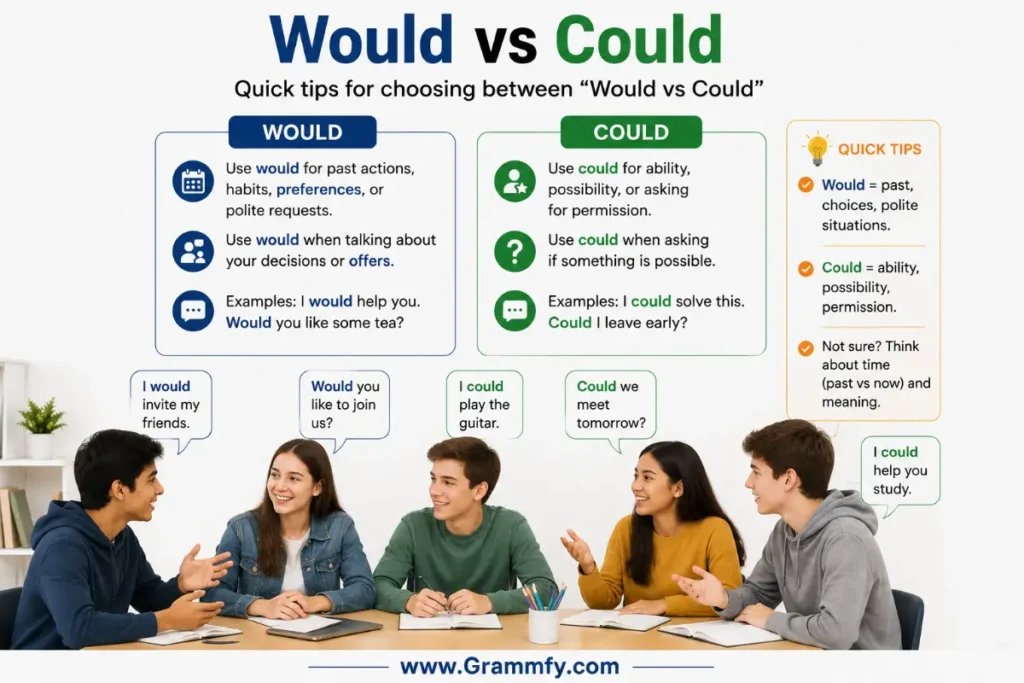
Quick tips for choosing between “Would vs Could”
Keep these rules nearby until the distinction feels automatic.
- Use would for preferences.
- Use would like for polite wants.
- Use would rather for preferences between choices.
- Use would for many hypothetical results.
- Use would to emphasize willingness.
- Use could for past ability.
- Use could for present or future possibility.
- Use could to offer an option.
- Use could for polite requests.
- Use could for permission questions.
- Use can when casual present ability is the main idea.
- Use will for a definite future decision.
- Use might when you want to emphasize uncertainty.
- Use should when you’re giving stronger advice than a simple option.
- Read the entire sentence before choosing the modal.
A final memory trick:
Would = “What would I choose or be willing to do?”
Could = “What is possible or what am I able to do?”
That simple contrast handles most everyday situations.
Final comparison: “Would vs Could” at a glance
| Feature | Would | Could |
|---|---|---|
| Main idea | willingness/preference | ability/possibility |
| Past ability | No | Yes |
| Present possibility | Sometimes in special structures | Very common |
| Hypothetical result | Very common | Possible/ability |
| Polite requests | Yes | Yes |
| Preference | Yes | No |
| “Would like” | Yes | No |
| “Could I…?” permission | No | Yes |
| Suggestions | Less direct | Very common |
| Repeated past actions | Yes | No |
| Example | I would choose it. | I could choose it. |
The difference can be summarized in one pair:
I would do it.
I am willing or inclined to do it.
I could do it.
I am able to do it, or it is possible.
That distinction will help you make better choices in most everyday sentences.
Conclusion
The choice between would vs could becomes much easier when you focus on the idea behind the sentence. Would is commonly connected with willingness, preference, polite offers, and imagined choices or results. Could is commonly connected with ability, possibility, permission, and available options.
When you ask, “Would you help me?” you’re mainly asking about willingness. When you ask, “Could you help me?” you’re making a polite request that focuses more on whether the person can do it. In many everyday conversations, both sound natural, so context and tone matter.
For writing, don’t choose a modal just because it sounds polite. Decide what you actually mean first. Then pick the word that communicates that meaning clearly. With a little practice, these two common modal verbs become much easier to use confidently.
Frequently Asked Questions
What’s the easiest way to remember would vs could?
Remember that would usually points to willingness, preference, or an imagined choice, while could usually points to ability, possibility, or an available option.
Should I say “Would you help me?” or “Could you help me?”
Both are correct and polite, but would focuses more on willingness while could focuses more on ability or possibility.
What’s another way to say “Could you help me?”
You can say “Can you help me?” for a casual request or “Would you be able to help me?” for a more formal and polite request.
Is could more polite than can?
Could often sounds a little softer than can when making a request, although both are normal in everyday American English.
When do I use would instead of will?
Use would for hypothetical situations, preferences, polite expressions, or conditional results, while will is commonly used for definite future actions or decisions.
Can I use would and could in the same sentence?
Yes. For example, “If I had more time, I could practice more, and I would probably improve faster” uses could for possibility and would for the imagined result.
Is “could” always about the past?
No. Could can describe past ability, present or future possibility, polite requests, and possible choices. Context determines its meaning.
