
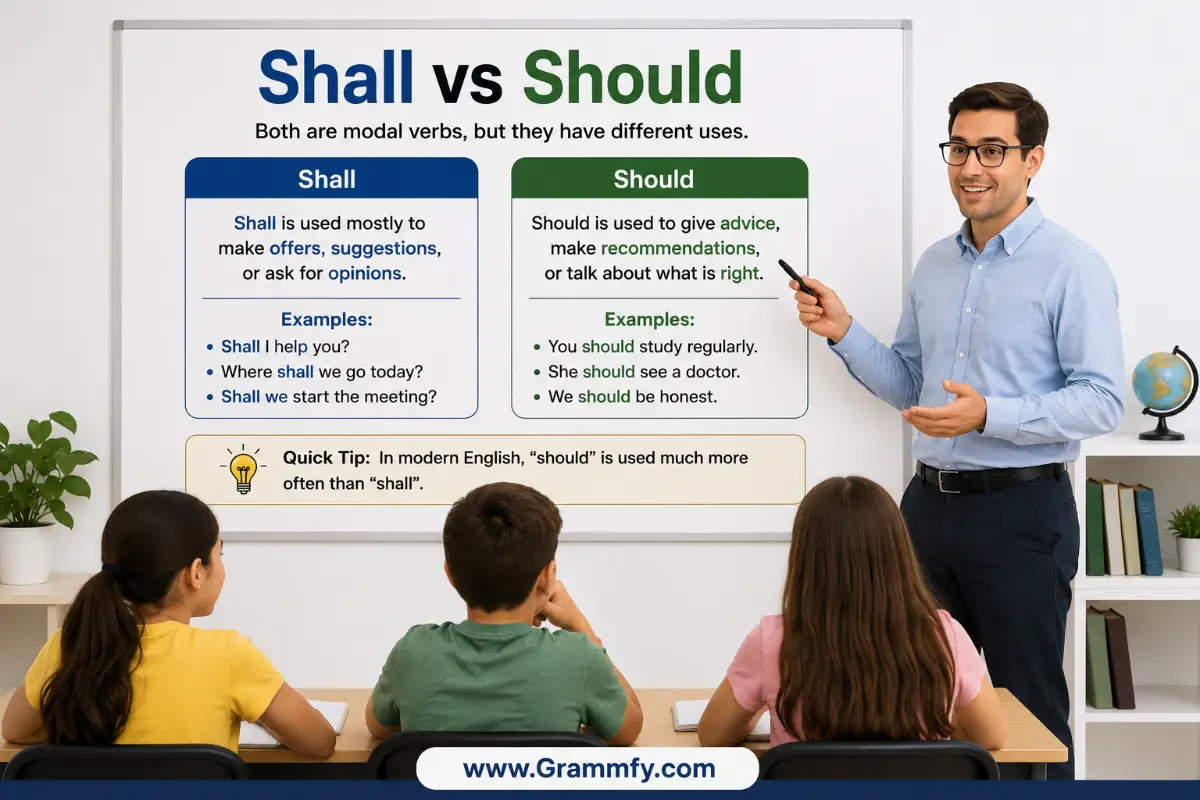
If you’re writing an email, finishing an essay, updating a resume, or sending a quick text, you may pause over shall vs should. Both words are modal verbs, and both can talk about future actions, duties, or expectations. But they don’t always sound the same, and one may fit your sentence much better than the other.
The easiest way to remember the difference is this: shall often expresses a future action, offer, suggestion, or formal requirement, while should usually expresses advice, expectation, or something that is considered right or likely.
Answer box: Use shall mainly for formal rules, offers, suggestions, or certain future statements. Use should for advice, expectations, recommendations, and things that are likely or appropriate.
The choice also depends on your audience. A legal document may use shall, while a friendly text will usually sound more natural with should, can, will, or could. American English also uses shall less often than British English in everyday speech.
This guide explains the meanings, origins, synonyms, strength levels, regional differences, common mistakes, and best choices for resumes, essays, emails, texts, and conversation. You’ll also see practical examples that show how these words work in real sentences.
If you often mix up similar words, check out our guide to [All ready vs already].
What do “Shall vs Should” mean?
Shall and should are both modal auxiliary verbs. They help another verb express ideas such as obligation, possibility, expectation, intention, advice, or a future action.
Their meanings overlap, but they are not interchangeable in every sentence.
What does shall mean?
Shall can express a future action, especially with I or we in traditional grammar.
For example:
- I shall return tomorrow.
- We shall discuss the issue later.
- Shall we begin?
- Shall I open the window?
In modern American English, these sentences often sound formal or old-fashioned. Speakers commonly use will, can, or should instead.
However, shall remains useful in certain situations. You may see it in contracts, laws, regulations, formal notices, and polite suggestions.
For example:
Employees shall wear identification badges while on the premises.
Here, shall signals a requirement.
It can also introduce an offer:
Shall I carry that bag for you?
Or a suggestion:
Shall we meet at six?
What does should mean?
Should has several common uses. The most familiar one is advice or recommendation.
- You should drink more water.
- You should check your work before submitting it.
- We should leave early to avoid traffic.
It can also describe an expectation:
- The package should arrive tomorrow.
- She should be home by now.
- The meeting should finish before noon.
In these examples, should doesn’t mean that something is guaranteed. It suggests that the result is expected or reasonable.
Should can also describe a moral or practical duty:
You should apologize when you make a serious mistake.
This sounds less forceful than:
You must apologize.
That difference in strength is important.
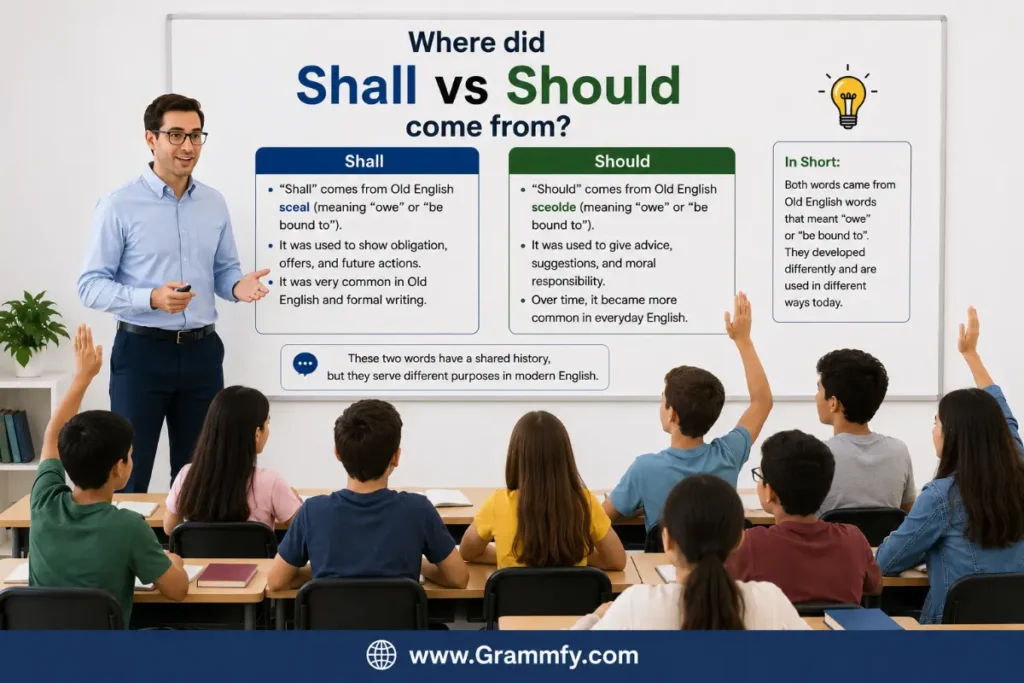
Where did “Shall vs Should” come from?
Understanding their history makes the modern difference easier to understand.
Both shall and should come from the Old English verb sceal, which carried meanings related to obligation, duty, or what a person was expected to do.
Over time, English developed different forms and uses for the word. Shall became associated with future statements and obligation, while should developed as its past or conditional form.
Older English used shall more frequently than modern American English does. Traditional grammar rules sometimes taught that shall belonged with I and we, while will belonged with you, he, she, and they.
For example, older formal grammar might give these patterns:
- I shall go.
- We shall go.
- You will go.
- They will go.
But modern English is much more flexible. Will is now the normal future auxiliary for most speakers:
- I will go.
- We will go.
- You will go.
- They will go.
Because of this change, shall now has a more specialized role in many varieties of English.
Should, meanwhile, became strongly connected with advice, expectation, duty, and conditional ideas:
- You should study.
- They should arrive soon.
- We should be careful.
So the historical connection between the two words is real, but their everyday meanings have moved apart.
What are the main differences between “Shall vs Should”?
The clearest distinction is their usual purpose.
| Word | Common purpose | Typical tone | Example |
|---|---|---|---|
| Shall | Formal requirement, offer, suggestion, future statement | Formal or polite | Shall we begin? |
| Should | Advice, expectation, recommendation, duty | Neutral | You should begin now. |
Think of shall as a word that often asks, announces, or formally requires.
Think of should as a word that often recommends, expects, or judges something appropriate.
Shall can ask for a decision
Shall we order pizza?
This means something like:
Do you want us to order pizza?
Should can give advice
We should order pizza.
This means:
I think ordering pizza is a good idea.
The first sentence asks about a possible action. The second recommends that action.
Shall can create a formal rule
Visitors shall remain in the waiting area.
The statement sounds like a rule.
Should can express a recommendation
Visitors should remain in the waiting area.
This may also communicate a rule, but it sounds less absolute. It can mean that remaining there is recommended or expected rather than strictly required.
What is the master synonym list for “Shall vs Should”?
There is no perfect one-word replacement for either modal verb in every situation. The best synonym depends on the meaning you want.
The table below groups useful alternatives by tone and common use.
| Word | Meaning | Tone | Example |
|---|---|---|---|
| will | Future action or decision | Neutral | I will call tomorrow. |
| need to | Necessary action | Neutral | You need to leave now. |
| can | Ability or possibility | Everyday | You can call me later. |
| would | Conditional choice or polite request | Polite | Would you help me? |
| advise | Give guidance | Formal | I advise caution. |
| suggest | Offer an idea | Neutral | I suggest waiting. |
| propose | Formally suggest | Formal | I propose a new plan. |
| urge | Strongly encourage | Strong | I urge you to respond. |
| encourage | Support an action | Positive | We encourage students to read. |
| require | Make something necessary | Formal | The form requires a signature. |
| demand | Insist on something | Strong | They demanded an answer. |
| expect | Believe something will happen | Neutral | We expect rain tonight. |
| intend | Plan to do something | Formal/neutral | We intend to continue. |
| plan to | Have a future plan | Everyday | We plan to move soon. |
| be supposed to | Be expected to do something | Everyday | You are supposed to wait. |
| be expected to | Be required or anticipated | Formal | Staff are expected to arrive early. |
| better | Strong informal advice | Informal | You’d better leave. |
| gotta | Have to | Slang/informal | I gotta go. |
| have got to | Must or need to | Informal | We’ve got to hurry. |
| let’s | Suggest a shared action | Everyday | Let’s start. |
| why don’t we | Make a suggestion | Friendly | Why don’t we meet Friday? |
| how about | Suggest an option | Friendly | How about lunch? |
Not all of these are true grammatical synonyms. Some replace only one specific meaning. That’s why context matters more than simply finding a word that looks similar in a dictionary.
Which synonyms are simple and everyday?
For most daily conversations, you don’t need shall.
Instead, common alternatives include:
- will
- should
- can
- could
- need to
- have to
- let’s
- why don’t we
- how about
For example:
Shall we take a taxi?
In casual American English, you could say:
Should we take a taxi?
Or:
Do you want to take a taxi?
Or:
Why don’t we take a taxi?
Each version has a slightly different feel.
Which synonyms sound formal?
Formal writing often uses words such as:
- shall
- must
- may
- require
- recommend
- advise
- propose
- urge
- be required to
- be expected to
These words can be useful in business, academic, legal, or official writing.
For example:
Applicants must submit all documents by Friday.
This is clearer than trying to make shall do all the work.
Which alternatives are informal or slang?
Casual speech has many shorter expressions.
Examples include:
- gotta
- better
- let’s
- why don’t we
- how about
- need to
- have to
For example:
You’d better save that file.
This is stronger and more conversational than:
You should save that file.
And:
Let’s grab lunch.
is much more natural in everyday conversation than:
Shall we partake in lunch?
The second sentence is grammatically possible but sounds unnatural in ordinary speech.
How do synonyms change from mild to strong?
Word choice can change how forceful a sentence feels.
| Strength | Useful expression | Example |
|---|---|---|
| Very mild | could | You could check the settings. |
| Mild | might want to | You might want to check the settings. |
| Moderate | should | You should check the settings. |
| Moderate-strong | ought to | You ought to check the settings. |
| Strong | need to | You need to check the settings. |
| Stronger | have to | You have to check the settings. |
| Very strong | must | You must check the settings. |
| Very strong | be required to | You are required to check the settings. |
This scale isn’t absolute. Tone can change depending on the speaker, relationship, and situation.
For example, a manager saying “You should finish this today” may sound like a strong expectation even though should is grammatically less forceful than must.
Are shall and should interchangeable?
No. They can overlap in some contexts, but changing one for the other can change the meaning.
Compare:
Shall we leave now?
This is a suggestion or question about what the group wants to do.
We should leave now.
This is a recommendation. The speaker thinks leaving is a good idea.
Now compare:
Employees shall wear safety glasses.
with:
Employees should wear safety glasses.
The first sounds like a formal requirement. The second sounds more like a recommendation or expectation.
That distinction becomes especially important in workplace policies and legal writing.
What is the difference between shall and will?
This is one of the most useful comparisons.
Will is the standard modern English way to express the future.
I will call you tonight.
Shall can also express a future action, but it is more formal and is much less common in everyday American English.
I shall call you tonight.
The second sentence is grammatical, but it may sound old-fashioned, highly formal, dramatic, or deliberately British depending on context.
There is another important use:
Shall we start?
This is a natural way to make a suggestion, especially in British English.
You would not normally replace it with:
Will we start?
That changes the question. Will we start? asks about whether the event will happen, while Shall we start? proposes starting.
Shall vs should — what’s different in a question?
Questions make the difference especially clear.
| Sentence | Main meaning |
|---|---|
| Shall I call her? | Do you want me to call her? |
| Should I call her? | Do you think calling her is a good idea? |
| Shall we leave? | Do you want us to leave? |
| Should we leave? | Do you think leaving is the right choice? |
The distinction can be subtle.
Shall I…? often asks what the other person wants you to do.
Should I…? asks for advice or an opinion about what would be best.
For example:
Shall I close the door?
This sounds like an offer to perform the action.
Should I close the door?
This asks whether closing the door is a good idea.
Should vs must — what’s different?
Should usually suggests advice or expectation.
Must expresses a stronger requirement.
Compare:
You should bring your passport.
This means bringing it is strongly recommended.
You must bring your passport.
This means bringing it is required.
A useful rule is:
- Use should when the person has some choice.
- Use must when there is no real choice.
Of course, real-life tone can blur the line. A parent saying “You should clean your room” may actually mean “Clean your room.”
Still, the grammatical difference remains useful.
Should vs ought to — what’s different?
Ought to is close to should, but it often sounds slightly more formal or old-fashioned.
Compare:
You should tell the truth.
You ought to tell the truth.
Both express advice or moral duty.
In modern American English, should is much more common.
Use ought to when it fits your voice or when you want a slightly formal tone. In everyday conversation, should will usually sound more natural.
How does part of speech affect synonym choice?
Shall and should are modal verbs, so they normally appear before the base form of another verb.
Correct:
You should study.
We shall begin.
Incorrect:
You should to study.
Incorrect:
We shall to begin.
After a modal verb, use the base verb without to.
Some related expressions work differently:
You need to study.
You have to study.
You ought to study.
Notice that need to, have to, and ought to require to, while should and shall do not.
This small grammar point prevents many common errors.
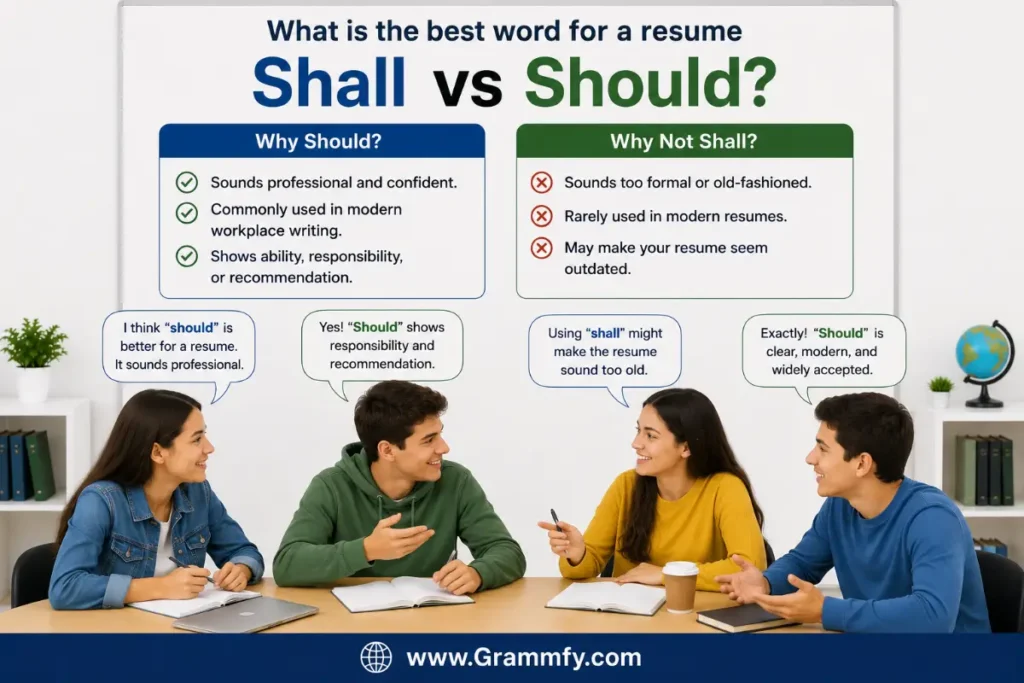
What is the best word for a resume “Shall vs Should”?
For a resume, should and shall are rarely your best choices.
Resumes usually benefit from strong, direct verbs.
Instead of:
I shall manage customer accounts.
write:
Managed customer accounts.
Instead of:
I should improve team communication.
write:
Improved team communication.
Use action verbs such as:
- managed
- created
- led
- improved
- organized
- developed
- analyzed
- increased
- reduced
- coordinated
A resume should show what you did, not what you planned or were supposed to do.
Resume example
Weak:
I should be able to manage multiple projects.
Better:
Managed five projects simultaneously while meeting all deadlines.
The second sentence gives the reader a concrete result.
What is the best word for an essay “Shall vs Should”?
For an academic essay, should can be useful when discussing recommendations, responsibility, or policy.
Example:
Schools should provide students with practical financial education.
Here, should clearly signals a recommendation.
Shall is usually unnecessary unless you’re discussing a quotation, a formal rule, historical language, or a legal text.
Academic writing also benefits from precise alternatives:
- should for recommendations
- must for strong requirements
- may for possibility
- might for uncertainty
- could for possible solutions
- suggests when discussing evidence
Essay example
Governments should invest in public transportation to reduce traffic and pollution.
This sounds natural and clear.
What is the best word for an email “Shall vs Should”?
In a professional email, choose based on your purpose.
We should review the report before Friday.
We could review the report together tomorrow.
All employees must complete the form by Friday.
Use shall only when a formal or contractual tone is genuinely appropriate:
The supplier shall provide written notice of any changes.
For most ordinary business emails, shall can sound unnecessarily stiff.
Email example
Natural:
We should discuss the updated schedule before the meeting.
More formal:
We shall discuss the updated schedule at the meeting.
The second sentence sounds like a formal announcement rather than a casual workplace message.
What is the best word for texting “Shall vs Should”?
For texts, avoid formal shall unless you’re intentionally being playful, dramatic, or formal.
Natural choices include:
- should
- could
- can
- will
- let’s
- want to
- need to
- have to
Examples:
Should we get coffee?
Can you pick me up?
Let’s meet at 7.
We could watch a movie.
A text such as:
Shall we commence our journey at 7?
may be grammatically correct, but it sounds humorous or theatrical.
That’s sometimes exactly what you want. Context matters.
What is the best word for speaking “Shall vs Should”?
For ordinary American conversation, should is far more common than shall.
You might say:
Should I bring anything?
We should leave soon.
You should try this restaurant.
You may also hear shall in questions such as:
Shall we?
This is more common in British English and formal situations than in casual American speech.
In the United States, many people would say:
Should we go?
instead of:
Shall we go?
Neither is inherently wrong. The first simply sounds more natural to many American speakers.
What are some real-life examples of “Shall vs Should”?
Here are examples from everyday, professional, academic, and formal situations.
- Should you need help, call the front desk.
- You should save a copy before closing the document.
- Shall we meet after work?
- Shall I send the updated file now?
- The tenant shall pay the fee by the first day of each month.
- You should read the instructions before starting.
- We should arrive around eight if traffic stays light.
- Shall we order another pizza?
- Employees shall follow all posted safety procedures.
- You should back up your files regularly.
- Should I include my phone number on the form?
- The results should be available next week.
- Shall I turn off the lights?
- Students should check their answers before submitting the test.
- The contractor shall repair any damage caused during the work.
- We should talk before making a final decision.
- Shall we begin the presentation?
- You should not share your password with anyone.
- The package should arrive by Friday.
- Participants shall remain seated until the announcement is complete.
These examples show why the two words cannot simply be swapped in every sentence.
What does shall mean in contracts and laws?
Legal and contractual writing is one area where shall has traditionally appeared often.
For example:
The buyer shall provide written notice within ten days.
The intended meaning is usually that the buyer is required to provide the notice.
However, modern legal drafting does not always favor shall. Some legal writers prefer clearer wording such as:
The buyer must provide written notice within ten days.
This can reduce ambiguity because must directly communicates obligation.
If you’re writing a contract, policy, or legal document, don’t assume that adding shall automatically makes the language more professional. Clear drafting is more important than sounding formal.
What does should mean in rules and policies?
Should can appear in policies when the writer wants to express guidance, recommendation, or an expected practice.
For example:
Employees should keep their desks clean.
This usually sounds less absolute than:
Employees must keep their desks clean.
The distinction matters when compliance is important.
If something is truly mandatory, must is often clearer.
If something is recommended, should is usually appropriate.
How does negative form change the meaning “Shall vs Should”?
The negative forms are:
- shall not
- should not
- shouldn’t
Shall not can express a formal prohibition:
Visitors shall not enter restricted areas.
Should not usually expresses advice:
You should not enter that area without permission.
The first sounds like a formal rule. The second can sound like guidance.
In everyday American English, shouldn’t is common:
You shouldn’t touch that.
In formal writing, the full form should not may be preferred.
How does should work with past situations?
Should have + past participle is important because it can express regret, criticism, or an action that was expected but did not happen.
Examples:
I should have called you.
This means I did not call you, but I now believe calling you would have been the right thing to do.
You should have checked the address.
This can criticize someone for failing to check it.
They should have arrived by now.
This means their arrival was expected earlier.
This structure is very different from simple should:
You should call her.
That refers to a recommended action now or in the future.
You should have called her.
That refers to an action that should already have happened.
How does should express expectation?
Should can mean “probably” or “is expected to.”
For example:
The train should arrive at 6:30.
This doesn’t guarantee the train’s arrival. It says that, based on the schedule or available information, that outcome is expected.
More examples:
- The doctor should call this afternoon.
- The package should arrive tomorrow.
- The meeting should end before lunch.
- The weather should improve later.
This use is common in both speech and writing.
How does shall express a suggestion?
One of the most useful conversational patterns is:
Shall we + base verb?
Examples:
Shall we start?
Shall we go?
Shall we take a break?
Shall we order dinner?
This construction asks for agreement about a shared action.
In British English, it remains fairly natural. In American English, alternatives such as these may be more common:
Should we start?
Do you want to go?
Why don’t we take a break?
So when choosing between these forms, consider your audience.
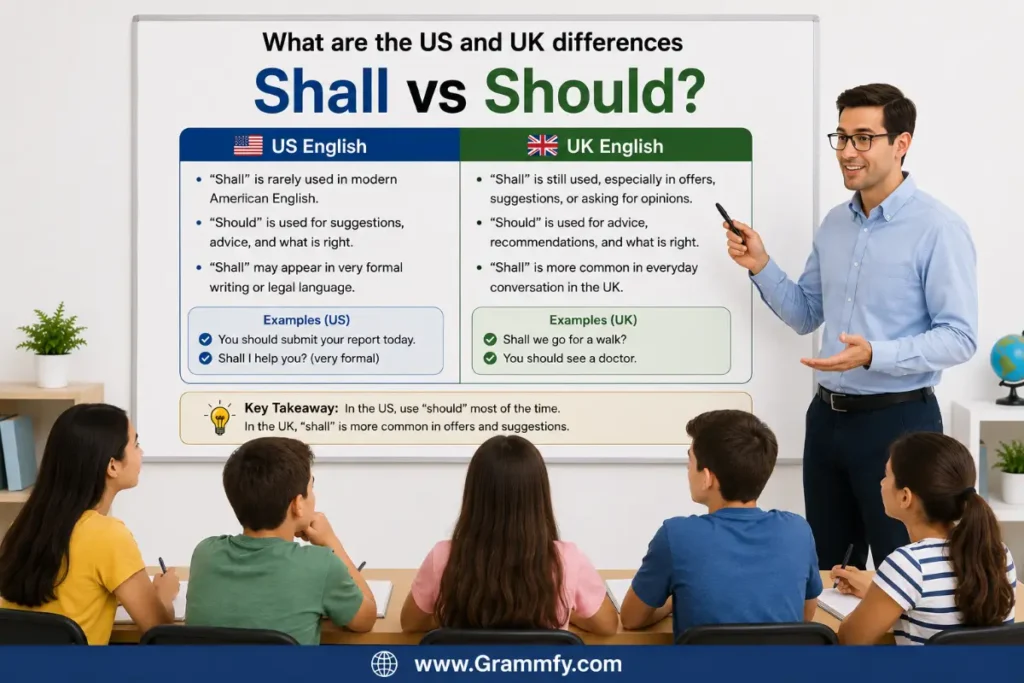
What are the US and UK differences “Shall vs Should”?
The difference between American and British usage is one reason learners can become confused.
In British English, shall still appears in ordinary questions, especially with I and we:
Shall we go?
Shall I open the window?
In American English, these expressions are understood but may sound more formal than everyday alternatives:
Should we go?
Should I open the window?
American English strongly favors will for ordinary future statements:
I will call you tomorrow.
British English also uses will widely, so this isn’t a simple US-versus-UK rule. The main difference is that shall remains more visible in some British conversational patterns.
Formal British documents may also use shall, although legal and technical writing practices vary.
What are common mistakes with “Shall vs Should”?
Mistake 1: Using shall for every future action
Incorrect style for most modern American writing:
I shall send the email tomorrow.
More natural:
I will send the email tomorrow.
Shall isn’t wrong, but it can sound unnecessarily formal.
Mistake 2: Using should when you mean a strict requirement
Employees should wear protective equipment.
If wearing it is mandatory, this may be too weak.
Better:
Employees must wear protective equipment.
Mistake 3: Adding “to” after should
Incorrect:
You should to study.
Correct:
You should study.
Modal verbs take the base form of the main verb.
Mistake 4: Assuming should means certainty
The package should arrive tomorrow.
This means you expect it to arrive. It doesn’t guarantee delivery.
For certainty, choose language that matches the evidence.
Mistake 5: Using shall in casual texts without a reason
Shall you come to my house tonight?
This doesn’t sound natural.
Try:
Are you coming over tonight?
or:
Will you come over tonight?
Mistake 6: Treating shall as automatically more professional
Formal doesn’t always mean better.
Compare:
The employee shall submit the form.
with:
The employee must submit the form.
If you mean a requirement, must may be clearer.
When should you NOT use shall?
Avoid shall when it makes ordinary writing sound stiff or unnatural.
For example:
I shall get back to you soon.
In a casual email, this may sound overly formal.
Better:
I’ll get back to you soon.
Avoid it in casual texts unless you’re using it for humor or a deliberately formal style.
Also avoid using shall simply because you think it makes your writing sound intelligent. Clear words usually make stronger writing.
What are the antonyms of “Shall vs Should”?
Modal verbs don’t always have direct antonyms, but several expressions can communicate the opposite idea.
For should, possible opposites include:
- should not
- shouldn’t
- must not
- don’t
- avoid
- need not
The exact opposite depends on the meaning.
For example:
You should go.
can contrast with:
You shouldn’t go.
But:
You should go.
can also contrast with:
You don’t need to go.
That second sentence doesn’t mean “you must not go.” It means going isn’t necessary.
This distinction is important because not necessary and not allowed are different ideas.
What are quick tips for choosing the right word “Shall vs Should”?
Use this simple checklist.
Choose should when:
- You are giving advice.
- You are making a recommendation.
- Something is expected.
- Something seems appropriate.
- You want to express a moderate duty.
- You are asking for an opinion about the best action.
Examples:
You should rest.
Should I call her?
Choose shall when:
- You are making a formal requirement.
- You are writing a formal rule.
- You are making an offer with “Shall I…?”
- You are making a suggestion with “Shall we…?”
- You are intentionally using formal or traditional language.
Examples:
Shall I help you?
Shall we begin?
Choose will when:
- You simply mean a future action.
- You are writing normal modern American English.
- You are making a promise or prediction.
Example:
I will send the report tomorrow.
Choose must when:
- Something is required.
- There is little or no choice.
- You need strong, direct language.
Example:
All visitors must sign in.
Choose could when:
- You want to offer a softer suggestion.
- You are presenting one possible option.
Example:
You could try restarting the computer.
A quick decision chart
When you’re stuck, ask what you mean.
| What do you mean? | Best choice |
|---|---|
| “Is this a good idea?” | Should |
| “Do you want me to do this?” | Shall I…? |
| “Do you want us to do this?” | Shall we…? |
| “This is required.” | Must or formal shall |
| “This is expected.” | Should |
| “This will happen in the future.” | Will |
| “This is one possible option.” | Could |
| “This is not necessary.” | Don’t need to / need not |
| “This is prohibited.” | Must not / cannot |
This chart is often enough to make the right choice quickly.
Can “Shall vs Should” be used politely?
Yes, but they create different kinds of politeness.
Shall I…? can be polite because it offers help or asks what the other person wants.
Shall I carry your bag?
Should I…? is polite because it asks for advice.
Should I bring anything?
Could I…? is another common polite option:
Could I ask you a question?
The most natural choice depends on the purpose of the question.
Why does word choice matter in professional English “Shall vs Should”?
Professional writing needs to communicate the intended level of obligation.
Compare these four sentences:
You could submit the form today.
This presents an option.
You should submit the form today.
This recommends it.
You need to submit the form today.
This says it is necessary.
You must submit the form today.
This makes the requirement very strong.
Adding shall creates a more formal or regulatory tone:
You shall submit the form today.
That may fit a formal rule, but it can sound stiff in an ordinary email.
Good professional writing isn’t about choosing the most formal word. It’s about choosing the word that communicates the exact meaning.
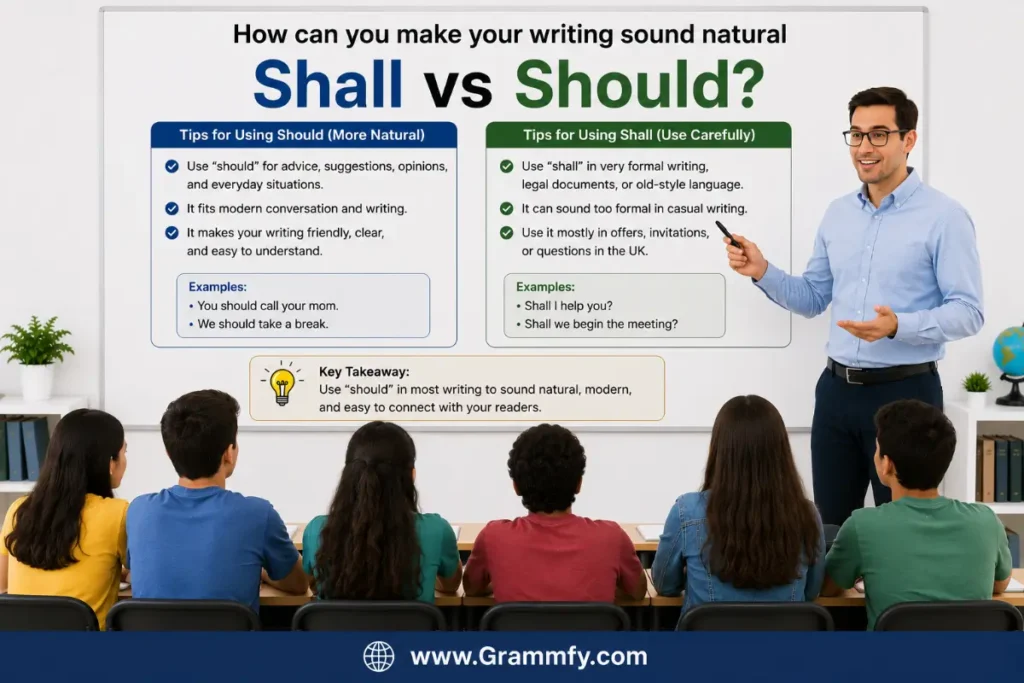
How can you make your writing sound natural “Shall vs Should”?
Start by deciding what you actually mean before choosing a modal verb.
If you’re giving advice, use should.
If you’re asking someone to choose whether you should perform an action, use Shall I…? in contexts where that form sounds natural.
If you’re suggesting a shared action, Shall we…? can work well, especially in British English or formal settings.
This approach produces more natural writing than trying to memorize a rigid grammar rule.
Conclusion
The key to shall vs should is not memorizing one rigid rule. Instead, focus on the job each word performs. Should is the everyday choice for advice, recommendations, expectations, and moderate duties. Shall has a narrower modern role, especially in formal requirements and the useful patterns “Shall I…?” and “Shall we…?”
For most American English, use will for ordinary future statements, should for advice, must for firm requirements, and could for softer suggestions. Use shall when its formal or traditional meaning genuinely fits the situation.
Once you connect each modal verb to its purpose, choosing the right one becomes much easier. The best sentence isn’t the one that sounds most formal. It’s the one that makes your intended meaning clear.
Frequently Asked Questions
Is shall still used in American English?
Yes, but it is less common in everyday American English than in British English. It remains useful in formal language and in expressions such as “Shall I?” and “Shall we?”
Should I use shall in a formal email?
Usually not unless the email describes a formal rule, obligation, or contractual requirement. For most professional emails, will, should, must, or could will sound more natural.
What’s another way to say shall?
Depending on the meaning, you can use will, must, should, shall we, let’s, could, or need to. There is no single replacement that works in every sentence.
Is should stronger than shall?
Not necessarily. Should usually expresses advice or expectation, while shall can express a formal obligation or a suggestion. The strength depends on the sentence and context.
Should I say “shall we” or “should we”?
Use shall we when making a suggestion or asking for agreement about a shared action, especially in British English or formal settings. Use should we when asking whether an action is a good idea.
Is “I shall” correct grammar?
Yes, “I shall” is grammatically correct, but it often sounds formal or old-fashioned in modern American English. “I will” is normally more natural for an ordinary future statement.
Can I replace should with must?
Only when you want to make the meaning stronger. Should usually gives advice or expresses expectation, while must normally communicates a requirement.
