
When you’re writing an email, finishing an essay, updating a resume, or sending a text, you may stop and wonder about will vs would. Both words are modal verbs, and both can talk about future actions, choices, willingness, expectations, and possibilities. The tricky part is that they don’t always mean the same thing.
The easiest way to remember the difference is that will usually presents something as real, expected, planned, or certain from the speaker’s point of view. Would often makes an idea hypothetical, conditional, polite, or connected to a past viewpoint.
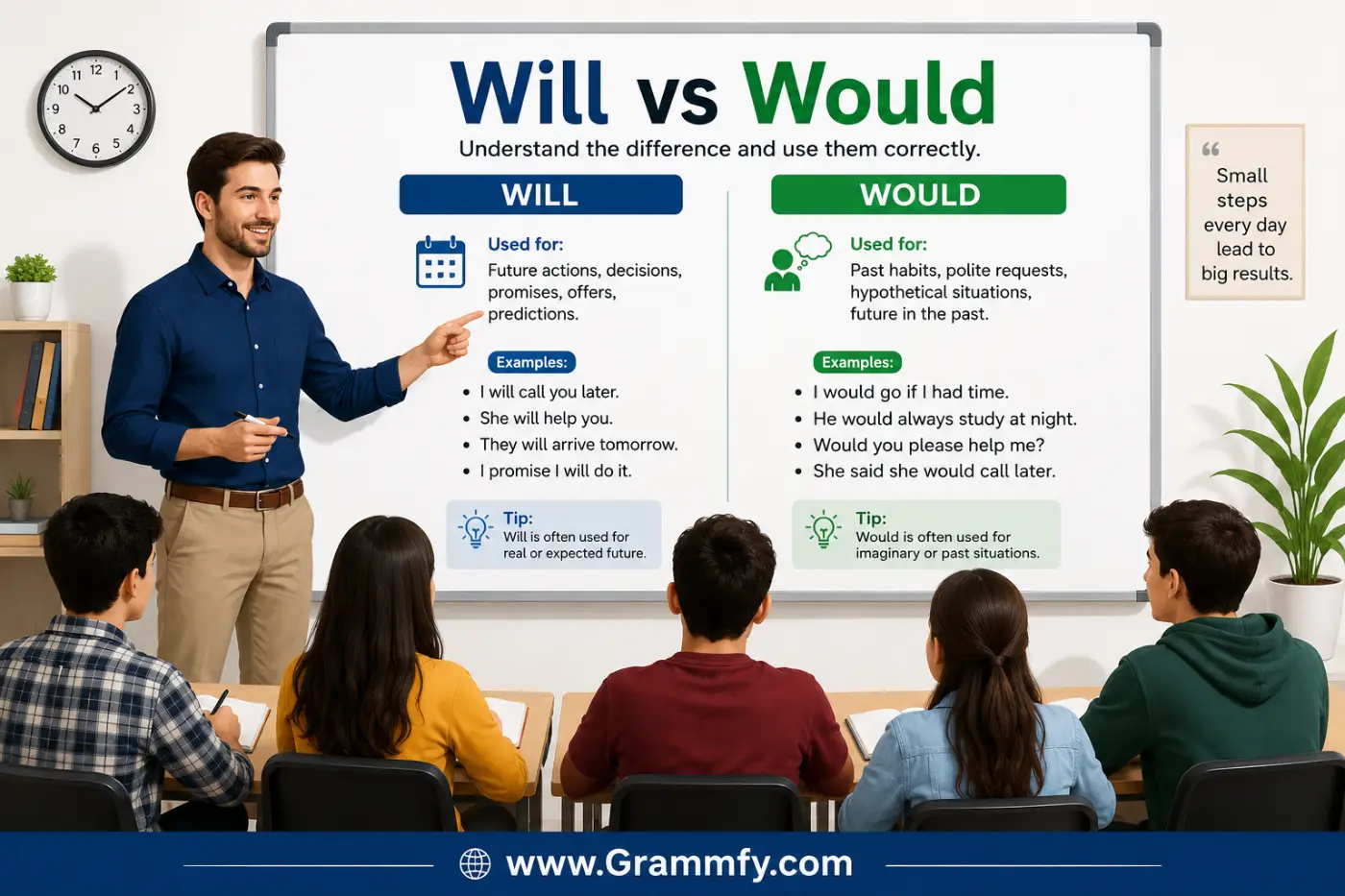
Answer box: Use will for real or expected future actions, promises, decisions, and willingness. Use would for hypothetical situations, polite requests, preferences, and future actions viewed from the past.
The difference becomes clearer when you look at the sentence around each word. “I will help you” expresses a real offer or promise. “I would help you if I could” describes a condition. “Would you help me?” uses would to make a request more polite.
This guide explains the plain-English meanings and origins of both words, useful synonyms, levels of intensity, regional differences, common mistakes, and practical examples. You’ll also learn which word works best in resumes, essays, emails, texts, and everyday speech.
If you want to improve your sentence structure, take a look at our article on grammar rule.
What do will and would mean?
Will and would are modal auxiliary verbs. They come before the base form of another verb and help express ideas about the future, possibility, willingness, conditions, habits, or polite communication.
For example:
- I will call you tonight.
- She will arrive soon.
- I would help if I had time.
- Would you open the door?
- When we were younger, we would visit our grandparents every summer.
Although the words are closely related, their meanings depend on context.
What does will mean?
Will commonly describes something that happens or is expected to happen in the future.
I will finish the report tonight.
It can also express a promise:
I’ll call you after work.
A decision:
I’ll take the blue one.
Willingness:
I will help you move.
Or a prediction:
The weather will improve tomorrow.
The speaker generally sees the event as real, planned, expected, or possible.
What does would mean?
Would has several common uses.
I would travel more if I had extra money.
Would you close the window?
I would rather stay home.
She said she would call later.
When we were kids, we would play outside after school.
So would isn’t simply a past-tense version of will. It has developed several uses of its own.
Where did “Will vs Would” come from?
The history of these two words helps explain their modern relationship.
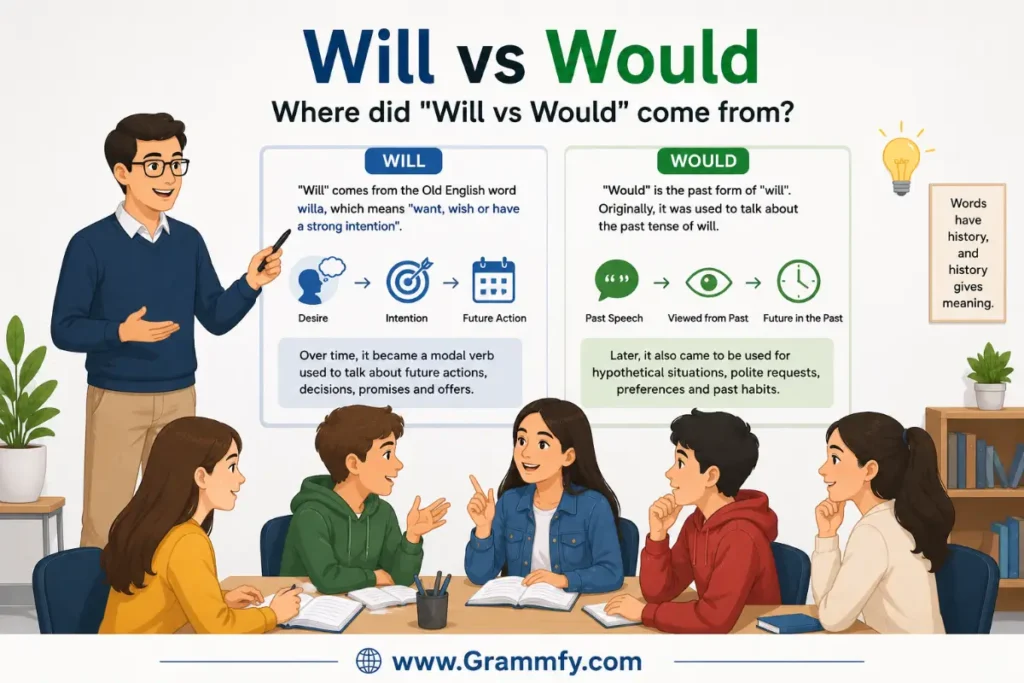
Will comes from an Old English verb associated with wanting, wishing, or intending. Over time, it became strongly connected with future meaning.
That older idea of desire or intention can still be seen in modern English.
For example:
I will do it.
Depending on context, this can mean more than “this will happen.” It can also suggest determination or willingness.
Would developed as the past form of will. English speakers later used it for several related meanings, including hypothetical situations, reported future actions, polite requests, preferences, and repeated past behavior.
Consider this pair:
He says he will come.
and:
He said he would come.
The first statement is reported from the present. The second reports what he said from a past viewpoint.
But look at this sentence:
Would you like some coffee?
Here, would isn’t simply describing the past. It’s a conventional polite expression used in the present.
That’s why learning the function of each word is more useful than memorizing “will means present” and “would means past.”
What is the main difference between “Will vs Would”?
The basic distinction is simple.
| Word | Common use | Typical meaning | Example |
|---|---|---|---|
| Will | Future, promise, willingness, prediction | Real or expected | I will call tomorrow. |
| Would | Hypothetical, polite, conditional, past habit | Imagined, softened, or viewed from the past | I would call if I had time. |
But there are several important uses that don’t fit into a single rule.
Will often describes a real future
We will meet at 5 p.m.
The speaker expects the meeting to happen.
Would often describes a condition
We would meet at 5 p.m. if everyone were available.
The meeting depends on a condition.
Will can show willingness
I will help you.
This can mean “I’m willing to help.”
Would can make an idea conditional
I would help you if I weren’t busy.
The speaker is willing, but another condition prevents the action.
Will can make a request sound direct
Will you send me the file?
This can ask about willingness or function as a direct request.
Would often sounds more polite
Would you send me the file?
This is a common polite request.
How do “Will vs Would” work in questions?
Questions are one of the clearest ways to see the difference.
Compare:
Will you help me?
This asks about willingness or a future action.
Would you help me?
This usually sounds more polite and may also suggest a hypothetical situation.
Now compare:
Will you come to the party?
This asks whether the person plans or intends to come.
Would you come to the party if I invited you?
This introduces a condition and asks about an imagined situation.
Another useful pair is:
Will you have coffee?
Would you like some coffee?
The second is a standard polite offer. It doesn’t mean the speaker is talking about the past.
What is the master synonym list for “Will vs Would”?
There isn’t one perfect synonym for either word. The best alternative depends on the meaning you want to communicate.
| Word or phrase | Meaning | Tone | Example |
|---|---|---|---|
| can | Ability or possibility | Everyday | I can help. |
| may | Possibility or permission | Formal/neutral | You may leave. |
| shall | Formal future, offer, or suggestion | Formal | Shall we begin? |
| must | Strong necessity | Strong | You must leave. |
| should | Advice or expectation | Neutral | You should call. |
| ought to | Advice or duty | Formal/neutral | You ought to call. |
| plan to | Have an intention | Neutral | I plan to travel. |
| expect to | Believe something will happen | Neutral | I expect to arrive soon. |
| be going to | Planned or likely future | Everyday | I’m going to call her. |
| be about to | Happen very soon | Neutral | We’re about to leave. |
| want to | Express a desire | Everyday | I want to help. |
| agree to | Accept a proposal | Neutral | She agreed to come. |
| promise to | Give an assurance | Neutral | I promise to help. |
| decide to | Make a choice | Neutral | We decided to stay. |
| choose to | Select an action | Neutral | I chose to wait. |
| prefer to | Like one option better | Neutral | I’d prefer to stay. |
| wish to | Want or desire | Formal | I wish to speak. |
| would rather | Express preference | Neutral | I’d rather stay home. |
| tend to | Usually behave in a certain way | Neutral | He tends to worry. |
| be willing to | Be ready or agree to act | Neutral | I’m willing to help. |
| be likely to | Have a strong chance | Neutral | She is likely to win. |
Some of these are close alternatives rather than direct grammatical replacements.
For example, will can make a prediction:
Sales will increase next year.
But be likely to focuses more directly on probability:
Sales are likely to increase next year.
The meanings overlap, but the emphasis is different.
Which alternatives are simple and everyday “Will vs Would”?
In normal American English, common alternatives include:
- will
- would
- can
- could
- might
- going to
- want to
- plan to
- need to
- have to
- let’s
- would like to
- would rather
For example:
I will call you later.
You could also say:
I’m going to call you later.
The first can sound like a decision, promise, or prediction. The second often focuses on a plan or expected action.
Another example:
Would you like some coffee?
This is natural and polite.
A more formal alternative such as:
Would you wish to consume coffee?
is grammatically understandable but unnatural in ordinary English.
Which alternatives sound formal “Will vs Would”?
Formal writing may use expressions such as:
- intend to
- expect to
- be expected to
- be prepared to
- be willing to
- wish to
- may
- shall
- must
- propose to
- agree to
For example:
The company intends to expand its services next year.
This sounds more formal than:
The company plans to expand its services next year.
Both are correct. The choice depends on the audience and purpose.
Formal language isn’t automatically better. If a simple word communicates the idea clearly, use it.
Which alternatives are informal or slang “Will vs Would”?
Casual speech often uses shortened forms and informal expressions.
Examples include:
- I’ll
- I’d
- we’ll
- you’d
- we’re gonna
- I’m gonna
- I’d rather
- gotta
- wanna
For example:
I’m gonna call you later.
is normal in casual speech.
For formal writing, use:
I’m going to call you later.
or:
I will call you later.
Contractions such as I’ll and I’d are perfectly normal in most everyday American English. The important thing is to match the level of formality to your audience.
How do these synonyms change from mild to strong?
Modal verbs can change the force of a statement.
| Strength | Expression | Example |
|---|---|---|
| Very tentative | might | I might go. |
| Tentative | could | We could go. |
| Possible | may | We may go. |
| Expected | should | We should go. |
| Firm intention | will | We will go. |
| Strong requirement | must | We must go. |
| Strong necessity | have to | We have to go. |
The same idea applies to requests.
| Expression | Example | General effect |
|---|---|---|
| Could you…? | Could you send the file? | Polite and soft |
| Would you…? | Would you send the file? | Polite and direct |
| Will you…? | Will you send the file? | More direct |
| Can you…? | Can you send the file? | Casual and common |
| You need to… | You need to send the file. | Firm |
| You must… | You must send the file. | Very firm |
This isn’t a strict politeness scale. Your voice, relationship, and situation can change how a sentence feels.
What part of speech are “Will vs Would”?
Will and would are modal auxiliary verbs.
They normally appear before the base form of another verb.
Correct:
I will go.
She would help.
They will arrive.
He would choose that option.
Don’t add to directly after the modal.
Incorrect:
I will to go.
Correct:
I will go.
Incorrect:
She would to help.
Correct:
She would help.
There are exceptions in larger structures where another verb takes to.
For example:
I would like to help.
Here, like is the main verb. The structure is:
would + like + to + verb
The same pattern appears in:
I would prefer to stay.
and:
I would love to join you.
When should you use will for the future?
Use will for several common future meanings.
Future decision
I’ll take the blue one.
The decision is being made now.
Promise
I will finish the work tonight.
Prediction
The team will probably win.
Offer
I’ll carry those boxes for you.
Warning
You’ll regret that decision.
Commitment
We will support the project.
Expected event
The train will arrive at 8:30.
The exact meaning changes slightly with context, but the common thread is that the speaker presents the future event as real, expected, intended, or firmly chosen.
When should you use would for hypothetical situations?
Use would when the result depends on an imagined or unreal condition.
A common structure is:
If + condition, would + result
For example:
If I had more time, I would learn Spanish.
The speaker doesn’t currently have more time.
Another example:
If we lived closer, we would visit more often.
The condition isn’t true now.
And:
If she asked me, I would say yes.
This presents an imagined situation.
This is one of the most useful patterns to learn.
What is the difference between “Will vs Would” in conditional sentences?
Compare these sentences:
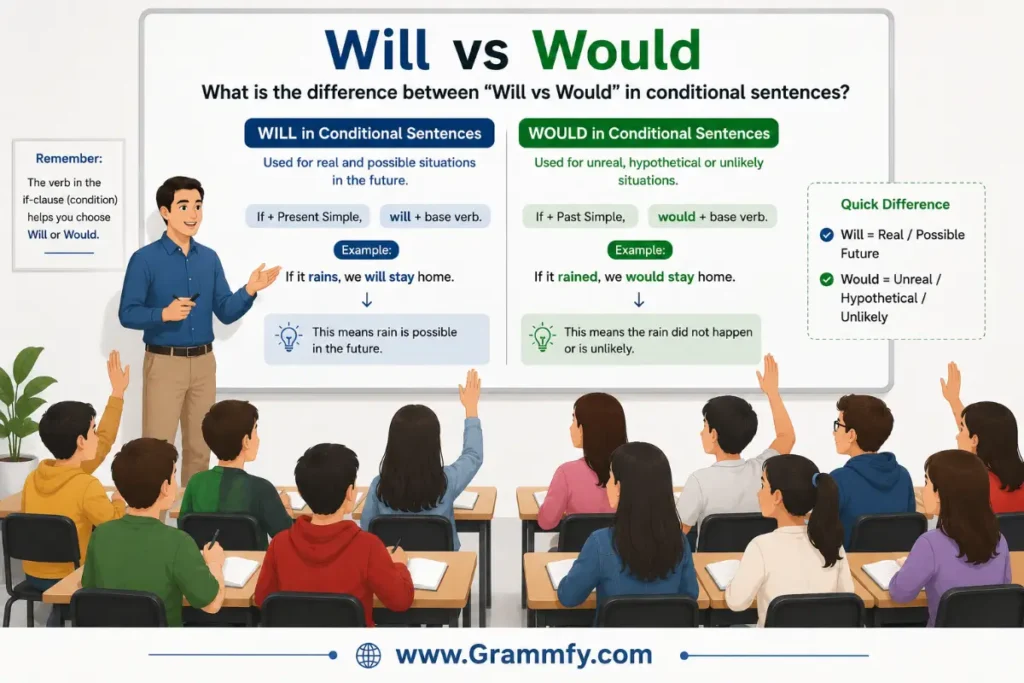
If it rains, we will stay home.
This describes a real future possibility.
Now compare:
If it rained, we would stay home.
This presents a hypothetical or less likely situation.
The difference is not simply about time. It also shows how the speaker views the condition.
| Sentence | Meaning |
|---|---|
| If it rains, we will stay home. | A possible future condition |
| If it rained, we would stay home. | A hypothetical or less likely condition |
| If it had rained, we would have stayed home. | An unreal past condition |
Another pair:
If I get the job, I will move.
The speaker thinks getting the job is possible.
If I got the job, I would move.
The speaker is imagining the situation.
This is why would is so important in conditional sentences.
“Will vs Would” — what’s different in questions?
Questions often reveal whether the speaker is asking about a real future action, willingness, or a hypothetical situation.
| Question | What it usually means |
|---|---|
| Will you help me? | Are you willing to help? |
| Would you help me? | Could you help me? / A more polite request |
| Will you come? | Are you planning or willing to come? |
| Would you come if I invited you? | Would you come under that condition? |
| Will you have coffee? | Do you want coffee? |
| Would you like coffee? | A polite offer |
Consider:
Will you open the door?
This can be a straightforward request.
Would you open the door?
This is usually softer and more polite.
The difference isn’t always huge, but would creates more distance and politeness.
How does would make language more polite?
English often uses hypothetical forms to soften requests.
Compare:
Give me the report.
Will you give me the report?
Would you give me the report?
The first is a command. The second is a direct request. The third is generally more polite.
Other examples:
Would you please wait here?
Would you mind closing the door?
Would you check this document?
Would you like to join us?
This is a major reason English learners hear would so often in customer service, restaurants, workplaces, and other polite situations.
What does would mean in “would like”?
Would like is a very common polite expression meaning want.
I would like a glass of water.
I’d like to speak with the manager.
We’d like to order dinner.
It doesn’t mean that the speaker wanted something in the past.
Compare:
I want some coffee.
with:
I would like some coffee.
The second sounds more polite or less direct.
This structure is especially useful in restaurants, hotels, offices, and formal conversations.
Would like vs want
| Expression | Meaning | Tone |
|---|---|---|
| I want… | Desire | Direct/casual |
| I would like… | Desire | Polite |
| I need… | Necessity | Direct |
| I would appreciate… | Polite request | Formal/polite |
For example:
I would like to schedule an appointment.
is a common professional sentence.
What does would mean in “would rather”?
Would rather expresses a preference.
I would rather stay home.
I’d rather take the train.
She’d rather wait.
You normally don’t use will rather for this meaning.
Incorrect:
I will rather stay home.
Better:
I would rather stay home.
You can compare two choices:
I’d rather walk than drive.
This means walking is the preferred option.
You can also use would rather not:
I’d rather not discuss it right now.
This is a polite way to express a negative preference.
Can would refer to the past?
Yes. It has two important past-related uses.
Future from a past viewpoint
She said she would call.
At the time she spoke, the call was in the future.
Compare:
She says she will call.
with:
She said she would call.
The reporting verb changes from present to past, and the future form changes accordingly.
Repeated past actions
Would can describe repeated actions in the past.
When we were children, we would visit our grandparents every Sunday.
Another example:
Every summer, my family would drive to the coast.
This use usually describes repeated actions, not permanent states.
For a past state, used to is generally better:
I used to live in Chicago.
Not:
I would live in Chicago.
The second sentence doesn’t normally express a past state in the same way.
What is the best word for a resume “Will vs Would”?
For resumes, will and would are often less useful than strong action verbs.
A resume should focus on completed work, achievements, responsibilities, and measurable results.
Weak:
I would manage customer accounts and resolve complaints.
This sounds hypothetical.
Better:
Managed customer accounts and resolved customer complaints.
Weak:
I will improve the company’s social media strategy.
That describes a future promise instead of a proven achievement.
Better:
Increased social media engagement by 35% through targeted content campaigns.
Strong resume verbs include:
- managed
- led
- created
- improved
- increased
- reduced
- developed
- analyzed
- organized
- coordinated
- launched
- trained
- supervised
- implemented
- delivered
Resume example
Instead of:
I would be responsible for managing a team of ten employees.
write:
Managed a team of 10 employees and improved project completion rates.
The second version shows an actual result.
What is the best word for an essay “Will vs Would”?
For an essay, choose will or would based on whether you’re making a real prediction or discussing a hypothetical result.
Use will for a confident future claim:
These changes will reduce energy use.
Use would for a hypothetical result:
These changes would reduce energy use if the city adopted them.
Academic writing often uses would when discussing possible effects of a proposed action.
For example:
The policy would benefit low-income families.
This doesn’t necessarily mean the policy already exists. It can mean that the writer predicts a result if the policy is adopted.
Essay example
If schools offered more financial education, students would enter adulthood with stronger money-management skills.
The writer is presenting a possible situation and its likely result.
What is the best word for an email “Will vs Would”?
For professional emails, will works well for plans, commitments, and clear information.
I will send the revised report by Friday.
This sounds direct and confident.
Would can make requests more polite:
Would you review the attached document?
It can also soften a recommendation:
I would suggest revising the final paragraph.
Compare:
I suggest revising the final paragraph.
with:
I would suggest revising the final paragraph.
The second is slightly softer.
Email examples
I will send the updated schedule this afternoon.
Would you please review the updated schedule?
I would recommend moving the meeting to Thursday.
If we changed the deadline, I would expect some delays.
Each sentence uses the modal verb for a different purpose.
What is the best word for texting “Will vs Would”?
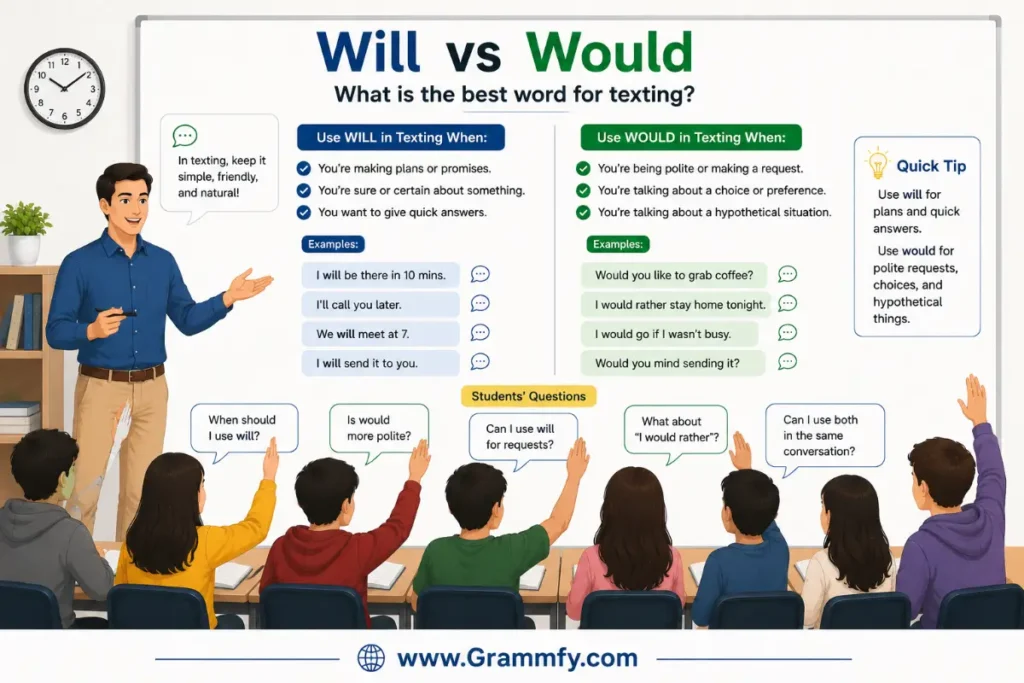
For texts, both words are common.
I’ll be there at 7.
I’d go if I wasn’t so tired.
I’d like to get pizza.
I’d rather stay home tonight.
Would you want to come with us?
In very casual American speech, someone might simply write:
Do you want to come with us?
The best choice depends on your relationship with the person.
A text to a close friend can be casual:
I’ll see you later.
A message to a coworker may be slightly more careful:
I’ll see you at the meeting.
Neither requires complicated grammar.
What is the best word for speaking “Will vs Would”?
In everyday American conversation, will is extremely common.
I’ll call you later.
We’ll see what happens.
She’ll probably come.
Would is also very common in polite requests and hypothetical statements.
Would you like some tea?
I’d help if I could.
I’d rather stay here.
Contractions are especially common in speech:
- I’ll = I will
- you’ll = you will
- he’ll = he will
- we’ll = we will
- they’d = they would
- I’d = I would
- you’d = you would
- we’d = we would
Be careful with I’d, because it can mean either I would or I had.
For example:
I’d like some water.
Here, I’d = I would.
But:
I’d finished the work before noon.
Here, I’d = I had.
The following word usually makes the meaning clear.
What are 15 real-life examples of will?
Here are examples from work, school, family life, travel, and everyday conversation.
- I’ll call you after dinner.
- We will finish the project tomorrow.
- She will probably arrive late.
- I’ll help you carry those boxes.
- The store will close at nine.
- I think you’ll enjoy this book.
- We’ll send the invoice by Friday.
- Don’t worry. I’ll take care of it.
- The meeting will begin at 10 a.m.
- He will be here soon.
- I’ll email the documents tonight.
- This decision will affect the entire team.
- The new system will save employees time.
- I will never forget your kindness.
- We’ll let you know when we have an update.
These examples show future plans, predictions, offers, promises, decisions, and expected results.
What are 15 real-life examples of would?
Here are examples showing different uses.
- I would help if I had more time.
- Would you open the window?
- She said she would call later.
- I would rather stay home tonight.
- Would you like some coffee?
- If I were you, I would wait.
- We would travel more if flights were cheaper.
- He would always bring snacks to school.
- They said they would arrive before noon.
- I would choose the second option.
- Would you mind closing the door?
- If I had the chance, I would take it.
- She would often read before bed.
- I would recommend checking the receipt.
- We would be happy to answer your questions.
These examples cover hypothetical situations, politeness, preferences, reported speech, repeated past actions, and softened recommendations.
“Will vs Would” — what’s different in offers?
Offers are a useful way to compare the two words.
I’ll help you with your bags.
This is a direct offer. The speaker is volunteering to help now.
I would help you with your bags if I weren’t carrying these boxes.
This is conditional. The speaker is willing but can’t currently do it.
For polite offers, would like is especially common:
Would you like some water?
This is a conventional polite offer.
You may also hear:
Will you have some coffee?
But in many situations, this sounds less natural than:
Would you like some coffee?
The second is the standard polite form for offering something.
“Will vs Would” — what’s different in promises?
Will is strongly connected with promises and commitments.
I will never tell anyone.
I will finish this tonight.
I’ll be there for you.
These sentences communicate determination.
Would generally makes the statement conditional:
I would finish it tonight if I didn’t have another deadline.
The speaker isn’t making the same kind of firm promise.
This is why replacing will with would can make a sentence sound less certain or more dependent on another condition.
“Will vs Would” — what’s different in predictions?
Both words can appear when talking about what may happen, but they don’t create the same meaning.
The company will grow next year.
This is a direct prediction.
The company would grow faster if it invested more in advertising.
This is a conditional prediction.
The second sentence tells us what the speaker expects under a particular condition.
You can also soften a prediction with other expressions:
The company might grow next year.
The company could grow next year.
These suggest less certainty than will.
How do “Will vs Would” compare with can and could?
This is another useful distinction.
Can often expresses present ability or possibility:
I can help you.
Could can express past ability, possibility, or a polite suggestion:
I could help you tomorrow.
Will commonly expresses future intention or expectation:
I will help you tomorrow.
Would commonly expresses a hypothetical result or polite request:
I would help you if I could.
Notice how the words work together:
If I could help, I would.
Here, could describes ability or possibility, while would describes the hypothetical result.
How do “Will vs Would” compare with should?
Should generally expresses advice or expectation.
You should call her.
Will expresses a future action or intention:
You will call her.
That can sound like a prediction or even an instruction, depending on tone.
Would expresses a hypothetical or conditional action:
You would call her if you needed help.
Compare:
| Sentence | Main idea |
|---|---|
| You should call her. | Advice |
| You will call her. | Future action or prediction |
| You would call her if you needed help. | Hypothetical result |
These three words can appear in similar sentences while serving very different purposes.
What are common mistakes with “Will vs Would”?
Mistake 1: Using would for every future action
Incorrect or unclear:
I would call you tomorrow.
Without another context, this may sound incomplete.
Better:
I will call you tomorrow.
If there is a condition:
I would call you tomorrow if I had your number.
Now would is appropriate.
Mistake 2: Using will after every if
For a standard first conditional, use the present simple after if.
Correct:
If it rains, we will stay home.
Usually incorrect:
If it will rain, we will stay home.
The if clause normally describes the condition with the present simple.
Mistake 3: Adding “to” after will
Incorrect:
I will to call you.
Correct:
I will call you.
Mistake 4: Adding “to” after would
Incorrect:
I would to help.
Correct:
I would help.
But:
I would like to help.
is correct because like is the main verb.
Mistake 5: Thinking would always means past
It doesn’t.
Would you like some tea?
This is a present-time polite offer.
Mistake 6: Thinking would always requires an if-clause
Not true.
For example:
Would you like some coffee?
There is no if clause.
Likewise:
I’d rather stay home.
and:
She said she would call.
don’t need an if clause.
Mistake 7: Using would for past states
Incorrect or unnatural for the intended meaning:
I would live in Boston when I was younger.
Better:
I used to live in Boston when I was younger.
Would is natural for repeated past actions:
When I was younger, I would visit Boston every summer.
The key difference is state versus repeated action.
When should you NOT use would?
Don’t use would just because you want your writing to sound more polite, formal, or intelligent.
For example:
I would send the report tomorrow.
This can sound incomplete if there is no condition or special context.
Better:
I will send the report tomorrow.
Or:
I plan to send the report tomorrow.
Don’t use would when you’re describing a straightforward future plan unless the context calls for it.
When should you NOT use will?
Don’t use will when the result belongs to a standard hypothetical conditional.
For example:
If I had a million dollars, I will buy a house.
Better:
If I had a million dollars, I would buy a house.
The condition is hypothetical, so would belongs in the result clause.
Also, don’t automatically use will for polite requests. Would may sound more natural:
Would you please wait here?
This is generally softer than:
Will you please wait here?
The second can still be polite, but it may sound more direct.
What are the antonyms of “Will vs Would”?
Neither word has one simple dictionary-style opposite. The opposite depends on the meaning.
For future intention:
I will go.
can contrast with:
I won’t go.
For willingness:
I will help.
can contrast with:
I won’t help.
For hypothetical willingness:
I would help.
can contrast with:
I wouldn’t help.
For a future prediction:
It will happen.
can contrast with:
It won’t happen.
The negative forms won’t and wouldn’t are therefore often more useful than looking for a single antonym.
What does won’t mean?
Won’t is the contraction of will not.
Examples:
I won’t be late.
She won’t answer the phone.
They won’t agree.
It can express a negative future, refusal, or lack of willingness.
There’s also an interesting use in sentences such as:
My car won’t start.
Here, won’t can suggest that the car refuses or fails to start.
The word still carries an idea of something not happening or not being willing to happen.
What does wouldn’t mean?
Wouldn’t is the contraction of would not.
Examples:
I wouldn’t do that.
She wouldn’t agree.
We wouldn’t go without checking first.
It can express a hypothetical negative:
I wouldn’t buy that car if I were you.
It can also describe repeated refusal or behavior in the past:
The old printer wouldn’t work.
or:
He wouldn’t listen to anyone.
The exact meaning comes from the context.
How do regional differences affect usage of “Will vs Would”?
American and British English share the main meanings of will and would, but frequency and style can vary.
American English commonly uses will for ordinary future statements:
I will see you tomorrow.
British English uses this form too.
One noticeable difference is that British English may use shall more often in suggestions:
Shall we go?
American speakers may be more likely to say:
Should we go?
Both are understandable.
Would is widely used in both American and British English for polite requests, hypothetical situations, preferences, reported speech, and repeated past actions.
Regional differences also affect how formal certain expressions feel. If you’re writing for a specific audience, follow the variety of English your readers expect.
What is the best choice for American English “Will vs Would”?
For most American English situations, these patterns are reliable:
| Meaning | Natural choice |
|---|---|
| Simple future | will |
| Future plan | will / be going to |
| Promise | will |
| Immediate decision | will |
| Hypothetical result | would |
| Polite request | would |
| Polite offer | would like |
| Preference | would rather |
| Future from past viewpoint | would |
| Repeated past action | would |
| Past state | used to |
This isn’t a complete grammar rule, but it’s a useful starting point for everyday writing and speech.
How should you choose between “Will vs Would”?
Ask yourself what your sentence is doing.
Is it a real future action?
Use will.
I’ll send it tomorrow.
Does the action depend on an imagined condition?
Use would.
I’d send it if I had the file.
Are you making a polite request?
Would is often a good choice.
Would you check this for me?
Are you making a firm promise?
Use will.
I’ll take care of it.
Are you expressing a preference?
Use would rather.
I’d rather wait.
Are you reporting a future action from the past?
Use would.
She said she would call.
Are you describing a repeated past action?
Would can work.
Every summer, we would visit the lake.
Are you describing a past state?
Use used to more naturally.
I used to live there.
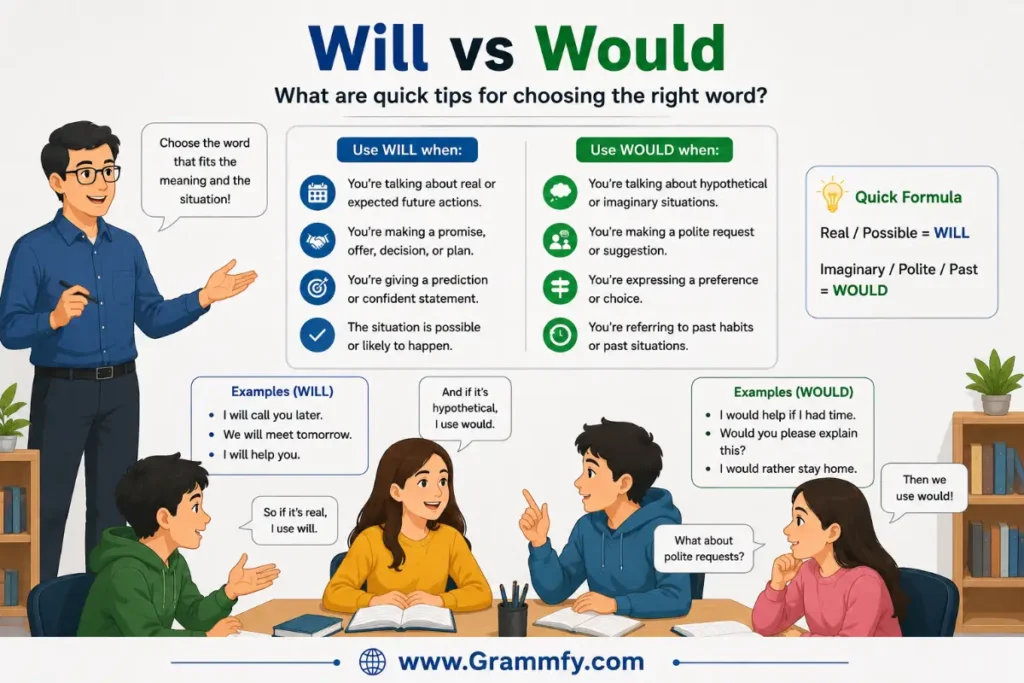
What are quick tips for choosing the right word “Will vs Would”?
When you’re unsure, ask these questions:
- Is this a real or expected future event?
Try will. - Is the result imaginary or dependent on a condition?
Try would. - Am I making a polite request?
Would is often appropriate. - Am I reporting what someone said about the future?
Use would when the reporting verb is in the past. - Am I talking about repeated behavior in the past?
Would can work. - Am I describing a past state?
Try used to. - Am I making a straightforward promise or commitment?
Use will.
A useful shortcut is:
Real or expected → will
Hypothetical, conditional, polite, or past viewpoint → would
That shortcut won’t solve every grammar question, but it works for many everyday sentences.
A quick comparison chart of “Will vs Would”
| Sentence | What it means |
|---|---|
| I will help. | I am willing to help. |
| I would help. | I am willing under a condition or in an imagined situation. |
| I will go. | I intend or expect to go. |
| I would go. | I would go under certain conditions. |
| Will you help me? | Are you willing to help? |
| Would you help me? | A softer or more hypothetical request. |
| I will choose it. | I have decided or expect to choose it. |
| I would choose it. | That’s my choice in an imagined situation. |
| She will call. | She is expected to call. |
| She said she would call. | Her future action is reported from the past. |
How can you make your writing sound natural?
Start with meaning, not formality.
Also, don’t add extra words just to make a sentence sound formal. Compare:
I will send the file tomorrow.
with:
I would like to hereby inform you that I shall endeavor to send the file tomorrow.
The second sentence is longer, but it isn’t clearer. Good writing gets to the point.
Conclusion
Understanding will vs would becomes much easier when you focus on the speaker’s meaning instead of memorizing a single tense rule. Will usually presents a future action, promise, decision, willingness, or prediction as real or expected. Would often introduces a condition, hypothetical idea, polite request, preference, or future action seen from a past point of view.
Pay attention to the words around the modal. An if clause often signals a hypothetical result with would. A past reporting verb such as said can lead to would for a future-in-the-past meaning. Expressions such as would like and would rather have their own common patterns.
When you’re writing, choose the form that matches your intended meaning. Clear, natural English matters more than making a sentence sound formal.
Frequently Asked Questions
What is the difference between will and would?
Will usually describes a real or expected future action, while would commonly describes hypothetical situations, polite requests, preferences, or future actions viewed from the past.
Is would just the past tense of will?
No. Would is historically related to the past form of will, but modern English uses it for several other purposes, including hypothetical conditions and polite requests.
When should I use will instead of would?
Use will when you’re talking about a real future action, prediction, promise, decision, or willingness. For example, “I’ll call you tonight.”
What’s another way to say would?
Depending on the meaning, alternatives include could, might, used to, planned to, intended to, preferred to, and was willing to. The best alternative depends on the sentence.
Should I say “I will” or “I would”?
Use I will for a real future intention or promise. Use I would when the action is conditional, hypothetical, or part of a polite expression such as “I would like.”
Why do people say “would you” instead of “will you”?
“Would you” often makes a request sound more polite and less direct. “Will you” can also be polite, but it may sound more direct depending on tone and context.
Can would describe something that happened in the past?
Yes. Would can describe repeated past actions and can report a future action from a past viewpoint. For example, “Every summer, we would visit the lake.”
