
When you’re writing an email, essay, resume, or quick text, all ready vs already can cause a surprising amount of confusion. The two expressions sound almost identical, but they don’t mean the same thing. One describes a state of preparation, while the other describes something that has happened before a certain time.
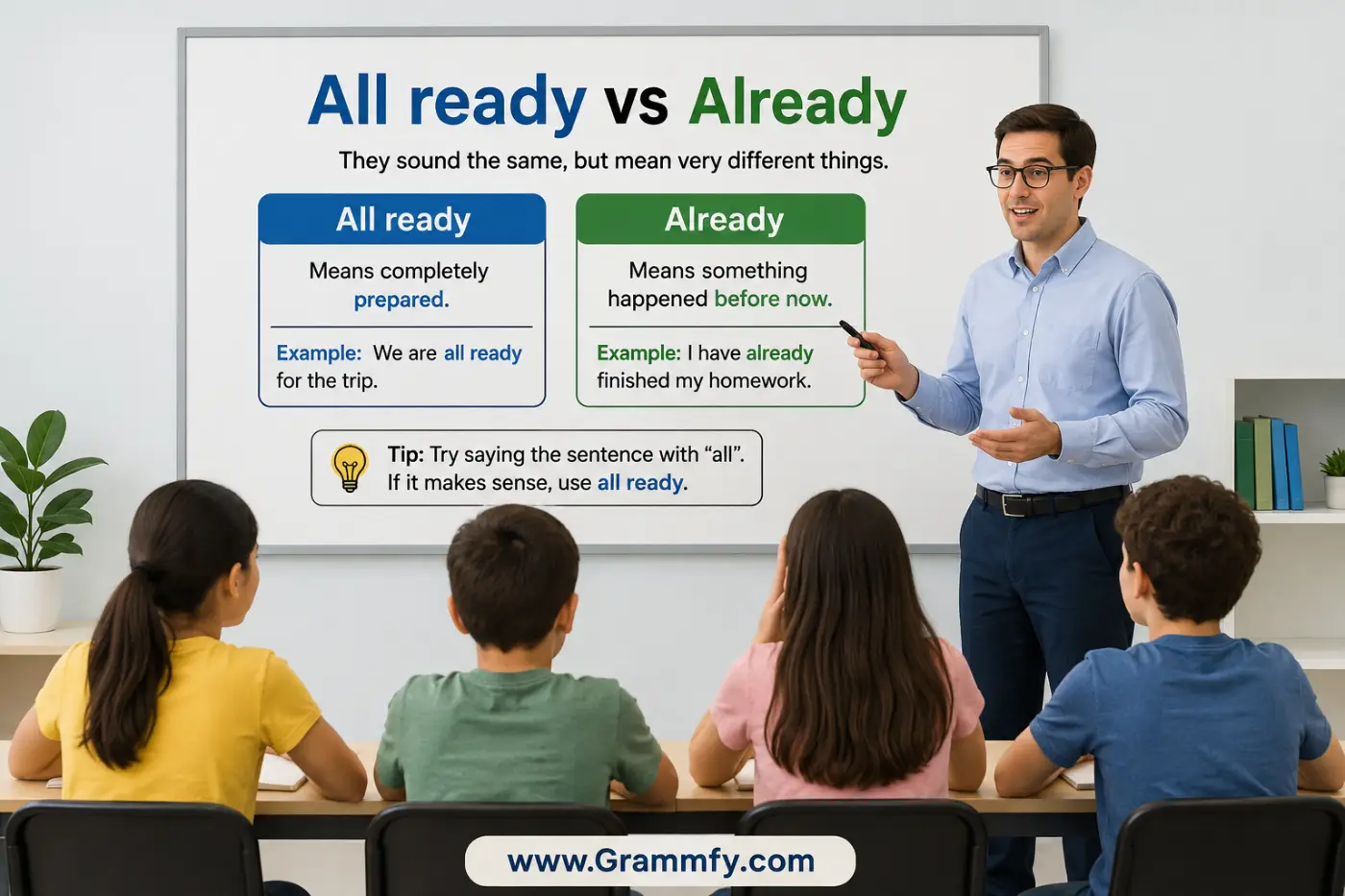
“All ready” means completely prepared, while “already” means something happened before now or before the expected time.
The easiest way to remember the difference is to look at the space. All ready has two words because it means “completely ready.” Already is one word because it is an adverb meaning “before now,” “by now,” or “sooner than expected.”
This guide explains their meanings, origins, grammar, synonyms, examples, common mistakes, regional usage, and the best choice for school, work, texting, resumes, emails, and everyday conversation.
For another common word-choice problem, see [assure vs ensure vs insure].
What is the difference between “All ready vs Already”?
The main difference is grammatical and semantic.
All ready is a two-word phrase. It means that everyone or everything is completely prepared.
We are all ready to leave.
Already is one word. It is an adverb that means something happened before now, before a particular time, or sooner than expected.
We have already left.
Compare these sentences:
| Expression | Meaning | Example |
|---|---|---|
| All ready | Completely prepared | The students are all ready for the test. |
| Already | Before now or sooner than expected | The students have already taken the test. |
The difference becomes clearer when you replace all ready with completely prepared.
We are all ready.
means:
We are completely prepared.
But you cannot replace already with “completely prepared.”
We have already eaten.
means:
We ate before now.
It does not mean that we are prepared.
What does all ready mean in simple English?
All ready means completely prepared.
The word all emphasizes the entire group or the complete state of preparation.
For example:
We are all ready for the trip.
This could mean everyone in the group is prepared.
It can also describe everything:
Is everything all ready for the party?
Here, the speaker wants to know whether every necessary thing has been prepared.
Other examples include:
- The children are all ready for school.
- My bags are all ready.
- We are all ready to begin.
- The documents are all ready for review.
- Dinner is all ready.
- The team is all ready for the game.
The phrase usually answers a question such as:
Are you prepared?
Is everything prepared?
Is everyone prepared?
Why does the space matter?
The space changes the meaning.
All ready contains the adjective ready. The word all modifies it.
They are all ready.
You can think of this as:
They are completely prepared.
Already, however, is a single adverb.
They have already arrived.
You can think of this as:
They arrived before now.
That small space creates a completely different grammatical structure.
What does already mean in simple English?
Already means something happened before now, before a particular time, or earlier than expected.
It often describes an action that has been completed.
I have already finished my homework.
The homework was completed before the present moment.
It can also express surprise that something happened sooner than expected:
You are already here?
The speaker expected the person to arrive later.
Other examples include:
- She has already eaten lunch.
- I’ve already seen that movie.
- The store is already closed.
- We already know the answer.
- He already finished the report.
- They have already made a decision.
The central idea is earlier than the relevant time.
Where did “All ready vs Already” come from?
The history of these expressions helps explain why they look so similar.
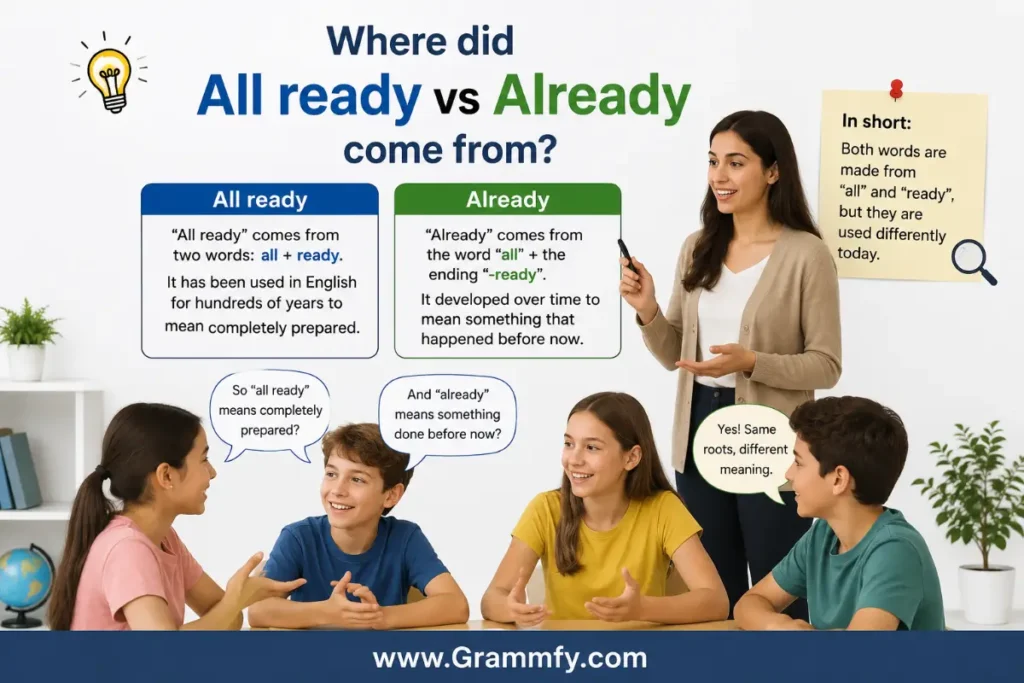
Ready is an old English word connected with being prepared, equipped, or in a suitable condition for something.
The word all is also very old and has long been used to express completeness or the whole of something.
When all combines with ready, the result is a normal phrase:
all ready = completely prepared
Already, however, developed into a single word over time. It came from an older combination meaning roughly “completely” or “by this time” and gradually became established as the adverb we use today.
Modern English treats already as one word.
That history explains why the spelling can feel confusing. The two forms share the word ready, but they developed different grammatical roles.
How can you tell which expression you need?
Use this simple test.
Can you replace it with “completely prepared”?
If yes, use all ready.
We are all ready.
Try:
We are completely prepared.
The meaning still works.
Can you replace it with “before now”?
If yes, use already.
We have already finished.
Try:
We finished before now.
The basic meaning remains.
This replacement test is one of the fastest ways to solve the problem.
What are the main synonyms for “All ready vs Already”?
Because the two expressions have different meanings, they need different synonym groups.
The following table gives related words and phrases across several tones.
| Word or Phrase | Meaning | Tone | Example |
| Prepared | Ready for something | Neutral | We are prepared for the meeting. |
| Set | Ready to begin | Casual | We’re all set. |
| Ready | Prepared | Neutral | I’m ready to go. |
| Equipped | Provided with what is needed | Formal | The team is fully equipped. |
| Organized | Arranged and prepared | Neutral | Everything is organized. |
| Finished | Completed and ready | Neutral | The report is finished. |
| Complete | Fully done | Formal | The application is complete. |
| Done | Finished | Casual | The work is done. |
| Good to go | Ready | Casual | We’re good to go. |
| All set | Completely ready | Casual | Everyone is all set. |
| Preparedness | State of being prepared | Formal | Preparedness is essential. |
| Ready to roll | Ready to begin | Informal | We’re ready to roll. |
| Before | Earlier than a time | Neutral | I saw it before lunch. |
| Previously | At an earlier time | Formal | The issue was previously discussed. |
| Earlier | Before a particular time | Neutral | She called earlier. |
| Formerly | At an earlier period | Formal | The building was formerly a school. |
| Beforehand | Before an event | Neutral | We prepared beforehand. |
| Prior to | Before | Formal | Submit the form prior to arrival. |
| In advance | Before something happens | Neutral | We booked the tickets in advance. |
| By this point | Before the current stage | Neutral | By this point, everyone knew. |
| To date | Until now | Formal | To date, no decision has been made. |
| Thus far | Until now | Formal | Thus far, the plan has worked. |
| Already | Before now | Neutral | I’ve already eaten. |
| All set | Completely prepared | Casual | We’re all set for dinner. |
| Good to go | Ready | Casual | The car is good to go. |
| Done and dusted | Completely finished | Informal | The project is done and dusted. |
What are the synonyms for all ready by tone?
Simple synonyms
These are easy and common:
Some alternatives work only in certain contexts. For example, already cannot always be replaced by previously, and all ready cannot always be replaced by prepared without changing emphasis.
These are easy and common:
Some alternatives work only in certain contexts. For example, already cannot always be replaced by previously, and all ready cannot always be replaced by prepared without changing emphasis.
These are easy and common:
- ready
- prepared
- set
- done
- complete
Example:
We’re ready to leave.
Everyday synonyms
These sound natural in ordinary conversation:
- all set
- good to go
- prepared
- finished
- ready to go
Example:
Are you all set?
Formal synonyms
These work well in professional or academic writing:
- fully prepared
- completely prepared
- adequately prepared
- properly equipped
- fully organized
Example:
The research team was fully prepared for the field study.
Slang and informal expressions
Casual English offers several colorful alternatives:
- good to go
- ready to roll
- good to hit the road
- done and dusted
- set to go
Example:
We’re ready to roll.
These expressions are best for casual speech, texts, and friendly messages rather than formal reports.
What are the synonyms for already by tone?
Simple synonyms
- before
- earlier
- by now
Example:
I’ve seen it before.
Everyday synonyms
- by now
- earlier
- before
- sooner than expected
Example:
She’s already home.
Formal synonyms
- previously
- beforehand
- prior to
- to date
- thus far
Example:
The issue was previously discussed.
Informal alternatives
There isn’t a true slang synonym for already in every situation, but casual speakers may use phrases such as:
- by now
- before this
- earlier
- long before
Example:
I told you that already.
What are the synonyms from mild to strong?
The intensity of these words depends heavily on context.
For preparation, a mild expression is:
ready
A stronger description might be:
fully prepared
An even stronger expression is:
completely prepared
For example:
The team is ready.
This simply states that the team can begin.
The team is fully prepared.
This emphasizes that the necessary preparation has been completed.
The team is completely prepared for every stage of the event.
This gives an even stronger sense of thorough preparation.
For time, already itself is usually neutral. However, expressions can emphasize how early something happened.
Mild
- earlier
- before
- previously
Stronger emphasis
- already
- by now
- sooner than expected
- long before
Compare:
She arrived earlier.
with:
She arrived much sooner than expected.
The second sentence carries more emphasis.
What part of speech are “All ready vs Already”?
This is one of the most important grammar differences.
All ready
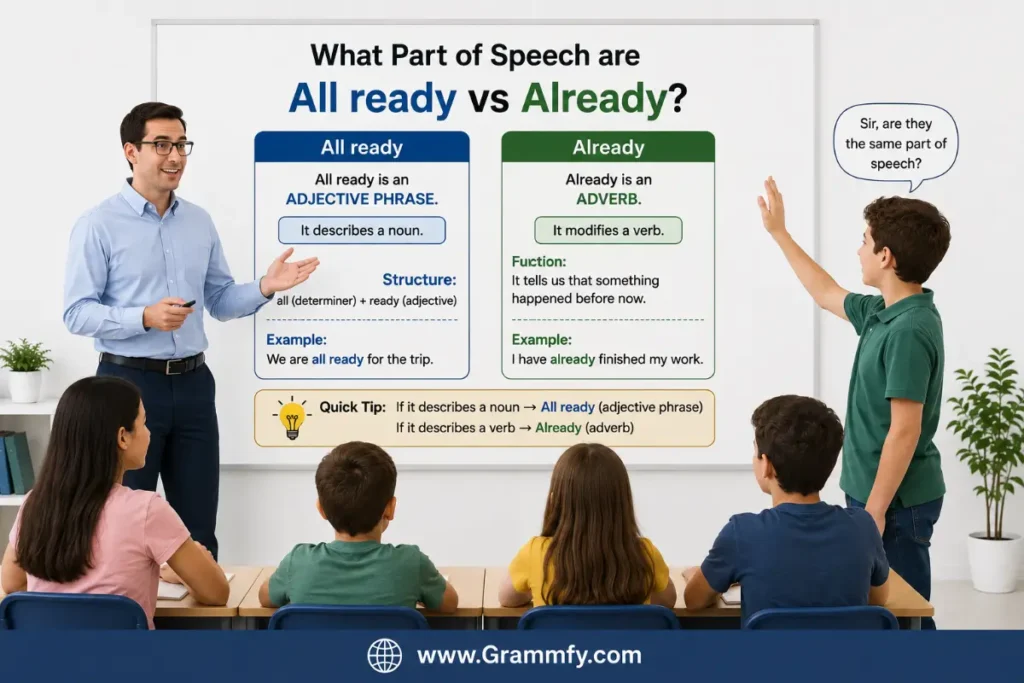
All ready is a phrase containing:
- all — determiner/pronoun/adverb depending on structure
- ready — adjective
Example:
We are all ready.
Here, ready describes the condition of the subject.
Already
Already is an adverb.
It modifies a verb, verb phrase, adjective, or sometimes an entire clause depending on how it is used.
Example:
I have already finished.
Here, already tells us when the finishing happened.
Another example:
It is already dark.
Here, already modifies the adjective phrase by emphasizing that the condition has happened sooner than expected.
This grammatical difference is why the two forms should not be treated as interchangeable.
Where does already go in a sentence?
Position can vary, but already commonly appears before the main verb.
I already know the answer.
With auxiliary verbs, it often comes after the auxiliary and before the main verb:
I have already finished.
With be, it commonly comes after the verb:
She is already here.
It can also appear at the end in informal speech:
I’ve eaten already.
This is natural in conversation.
Already in questions
Already can express surprise:
Are you already leaving?
The speaker expected the person to stay longer.
It can also ask whether an action has happened:
Have you already finished?
Depending on tone, the sentence may show surprise or simply ask about completion.
How is all ready used in a sentence?
All ready usually appears after a form of be or another linking verb.
Examples:
We are all ready.
The students were all ready.
Is everyone all ready?
It can also appear after a noun phrase:
The equipment is all ready.
The phrase describes preparation.
All ready with groups
When talking about people, all ready can emphasize that everyone is prepared:
The players are all ready.
This differs slightly from:
All the players are ready.
The first emphasizes their shared state of readiness. The second emphasizes the entire group of players.
Both can be correct.
Is “All ready vs Already” better for a resume?
What should you use on a resume?
A resume rarely needs all ready, unless you’re describing a specific state of preparation.
For example:
All project materials were ready before the deadline.
However, professional resumes more often use words such as:
- prepared
- completed
- organized
- finalized
- equipped
- coordinated
For example:
Prepared project materials ahead of schedule.
If you’re discussing time, already may be useful:
Already familiar with major project management platforms.
Still, resume writing usually benefits from stronger, more specific action verbs.
Instead of:
I was already prepared for the project.
Consider:
Prepared project materials before the launch date.
The second version gives a clearer picture of what you did.
Is “All ready vs Already” better for an essay?
Which word should you use in an essay?
Both can be correct, but they communicate different ideas.
Use all ready when discussing complete preparation:
By Friday, the research team was all ready to begin the experiment.
Use already when discussing an earlier event:
By Friday, the research team had already completed the first stage.
Academic writing often uses already when explaining chronology.
For example:
Researchers had already identified the problem before the study began.
This helps establish the order of events.
All ready is less common in formal essays because writers often choose more precise alternatives such as fully prepared.
Is “All ready vs Already” better for texting?
Which expression sounds natural in a text?
Both can appear in texts.
Use all ready when you’re saying you’re prepared:
I’m all ready!
Use already when something has happened:
I’m already there.
These can produce two very different messages.
I’m all ready.
means:
I’m completely prepared.
I’m already there.
means:
I arrived before now.
A simple text exchange shows the contrast:
Friend: Are you ready to leave?
You: I’m all ready.
But:
Friend: Have you arrived?
You: I’m already here.
In casual texting, people sometimes shorten the first idea to:
I’m ready!
or:
All set!
Is “All ready vs Already” better for an email?
Which form is correct in a professional email?
Choose based on meaning.
Use all ready when discussing preparation:
The documents are all ready for your review.
Use already when describing an earlier action:
I have already sent the documents.
These sentences can even appear together:
The documents are all ready, and I have already sent them.
The first describes their condition. The second tells the reader what happened earlier.
This is a useful way to remember the distinction because both forms can occur naturally in the same message.
Is “All ready vs Already” better when speaking?
What sounds natural in conversation?
In everyday speech, both are common.
All ready is natural when confirming preparation:
We’re all ready to go.
Already is natural when talking about something that happened:
We’ve already eaten.
Native speakers often use contractions:
We’re all ready.
I’ve already finished.
She’s already home.
The pronunciation is similar enough that listeners usually rely on context. In writing, however, the difference must be shown through spelling.
What are real-life examples of all ready?
Here are examples from different situations.
At school
The students are all ready for the final exam.
Before a trip
Our bags are all ready for tomorrow.
At work
The presentation slides are all ready for the meeting.
At a wedding
The decorations are all ready for the guests.
The players are all ready to take the field.
Is everyone all ready to eat?
The boxes are all ready to load into the truck.
During a project
The files are all ready for the client.
Before a performance
The actors are all ready backstage.
At home
We’re all ready for bed.
Each sentence describes a condition of preparation.
What are real-life examples of already?
Now compare examples involving earlier actions or states.
At school
I have already finished my assignment.
At work
The manager has already approved the report.
During travel
We’ve already booked the hotel.
At home
She is already asleep.
In a restaurant
We’ve already ordered our food.
During shopping
I’ve already bought that shirt.
In a meeting
We already discussed this issue.
During a phone call
I already sent you the information.
In an emergency
The firefighters have already arrived.
In everyday conversation
It’s already getting late.
Here, already points to an earlier time or an unexpectedly early state.
Can “All ready vs Already” appear in the same sentence?
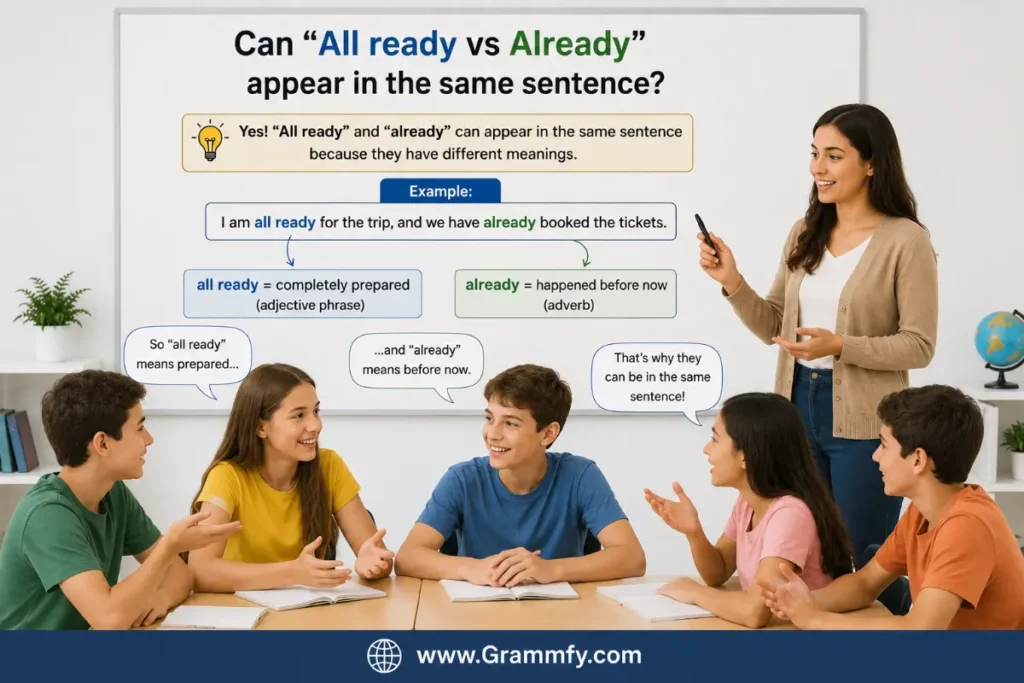
Yes.
This is one of the best ways to understand the distinction.
We are all ready, but the bus has already left.
The first phrase describes preparation.
The second word describes an earlier event.
Another example:
The students are all ready, but the teacher has already started the lesson.
Again:
- all ready = prepared
- already = happened before now
You can even write:
We’re all ready because we’ve already packed everything.
The two forms have different jobs but work perfectly together.
What are the closest confusing alternatives?
All ready vs all set
These expressions are very close.
| Phrase | Meaning | Example |
|---|---|---|
| All ready | Completely prepared | We are all ready to leave. |
| All set | Completely prepared or arranged | We are all set to leave. |
In everyday American English, all set is often more conversational.
Are you all set?
sounds very natural in speech.
All ready is also correct:
Are you all ready?
The difference is mainly style and context rather than meaning.
Already vs previously
These words can overlap, but they are not identical.
| Word | Main idea | Example |
|---|---|---|
| Already | Before now or sooner than expected | I have already seen it. |
| Previously | At an earlier time | I previously saw it. |
Already often sounds more natural in everyday conversation.
Previously is more formal and is common in reports, articles, and academic writing.
Compare:
We’ve already discussed this.
with:
We previously discussed this matter.
Both refer to an earlier discussion, but the second sounds more formal.
What are common mistakes with “All ready vs Already”?
Mistake 1: Writing already when you mean prepared
Incorrect:
We are already for the meeting.
Correct:
We are all ready for the meeting.
The first sentence is missing the idea of preparation.
Mistake 2: Writing all ready when you mean before now
Incorrect:
I have all ready finished my homework.
Correct:
I have already finished my homework.
The action happened before now, so the one-word adverb is required.
Mistake 3: Thinking all ready is always wrong
Some writers learn that already is one word and then use it everywhere.
But all ready is completely correct when you mean completely prepared.
The guests are all ready.
This is not a spelling mistake.
Mistake 4: Confusing “all” with “already”
The phrase all ready contains the normal word all.
Compare:
They are all ready.
with:
They are already here.
The first talks about preparation.
The second talks about arrival before now.
Mistake 5: Changing the meaning by removing the space
Compare:
The children are all ready.
and:
The children have already arrived.
The difference isn’t merely spelling. The grammatical meaning changes too.
When should you NOT use all ready?
Don’t use all ready when you’re talking about an action that happened earlier.
For example:
I have all ready completed the form.
If you mean the form was completed before now, write:
I have already completed the form.
Use all ready only when the idea of preparation or readiness is intended.
When should you NOT use already?
Don’t use already when you mean “completely prepared.”
For example:
Are you already to leave?
This is incorrect if you mean “Are you prepared to leave?”
Use:
Are you all ready to leave?
Or simply:
Are you ready to leave?
Already needs the meaning of earlier time, previous completion, or sooner-than-expected timing.
What are the antonyms?
Antonyms of all ready
The opposite of being completely prepared can include:
- unprepared
- unready
- unfinished
- incomplete
- disorganized
- not set
Example:
The team is all ready.
Opposite:
The team is unprepared.
Antonyms of already
Depending on the context, possible opposites include:
- not yet
- later
- afterward
- eventually
- still pending
The most useful opposite is often yet in negative or question forms.
Compare:
I have already finished.
with:
I haven’t finished yet.
Or:
Have you finished yet?
The word yet often refers to something that has not happened up to the present time.
Why is “not yet” useful for remembering already?
Already and yet often appear in contrasting sentences.
I’ve already eaten.
I haven’t eaten yet.
The first says an action happened before now.
The second says the action has not happened up to now.
This contrast can help English learners understand time expressions.
Another pair:
She has already arrived.
She hasn’t arrived yet.
These sentences make the timeline easy to see.
What does “already” mean when someone sounds surprised?
Already can carry a feeling of surprise.
For example:
You’re already leaving?
The speaker thought the person would stay longer.
Another example:
It’s already midnight!
The speaker may be surprised that so much time has passed.
In these sentences, already doesn’t simply mean “before now.” It can also suggest earlier than expected.
That extra meaning is common in everyday speech.
Can already be used with different verb tenses?
Yes.
Present perfect
I have already finished.
Simple past
I already finished.
The simple past version is common in American English conversation.
Present tense
I already know.
Past perfect
She had already left when I arrived.
Future-related context
By tomorrow, they will already have completed the work.
These examples show that already is flexible. Its main job is to establish that something happened or became true before a relevant point in time.
Can all ready describe people and things?
Yes.
It can describe people:
The children are all ready.
The decorations are all ready.
The volunteers are all ready.
Everything is all ready for the event.
The exact meaning depends on what is being described, but the central idea remains preparation.
How can you remember the difference in five seconds?
Use the space test.
Two words: all ready
Ask:
Can I say “completely prepared”?
If yes:
all ready
Example:
We are all ready.
One word: already
Ask:
Can I say “before now” or “by now”?
If yes:
already
Example:
We have already finished.
Then remember:
All ready = prepared. Already = earlier.
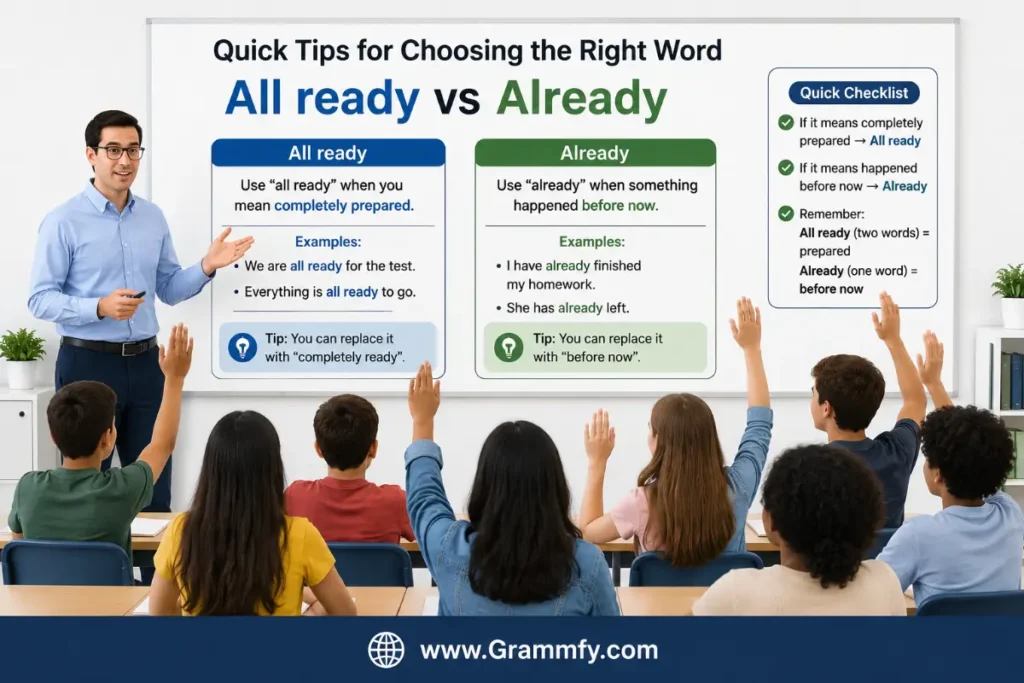
Quick tips for choosing the right word “All ready vs Already”
- Use all ready for preparation.
- Use already for an earlier action or state.
- Think two words = completely ready.
- Think one word = before now.
- Replace all ready with “completely prepared” to test it.
- Replace already with “before now” to test it.
- Use all set as a casual alternative to all ready.
- Use previously as a more formal alternative to already when the context allows.
- Don’t use already when you mean “prepared.”
- Don’t use all ready when you mean “before now.”
- In texts, both forms are common and natural.
- In formal writing, choose the form based on meaning, not appearance.
- Read the whole sentence aloud if you’re unsure.
- Look for a time idea: if something happened earlier, already is probably right.
- Look for a preparation idea: if someone or something is prepared, all ready is probably right.
A final comparison at a glance
| Question | Use | Example |
|---|---|---|
| Are you completely prepared? | All ready | We are all ready. |
| Did something happen before now? | Already | We have already finished. |
| Is everyone prepared? | All ready | Everyone is all ready. |
| Has everyone arrived before now? | Already | Everyone has already arrived. |
| Are the documents prepared? | All ready | The documents are all ready. |
| Were the documents sent earlier? | Already | The documents were already sent. |
| Are you prepared to go? | All ready | We’re all ready to go. |
| Did you leave earlier than expected? | Already | We already left. |
Conclusion
The difference between these two forms becomes simple once you focus on meaning instead of spelling. All ready describes a state of complete preparation, while already places an action or condition earlier on a timeline. That distinction works across school writing, professional emails, casual texts, and everyday conversation.
A quick substitution test can help. If you can replace the expression with “completely prepared,” choose all ready. If you can replace it with “before now” or “by now,” choose already. You can also remember the short rule: all ready means prepared; already means earlier.
Once you start looking for preparation versus time, the choice becomes almost automatic. Use the word that matches your meaning, and your writing will stay clear and natural.
Frequently Asked Questions
What is the difference between all ready and already?
All ready means completely prepared, while already means before now or sooner than expected. The space changes both the grammar and the meaning.
Is “I am all ready” correct English?
Yes, “I am all ready” is correct when you mean “I am completely prepared.” You can also simply say “I am ready.”
Is “I am already ready” grammatically correct?
Yes. It means you became ready before the expected time or before the current moment. For example, “You don’t need to wait for me; I am already ready.”
What’s another way to say already?
Depending on the sentence, you can use previously, earlier, before, by now, or beforehand. The best replacement depends on the exact time relationship.
Should I write all ready or already in an email?
Use all ready when describing preparation and already when describing something that has happened earlier. For example, “The files are all ready” differs from “I have already sent the files.”
Is all ready one word or two words?
All ready is always two words when it means completely prepared. Already is one word when it means before now or sooner than expected.
Why do all ready and already sound the same?
They have very similar pronunciation because they developed from related words and combinations. Their meanings and grammatical functions, however, are different.
