
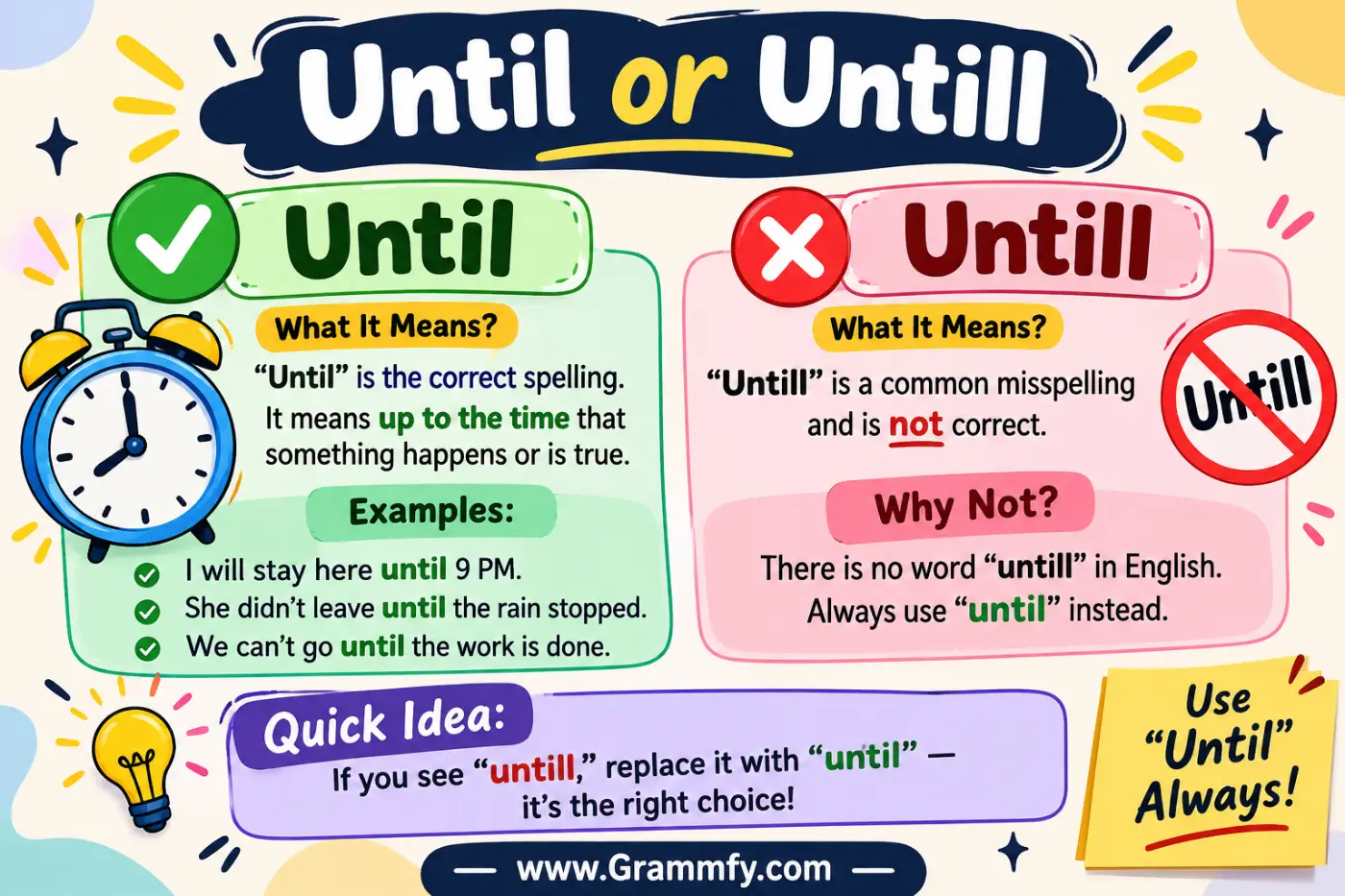
Until or Untill is a common spelling question that can cause confusion when writing emails, school assignments, work messages, or everyday texts. Both forms look similar, but only one is correct in standard English.
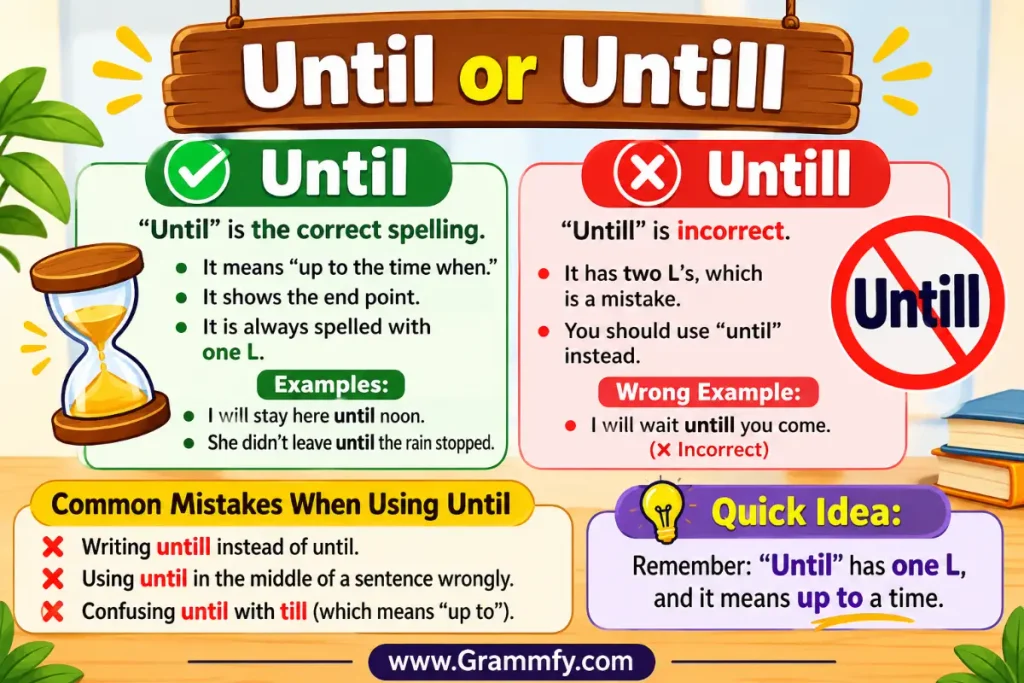
The correct spelling is “until.” The word untill is a misspelling. Use until when you want to show that an action, event, or situation continues up to a particular time or point.
For example, you might write, “I will wait until Monday” or “The library stays open until 8 p.m.” In both sentences, the word connects an action or situation to a specific time.
Knowing the correct spelling helps you avoid mistakes in formal and casual writing. This guide explains the meaning, origin, pronunciation, common uses, alternatives, and examples of until. You’ll also learn when to use similar words such as till, by, and through.
Quick Answer: Until is the correct spelling in standard English. Untill is incorrect because it has an extra l. Use until to show how long something continues or when it stops.
English has many words that look or sound similar but have different meanings and spellings. Explore more commonly confused words to spot these tricky mistakes and learn which word fits best. These simple comparisons can help you write more clearly and improve your spelling with confidence.
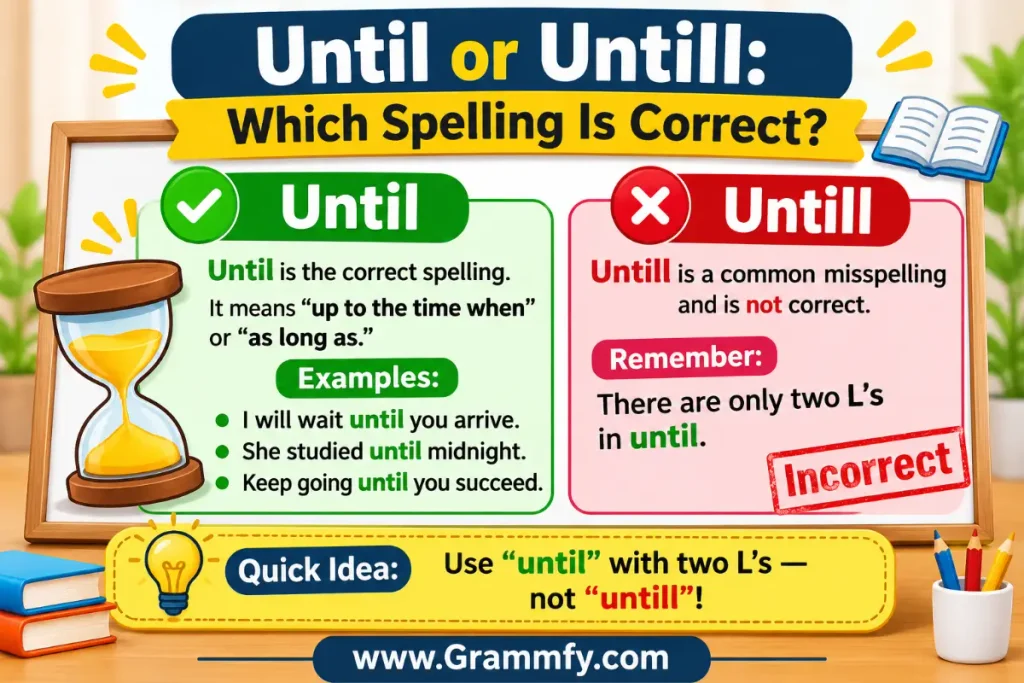
Until or Untill: Which Spelling Is Correct?
The correct spelling is until, with one l at the end. You should use it in essays, emails, text messages, reports, and everyday conversations.
Untill is not an accepted standard spelling. Although people sometimes type it by mistake, adding another l doesn’t create a different word or meaning.
| Spelling | Correct or Incorrect? | Explanation |
|---|---|---|
| Until | Correct | Standard English spelling |
| Untill | Incorrect | Contains an extra letter l |
Here are two examples:
- Correct: Please stay here until I return.
- Incorrect: Please stay here untill I return.
The first sentence uses the accepted spelling. The second contains a spelling error.
Why Do People Confuse Until or Untill?
The confusion usually happens because English has many words that end with a double l. Words such as still, skill, bill, and fill may influence how people spell until.
Typing habits can also cause mistakes. Someone may add an extra l without noticing it, especially when writing quickly.
Remember that until has only five letters:
- U
- N
- T
- I
- L
There is no second l at the end.
What Does Until Mean?
Until is a preposition and conjunction that refers to the time when an action, event, or situation stops or reaches a particular point.
It helps readers understand how long something continues.
For example:
- I studied until midnight.
- The shop remains open until Friday.
- Wait until the teacher arrives.
In the first sentence, the studying continues up to midnight. In the second, the shop remains open up to Friday. The final example asks someone to wait for a particular event.
Until as a Preposition
A preposition connects a noun or noun phrase to another part of a sentence. When until works as a preposition, it usually comes before a time expression.
Examples:
- We stayed at the beach until sunset.
- The office will remain closed until Monday.
- She worked until 6 p.m.
- The offer is available until the end of the month.
Until as a Conjunction
A conjunction connects words, phrases, or clauses. Until can introduce a clause that explains when an action or situation ends.
Examples:
- Wait until I finish my work.
- Don’t leave until the meeting ends.
- She kept practicing until she learned the song.
- I’ll stay here until you come back.
In these examples, until connects the main action to another event.
Word Origin: Where Did Until Come From?
Understanding a word’s history can make its spelling easier to remember. The word until has roots in older forms of English and developed over many centuries.
It comes from Middle English unto, which combined the preposition to with the prefix un-. Its earlier history also connects to Old Norse und, meaning “as far as” or “up to.”
Over time, English speakers began using until to express the point at which an action or situation ends.
The spelling eventually settled into the form we use today.
How Did the Spelling Develop?
English spelling has changed throughout history. Many words once had different forms, but regular use helped establish their modern spellings.
Until became the accepted form. The extra l in untill doesn’t come from a separate historical meaning. It’s simply a common spelling mistake.
You don’t need to memorize the full history to spell it correctly. Just remember that the standard word ends with one l.
How to Use Until in Everyday English
The word until works in many situations. You can use it to describe a deadline, a waiting period, a continuing activity, or a change that happens at a particular time.
The meaning depends on the sentence, but the central idea stays the same: something continues up to a particular point.
1. To Show When an Action Stops
Use until when an activity continues and then ends at a particular time.
Examples:
- I watched television until 10 p.m.
- They played football until sunset.
- She worked until everyone left.
- We talked until the restaurant closed.
Each sentence identifies the point when the activity stops.
2. To Describe a Waiting Period
You can use until when someone needs to wait for a person, event, or result.
Examples:
- Wait until your name is called.
- I’ll stay here until you arrive.
- Please don’t open the package until tomorrow.
- He waited until the doctor returned.
This construction is common in instructions and everyday conversations.
3. To Talk About Deadlines
Until can also show how long an offer, opportunity, or arrangement remains available.
Examples:
- You can submit your application until Friday.
- The discount is available until the end of the week.
- Registration remains open until December 15.
- The payment window stays active until midnight.
When writing about deadlines, make sure the reader understands the exact date and time.
4. To Describe a Change
Use the word when one situation continues before another event changes it.
Examples:
- The road remained quiet until the rain stopped.
- He didn’t understand the lesson until the teacher explained it.
- The children stayed inside until the weather improved.
- I didn’t notice the mistake until I checked the document.
These sentences show that one condition continued before something different happened.
Synonyms for Until: 20 Useful Alternatives
The best alternative depends on your sentence. Some words describe a time limit, while others show continuation, a deadline, or a final point.
Not every alternative works in every situation. Check the meaning before replacing until with another expression.
| Word or Phrase | Meaning | Tone | Example |
|---|---|---|---|
| Till | Up to a time | Everyday | Stay till noon. |
| Up to | As far as a point | Neutral | Work up to Friday. |
| Up until | Continuing to a point | Neutral | We waited up until midnight. |
| Through | During an entire period | Neutral | Open through Sunday. |
| Before | Earlier than a time | Neutral | Finish before noon. |
| By | No later than a deadline | Neutral | Submit it by Monday. |
| Pending | While awaiting something | Formal | Payment is pending approval. |
| Prior to | Before a particular time | Formal | Arrive prior to the meeting. |
| Up to the point when | Until a particular event | Formal | Continue up to the point when the timer ends. |
| Up to the time that | Until a specified moment | Formal | Wait up to the time that the manager arrives. |
| All the way to | Continuing to a final point | Everyday | We drove all the way to sunset. |
| Right up to | Continuing very close to a point | Everyday | She practiced right up to the show. |
| As far as | Reaching a particular point | Neutral | The road stays open as far as the bridge. |
| During | Within a period | Neutral | No calls during the meeting. |
| Throughout | During the whole period | Neutral | The service runs throughout the weekend. |
| While | During the time something happens | Everyday | Stay here while I work. |
| Awaiting | Waiting for an event or result | Formal | The request is awaiting approval. |
| Until such time as | Up to a specified future point | Very formal | Remain here until such time as instructed. |
| Pending the arrival of | While waiting for someone | Formal | Wait pending the arrival of the supervisor. |
| Before the end of | Earlier than the closing point | Neutral | Reply before the end of the day. |
Important: These expressions are related in meaning, but they’re not always interchangeable. For example, by Friday gives a deadline, while until Friday describes how long something continues.
Simple Alternatives
Simple alternatives work well in everyday conversations and basic writing.
- Till
- Up to
- Up until
- Before
- By
Example:
- Original: I will stay until noon.
- Alternative: I will stay till noon.
Both sentences communicate the same general time limit.
Everyday Alternatives
These expressions sound natural in regular conversations, messages, and informal writing.
- Right up to
- All the way to
- Through
- While
- As far as
Example:
- Original: The store stays open until Sunday.
- Alternative: The store stays open through Sunday.
Check the intended closing date because through Sunday normally includes Sunday.
Formal Alternatives
Formal alternatives can work in reports, business documents, policies, and professional communication.
- Prior to
- Pending
- Up to the point when
- Up to the time that
- Until such time as
Example:
- Original: Please wait until the review is complete.
- Formal: Please wait until such time as the review is complete.
The second sentence sounds more formal, but it may be unnecessarily wordy. Choose a simpler expression when it communicates the same idea.
Casual and Conversational Alternatives
Some expressions sound more natural in relaxed speech.
- Till
- Right up to
- All the way to
- Up until
- While
Example:
- Original: We talked until midnight.
- Casual: We talked till midnight.
The meaning stays almost the same.
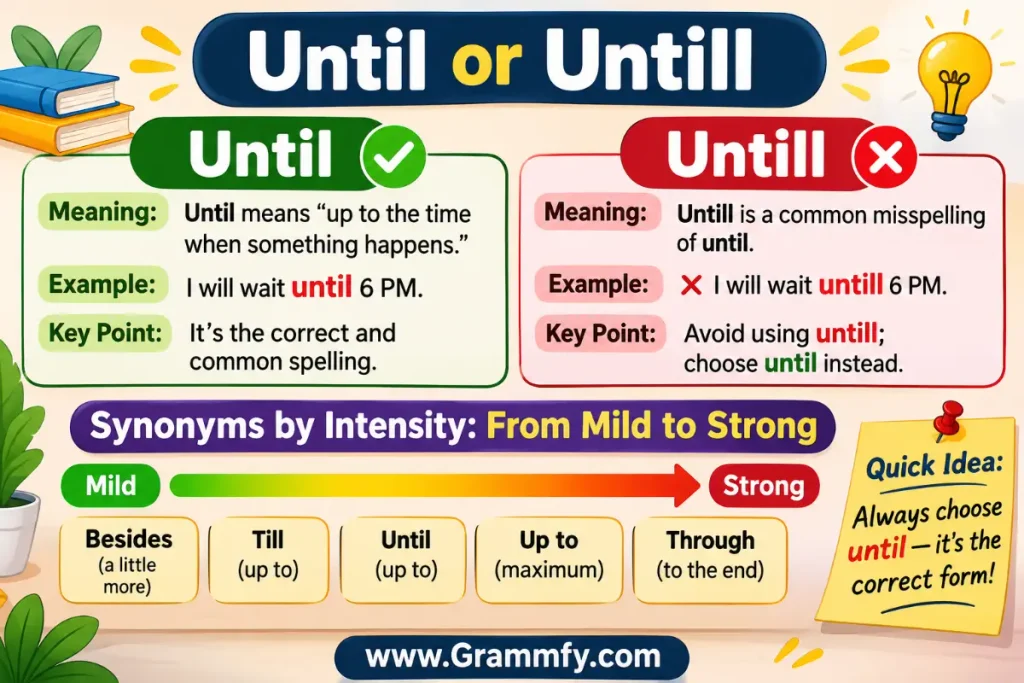
Synonyms by Intensity: From Mild to Strong
Some alternatives suggest a simple time limit. Others emphasize that an activity continues for a long period or reaches a final point.
The following list moves from basic expressions to more emphatic ones.
| Level | Alternative | Example |
|---|---|---|
| 1. Mild | By | Finish by Friday. |
| 2. Mild | Before | Come before sunset. |
| 3. Mild | While | Wait while I finish. |
| 4. Mild | Till | Stay till noon. |
| 5. Moderate | Up to | Continue up to the gate. |
| 6. Moderate | Through | The event runs through Sunday. |
| 7. Moderate | Throughout | The service operates throughout the day. |
| 8. Moderate | Up until | We worked up until midnight. |
| 9. Strong | Right up to | She practiced right up to the performance. |
| 10. Strong | All the way to | They traveled all the way to the final stop. |
These levels describe emphasis rather than strict dictionary rankings. Choose the expression that fits your intended meaning.
Until vs. Till: What’s the Difference?
Until and till have nearly the same meaning. Both describe something that continues up to a particular time or point.
The main difference is style. Until is common in both formal and informal writing, while till often sounds more conversational.
| Feature | Until | Till |
|---|---|---|
| Meaning | Up to a time | Up to a time |
| Tone | Neutral | Casual or neutral |
| Formal writing | Suitable | Usually acceptable |
| Everyday speech | Common | Common |
| Spelling | One L at the end | Two Ls at the end |
Examples:
- I’ll wait until you return.
- I’ll wait till you return.
Both sentences are correct.
Is Till Short for Until?
No. Till is not simply a shortened spelling of until. It is an established English word with its own history.
It has been used in English for centuries. You can use either form without changing the basic meaning.
Don’t confuse till with ’til, which is sometimes used as an informal shortened form. In standard writing, till or until is usually the safer choice.
Until vs. By: What’s the Difference?
These words are often confused because both relate to time. However, they communicate different ideas.
- Until describes how long an action or situation continues.
- By describes the latest time something must happen.
| Until | By |
|---|---|
| I will work until Friday. | I will finish the work by Friday. |
| Stay here until 5 p.m. | Arrive here by 5 p.m. |
| The shop stays open until Sunday. | Pay the bill by Sunday. |
When Should You Use Until?
Use it when you want to describe an activity or situation that continues to a particular point.
Example: I will stay at the office until 6 p.m.
This means your stay continues up to 6 p.m.
When Should You Use By?
Use it when something needs to happen before or at a deadline.
Example: Please send the report by 6 p.m.
This means the report must arrive no later than 6 p.m.
Until vs. Through: What’s the Difference?
Through and until can both describe a period of time, but their use can differ.
Until usually identifies the point when something stops. Through often emphasizes that something continues during an entire period, including its final day.
Examples:
- The office is open until Friday.
- The office is open through Friday.
The first sentence can mean the office closes when Friday arrives, depending on context. The second usually means it remains open for Friday as well.
Use through when you want to make clear that the final day is included.
US vs. UK English: Is the Spelling Different?
The spelling of until is the same in American and British English. Both varieties use the same five-letter form.
You don’t need to change the spelling when writing for readers in the United States, United Kingdom, Canada, or Australia.
| English Variety | Correct Spelling | Incorrect Spelling |
|---|---|---|
| American English | Until | Untill |
| British English | Until | Untill |
| Canadian English | Until | Untill |
| Australian English | Until | Untill |
Does British English Prefer Till?
Both till and until are used in British English. The choice often depends on the sentence and writing style.
Examples:
- British English: The train service operates until midnight.
- British English: The train service operates till midnight.
Both are natural.
American English also uses both forms. Neither variety accepts untill as the standard spelling.
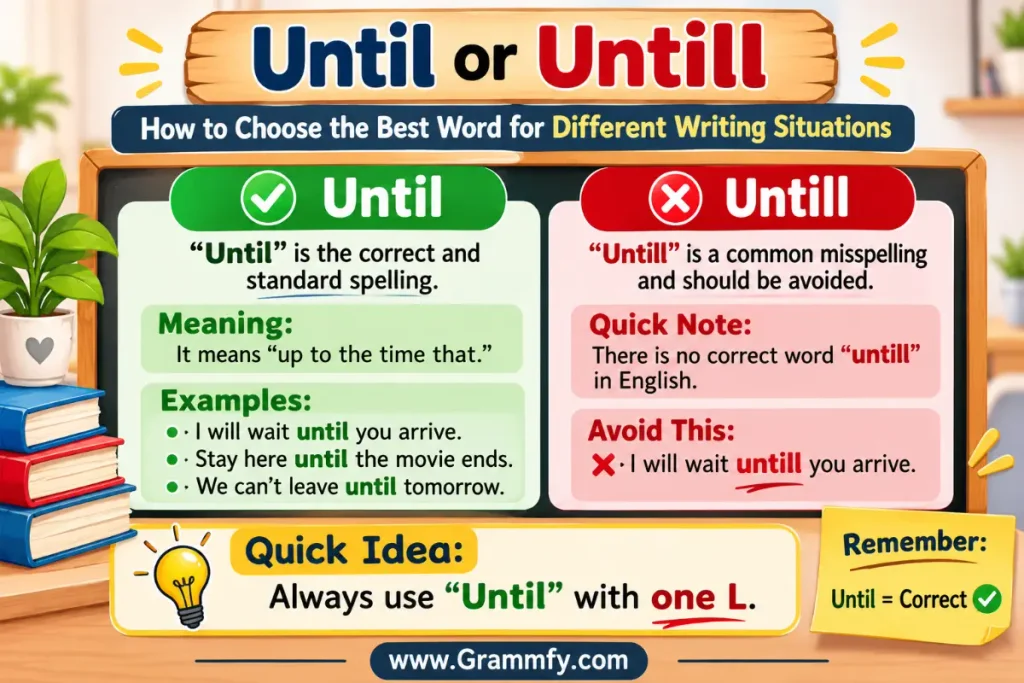
How to Choose the Best Word for Different Writing Situations
The best word depends on your audience and purpose. A text message doesn’t need the same tone as a business report.
Here are some practical ways to choose the right expression.
1. Until in a Resume
Resumes need clear information about work history, employment dates, and responsibilities.
Use until when you want to describe how long a position, project, or responsibility continued.
Examples:
- Worked as a sales assistant until June 2025.
- Managed daily operations until the company expanded.
- Served as a team leader until the project ended.
Writing tip: If you’re listing employment dates, use clear month and year formats whenever possible. For example, “January 2023–June 2025” is more direct than a long sentence.
2. Until in an Essay
Essays often discuss events, historical periods, changes, and time sequences.
Until helps show when an action or condition ended.
Examples:
- The community remained isolated until a new road connected it to the city.
- The policy stayed in place until the government introduced new rules.
- People relied on traditional methods until modern technology became widely available.
Writing tip: Use until to make time relationships clear. Avoid repeating the same sentence structure throughout your essay.
3. Until in Text Messages
Text messages usually need simple, natural language. You can use either until or till.
Examples:
- I’ll be busy until 7.
- Wait till I get home.
- Don’t start until I arrive.
- Can you stay until tomorrow?
Writing tip: Choose the expression that sounds natural. You don’t need a complicated alternative when a simple word works.
4. Until in Professional Emails
Professional emails should communicate dates, waiting periods, and deadlines clearly.
Examples:
- Please keep the document open until I review it.
- The updated offer remains valid until November 30.
- We will wait until the client confirms the appointment.
- Kindly keep your application active until further notice.
Writing tip: When a deadline matters, include the date, time, and time zone if needed. This prevents confusion between people working in different locations.
5. Until in Everyday Speaking
In conversations, both until and till sound natural.
Examples:
- I’ll wait until you finish.
- We can stay till sunset.
- She worked until midnight.
- Don’t leave until I call you.
Speaking tip: Don’t worry about choosing a more formal alternative. Use the word that makes your meaning clear.
15 Original Example Sentences Using Until
Examples make spelling rules easier to understand. The following sentences cover school, work, travel, family life, shopping, and other everyday situations.
- School: The students stayed in the classroom until their teacher arrived.
- Work: Daniel worked on the presentation until he completed every slide.
- Travel: We waited at the station until the next train arrived.
- Family: My mother asked me to stay home until my brother returned.
- Shopping: The store will offer special prices until the end of the month.
- Technology: Keep your computer connected until the software update finishes.
- Health: The nurse asked the patient to rest until the doctor returned.
- Weather: The children played indoors until the storm passed.
- Sports: The team practiced every evening until the championship began.
- Cooking: Leave the cake in the oven until the top turns golden brown.
- Education: Sarah studied the difficult chapter until she understood the main idea.
- Business: The company extended its registration period until Friday.
- Personal plans: I’ll save money until I can afford a new laptop.
- Entertainment: We watched the movie until the final scene ended.
- Communication: Please don’t share the news until everyone knows about the decision.
More Examples With Negative Sentences
Until also appears in negative sentences. These sentences often describe something that doesn’t happen before a certain event.
Examples:
- I didn’t know about the meeting until yesterday.
- She won’t leave until her work is finished.
- Don’t switch off the machine until the light turns green.
- He didn’t understand the instructions until someone explained them.
- We can’t make a decision until we receive the results.
Pay attention to the relationship between the negative action and the event that follows until.
Common Mistakes When Using Until
Even when you know the correct spelling, you can still make mistakes with its use. Some errors involve extra letters, while others involve incorrect sentence structure or confusion with related time expressions.
1. Adding an Extra L
This is the most common spelling mistake.
- Incorrect: I will wait untill Monday.
- Correct: I will wait until Monday.
The correct form has one l at the end.
2. Confusing Until With By
These words don’t always express the same meaning.
- Incorrect for a deadline: Please submit the assignment until Friday.
- Correct: Please submit the assignment by Friday.
Use by when you mean no later than a particular time.
3. Using Until Instead of Before
Before means earlier than a specific event or time. Until describes continuation up to a point.
Compare:
- Please arrive before 9 a.m.
- Please stay until 9 a.m.
The first sentence gives an arrival requirement. The second tells someone how long to stay.
4. Forgetting the Meaning of the Final Point
A sentence should make it clear what continues and when it ends.
Unclear: The office is open until the weekend.
Clearer: The office is open until Friday evening.
Specific time references help readers understand your message.
5. Using an Incorrect Verb Form After Until
When until introduces a future time clause, English normally uses the present simple rather than will.
- Incorrect: I’ll wait until you will arrive.
- Correct: I’ll wait until you arrive.
The main clause can use will, but the time clause normally uses the present tense.
More examples:
- Correct: I’ll call you until you answer.
- Correct: I’ll wait until you answer.
However, the first sentence can sound unnatural depending on the intended meaning. If you mean that you will keep calling, write, “I’ll keep calling until you answer.”
6. Treating Until and Till as Different in Meaning
Some writers believe till is always incorrect or less grammatical. That’s not true.
Both are accepted English words. The choice is mainly about tone and style.
7. Using a Long Alternative When a Simple Word Works
Long expressions can make sentences harder to read.
Wordy: We will remain at this location up to the time that the manager arrives.
Better: We will stay here until the manager arrives.
Choose direct wording whenever possible.
When Should You NOT Use Until?
Although until is useful, it doesn’t fit every sentence about time. Choosing the wrong expression can change the meaning of your message.
Here are situations where another word works better.
When You Mean a Final Deadline
Use by instead of until when an action must happen no later than a particular time.
- Less suitable: Finish your application until Monday.
- Better: Finish your application by Monday.
When You Mean an Earlier Time
Use before when something needs to happen earlier than a specific point.
- Less suitable: Please arrive until 8 a.m.
- Better: Please arrive before 8 a.m.
When You Mean the Whole Duration
Use throughout when you want to emphasize the entire period.
- Original: The music played until the evening.
- Alternative: The music played throughout the evening.
The second sentence focuses on the complete evening rather than just the stopping point.
When You Mean a Condition That Continues
Use while when two actions happen during the same period.
- Original: Stay here until I work.
- Better: Stay here while I work.
The word while makes the relationship between the two activities clearer.
Antonyms of Until
Until doesn’t have one exact opposite in every context. However, some time expressions communicate a different or contrasting relationship.
| Opposite or Contrasting Expression | Meaning | Example |
|---|---|---|
| Since | From a past point to now or another point | I’ve lived here since 2020. |
| From | Starting at a particular time | The office opens from Monday. |
| Starting at | Beginning at a specified point | Classes begin starting at 9 a.m. |
| After | Later than a particular time | We went home after lunch. |
| Beyond | Later or farther than a limit | The deadline extends beyond Friday. |
| Following | Coming after something | We met following the event. |
These expressions are contextual contrasts, not direct dictionary antonyms.
For example, since often describes when something began, while until describes when something ends.
Compare:
- I have worked here since 2022.
- I will work here until 2028.
The first sentence identifies a starting point. The second identifies an ending point.
Quick Tips for Choosing the Correct Word
Use these practical tips when writing about time.
- Check the spelling: Write until with one final l.
- Think about the meaning: Ask whether you mean a starting point, ending point, or deadline.
- Choose between until and by: Use until for continuation and by for a deadline.
- Use till for casual writing: It works naturally in conversations and informal messages.
- Avoid unnecessary alternatives: A simple word is often clearer than a long phrase.
- Add exact times: Include a date or time when the reader needs a clear deadline.
- Check your sentence structure: Use the present simple in future time clauses beginning with until.
- Proofread your work: Look for the extra l before sending an email or submitting an assignment.
An Easy Memory Trick
Remember this simple rule:
Until has one L at the end.
Think of the word as a five-letter spelling pattern:
U + N + T + I + L = UNTIL
When you type another l, you’ve added a letter that doesn’t belong.
You can also remember this example:
“I’ll wait until the last minute.”
Both the spelling and sentence show the correct form.
Conclusion: Remember the Correct Spelling
Choosing between Until or Untill becomes easy when you remember one simple rule: until is always the correct standard spelling, and untill is a misspelling. The word has one l at the end and works in both formal and casual writing.
Use until when describing how long an action continues or when a particular event happens. You can also use till as a similar alternative, while by works better for deadlines. Pay attention to these differences when writing emails, essays, reports, and everyday messages.
A quick spelling check can prevent small mistakes and make your writing clearer. Keep the five-letter spelling in mind, and you’ll have no trouble using it correctly.
Frequently Asked Questions
1. Is Until or Untill the Correct Spelling?
Until is the correct spelling in standard English. Untill is incorrect because it contains an extra l.
2. Why Does Until Have Only One L?
The standard English spelling developed as until. There is no second l at the end, so adding one creates a spelling error.
3. Is Till the Same as Until?
Yes. Till and until have nearly the same meaning. Both describe something that continues up to a particular time or event.
4. What’s Another Word for Until?
Common alternatives include till, up to, through, and up until. The best choice depends on the sentence and whether you’re describing a deadline or a continuing action.
5. Can I Use Until in Formal Writing?
Yes. Until is suitable for formal writing, including essays, business emails, reports, and professional documents.
6. Is Until American or British English?
Until is used in both American and British English. The spelling doesn’t change between these varieties.
7. How Do I Remember the Correct Spelling?
Remember that until has five letters and ends with one l. You can practice by writing a short sentence, such as “Wait until tomorrow.”

Tylerbrooks is a US-based English grammar writer and contributor at Grammfy. He writes helpful articles about grammar, spelling, commonly confused words, and vocabulary. His goal is to explain English topics in simple language with clear examples and practical tips. Through his articles, he helps readers improve their writing and everyday English skills.