
When writing an email, text, or school assignment, you may wonder whether Until or Untill is the correct spelling. The two words look almost the same, but only until is correct in English. People often add an extra “l” by mistake, especially when typing quickly, so it’s easy to get confused. Whether you’re saying you’ll wait until tomorrow or work until evening, using the correct spelling helps keep your writing clear and natural.
English has many words that seem correct because they follow familiar spelling patterns. However, a word’s appearance doesn’t always tell you whether it’s accepted in everyday writing. The difference between these two spellings is easy to miss, especially when you’re typing quickly or relying on spellcheck.
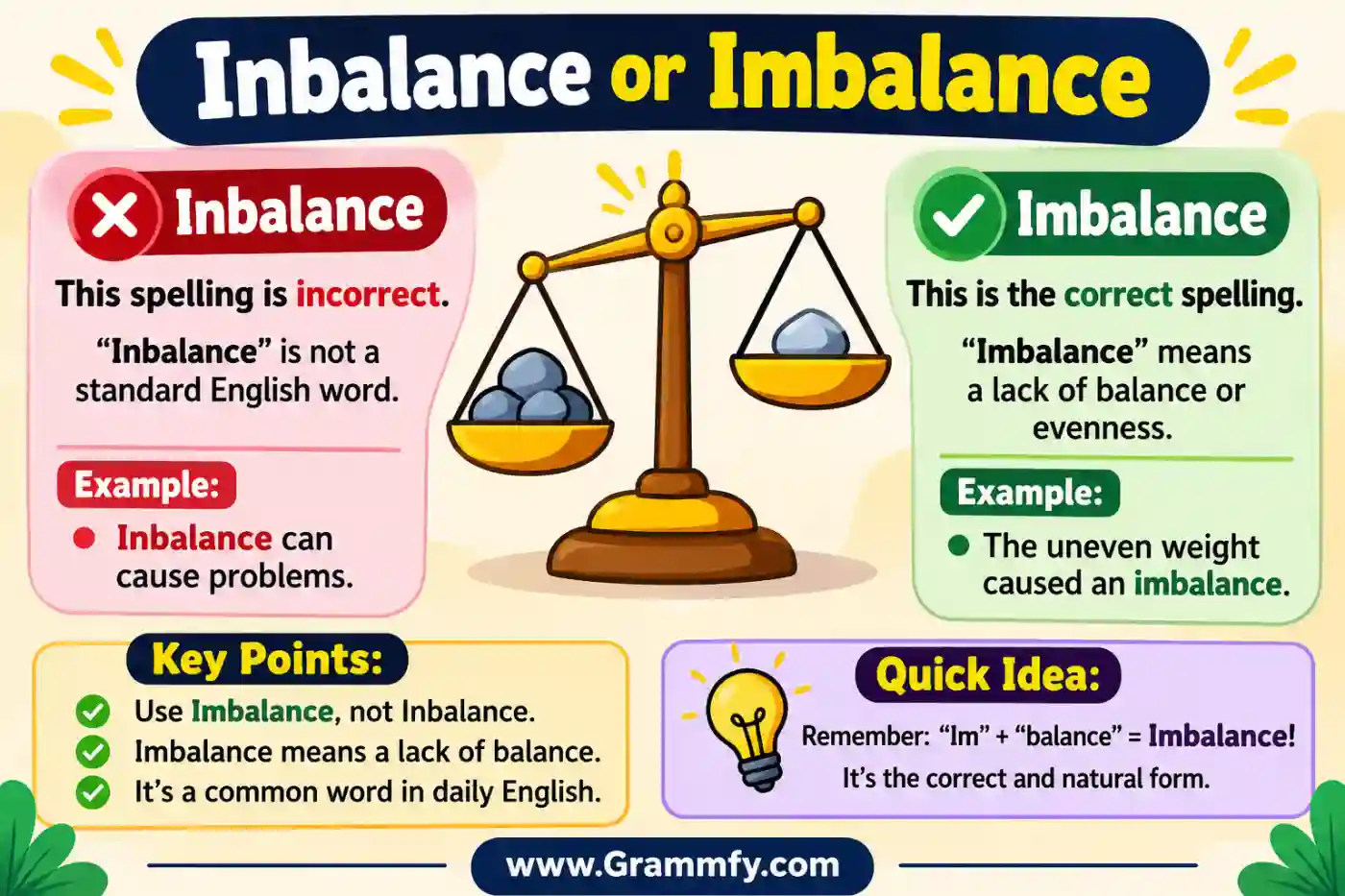
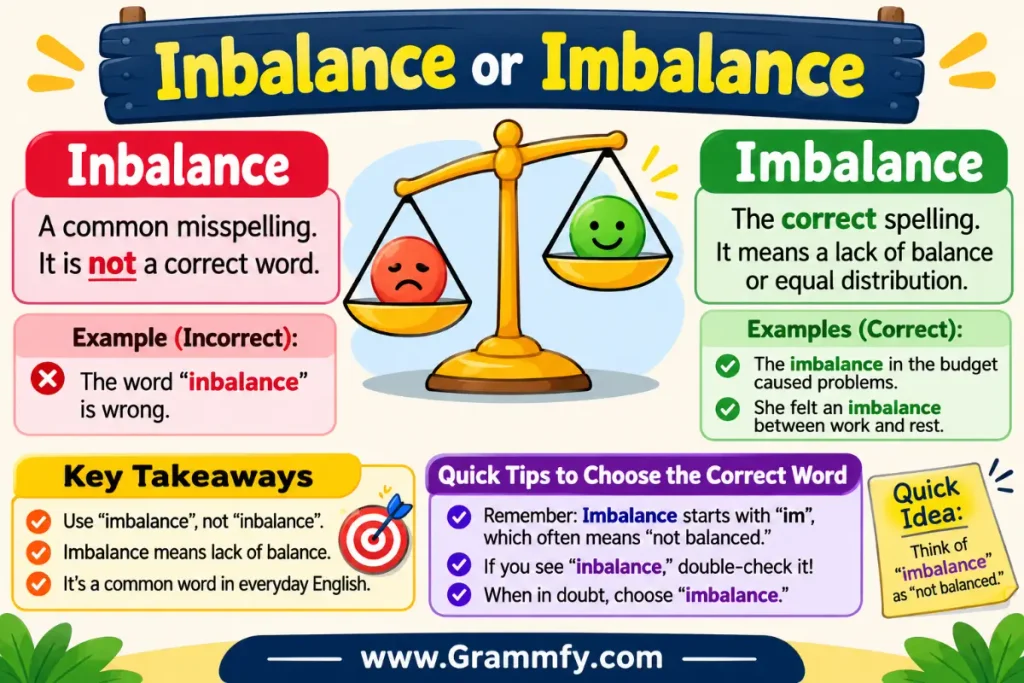
The correct spelling is imbalance. It means a lack of balance, equality, stability, or proportion between two or more things. Inbalance is a nonstandard spelling and should generally be avoided in formal and informal writing.
Understanding this spelling doesn’t require memorizing complicated grammar rules. In this guide, you’ll learn where the word comes from, what it means, which alternatives work best in different situations, how to use it in real sentences, and how to avoid similar spelling mistakes.
Spelling mistakes often happen when a word contains a repeated letter or an unusual spelling pattern. Learning commonly misspelled English words can help you avoid these errors and improve your writing confidence.
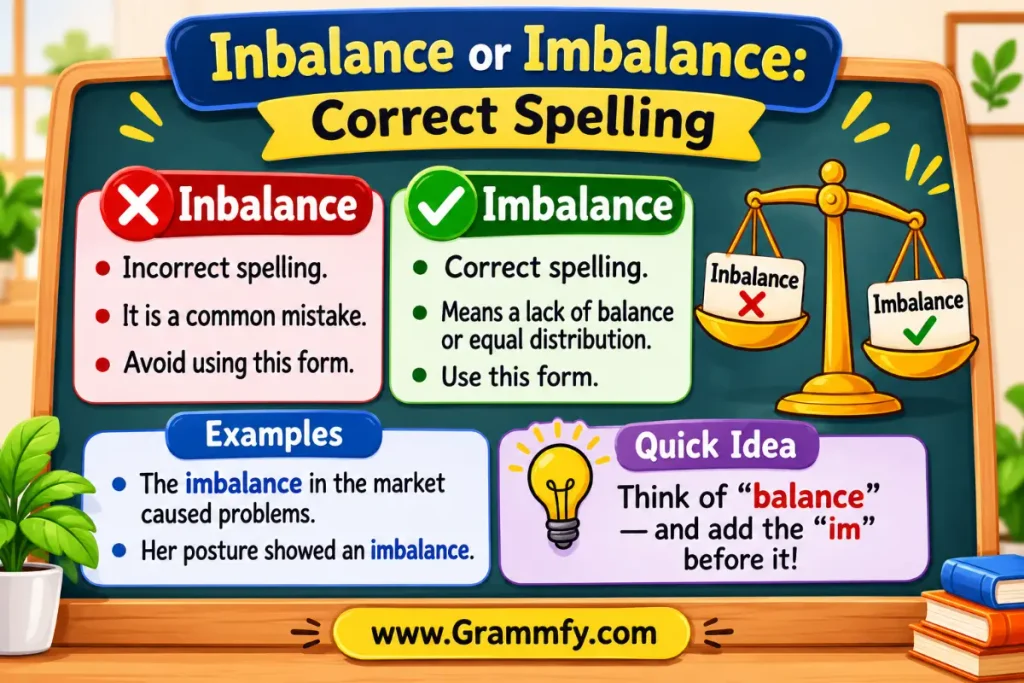
Inbalance or Imbalance: Correct Spelling
When comparing Inbalance or Imbalance, the difference comes down to standard spelling rather than meaning. People may write inbalance because they assume adding the prefix in- to balance creates the opposite meaning. Although that pattern works with many English words, it doesn’t work here.
| Word | Correct or incorrect? | Meaning |
|---|---|---|
| Inbalance | Nonstandard spelling | Intended to mean a lack of balance |
| Imbalance | Correct spelling | A lack of balance, equality, or proportion |
The word imbalance is the correct noun in standard American English. You can use it when discussing physical stability, emotions, finances, health, relationships, workloads, or differences between two things.
For example:
- The company has an imbalance between its income and expenses.
- A poor diet can create a nutritional imbalance.
- There is an imbalance of power in their relationship.
- The team struggled because of an imbalance in its workload.
The incorrect form inbalance is understandable because English has words such as incomplete, inaccurate, and inconsistent. However, spelling patterns don’t always work the same way across every word.
If you’re unsure which spelling to use, choose imbalance. It is the accepted form in dictionaries, professional writing, academic work, and everyday communication.
What Does Imbalance Mean?
Imbalance is a noun that describes a situation in which things aren’t equal, properly arranged, stable, or in the right proportion. It usually suggests that one part is greater, weaker, stronger, more important, or more influential than another part.
An imbalance can be small and temporary, or it can be serious enough to cause problems. The word doesn’t always mean something is completely wrong. Sometimes it simply describes a difference that needs attention.
Simple definition
An imbalance is a lack of balance between two or more things that should be equal, stable, or properly proportioned.
For example, when one employee has far more work than everyone else, there may be a workload imbalance. If a person spends too much time working and too little time resting, they may experience an imbalance in their daily routine.
How imbalance works in everyday life
The word is useful in many situations because balance is important in different areas of life.
| Situation | What the imbalance means |
|---|---|
| Work | One person has too many responsibilities |
| Health | Certain nutrients are too high or too low |
| Finance | Spending is greater than income |
| Relationships | One person gives more effort than the other |
| Education | A student focuses on one subject while ignoring others |
| Nature | A change disrupts an ecosystem |
| Technology | One system component receives more resources than another |
| Sports | A team has more strength in one area than another |
| Emotions | A person’s emotional needs or reactions are out of proportion |
| Business | Demand and supply aren’t properly matched |
A word like imbalance helps explain why something isn’t working as expected. Rather than saying something is “not right,” you can identify the problem more clearly.
Inbalance or Imbalance: Word Origin and History
Understanding the word’s origin makes the correct spelling easier to remember. English uses prefixes to change the meaning of words, but these prefixes aren’t always interchangeable.
Where does the word imbalance come from?
The word imbalance is formed from two parts:
- Im-: A prefix used in some words to express negation or an opposite condition.
- Balance: A state of equality, stability, or proper proportion.
When combined, imbalance describes a condition in which balance is missing or disrupted.
The prefix im- is a form of the negative prefix in-. It changes to im- before certain consonant sounds, especially b, m, and p, in many English words.
Examples include:
| Base word | Negative form | Meaning |
|---|---|---|
| Balance | Imbalance | Lack of balance |
| Possible | Impossible | Cannot happen or be done |
| Mature | Immature | Not fully developed |
| Mobile | Immobile | Unable to move |
| Patient | Impatient | Unable to wait calmly |
| Perfect | Imperfect | Not flawless |
| Polite | Impolite | Not showing politeness |
This spelling pattern helps explain why imbalance begins with im- instead of in-.
Why isn’t inbalance correct?
The spelling inbalance may look logical to someone who knows that in- can mean “not.” However, the standard word uses im- before the letter b.
The spelling change isn’t a separate grammar rule that you must apply every time you write. It’s part of how many negative words have developed and are accepted in English.
Compare these examples:
- Incorrect: The report shows an inbalance in spending.
- Correct: The report shows an imbalance in spending.
- Incorrect: An inbalance between work and rest can affect productivity.
- Correct: An imbalance between work and rest can affect productivity.
You may occasionally encounter inbalance in old material, informal writing, online posts, or misspelled documents. Seeing it in use doesn’t make it the standard spelling.
Is Imbalance a Noun, Verb, or Adjective?
A common question about Inbalance or Imbalance is whether the correct word can be used in different grammatical forms. The answer is yes, but imbalance itself is a noun. Related forms are used as verbs and adjectives.
| Word | Part of speech | Meaning | Example |
|---|---|---|---|
| Imbalance | Noun | A lack of balance | The imbalance affected the results. |
| Imbalanced | Adjective | Not balanced | The system is imbalanced. |
| Imbalance | Verb (rare) | To cause a lack of balance | Some older or specialized uses employ it as a verb. |
| Unbalanced | Adjective | Not balanced or stable | The shelf looks unbalanced. |
| Balance | Noun or verb | Stability or to make equal | Try to balance your schedule. |
Imbalance as a noun
This is the most common form. It names a condition, problem, or difference.
- There is an imbalance in the budget.
- The imbalance between the two teams was obvious.
- Doctors are checking for a hormonal imbalance.
Imbalanced as an adjective
The word imbalanced describes something that lacks proper balance or proportion.
- The market is imbalanced.
- She has an imbalanced schedule.
- An imbalanced diet may not provide enough nutrients.
Unbalanced as an adjective
Unbalanced is also correct and is often more natural in everyday English. It can describe something physically unstable, uneven, unfair, or emotionally unsettled.
- The table is unbalanced.
- His schedule is unbalanced.
- She felt emotionally unbalanced after the stressful week.
Although imbalanced and unbalanced sometimes overlap, their best uses depend on the sentence and the intended tone.
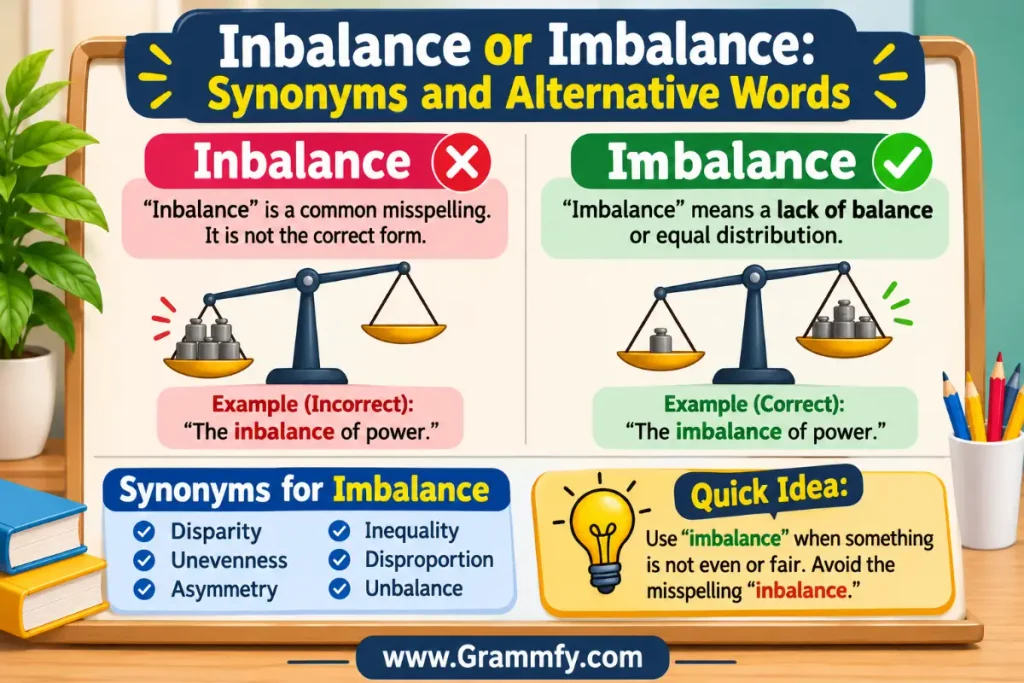
Inbalance or Imbalance: Synonyms and Alternative Words
When writing an article, email, report, or social media post, you don’t always need to repeat imbalance. Choosing a more precise word can make your writing clearer and less repetitive.
The best replacement depends on what kind of imbalance you’re describing. A financial problem may involve a disparity, while a physical problem may involve instability. An unfair relationship may involve inequality.
Below is a master list of alternatives grouped by tone and situation.
Simple synonyms for imbalance
These words are easy to understand and work well in everyday writing.
| Word | Meaning | Tone | Example |
|---|---|---|---|
| Difference | A way in which things aren’t the same | Neutral | There’s a difference in their workloads. |
| Unevenness | A lack of uniformity | Simple | The unevenness of the surface caused problems. |
| Gap | A noticeable difference | Everyday | There’s a gap between income and expenses. |
| Mismatch | Two things don’t fit or work well together | Everyday | The skills and job requirements were a mismatch. |
| Disproportion | A lack of proper proportion | Neutral | The response was out of proportion. |
| Instability | Lack of steadiness or security | Neutral | The system showed instability. |
| Inequality | Unequal treatment or distribution | Neutral | Income inequality remains a concern. |
Everyday synonyms for imbalance
These alternatives are useful in conversations, emails, blogs, and general writing.
| Word | Meaning | Tone | Example |
|---|---|---|---|
| Disparity | A significant difference between things | Everyday/formal | There is a disparity in wages. |
| Unequalness | The state of not being equal | Simple | Unequalness in the process was noticeable. |
| Distortion | A change that makes something inaccurate or uneven | Everyday | The imbalance caused a distortion in the results. |
| Irregularity | Something that doesn’t follow a normal pattern | Everyday | An irregularity appeared in the data. |
| Skew | A tendency toward one side | Everyday | The survey showed a gender skew. |
| Difference in proportion | A variation in relative amounts | Neutral | The difference in proportion was clear. |
| Shortfall | A shortage compared with what is needed | Everyday | The budget had a shortfall. |
| Excess | More than the required amount | Everyday | An excess of sugar can be unhealthy. |
Formal synonyms for imbalance
These words are more suitable for research, business, academic writing, technical reports, and professional discussions.
| Word | Meaning | Tone | Example |
|---|---|---|---|
| Disproportionality | A condition of unequal proportions | Formal | Disproportionality affected the outcome. |
| Discrepancy | A difference between things expected to match | Formal | The report revealed a discrepancy. |
| Inequity | Unfairness in distribution or treatment | Formal | The policy created inequity. |
| Asymmetry | A lack of symmetry or equal arrangement | Formal/technical | The structure displayed asymmetry. |
| Disequilibrium | A state of instability or lack of equilibrium | Technical | The market entered disequilibrium. |
| Divergence | A movement or difference away from similarity | Formal | A divergence in outcomes developed. |
| Maldistribution | Poor or unequal distribution | Technical | Maldistribution of resources affected the region. |
| Disbalance | A lack of balance; less common than imbalance | Formal/less common | The process created a disbalance in priorities. |
Slang and informal alternatives for imbalance
These words aren’t exact synonyms in every situation, but they’re useful in relaxed conversation.
| Word or phrase | Meaning | Tone | Example |
|---|---|---|---|
| Off | Not right or not in proper condition | Casual | Something feels off with this setup. |
| Lopsided | Heavily uneven on one side | Informal | The competition was lopsided. |
| Out of whack | Not working or arranged properly | Slang | My sleep schedule is out of whack. |
| Skewed | Biased or uneven | Casual | The results look skewed. |
| All over the place | Disorganized or inconsistent | Informal | His priorities are all over the place. |
| Uneven | Not equally distributed | Casual | The workload is uneven. |
| Tilted | Leaning toward one side | Informal | The discussion felt tilted toward one opinion. |
Not every alternative fits every sentence. Lopsided works well when one side is much stronger or larger. Disparity is useful when comparing two amounts. Instability is better when a situation can’t remain steady.
Inbalance or Imbalance: US vs. UK English
Some English words have different spellings in American and British English, such as color/colour, organize/organise, and center/centre. However, Inbalance or Imbalance isn’t a regional spelling difference.
Imbalance is the standard spelling in both American and British English.
| Region | Correct spelling | Incorrect/nonstandard form |
|---|---|---|
| American English (US) | Imbalance | Inbalance |
| British English (UK) | Imbalance | Inbalance |
| Canadian English | Imbalance | Inbalance |
| Australian English | Imbalance | Inbalance |
You can use imbalance in a school essay in the United States, a business report in the United Kingdom, an Australian news article, or a Canadian research paper. The spelling stays the same.
Does the meaning change between US and UK English?
No. The word has the same basic meaning in both regions. It describes a lack of balance, proportion, equality, or stability.
The only difference you may notice is the context in which it’s used. American and British writers may prefer different expressions in some situations, but neither region uses inbalance as the standard spelling.
Inbalance or Imbalance: Which Word Should You Use in Different Contexts?
The right word depends on your audience and what you’re trying to explain. In most situations, imbalance is the safest choice. However, using a more specific alternative may make your writing clearer.
In a resume or job application
When writing a résumé, cover letter, or professional profile, avoid vague statements. Describe the actual difference or problem instead of using a broad word without context.
Less clear:
– I helped solve an imbalance in the workplace.
Better:
- I helped redistribute tasks to address an imbalance in the team’s workload.
- I improved resource allocation to reduce disparities in team performance.
- I supported a more balanced workflow across departments.
The word imbalance is appropriate in professional writing, but concrete details help employers understand what you accomplished.
In an academic essay
Academic writing often requires precise language. Choose imbalance when explaining an unequal relationship between factors, results, resources, or groups.
Examples:
- The study identifies an imbalance in the distribution of resources.
- An imbalance between theoretical knowledge and practical experience may affect student performance.
- Researchers observed a disparity between the two groups.
For formal essays, disparity, inequality, asymmetry, and disequilibrium may be useful when they describe the issue more precisely.
In an email
Emails should be clear and direct. The correct spelling is important, but the message should also explain what needs to be changed.
Example:
- We noticed an imbalance in the current workload and would like to review task assignments.
- The report highlights an imbalance between expenses and available funding.
- Could we discuss ways to correct this imbalance before the next project begins?
Use imbalance when it’s the right word. Don’t replace it with a complicated synonym simply to sound formal.
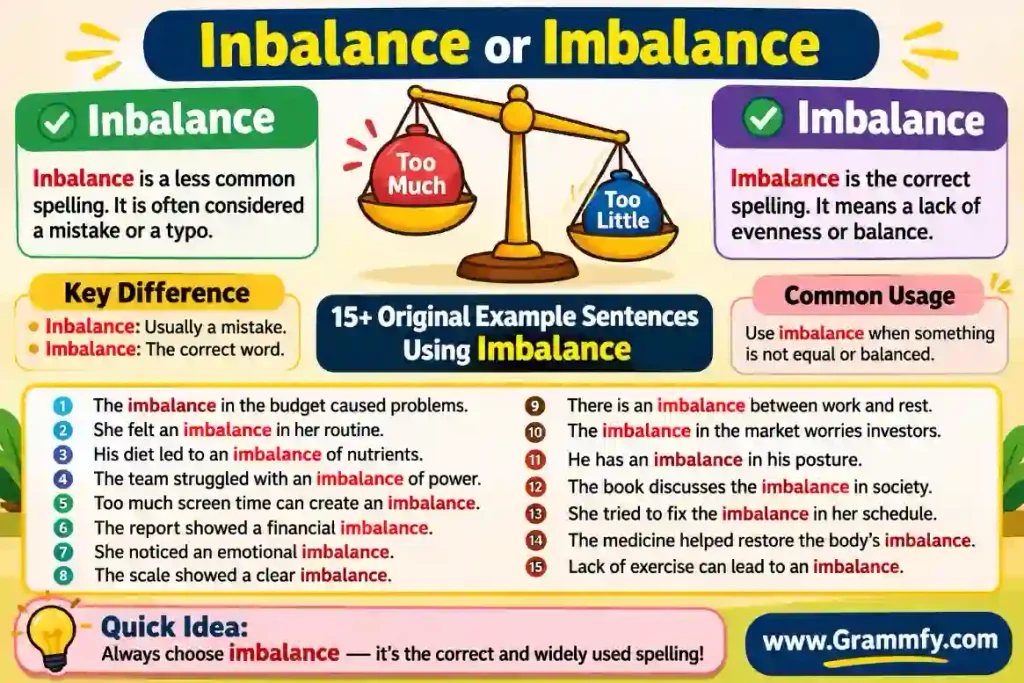
15+ Original Example Sentences Using Imbalance
The following examples show how the correct spelling works in different situations. Notice how the meaning changes depending on the topic.
School and education
- The teacher noticed an imbalance between reading and writing activities in the classroom.
- An imbalance between theory and practice made the course harder for some students.
- The school tried to address the imbalance in resources available to different classrooms.
- A student may develop an imbalance in study time by focusing too heavily on one subject.
Business and finance
- The company faced an imbalance between its operating costs and revenue.
- A supply imbalance caused prices to rise unexpectedly.
- The manager worked to reduce the imbalance in the team’s workload.
- The budget revealed an imbalance between spending and savings.
- The business experienced a temporary imbalance after demand increased.
Health and science
- An electrolyte imbalance can affect how the body functions.
- The doctor checked whether a hormonal imbalance could explain the symptoms.
- An imbalance in the ecosystem affected several animal populations.
- Researchers studied the imbalance between oxygen supply and demand.
Technology and systems
- The software showed an imbalance in processing resources.
- An imbalance in network traffic caused the website to slow down.
- The machine stopped working because of an imbalance in its rotating parts.
- A data imbalance can affect the performance of a machine-learning model.
These examples demonstrate that imbalance isn’t limited to one subject. It’s a flexible noun that can describe unequal amounts, unfair arrangements, physical instability, or a mismatch between related factors.
Inbalance or Imbalance: Close Synonyms Compared
Some words look like perfect replacements for imbalance, but they have different meanings. Choosing the wrong one may change the message.
Imbalance vs. Disparity — What’s the Difference?
Both words describe a difference, but disparity often emphasizes how large or unfair that difference is, especially between people, groups, or outcomes.
| Imbalance | Disparity |
|---|---|
| Lack of balance or proportion | A noticeable difference or inequality |
| Can describe physical, financial, emotional, or technical situations | Often used for social, economic, or measurable differences |
| Focuses on a condition that isn’t balanced | Focuses on the gap between two sides |
Examples:
- There is an imbalance in the team’s workload. (Tasks aren’t distributed fairly.)
- There is a disparity in salaries between the two departments. (The pay difference is noticeable.)
Use disparity when the gap itself is important. Choose imbalance when you’re talking about a condition that lacks proper balance.
Imbalance vs. Inequality — What’s the Difference?
Inequality usually refers to unequal rights, treatment, opportunities, resources, or status. Imbalance is broader and can describe situations that aren’t necessarily unfair.
| Imbalance | Inequality |
|---|---|
| Lack of balance or proportion | Unequal conditions or treatment |
| Can be neutral or negative | Often connected with fairness |
| Applies to systems, health, nature, finances, and relationships | Commonly applies to society, rights, wealth, and opportunities |
Examples:
- The diet has an imbalance of nutrients. (The amounts aren’t properly proportioned.)
- The policy may contribute to inequality. (People may not receive fair treatment or opportunities.)
A nutritional problem isn’t automatically an inequality. Likewise, an unequal distribution of resources can be described as an imbalance, but inequality may better express the fairness issue.
Imbalance vs. Instability — What’s the Difference?
Instability describes a condition that isn’t steady, secure, or predictable. An imbalance may cause instability, but the two words don’t mean the same thing.
| Imbalance | Instability |
|---|---|
| Lack of balance | Lack of steadiness |
| Unequal amounts or proportions | Conditions may change suddenly or unpredictably |
| May exist without immediate movement or change | Often suggests a risk of change, failure, or disruption |
Examples:
- An imbalance in the system caused concern.
- The system’s instability made it difficult to operate safely.
The first sentence describes a lack of balance. The second describes a system that isn’t stable or reliable.
Imbalance vs. Discrepancy — What’s the Difference?
A discrepancy is a difference between two things that are expected to agree, match, or be consistent. An imbalance is a lack of balance or proportion.
| Imbalance | Discrepancy |
|---|---|
| Unequal distribution or proportion | Difference between expected or reported values |
| Can be physical or abstract | Often appears in records, reports, measurements, or statements |
| May describe an unfair or unhealthy condition | May indicate an error, inconsistency, or unexplained difference |
Examples:
- The department has an imbalance in staff numbers. (Uneven staffing.)
- There is a discrepancy between the invoice and the receipt. (The figures don’t match.)
Use discrepancy when two pieces of information should match but don’t. Choose imbalance when the proportions or distribution aren’t appropriate.
Common Mistakes When Writing Imbalance
Even though the spelling rule is simple, people often make mistakes when using imbalance. Some errors involve spelling, while others come from choosing the wrong word or using it in a sentence where it doesn’t fit.
1. Writing inbalance instead of imbalance
This is the most common spelling mistake. People may think the prefix in- should remain unchanged, but the standard spelling uses im-.
- Incorrect: The report shows an inbalance in the system.
- Correct: The report shows an imbalance in the system.
Remember that imbalance is the accepted spelling in standard English.
2. Confusing imbalance with unbalance
The words imbalance and unbalance are related, but they don’t always work the same way.
- Imbalance: A noun describing a lack of balance.
- Unbalance: Usually a verb meaning to make something lose balance or stability; it can also be a noun in some uses.
Examples:
- The imbalance affected the results.
- The sudden movement unbalanced the player.
- The heavy box unbalanced the shelf.
Don’t use unbalance when you need a noun that names an unequal condition.
3. Using imbalance when disparity is more precise
Sometimes the word imbalance is too general. A more specific word may help your reader understand the exact issue.
- General: There is an imbalance in income.
- More specific: There is a disparity between the incomes of the two groups.
Both sentences can be correct, but the second one gives a clearer comparison.
4. Treating every difference as an imbalance
Not all differences are problems. People have different skills, interests, opinions, and needs. Those differences don’t automatically create an imbalance.
For example, two employees may have different skills without the team being poorly organized. However, when one employee has an unreasonable workload and the other has very little work, the distribution may be imbalanced.
Use the word only when the difference relates to balance, proportion, fairness, or stability.
5. Overusing the word in one paragraph
Repeating imbalance in every sentence can make your writing sound awkward.
Repetitive:
– The imbalance affected the company. As a result, several delays occurred. Managers also found the situation difficult to fix.
Improved:
– The imbalance affected the company and caused delays. Managers later reviewed the uneven distribution of work to find a solution.
Use a synonym only when it preserves the intended meaning. Uneven distribution, disparity, instability, and mismatch may work in different situations.
When Should You NOT Use Imbalance?
The word is useful, but it isn’t the right choice for every kind of difference. Understanding when not to use it makes your writing more precise.
Don’t use it for a normal difference
If two things are different but neither is improperly balanced, difference or variation is usually better.
- Better: The two students have different learning styles.
- Less appropriate: The two students have an imbalance in their learning styles.
The second sentence sounds like the difference is causing a problem, which may not be what you mean.
Don’t use it when you mean a mistake
If a document contains incorrect information, use error, mistake, or discrepancy.
- Better: There is an error in the final report.
- Better: There is a discrepancy between the two totals.
An imbalance refers to a lack of balance, not necessarily incorrect information.
Don’t use it when you mean a shortage
A shortage occurs when there isn’t enough of something. An imbalance can involve too much of one thing and too little of another.
- Better: The hospital experienced a shortage of medical supplies.
- Better: The region has an imbalance between the number of doctors and patients.
A shortage may contribute to an imbalance, but the two words describe different conditions.
Don’t use it to describe something simply unfinished
If a task, plan, or project isn’t complete, incomplete is the correct word.
- Incorrect meaning: The project has an imbalance because it isn’t finished.
- Better: The project is incomplete because two sections haven’t been written.
A lack of completion doesn’t automatically mean a lack of balance.
Antonyms of Imbalance
Antonyms are words that have opposite or nearly opposite meanings. The best opposite of imbalance is balance, although a few related terms work in specific contexts.
| Antonym | Meaning | Example |
|---|---|---|
| Balance | A state of stability or proportion | The budget is in balance. |
| Equilibrium | A state in which opposing forces are equal | The system reached equilibrium. |
| Stability | The ability to remain steady | The structure has stability. |
| Equality | The state of being equal | They aim for equality in treatment. |
| Harmony | A pleasing or orderly relationship | The parts work in harmony. |
| Proportion | A proper relationship between amounts | The design has the right proportion. |
| Symmetry | Balanced arrangement of parts | The shape has symmetry. |
| Fairness | Just or reasonable treatment | Fairness matters to the team. |
These words aren’t interchangeable in every sentence. Balance is the most direct opposite, while equilibrium is often used in science and economics. Fairness is appropriate when the issue involves equal or just treatment.
Quick Tips to Choose the Correct Word
If you’re comparing Inbalance or Imbalance while writing, these simple tips can help you make the right choice without checking a dictionary every time.
- Remember the B: The correct word begins with im- followed by balance. Think of the B as a reminder.
- Use imbalance as a noun: It names the condition of lacking balance.
- Use imbalanced as an adjective: It describes something that isn’t balanced.
- Think about the meaning: If you’re describing unequal amounts, proportions, or stability, imbalance may fit.
- Don’t confuse it with unbalance: Unbalance is commonly a verb, as in “The sudden movement unbalanced him.”
- Check the context: If you mean a difference, shortage, error, or unfair treatment, a more specific word may be better.
- Keep the spelling consistent: Whether you’re writing in American, British, Canadian, or Australian English, use imbalance.
An easy memory trick
Think of the word balance first. Then add the prefix im- to create its opposite:
- Balance = things are steady, equal, or properly arranged.
- Imbalance = things aren’t steady, equal, or properly arranged.
You can also remember impossible, impatient, and imperfect. The prefix im- appears in these familiar words, making the spelling of imbalance easier to recall.
Conclusion: Choose Imbalance for Correct English Writing
Choosing the correct spelling becomes easier when you understand how the word is formed and what it means. Although inbalance may look reasonable, it’s not the standard English spelling. Imbalance is the correct noun for describing a lack of balance, proportion, equality, or stability.
Use it when talking about an uneven workload, financial differences, health concerns, relationships, science, or any situation where things aren’t properly balanced. When another word offers a more precise meaning, such as disparity, mismatch, or instability, feel free to use it instead.
The easiest way to remember the spelling is to connect it with balance and the prefix im-. Once you recognize the pattern, you’ll be less likely to make the same mistake in emails, essays, reports, or everyday messages. Keep your writing clear, choose words that fit the context, and trust the correct spelling.
Frequently Asked Questions
Is inbalance or imbalance the correct spelling?
Imbalance is the correct spelling. It means a lack of balance, equality, stability, or proper proportion. Inbalance is a nonstandard spelling and should be avoided in standard English.
Is inbalance ever a correct English word?
No, inbalance isn’t recognized as the standard spelling in modern English. Although you may find it in online writing or old documents, imbalance is the correct form for everyday, academic, and professional use.
What is another word for imbalance?
Other words for imbalance include disparity, inequality, unevenness, mismatch, instability, discrepancy, and asymmetry. The best synonym depends on the context. For example, disparity works well for a noticeable difference, while instability describes a lack of steadiness.
What is the difference between imbalance and unbalance?
Imbalance is a noun that describes a lack of balance. Unbalance is usually a verb meaning to make something lose its stability. For example, “The imbalance affected the system” and “The sudden movement unbalanced him.”
How do you use imbalance in a sentence?
You can use imbalance to describe unequal amounts, unfair distributions, or a lack of stability. For example, “The company noticed an imbalance between its expenses and income.” The word is common in health, finance, business, relationships, and science.
Is imbalance the same in American and British English?
Yes. American and British English use the same spelling, imbalance. It doesn’t have a regional spelling variation, and its meaning remains the same across both varieties of English.
How can I remember the spelling of imbalance?
Remember that the correct word begins with im- before balance. Think of similar words such as impossible and imperfect to help you recall the spelling pattern.

Tylerbrooks is a US-based English grammar writer and contributor at Grammfy. He writes helpful articles about grammar, spelling, commonly confused words, and vocabulary. His goal is to explain English topics in simple language with clear examples and practical tips. Through his articles, he helps readers improve their writing and everyday English skills.