
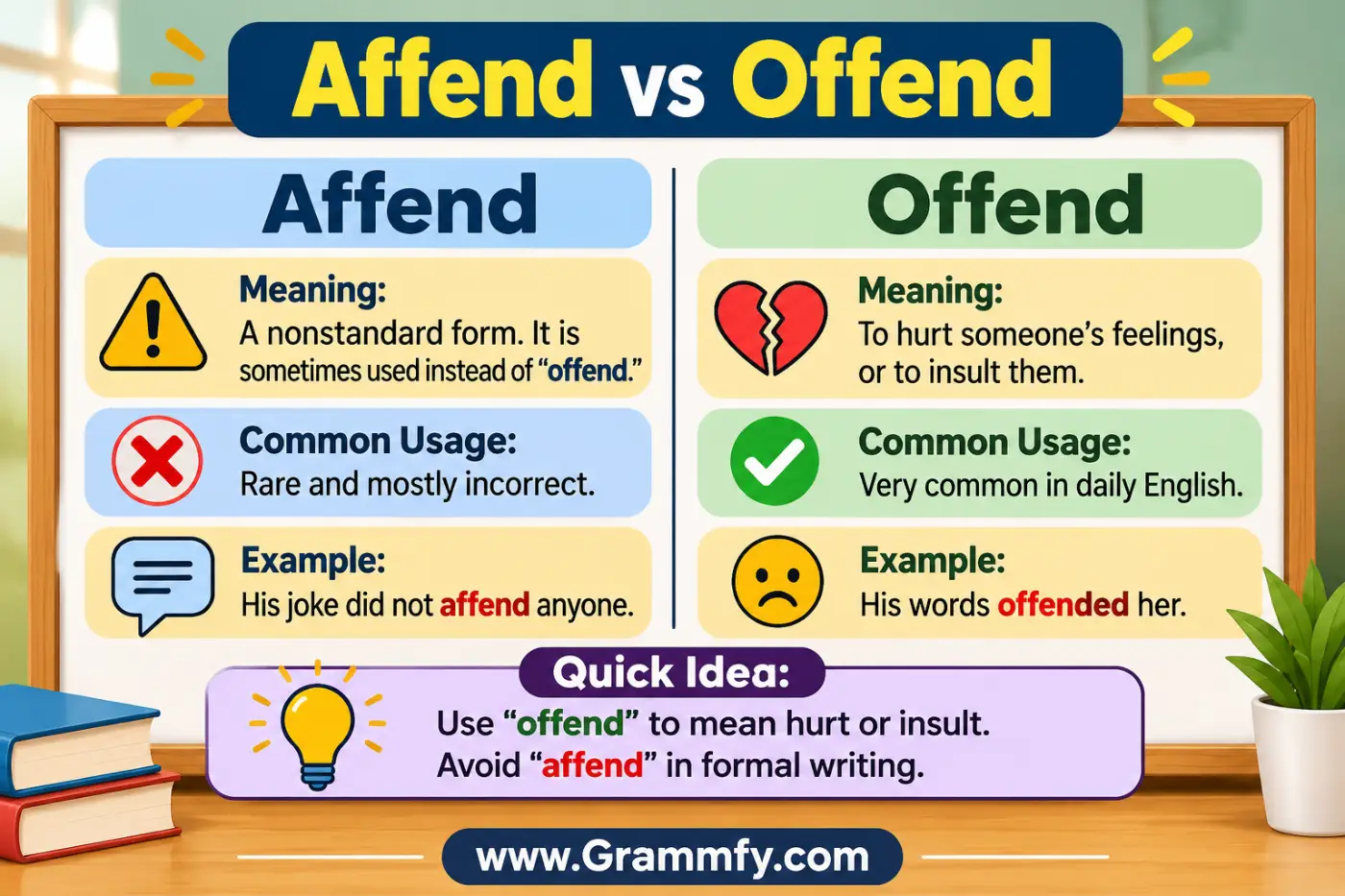
Have you ever written an email, text message, or essay and wondered whether to use affend vs offend? These words look similar, so it’s easy to mix them up. However, only one is a correct English spelling. If you’ve searched for Affend vs Offend, you’re probably trying to find the right spelling, understand its meaning, or learn how to use it in a sentence.
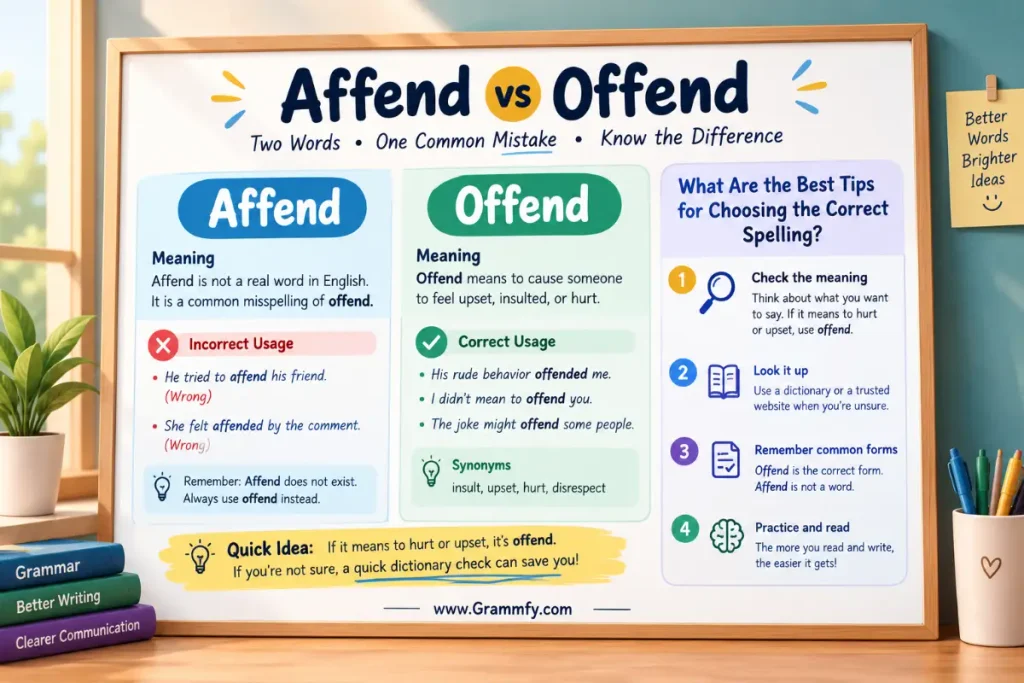
The correct spelling is offend. The word affend is a misspelling and isn’t recognized as a standard English word. You should use offend when you mean to hurt someone’s feelings, upset them, or make them feel insulted.
Quick Answer: Offend is the correct spelling. It means to upset, insult, or hurt someone’s feelings through words or actions. Affend is an incorrect spelling and should not be used in standard English writing.
Although the difference comes down to one letter, choosing the right spelling matters in professional and everyday communication. A spelling error can distract readers and make an otherwise clear message look less polished.
In this guide, you’ll learn why offend is correct, where it comes from, which synonyms can replace it, and how to use it in different situations. You’ll also find practical examples, common mistakes, spelling tips, and answers to frequently asked questions.
Many English learners confuse similar-looking spellings, so here’s why engage is the correct word instead of ingage and how to use it properly.
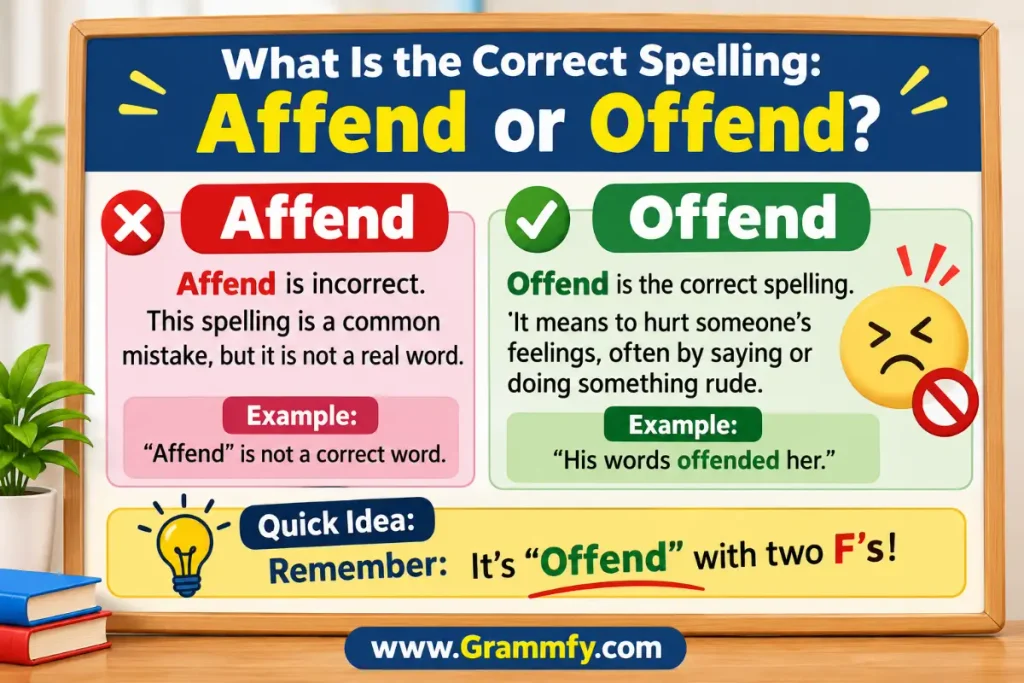
What Is the Correct Spelling: Affend or Offend?
The correct spelling is offend, with an O at the beginning. The spelling affend, with an A, is incorrect in standard English.
Here’s a simple comparison:
| Word | Correct or Incorrect? | Meaning |
|---|---|---|
| Offend | Correct | To upset, insult, or hurt someone’s feelings |
| Affend | Incorrect | Not a standard English word |
The confusion usually happens because the two spellings sound similar when spoken quickly. Their pronunciation may seem close, but their written forms aren’t interchangeable.
For example:
- Correct: I didn’t mean to offend anyone with my comment.
- Incorrect: I didn’t mean to affend anyone with my comment.
The first sentence uses the standard English spelling. The second contains a spelling mistake.
Remember that offend is a regular English verb. You can change its form depending on the sentence:
- Offend: Don’t offend your classmates.
- Offends: His careless attitude offends people.
- Offended: She felt offended by the joke.
- Offending: The offending remark was removed.
- Offense: His words caused offense.
- Offensive: That comment was offensive.
These forms are useful because they allow you to describe an action, a feeling, or something that causes discomfort.
What Do Affend and Offend Mean?
Understanding the meaning makes it easier to remember which spelling to choose. However, it’s important to separate the incorrect spelling from the actual English word.
What Does Offend Mean?
Offend is a verb that means to make someone feel hurt, upset, insulted, or disrespected. It usually describes an action, statement, or behavior that causes an unpleasant emotional reaction.
Someone might offend another person intentionally or without realizing it.
For example:
- His rude joke offended the entire group.
- I hope my question doesn’t offend you.
- She didn’t want to offend her new neighbors.
- The manager’s careless remarks offended several employees.
The word can also describe something that goes against a person’s beliefs, values, or sense of what is appropriate.
Consider these examples:
- The advertisement may offend some viewers.
- His comments offended the audience’s cultural values.
- The article contains language that could offend readers.
In these sentences, offend doesn’t necessarily mean that someone becomes extremely angry. It can describe anything from mild discomfort to serious emotional hurt.
What Does Affend Mean?
Affend doesn’t have an established meaning in standard modern English. It isn’t the accepted spelling of the verb meaning to insult or upset someone.
You might see this spelling in social media comments, informal messages, search queries, or poorly edited content. However, its appearance doesn’t make it correct.
For standard writing, always replace affend with offend.
For example:
- Incorrect: I never wanted to affend my teacher.
- Correct: I never wanted to offend my teacher.
The corrected version communicates the intended meaning clearly.
Where Did the Word Offend Come From?
The history of a word can help you understand why its spelling looks the way it does. The verb offend has an interesting history that goes back to Latin.
The Latin Origin
Offend comes from the Latin verb offendere. Its original sense included striking against something, stumbling, or coming into conflict with something.
Over time, the meaning developed to include causing injury, displeasure, or insult.
This change makes sense when you think about the connection between physical and emotional harm. In earlier language, the idea of striking against something could also describe a person coming into conflict with another person’s feelings or expectations.
How It Entered English
The word entered English through Old French offendre, which came from Latin offendere.
As English developed, the word gained the familiar meaning of upsetting, insulting, or displeasing someone.
Its spelling settled into the modern form:
- Latin: offendere
- Old French: offendre
- Modern English: offend
This historical development explains why the word begins with O rather than A.
Why Isn’t Affend an Alternative Spelling?
English spelling often preserves parts of a word’s historical development. Although many English words have alternative spellings, that doesn’t mean every similar-looking form is acceptable.
For instance, color and colour are both correct regional spellings. However, affend isn’t a recognized regional alternative to offend.
The spelling difference isn’t a US-versus-UK issue. The correct verb remains offend in both varieties of English.
What Are the Best Synonyms for Offend?
The word offend has several synonyms, but each one expresses a slightly different feeling or level of intensity. Some describe mild irritation, while others suggest serious disrespect or emotional harm.
Choosing a suitable replacement depends on your audience, purpose, and situation.
Here are 28 useful alternatives, grouped by tone and everyday usage.
1. Simple Synonyms for Offend
These words work well in everyday conversations, basic writing, and situations where you want to communicate an idea clearly.
| Word | Meaning | Tone | Example |
|---|---|---|---|
| Upset | To make someone unhappy | Simple | His comment upset his sister. |
| Hurt | To cause emotional pain | Simple | I didn’t mean to hurt you. |
| Annoy | To make someone slightly angry | Casual | The constant noise annoyed everyone. |
| Bother | To cause discomfort or concern | Casual | Her question bothered him. |
| Anger | To make someone feel angry | Direct | The unfair decision angered the workers. |
| Irritate | To cause frustration | Everyday | His repeated interruptions irritated the team. |
| Displease | To make someone dissatisfied | Neutral | The manager’s response displeased the customer. |
These alternatives are especially useful when writing for readers who prefer familiar vocabulary. They also help you avoid repeating the same verb throughout an article or conversation.
2. Everyday Synonyms for Offend
These words are suitable for emails, discussions, personal messages, and general writing.
| Word | Meaning | Tone | Example |
|---|---|---|---|
| Insult | To speak or act disrespectfully | Direct | His remark insulted the guest. |
| Disrespect | To show a lack of respect | Direct | Don’t disrespect your colleagues. |
| Slight | To treat someone as unimportant | Subtle | She felt he had slighted her. |
| Aggravate | To make someone more irritated | Everyday | His attitude aggravated the situation. |
| Provoke | To cause a strong reaction | Strong | The statement provoked an angry response. |
| Alienate | To make someone feel excluded | Serious | His behavior alienated his friends. |
| Antagonize | To make someone hostile or angry | Strong | Avoid comments that antagonize your audience. |
Although these words share some meaning with offend, they aren’t always interchangeable. For example, alienate focuses on creating distance between people, while insult focuses on disrespectful treatment.
3. Formal Synonyms for Offend
Formal alternatives are useful in professional documents, academic essays, reports, and carefully written discussions.
| Word | Meaning | Tone | Example |
|---|---|---|---|
| Affront | To insult someone openly | Formal | His behavior was an affront to the committee. |
| Outrage | To cause intense anger | Formal | The decision outraged the public. |
| Humiliate | To make someone feel deeply ashamed | Formal | The supervisor humiliated the employee. |
| Demean | To make someone seem less worthy | Formal | The remark demeaned the entire team. |
| Distress | To cause emotional suffering | Formal | The news distressed her family. |
| Perturb | To disturb or unsettle someone | Formal | The unexpected announcement perturbed investors. |
| Scandalize | To shock people by breaking social expectations | Formal | The controversial statement scandalized the audience. |
Use these expressions when the situation calls for a more precise or professional tone.
For example, perturb is more suitable for a formal report than a casual text message. Similarly, humiliate describes a much stronger experience than simply making someone uncomfortable.
4. Slang and Informal Synonyms for Offend
Informal expressions are common in conversations, texting, and casual online discussions. However, some of them can sound rude or inappropriate in professional settings.
| Word or Phrase | Meaning | Tone | Example |
|---|---|---|---|
| Rub someone the wrong way | To annoy or upset someone | Informal | His attitude rubs me the wrong way. |
| Get under someone’s skin | To irritate someone | Casual | Her constant complaints get under my skin. |
| Rile up | To make someone angry | Informal | The comment riled up the crowd. |
| Tick off | To make someone angry | Slang | His careless behavior ticked me off. |
| Piss off | To make someone very angry | Vulgar slang | That comment really pissed him off. |
| Put someone’s nose out of joint | To annoy or offend someone | Informal idiom | Her promotion put a few colleagues’ noses out of joint. |
| Get on someone’s nerves | To annoy someone repeatedly | Casual | His loud music gets on my nerves. |
Be careful when using slang. Expressions such as piss off can sound offensive themselves, especially in workplace communication or formal writing.
Which Synonym for Offend Is Strongest?
Not every situation requires the same level of language. A small disagreement doesn’t need the same vocabulary as a deeply insulting statement.
You can choose a better alternative by considering the intensity of the situation.
Mild Synonyms
Mild words describe small disagreements, uncomfortable situations, or minor emotional reactions.
- Bother
- Displease
- Irritate
- Annoy
- Upset
Examples:
- His question bothered me a little.
- The delay annoyed the customers.
- I hope my suggestion doesn’t upset anyone.
These words work well when you don’t want to exaggerate someone’s reaction.
Moderate Synonyms
Moderate words describe more noticeable emotional discomfort, disrespect, or frustration.
- Hurt
- Insult
- Disrespect
- Aggravate
- Slight
- Antagonize
Examples:
- His careless words hurt her feelings.
- The joke insulted several people.
- Ignoring the team could disrespect their hard work.
Use these words when a person’s behavior has a clear negative effect on someone else.
Strong Synonyms
Strong alternatives describe serious emotional harm, intense anger, or deeply disrespectful behavior.
- Outrage
- Humiliate
- Demean
- Affront
- Scandalize
- Provoke
Examples:
- The public statement outraged the community.
- His manager humiliated him in front of everyone.
- The advertisement scandalized several viewers.
These expressions should be reserved for situations that genuinely justify their intensity.
Quick tip: Start with a mild word when the emotional reaction is uncertain. Choose a stronger expression only when the situation supports it.
What Are the Different Parts of Speech Related to Offend?
The word offend belongs to a word family. Its related forms serve different grammatical purposes, so understanding them helps you create accurate sentences.
| Word | Part of Speech | Meaning | Example |
|---|---|---|---|
| Offend | Verb | To upset or insult someone | Don’t offend your readers. |
| Offends | Verb | Third-person singular form | His attitude offends people. |
| Offended | Verb / Adjective | Hurt or insulted | She felt offended by his remark. |
| Offending | Verb / Adjective | Causing an unpleasant reaction | The offending message was deleted. |
| Offense | Noun | An act or feeling of insult | His words caused offense. |
| Offensive | Adjective | Causing insult or discomfort | That joke was offensive. |
Offend as a Verb
A verb describes an action. When you use offend, you’re describing something that causes someone to feel hurt, insulted, or upset.
Examples:
- Please don’t offend the guests.
- His jokes often offend people.
- I never intended to offend anyone.
The verb can take a direct object, such as someone, the audience, or your colleagues.
Offended as an Adjective
Offended describes a person’s emotional state after experiencing something insulting or upsetting.
Examples:
- My friend was offended by the comment.
- The customers felt offended.
- She seemed offended by my question.
It often appears with the verb feel or be.
Offensive as an Adjective
Offensive describes something that causes disrespect, discomfort, or emotional harm.
Examples:
- The advertisement contained offensive language.
- His behavior was offensive to the guests.
- Some readers found the joke offensive.
Notice the difference: a person feels offended, while a comment or action can be offensive.
Offense as a Noun
Offense is the noun form in American English. It can describe an insult, an action that causes displeasure, or a feeling of being insulted.
Examples:
- No offense, but I disagree.
- She took offense at his remark.
- The comment caused serious offense.
This noun has a regional spelling difference, which we’ll discuss next.
Is Offend Spelled Differently in American and British English?
No. The verb offend has the same spelling in American and British English.
However, its related noun has two accepted regional spellings:
| American English | British English |
|---|---|
| Offend | Offend |
| Offended | Offended |
| Offending | Offending |
| Offense | Offence |
| Offensive | Offensive |
For example:
- American: His comment caused offense.
- British: His comment caused offence.
Both sentences are correct. The difference appears in the noun, not the main verb.
Which Spelling Should You Use for a US Audience?
Use offense when writing for American readers. This spelling is standard in US dictionaries, newspapers, educational materials, and professional documents.
For example:
- I hope you don’t take offense.
- The remark caused unnecessary offense.
Which Spelling Should You Use for a UK Audience?
British English generally uses offence as the noun.
For example:
- I hope you don’t take offence.
- His words caused great offence.
Does Affend Work in Any English-Speaking Region?
No standard US or UK spelling uses affend as an alternative to offend.
You shouldn’t use it in academic papers, business emails, website content, or everyday messages. The correct verb remains offend regardless of the reader’s location.
Which Word Should You Use Instead of Offend in Different Situations?
The best word depends on your audience and the message you’re trying to communicate. A formal email may require a softer expression, while a personal conversation might allow a more direct one.
Here are some practical choices for five common writing and speaking situations.
1. What Word Should You Use Instead of Offend in a Resume?
A resume should sound professional, positive, and respectful. You rarely need the verb offend in a resume because employers expect language that highlights your communication skills and ability to work with others.
Instead, consider words such as:
- Disrespect
- Upset
- Alienate
- Misunderstand
- Displease
The right choice depends on the point you’re making.
Examples:
- I communicate respectfully with clients from different backgrounds.
- I resolve disagreements without upsetting team relationships.
- My approach helps prevent misunderstandings in the workplace.
If you’re describing a workplace challenge, focus on the solution rather than emphasizing negative behavior.
Best tip: Use positive language that demonstrates professionalism, teamwork, and emotional awareness.
2. What Word Should You Use Instead of Offend in an Essay?
Academic essays require precise vocabulary. The best replacement depends on the argument and the seriousness of the situation.
Useful choices include:
- Insult
- Disrespect
- Alienate
- Distress
- Outrage
- Antagonize
Examples:
- The speaker’s comments insulted members of the community.
- Discriminatory language can alienate readers.
- The controversial policy outraged many citizens.
For an academic discussion, don’t automatically choose the most complicated word. A simple and accurate verb is usually stronger than an impressive but unsuitable alternative.
Best tip: Choose vocabulary that explains the actual impact of an action rather than using dramatic language without evidence.
3. What Word Should You Use Instead of Offend in Texting?
Text messages are usually short and conversational. You can use familiar expressions that communicate your feelings naturally.
Consider these alternatives:
- Hurt
- Upset
- Annoy
- Bother
- Rub someone the wrong way
- Get on someone’s nerves
Examples:
- I didn’t mean to hurt your feelings.
- Sorry if my message upset you.
- That joke bothered me a little.
- I hope I didn’t say anything disrespectful.
When texting a friend, a simple apology often works better than a long explanation.
Best tip: Be honest and direct. If you think your message hurt someone, acknowledge their feelings instead of arguing about their reaction.
4. What Word Should You Use Instead of Offend in an Email?
Professional emails require careful word choices because readers can’t always understand your tone.
Instead of writing offend repeatedly, consider these alternatives:
- Upset
- Displease
- Concern
- Disrespect
- Cause discomfort
Examples:
- I hope my earlier message didn’t cause any discomfort.
- Please accept my apologies if my comments upset you.
- I didn’t intend to make anyone feel disrespected.
- My intention wasn’t to cause offense.
A respectful tone helps maintain positive working relationships.
Best tip: Use polite expressions when addressing customers, managers, colleagues, or business partners.
5. What Word Should You Use Instead of Offend When Speaking?
Spoken English gives you more flexibility. You can choose a direct word, a softer phrase, or a casual expression depending on the person you’re talking to.
Useful alternatives include:
- Upset
- Hurt
- Annoy
- Insult
- Bother
- Make someone uncomfortable
Examples:
- I didn’t want to upset you.
- That comment really hurt my feelings.
- Are you sure that joke won’t insult anyone?
- I hope I haven’t made you uncomfortable.
Your tone also matters. Even a polite sentence can sound rude if you deliver it aggressively.
Best tip: Pay attention to the listener’s reaction and choose words that communicate your message without creating unnecessary tension.
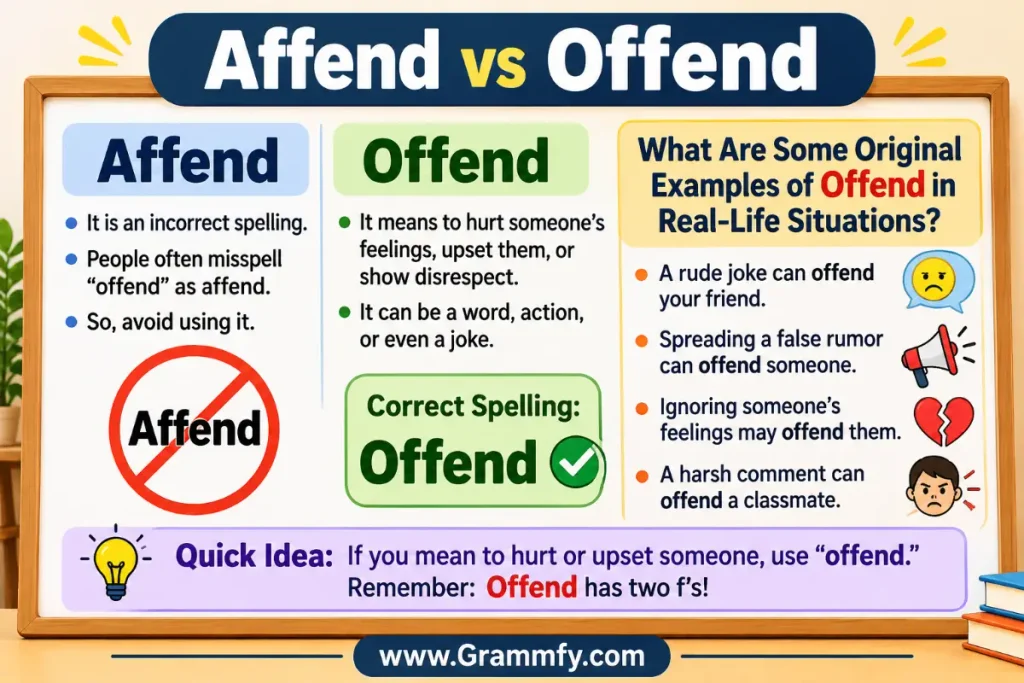
What Are Some Original Examples of Offend in Real-Life Situations?
Examples make it easier to understand how a word works in everyday communication. The following sentences cover personal conversations, school, work, social media, and other familiar situations.
Everyday Conversations
- I didn’t realize that my joke would offend anyone at the family dinner.
- Please don’t take offense if I disagree with your opinion.
- His careless comment offended his friend, even though he was only joking.
- She apologized because she never intended to offend her neighbors.
- Sometimes, a person’s tone can offend others even when the words seem harmless.
School and Education
- The student’s answer offended another classmate.
- Teachers should correct mistakes without offending their students.
- A respectful classroom encourages students to share their opinions without fear of being insulted.
- The teacher explained why the joke might offend people from different backgrounds.
- Students should learn how to disagree without making personal remarks.
Workplace Communication
- The manager changed his wording because he didn’t want to offend the new employees.
- An insensitive email can offend a customer and damage a professional relationship.
- Her feedback was honest, but she delivered it without offending her colleagues.
- The company removed the advertisement after several viewers complained that it could offend them.
- Good communication requires people to express disagreement without insulting others.
Social Media and Online Discussions
- A careless social media post can offend thousands of readers.
- He deleted his comment after realizing that it might offend his followers.
- People should think carefully before posting jokes that could offend others.
- The discussion became uncomfortable when one user started making offensive remarks.
- She responded politely instead of allowing the criticism to offend her.
Formal and Academic Writing
- Certain expressions may offend readers because they reinforce harmful stereotypes.
- The author revised the passage to avoid language that could offend the audience.
- Public statements should consider cultural differences to prevent unnecessary offense.
- The committee rejected the proposal because its wording was likely to offend several members.
- Freedom of expression doesn’t mean that every statement will be free from criticism or offense.
These examples show that offend can describe different levels of emotional discomfort. The surrounding sentence helps readers understand the situation.
What Is the Difference Between Offend and Insult?
Offend and insult are closely related, but they don’t always mean exactly the same thing.
Offend is a broad word for causing someone to feel upset, hurt, or disrespected. Insult usually describes a more direct act of disrespect through words or behavior.
| Offend | Insult |
|---|---|
| Can describe intentional or unintentional behavior | Often suggests direct disrespect |
| May involve beliefs, feelings, or social expectations | Usually involves a personal attack or disrespectful remark |
| Can be mild or serious | Often sounds more direct |
| Example: His joke offended the audience. | Example: His joke insulted the guest. |
When Should You Use Offend?
Choose offend when you want to describe a general negative reaction.
Examples:
- The advertisement offended some viewers.
- I didn’t mean to offend my friend.
- His comments offended the audience.
When Should You Use Insult?
Choose insult when someone directly attacks another person’s dignity, intelligence, appearance, or character.
Examples:
- He insulted my intelligence during the meeting.
- The guest insulted the host with a rude comment.
- Never insult someone because of their background.
Remember: An insult can offend someone, but not everything that offends someone is necessarily a direct insult.
What Is the Difference Between Offend and Upset?
Both words describe negative emotional reactions, but upset is generally broader and often less focused on disrespect.
Offend usually suggests that someone feels insulted, disrespected, or hurt by something another person said or did. Upset can describe sadness, worry, disappointment, frustration, or anger.
| Offend | Upset |
|---|---|
| Often relates to disrespect | Covers many emotional reactions |
| May involve insulting language | May involve disappointing news or problems |
| Can be intentional or accidental | Doesn’t necessarily involve another person’s behavior |
| Example: His remark offended me. | Example: The bad news upset me. |
Examples of Offend
- Her joke offended the audience.
- The article offended several readers.
- His disrespectful comment offended his colleague.
Examples of Upset
- The unexpected news upset the family.
- I felt upset when my friend canceled our plans.
- Losing the competition upset the team.
Remember: Use offend when the issue involves an insult or perceived disrespect. Choose upset when describing a wider range of negative feelings.
What Is the Difference Between Offend and Annoy?
Offend and annoy both describe unpleasant reactions, but the intensity and meaning can differ.
Offend often involves hurt feelings or a sense of disrespect. Annoy generally means to irritate someone or make them slightly angry.
| Offend | Annoy |
|---|---|
| May hurt someone’s feelings | Usually causes irritation |
| Can involve disrespect | Often involves inconvenience or repeated behavior |
| May create emotional discomfort | Often describes frustration |
| Example: His remark offended her. | Example: His loud music annoyed her. |
Consider these situations:
- A rude personal comment may offend someone.
- Repeated interruptions may annoy someone.
- A disrespectful joke could offend an audience.
- A slow internet connection might annoy a user.
The difference is useful when describing someone’s reaction accurately.
What Are the Most Common Mistakes When Using Offend?
Even when writers know the correct spelling, they sometimes use the word incorrectly in sentences. Understanding these mistakes will help you communicate more clearly.
1. Writing Affend Instead of Offend
This is the main spelling mistake.
Incorrect: I hope I didn’t affend you.
Correct: I hope I didn’t offend you.
The correct form starts with O. There is no standard spelling rule that makes affend acceptable.
2. Confusing Offend With Offended
Both words belong to the same word family, but they perform different grammatical roles.
Incorrect: I was offend by his comment.
Correct: I was offended by his comment.
Use offended when describing how someone feels after an unpleasant experience.
3. Using Offensive When You Mean Offended
These two forms are easy to confuse.
- Offended describes the person experiencing the feeling.
- Offensive describes the action, remark, or thing causing that feeling.
Incorrect: I was offensive by his joke.
Correct: I was offended by his joke.
Another correct sentence is: His joke was offensive.
4. Confusing Offend With Affect
These words look and sound somewhat similar, but they have different meanings.
- Offend: To upset or insult someone.
- Affect: To influence or have an impact on something.
Examples:
- His rude behavior offended the customers.
- Poor sleep can affect your concentration.
Don’t replace one with the other simply because their spellings are similar.
5. Using Offend When You Mean Disagree
Having a different opinion doesn’t automatically mean that you have offended someone.
For example:
- Correct: I disagree with your explanation.
- Correct: My response offended him because I criticized his work personally.
The first sentence describes a difference of opinion. The second describes an emotional reaction to someone’s response.
6. Assuming Everyone Will Feel Offended by the Same Thing
People have different experiences, beliefs, and expectations. A statement that seems harmless to one person may feel disrespectful to someone else.
For example:
- The joke offended one audience member but didn’t bother the others.
- Her comment was considered inappropriate by some readers.
Avoid making broad claims about how everyone feels.
7. Using Offend When a Softer Word Is Better
Sometimes, offend sounds stronger than necessary.
For example:
- Stronger: I offended my colleague by arriving late.
- More precise: My colleague was disappointed because I arrived late.
The second sentence explains the actual reaction more clearly.
8. Using the Wrong Preposition
The most common structure is offend someone without adding a preposition between the verb and the person.
Correct:
- His comment offended me.
- She didn’t want to offend her parents.
- That remark offended several readers.
You can also use these structures:
- Offend someone with something: He offended the audience with his remarks.
- Be offended by something: She was offended by the joke.
- Take offense at something: He took offense at the suggestion.
- Take offense to something: This form is also used, particularly in American English, though take offense at is a standard choice.
Avoid writing offend to someone when you mean to say that you upset or insulted that person.
9. Confusing No Offense With No Offence
This difference depends on regional spelling.
- American English: No offense.
- British English: No offence.
Both are correct in their respective varieties.
However, the phrase no offense doesn’t automatically make a rude comment acceptable. The listener may still find the statement disrespectful.
When Should You NOT Use Offend?
The word offend is useful, but it isn’t the best choice for every situation. Selecting a more precise expression can make your writing sound clearer and more natural.
When You’re Describing Ordinary Disagreement
Use disagree when two people have different opinions without necessarily hurting each other’s feelings.
Less precise: I offended my friend because we had different opinions.
Better: I disagreed with my friend about the topic.
When You’re Describing Disappointment
Choose disappoint when someone fails to meet another person’s expectations.
Less precise: The canceled event offended the guests.
Better: The canceled event disappointed the guests.
When You’re Describing Physical Discomfort
Use words such as irritate, bother, or cause discomfort when discussing physical irritation.
Examples:
- The strong perfume irritated my eyes.
- The uncomfortable chair bothered my back.
- The rough fabric caused discomfort.
When You’re Describing a Small Inconvenience
Choose annoy when something creates minor frustration.
Examples:
- The slow website annoyed its visitors.
- The repeated notifications annoyed me.
- The traffic noise bothered the neighbors.
When You’re Not Sure How Someone Feels
Avoid assuming that another person is offended without evidence.
Instead of saying, “I know my comment offended you,” you could say:
- I hope my comment didn’t upset you.
- Please let me know if my wording was uncomfortable.
- I didn’t intend to cause any offense.
This approach leaves room for the other person’s actual feelings.
What Are the Antonyms of Offend?
Antonyms are words with opposite or contrasting meanings. The best opposite of offend depends on the situation.
Here are some useful alternatives:
| Antonym | Meaning | Example |
|---|---|---|
| Please | To make someone happy | Her kind words pleased the guests. |
| Delight | To give great pleasure | The surprise delighted the children. |
| Comfort | To make someone feel better | His support comforted his friend. |
| Reassure | To remove someone’s worries | The manager reassured the employees. |
| Respect | To show consideration | We should respect other people’s opinions. |
| Appreciate | To recognize someone’s value | She appreciated his honest feedback. |
| Appease | To calm someone’s anger | He tried to appease the frustrated customer. |
| Compliment | To express praise | I complimented her excellent work. |
These words aren’t perfect opposites in every context. For instance, please can be the opposite of causing displeasure, while respect is a useful contrast when the original action involves disrespect.
What Are the Best Tips for Choosing the Correct Spelling?
Spelling mistakes often happen because writers rely on how a word sounds instead of remembering its written form. A few simple habits can help you avoid this problem.
1. Remember the First Letter
The easiest way to remember the correct spelling is to focus on its first letter.
The word begins with O:
O-F-F-E-N-D
Don’t replace the first letter with A.
2. Connect Offend With Offense
Remember the related noun offense. Both words begin with O.
This connection gives you another way to recall the spelling when you’re writing quickly.
For American English, the noun is offense. British English uses offence, but the verb remains offend.
3. Learn the Word Family
Memorizing related forms can strengthen your spelling knowledge.
- Offend
- Offends
- Offended
- Offending
- Offense
- Offensive
When you remember the main form, the related words become easier to recognize.
4. Read the Sentence Aloud
Reading a sentence aloud can help you notice whether the word fits its intended meaning.
For example:
- I didn’t want to offend anyone.
- I didn’t want to upset anyone.
- I didn’t want to insult anyone.
All three sentences are grammatically correct, but they communicate slightly different ideas.
5. Use a Spell Checker
A reliable spelling checker can identify affend as an error and suggest offend as the correction.
However, don’t depend on automated tools alone. They may not always understand the meaning you intend to communicate.
6. Practice With Short Sentences
Write a few sentences using the correct word:
- I don’t want to offend anyone.
- His behavior offended the audience.
- She felt offended by the comment.
- That joke was offensive.
- No offense was intended.
Regular practice makes the correct form easier to remember.
7. Think About Your Audience
Before choosing a synonym, consider who will read your writing.
A casual message can use bother or upset. A professional report may require disrespect, distress, or cause offense.
Choosing the right word helps you express your meaning without exaggerating or weakening your message.
8. Check the Whole Sentence
Don’t focus on spelling alone. Make sure the word fits the grammar and meaning of your sentence.
For example:
- Correct: His words offended me.
- Correct: I felt offended by his words.
- Correct: His words were offensive.
Each sentence uses a different grammatical form, but all three are correct.
Conclusion
Choosing the correct spelling makes your writing clearer and more professional. When comparing Affend vs Offend, remember that only offend is accepted in standard English. It describes an action that makes someone feel hurt, insulted, or uncomfortable. The incorrect form affend should be avoided in emails, essays, conversations, and website content.
You can also improve your vocabulary by learning related words such as upset, insult, annoy, and disrespect. Each alternative has a slightly different meaning, so consider the situation before choosing one. Remember the O at the beginning, practice using the word in everyday sentences, and check your spelling when needed. With a little practice, you’ll find it much easier to use the correct form confidently.
Frequently Asked Questions
Is Affend a Real English Word?
No, affend isn’t a standard English word. It’s a misspelling of offend, which means to upset, insult, or hurt someone’s feelings. Use offend in formal and informal writing.
Is It Affend or Offend?
Offend is the correct spelling, while affend is incorrect. The correct word starts with O and is used when someone causes another person to feel insulted or upset.
Why Do People Spell Offend as Affend?
People may write affend because they confuse the vowel sounds or remember the word incorrectly. However, pronunciation isn’t a reliable guide to English spelling. Remembering the O at the beginning can help prevent this mistake.
What’s Another Way to Say Offend?
You can use upset, hurt, insult, annoy, disrespect, or displease as alternatives to offend. The best choice depends on how serious the situation is and whether you’re describing hurt feelings, irritation, or direct disrespect.
Is Offend the Same as Insult?
No, the words are related but have slightly different meanings. Offend broadly describes causing emotional discomfort or displeasure, while insult usually refers to a direct expression of disrespect.
Is Offense American or British English?
Offense is the standard American English noun spelling, while offence is commonly used in British English. Both varieties use the verb offend with the same spelling.
How Do You Use Offend in a Sentence?
You can use offend to describe an action that hurts someone’s feelings or makes them feel disrespected. For example, “I didn’t mean to offend my colleague with my question.” The word can also appear in sentences such as “His remarks offended the audience.”

Tylerbrooks is a US-based English grammar writer and contributor at Grammfy. He writes helpful articles about grammar, spelling, commonly confused words, and vocabulary. His goal is to explain English topics in simple language with clear examples and practical tips. Through his articles, he helps readers improve their writing and everyday English skills.