
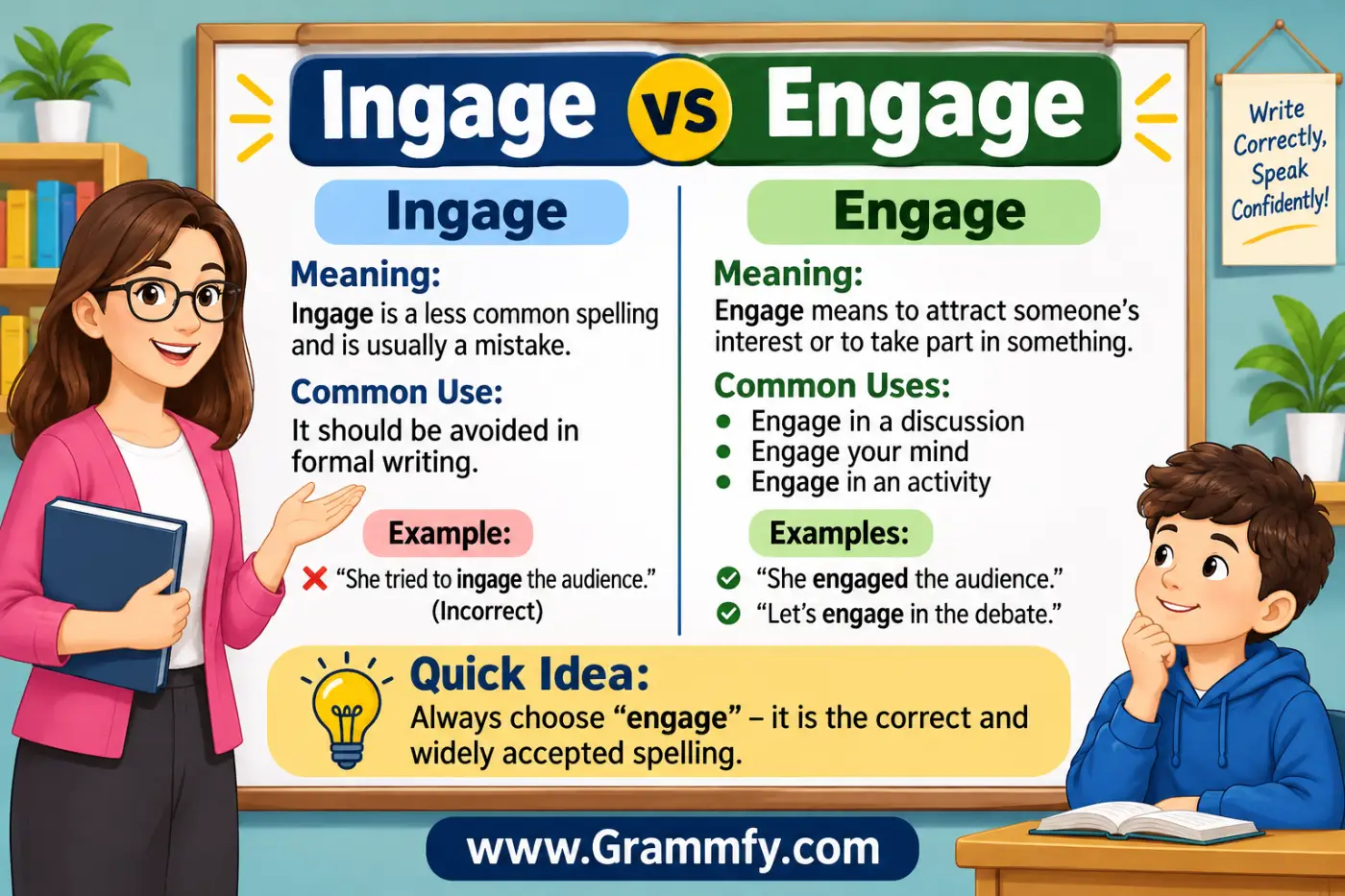
Have you ever written an email, school assignment, or professional message and wondered whether Ingage vs Engage is the correct spelling? These words look almost identical, so it’s easy to choose the wrong one. However, only one is accepted as the standard spelling in modern English.
Engage is the correct English word. It means to participate in something, involve someone, attract attention, or become involved in an activity. Ingage is generally a misspelling and should not be used in standard writing.
Understanding this spelling difference can help you write more clearly in emails, essays, resumes, and everyday conversations. Let’s explore the meanings, origins, examples, synonyms, and common mistakes so you can always choose the right form.
If you’re unsure about the correct spelling, check out why pastime is correct and passtime is not to avoid this common spelling mistake.
What Is the Difference Between Ingage vs Engage?
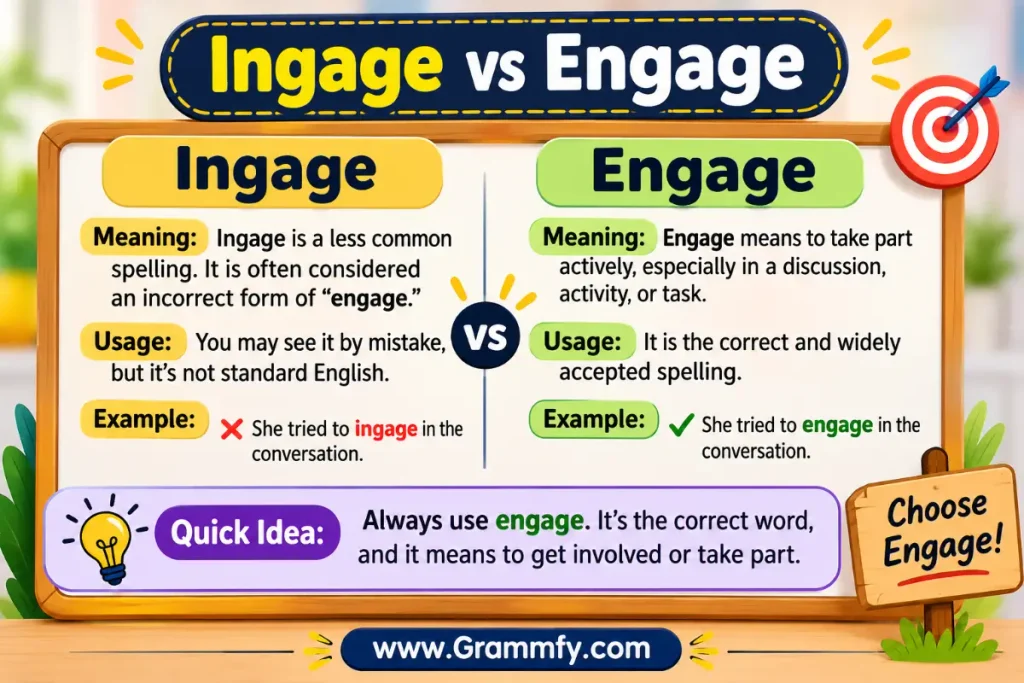
The main difference is spelling and standard usage. Engage is a recognized English verb, while ingage is not a standard modern English spelling.
| Word | Correctness | Meaning | Example |
|---|---|---|---|
| Engage | Correct | To participate or involve | Students engage in class discussions. |
| Ingage | Incorrect | Nonstandard spelling | Avoid this spelling in formal writing. |
Quick answer: Always use engage in modern English unless Ingage is an intentional brand name, personal name, or title.
Where Do Engage and Ingage Come From?
The word engage comes from Middle French engager, which is connected to the idea of making a pledge or commitment. Its roots are associated with an Old French word meaning a pledge or security.
Over time, its meaning expanded. Today, it can describe taking part in an activity, attracting someone’s interest, hiring a person, or becoming involved in a discussion.
In contrast, ingage does not have the same accepted status as a standard modern English spelling. The initial en- in engage is part of its established spelling, so replacing it with in- creates an error.
Historical note: Oxford records ingage as an older spelling of engage in late Middle English. However, modern standard English uses engage. Oxford Learner’s Dictionaries
What Are Some Useful Synonyms for Engage?
The best alternative depends on what you want to express.
| Word | Meaning | Tone | Example |
|---|---|---|---|
| Join | Become part of | Simple | Join the team. |
| Help | Give support | Simple | Help your classmates. |
| Include | Make someone part | Everyday | Include everyone. |
| Involve | Bring into an activity | Everyday | Involve the audience. |
| Interest | Make curious | Everyday | Interest your readers. |
| Attract | Draw attention | Everyday | Attract new customers. |
| Connect | Build a relationship | Everyday | Connect with people. |
| Participate | Take part | Formal | Participate in discussions. |
| Interact | Communicate | Formal | Interact with clients. |
| Absorb | Hold attention | Formal | Absorb the reader. |
| Captivate | Hold someone’s interest | Formal | Captivate your audience. |
| Enthrall | Fascinate deeply | Formal | Enthrall listeners. |
| Involve | Include actively | Formal | Involve employees. |
| Employ | Give someone work | Formal | Employ skilled workers. |
| Hire | Recruit someone | Everyday | Hire a designer. |
| Chat | Talk casually | Slang | Chat with friends. |
| Hang out | Spend time together | Slang | Hang out with friends. |
| Team up | Work together | Slang | Team up on a project. |
| Get involved | Take part | Everyday | Get involved locally. |
| Draw in | Attract attention | Everyday | Draw in readers. |
Which Synonyms Are Stronger Than Engage?
Choose alternatives according to the strength of the meaning:
- Mild: Notice, interest, join.
- Moderate: Involve, connect, participate.
- Strong: Absorb, captivate, fascinate, enthrall.
How Does Engage Work as Different Parts of Speech?
- Verb: We engage students in creative activities.
- Noun: Engagement is important for learning.
- Adjective: The engaged audience listened carefully.
Is Engage Spelled Differently in the US and UK?
No. Both American and British English use engage. The spelling does not change between these varieties.
Which Word Should You Use in Different Situations?
In a Resume
Use engage to describe professional communication.
Example: I engage with customers to understand their needs.
In an Essay
Use participate or involve when discussing activities.
Example: Students should engage in classroom discussions.
In an Texting
Use join, chat, or connect for casual communication.
Example: Let’s connect after school.
In an Email
Use engage when inviting someone to participate.
Example: We hope to engage your team in this project.
In an Speaking
Use join or get involved for natural conversation.
Example: Everyone can get involved in the event.
What Are 10 Examples of Engage in Sentences?
- Teachers engage students through interesting lessons.
- The speaker engaged the audience with a funny story.
- Employees engage in regular training sessions.
- Our company wants to engage more customers.
- She tried to engage her friends in conversation.
- Reading can engage your imagination.
- Parents should engage children in outdoor activities.
- The manager will engage a professional designer.
- Good questions engage readers in an article.
- Both teams agreed to engage in a friendly competition.
What Is the Difference Between Engage and Participate?
Engage can mean involving someone or attracting attention, while participate specifically means taking part in an activity.
- Engage: The teacher engaged the students.
- Participate: The students participated in the lesson.
Engage vs Involve: What’s the Difference?
Involve means making someone part of an activity. Engage can also suggest active interest, attention, or interaction.
- Involve: We involved everyone in the planning.
- Engage: We engaged everyone in a meaningful discussion.
What Are Common Mistakes When Using Engage?
Avoid these common errors:
- Writing ingage instead of engage.
- Using engage when you mean simply employ without considering the context.
- Confusing engage in with engage with.
- Forgetting the correct forms: engaged, engaging, and engagement.
Remember: Use engage in an activity and engage with a person or subject.
What Are the Antonyms of Engage?
Common opposites include disengage, withdraw, ignore, avoid, disconnect, and detach. The best opposite depends on the sentence.
How Can You Choose the Correct Spelling Quickly?
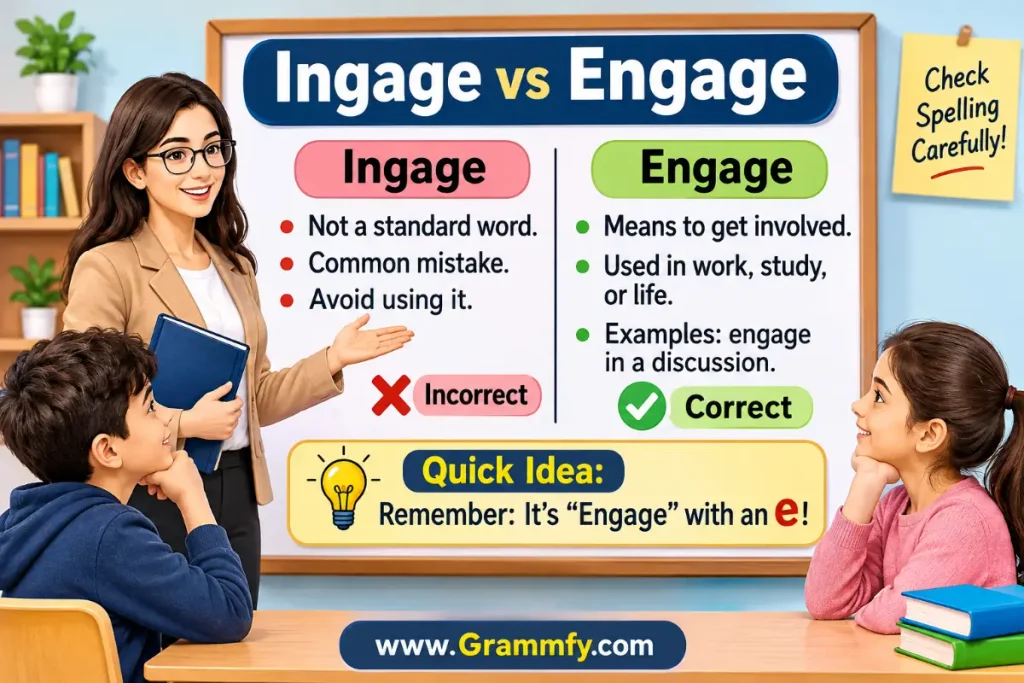
- Remember that engage begins with EN.
- Check the spelling before submitting professional documents.
- Use a dictionary if you are unsure.
- Remember that engagement and engaged follow the same spelling pattern.
Conclusion
Choosing the correct spelling makes your writing clearer and more professional. When comparing Ingage vs Engage, remember that engage is the standard modern English form. It can describe participation, communication, attention, employment, and involvement. Although ingage appeared as an older spelling, it is not appropriate for ordinary modern writing. You can also use alternatives such as involve, participate, connect, or captivate when they better express your meaning. Before submitting an essay, email, or resume, check your spelling and sentence context. A simple habit of remembering EN in engage will help you avoid this common mistake and write with greater confidence.
Frequently Asked Questions
Is Ingage vs Engage a spelling mistake?
Yes, Ingage vs Engage is generally a spelling issue in modern English. Use engage in standard writing.
What does engage mean in simple English?
Engage means to take part, involve someone, or attract attention.
Is ingage ever correct?
It appears as a historical spelling and may also be used as a name or brand, but it is not the standard modern English form.
What’s another way to say engage?
You can say involve, participate, join, interact, connect, or captivate, depending on the context.
Is engage a verb or noun?
Engage is a verb. Its related noun is engagement.
Should I use engage in an academic essay?
Yes. Engage is appropriate for academic writing when you use it with the correct meaning and sentence structure.

Tylerbrooks is a US-based English grammar writer and contributor at Grammfy. He writes helpful articles about grammar, spelling, commonly confused words, and vocabulary. His goal is to explain English topics in simple language with clear examples and practical tips. Through his articles, he helps readers improve their writing and everyday English skills.