
Have you ever written an email, school assignment, or social media post and wondered whether to write shinning or shining? Both words look similar, but only one describes something giving off light or looking bright. The confusion happens because English spelling rules sometimes change the final letters of a word when adding -ing.
The difference becomes easier when you understand the verbs behind these spellings. Shining comes from shine, which means to give off light, reflect brightness, or perform exceptionally well. Shinning comes from shin, a much less common verb that means climbing up or down something by gripping it with your arms and legs.
Shining is the correct spelling when you mean glowing, reflecting light, or showing great ability. Shinning is also a real word, but it describes a climbing action rather than brightness.
Knowing when to use each form can improve your grammar and help you avoid common spelling mistakes. This guide explains their meanings, origins, spelling rules, synonyms, and examples. You’ll also learn how to use related words in professional writing, everyday conversations, and academic assignments.
If you’re unsure which spelling to choose, check out why holistic is preferred over wholistic and learn how to use it correctly.
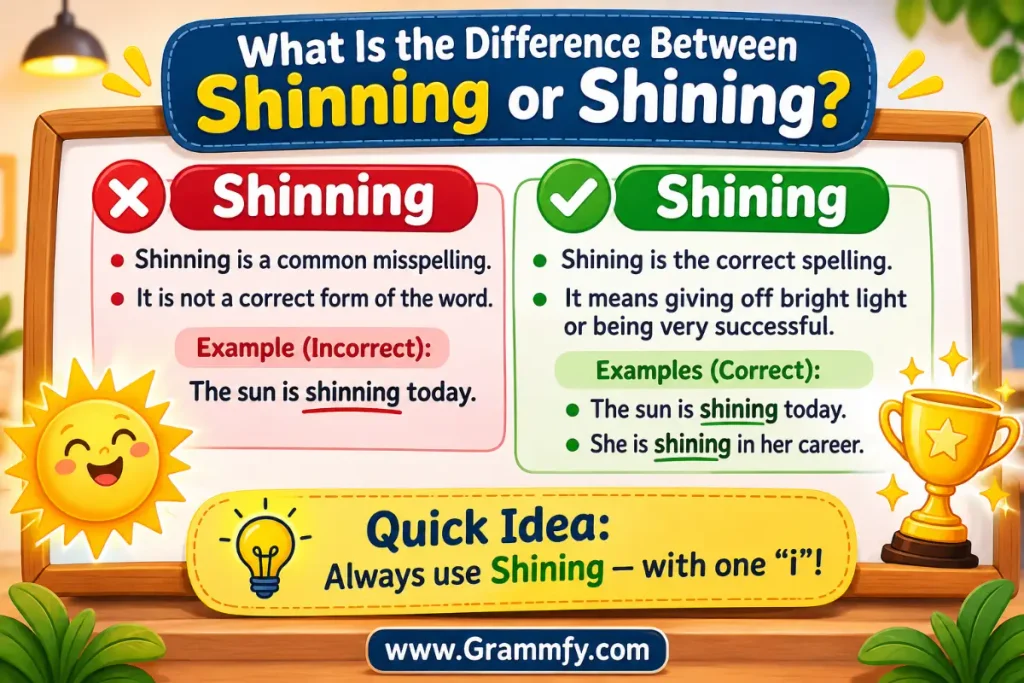
What Is the Difference Between Shinning or Shining?
The main difference comes from the base verbs shine and shin. Although the words look almost identical, they describe two different actions.
Shining is the present participle of shine. It describes something producing light, reflecting brightness, becoming polished, or showing an excellent quality.
Shinning is the present participle of shin. It describes someone climbing a pole, tree, or similar object by holding it with their hands and legs.
Look at these examples:
- Shining: The stars are shining brightly in the night sky.
- Shinning: The boy is shinning up a tall tree.
The first sentence describes light coming from stars. The second describes a person climbing a tree.
| Feature | Shining | Shinning |
|---|---|---|
| Base verb | Shine | Shin |
| Part of speech | Present participle or adjective | Present participle or gerund |
| Main meaning | Giving off or reflecting light | Climbing with the help of arms and legs |
| Pronunciation | SHY-ning | SHIN-ing |
| Common use | Everyday and professional English | Less common, mainly a climbing action |
| Example | The sun is shining. | He is shinning up a pole. |
| Related words | Glow, gleam, sparkle | Climb, scale, clamber |
Quick answer: If you’re talking about sunlight, stars, polished shoes, or someone’s excellent performance, use shining. If someone is climbing a pole or tree by gripping it with their limbs, shinning can be correct.
What Does Shining Mean in English?
Shining is the -ing form of the verb shine. It has several meanings, depending on how you use it in a sentence.
1. Shining Means Giving Off Light
The most common meaning describes something that produces light or sends out rays of brightness.
For example:
- The sun is shining through the bedroom window.
- A bright star was shining above the mountains.
- The flashlight is shining into the dark hallway.
- The streetlights were shining after sunset.
In these examples, the word describes visible light.
2. Shining Means Reflecting Light
An object doesn’t always produce its own light. Sometimes it looks bright because it reflects light from another source.
For example:
- Her shining shoes looked brand new.
- The shining silver mirror reflected the sunlight.
- Water was shining on the wet road.
- His polished watch was shining under the lamp.
The light comes from somewhere else, but the surface reflects it.
3. Shining Means Looking Happy or Excited
The word can also describe someone’s eyes or face when they show strong emotions.
Examples:
- Her eyes were shining with happiness.
- The children had shining faces after receiving their awards.
- His eyes were shining with excitement.
- She welcomed us with a shining smile.
Here, shining communicates an emotional quality rather than literal light.
4. Shining Means Performing Exceptionally Well
English speakers also use shine figuratively to describe someone who performs very well or displays an impressive ability.
Examples:
- Maria is shining in her new position.
- The young athlete is shining on the basketball court.
- His creativity is shining through his latest project.
- She has been shining in her science classes.
Remember: Shining can describe physical brightness as well as success, talent, happiness, and excellent performance.
What Does Shinning Mean in English?
Shinning is the present participle of the verb shin. This verb is connected to the shinbone, the front part of the lower leg.
Its main meaning is to climb something by gripping it with your arms and legs and pulling yourself upward or lowering yourself downward.
For example:
- The child was shinning up a tree.
- The worker started shinning down the pole.
- We watched a monkey shinning up a tall branch.
- The man was shinning along a narrow support.
This action is different from ordinary walking or climbing stairs. It usually involves holding tightly to a narrow or upright object while using your arms and legs to move.
Can Shinning Have Another Meaning?
Yes. The verb shin can also mean kicking someone in the shins.
For example:
- The player was shinning his opponent during the rough game.
This use is much less common than the climbing meaning in everyday writing.
However, the important point is that shinning belongs to the verb shin, not the verb shine.
Is Shinning a Common Word?
No. It is much less common than shining.
Most people encounter shining in everyday conversations, books, advertisements, school assignments, and professional writing. Shinning usually appears in descriptions of climbing, outdoor activities, or physical movement.
If you are writing about brightness, light, beauty, or achievement, shinning is not the right choice.
What Is the Origin of Shining and Shinning?
Understanding the history of these words helps explain why their spellings are different.
Although they look related, they developed from separate English verbs.
Where Did Shining Come From?
The word shining comes from the verb shine, which has a long history in the English language.
Shine developed from the Old English word scīnan, which meant to send out light, give light, or appear radiant.
It later became shinen in Middle English.
Over time, its meaning expanded. People began using it not only for sunlight and other sources of light but also for polished surfaces, attractive appearances, and impressive abilities.
The development can be understood in three stages:
- Old English: Scīnan referred to giving out or displaying light.
- Middle English: Shinen continued the meaning of producing or reflecting brightness.
- Modern English: Shine developed additional meanings related to polishing, appearance, and outstanding performance.
The -ing form developed by applying the regular spelling pattern for verbs ending in silent e.
Where Did Shinning Come From?
Shinning comes from the verb shin, which is connected to the name of the lower-leg bone.
The noun shin developed from Old English scinu. Its older Germanic roots are associated with a thin piece or narrow section.
The climbing verb appeared in the early nineteenth century. It originally had a nautical connection and described climbing by using the arms and legs.
Its modern form follows a different spelling pattern from shine.
The development looks like this:
- Shin: The base verb associated with climbing or using the shins.
- Shinned: The past-tense form.
- Shinning: The present participle and gerund.
Why Do These Words Have Different Origins?
The similar spelling can make the words appear related, but their histories point to different meanings.
- Shine developed around the idea of light and brightness.
- Shin developed from a word for the lower part of the leg.
- Shining describes brightness or excellent performance.
- Shinning describes an action involving climbing or movement.
The two words are not alternative spellings of the same verb. They come from different base words.
Why Does Shine Become Shining but Shin Become Shinning?
English spelling rules explain the difference. When adding -ing to a verb, the final letters sometimes change.
The rules are easier to understand when you examine each base word separately.
1. Why Does Shine Drop the Final E?
The verb shine ends with a silent e.
When you add a suffix beginning with a vowel, such as -ing, the final e is usually removed.
The spelling changes like this:
- Shine + ing = Shining
- Write + ing = Writing
- Make + ing = Making
- Smile + ing = Smiling
- Dance + ing = Dancing
The final e disappears, but the original long vowel sound remains.
For example:
- The moon is shining over the lake.
- She is writing a new article.
- My brother is making dinner.
2. Why Does Shin Double the Final N?
The verb shin follows another common spelling rule.
When a one-syllable verb ends in a consonant-vowel-consonant pattern, the final consonant is often doubled before adding -ing.
The spelling changes like this:
- Shin + ing = Shinning
- Run + ing = Running
- Sit + ing = Sitting
- Swim + ing = Swimming
- Stop + ing = Stopping
Doubling the final consonant helps preserve the short vowel sound.
For example:
- The child is shinning up the tree.
- The athlete is running around the field.
- The students are sitting quietly.
What Is the Main Spelling Rule to Remember?
| Base Word | Spelling Change | Correct Form |
|---|---|---|
| Shine | Remove final e | Shining |
| Shin | Double final n | Shinning |
| Write | Remove final e | Writing |
| Run | Double final n | Running |
| Make | Remove final e | Making |
| Sit | Double final t | Sitting |
Easy memory tip: Shine loses its silent e, while shin doubles its final n.
This small spelling difference changes the meaning of the word.
What Are the Best Synonyms for Shining?
Synonyms are words with similar meanings. Choosing the right alternative can make your writing clearer and help you avoid repeating the same word.
Shining has several synonyms related to light, brightness, polished surfaces, and excellent performance.
Here are more than 30 useful alternatives, grouped by tone and everyday use.
1. Simple Synonyms for Shining
These words work well in basic sentences, school assignments, and everyday conversations.
| Word | Meaning | Tone | Example |
|---|---|---|---|
| Bright | Giving or reflecting much light | Simple | The bright lamp lit the room. |
| Glowing | Producing a soft, steady light | Simple | The glowing candle looked beautiful. |
| Glossy | Having a smooth, shiny surface | Simple | She wore glossy black shoes. |
| Sparkly | Reflecting small points of light | Simple | The sparkly dress caught everyone’s attention. |
| Lit | Illuminated by light | Simple | The room was brightly lit. |
| Gleaming | Looking clean and bright | Simple | His shoes were gleaming. |
| Clear | Easy to see or bright in appearance | Simple | The clear glass reflected sunlight. |
| Radiant | Showing a bright or happy appearance | Simple | Her radiant smile made everyone happy. |
2. Everyday Synonyms for Shining
These alternatives sound natural in conversations, descriptions, and general articles.
| Word | Meaning | Tone | Example |
|---|---|---|---|
| Glistening | Shining with reflected light | Everyday | The grass was glistening with dew. |
| Glittering | Shining with many small flashes | Everyday | The glittering stars filled the sky. |
| Beaming | Showing happiness or bright light | Everyday | She was beaming with pride. |
| Shimmering | Giving off a soft, changing light | Everyday | The lake was shimmering in the sunlight. |
| Twinkling | Shining with quick, small flashes | Everyday | The stars were twinkling overhead. |
| Flashing | Giving off sudden bursts of light | Everyday | The warning light was flashing. |
| Gleamy | Having a bright or polished look | Informal | The surface looked gleamy after cleaning. |
| Lustrous | Having a rich, attractive shine | Everyday | Her hair looked lustrous and healthy. |
3. Formal Synonyms for Shining
These words are useful in descriptive writing, literature, professional articles, and academic work.
| Word | Meaning | Tone | Example |
|---|---|---|---|
| Luminous | Giving off or displaying light | Formal | The luminous moon appeared above the hills. |
| Resplendent | Extremely bright or impressive | Formal | The palace looked resplendent at night. |
| Brilliant | Very bright or exceptionally impressive | Formal | A brilliant light filled the hall. |
| Effulgent | Shining with great brightness | Literary | The effulgent sun rose above the valley. |
| Incandescent | Giving off intense light or heat | Formal | The incandescent bulb lit the room. |
| Dazzling | So bright that it is hard to look at | Formal | The dazzling sunlight covered the beach. |
| Illustrious | Famous and highly respected | Formal | She built an illustrious career in science. |
| Polished | Smooth and reflective | Formal | The polished surface reflected the lights. |
4. Slang and Casual Alternatives
These expressions are useful in informal writing, texts, and friendly conversations. Some describe brightness, while others describe outstanding performance.
| Word or Phrase | Meaning | Tone | Example |
|---|---|---|---|
| Lit | Bright or exciting | Slang | The decorations made the room look lit. |
| On fire | Performing extremely well | Slang | The team is on fire this season. |
| Killing it | Doing something very successfully | Slang | She’s killing it in her new job. |
| Crushing it | Performing exceptionally well | Slang | He is crushing it in the competition. |
| Glowing up | Becoming more attractive or confident | Casual slang | Her confidence has been glowing up. |
| Blazing | Giving off very strong light or heat | Casual | The sun was blazing all afternoon. |
| Shiny | Having a bright or reflective surface | Casual | Look at those shiny new shoes. |
| Lighting up | Becoming bright or visibly happy | Casual | His face was lighting up with excitement. |
Important: These words aren’t perfect replacements in every sentence. For example, twinkling describes small flashes, while glowing usually suggests a softer and steadier light. Choose according to the exact meaning you need.
What Are the Synonyms for Shinning?
Shinning has a much narrower meaning than shining, so its synonyms relate mainly to climbing.
The following alternatives can help you describe the same general action without repeating the word.
| Word or Phrase | Meaning | Tone | Example |
|---|---|---|---|
| Climbing | Moving upward or downward using the body | Everyday | The boy was climbing the tree. |
| Scaling | Climbing a tall or difficult object | Formal | The workers were scaling the wall. |
| Clambering | Climbing with difficulty using hands and feet | Everyday | She was clambering over the rocks. |
| Scrambling | Climbing quickly with some difficulty | Everyday | The children were scrambling up the hill. |
| Ascending | Moving upward | Formal | The climber was ascending the pole. |
| Mounting | Moving onto or upward | Formal | The worker was mounting the structure. |
| Hauling oneself up | Pulling the body upward | Descriptive | He was hauling himself up the rope. |
| Shinnying | Climbing by gripping with arms and legs | Informal | They were shinnying up the tree. |
Use climbing when you want a general word. Choose scaling when the object is difficult or tall. Clambering and scrambling suggest a less controlled or more effortful movement.
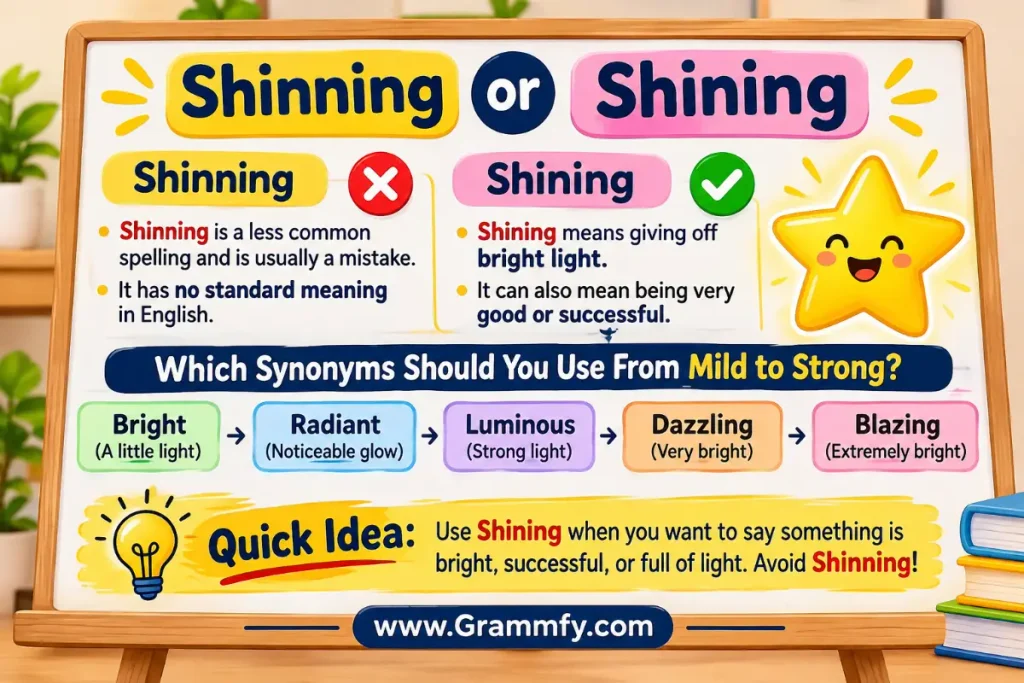
Which Synonyms Should You Use From Mild to Strong?
Sometimes, the right synonym depends on how much brightness you want to describe.
A faint light needs a different expression from an extremely bright flash.
The following scale moves from low intensity to strong brightness.
| Intensity | Word or Phrase | Meaning | Example |
|---|---|---|---|
| 1. Very mild | Faintly glowing | Producing a little light | The candle was faintly glowing. |
| 2. Mild | Glimmering | Giving off a weak, uncertain light | A lamp was glimmering in the distance. |
| 3. Moderate | Gleaming | Showing a clear, steady shine | The silver ring was gleaming. |
| 4. Moderate | Shimmering | Producing a soft, changing light | The water was shimmering. |
| 5. Strong | Radiant | Giving off a strong, attractive brightness | Her face looked radiant. |
| 6. Strong | Brilliant | Extremely bright | A brilliant light appeared outside. |
| 7. Very strong | Dazzling | So bright that it can be hard to look at | The dazzling sun filled the sky. |
| 8. Extremely strong | Blazing | Giving off intense light or heat | The blazing fire lit the campsite. |
This is a practical guide rather than a strict dictionary ranking. Context can change the strength of a word.
How Do You Choose the Right Intensity?
- Use glimmering for a weak or distant light.
- Choose glowing for a soft, steady brightness.
- Pick gleaming for a clean or polished appearance.
- Use shimmering when light seems to move or change.
- Choose radiant for a strong and attractive appearance.
- Pick dazzling when the brightness is powerful.
- Use blazing for extremely intense light or heat.
For a climbing action, these intensity levels don’t apply. Words such as scrambling, scaling, and clambering describe different ways of moving rather than degrees of brightness.
What Are the Different Parts of Speech?
Understanding the related word forms can help you use these terms correctly.
1. Shine as a Verb
Shine is the base verb. It means to give off light, reflect brightness, make something polished, or perform well.
Examples:
- The stars shine at night.
- Her skills shine in difficult situations.
- These shoes shine after polishing.
- The moon will shine over the ocean.
2. Shining as a Present Participle
Shining is the -ing form of shine. It can appear in continuous verb tenses or function as an adjective.
Examples:
- The sun is shining brightly.
- She is shining in her new role.
- We saw a shining star.
- His shining shoes looked expensive.
3. Shine as a Noun
Shine can also be a noun. It describes brightness, polish, or the reflective quality of a surface.
Examples:
- The furniture has a beautiful shine.
- This product gives your hair extra shine.
- The shoes lost their shine after several months.
4. Shiny as an Adjective
Shiny describes something that reflects light or has a polished appearance.
Examples:
- She bought a shiny new bicycle.
- The shiny floor reflected the ceiling lights.
- His jacket had shiny buttons.
5. Shin as a Verb
Shin is the base verb associated with the climbing action.
Examples:
- They shin up the pole during practice.
- He tried to shin down the tree.
- The worker decided to shin up the support.
6. Shinning as a Present Participle or Gerund
Shinning is the -ing form of shin. It describes the climbing action or names the action itself.
Examples:
- The children are shinning up the trees.
- Shinning up a tall pole takes strength.
- We watched him shinning down the structure.
Remember: Shining belongs to shine, while shinning belongs to shin. Their grammatical forms are different because their base verbs are different.
Is There a Difference Between Shinning or Shining in US and UK English?
The basic spelling difference is the same in American and British English. Neither region uses shinning as a standard alternative spelling of shining.
However, the climbing verb has some regional variation.
| Region | Word for Giving Off Light | Word for Climbing |
|---|---|---|
| United States | Shining | Shinning or shinnying |
| United Kingdom | Shining | Shinning |
| Canada | Shining | Shinnying is also recognized |
| Australia | Shining | Shinning may be used |
| New Zealand | Shining | Shinning may be used |
The exact choice for the climbing verb can depend on the dictionary and local usage. Oxford Learner’s Dictionaries identifies shin as British English and shinny as North American English. Collins also records shinning as the present participle of shin.
Does the Pronunciation Change Between Regions?
The two words have different vowel sounds.
- Shining has a long I sound, like the word shine.
- Shinning has a short I sound, like the word shin.
The difference is important because these words aren’t homophones.
In standard pronunciation, shining sounds like SHY-ning, while shinning sounds like SHIN-ing.
Both American and British speakers generally maintain this distinction.
What About Shone and Shined?
There is another small regional and grammatical point worth knowing.
The past tense and past participle of shine can be either shone or shined, depending on the meaning and usage.
Examples:
- The sun shone brightly yesterday.
- She shined her shoes before the interview.
- The flashlight shone through the window.
- He shined a flashlight into the garage.
Shone is common when describing light, while shined is often used when talking about polishing or directing a light. Both forms appear in modern English.
Which Word Works Best in Different Writing Situations?
The right choice depends on what you’re describing and who will read your writing.
Shining is useful in many settings, while shinning is suitable only when the climbing action is relevant.
1. Which Word Works Best in a Resume?
A resume should use clear and professional language. You can use shining when describing an impressive achievement, but more specific words often make your experience sound stronger.
Useful alternatives include:
- Outstanding
- Excellent
- Impressive
- Accomplished
- Exceptional
- Successful
Examples:
- Demonstrated outstanding leadership during a major company project.
- Delivered excellent results while managing a five-member team.
- Showed exceptional problem-solving skills during difficult assignments.
- Built a successful record of improving customer satisfaction.
You can also use shining in a phrase such as:
“Her performance was a shining example of strong leadership.”
However, this sounds more natural in a recommendation letter than in a resume bullet.
Resume tip: Use achievement-focused language rather than relying on general praise.
Shinning is usually unnecessary in a resume unless you’re describing a literal climbing task in an occupation that involves such work.
2. Which Word Works Best in an Essay?
Shining is useful in descriptive, narrative, and academic writing.
You can use it to describe sunlight, reflective surfaces, emotions, or impressive achievements.
Examples:
- The shining moon created a peaceful atmosphere.
- The researcher’s shining example encouraged other students.
- Sunlight was shining through the classroom windows.
- Her shining performance impressed the entire audience.
When writing an academic essay, avoid using too many decorative words. Choose precise expressions that support your argument.
For example, instead of writing “a shining result,” you might use “a significant achievement” when discussing research findings.
3. Which Word Works Best in Texting?
Text messages are usually informal, so simple language is often the best option.
Examples:
- The sun is shining today!
- Your new shoes look so shiny.
- You’re really shining at your new job.
- The stars are shining tonight.
If you’re talking about someone climbing a tree or pole, you can use shinning, but climbing is more familiar to most readers.
For example:
“He’s climbing that tree again!”
This sounds more natural in an everyday text than using a less familiar climbing verb.
4. Which Word Works Best in an Email?
Professional emails should be direct and easy to understand.
Shining works when you want to describe an impressive performance or a bright appearance.
Examples:
- Your team delivered an outstanding performance this quarter.
- Her shining contribution helped the project succeed.
- The presentation highlighted the company’s excellent results.
- We appreciate your exceptional work on this assignment.
If you’re discussing a climbing task, use a more familiar expression unless the specific verb is important.
For example:
“The technician climbed the support structure to complete the inspection.”
This is clearer than using shinning in a general business email.
5. Which Word Works Best in Speaking?
In conversations, the correct choice depends on the action you’re describing.
Use shining when discussing light, happiness, appearance, or success.
Examples:
- The sun is shining beautifully today.
- Your face is shining with happiness.
- She is shining in her new position.
- His shoes are shining after cleaning.
Choose climbing or shinning when someone is moving up or down an object.
For example:
“The boy was climbing the tree.”
This is easier for most listeners to understand than the less common expression “The boy was shinning up the tree.”
Speaking tip: Use familiar words when they communicate your meaning clearly. Save less common vocabulary for situations where it adds useful detail.
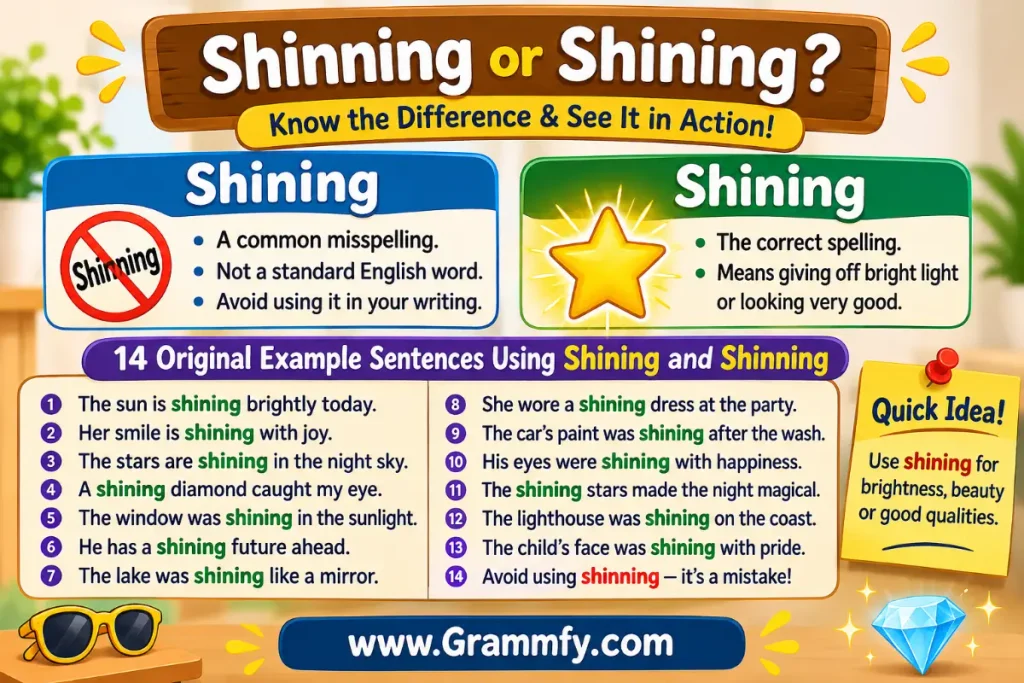
What Are 14 Original Example Sentences Using Shining and Shinning?
Examples help you understand how the two forms work in real situations.
Here are 14 original sentences from everyday life, school, work, and outdoor activities.
Examples Using Shining
- Weather: The sun was shining brightly when we arrived at the beach.
- Night sky: Several stars were shining above the quiet village.
- Home: A shining lamp stood beside the living room sofa.
- Cleaning: My father spent an hour shining his old leather shoes.
- School: The student is shining in mathematics because of her hard work.
- Emotions: Her eyes were shining with happiness when she received the good news.
- Travel: The morning sunlight was shining through the train windows.
- Business: His shining performance earned him a promotion at work.
- Nature: Small drops of water were shining on the green leaves after the rain.
- Celebration: The shining decorations made the wedding hall look beautiful.
Examples Using Shinning
- Outdoor activity: The young boy was shinning up a tree to reach a low branch.
- Construction: The worker was shinning down the pole carefully.
- Adventure: We saw a monkey shinning up a tall tree near the forest entrance.
- Physical movement: Shinning up the narrow support required strength and a firm grip.
What Can You Learn From These Sentences?
The examples show that the words belong to different situations.
Shining can describe:
- Natural light
- Artificial light
- Reflective objects
- Emotional expressions
- Personal achievements
- Excellent performance
Shinning mainly describes:
- Climbing trees
- Moving up poles
- Climbing narrow structures
- Pulling yourself up with your limbs
When you understand the action, choosing the spelling becomes much easier.
Shining vs. Glowing: What’s the Difference?
Both words describe brightness, but they don’t always create the same picture.
Shining usually suggests that something gives off or reflects visible light. Glowing often describes a soft, steady, or warm light.
| Feature | Shining | Glowing |
|---|---|---|
| Main meaning | Giving off or reflecting light | Producing a soft or steady light |
| Appearance | Can be bright or reflective | Often soft and warm |
| Common use | Stars, sunlight, polished objects | Candles, embers, faces |
| Intensity | Can range from mild to strong | Often suggests a gentle light |
| Example | The silver ring was shining. | The fireplace was glowing. |
Examples:
- The shining stars appeared above the mountains.
- The glowing embers warmed the room.
- Her shining eyes showed excitement.
- His face was glowing with happiness.
Use shining when you want to emphasize brightness or reflection. Choose glowing when you want to describe a soft, warm, or steady light.
Shining vs. Sparkling: What’s the Difference?
These words are closely related, but they describe different visual effects.
Shining can describe a steady source of brightness. Sparkling suggests many small flashes or points of light.
| Feature | Shining | Sparkling |
|---|---|---|
| Main idea | Giving or reflecting light | Producing small flashes of light |
| Light pattern | Can be steady | Often appears in brief flashes |
| Common examples | Sun, polished metal, lamp | Diamonds, water, stars |
| Tone | General | More decorative or lively |
| Example | The polished table was shining. | The diamond was sparkling. |
Consider these sentences:
- The moon was shining over the ocean.
- The waves were sparkling under the sunlight.
- Her shoes were shining after polishing.
- The sparkling necklace caught everyone’s attention.
A surface may be shining without sparkling. Likewise, something sparkling usually reflects light in small, noticeable flashes.
Shinning vs. Climbing: What’s the Difference?
These words are related, but shinning describes a more specific type of movement.
Climbing is a general term for moving upward or downward. Shinning usually involves gripping an upright object with your arms and legs to pull yourself along it.
| Feature | Shinning | Climbing |
|---|---|---|
| Meaning | Moving along an object by gripping it with the limbs | Moving upward or downward |
| Scope | Narrower meaning | General meaning |
| Common objects | Poles and trees | Mountains, stairs, ladders, trees |
| Movement | Pulling and gripping | Can involve hands, feet, or equipment |
| Example | He was shinning up a pole. | She was climbing a mountain. |
For example:
- The worker was shinning up a narrow support.
- The worker was climbing a ladder.
The second sentence describes a general upward movement. The first describes a particular climbing method.
All shinning in this climbing sense involves climbing, but not all climbing is shinning.
What Are the Common Mistakes When Using These Words?
Writers often confuse these forms because they differ by only one letter. However, the wrong choice can change the meaning of a sentence.
Here are the mistakes you should avoid.
1. Writing Shinning When You Mean Giving Off Light
Incorrect:
- The sun is shinning brightly today.
Correct:
- The sun is shining brightly today.
The sun gives off light, so you need the verb shine.
2. Using Shinning to Describe a Bright Star
Incorrect:
- A beautiful star was shinning in the sky.
Correct:
- A beautiful star was shining in the sky.
A star produces light. It isn’t climbing anything.
3. Confusing Shining With Shinning in School Assignments
Incorrect:
- She is shinning in her English class.
Correct:
- She is shining in her English class.
The sentence describes her excellent performance, not a climbing action.
4. Using Shining When You Mean Climbing
Incorrect:
- The boy was shining up the tree.
Correct:
- The boy was shinning up the tree.
You can also use the simpler sentence:
- The boy was climbing up the tree.
5. Forgetting to Remove the Final E
Incorrect:
- Shineing
Correct:
- Shining
When you add -ing to shine, remove the silent e.
6. Forgetting to Double the Final N
Incorrect:
- Shining up the pole, when describing the climbing action.
Correct:
- Shinning up the pole.
The verb shin doubles its final consonant before adding -ing.
7. Assuming Both Words Are Pronounced the Same
They have different vowel sounds.
Shining uses the long I sound, while shinning uses the short I sound.
Remembering this difference can help you recognize the correct word when speaking.
8. Assuming Shinning Is Always Wrong
This is another common misunderstanding.
Shinning is a legitimate English word when it comes from the verb shin.
For example:
“The worker was shinning down the pole.”
The word is correct because it describes a climbing movement.
9. Confusing Shinning With Shinnying
Shinnying is another form connected with the verb shinny, which also means climbing by gripping an object.
For example:
- The children were shinnying up the tree.
It is related to the climbing meaning, not to brightness.
10. Using a Rare Word When a Simple One Is Better
Although shinning is correct in its specific meaning, it isn’t familiar to every reader.
In general writing, climbing is often clearer.
For example:
- Less familiar: He was shinning up the pole.
- More familiar: He was climbing up the pole.
Use the specific term when it adds meaning. Otherwise, choose the clearer expression.
What Are the Antonyms of Shining or Shinning?
Antonyms are words with opposite or contrasting meanings.
Since shining has several meanings, its opposites depend on the context.
Antonyms of Shining
| Antonym | Meaning | Example |
|---|---|---|
| Dull | Not bright or reflective | The dull metal looked old. |
| Dim | Giving off little light | The room was dim. |
| Dark | Having little or no light | The street was dark. |
| Gloomy | Dark or lacking brightness | The sky looked gloomy. |
| Matte | Not shiny or reflective | The table had a matte finish. |
| Lackluster | Lacking brightness or energy | His performance was lackluster. |
| Ordinary | Not especially impressive | The result was ordinary. |
Antonyms of Shinning
Shinning describes a climbing action, so its opposite depends on the direction and situation.
| Contrasting Word | Meaning | Example |
|---|---|---|
| Descending | Moving downward | The climber was descending the pole. |
| Staying | Remaining in one place | The boy was staying on the ground. |
| Stepping down | Moving from a higher position to a lower one | She was stepping down from the platform. |
There isn’t one perfect opposite for every use of shinning. For an upward movement, descending may express the opposite direction. For a climbing action in general, remaining still or staying on the ground provides a clearer contrast.
What Are the Best Tips for Choosing the Correct Word?
You don’t need to memorize complicated grammar rules to choose between these forms. A few practical checks can help you make the right decision.
1. Identify the Base Verb
Start by asking which action you want to describe.
- Shine means to give off or reflect light.
- Shin means to climb by gripping an object with your limbs.
This is the most important distinction.
2. Think About the Meaning of Your Sentence
Look at the subject and action.
If you’re describing the sun, a lamp, polished shoes, or someone’s success, choose shining.
When you’re describing someone climbing a pole or tree, shinning may be correct.
3. Remember the Silent E Rule
The verb shine loses its final e before the -ing ending.
Examples:
- Shine → Shining
- Write → Writing
- Drive → Driving
- Smile → Smiling
4. Remember the Double-Consonant Rule
The verb shin doubles its final n before adding -ing.
Examples:
- Shin → Shinning
- Run → Running
- Swim → Swimming
- Sit → Sitting
5. Check the Pronunciation
Listen to the vowel sound.
- Shining has a long I sound.
- Shinning has a short I sound.
This difference can help you remember their separate meanings.
6. Use Simple Synonyms When Necessary
If shinning sounds unfamiliar to your audience, replace it with climbing.
If shining feels repetitive, consider alternatives such as glowing, gleaming, sparkling, or radiant.
Choose an alternative that matches the sentence.
7. Read the Complete Sentence Again
A spelling may look correct on its own but create the wrong meaning in a sentence.
For example:
“The stars were shinning above the mountains.”
The sentence is about light, so the correct form is shining.
Reading the sentence again helps you catch this mistake.
8. Use a Reliable Dictionary
If you’re unsure, check a trusted dictionary for the base verb and its forms.
Cambridge, Oxford Learner’s Dictionaries, and Collins provide useful definitions and examples.
Don’t rely only on spell-checking software. Some programs may identify an uncommon word without understanding whether it fits your intended meaning.
9. Avoid Overcomplicating Your Writing
You don’t need to use shinning just to make a sentence sound advanced.
For most readers, “climbing the tree” is clearer than “shinning up the tree.”
Likewise, shining is usually the best choice when describing brightness.
10. Practice With Your Own Sentences
Write two sentences using each word.
For example:
- The sun is shining through the window.
- Her shoes are shining after cleaning.
- The boy is shinning up a tree.
- The worker is shinning down the pole.
This exercise helps you connect each spelling with its correct action.
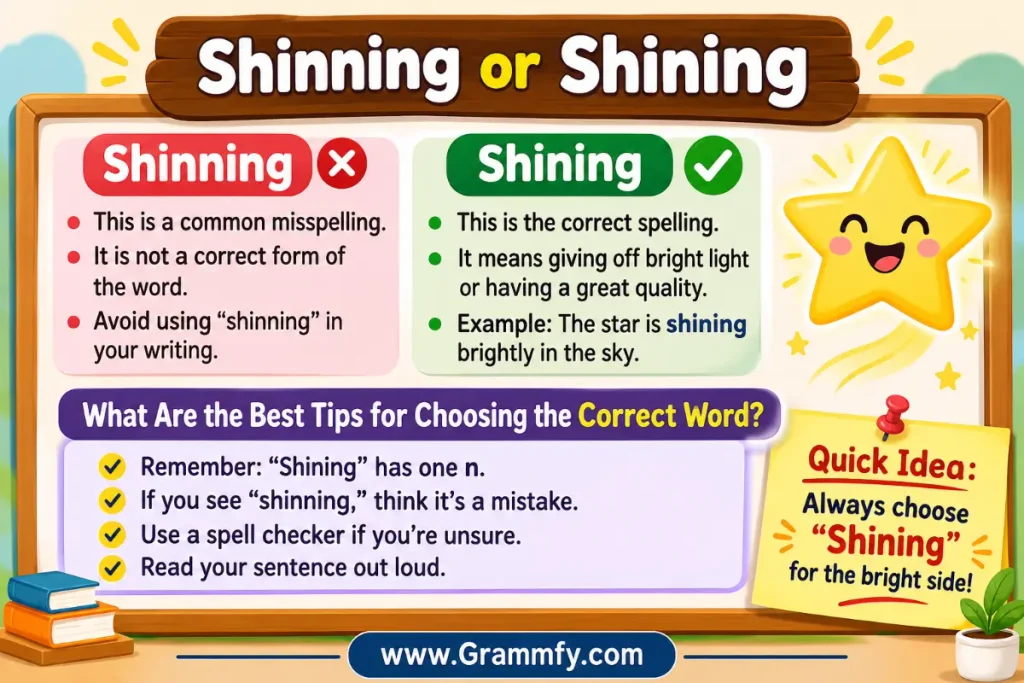
Conclusion:
The choice between Shinning or Shining depends on the meaning you want to express. Shining is the correct form when describing light, brightness, reflective surfaces, happiness, or outstanding performance. Shinning is also correct, but it belongs to the separate verb shin and describes climbing by gripping an object with your arms and legs. The spelling difference follows two useful English rules: remove the silent e from shine before adding -ing, but double the final n in shin. Remembering these patterns will help you avoid common mistakes in essays, emails, and everyday conversations. When in doubt, identify the base verb first. That simple habit makes choosing the correct spelling much easier.
Frequently Asked Questions
1. Is Shinning or Shining the Correct Spelling?
Shining is correct when you mean giving off light, reflecting brightness, or performing well. Shinning is also a correct word when describing the action of climbing something by gripping it with your arms and legs.
2. Why Is Shining Spelled With One N?
Shining comes from shine, which ends in a silent e. English usually removes that final e before adding a vowel-starting suffix such as -ing.
3. Is Shinning a Real English Word?
Yes, shinning is a real English word and the present participle of shin. It mainly describes climbing a pole, tree, or similar object by using your arms and legs.
4. What’s Another Word for Shining?
Glowing, gleaming, sparkling, radiant, luminous, glittering, and shimmering are useful alternatives. Choose one based on whether you’re describing light, a polished surface, or an attractive appearance.
5. Do Shinning or Shining Sound the Same?
No, they have different vowel sounds. Shining has a long I sound, while shinning has a short I sound, like the vowel in shin.
6. Should I Write the Sun Is Shinning or Shining?
Write “The sun is shining.” The sentence describes sunlight, so you need the -ing form of shine rather than shin.
7. What Is the Difference Between Shinning or Shinnying?
Both forms relate to climbing by gripping an object with the arms and legs. Shinning comes from shin, while shinnying comes from shinny, a related verb also used for this climbing action.

Tylerbrooks is a US-based English grammar writer and contributor at Grammfy. He writes helpful articles about grammar, spelling, commonly confused words, and vocabulary. His goal is to explain English topics in simple language with clear examples and practical tips. Through his articles, he helps readers improve their writing and everyday English skills.