
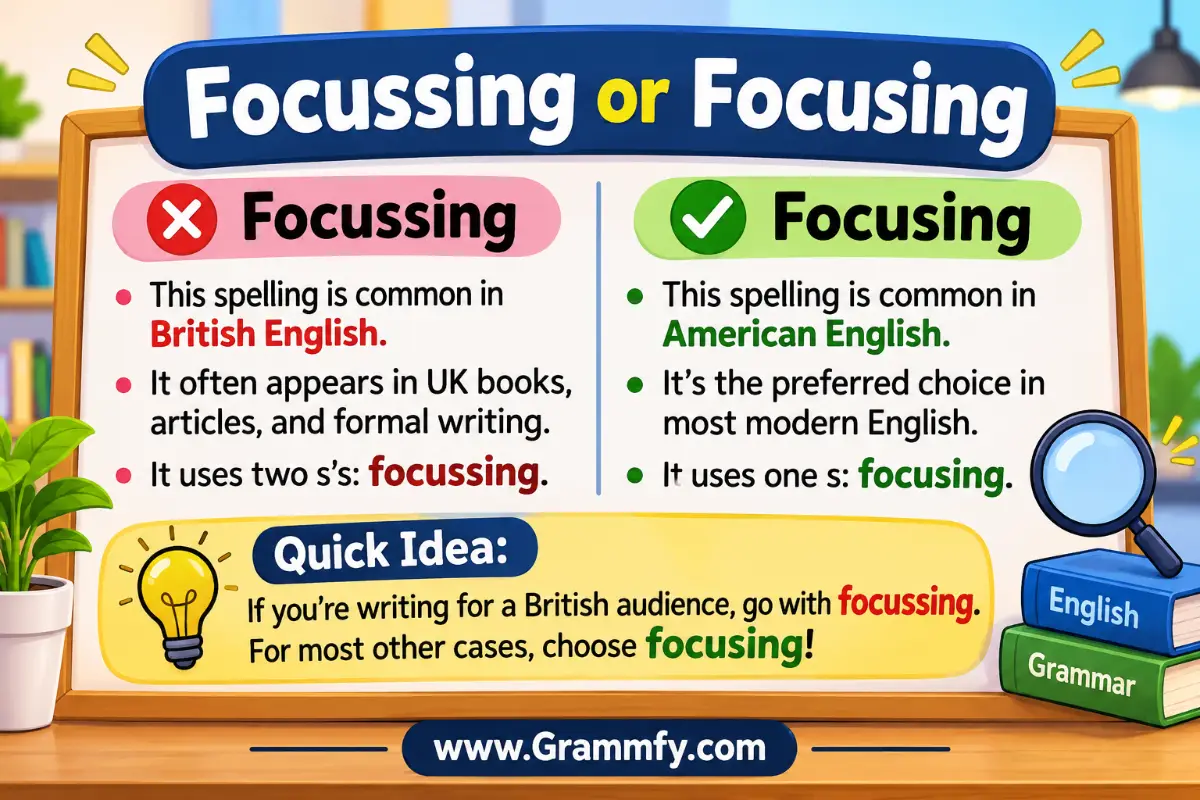
Have you ever paused while writing an email, essay, or work report because you weren’t sure whether to type focussing or focusing? You’re not alone. Both spellings appear in English, and the extra s can make the choice confusing. The good news is that you don’t need to learn two different meanings or memorize a complicated grammar rule.
The difference between Focussing or Focusing comes down to spelling preference and regional usage. Both forms come from the verb focus, which means to direct your attention toward something or adjust a lens so an image becomes clear. However, one spelling is much more common in American English.
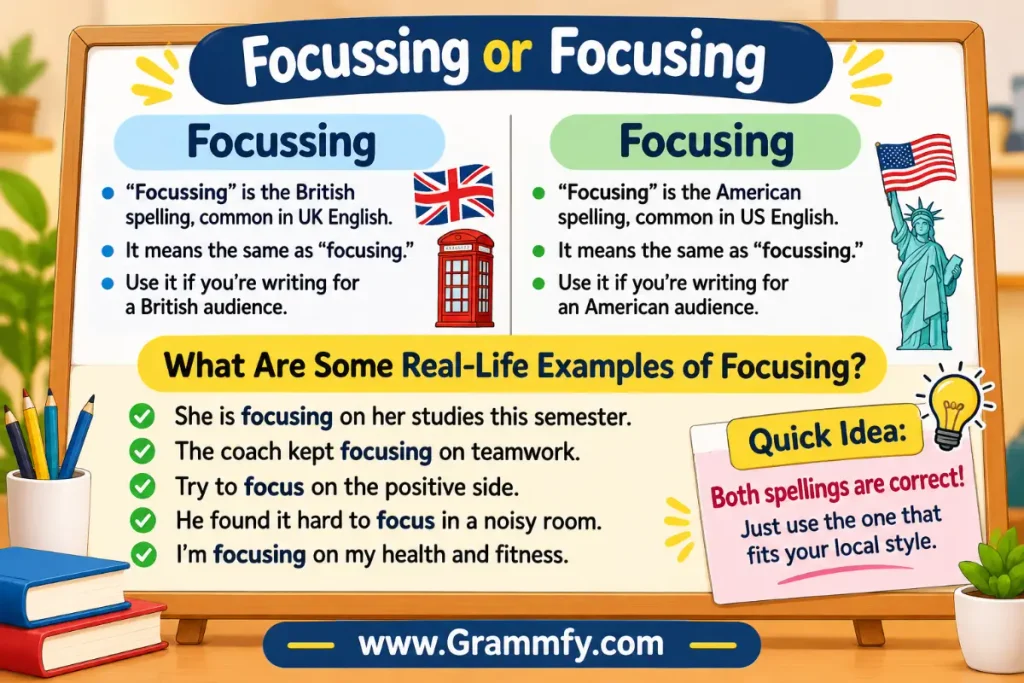
Quick answer: Focusing is the standard and preferred spelling in American English. Focussing is also an accepted variant, especially in some British and Commonwealth writing, but focusing is widely used there too.
Choosing the right form matters when you’re preparing a school assignment, writing a professional email, or publishing content for an international audience. Using the preferred spelling for your readers also helps keep your writing consistent and polished.
In this guide, you’ll learn what each spelling means, where the word comes from, how the two forms differ by region, and which alternatives you can use in different situations. You’ll also find practical examples, common mistakes, and simple tips to help you remember the correct form.
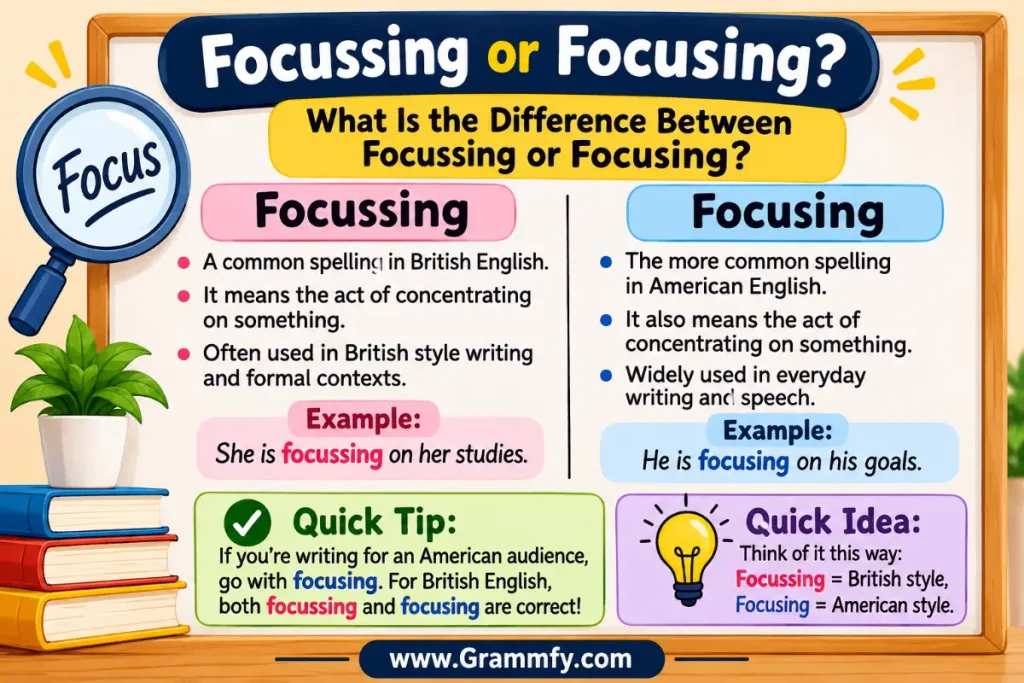
What Is the Difference Between Focussing or Focusing?
The main difference is the number of s letters. Focusing has one s, while focussing has two. Both are present participles of the verb focus, and both can describe directing attention, concentrating on a task, or adjusting a camera lens.
Here is a simple comparison:
| Spelling | Status | Common usage | Example |
|---|---|---|---|
| Focusing | Standard spelling | American English and widely used internationally | She is focusing on her studies. |
| Focussing | Accepted spelling variant | Some British and Commonwealth writing | He is focussing on the main problem. |
Neither spelling creates a different meaning. The choice is about spelling convention, not grammar or pronunciation.
Does Focusing Mean Something Different From Focussing?
No. Both forms describe the same action.
For example:
- Focusing: The photographer is focusing the camera on the mountain.
- Focussing: The photographer is focussing the camera on the mountain.
Both sentences mean that the photographer is adjusting the camera to make the mountain appear clear.
The same is true when the word refers to attention:
- Focusing: I’m focusing on my work today.
- Focussing: I’m focussing on my work today.
The meaning stays the same. The spelling changes, but the action does not.
Which Spelling Should You Use in American English?
Use focusing in American English. It is the standard spelling and the safest choice for school assignments, business writing, websites, emails, and everyday communication in the United States.
The single-s spelling is also widely accepted in modern British English. Although some British writers use focussing, you don’t need to add the second s to make the word correct.
If you’re writing for a mixed international audience, focusing is a practical choice because readers in both American and British English commonly recognize it.
Where Does the Word Focus Come From?
The history of a word can make its spelling easier to understand. The verb focus has an interesting origin connected to fire, light, and the idea of a central point.
The English word focus comes from the Latin word focus, which meant hearth or fireplace. A hearth was the place where a fire burned in a home. Over time, the word developed a connection with a central point or place where something comes together.
In the 1600s, the term began appearing in English in mathematical and optical contexts. It described a point where light rays meet or appear to meet. Later, the word gained a broader meaning: the main point of interest or attention.
The verb focus developed from the noun. It first appeared in optical use in the late 1700s. Its meaning later expanded to include directing your thoughts, attention, or effort toward something.
Today, the word appears in many situations:
- A camera focuses on a subject to make it clear.
- A student focuses on a lesson to understand it.
- A business focuses on customer needs.
- A writer focuses on the main idea of an article.
- A team focuses on completing an important goal.
The spelling forms focusing and focussing developed as accepted ways to add the -ing ending to focus. The single-s form is now the more widely preferred choice, especially in American English.
What Does Focusing Mean in Simple English?
Focusing means giving your attention, time, or effort to one particular person, activity, subject, or goal. It can also mean adjusting a camera, lens, or other optical device to make an image clear.
The word has two common uses.
1. Focusing Means Paying Attention
This is the most common everyday meaning. When you focus on something, you give it your attention instead of allowing other things to distract you.
Examples:
- Mia is focusing on her final exams.
- The team is focusing on customer service.
- I’m focusing on one task at a time.
- We should be focusing on the main issue.
In each sentence, the word describes mental attention or effort.
2. Focusing Means Making an Image Clear
The word also has a physical meaning in photography, science, and vision. It describes adjusting a lens or optical device so that an object appears sharp and clear.
Examples:
- The photographer is focusing the camera on the flowers.
- I had trouble focusing the microscope.
- The camera is focusing on the person near the window.
- The telescope is focusing on a distant planet.
In these examples, the word refers to an optical adjustment rather than mental concentration.
Can Focusing Be a Noun?
Yes. The -ing form can act as a gerund, which means it can function like a noun in a sentence.
Examples:
- Focusing requires patience.
- Focusing on your goals can improve your progress.
- Focusing for long periods can be difficult.
- Focusing on small details takes practice.
Here, the word names an activity rather than simply describing what someone is doing.
What Are the Best Synonyms for Focusing?
The best replacement depends on what you want to express. Some words describe giving attention to a task, while others suggest careful thought, strong concentration, or a narrow area of interest.
The following list includes simple, everyday, formal, and informal alternatives. These words are related to focusing, but they aren’t perfect replacements in every sentence. Check the meaning and tone before choosing one.
What Are Simple Synonyms for Focusing?
Simple synonyms are useful in everyday writing, schoolwork, and conversations. They are easy to understand and don’t sound overly formal.
| Word | Meaning | Tone | Example |
|---|---|---|---|
| Paying attention | Giving notice to something | Simple | I’m paying attention to the lesson. |
| Concentrating | Giving mental effort to one task | Neutral | She is concentrating on her homework. |
| Watching | Looking carefully at something | Simple | He is watching the road. |
| Listening | Giving attention to sounds or speech | Simple | The students are listening to the teacher. |
| Studying | Giving time to learning a subject | Everyday | I’m studying for my science test. |
| Looking at | Directing your eyes toward something | Simple | We are looking at the main problem. |
| Thinking about | Giving attention to an idea | Everyday | She is thinking about her next step. |
| Working on | Giving effort to a task | Everyday | I’m working on my writing skills. |
What Are Everyday Synonyms for Focusing?
Everyday alternatives work well in emails, conversations, reports, and general writing. They can make your sentences sound more natural or help you avoid repeating the same word.
| Word | Meaning | Tone | Example |
|---|---|---|---|
| Attending to | Giving attention or care to something | Neutral | The manager is attending to customer concerns. |
| Zeroing in on | Directing attention to one specific thing | Conversational | We’re zeroing in on the main issue. |
| Centering on | Making something the main point | Neutral | The discussion is centering on education. |
| Targeting | Directing effort toward a specific goal | Business | The campaign is targeting new customers. |
| Prioritizing | Giving something greater importance | Everyday | I’m prioritizing my most urgent tasks. |
| Considering | Thinking carefully about something | Neutral | The committee is considering the proposal. |
| Examining | Looking at something carefully | Neutral | The doctor is examining the results. |
| Narrowing down | Reducing the number of choices or possibilities | Conversational | We’re narrowing down our options. |
What Are Formal Synonyms for Focusing?
Formal alternatives are useful in academic papers, professional reports, research, and business communication. They can express a more specific type of attention or analysis.
| Word | Meaning | Tone | Example |
|---|---|---|---|
| Directing attention | Guiding attention toward a subject | Formal | The report is directing attention to safety concerns. |
| Concentrating efforts | Bringing effort together for a purpose | Formal | The team is concentrating efforts on development. |
| Emphasizing | Giving special importance to something | Formal | The article is emphasizing the need for reform. |
| Investigating | Studying a subject to discover facts | Formal | Researchers are investigating the cause. |
| Analyzing | Examining information in detail | Academic | The students are analyzing the results. |
| Scrutinizing | Examining something very closely | Formal | The panel is scrutinizing the evidence. |
| Addressing | Dealing with a problem or subject | Professional | The company is addressing employee concerns. |
| Refining | Improving something by making careful changes | Formal | The writer is refining the final draft. |
What Are Informal or Slang Alternatives for Focusing?
Informal expressions can make a conversation sound relaxed and natural. Some are idioms rather than direct synonyms, so use them when the situation suits their meaning.
| Word | Meaning | Tone | Example |
|---|---|---|---|
| Locking in | Giving full attention to a task | Slang | I’m locking in before the exam. |
| Tuning in | Paying attention to something | Informal | Everyone is tuning in to the discussion. |
| Getting into | Becoming interested or involved in something | Informal | She’s getting into her new project. |
| Buckling down | Starting to work seriously | Informal | It’s time to buckle down and finish the report. |
| Dialing in | Making a careful adjustment or becoming fully prepared | Informal | He’s dialing in the camera settings. |
| Keeping your eye on | Watching or monitoring something | Informal | Keep your eye on the main goal. |
| Staying on track | Continuing toward the planned goal | Informal | We’re staying on track with the project. |
| Getting your head in the game | Becoming mentally ready and attentive | Slang | I need to get my head in the game. |
Quick note: Analyzing, studying, watching, and locking in can replace focusing in some situations, but they don’t all mean exactly the same thing. Choose the word that describes the action you intend to express.
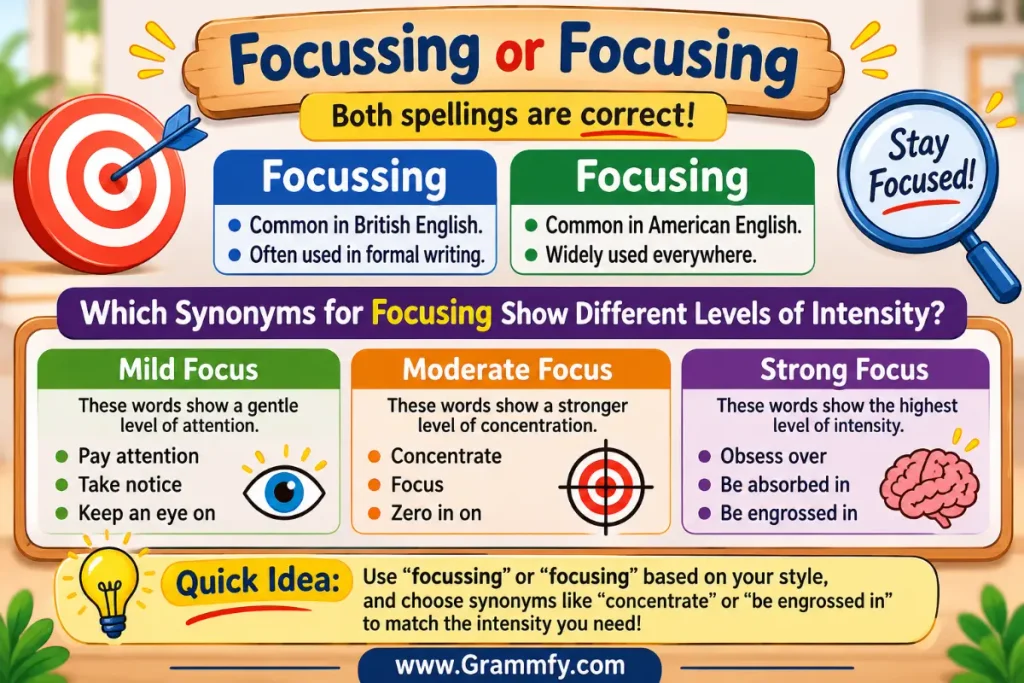
Which Synonyms for Focusing Show Different Levels of Intensity?
Not every situation requires the same level of concentration. Sometimes you only need to notice something. In other situations, you may need to give it your full attention and ignore distractions.
This intensity guide moves from mild attention to very strong concentration.
| Level | Word or phrase | Meaning | Example |
|---|---|---|---|
| 1. Mild | Noticing | Becoming aware of something | I started noticing the small changes. |
| 2. Mild | Observing | Watching something carefully | She is observing the birds. |
| 3. Light | Paying attention | Giving something basic attention | Please pay attention to the instructions. |
| 4. Light | Considering | Thinking about an idea | We’re considering another option. |
| 5. Moderate | Attending to | Giving attention to a matter | He is attending to the details. |
| 6. Moderate | Concentrating | Giving mental effort to something | I’m concentrating on my assignment. |
| 7. Strong | Applying yourself | Making a serious effort | She’s applying herself to her studies. |
| 8. Strong | Immersing yourself | Becoming deeply involved in an activity | He is immersing himself in the research. |
| 9. Very strong | Zeroing in on | Directing attention to one specific point | The team is zeroing in on the cause. |
| 10. Very strong | Locking in | Giving full attention with few distractions | I’m locking in for the final exam. |
How Do You Choose the Right Level?
Think about the amount of attention the situation requires.
- For a quick observation: Use noticing or observing.
- For ordinary attention: Use paying attention or considering.
- For serious work: Use concentrating or applying yourself.
- For deep involvement: Use immersing yourself.
- For intense concentration: Use zeroing in on or locking in.
For example, saying “I’m noticing my assignment” doesn’t communicate the same effort as “I’m concentrating on my assignment.” The first describes awareness, while the second describes active mental effort.
What Are the Different Forms of the Word Focus?
Understanding the word family helps you use the correct form in different sentences. Focus can work as both a noun and a verb. Its related forms include focused, focusing, and focuses.
| Word form | Part of speech | Meaning | Example |
|---|---|---|---|
| Focus | Noun | Main point or center of attention | The focus of the lesson is grammar. |
| Focus | Verb | To direct attention | I need to focus on my work. |
| Focuses | Verb | Third-person singular form | She focuses on her goals. |
| Focusing | Gerund or present participle | The act of directing attention | Focusing takes practice. |
| Focused | Past tense or past participle | Directed attention toward something | He focused on the question. |
| Focused | Adjective | Giving attention to a goal | She is a focused student. |
| Foci | Plural noun | Multiple central points or points in optics and mathematics | The study examines several foci. |
When Should You Use Focusing as a Verb?
Use focusing when someone or something is carrying out the action now or when the action is ongoing.
Examples:
- The children are focusing on their reading.
- Our company is focusing on better service.
- I’m focusing on improving my English.
- The camera is focusing on the moving car.
It can also describe an action as a general activity:
- Focusing on one goal can make work easier.
- Focusing during a long meeting takes effort.
When Should You Use Focused Instead?
Use focused when you need the simple past tense, past participle, or adjective.
Examples:
- I focused on my studies last night.
- The photographer focused the camera on the subject.
- She remained focused during the interview.
- The team is focused on its next target.
Remember that focused describes a completed action or a state of attention. Focusing describes an ongoing action or the activity itself.
Is Focuses Different From Focusing?
Yes. Focuses is the third-person singular form of the verb. Focusing is the -ing form.
Compare these sentences:
- She focuses on her goals every morning.
- She is focusing on her goals right now.
The first sentence describes a regular habit. The second describes an action happening at the moment.
Is Focusing or Focussing Correct in American and British English?
Both spellings are accepted, but their use differs by writing convention. The single-s form is standard in American English and is also common in British English. The double-s form appears in some British and Commonwealth publications.
Which Form Is Preferred in American English?
American English uses focusing as the standard spelling. This is the form you should choose for:
- School assignments and college essays
- Business emails and reports
- American websites and blogs
- Job applications and resumes
- News articles and professional documents
- Social media posts aimed at US readers
For example:
- I’m focusing on improving my communication skills.
- The company is focusing on customer satisfaction.
- Our teacher is focusing on sentence structure.
Using focusing keeps your writing aligned with common American spelling conventions.
Is Focussing Accepted in British English?
Yes. Focussing is an accepted spelling variant in British English, but it is not the only correct form. Many British writers and publications use focusing with one s.
The double-s spelling may appear in British or Commonwealth material, but it is not necessary. If you’re following a style guide, use the form that the guide recommends.
Examples:
- The student is focussing on the final chapter.
- The team is focussing on the new plan.
- The photographer is focussing the lens.
Each sentence can also use focusing without changing its meaning.
What About Australian, Canadian, and Other English Varieties?
English spelling conventions can vary across countries, publishers, and organizations. In Australian, Canadian, and other Commonwealth writing, you may encounter both forms.
However, don’t assume that every writer in these countries prefers the double-s spelling. The single-s form is widely understood and used internationally.
A useful approach is to follow the dictionary or style guide used by your school, workplace, publisher, or website. Consistency is more important than switching between spellings without a reason.
Which Spelling Is Best for International Readers?
Focusing is generally the safer choice for international content. It is the standard American form and is also familiar to readers who use British English.
If you publish articles for a global audience, using the single-s spelling can help you maintain one consistent spelling throughout your content.
Which Word Should You Use in a Resume, Essay, Email, or Conversation?
The best word depends on your audience and purpose. Focusing is useful in many situations, but a more specific alternative can make your writing clearer.
What Word Should You Use in a Resume?
In a resume, choose words that show your skills, responsibilities, and results. Instead of repeating focusing, use stronger action verbs when they describe what you actually did.
Good alternatives include:
- Prioritizing
- Managing
- Targeting
- Coordinating
- Improving
- Analyzing
- Directing
- Developing
Examples:
- Original: Focusing on customer needs to improve service.
- Improved: Prioritized customer needs to improve service.
- Original: Focusing on monthly sales targets.
- Improved: Worked toward monthly sales targets and tracked progress.
- Original: Focusing on team performance.
- Improved: Improved team performance through regular feedback.
A resume should describe completed achievements whenever possible. If you’re describing a current responsibility, the -ing form may still be appropriate, but an action verb with a clear result often makes a stronger statement.
What Word Should You Use in an Essay?
In an essay, use focusing when you want to describe the main subject or direction of an argument. Alternatives such as examining, analyzing, exploring, and emphasizing can make your meaning more precise.
Examples:
- The essay is focusing on the causes of climate change.
- The essay examines the causes of climate change.
- This section is focusing on the role of education.
- This section analyzes the role of education.
- The study is focusing on language development.
- The study explores language development.
Use examining when you are looking closely at a topic. Choose analyzing when you are breaking information into parts to understand it. Use emphasizing when you want to highlight an important point.
What Word Should You Use in a Text Message?
Text messages are usually relaxed and direct. You can use focusing, concentrating, locking in, or working on, depending on how casual you want to sound.
Examples:
- I’m focusing on homework right now.
- I’m concentrating on this assignment.
- I’m locking in for the test.
- I’m working on my project. I’ll text you later.
- Let me finish this first. I need to stay focused.
For a casual message, locking in can sound natural among people who use that expression. In a more neutral conversation, focusing or working on is a safer choice.
What Word Should You Use in a Professional Email?
In professional emails, clear and polite language is usually best. Focusing, prioritizing, addressing, and working toward are useful choices.
Examples:
- Our team is focusing on the client’s main concerns.
- We are prioritizing the most urgent requests.
- The department is addressing the issues raised in the meeting.
- I’m focusing on completing the report by Friday.
- We are working toward the goals discussed earlier.
If you want to sound more specific, explain what the team is doing rather than using a general phrase repeatedly.
What Word Should You Use When Speaking?
In everyday speech, choose a word that feels natural and easy to understand. Concentrating, paying attention, and working on are common alternatives.
Examples:
- I’m focusing on what you’re saying.
- I’m trying to concentrate.
- Please pay attention to the road.
- We’re working on the final part.
- I need to think about this carefully.
In conversation, the best replacement is often the simplest one. You don’t need a formal word when an everyday expression communicates your point clearly.
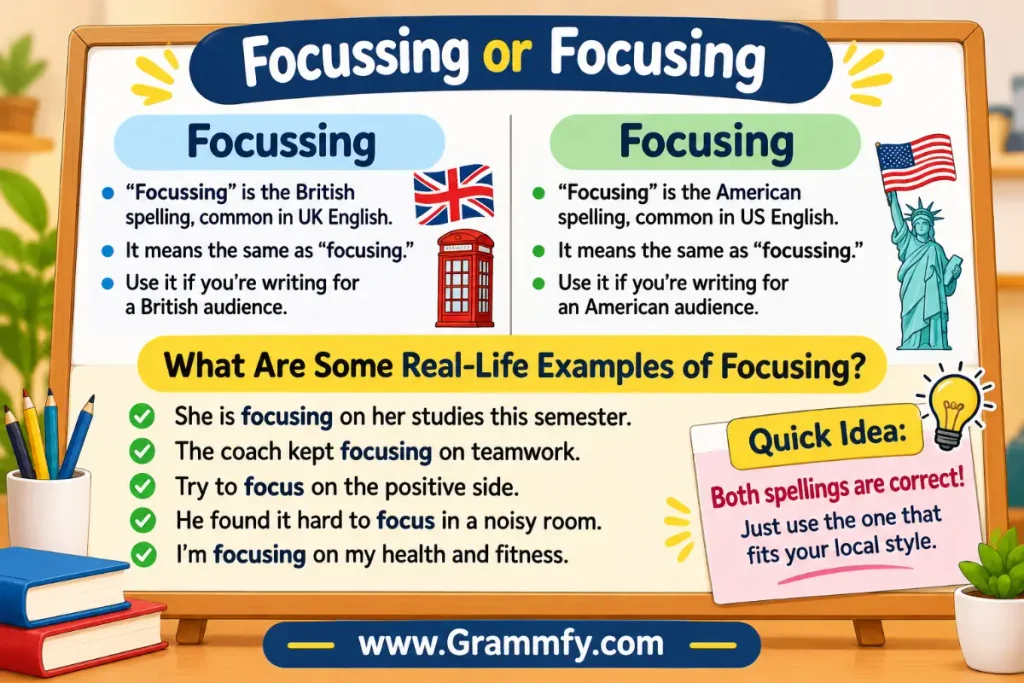
What Are Some Real-Life Examples of Focusing?
Examples can show how a word works in different situations. The following sentences use focusing in school, work, personal life, photography, and everyday communication.
School and Learning
- Maya is focusing on her math homework before dinner.
- The teacher is focusing on the difference between nouns and verbs.
- I’m focusing on improving my reading skills this semester.
- The students are focusing on the instructions before starting the test.
- Focusing on one chapter at a time makes studying feel more manageable.
Work and Business
- Our marketing team is focusing on reaching new customers.
- The manager is focusing on employee training this month.
- The company is focusing on quality instead of increasing production.
- I’m focusing on finishing the presentation before the meeting.
- The department is focusing on reducing unnecessary expenses.
Personal Goals
- She is focusing on building healthier daily habits.
- I’m focusing on saving money for a new laptop.
- He started focusing on his goals after changing jobs.
- Focusing on small improvements can help you make steady progress.
- We’re focusing on spending more time with our family.
Photography and Science
- The photographer is focusing the lens on the child’s face.
- The camera keeps focusing on the background instead of the subject.
- The scientist is focusing the microscope on the sample.
- I adjusted the camera while it was focusing on the distant building.
- The telescope is focusing on a bright object in the night sky.
Examples About Conversations and Daily Life
- Please keep focusing on the question instead of changing the subject.
- I’m having trouble focusing because the room is noisy.
- The speaker is focusing on the benefits of regular exercise.
- After a short break, I felt ready to start focusing again.
- We should focus on finding a solution rather than blaming each other.
These examples show that the word can describe mental attention, practical effort, and optical adjustment. The surrounding words help readers understand which meaning you intend.
What’s the Difference?: Focusing vs. Concentrating
Focusing and concentrating are close in meaning, but they don’t always communicate exactly the same thing.
Focusing usually means directing attention toward a particular subject, goal, or task. It can also refer to making an image clear through a lens.
Concentrating places more emphasis on mental effort. It often suggests giving a task sustained attention and avoiding distractions.
| Focusing | Concentrating |
|---|---|
| Directing attention toward something | Giving strong mental effort to something |
| Can describe an optical adjustment | Usually describes mental attention |
| Can identify the main subject or goal | Often suggests sustained effort |
| Example: I’m focusing on the report. | Example: I’m concentrating on writing the report. |
Consider these sentences:
- The camera is focusing on the bird.
- The student is concentrating on the exam.
The first sentence describes a camera adjustment. The second describes mental effort. You can also use concentrating for the student’s action and focusing for the camera’s action, but the two words are not interchangeable in every context.
Focusing vs. Paying Attention: Which One Is Better?
Both expressions describe directing your attention, but they have slightly different uses.
Paying attention is a common everyday phrase. It often means listening, watching, or noticing something carefully.
Focusing can suggest a more deliberate effort to keep your attention on one subject or goal.
| Focusing | Paying attention |
|---|---|
| Often suggests directing or maintaining attention | Often means noticing or listening carefully |
| Can refer to goals, tasks, or a subject | Commonly refers to instructions, people, and events |
| Works in formal and informal writing | Sounds natural in everyday speech |
| Example: I’m focusing on my goals. | Example: I’m paying attention to the teacher. |
Compare:
- I’m focusing on my project. This means you’re directing your effort toward completing the project.
- I’m paying attention to the instructions. This means you’re listening or watching carefully so you understand what to do.
Choose focusing when you want to highlight a particular goal or task. Choose paying attention when you mean listening, noticing, or following what is happening.
What Are the Common Mistakes When Using Focusing?
The spelling is simple once you understand the difference, but writers can still make mistakes when using the word in sentences.
1. Using Focussing in American Writing Without a Reason
Focussing is a recognized variant, but it isn’t the standard American spelling.
- Less suitable for standard US writing: I’m focussing on my studies.
- Preferred in US English: I’m focusing on my studies.
If your audience follows American English, choose the single-s form.
2. Treating the Two Spellings as Different Words
Some writers assume that the double-s form has a different meaning. It doesn’t.
Both forms describe directing attention or adjusting an optical device. The difference is spelling preference, not meaning.
3. Mixing the Spellings in the Same Article
Switching between focusing and focussing without a clear reason can make an article look inconsistent.
For example:
- The team is focusing on customer service.
- Our manager is focussing on employee training.
- The company is focusing on quality.
Although readers can understand all three sentences, the spelling changes unnecessarily. Choose one form and use it throughout the document.
4. Using Focusing When Focused Is Needed
These forms have different grammatical jobs.
- Incorrect for a completed action: I am focused on my work yesterday.
- Correct: I focused on my work yesterday.
- Correct for an ongoing action: I am focusing on my work today.
Use focused for a completed action or an adjective. Use focusing for an ongoing action or a gerund.
5. Using Focusing When Another Word Is More Precise
Sometimes focusing is too general. A more exact word can explain what someone is doing.
Compare:
- General: The researchers are focusing on the results.
- More precise: The researchers are analyzing the results.
The second sentence tells readers that the researchers are examining the results in detail.
Other useful choices include:
- Investigating when looking for facts or causes.
- Examining when inspecting something carefully.
- Prioritizing when deciding what matters most.
- Emphasizing when highlighting an important point.
- Monitoring when watching something over time.
6. Confusing Focus With Focuses
Focus and focuses are not interchangeable in every sentence.
- Correct: I focus on my goals.
- Correct: She focuses on her goals.
- Incorrect: She focus on her goals.
Use focuses with he, she, or it in the simple present tense.
7. Forgetting That Focusing Can Be a Gerund
The -ing form can act as a noun, so it doesn’t always need a helping verb.
- Correct: Focusing on your goals takes discipline.
- Correct: She is focusing on her goals.
The first sentence uses focusing as a gerund. The second uses it as part of the present continuous verb phrase.
What Are the Antonyms of Focusing?
An antonym is a word with the opposite or nearly opposite meaning. The best opposite of focusing depends on whether you’re talking about attention, effort, or a camera image.
| Antonym | Meaning | Example |
|---|---|---|
| Ignoring | Giving no attention to something | He is ignoring the instructions. |
| Distracting | Taking attention away from something | The noise is distracting the students. |
| Neglecting | Failing to give proper attention | She is neglecting her responsibilities. |
| Overlooking | Failing to notice something | I overlooked an important detail. |
| Wandering | Moving from one subject or thought to another | My thoughts are wandering. |
| Daydreaming | Thinking about pleasant or unrelated things | He is daydreaming during the lesson. |
| Disregarding | Choosing not to consider something | They are disregarding the warning. |
| Blurring | Making an image or outline unclear | The moving camera is blurring the picture. |
Remember: Distracting and ignoring are useful opposites when discussing attention. Blurring is more suitable when talking about images or optical clarity.
What Are the Quick Tips for Choosing the Right Spelling?
You don’t need to memorize a long list of rules to choose between the two forms. A few simple habits can help you make the right decision.
- Use focusing for American English. The single-s spelling is the standard choice in the United States.
- Remember that focussing is a variant. It is accepted in some British and Commonwealth writing, but it is not required.
- Keep your spelling consistent. Don’t switch between the two forms in the same article without a clear style reason.
- Check your audience. Follow the spelling convention used by your school, employer, publisher, or website.
- Learn the base word. Both forms come from focus, so neither spelling changes the meaning.
- Don’t confuse focusing with focused. The first describes an ongoing action or activity; the second can describe a completed action or a state.
- Choose precise synonyms when needed. Use analyzing, examining, or prioritizing when those words describe your action more clearly.
- Read your sentence aloud. Check whether the word fits the meaning and grammar of the sentence.
- Use a trusted dictionary. When a spelling question comes up, check a reliable American or British dictionary.
- Follow one style guide. A consistent spelling choice makes professional and online writing easier to read.
What Is the Easiest Way to Remember the Difference?
Use this short reminder:
- Focusing = one s = standard American spelling.
- Focussing = two s letters = accepted variant in some other English conventions.
You don’t need to attach a different meaning to the extra s. Both forms come from the same verb and describe the same action.
Conclusion: Which Spelling Should You Remember?
The choice between Focussing or Focusing is easier when you remember that both spellings have the same meaning. The main difference is regional spelling preference. Focusing is the standard form in American English and is widely used in other varieties, while focussing remains an accepted variant in some British and Commonwealth writing.
For American schoolwork, professional emails, resumes, and website content, choose focusing. If you’re writing for a publication that follows a different spelling guide, check its preferred form and use it consistently. You can also replace the word with alternatives such as concentrating, analyzing, or paying attention when they express your meaning more clearly. Once you know the difference, choosing the right form becomes simple. Keep your writing consistent, and you’ll be ready to use the word with confidence.
Frequently Asked Questions
Is focusing spelled with one s or two?
Focusing is spelled with one s in standard American English. Focussing, with two s letters, is also an accepted variant in some British and Commonwealth writing.
Is focussing wrong in British English?
No, focussing is not wrong in British English. It is an accepted spelling variant, although focusing is also widely used and often preferred.
Which spelling is correct in the USA: focusing or focussing?
Focusing is the standard spelling in the United States. Use it in American school assignments, business writing, websites, and professional communication.
Does focusing have the same meaning as focussing?
Yes. Both spellings are forms of the verb focus and have the same meaning. They can describe directing attention toward a task or adjusting a lens to make an image clear.
What’s another way to say focusing?
You can say concentrating, paying attention, zeroing in on, working on, or directing attention. The best alternative depends on your sentence and the level of attention you want to describe.
Is focusing a verb or a noun?
Focusing is the present participle of the verb focus, but it can also work as a gerund. For example, “She is focusing” uses it as part of a verb phrase, while “Focusing takes practice” uses it as a noun.
Should I write focused or focusing?
Use focused for a completed action or to describe someone’s state of attention. Use focusing for an ongoing action or the activity itself, as in “I’m focusing on my work.”

Tylerbrooks is a US-based English grammar writer and contributor at Grammfy. He writes helpful articles about grammar, spelling, commonly confused words, and vocabulary. His goal is to explain English topics in simple language with clear examples and practical tips. Through his articles, he helps readers improve their writing and everyday English skills.