
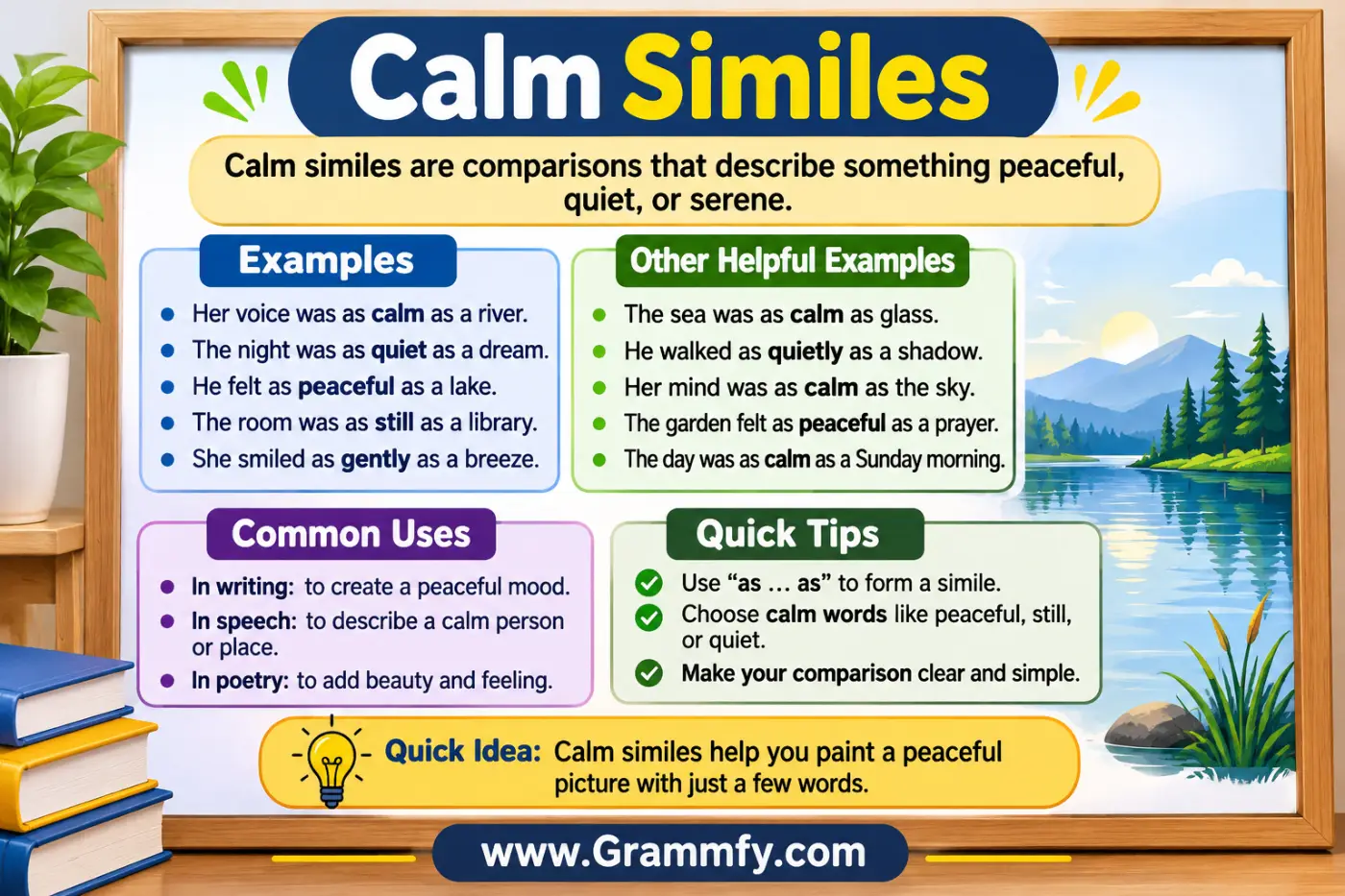
When you’re writing an essay, sending a thoughtful email, or describing a quiet evening, finding the right words for a peaceful feeling can be harder than it seems. You might want to describe a friend who stays relaxed under pressure, a lake without a ripple, or a room that feels safe and quiet. That’s where Calm Similes can help you make your writing more vivid and natural.
A good simile compares one thing to another using like or as. It helps readers picture a feeling instead of simply reading a description. For example, saying someone is “as calm as a still lake” creates a clearer image than saying the person is relaxed.
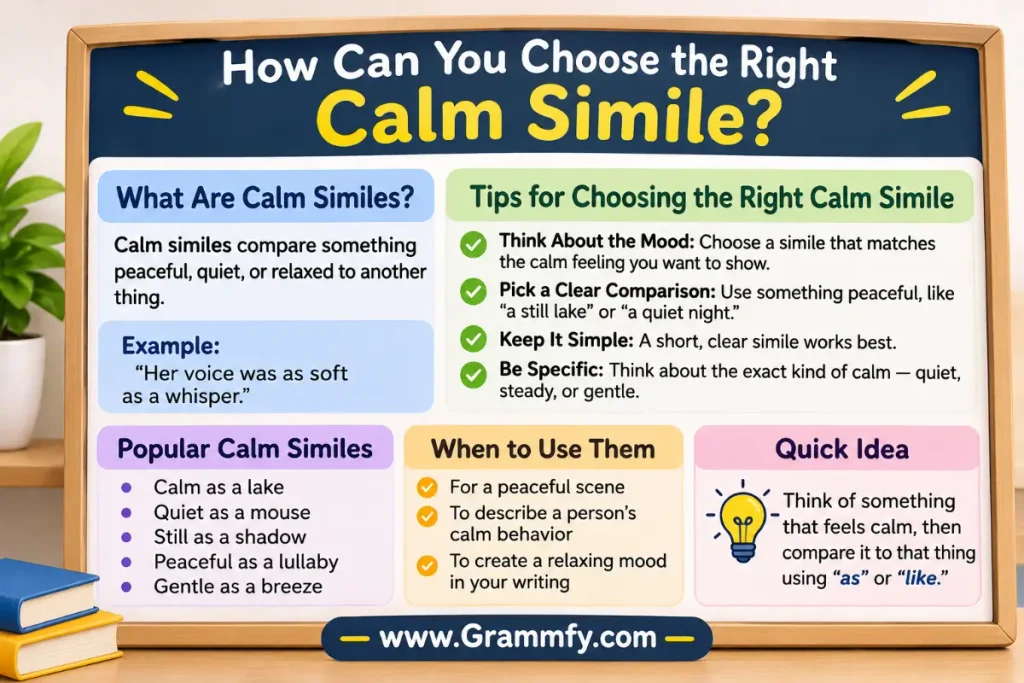
Calm similes are comparisons that describe peace, quietness, emotional control, or freedom from worry. They use familiar images, such as still water, a gentle breeze, or a sleeping cat, to make calm feelings easier to imagine.
Whether you’re writing a poem, improving a school assignment, creating a social media caption, or describing someone who handles stress well, the right comparison can make your words more memorable. Below, you’ll find original examples, meanings, useful alternatives, and practical advice to help you choose a simile that fits your situation.
Need a more vivid way to describe energetic? Explore our guide to creative energetic similes and examples for fresh ideas and examples.
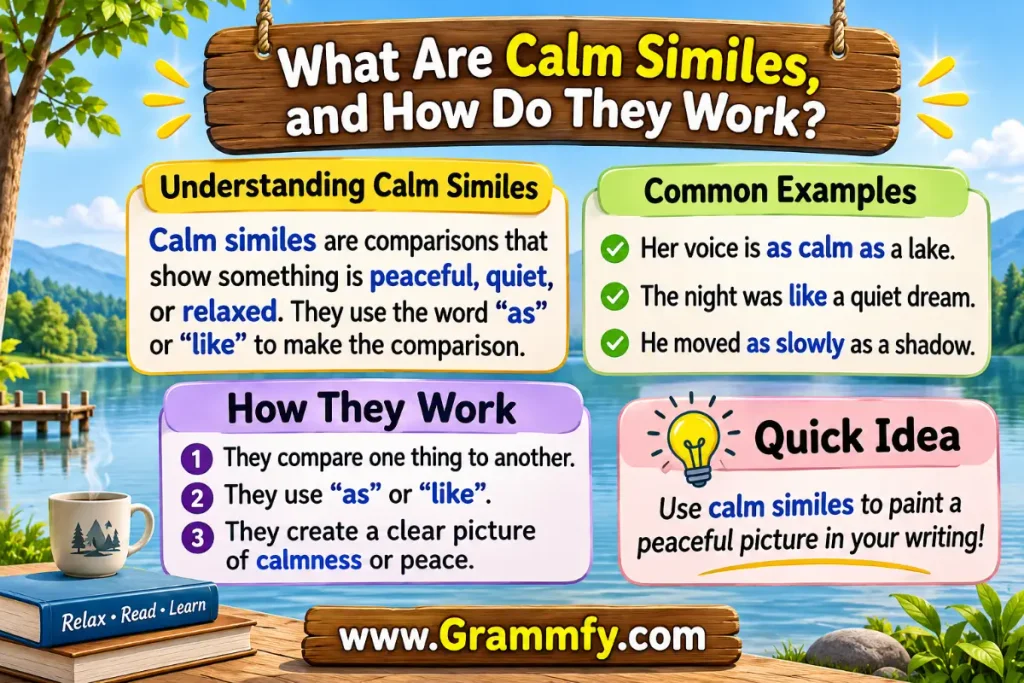
What Are Calm Similes, and How Do They Work?
A simile compares two different things to highlight a shared quality. When the quality is calmness, the comparison usually focuses on stillness, gentleness, quietness, patience, or emotional balance.
For example:
- As calm as a still lake: Describes someone or something that feels completely peaceful.
- Like a gentle breeze: Suggests a soft, comforting, and refreshing presence.
- As peaceful as a sleeping baby: Creates an image of quietness and safety.
- Like a boat floating on still water: Suggests a relaxed state without struggle or disturbance.
These comparisons work because readers already understand the images. Most people can imagine a quiet lake or a gentle breeze, so they can connect those pictures to the feeling you’re describing.
What Is the Difference Between a Simile and a Simple Description?
A simple description tells readers what something is like in direct terms. A simile gives them an image to imagine.
| Simple description | Simile | What changes? |
|---|---|---|
| She was calm. | She was as calm as a still lake. | Adds an image of stillness. |
| His voice was gentle. | His voice was like a soft breeze. | Emphasizes softness. |
| The room was peaceful. | The room was as peaceful as a quiet garden. | Creates a relaxing setting. |
| He stayed relaxed. | He stayed cool as a cucumber. | Adds a casual, familiar expression. |
| The sea was quiet. | The sea rested like a sleeping giant. | Gives the scene a poetic quality. |
A simile doesn’t always need to be elaborate. One clear comparison can do more than a long sentence filled with adjectives.
Why Do Writers Use Comparisons for Calmness?
Calmness is an abstract feeling. Readers can’t see peace or emotional balance directly, but they can picture objects and scenes that represent them.
Writers use these comparisons to:
- Make descriptions easier to visualize.
- Create a peaceful mood in stories and poems.
- Show how a character responds to pressure.
- Describe relaxing places and quiet moments.
- Make emotional writing more engaging.
- Avoid repeating words such as calm, quiet, and peaceful.
The best comparison depends on what kind of calmness you mean. A person who stays composed during an emergency needs a different description from a garden that feels quiet on a summer morning.
What Is the Origin of Similes About Calmness?
The word simile comes from the Latin word similis, meaning “like” or “similar.” This origin reflects the main purpose of a simile: to explain one thing by comparing it with another.
The word calm entered English through French and ultimately traces back to a Greek word associated with stillness or a lack of wind. Its meaning developed to include quiet weather, peaceful surroundings, and a relaxed state of mind.
These two ideas work naturally together. A simile compares something to a familiar image, while calmness provides the quality being described.
For centuries, writers have used natural scenes to express peaceful feelings. Still water can suggest a mind without distracting thoughts. A gentle breeze can represent a comforting presence. A quiet garden can symbolize a place where someone feels safe.
Not every comparison has a documented historical origin, however. Many expressions are ordinary creative descriptions rather than traditional sayings with a known source.
For modern writers, the important point is simple: choose an image that helps readers understand the particular kind of calmness you want to express.
What Are the 35 Best Calm Similes With Meanings?
The following examples cover different forms of peace, from emotional control to a quiet atmosphere. Each includes a meaning and a sentence showing how you can use it.
| # | Simile | Meaning | Example sentence |
|---|---|---|---|
| 1 | As calm as a still lake | Completely peaceful and undisturbed | Her mind was as calm as a still lake before the competition. |
| 2 | As peaceful as a sleeping baby | Quiet, gentle, and undisturbed | The nursery was as peaceful as a sleeping baby. |
| 5 | As cool as a cucumber | Relaxed under pressure | He remained as cool as a cucumber during the interview. |
| 6 | Like a boat on calm water | Relaxed and free from disturbance | After finishing her work, she felt like a boat on calm water. |
| 7 | As quiet as falling snow | Extremely quiet and gentle | The street was as quiet as falling snow before sunrise. |
| 8 | Like a cat in the sunshine | Comfortable and content | Grandpa rested like a cat in the sunshine. |
| 11 | As serene as a mountain lake | Deeply peaceful | His expression was as serene as a mountain lake. |
| 12 | Like a candle glowing in a quiet room | Soft and soothing | Her voice was like a candle glowing in a quiet room. |
| 13 | As steady as a rock | Reliable and emotionally firm | During the family crisis, he was as steady as a rock. |
| 15 | As soft as a whisper | Quiet and gentle | The music was as soft as a whisper. |
| 16 | Like a leaf resting on water | Still and undisturbed | She sat by the window like a leaf resting on water. |
| 17 | As tranquil as a hidden garden | Peaceful and removed from noise | The courtyard was as tranquil as a hidden garden. |
Writing tip: Some of these are creative comparisons rather than fixed idioms. You can adapt them to fit your characters, settings, and tone. For instance, a mountain lake might suit a serious poem, while a Sunday morning might work better in a casual blog post.
Which Calm Similes Are Best for Different Situations?
Not every comparison creates the same feeling. Some suggest complete silence, while others show confidence, comfort, or peace after a stressful event.
What Simile Describes Complete Stillness?
Use comparisons involving still water, a statue, or falling snow when you want to emphasize a lack of movement or disturbance.
Examples:
- Her face was as still as a frozen pond.
- The classroom became as quiet as falling snow.
- He sat like a statue while waiting for his name to be called.
- The water rested like a mirror beneath the morning sun.
These work best when the scene is almost motionless. Avoid them when you want to describe a person who is friendly and relaxed but still active.
What Simile Describes a Calm Person Under Pressure?
Choose comparisons that suggest stability, control, and confidence.
Examples:
- She was as cool as a cucumber during the job interview.
- He remained as steady as a rock when the plan changed.
- The nurse was as composed as a seasoned pilot during the emergency.
- My coach stayed as level as a balanced scale while we discussed the loss.
These descriptions are especially useful when calmness matters because someone must make a good decision. They show more than a quiet personality; they suggest an ability to respond thoughtfully.
What Simile Creates a Peaceful Mood?
Natural scenes and gentle sounds often create a relaxing atmosphere.
Examples:
- The cabin felt like a warm blanket on a cold night.
- The garden was as peaceful as a hidden valley.
- Her words drifted through the room like a gentle breeze.
- The music flowed like a slow river through a meadow.
Use these comparisons in descriptive writing, reflective essays, and scenes where readers should feel comfortable.
What Simile Describes Calmness After Stress?
Sometimes calmness means relief rather than silence. In these situations, a comparison should suggest that a difficult period has ended.
Examples:
- After the argument, the house settled like the sea after a storm.
- Finishing the exam felt like watching dark clouds drift away.
- When the last customer left, the shop became as peaceful as an empty beach.
- After submitting her project, she felt like a bird released into an open sky.
These images work well in stories because they can show a change in mood. The calmness feels meaningful because the reader understands what came before it.
What Words Describe Different Levels of Calmness?
The best comparison depends on the intensity of the feeling. Someone who is slightly relaxed is not necessarily as peaceful as someone who feels completely free from worry.
Use this guide to choose the right level.
| Intensity | Useful words | Example simile | Best use |
|---|---|---|---|
| Mild | Relaxed, easygoing, settled | Like a chair on a sunny porch | Everyday comfort |
| Gentle | Soft, soothing, quiet | Like a light breeze | Kind voices and peaceful settings |
| Moderate | Peaceful, composed, steady | As steady as a rock | Everyday challenges |
| Strong | Serene, tranquil, untroubled | As serene as a mountain lake | Reflective or descriptive writing |
| Very strong | Still, motionless, undisturbed | As still as a frozen pond | Complete silence or stillness |
| Calm after stress | Relieved, settled, reassured | Like the sea after a storm | Resolution and recovery |
When Should You Use “Relaxed” Instead of “Serene”?
Relaxed usually describes someone who feels comfortable and free from tension. Serene suggests a deeper, more settled peace.
- Relaxed: “He looked relaxed after lunch.”
- Serene: “She looked serene as she watched the sunrise.”
A person can be relaxed while laughing, talking, or playing a game. A serene description often creates a quieter, more reflective mood.
When Should You Use “Composed” Instead of “Untroubled”?
Composed describes someone who controls their outward reaction, particularly in a difficult situation. Untroubled suggests an absence of worry or concern.
- Composed: “The speaker remained composed when the microphone stopped working.”
- Untroubled: “She looked untroubled as she walked through the garden.”
Someone may feel anxious inside but remain composed on the outside. The word untroubled more directly suggests that worry is absent.
When Should You Use “Still” Instead of “Peaceful”?
Still focuses on a lack of movement or noise. Peaceful focuses on a feeling or atmosphere without conflict or disturbance.
- Still: “The lake was as still as glass.”
- Peaceful: “The village was as peaceful as a quiet garden.”
A place can be peaceful even when birds are singing and children are playing. It doesn’t have to be silent.
What Are the Best Synonyms for Calmness?
The following list includes 32 useful words grouped by tone and purpose. These words are related to calmness, but they aren’t interchangeable in every sentence.
| Word | Meaning | Tone | Example |
|---|---|---|---|
| Quiet | Making little noise | Simple | The room was quiet after lunch. |
| Still | Not moving | Simple | The water remained still. |
| Cool | Relaxed under pressure | Everyday | She stayed cool during the interview. |
| Relaxed | Free from tension | Simple | He felt relaxed after his walk. |
| Gentle | Soft and kind | Everyday | She spoke in a gentle voice. |
| Peaceful | Free from disturbance | Simple | We spent a peaceful afternoon outside. |
| Steady | Firm and consistent | Everyday | His steady response reassured the team. |
| Collected | In control of emotions | Everyday | She remained collected during the discussion. |
| Levelheaded | Able to think sensibly | Everyday | A levelheaded manager considers the facts. |
| Composed | Emotionally controlled | Formal | The presenter remained composed. |
| Serene | Deeply peaceful | Formal | The lake looked serene at sunrise. |
| Tranquil | Quiet and undisturbed | Formal | They visited a tranquil retreat. |
| Placid | Calm, with little movement | Formal | A placid pond reflected the trees. |
| Imperturbable | Difficult to upset | Formal | The judge remained imperturbable. |
| Mellow | Relaxed and easygoing | Everyday | The mellow music softened the mood. |
| Laid-back | Casual and relaxed | Everyday | He has a laid-back approach to weekends. |
| Chill | Relaxed or easygoing | Slang | Let’s keep things chill tonight. |
| Coolheaded | Able to think clearly under pressure | Everyday | A coolheaded response prevented a mistake. |
| Restful | Helping someone rest | Everyday | The room had a restful atmosphere. |
| Soothing | Reducing tension or distress | Everyday | Her soothing words helped me relax. |
| Reassured | Made to feel less worried | Everyday | I felt reassured after the conversation. |
| Nonchalant | Appearing casual or unconcerned | Everyday | She gave a nonchalant shrug. |
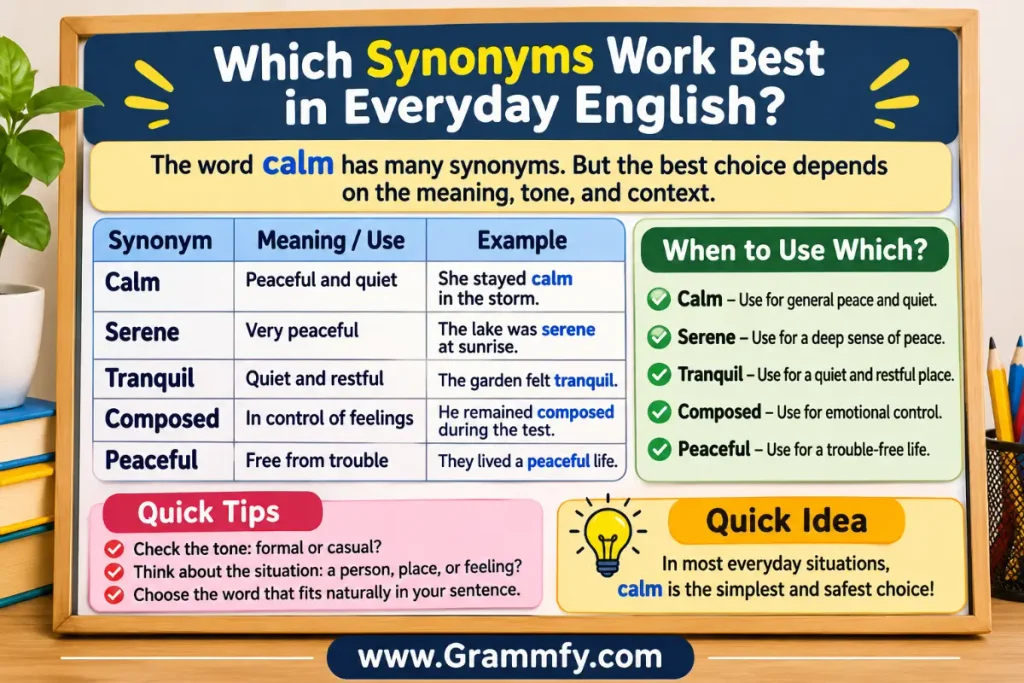
Which Synonyms Work Best in Everyday English?
For ordinary conversation, use familiar words such as relaxed, quiet, easygoing, peaceful, and chill.
For professional writing, composed, steady, levelheaded, and unflappable are often more precise.
To poetry and descriptive prose, serene, tranquil, placid, and soothing can create a more reflective tone.
Be careful with complacent, stoic, and nonchalant. They don’t simply mean peaceful. Each carries an additional meaning that can change how readers interpret the person you’re describing.
What Are the Best Calmness Words by Part of Speech?
Choosing the correct part of speech helps your sentences sound natural. Some words describe a person, some describe an action, and others name the feeling itself.
| Part of speech | Useful words | Example |
|---|---|---|
| Nouns | Calmness, peace, serenity, tranquility, composure | Her calmness helped the group focus. |
| Adjectives | Calm, peaceful, serene, composed, placid | The water looked placid. |
| Verbs | Settle, soothe, relax, reassure, quiet | The music soothed the tired child. |
| Adverbs | Calmly, peacefully, quietly, steadily, gently | She answered calmly. |
Can You Use a Simile With an Adjective?
Yes. An adjective can describe the person or thing being compared.
- He was as calm as a still lake.
- Her voice was as gentle as a summer breeze.
- The garden looked as peaceful as a hidden valley.
The adjective tells readers what quality the subject has, while the comparison makes that quality more vivid.
Can You Use a Simile With a Verb?
Yes. A comparison can describe how someone acts or how an event unfolds.
- She moved like a leaf drifting on water.
- The music flowed like a quiet stream.
- His anger faded like clouds after a storm.
These examples focus on movement or change rather than a fixed quality. They can be particularly effective when describing a character’s emotions.
Is “Calmly” a Simile?
No. Calmly is an adverb, not a simile. It explains how an action happens.
For example, “She answered calmly” describes her manner. “She answered as calmly as a captain guiding a ship through quiet waters” uses a comparison to make the description more specific.
Both constructions are correct. Choose the simile when the image adds something useful.
Which Calm Similes Work Best in a Resume?
In a resume, calmness usually means staying composed, making sound decisions, and working well under pressure. A creative comparison can be memorable in conversation, but resumes generally benefit from direct professional language.
Instead of writing “I am as cool as a cucumber,” describe the skill behind that quality.
Examples for Professional Resumes
- “Maintained a composed approach while managing competing deadlines.”
- “Stayed levelheaded when resolving customer concerns.”
- “Provided steady leadership during unexpected project changes.”
- “Handled high-pressure tasks with patience and professionalism.”
- “Helped the team remain focused during challenging situations.”
If you’re writing a creative personal statement, a comparison may fit naturally:
“Like a steady lighthouse in rough weather, I help my team find a clear direction when projects become difficult.”
This sentence is more expressive than a typical resume bullet. Use it only when the application allows a personal or narrative style.
Best choice: Use composed, levelheaded, steady, or calm under pressure in formal job applications. Show the result of your calm behavior whenever possible.
Which Calm Similes Work Best in an Essay?
Essays often need a balance between clear explanations and descriptive language. A comparison can help you introduce an atmosphere, explain a character’s behavior, or make a reflective point.
Examples for School and College Essays
- The lake was as still as glass, reflecting the mountains around it.
- Her response was as measured as a clock ticking through the night.
- The classroom became as quiet as a library after the teacher began speaking.
- His patience was like a deep river that continued flowing around every obstacle.
- After the disagreement, the family gathered like travelers finding shelter after a storm.
How Can You Avoid Overusing Similes in an Essay?
Use a simile when it adds a new image, meaning, or emotional effect. Don’t add a comparison to every sentence.
For example:
Too repetitive: “The lake was like glass. The sky was like silk. The trees were like statues. The air was like a whisper.”
More effective: “The lake lay still beneath the mountains. Even the trees seemed motionless in the early morning light.”
The second version gives readers a clear picture without forcing every detail into a comparison.
A useful rule is to choose one strong simile for an important moment, then let direct descriptions support it.
Which Calm Similes Work Best in Text Messages?
Text messages usually sound more natural when they use short, familiar expressions. A long poetic comparison may feel out of place in a casual conversation.
Try these examples:
- “You’re cool as a cucumber!”
- “Let’s keep it chill.”
- “Your place feels like a little peaceful corner of the world.”
- “Talking to you is like a breath of fresh air.”
- “Today feels as relaxed as a lazy Sunday.”
- “You handled that like a pro.”
These expressions work well when you’re reassuring a friend, describing a relaxing weekend, or praising someone for staying calm.
For a comforting message, you might write:
“Take a breath. You don’t have to solve everything at once. Think of your mind like a lake settling after the wind stops.”
This comparison feels supportive because it suggests that peace can return gradually.
Which Calm Similes Work Best in Emails?
Email tone depends on the reader and purpose. A friendly message can use a simple comparison, but a formal business email should focus on clear, professional wording.
Examples for Friendly Emails
- “Your message was like a breath of fresh air during a busy week.”
- “The meeting felt as relaxed as a conversation over coffee.”
- “I’m glad we could settle the issue like a boat returning to calm waters.”
Examples for Professional Emails
- “Thank you for your composed response during a challenging discussion.”
- “Your steady guidance helped the team work through the issue.”
- “I appreciate the calm and thoughtful approach you brought to the meeting.”
In a formal email, it’s often better to describe the person’s behavior directly rather than use a decorative simile. Save creative comparisons for situations where they match your relationship with the reader.
Which Calm Similes Work Best in Speaking?
Spoken English tends to favor expressions that listeners recognize immediately. Familiar comparisons are easier to understand than elaborate images.
Consider these options:
- “She was cool as a cucumber.”
- “He’s steady as a rock.”
- “The place was as quiet as a library.”
- “Talking to her is like a breath of fresh air.”
- “He stayed calm when everyone else started worrying.”
You can also use a more expressive comparison when telling a story:
“After the storm passed, the beach was as peaceful as a sleeping village.”
The image helps listeners imagine the setting. However, if you’re speaking in a meeting or giving instructions, a direct statement such as “We need to stay calm and focus on the next step” is usually clearer.
What Is the Difference Between Calm, Peaceful, and Serene?
These words overlap, but each emphasizes a different quality. Choosing the right one makes a description more accurate.
| Word | Main idea | Example simile | Best context |
|---|---|---|---|
| Calm | Little agitation or emotional disturbance | As calm as a still lake | People, weather, situations |
| Peaceful | Free from conflict or disturbance | As peaceful as a quiet village | Places, relationships, experiences |
| Serene | Deep, graceful, settled peace | As serene as a mountain lake | Nature, faces, reflective moments |
| Tranquil | Quiet and free from disruption | As tranquil as a secluded garden | Landscapes, settings, moods |
| Composed | Controlled and emotionally steady | As composed as an experienced pilot | Pressure, work, difficult conversations |
| Relaxed | Free from physical or mental tension | As relaxed as a Sunday morning | Leisure, everyday life, comfort |
Calm vs. Peaceful: What’s the Difference?
Calm often describes the absence of agitation, while peaceful can suggest freedom from conflict or disturbance.
A person can remain calm during an argument without the situation itself being peaceful.
- “She stayed as calm as a still lake while the customers complained.”
- “The neighborhood was as peaceful as a village on a quiet morning.”
The first example focuses on emotional control. The second describes the surrounding environment.
Serene vs. Tranquil: Which Is Better?
Serene often emphasizes a graceful, deeply settled feeling. Tranquil usually emphasizes quietness and freedom from disturbance.
- “Her serene expression showed that she felt at peace.”
- “The tranquil garden was far from the noise of traffic.”
The distinction isn’t absolute. Both words can describe a peaceful person, place, or moment. Choose the one that best fits the image and tone of your sentence.
Composed vs. Nonchalant: Are They the Same?
No. Composed usually suggests controlled behavior, while nonchalant describes an apparently casual or unconcerned attitude.
- “He remained composed while answering difficult questions.” This suggests self-control.
- “He gave a nonchalant shrug when asked about the delay.” This suggests he appeared unconcerned.
Nonchalance can sometimes look dismissive. If you want to praise someone’s professionalism, composed is usually a safer choice.
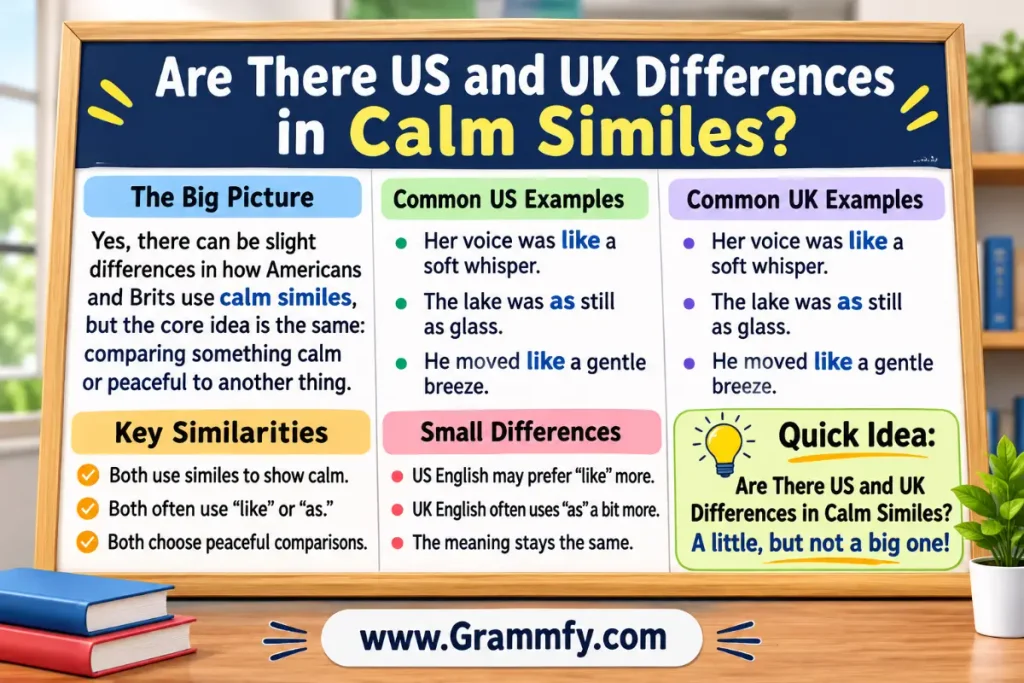
Are There US and UK Differences in Calm Similes?
Most common similes about calmness work in both American and British English. Expressions such as “as calm as a still lake,” “as steady as a rock,” and “like a gentle breeze” are widely understandable.
Differences are more likely to involve everyday vocabulary, spelling, or tone than the basic structure of a simile.
| Expression | US English | UK English | Note |
|---|---|---|---|
| Cool as a cucumber | Common | Common | Familiar idiom in both varieties |
| Laid-back | Common | Common | Informal description of a relaxed person |
| Chill | Very common in casual speech | Also used in casual speech | Informal; meaning depends on context |
| Tranquil | Common | Common | More formal or descriptive |
| At peace | Common | Common | Can describe emotional or spiritual calm |
| Taking it easy | Common | Common | Casual expression for relaxing |
Should You Use “Cool as a Cucumber” in Formal Writing?
The expression is widely understood, but its tone is informal. It fits casual stories and conversations better than a formal research paper or business report.
For example:
- Casual: “Maya was cool as a cucumber during the quiz.”
- Formal: “Maya remained composed throughout the assessment.”
Both describe calm behavior, but the second is better suited to formal contexts.
Do Regional Expressions Change the Meaning?
Sometimes. A phrase may be more familiar in one community, age group, or region than another. Slang also changes over time.
If your audience includes English learners or readers from different countries, choose clear expressions that are easy to understand. Familiar natural images are often more effective than obscure regional sayings.
What Are Some Original Calm Similes for Creative Writing?
When you want a distinctive description, build your comparison around the scene rather than choosing a familiar phrase automatically. Think about the character, setting, sound, or movement you want readers to imagine.
Here are 12 additional examples designed for stories, poems, and reflective writing.
| Simile | What it suggests | Example sentence |
|---|---|---|
| Like a lantern glowing at dusk | Gentle comfort | Her smile was like a lantern glowing at dusk. |
| As patient as a tree through winter | Endurance and patience | He waited as patiently as a tree through winter. |
| Like a sail resting after the wind fades | Relief after activity | After the long journey, she felt like a sail resting after the wind faded. |
| As quiet as dust settling on a shelf | Gradual silence | The room became as quiet as dust settling on a shelf. |
| Like sunlight spreading across a floor | Gentle warmth | His kindness arrived like sunlight spreading across a floor. |
| As steady as a heartbeat at rest | Regularity and control | Her voice was as steady as a heartbeat at rest. |
| Like a path winding through a meadow | Unhurried progress | Their conversation moved like a path winding through a meadow. |
| As soft as mist over a field | Gentle, muted atmosphere | The morning looked as soft as mist over a field. |
| Like a boat tied safely to shore | Security and relief | At home, he felt like a boat tied safely to shore. |
| As peaceful as the first moment after rain | Freshness and relief | The garden was as peaceful as the first moment after rain. |
| Like a song fading into the distance | Quiet transition | Her worries faded like a song drifting into the distance. |
| As unhurried as shadows at sunset | Slow, relaxed movement | They walked as unhurried as shadows at sunset. |
How Can You Create Your Own Simile for Calmness?
You don’t need to memorize every example. You can build your own comparisons by following three steps.
Step 1: Decide what kind of calmness you mean.
Is it silence, emotional control, comfort, patience, or relief?
Step 2: Choose an image that shares that quality.
For silence, consider fresh snow or an empty library. For comfort, consider a warm blanket. To emotional control, consider a steady lighthouse.
Step 3: Connect the image naturally.
Use like or as to make the comparison.
For example:
- Feeling: Relief after a stressful week.
- Image: A window opening after a stuffy day.
- Simile: “The weekend felt like a window opening after a long, stuffy day.”
The image works because it suggests both relief and a fresh start.
How Can You Keep Creative Similes From Sounding Awkward?
A creative comparison should make sense to the reader, even if the image is unusual.
Ask yourself:
- Does the image share a clear quality with calmness?
- Can readers picture the comparison?
- Does it fit the mood of the passage?
- Is the sentence easy to understand when read aloud?
- Does the comparison add something beyond the word calm?
If the connection is difficult to explain, try a simpler image. Original writing doesn’t have to be complicated to be effective.
What Are Common Mistakes When Using Calm Similes?
Similes can make writing more vivid, but a poorly chosen comparison may confuse readers or create the wrong tone.
Mistake 1: Using an Image That Doesn’t Match the Feeling
Not every quiet image communicates comfort.
For example, “as silent as an abandoned hospital” may suggest fear, loneliness, or unease rather than peace.
Better: “As quiet as a garden before sunrise.”
Use the abandoned hospital comparison only if you want an unsettling atmosphere.
Mistake 2: Confusing Calmness With Happiness
Calmness and happiness can occur together, but they aren’t the same.
- Calm: “She remained as steady as a rock during the disagreement.”
- Happy: “She smiled like a child opening a birthday present.”
The first emphasizes emotional control. The second expresses excitement and joy.
Choose the comparison that matches the emotion you actually want to describe.
Mistake 3: Using Too Many Similes in One Paragraph
A paragraph filled with comparisons can become difficult to follow.
For example, comparing a person to a lake, a breeze, a mountain, and a candle within a few sentences may distract readers from the main point.
Better approach: Choose one main image, then support it with direct descriptions.
“His voice was as gentle as a breeze. He listened without interrupting and answered every question patiently.”
The comparison establishes the mood, while the next sentence shows the behavior.
Mistake 4: Using a Simile When a Direct Statement Is Clearer
Sometimes a direct description works better.
- Wordy: “The team leader was like a lighthouse standing in a sea of difficult decisions.”
- Clearer: “The team leader stayed calm and gave everyone clear instructions.”
The first sentence may suit a speech or story. The second is more effective in a workplace report.
Mistake 5: Assuming Every Calmness Synonym Is Positive
Some words carry meanings that may sound critical.
- Complacent suggests being too comfortable to notice risks.
- Nonchalant may suggest a lack of concern.
- Stoic can imply that someone hides or endures emotion without expressing it.
If you want to compliment a person, composed, patient, or levelheaded may communicate your meaning more clearly.
Mistake 6: Forgetting the Grammar of a Simile
A simile usually needs a clear comparison.
Correct:
- “She was as calm as a lake.”
- “He moved like a drifting cloud.”
- “The room felt like a peaceful garden.”
Less natural:
– “She was calm like lake.”
The final example needs an article and a more natural sentence structure. Write “She was as calm as a lake” or “She was calm like a still lake.”
Mistake 7: Treating a Creative Comparison as a Fixed Idiom
Some expressions are established idioms, while others are original descriptions.
“Cool as a cucumber” is a familiar idiom. “As peaceful as moonlight resting on a garden” is a creative simile.
Both can work, but readers may recognize the first immediately and interpret the second through its imagery. Don’t claim that a newly created comparison is a traditional saying unless you have reliable evidence for that claim.
What Are the Opposites of Calmness?
Antonyms help you describe contrast. A character may begin a story feeling peaceful and later become anxious, angry, or overwhelmed.
| Opposite | Meaning | Example |
|---|---|---|
| Agitated | Emotionally disturbed or restless | He became agitated when the train was delayed. |
| Anxious | Worried about what may happen | She felt anxious before the interview. |
| Restless | Unable to relax or stay still | The restless child paced around the room. |
| Frantic | Extremely hurried or distressed | The frantic caller searched for the missing documents. |
| Turbulent | Marked by disturbance or instability | Their turbulent discussion continued for an hour. |
| Chaotic | Completely disorganized | The office became chaotic before the deadline. |
| Irritated | Annoyed or slightly angry | He sounded irritated by the repeated questions. |
| Distressed | Experiencing strong worry or upset | She looked distressed after hearing the news. |
You can use contrasting images to make calmness stand out.
For example:
“While everyone else rushed around like leaves in a storm, Nina remained as steady as a rock.”
The contrast highlights Nina’s self-control without needing a long explanation.
How Can You Choose the Right Calm Simile?
Use these practical tips to make your writing clearer and more natural.
1. Identify the Feeling Before Choosing the Image
Ask what the subject is experiencing.
- Silence: a still lake or an empty library.
- Comfort: a warm blanket or a sunny porch.
- Confidence: a steady rock or an experienced pilot.
- Patience: a mountain or a tree through winter.
- Relief: the sea after a storm.
- Gentle kindness: a soft breeze or warm sunlight.
This step prevents you from using the same comparison for every situation.
2. Match the Tone to Your Audience
A text message can use casual expressions, while a formal essay may need more careful wording.
For example:
- Texting: “You were cool as a cucumber!”
- School essay: “She remained as composed as a seasoned pilot.”
- Creative writing: “Her thoughts settled like leaves on still water.”
- Workplace report: “He remained composed throughout the meeting.”
The right choice is the one that fits the reader and purpose.
3. Prefer Familiar Images When Clarity Matters
A familiar image makes your meaning easier to understand. Still water, a gentle breeze, and a quiet garden are useful because readers can picture them quickly.
Choose an unusual image only when it adds something meaningful.
4. Read the Sentence Aloud
A comparison may look good on the page but sound awkward when spoken.
For example, “Her mind was like a completely motionless and exceptionally peaceful lake” is unnecessarily long.
“As calm as a still lake” expresses the idea more smoothly.
5. Avoid Repeating the Same Comparison
If you’ve already used a still lake, choose a different image for the next description. You might use soft rain, a quiet garden, or a warm blanket.
Variety helps your writing feel more natural, but don’t change images simply for the sake of variety. Every comparison should serve a purpose.
6. Show Calm Behavior When Describing a Person
A simile can tell readers that someone is calm, but actions can make the description more convincing.
Instead of writing only:
“He was as calm as a still lake.”
You could write:
“He was as calm as a still lake. He listened to each complaint, asked clear questions, and helped the group agree on a solution.”
The second version shows what calmness looks like in practice.
7. Use a Simile Only When It Adds Value
Before keeping a comparison, ask whether it makes the sentence clearer, more vivid, or more memorable.
If the sentence already communicates the meaning well, you may not need a simile at all.
Conclusion:
The best comparisons don’t just tell readers that someone is calm. They help readers picture the feeling, understand the situation, and connect with the moment. A still lake can suggest emotional balance, a gentle breeze can communicate comfort, and a steady rock can represent reliability under pressure.
When choosing Calm Similes, think about the meaning you want to express before selecting an image. Use familiar comparisons for everyday communication, more descriptive language for poetry, and direct professional wording when clarity matters most. You can also create your own comparisons by connecting calmness with natural scenes, gentle sounds, or familiar experiences.
Remember that one well-chosen simile is often more effective than several competing images. Keep your comparisons clear, match them to your audience, and use them when they add meaning. With practice, you’ll find it easier to describe peaceful people, quiet places, and moments of relief in ways that feel natural and memorable.
Frequently Asked Questions
What are some examples of calm similes?
Examples include “as calm as a still lake,” “like a gentle breeze,” and “as cool as a cucumber.” Each expresses a slightly different type of calmness, from peaceful stillness to confidence under pressure.
What’s another way to say someone is calm?
You can say someone is relaxed, composed, levelheaded, unruffled, or at peace. Choose composed for emotional control, relaxed for comfort, and levelheaded for sensible thinking under pressure.
What is a good simile for a peaceful person?
“As calm as a still lake” is a good choice for someone who seems peaceful and undisturbed. For a person who stays confident during a challenge, “as cool as a cucumber” may fit better.
What are some Calm Similes for students to use in essays?
Students can use “as quiet as falling snow,” “like a gentle breeze,” and “as peaceful as a moonlit beach.” The best option depends on whether the essay describes a person, a setting, or an emotional experience.
Is “cool as a cucumber” a simile or an idiom?
It is both a simile and an idiom. It uses a comparison with as to describe someone who remains relaxed, especially in a stressful situation.
How do you write an original simile for calmness?
Start with the feeling you want to express, choose an image that shares that quality, and connect them with like or as. For example, “Her worries faded like mist in the morning sun” suggests that her anxiety gradually disappeared.
What is the difference between a calm simile and a calm metaphor?
A simile makes an explicit comparison using words such as like or as. A metaphor describes one thing as another, such as “Her mind was a still lake.” Both can express peace, but they create different forms of imagery.

Tylerbrooks is a US-based English grammar writer and contributor at Grammfy. He writes helpful articles about grammar, spelling, commonly confused words, and vocabulary. His goal is to explain English topics in simple language with clear examples and practical tips. Through his articles, he helps readers improve their writing and everyday English skills.