
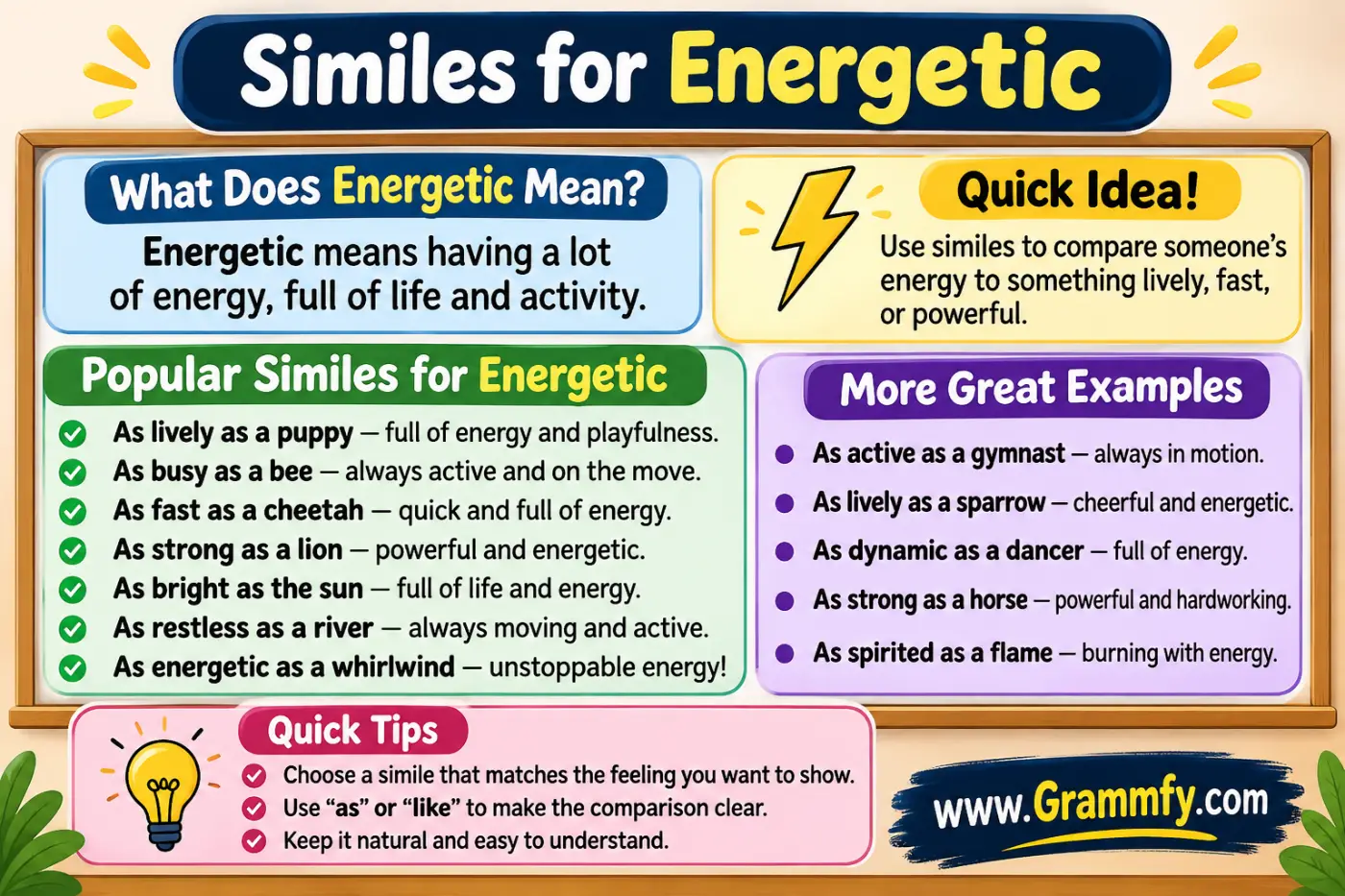
Similes for Energetic help you show what energy looks and feels like. Instead of simply saying someone is energetic, you can compare them to a bouncing ball, a buzzing bee, or a spark that lights up a room. These comparisons make your writing easier to picture and more fun to read.
A good simile can also reveal the kind of energy you mean. Someone might be playful and bouncy, fast and powerful, or excited and full of enthusiasm. Choosing the right comparison helps readers understand the person, action, or feeling you want to describe.
Answer box: A simile for energetic compares a person, animal, or thing full of energy to something lively, active, or powerful, usually using like or as. For example, “She was as energetic as a bouncing ball” shows that she is full of movement and excitement.
In this guide, you’ll find creative examples with clear meanings, useful synonyms, comparisons between similar expressions, and practical tips for using similes in essays, stories, emails, and everyday conversation.
These words are easy to mix up, so read our guide to the difference between Alligator vs Crocodile to see their meanings and examples side by side.
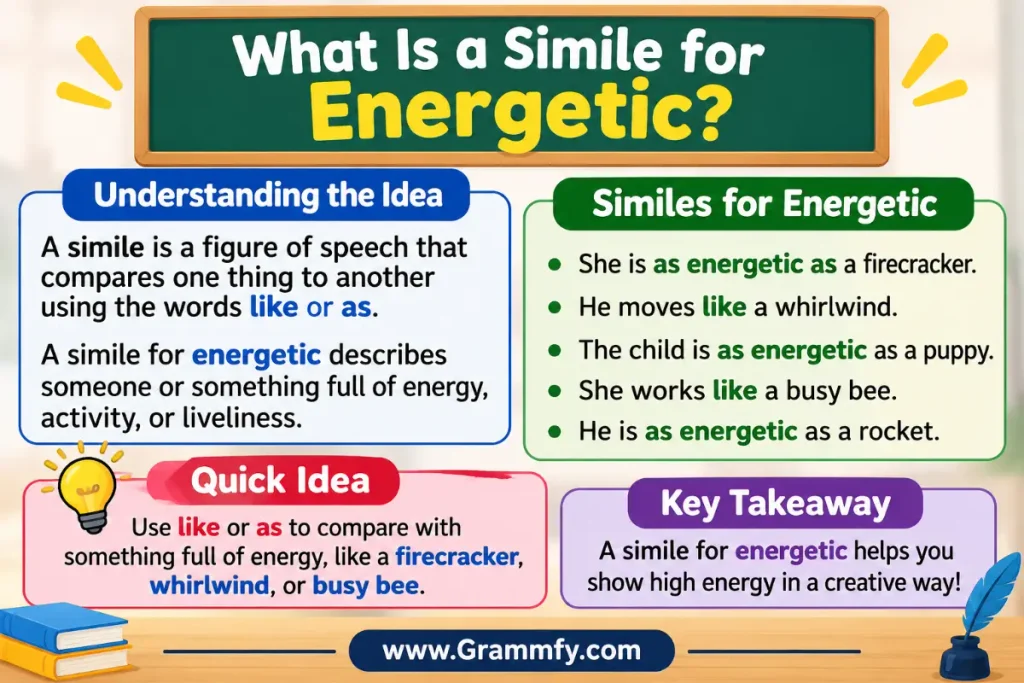
What Is a Simile for Energetic?
A simile is a figure of speech that compares two different things using words such as like or as. The comparison helps readers imagine a quality more clearly.
For example:
- Literal: The puppy was energetic.
- With a simile: The puppy was like a tiny tornado, racing from room to room.
The second sentence creates a stronger picture. You can imagine the puppy moving quickly and making a lot of noise.
An energetic simile can describe physical movement, excitement, enthusiasm, or mental activity. It doesn’t always mean someone is running or jumping. A student who eagerly answers questions can be energetic, too.
How do similes make descriptions more powerful?
Similes add detail without requiring a long explanation. They can make writing more emotional, humorous, dramatic, or memorable.
Compare these examples:
| Plain description | More vivid simile | What it suggests |
|---|---|---|
| He ran quickly. | He ran like a racing greyhound. | Speed and focus |
| She was excited. | She was like a firework ready to burst. | Strong excitement |
| The children were active. | The children bounced around like rubber balls. | Playful movement |
| He worked hard. | He worked like a machine. | Steady, tireless effort |
| The crowd was lively. | The crowd buzzed like a beehive. | Noise and activity |
The best comparison depends on the situation. A racing greyhound suits a sports story, while a buzzing beehive might work better when describing a busy classroom.
What Is the Origin and Meaning of Energetic?
The word energetic comes from energy, a word that traces back through French and Latin to Greek roots associated with activity and work. The Greek word energeia referred to activity or operation.
In modern English, energetic describes someone or something that shows a high level of energy, activity, or enthusiasm.
Here are a few everyday examples:
- An energetic child enjoys running, playing, and exploring.
- An energetic speaker uses an expressive voice and lively gestures.
- An energetic team works with enthusiasm and keeps moving toward its goal.
- An energetic performance feels active, exciting, and full of life.
A simile takes this meaning one step further. It connects energy to something readers already understand.
For example, “He was as energetic as a hummingbird” suggests quick, constant movement. “She was like a bright spark” suggests enthusiasm that can inspire others.
Keep in mind that energy can mean different things in different contexts. A person may be physically active, mentally alert, emotionally excited, or highly motivated. Your comparison should match the type of energy you want to show.
35 Best Similes for Energetic With Meanings
The following examples cover different kinds of energy, from playful movement to determination and excitement. Each one includes a meaning and a sample sentence to help you use it naturally.
1. As Energetic as a Bouncing Ball
Meaning: Full of movement and unable to stay still for long.
This simile is ideal for children, playful pets, or anyone who seems to have endless physical energy. A bouncing ball keeps moving after it hits the ground, making it a simple image for constant activity.
Example: After breakfast, my little brother was as energetic as a bouncing ball, jumping from one game to another.
Best for: Children’s stories, school writing, and playful descriptions.
2. Like a Buzzing Bee
Meaning: Busy, active, and constantly moving.
Bees move from flower to flower while searching for nectar. This comparison can describe someone who always has something to do.
Example: Before the school festival, Maya moved around like a buzzing bee, checking decorations and helping every team.
Best for: Busy people, workplaces, classrooms, and event preparation.
3. As Lively as a Firework
Meaning: Extremely excited, expressive, and full of enthusiasm.
Fireworks burst with light, sound, and movement. This simile is especially useful for a person whose excitement is difficult to hide.
Example: The children were as lively as fireworks when the teacher announced the class trip.
Best for: Celebrations, surprises, parties, and exciting moments.
4. Like a Racing Greyhound
Meaning: Fast, alert, and eager to move.
Greyhounds are known for their speed. This comparison emphasizes quick movement more than friendliness or excitement.
Example: At the starting whistle, Jordan shot forward like a racing greyhound.
Best for: Sports stories, races, and action scenes.
5. As Busy as a Beehive
Meaning: Full of activity, with many things happening at once.
A beehive is a useful image for a group rather than one person. It suggests constant movement and shared work.
Example: The school hall was as busy as a beehive before the annual concert.
Best for: Classrooms, offices, kitchens, and crowded events.
6. Like a Spark Plug
Meaning: Full of drive and able to get things moving.
A spark plug helps an engine start. As a comparison for a person, it suggests someone who brings enthusiasm and encourages action.
Example: Our captain was the spark plug of the team, cheering everyone on during practice.
Best for: Teamwork, leadership, sports, and group projects.
7. As Energetic as a Puppy
Meaning: Playful, cheerful, and eager to explore.
Puppies often run, play, and investigate everything around them. This comparison adds a warm, friendly tone.
Example: The puppy was as energetic as a puppy itself could be, chasing its toy across the garden.
A more natural alternative for polished writing is: “The little boy was as energetic as a playful puppy.”
Best for: Family stories, pets, and lighthearted descriptions.
8. Like a Whirlwind
Meaning: Moving quickly and causing a great deal of activity.
A whirlwind moves rapidly and can stir up everything around it. This simile can suggest impressive energy or a little chaos, depending on the context.
Example: She rushed through the kitchen like a whirlwind, preparing lunch before the guests arrived.
Best for: Fast-paced scenes and busy people.
9. As Restless as a Caged Tiger
Meaning: Full of energy but unable to move or act freely.
This comparison suggests frustration as well as activity. It works when someone wants to get moving but has to wait.
Example: The players were as restless as caged tigers while waiting for the rain to stop.
Best for: Suspense, waiting rooms, sports, and scenes of impatience.
10. Like a Battery That Never Runs Out
Meaning: Seemingly able to stay active for a very long time.
This modern comparison is easy to understand and works well in casual writing.
Example: My cousin is like a battery that never runs out; she can hike all morning and play games all evening.
Best for: Everyday conversation, family stories, and informal writing.
11. As Fast as Lightning
Meaning: Moving extremely quickly.
Lightning is a familiar image of speed. This simile emphasizes how fast someone moves rather than how much energy they have overall.
Example: The goalkeeper reacted as fast as lightning and blocked the shot.
Best for: Sports, action scenes, and quick reactions.
12. Like a Rocket Taking Off
Meaning: Starting an activity with great speed and force.
A rocket launches rapidly into the sky. This comparison is useful when someone begins a task or race with a sudden burst of energy.
Example: When the race began, Amira ran like a rocket taking off.
Best for: Races, competitions, and sudden action.
13. As Spirited as a Wild Horse
Meaning: Full of life, strength, and independence.
A wild horse suggests powerful movement and a strong spirit. The comparison can describe someone lively who dislikes being held back.
Example: The young dancer was as spirited as a wild horse, bringing energy to every rehearsal.
Best for: Character descriptions, adventure stories, and expressive performances.
14. Like a Drumbeat That Never Stops
Meaning: Steady, strong, and continuous.
A drumbeat keeps a rhythm going. This simile works well for energy that lasts rather than energy that comes in sudden bursts.
Example: His enthusiasm was like a drumbeat that never stopped, keeping the volunteers motivated all afternoon.
Best for: Teamwork, music, long projects, and sustained effort.
15. As Excited as a Child on Christmas Morning
Meaning: Full of joyful anticipation.
This comparison captures the feeling of waiting for something wonderful. It describes emotional energy more than physical speed.
Example: Liam was as excited as a child on Christmas morning when he opened his first science kit.
Best for: Holidays, birthdays, surprises, and happy announcements.
16. Like a Hummingbird in Flight
Meaning: Quick, alert, and constantly in motion.
Hummingbirds beat their wings rapidly and move with remarkable agility. This simile gives a description a light, delicate feeling.
Example: The gymnast moved like a hummingbird in flight, shifting quickly from one position to the next.
Best for: Dance, gymnastics, small animals, and graceful movement.
17. As Powerful as a Charging Bull
Meaning: Strong, forceful, and determined.
A charging bull suggests intense physical power. Because the image can also imply aggression, use it carefully when describing people.
Example: The forward charged toward the goal like a powerful bull, determined to score.
Best for: Sports, action scenes, and forceful movement.
18. Like a Dancing Flame
Meaning: Lively, changing, and full of movement.
A flame flickers and shifts shape. This comparison describes energy that looks graceful, expressive, or captivating.
Example: On stage, the young performer moved like a dancing flame, drawing every eye in the room.
Best for: Dance, performance, creative writing, and artistic descriptions.
19. As Cheerful as a Morning Songbird
Meaning: Bright, happy, and full of life.
A songbird’s call can make a morning feel lively. This simile combines enthusiasm with a positive mood.
Example: Our guide was as cheerful as a morning songbird, greeting every visitor with a smile.
Best for: Friendly characters, travel stories, and positive descriptions.
20. Like a River Rushing Downhill
Meaning: Moving with strong, continuous momentum.
A rushing river suggests energy that is difficult to stop. It can describe a person, a team, or a project gaining speed.
Example: Once the debate began, her ideas flowed like a river rushing downhill.
Best for: Speeches, creative work, group projects, and fast-moving events.
21. As Active as a Squirrel
Meaning: Quick, alert, and always doing something.
Squirrels often dart around, climb, and search for food. This simile is useful for people who seem constantly occupied.
Example: The young gardener was as active as a squirrel, gathering tools and planting seeds before sunrise.
Best for: Children, animals, gardens, and daily routines.
22. Like a Popcorn Kernel in a Hot Pan
Meaning: Bursting with movement and excitement.
Popcorn kernels jump and pop as they heat up. This funny comparison suits someone who cannot contain their excitement.
Example: The students were like popcorn kernels in a hot pan when the principal announced a surprise holiday.
Best for: Humor, school stories, and exciting announcements.
23. As Tireless as a Marathon Runner
Meaning: Able to keep working or moving for a long time.
A marathon runner must maintain effort over a long distance. This simile emphasizes endurance, not simply quick movement.
Example: The volunteers were as tireless as marathon runners, sorting supplies until the final box was ready.
Best for: Work, training, volunteering, and long tasks.
24. Like a Tornado in Sneakers
Meaning: Extremely active, fast-moving, and a little chaotic.
This playful comparison combines the force of a tornado with the everyday image of someone running around in shoes.
Example: During recess, Ben was like a tornado in sneakers, racing across the playground and inventing new games.
Best for: Funny stories, children, and informal descriptions.
25. As Bright as a Live Wire
Meaning: Alert, lively, and full of nervous or exciting energy.
A live wire suggests electricity and intensity. When used for a person, the phrase can imply someone who is very active or hard to ignore.
Example: The young comedian was as bright as a live wire, responding quickly to every joke from the audience.
Best for: Performers, quick thinkers, and energetic personalities.
26. Like a Race Car on a Straight Track
Meaning: Moving quickly with focus and momentum.
This simile connects energy with speed and direction. It suits a person who is eager to reach a goal.
Example: After finishing her homework, Nina worked on her science project like a race car on a straight track.
Best for: Studying, competitions, and goal-focused work.
27. As Bouncy as a Rubber Ball
Meaning: Playful, springy, and full of physical energy.
A rubber ball quickly springs back after hitting the ground. This comparison is especially useful for someone who jumps, skips, or moves with a lot of enthusiasm.
Example: The toddler was as bouncy as a rubber ball throughout the family picnic.
Best for: Young children, playful pets, and cheerful scenes.
28. Like a Wind-Up Toy
Meaning: Moving continuously, often in repeated or rapid actions.
A wind-up toy keeps moving after it is set in motion. This comparison can be affectionate or humorous, but it may suggest that someone needs a break.
Example: Once the music started, the little dancer moved like a wind-up toy across the living room.
Best for: Humor, dancing, and repetitive activity.
29. As Eager as a Scout on an Adventure
Meaning: Ready to explore, learn, or take action.
This comparison focuses on curiosity and enthusiasm. It works especially well for a person who welcomes new experiences.
Example: The new student was as eager as a scout on an adventure, asking questions about every club at school.
Best for: Learning, travel, exploration, and new opportunities.
30. Like a Powerhouse in Motion
Meaning: Showing great strength, effort, and productivity.
A powerhouse produces a large amount of power. The phrase suggests a person who gets a lot done and keeps going.
Example: During the charity event, Priya worked like a powerhouse in motion, organizing donations and guiding volunteers.
Best for: Leadership, work, athletics, and ambitious projects.
31. As Energetic as a Summer Storm
Meaning: Intense, dramatic, and full of sudden activity.
A summer storm can arrive with strong wind, rain, and thunder. This comparison is useful for describing an energetic person whose presence changes the atmosphere.
Example: The actor entered the stage as energetically as a summer storm, instantly capturing the audience’s attention.
Best for: Dramatic writing, performances, and powerful personalities.
32. Like a Fountain Bursting Into the Air
Meaning: Overflowing with movement, joy, or enthusiasm.
A fountain sends water upward in a lively display. This image can describe someone whose happiness is visible to everyone.
Example: The children leaped like a fountain bursting into the air when the final school bell rang.
Best for: Celebrations, happy reunions, and joyful moments.
33. As Determined as a Climbing Mountain Goat
Meaning: Energetic, persistent, and ready to overcome obstacles.
Mountain goats climb steep slopes with impressive agility. This comparison adds determination to the idea of energy.
Example: Even after several failed attempts, the young climber remained as determined as a mountain goat.
Best for: Challenges, school goals, training, and personal growth.
34. Like a Band Playing at Full Volume
Meaning: Loud, lively, and full of excitement.
A band playing at full volume creates a strong sense of energy. This simile works particularly well for crowds and celebrations.
Example: The stadium crowd sounded like a band playing at full volume as the home team scored.
Best for: Concerts, sports events, parties, and noisy gatherings.
35. Like a Match Lighting a Campfire
Meaning: Bringing a small spark of energy that grows into greater enthusiasm.
A match can start a much larger fire. This comparison suits someone who inspires others to join in and become more active.
Example: The teacher’s enthusiasm was like a match lighting a campfire, encouraging the whole class to take part in the project.
Best for: Teaching, leadership, teamwork, and motivation.
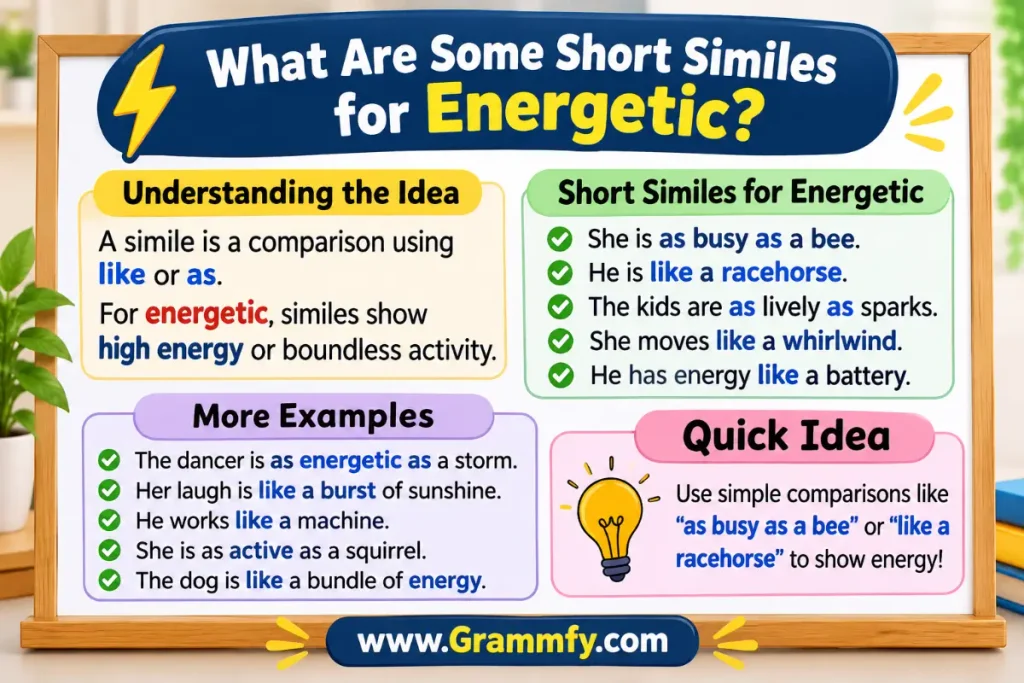
What Are Some Short Similes for Energetic?
Sometimes a short phrase is better than a detailed comparison. Short similes fit easily into poems, school assignments, captions, and everyday conversation.
Here are ten concise options:
| Simile | Meaning | Example |
|---|---|---|
| Like a rocket | Very fast and eager | He ran like a rocket. |
| Like a live wire | Lively and alert | She’s like a live wire. |
| Like a buzzing bee | Busy and active | He worked like a buzzing bee. |
| Like a bouncing ball | Playful and restless | The child moved like a bouncing ball. |
| Like a whirlwind | Fast and chaotic | She entered like a whirlwind. |
| Like lightning | Extremely quick | He reacted like lightning. |
| Like a spark | Full of enthusiasm | Her idea spread like a spark. |
| Like a race car | Fast and focused | He worked like a race car. |
| Like a dancing flame | Lively and graceful | She moved like a dancing flame. |
| Like a hummingbird | Quick and agile | The gymnast moved like a hummingbird. |
For the strongest result, choose a phrase that matches the action. “Like lightning” is excellent for speed, while “like a spark” is better for enthusiasm that inspires others.
What Words Can Replace Energetic? A Master Synonym List
The word energetic has many alternatives, but they don’t all mean the same thing. Some describe physical activity, while others suggest enthusiasm, determination, or a lively personality.
The table below groups 32 useful synonyms and related expressions by tone. The categories are practical guides, not strict rules; a word can fit more than one group.
Simple synonyms for energetic
These words are easy to understand and work well in school writing and everyday speech.
| Word | Meaning | Tone | Example |
|---|---|---|---|
| Active | Doing things or moving often | Neutral | The active child played outside. |
| Lively | Full of life and activity | Positive | The lively class enjoyed the game. |
| Busy | Occupied with tasks | Neutral | She had a busy morning. |
| Alert | Quick to notice things | Neutral | The alert student answered first. |
| Awake | Not asleep; mentally aware | Casual | I felt awake after a short walk. |
| Quick | Moving or responding fast | Neutral | He was quick to help. |
| Eager | Excited to do something | Positive | The eager students opened their books. |
| Peppy | Cheerful and full of energy | Informal | Her peppy attitude lifted the group. |
Everyday synonyms for energetic
These words suit conversation, personal stories, and informal descriptions.
| Word | Meaning | Tone | Example |
|---|---|---|---|
| Bouncy | Springy and playful | Informal | The bouncy puppy chased its tail. |
| Spirited | Lively and full of determination | Positive | She gave a spirited performance. |
| Zippy | Quick and lively | Informal | The zippy little car sped away. |
| Animated | Expressive in movement or speech | Neutral | He became animated during the story. |
| Perky | Cheerful and alert | Informal | She sounded perky on the phone. |
| Vibrant | Full of life and activity | Positive | The market was vibrant and colorful. |
| Fired-up | Highly excited or motivated | Informal | The team felt fired-up before the match. |
| Tireless | Continuing without seeming to tire | Positive | The tireless volunteer helped all day. |
Formal synonyms for energetic
Use these options in essays, reports, professional writing, and thoughtful descriptions.
| Word | Meaning | Tone | Example |
|---|---|---|---|
| Vigorous | Strong and forceful | Formal | The group held a vigorous discussion. |
| Dynamic | Active and full of change | Professional | She is a dynamic team leader. |
| Enthusiastic | Showing strong interest or excitement | Positive | He gave an enthusiastic response. |
| Diligent | Careful and persistent in work | Formal | The diligent researcher checked every source. |
| Industrious | Hardworking and productive | Formal | The industrious staff completed the project. |
| Proactive | Taking action before being asked | Professional | She took a proactive approach to planning. |
| Robust | Strong, healthy, or effective | Formal | The program supports robust participation. |
| Assiduous | Showing steady, careful effort | Very formal | His assiduous work improved the report. |
Slang and informal alternatives for energetic
These expressions can make a conversation sound relaxed and natural. Some are regional or context-dependent.
| Word or phrase | Meaning | Tone | Example |
|---|---|---|---|
| Hyper | Extremely active or excited | Informal | The kids were hyper after the party. |
| Pumped | Very excited or motivated | Casual | I’m pumped for the game. |
| Full of beans | Cheerful and energetic | Informal, especially British English | The puppy is full of beans today. |
| On the go | Constantly busy or moving | Conversational | She’s always on the go. |
| Raring to go | Eager to start | Informal | We’re raring to go. |
| Buzzing | Excited and full of energy | Informal, often British English | The crowd was buzzing after the win. |
| Amped | Highly excited or energized | Slang | The players were amped before kickoff. |
| Fired up | Very enthusiastic or determined | Informal | Everyone was fired up for the challenge. |
How do you choose between these synonyms?
Think about what you want readers to notice.
- Choose active for general movement or participation.
- Choose lively for a cheerful atmosphere or personality.
- Choose vigorous for strong physical effort or debate.
- Choose enthusiastic for interest and excitement.
- Choose diligent for careful, steady work.
- Choose dynamic for someone who brings energy and change to a group.
- Choose hyper when someone is unusually restless or overexcited.
- Choose tireless when the main point is endurance.
A synonym should make the meaning clearer, not simply replace a word with a more complicated one.
Which Synonyms Show Different Levels of Energy?
Not every energetic person has the same level of activity. Someone may be mildly active, lively and engaged, or so excited that they seem impossible to slow down.
Use the following scale to choose a word that fits the situation.
| Intensity | Useful words | What they suggest | Example |
|---|---|---|---|
| Mild | Alert, active, awake | Some energy or awareness | He felt alert after breakfast. |
| Moderate | Lively, engaged, eager | Noticeable interest and activity | The students were lively during the discussion. |
| Strong | Spirited, vigorous, enthusiastic | High energy and effort | The team gave a vigorous performance. |
| Very strong | Fired-up, amped, hyper | Intense excitement or activity | The crowd was fired-up before the final. |
| Sustained | Tireless, industrious, persistent | Energy that lasts over time | The tireless crew worked through the afternoon. |
This scale isn’t an exact measurement. Context matters. A person can be enthusiastic without moving much, and someone can work tirelessly without appearing especially excited.
What is the difference between lively and vigorous?
Lively usually suggests that someone or something is full of life, movement, or interest. Vigorous emphasizes strength, force, or intensity.
- Lively: The children had a lively conversation about their favorite books.
- Vigorous: The athletes completed a vigorous training session.
Use lively for a cheerful conversation or atmosphere. Use vigorous when an activity involves strong effort.
What is the difference between energetic and enthusiastic?
Energetic describes a high level of activity or energy. Enthusiastic describes strong interest, excitement, or support.
- Energetic: The runner stayed energetic throughout practice.
- Enthusiastic: The runner was enthusiastic about joining the team.
A person can be enthusiastic while sitting still, such as when discussing a favorite subject. A person can also be energetic without being enthusiastic, such as when rushing to finish an unpleasant task.
What is the difference between busy and productive?
Busy means having a lot to do. Productive means getting useful work done.
- Busy: I was busy all morning answering messages.
- Productive: I finished three important tasks before lunch.
Someone may be busy without making much progress. If you’re describing useful effort, productive may be more accurate than energetic.
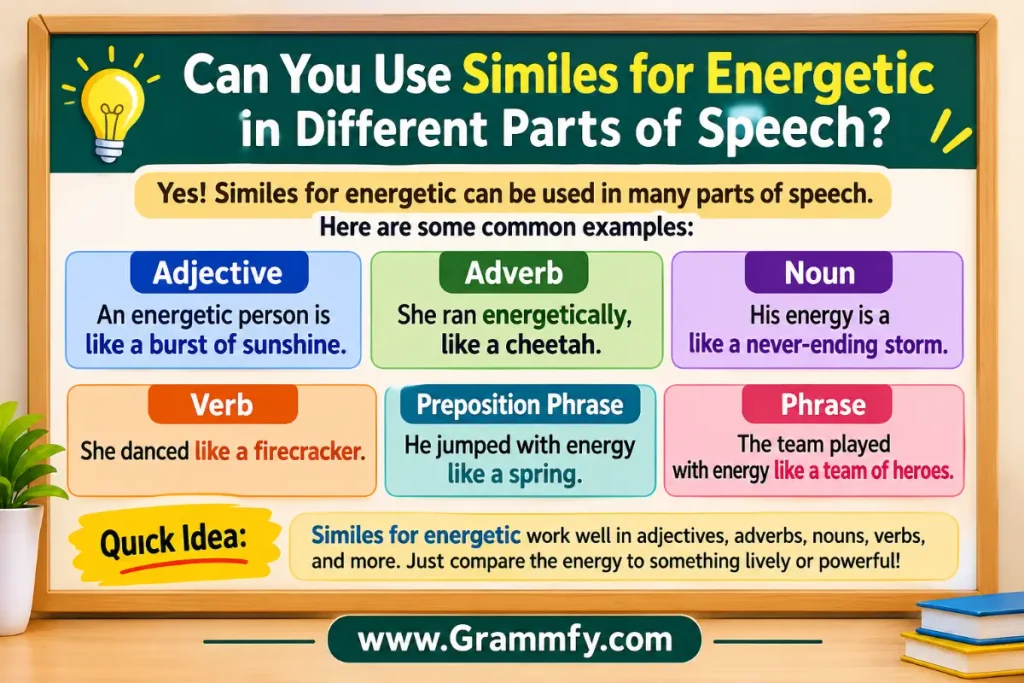
Can You Use Similes for Energetic in Different Parts of Speech?
Yes, but it’s important to understand that a simile is a comparison, not a part of speech. The sentence structure depends on whether you’re describing a person, an action, or a feeling.
Describing a person with an adjective
Use energetic or another adjective after a linking verb such as is, was, or seems.
- She is energetic.
- He seems lively.
- The coach was as spirited as a wild horse.
- My younger brother is like a bouncing ball.
These sentences describe a person’s general qualities.
Describing an action with an adverb
Adverbs explain how an action happens. You can combine an energetic simile with an action verb to make the movement clearer.
- She danced like a flame in the wind.
- He ran like a racing greyhound.
- The children bounced around like rubber balls.
- The volunteers worked like a well-trained team.
In “He ran like a racing greyhound,” the comparison explains how he ran.
Describing a person or thing with a noun
Nouns name people, places, things, or ideas. You can use a noun-based comparison to describe someone’s role or influence.
- Our captain was the spark plug of the team.
- The classroom was a beehive of activity.
- The new organizer became the powerhouse behind the event.
These examples use metaphors rather than strict similes because they identify one thing with another without using like or as. They’re still useful when writing about energy, but don’t label every comparison as a simile.
How Do You Use Similes for Energetic in a Resume?
In a resume, it’s usually better to show energy through specific skills and actions than to use a playful comparison. Recruiters look for evidence of initiative, productivity, and results.
Use action words to show energy at work
Good alternatives include proactive, dynamic, motivated, resourceful, and results-driven. Choose words that match what you actually did.
Example:
- Weak: I am an energetic employee who works hard.
- Stronger: I took initiative to organize weekly team meetings and keep projects on schedule.
The stronger sentence gives the reader evidence instead of asking them to accept a general claim.
Can you use an energetic simile in a resume?
Usually, avoid expressions such as “I work like a machine” or “I’m as energetic as a rocket” in a formal resume. They may sound exaggerated or too casual.
Instead, describe a concrete result:
- “Coordinated five project tasks while meeting weekly deadlines.”
- “Proactively supported team members during a busy launch.”
- “Maintained consistent productivity during high-volume work periods.”
These examples communicate energy in a professional way.
How Do You Use Similes for Energetic in an Essay?
In an essay, a simile can make a description more vivid, especially in narrative or descriptive writing. It helps the reader picture an action rather than simply reading a list of adjectives.
Example for a school essay
“The playground came alive when the bell rang. The children scattered like birds taking flight, racing toward the swings and climbing frames. Their laughter filled the air as they played.”
This passage uses a comparison to show quick movement. The details around it help create a complete scene.
Example for an essay about teamwork
“Our class worked like a beehive before the charity fair. Some students arranged books, others prepared signs, and the rest checked the donation boxes. Everyone had a job, and the whole room seemed to move with purpose.”
This comparison describes a group working together rather than one energetic person.
How many similes should you use in an essay?
Use only as many as the writing needs. One strong comparison is often better than several similar phrases in the same paragraph.
For example, avoid writing:
“The boy was like a rocket, a bouncing ball, a tornado, and a racing car.”
The comparisons compete with one another. Choose one that best fits the action:
“The boy raced across the playground like a rocket.”
That sentence is easier to imagine and sounds more natural.
How Do You Use Energetic Similes in Texting and Email?
The best comparison depends on how well you know the reader and how formal the message needs to be.
In a text message
Casual expressions can make a message feel friendly and natural.
Examples:
- “The kids are bouncing around like rubber balls today.”
- “I’m pumped for the match!”
- “She’s been on the go since sunrise.”
- “Our group chat is buzzing after the announcement.”
These phrases work well with friends and family. However, avoid calling someone hyper if they might interpret it as criticism.
In a friendly email
You can use a light comparison when writing to a coworker or someone you know well.
Example:
“Everyone was buzzing with excitement after the team announcement. Thanks for helping us get everything ready.”
For a formal email, keep the focus on the work:
“The team has shown strong enthusiasm and consistent effort throughout the preparation stage.”
The second option is clearer in a professional setting.
In a formal email
Avoid dramatic comparisons that distract from your main message. Words such as proactive, engaged, productive, and enthusiastic are usually more suitable.
Example:
“Thank you for your proactive support and continued commitment to the project.”
This expresses appreciation without relying on figurative language.
How Do You Describe an Energetic Person When Speaking?
In conversation, simple expressions usually sound more natural than elaborate comparisons. The best phrase depends on whether you want to praise someone, make a joke, or explain how busy they are.
| Situation | Natural expression | Example |
|---|---|---|
| Praising a teammate | Full of energy | “She’s always full of energy at practice.” |
| Describing a busy friend | Always on the go | “He’s always on the go, even on weekends.” |
| Showing excitement | Pumped | “I’m really pumped about the trip.” |
| Describing a cheerful person | Full of life | “Our new teacher is full of life.” |
| Describing a very active child | Like a bouncing ball | “He’s like a bouncing ball after school.” |
| Praising steady effort | Tireless | “She’s a tireless volunteer.” |
When speaking, consider your relationship with the listener. A funny phrase might be perfect among friends but feel out of place in a job interview.
Are There US and UK Differences in Energetic Expressions?
The adjective energetic is common in both American and British English. Most of the similes in this guide will be understood in either variety, but a few informal expressions differ in how often they’re used.
| Expression | US English | UK English | Meaning |
|---|---|---|---|
| Energetic | Common | Common | Full of energy |
| Full of beans | Understood | Common informal expression | Cheerful and active |
| Pumped | Common informal expression | Understood, but use varies | Very excited |
| Buzzing | Understood; context matters | Common informal use | Excited or full of energy |
| Zippy | Used, especially casually | Understood; use varies | Quick and lively |
| Raring to go | Common | Common | Eager to begin |
| On the go | Common | Common | Constantly active |
Regional preferences can change by age, community, and situation. These are general tendencies rather than strict rules.
For international readers, energetic, lively, active, and enthusiastic are safe choices in most contexts. For creative writing, a familiar simile may work better than an unfamiliar slang expression.
What Are Some Original Simile Examples for Everyday Situations?
A useful comparison should fit the scene, not just the word you’re trying to describe. Here are additional examples for school, work, sports, family life, and creative writing.
At school
1. “Before the spelling bee, Ava was like a hummingbird, checking her notes and moving from desk to desk.” This suggests quick movement and nervous excitement.
2. “The class became as busy as a beehive when the science fair deadline approached.” This shows a group working on many tasks at once.
3. “After the teacher announced the outdoor lesson, the children bounced like rubber balls.” This emphasizes playful excitement.
At work
4. “During the product launch, Marcus was like a spark plug, getting every team member involved.” This shows leadership and the ability to motivate others.
5. “The kitchen moved like a racing car team during the dinner rush.” This suggests speed, coordination, and pressure.
6. “Her ideas flowed like a rushing river during the planning meeting.” This highlights a steady stream of ideas rather than physical movement.
In sports
7. “The striker moved like lightning as he raced toward the goal.” This emphasizes speed.
8. “The players were as restless as caged tigers while waiting for the referee.” This suggests impatience and stored-up energy.
9. “Our coach was like a drumbeat that never stopped, keeping us focused through every drill.” This shows steady encouragement.
At home
10. “My little sister was like a wind-up toy, dancing around the living room after hearing her favorite song.” This creates a playful picture of constant motion.
11. “Grandpa was as lively as a songbird while telling stories about his childhood.” This describes expressive, cheerful energy without suggesting that he is running around.
12. “The dog raced through the garden like a rocket taking off.” This gives a quick, energetic image of a pet in motion.
In creative writing
13. “The festival burst into life like a firework lighting up the night.” This describes a sudden increase in excitement and activity.
14. “Her courage was like a small flame that grew stronger with every challenge.” This uses fire as an image for inner drive. It’s closer to a metaphorical comparison than a direct description of physical energy.
15. “The dancers swept across the stage like a summer storm.” This suggests powerful, dramatic movement.
Notice how the comparisons vary. Some show speed, some show teamwork, and others show enthusiasm. That variety keeps writing interesting.
What Are the Common Mistakes When Using Energetic Similes?
Similes are easy to create, but a comparison can become confusing if it doesn’t match the meaning or tone of the sentence.
Mistake 1: Choosing a comparison that only shows speed
Not all energy means moving quickly.
Less accurate: “She was energetic because she finished the race like lightning.”
This works if the main point is speed, but it doesn’t explain whether she stayed active for a long time or showed enthusiasm.
Better: “She trained like a tireless marathon runner, practicing every afternoon.”
This comparison focuses on sustained effort.
Mistake 2: Mixing too many comparisons
Using several similes at once can make a sentence hard to picture.
Confusing: “He was like a rocket, a bee, a tornado, and a bouncing ball.”
Clearer: “He raced around the playground like a tornado in sneakers.”
One well-chosen image usually creates a stronger effect.
Mistake 3: Using playful similes in formal writing
Expressions such as “like a tornado in sneakers” can be fun in a story but too casual for a business report.
For formal writing, choose words such as vigorous, proactive, productive, or enthusiastic, depending on the meaning.
Mistake 4: Treating energetic and enthusiastic as exact synonyms
Energy often describes activity, while enthusiasm describes interest or excitement. A person can show one without the other.
Example: “He worked energetically to finish the report, even though it wasn’t his favorite task.”
The sentence shows effort without suggesting that he enjoyed the work.
Mistake 5: Forgetting the tone of the comparison
Some images sound positive, while others suggest disorder or aggression.
- Positive: “She was as lively as a songbird.”
- Potentially negative: “She rushed through the room like a tornado.”
- Forceful: “He charged like a bull.”
Think about how readers might interpret the image before using it.
Mistake 6: Making an exaggerated claim
A simile is figurative, so it doesn’t need to be literally true. Still, a comparison should feel believable in the scene.
For example, describing a student as “more powerful than a thousand storms” may sound dramatic, but it could distract from a simple school story. A more grounded comparison can be more effective.
When Should You Avoid an Energetic Simile?
There are situations where a direct statement is clearer than a figurative comparison.
- Scientific writing: Use precise language such as “The device operates at high speed.”
- Professional reports: Say “The team completed the work ahead of schedule” instead of “The team worked like a rocket.”
- Sensitive conversations: Avoid joking that someone is “hyper” if you’re discussing stress or discomfort.
- Instructions: Use direct commands such as “Move quickly to the exit” rather than a colorful comparison.
- Formal resumes: Describe skills and results instead of relying on playful images.
The purpose of figurative language is to improve communication. If a comparison makes the message less clear, leave it out.
What Are the Opposites of Energetic?
Antonyms are words with opposite or contrasting meanings. The right opposite depends on the kind of energy you’re describing.
| Antonym or contrasting word | Meaning | Example |
|---|---|---|
| Tired | Needing rest | I felt tired after the long hike. |
| Lethargic | Lacking energy or alertness | The heat made everyone lethargic. |
| Sluggish | Moving or acting slowly | The computer felt sluggish. |
| Inactive | Not active | The club remained inactive over summer. |
| Listless | Lacking interest or enthusiasm | He seemed listless during the meeting. |
| Calm | Peaceful and not agitated | She remained calm before the exam. |
| Passive | Not taking much action | The group took a passive role. |
| Exhausted | Extremely tired | The runners were exhausted after the race. |
Not all these words are exact opposites. Calm, for example, doesn’t necessarily mean low in energy. A calm person can be active and alert. Choose the word that matches the quality you want to contrast.
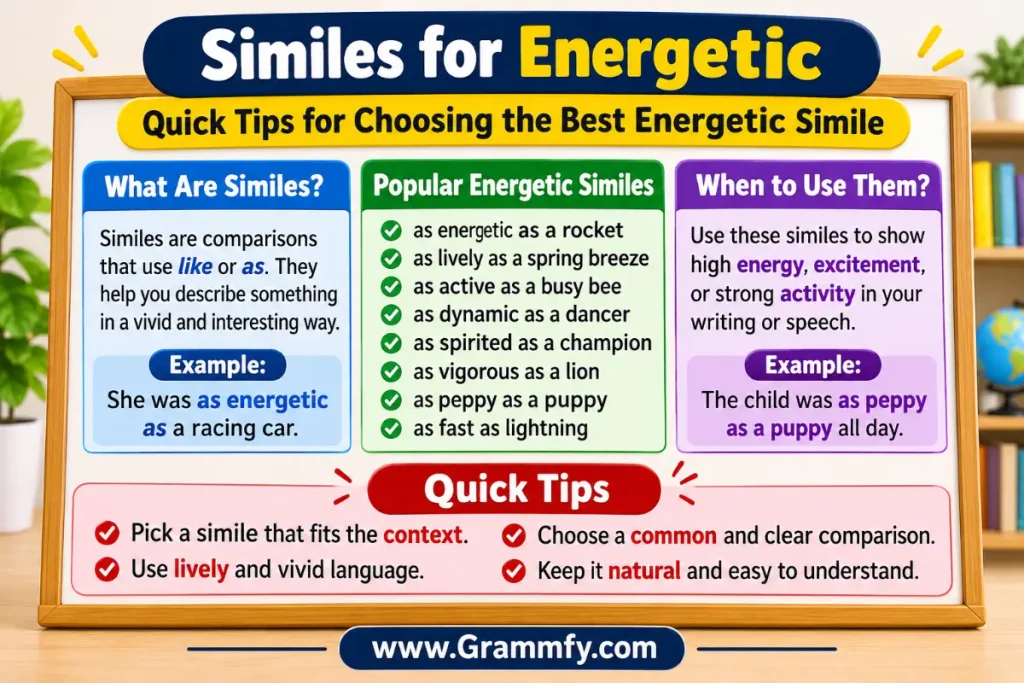
Quick Tips for Choosing the Best Energetic Simile
Use these practical rules to make your comparison clear and natural.
- Decide what kind of energy you mean. Is the person fast, cheerful, hardworking, restless, or motivated?
- Match the image to the action. Use lightning for speed, a beehive for busy activity, and a marathon runner for endurance.
- Think about the tone. A bouncing ball sounds playful, while a charging bull sounds forceful.
- Consider your audience. Slang works in casual messages but may not suit an academic essay.
- Use one strong comparison. Avoid stacking several images into one sentence.
- Make the meaning easy to understand. Readers shouldn’t have to stop and guess what your comparison means.
- Read the sentence aloud. If it sounds awkward or exaggerated, try a simpler phrase.
- Use details when they matter. A simile becomes stronger when the surrounding sentence shows what the person is doing.
- Don’t confuse activity with results. Someone who is busy isn’t always productive, and someone who is enthusiastic isn’t always physically active.
- Keep the sentence natural. A familiar comparison often works better than an unusual phrase chosen just to sound creative.
For example, if you’re describing a child who keeps jumping around, “as bouncy as a rubber ball” is a natural choice. If you’re describing a worker who stays focused throughout a long shift, “as tireless as a marathon runner” may fit better.
Conclusion
The best simile depends on the kind of energy you want readers to imagine. A bouncing ball suggests playful movement, lightning highlights speed, a buzzing beehive shows constant activity, and a marathon runner represents endurance. These differences help you choose a comparison that fits your message instead of using the same description every time.
When writing a story, essay, or casual message, Similes for Energetic can make your descriptions more vivid and memorable. Start by identifying whether the energy is physical, emotional, or connected to effort. Then choose an image your readers can picture easily. In formal settings, direct words such as proactive, vigorous, and enthusiastic may be more effective. With a little practice, you’ll be able to describe lively people and exciting moments clearly, naturally, and with confidence.
Frequently Asked Questions
What is a good simile for energetic?
A good simile is “as energetic as a bouncing ball.” It describes someone who is playful, active, and always moving.
What’s another way to say someone is full of energy?
You can say someone is lively, spirited, enthusiastic, or like a buzzing bee. Choose the expression that best fits the person’s actions and mood.
What are some funny similes for energetic people?
Funny options include “like a tornado in sneakers,” “like a wind-up toy,” and “like a popcorn kernel in a hot pan.” These comparisons work best in casual stories and playful conversations.
How do I use Similes for Energetic in a sentence?
Use a comparison that matches the situation, such as “The children bounced around like rubber balls during recess.” The phrase should help readers picture the energy rather than simply repeat the adjective.
What is the difference between energetic and lively?
Energetic emphasizes having or showing energy, while lively often suggests being cheerful, interesting, or full of life. The words overlap, but lively can describe a conversation or atmosphere as well as a person.
Can I use similes for energetic in a formal essay?
Yes, especially in descriptive or narrative essays, where figurative language can make a scene clearer. In research papers and professional reports, direct wording is usually more suitable.
What is the opposite of energetic?
Common opposites include lethargic, sluggish, inactive, and listless. The best choice depends on whether you mean low physical energy, slow movement, or a lack of enthusiasm.

Tylerbrooks is a US-based English grammar writer and contributor at Grammfy. He writes helpful articles about grammar, spelling, commonly confused words, and vocabulary. His goal is to explain English topics in simple language with clear examples and practical tips. Through his articles, he helps readers improve their writing and everyday English skills.