
Imagine you’re watching a wildlife documentary or planning a trip to Florida, and you spot a large reptile resting near the water. Is it an alligator vs a crocodile? At first glance, they may look almost identical. Both have powerful jaws, tough skin, long tails, and sharp teeth. However, a few clear features can help you tell them apart.
Understanding Alligator vs Crocodile becomes much easier when you know what to look for. The shape of the snout, the visibility of the teeth when the mouth is closed, skin color, habitat, and behavior all provide useful clues.
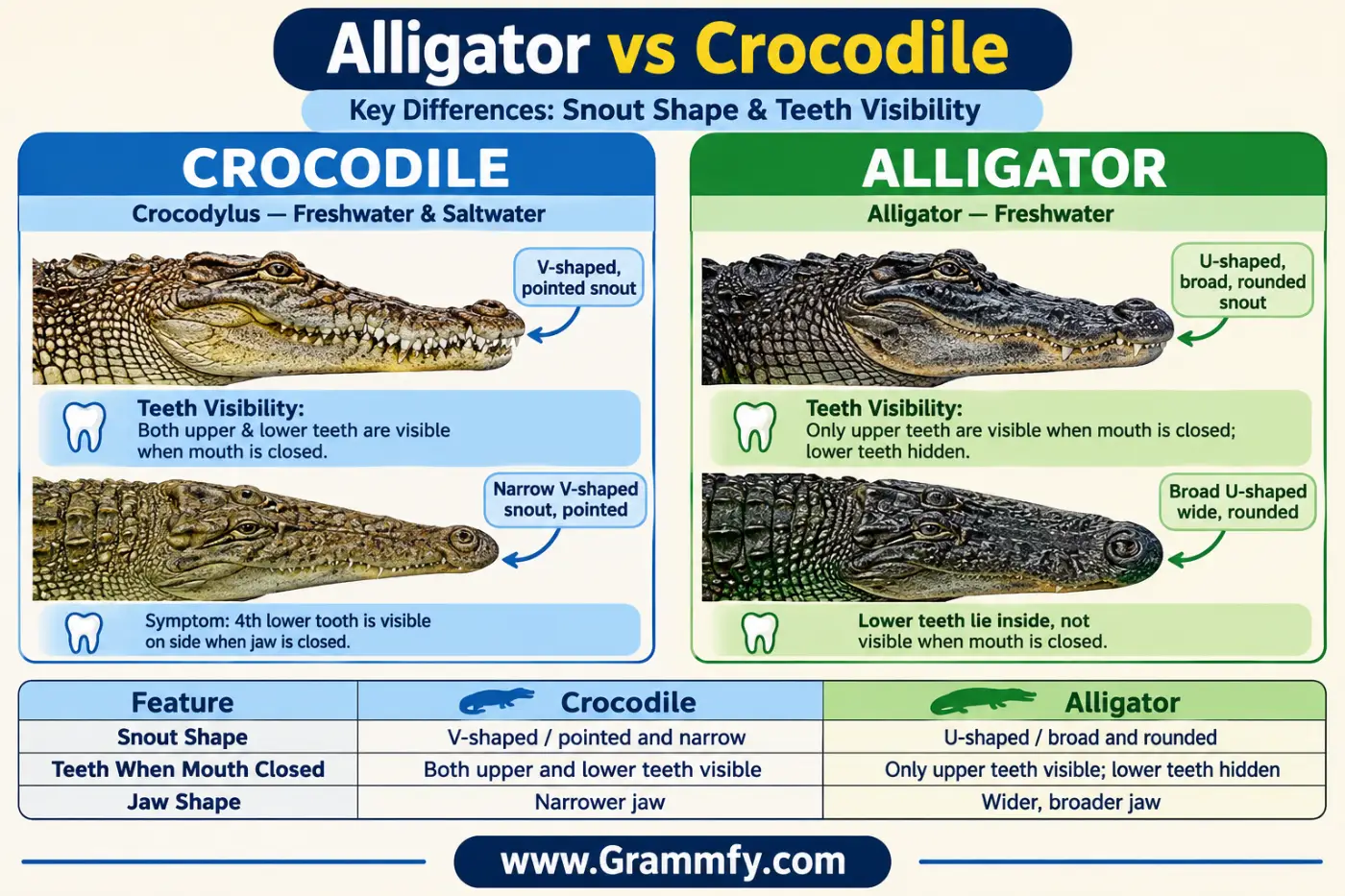
Quick answer: Alligators usually have wider, U-shaped snouts and darker skin, while crocodiles generally have narrower, V-shaped snouts and lighter olive or brown skin. A crocodile’s lower fourth tooth often remains visible when its mouth is closed, while an alligator’s lower teeth are usually hidden.
Although these reptiles belong to the same broader reptile group, they differ in several important ways. Knowing those differences can help you identify them in photographs, understand wildlife documentaries, and learn more about their habitats.
This guide explains their appearance, behavior, size, diet, habitat, origins, and safety risks. You’ll also find comparison tables, real-world examples, common identification mistakes, and answers to frequently asked questions.
These words are easy to mix up, so read our guide to the difference between Miner vs Minor to see their meanings and examples side by side.
What Is the Difference Between an Alligator and a Crocodile?
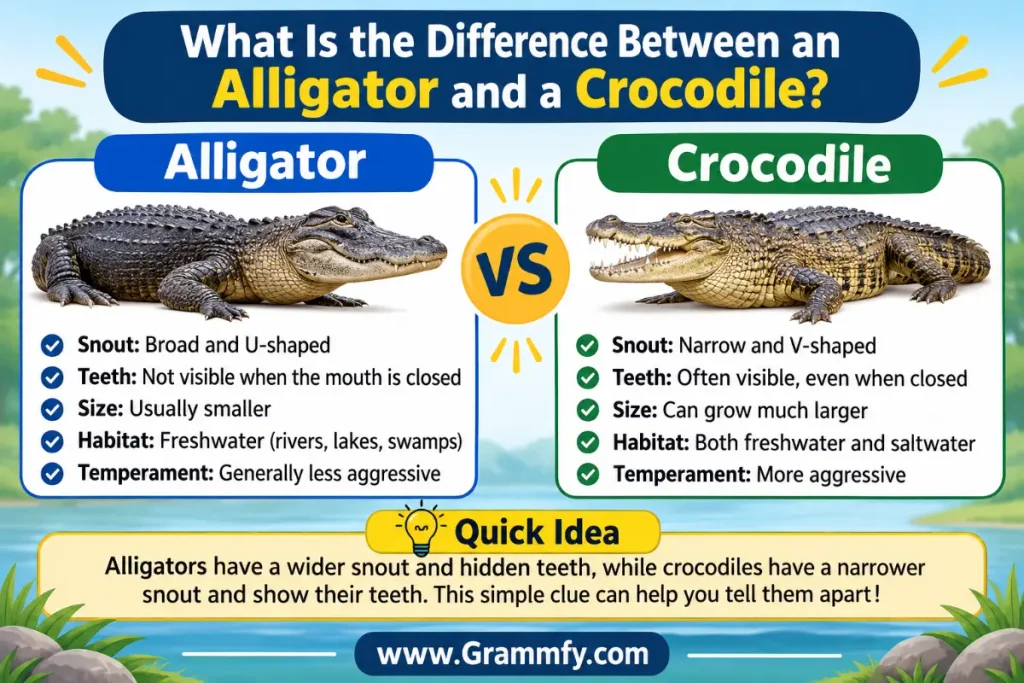
The main difference between these reptiles is their physical appearance, especially their snouts and teeth. Alligators usually have broad, rounded snouts, while crocodiles tend to have narrower, more pointed snouts.
Both animals belong to the order Crocodylia, which includes several groups of large, semiaquatic reptiles. They spend much of their time in or near water and are skilled predators.
Despite their similarities, they belong to different families:
- Alligators belong to the family Alligatoridae.
- Crocodiles belong to the family Crocodylidae.
The word crocodilian is a broader term that can describe members of this reptile group, including alligators, crocodiles, caimans, and gharials.
Alligator vs Crocodile: Quick Comparison Chart
| Feature | Alligator | Crocodile |
|---|---|---|
| Snout shape | Broad and U-shaped | Narrower and V-shaped |
| Typical skin color | Dark gray to nearly black | Olive green, gray, or brown |
| Teeth when mouth is closed | Most lower teeth are hidden | Large lower fourth tooth often remains visible |
| Saltwater tolerance | Generally lower | Some species tolerate saltwater well |
| Common US habitat | Southeastern wetlands and freshwater areas | Mainly southern Florida for American crocodiles |
| Global distribution | Mainly the Americas and China | Africa, Asia, Australia, and the Americas |
| Temperament | Can be dangerous and defensive | Can be dangerous and defensive |
| Body shape | Often broad and robust | Varies by species; many have a more streamlined appearance |
| Family | Alligatoridae | Crocodylidae |
These are general identification clues, not absolute rules for every individual or species. Lighting, age, body size, and viewing angle can make an animal harder to identify.
How Can You Tell an Alligator From a Crocodile by Its Snout?
The snout is one of the easiest features to check when identifying these reptiles. You can often make a good initial guess by looking at the shape of the head from the front or side.
Why does an alligator have a U-shaped snout?
An alligator usually has a broad, rounded snout that resembles the letter U. Its wider jaw gives the head a relatively blunt appearance.
This shape is especially noticeable in the American alligator, a species found in the southeastern United States.
Look for these features:
- A broad head with rounded edges.
- A wide snout that does not taper sharply.
- A relatively dark appearance in many adult animals.
- A jaw shape that looks more rounded than pointed.
The broad snout is a useful clue, but it should not be the only feature you use. Some crocodilian species have wider snouts than others.
Why does a crocodile have a V-shaped snout?
Many crocodiles have a narrower snout that tapers toward the nose. From above, it often resembles the letter V.
This shape is particularly noticeable in the American crocodile and several other crocodile species.
Look for these features:
- A narrower, more pointed head.
- A snout that gradually tapers toward the nose.
- A visible lower tooth when the mouth is closed.
- Skin that may appear olive, gray, or brown.
Not every crocodile has an equally narrow snout. Species differ in head shape, so use the snout together with other identifying features.
Can you identify the reptile by its head alone?
Often, yes, but not always.
A clear photograph of the head may provide enough information to make a likely identification. However, a side view can hide the shape of the snout, and shadows may make the teeth difficult to see.
For a more reliable identification, check at least two or three features:
- Snout shape.
- Teeth visible when the mouth is closed.
- Skin color and body markings.
- Geographic location.
- Overall body shape.
Combining these clues is more reliable than judging by color alone.
Why Do Alligators vs Crocodiles Have Different Teeth?
Their teeth provide another helpful clue. Both animals have strong jaws and pointed teeth adapted for catching and holding prey, but their teeth sit differently when their mouths are closed.
What happens to an alligator’s teeth when its mouth closes?
An alligator’s broad upper jaw usually covers its lower teeth when the mouth is closed. Most of the lower teeth are hidden from view.
Its upper teeth may still be visible along the edge of the mouth, but the lower fourth tooth does not usually create the same exposed-tooth appearance seen in many crocodiles.
This gives the closed mouth a relatively smooth outline.
Why are a crocodile’s lower teeth more visible?
In many crocodile species, the upper and lower jaws fit together differently. A large tooth near the front of the lower jaw, often called the fourth mandibular tooth, remains visible outside the upper jaw when the mouth is closed.
That exposed tooth can make the mouth look more jagged.
| Tooth feature | Alligator | Crocodile |
|---|---|---|
| Lower fourth tooth | Usually hidden | Often visible |
| Closed-mouth appearance | Generally smoother | Often more toothy |
| Jaw fit | Upper jaw tends to cover lower teeth | Some lower teeth fit into visible notches |
| Identification value | Useful clue | Useful clue |
This distinction works well for many common species, including the American alligator and American crocodile. Still, tooth visibility can vary with species, age, and the angle of the photograph.
Never approach a wild animal to inspect its teeth. Use photographs or observe from a safe, permitted distance.
Where Do Alligators and Crocodiles Live?
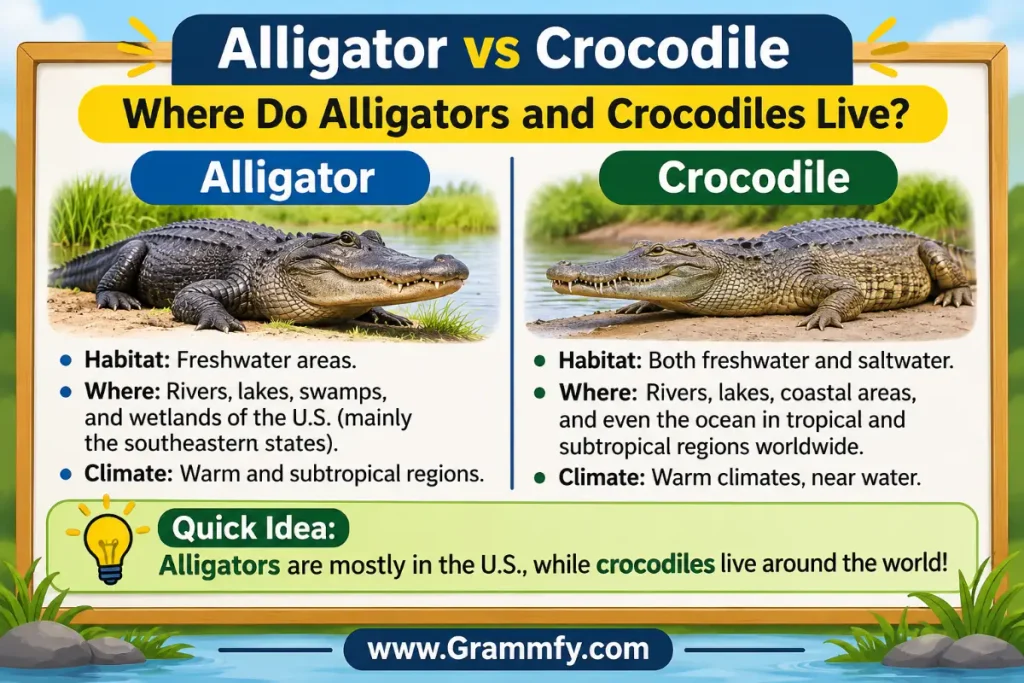
Geography can help you identify these reptiles. Their ranges overlap in some places, but they do not live in exactly the same regions.
Where do alligators live in the United States?
The American alligator lives mainly in the southeastern United States. Its range includes Florida and parts of states such as Louisiana, Georgia, Alabama, Mississippi, South Carolina, North Carolina, and Texas.
It commonly inhabits:
- Freshwater lakes.
- Rivers and streams.
- Swamps.
- Marshes.
- Wetlands and ponds.
Alligators can sometimes enter brackish water, which contains a mixture of fresh and salt water. However, they generally do not tolerate prolonged exposure to high salinity as well as some crocodile species.
The American alligator is particularly associated with Florida’s wetlands and the coastal plains of the southeastern United States.
Where do crocodiles live in the United States?
The American crocodile occurs in southern Florida, including parts of the Florida Keys and coastal areas around the southern tip of the state.
Unlike alligators, American crocodiles are strongly associated with coastal environments, estuaries, and brackish water. They can also use freshwater habitats.
Florida is unusual because both American alligators and American crocodiles occur there. This makes the state one of the most useful places to learn how to distinguish them.
Where are crocodiles found around the world?
Crocodiles occur in tropical and subtropical regions across several continents.
Depending on the species, their ranges include parts of:
- Africa.
- South and Southeast Asia.
- Northern Australia.
- Central America.
- South America.
- The Caribbean.
- Southern Florida.
Saltwater crocodiles, for example, live across parts of Southeast Asia and northern Australia. Nile crocodiles occur in many parts of sub-Saharan Africa.
Different species have different geographic ranges. A crocodile found in Australia may not have the same appearance or behavior as an American crocodile.
Do alligators and crocodiles live together?
Yes, they occur in the same broad region in southern Florida.
The American alligator and American crocodile can use overlapping habitats, although their preferences differ. Alligators are commonly associated with freshwater wetlands, while American crocodiles often use coastal and brackish environments.
Their ranges and habitat choices are not completely separate, so location alone cannot always identify an animal.
If you see a large crocodilian in southern Florida, check the snout, teeth, and other physical features rather than assuming its identity from the location.
Are Alligators or Crocodiles Bigger?
Size depends on the species, sex, age, and individual animal. In general, many crocodile species can grow larger than the American alligator, but this is not a rule that applies to every crocodilian.
How big can an American alligator grow?
Adult American alligators commonly reach several feet in length, with large adults growing much longer. Males tend to be larger than females.
Very large individuals can exceed 13 feet, although animals of that size are not typical of every habitat.
An alligator’s size is influenced by factors such as food availability, habitat quality, age, and health.
How big can a crocodile grow?
Crocodile size varies greatly by species.
The American crocodile can grow to more than 13 feet, with some individuals becoming considerably larger. Saltwater crocodiles are among the largest living reptiles, and exceptional adults can exceed 20 feet.
Nile crocodiles can also reach very large sizes.
These maximum lengths refer to large individuals, not the average size of every adult.
Alligator vs Crocodile: Size Comparison
| Species | General size pattern | Important note |
|---|---|---|
| American alligator | Large adults often reach several feet to over 10 feet | Very large males can exceed 13 feet |
| American crocodile | Large adults can exceed 13 feet | Size varies by sex and region |
| Nile crocodile | Often a large-bodied crocodile | Some individuals grow to very large lengths |
| Saltwater crocodile | Can exceed 20 feet in exceptional cases | One of the largest living reptiles |
| Chinese alligator | Much smaller than the American alligator | Adults are commonly only a few feet long |
There is no single size rule that works for every member of these groups. The American alligator may be larger than some crocodile species, while the saltwater crocodile can grow much larger than the American alligator.
What Do Alligators and Crocodiles Eat?
Both reptiles are carnivores, meaning they eat other animals. Their diets depend on their size, habitat, and the prey available nearby.
What do alligators eat?
American alligators eat a wide range of prey, including:
- Fish.
- Frogs.
- Turtles.
- Snakes.
- Birds.
- Small mammals.
- Crustaceans and other aquatic animals.
Large alligators may capture bigger prey when the opportunity arises. Young alligators usually eat smaller animals, such as insects and small fish.
Alligators often wait near the water’s edge before striking at prey that comes within reach.
What do crocodiles eat?
Crocodiles also eat fish, birds, amphibians, reptiles, and mammals. The exact diet varies by species and habitat.
For example, a crocodile living near a river may feed on fish and animals that approach the water. A large saltwater crocodile may capture much larger prey.
Crocodiles use ambush tactics. They often remain still until prey comes close enough for a rapid attack.
Do crocodiles eat more than alligators?
There is no simple rule that crocodiles always eat more than alligators. Feeding needs depend on body size, temperature, activity level, and the availability of prey.
Both groups are ectothermic, meaning their body temperature depends largely on their surroundings. They generally use less energy at rest than similarly sized mammals, so they do not need to eat as often as many warm-blooded animals.
Their feeding patterns also vary with season and habitat conditions.
Are Alligators More Dangerous Than Crocodiles?
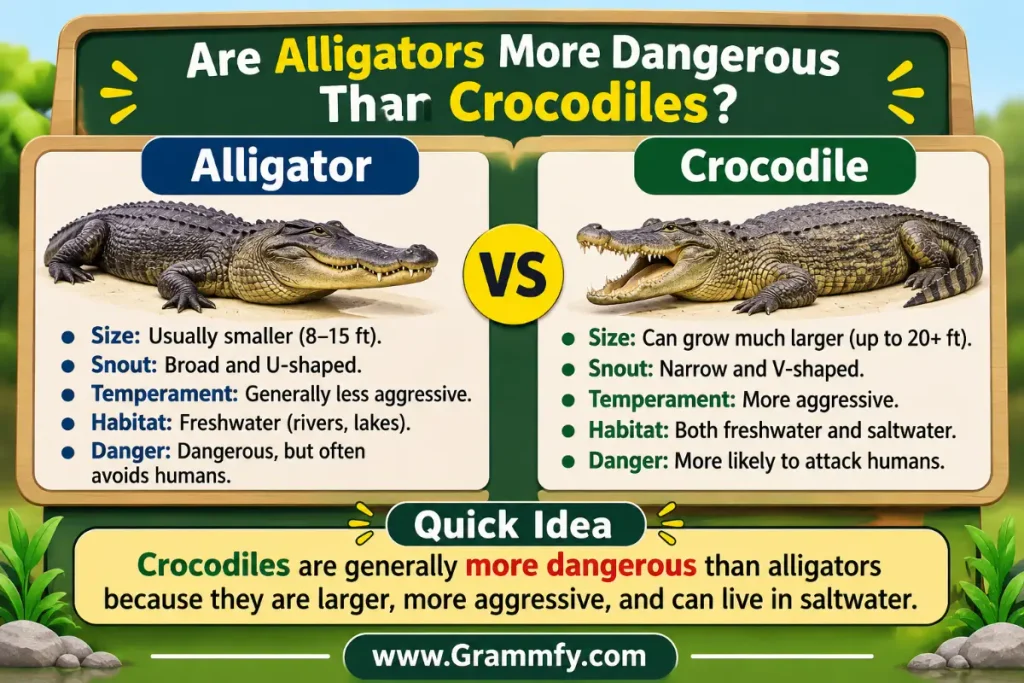
Both alligators and crocodiles are powerful wild predators. Either animal can seriously injure or kill a person, so neither should be approached, touched, fed, or cornered.
Crocodiles are often considered more dangerous to humans overall, particularly in areas where large species such as saltwater and Nile crocodiles live close to people. However, the level of risk depends on the species, location, and situation.
Are alligators aggressive?
Alligators do not usually seek out people as prey, but they can attack when they feel threatened, defend a nest or young, or associate humans with food.
Risk increases when people:
- Feed alligators.
- Approach them for photographs.
- Swim near them in unsuitable areas.
- Walk dogs close to the water’s edge.
- Ignore posted warnings.
Even a relatively small alligator can bite with great force.
Are crocodiles more aggressive?
Some crocodile species are responsible for frequent attacks on people in areas where their habitats overlap with human activity.
Nile crocodiles and saltwater crocodiles are especially important examples because of their size, strength, and potential to encounter people near rivers, lakes, and coastal waters.
However, behavior differs among species and individuals. It is not accurate to say that every crocodile is more aggressive than every alligator.
Which one should you avoid?
Avoid both. Keep a safe distance from any wild crocodilian, follow local wildlife guidance, and never enter water where authorities warn that these animals may be present.
If you see one near a trail, boat ramp, or swimming area, move away calmly and follow local safety instructions. Do not attempt to feed it or force it back into the water.
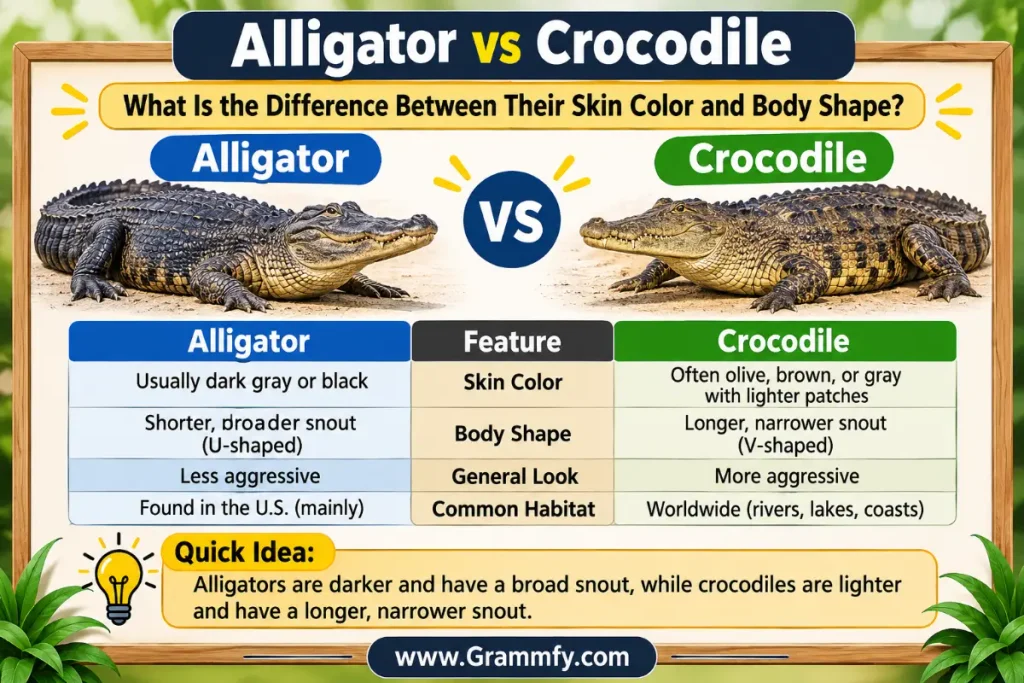
What Is the Difference Between Their Skin Color and Body Shape?
Color can support identification, but it is less reliable than snout shape and tooth placement.
Why are alligators often darker?
American alligators often have dark gray or nearly black skin. Their color can help them blend into muddy water, shaded wetlands, and dark vegetation.
An individual alligator may look lighter or darker depending on lighting, water quality, age, and the condition of its skin.
Why do crocodiles often look lighter?
Many crocodiles appear olive green, gray, or brown. Some have lighter markings or patterns that help them blend into rivers, mangroves, and coastal environments.
Color varies widely among species. A crocodile should not be identified by color alone.
How does body shape help?
Alligators often look broad and heavy-bodied, especially around the head. Many crocodiles have a more tapered snout and a streamlined appearance.
These differences are tendencies, not strict rules. Body size, posture, and the animal’s position in the water can change how its shape appears.
For the most reliable identification, use several features together rather than relying on one visual clue.
What Are the Origins of the Words Alligator vs Crocodile?
The names have different linguistic histories, even though they describe closely related animals.
Where does the word alligator come from?
The English word alligator developed from Spanish el lagarto, meaning “the lizard.” Early European descriptions of these reptiles helped the Spanish phrase enter English in an altered form.
The name reflects the animal’s lizard-like appearance, especially its long body, powerful tail, and scaly skin.
Today, alligator usually refers to members of the family Alligatoridae, especially the American alligator and Chinese alligator in everyday discussion.
The wider family also includes caimans, which are related crocodilians found mainly in Central and South America.
Where does the word crocodile come from?
The word crocodile entered English through older European forms connected to Latin crocodilus and Greek krokódilos.
The ancient Greek term was used for lizard-like animals, including crocodilians.
Modern English uses crocodile for members of the family Crocodylidae. This group includes species such as the American crocodile, Nile crocodile, and saltwater crocodile.
Are alligators and crocodiles the same type of animal?
They are related, but they are not the same animal or family.
Both belong to the order Crocodylia, along with other crocodilians. They share many traits because of their common ancestry, including strong jaws, scaly skin, powerful tails, and adaptations for living in and around water.
Their differences developed over a long evolutionary history. Today, their head shape, teeth, habitat preferences, and other traits help scientists classify and identify them.
What Are the Main Types of Alligators vs Crocodiles?
There are several living species of crocodilians. Learning the best-known examples helps explain why not every alligator or crocodile looks exactly the same.
What are the main alligator species?
Two living species are commonly recognized as true alligators.
American alligator (Alligator mississippiensis)
- Native to the southeastern United States.
- Common in freshwater wetlands, lakes, rivers, and swamps.
- Usually has a broad snout and dark coloration.
- Can grow to a large size.
Chinese alligator (Alligator sinensis)
- Native to eastern China.
- Much smaller than the American alligator.
- Lives in freshwater habitats.
- Is critically endangered.
The Chinese alligator is far less familiar to most people because its natural range is limited and its population has declined greatly.
What are the best-known crocodile species?
Several crocodile species are notable for their size, range, or relationship with people.
American crocodile (Crocodylus acutus)
Found in parts of the Americas and the Caribbean, including southern Florida. It often uses coastal and brackish habitats.
Nile crocodile (Crocodylus niloticus)
Found in many parts of sub-Saharan Africa. It is a large predator that uses rivers, lakes, and other freshwater habitats.
Saltwater crocodile (Crocodylus porosus)
Found across parts of Southeast Asia and northern Australia. It tolerates saltwater well and can travel between coastal and freshwater environments.
Morelet’s crocodile (Crocodylus moreletii)
Native to parts of Mexico and Central America. It often lives in freshwater environments such as swamps, rivers, and lakes.
These species differ in size, appearance, behavior, and habitat. Their differences also show why a single identification rule cannot cover every crocodilian.
What Are the Best Ways to Identify an Alligator vs Crocodile in Real Life?
If you encounter one in a wildlife park, on a nature trail, or in a photograph, use a careful identification process.
Step 1: Check the snout
A broad, rounded snout suggests an alligator. A narrower, pointed snout often suggests a crocodile.
This is a useful first clue, but not a guarantee.
Step 2: Look at the closed-mouth teeth
A crocodile’s lower fourth tooth often remains visible when its mouth is closed. An alligator’s lower teeth are usually hidden by the upper jaw.
Use a clear photograph if you’re learning identification. Never approach a live animal to check.
Step 3: Consider the location
Ask where the animal was observed.
- Southeastern US freshwater wetlands commonly support American alligators.
- Southern Florida supports both American alligators and American crocodiles.
- Northern Australia is home to saltwater crocodiles.
- Many parts of sub-Saharan Africa are home to Nile crocodiles.
Geography can narrow down the possibilities considerably.
Step 4: Check the habitat
An animal in a freshwater swamp may be an alligator, especially in the southeastern United States. A crocodilian in a coastal mangrove or estuary may be a crocodile.
However, both groups can occupy a range of aquatic environments.
Step 5: Compare several clues
Do not rely on a single feature. Combine the snout, teeth, color, habitat, and geographic range.
If the evidence is unclear, it’s better to say “crocodilian” than to make a confident but unsupported identification.
What Are Some Common Alligator vs Crocodile Myths?
Several common beliefs about these reptiles are too simple to be reliable.
Myth 1: Alligators live only in freshwater
Fact: Alligators mainly prefer freshwater, but they can enter brackish water for limited periods. Their ability to tolerate high salinity is generally lower than that of crocodiles adapted to coastal environments.
Myth 2: Crocodiles are always green
Fact: Crocodile color varies by species and environment. Many appear olive, gray, or brown, and lighting can change how their skin looks in a photograph.
Myth 3: Alligators are harmless if they look calm
Fact: A motionless alligator can still be dangerous. These reptiles can move quickly over short distances and may attack if threatened or attracted by food.
Myth 4: Every crocodile is larger than every alligator
Fact: Size varies widely. A large American alligator can be bigger than members of smaller crocodile species, although some crocodiles, especially saltwater crocodiles, can grow much larger.
Myth 5: You can always identify them by color
Fact: Color is only one clue. Snout shape, tooth placement, geographic location, and habitat generally provide a more useful combination of evidence.
What Are the Best Tips for Remembering the Difference?
A few simple memory tricks can help you remember the main distinctions.
- Alligator = broad: Picture a wide, rounded U-shaped snout.
- Crocodile = pointed: Picture a narrower V-shaped snout.
- Crocodile = exposed tooth: Remember the lower fourth tooth that often remains visible.
- Alligator = freshwater preference: Think of swamps, lakes, and wetlands.
- Crocodile = broader saltwater tolerance: Remember that some species live in coastal waters and estuaries.
These clues are useful for basic identification, but they should not replace careful observation.
For a quick decision, ask yourself three questions:
- Is the snout broad or pointed?
- Are lower teeth visible when the mouth is closed?
- Does the animal’s location match the known range of the species?
Together, these checks can help you make a more informed identification.
Conclusion:
Understanding Alligator vs Crocodile becomes much easier when you focus on a few clear features. Alligators generally have broad, U-shaped snouts, darker skin, and lower teeth that are mostly hidden when the mouth closes. Crocodiles often have narrower, V-shaped snouts, lighter olive or brown coloration, and a visible lower fourth tooth.
Habitat can provide another useful clue. American alligators are common in southeastern US freshwater wetlands, while American crocodiles occur in coastal areas of southern Florida. Around the world, crocodile species live across parts of Africa, Asia, Australia, and the Americas.
Remember that these are general patterns, not rules without exceptions. Use several clues together when identifying an animal, and always observe wild crocodilians from a safe distance. With practice, you’ll find it much easier to recognize the differences between these remarkable reptiles.
Frequently Asked Questions
What is the easiest way to tell an alligator from a crocodile?
The easiest method is to look at the snout and teeth. Alligators usually have broad, U-shaped snouts, while crocodiles often have narrower, V-shaped snouts and a visible lower fourth tooth.
Are alligators and crocodiles related?
Yes, both belong to the order Crocodylia and share a common evolutionary history. However, true alligators belong to the family Alligatoridae, while true crocodiles belong to the family Crocodylidae.
Which is bigger, an alligator or a crocodile?
It depends on the species. Saltwater crocodiles can grow much larger than American alligators, but some crocodile species are smaller than large adult alligators.
Are alligators more dangerous than crocodiles?
Crocodiles, particularly large species such as Nile and saltwater crocodiles, are associated with many serious attacks on humans. However, both groups can be dangerous, and you should never approach or feed either animal.
Can alligators and crocodiles live in the same place?
Yes, American alligators and American crocodiles both live in southern Florida. They have different habitat preferences, but their geographic ranges overlap.
What’s another way to describe an alligator or crocodile?
Both can be called crocodilians, a broad term for members of the order Crocodylia. This term also includes caimans and gharials, which are related but distinct groups.
Do alligators and crocodiles have the same diet?
Their diets overlap, and both eat fish, birds, reptiles, amphibians, and mammals. The exact prey depends on the species, body size, habitat, and food available.

Tylerbrooks is a US-based English grammar writer and contributor at Grammfy. He writes helpful articles about grammar, spelling, commonly confused words, and vocabulary. His goal is to explain English topics in simple language with clear examples and practical tips. Through his articles, he helps readers improve their writing and everyday English skills.