
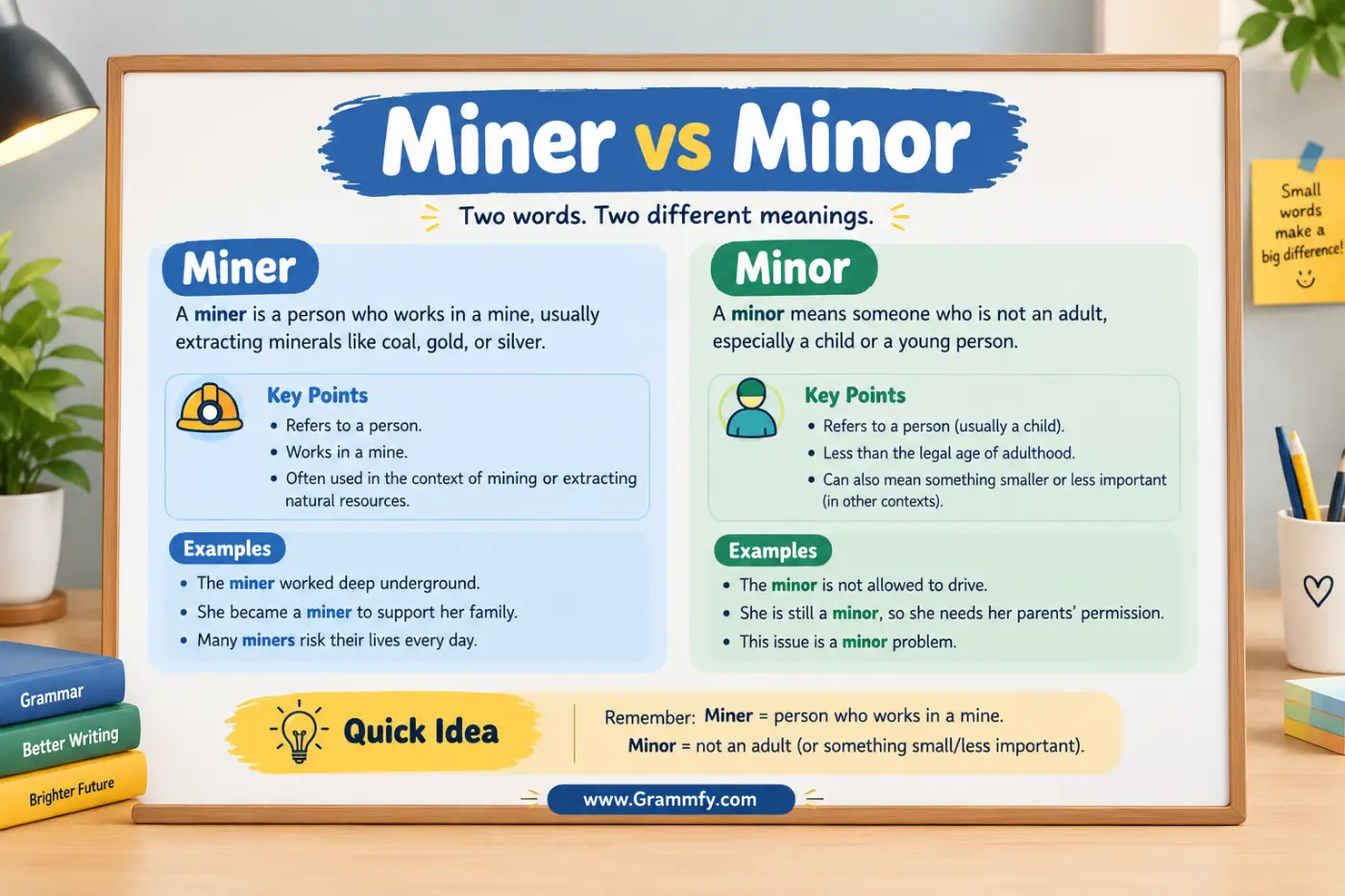
Have you ever written an email or school assignment and paused because you weren’t sure whether to use miner vs minor? These two words look almost identical, but they have very different meanings. Choosing the wrong one can change the entire message.
Understanding Miner vs Minor is easier when you connect each word to a real situation. A miner is a person who works in a mine, while minor can describe something small, less important, or someone who is below the legal age of adulthood.
- Quick answer: A miner is someone who extracts minerals, coal, or other resources from the earth. A minor is something less important or a person who has not reached the legal age of adulthood.
Although these words differ by only one letter, they belong in different contexts. You might use miner when discussing mining, natural resources, or a worker’s job. You might use minor when writing about a small problem, a legal issue, or an underage person.
In this guide, you’ll learn their meanings, origins, pronunciation, examples, common mistakes, and differences in everyday American English. You’ll also discover which word fits best in emails, essays, resumes, and conversations.
These words are easy to mix up, so read our guide to the difference between Cubical vs Cubicle to see their meanings and examples side by side.
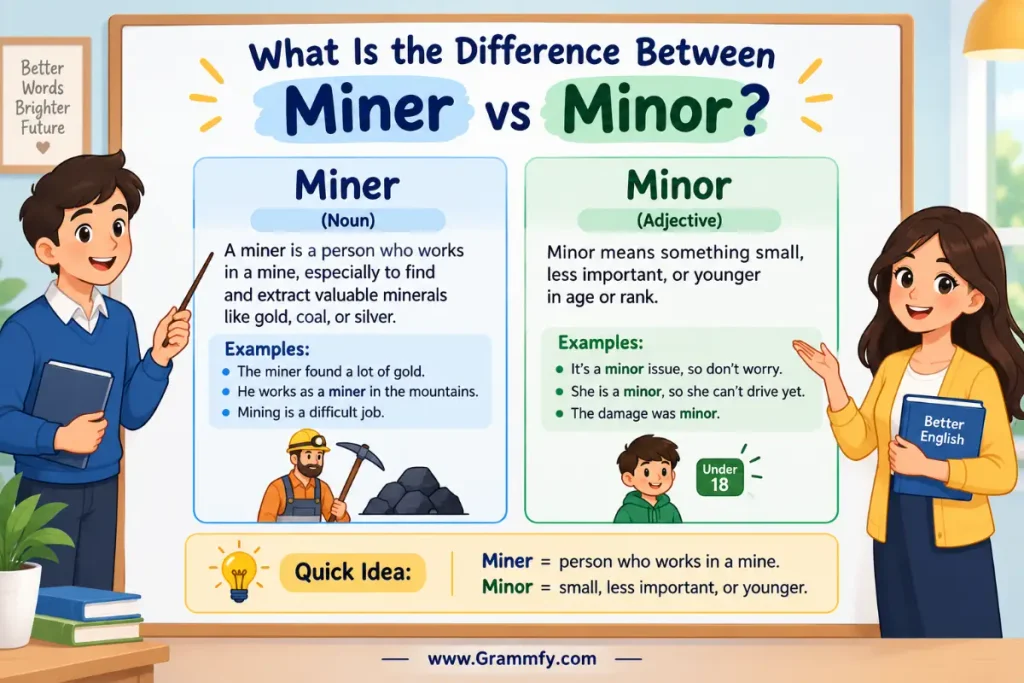
What Is the Difference Between Miner vs Minor?
The main difference is that miner refers to a person who works in a mine, while minor usually refers to something small or less important, or a person below the legal age of adulthood.
| Word | Part of speech | Main meaning | Example |
|---|---|---|---|
| Miner | Noun | A person who works in a mine | The miner entered the tunnel early. |
| Minor | Adjective | Small or less important | We found a minor error in the report. |
| Minor | Noun | A person below the legal age of adulthood | The minor needed a parent’s permission. |
| Minor | Noun | A secondary field of academic study | Her college minor is history. |
| Minor | Noun | A musical key or mode, or a musical interval in certain contexts | The song is written in a minor key. |
The easiest way to remember the difference is to associate miner with a mine and minor with something smaller, secondary, or below a legal age threshold.
When should you use miner?
Use miner when you mean a person who extracts resources from the earth. These resources may include coal, gold, silver, copper, or other minerals.
Examples:
- The miner worked underground for eight hours.
- A gold miner discovered a new deposit.
- The mining company provided safety equipment to every miner.
- Her grandfather was a coal miner for nearly 30 years.
The word refers to the worker, not the machine or the material being extracted.
For example, a machine that digs through rock is usually called a mining machine or excavator, not a miner.
When should you use minor?
Use minor when discussing something small, less serious, secondary, or below a legal age threshold.
Examples:
- The editor found a minor spelling mistake.
- The doctor described the injury as minor.
- A minor may need parental consent for certain activities.
- He chose biology as his minor at college.
Notice how the meaning changes according to the sentence.In the first two examples, minor describes something. The third example uses it to refer to a person, while the fourth refers to an academic subject.
Where Do Miner vs Minor Come From?
Understanding a word’s origin can make it easier to remember. Although these words look and sound similar, their histories and meanings developed along different paths.
What is the origin of miner?
Miner comes from mine, a word connected to digging and extracting valuable materials from the earth. The English word mine developed through older European language forms, including Old French mine.
Over time, miner became the common term for a person who works in a mine.
The word is associated with industries such as:
- Coal mining
- Gold and silver mining
- Copper extraction
- Gemstone mining
- Underground mineral exploration
The related words mine, mining, and mineral can help you remember its meaning.
Memory trick: A miner works in a mine.
What is the origin of minor?
Minor comes from Latin minor, meaning “smaller” or “less.” It is related to the Latin comparative form of parvus, meaning “small.”
The word entered English through French and Latin influences. Today, it appears in several contexts, including law, education, music, and everyday conversation.
For example:
- A minor problem is a small problem.
- A minor legal issue is less serious than a major one.
- A minor is a person who has not reached the relevant legal age.
- A college minor is a secondary field of study.
- A minor key is a musical key associated with a particular musical structure and sound.
Memory trick: A minor issue is often a smaller issue.
The connection between minor and smaller is especially useful because it applies to many everyday uses of the word.
How Do You Pronounce Miner vs Minor?
In standard American English, miner and minor are generally pronounced the same way: /ˈmaɪnər/.
Both have two syllables, with the stress on the first syllable.
| Feature | Miner | Minor |
|---|---|---|
| Pronunciation | /ˈmaɪnər/ | /ˈmaɪnər/ |
| Syllables | Two | Two |
| First sound | Like “my” | Like “my” |
| Stress | First syllable | First syllable |
| Sound difference | None in common American pronunciation | None in common American pronunciation |
Because they are homophones, you usually cannot tell which word someone means by listening alone. Context provides the answer.
For example:
- “The miner arrived early.” The sentence refers to a worker.
- “The mistake was minor.” The sentence describes a small mistake.
When speaking, both sentences may sound similar around the target word. When writing, however, the spelling matters.
Why do people confuse these words?
There are three main reasons.
- Similar spelling: Both words contain the same letters except for the second vowel.
- Identical pronunciation: In standard American English, they sound alike.
- Different grammatical uses: Minor has several meanings, while miner usually refers to a person working in mining.
This combination makes the pair easy to mix up in schoolwork, online messages, and professional writing.
What Are the Different Meanings of Minor?
The word minor has several meanings. Knowing the context helps you identify the correct one.
Minor meaning small or less important
This is one of the most common uses of minor.
It describes something that is not large, serious, or important compared with something else.
Examples:
- We made a minor change to the website.
- The car has a minor scratch.
- The teacher corrected a minor grammar mistake.
- There was a minor delay at the airport.
In these examples, minor does not mean that something is completely unimportant. It means that the issue is relatively small compared with more serious problems.
Minor meaning a person below legal adulthood
In legal contexts, a minor is someone who has not reached the age at which they are treated as an adult for a particular legal purpose.
In many parts of the United States, the general age of majority is 18, but legal rules and exceptions vary by state and situation.
Examples:
- A minor may need parental permission for certain medical decisions.
- The organization has a program for minors.
- The law provides special protections for minors.
Do not assume that every rule applies identically to every minor. Legal rights and requirements depend on the jurisdiction and the issue involved.
Minor meaning a secondary college subject
In American higher education, a minor is a secondary academic field that a student studies alongside a major.
For example:
- Her major is English, and her minor is psychology.
- He completed a minor in business administration.
- A computer science major can sometimes choose mathematics as a minor.
A minor generally requires fewer courses than a major, although each college sets its own requirements.
Minor in music
In music, minor describes a type of key, scale, chord, or interval.
Examples:
- The composer wrote the piece in A minor.
- The song changes from a major key to a minor key.
- The musician practiced a minor scale.
In many musical contexts, minor keys are associated with a darker or more somber sound, although the emotional effect depends on the composition and performance.
Minor as a noun or adjective
The grammatical role depends on how the word is used.
| Sentence | Part of speech | Why |
|---|---|---|
| It was a minor issue. | Adjective | It describes the issue. |
| The minor signed the form with a guardian. | Noun | It identifies a person. |
| She chose art as her minor. | Noun | It identifies a field of study. |
| The song is in a minor key. | Adjective | It describes the musical key. |
This flexibility is one reason minor appears in so many different types of writing.
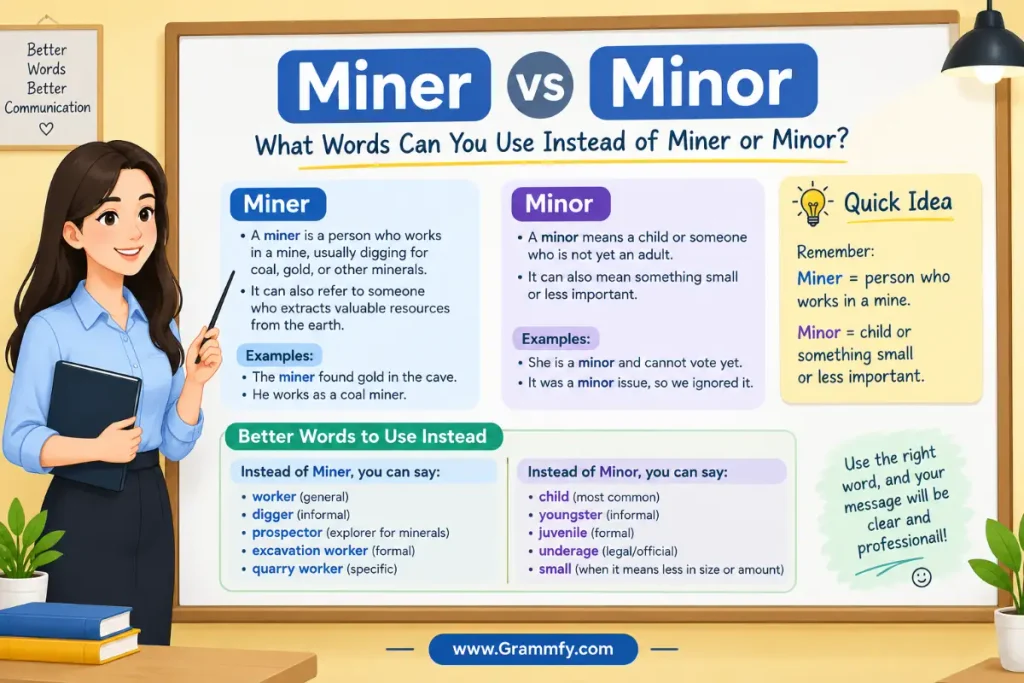
What Words Can You Use Instead of Miner or Minor?
The best replacement depends on the intended meaning. You cannot replace miner with a synonym for minor simply because the words sound alike.
For miner, useful alternatives include mine worker, coal miner, gold miner, and mining worker. Some describe specific jobs rather than exact synonyms.
For minor, alternatives include small, slight, limited, secondary, and underage. These words are not interchangeable in every sentence.
The following table groups useful alternatives by tone and context.
Simple and everyday alternatives
| Word | Meaning | Tone | Example |
|---|---|---|---|
| Small | Not large in size or importance | Simple | We found a small error. |
| Slight | Small in amount or degree | Everyday | There was a slight delay. |
| Little | Small in size or degree | Casual | It was a little problem. |
| Small-scale | Limited in size or scope | Neutral | It was a small-scale repair. |
| Limited | Restricted in amount or extent | Neutral | The damage was limited. |
| Secondary | Less important or not primary | Neutral | Cost was a secondary concern. |
| Less serious | Not as serious as something else | Everyday | The injury was less serious than expected. |
| Underage | Below the relevant legal age | Everyday | The event does not admit underage guests. |
Formal alternatives
| Word | Meaning | Tone | Example |
|---|---|---|---|
| Negligible | So small it may not matter much | Formal | The difference was negligible. |
| Marginal | Small or limited | Formal | The project showed marginal improvement. |
| Insignificant | Not important enough to affect the result | Formal | The change was insignificant. |
| Modest | Limited or relatively small | Formal | The company reported modest growth. |
| Minimal | As small as possible or very limited | Formal | The system requires minimal maintenance. |
| Trivial | Of little importance | Formal | The dispute concerned a trivial detail. |
| Peripheral | Not central to the main issue | Formal | The discussion covered peripheral concerns. |
| Subsidiary | Secondary or supporting | Formal | The report included a subsidiary analysis. |
Alternatives for a miner or mining worker
| Word | Meaning | Tone | Example |
|---|---|---|---|
| Mine worker | A person employed in mining | Neutral | The mine worker completed safety training. |
| Mining worker | Someone who works in the mining industry | Neutral | Mining workers received new equipment. |
| Coal miner | A worker who extracts coal | Specific | The coal miner described his daily routine. |
| Gold miner | A person who extracts gold | Specific | The gold miner searched the riverbank. |
| Underground worker | A worker whose job takes place underground | Descriptive | The underground worker inspected the tunnel. |
| Excavation worker | A worker involved in digging or excavation | Technical | The excavation worker cleared the site. |
| Extraction worker | A worker involved in removing natural resources | Technical | The extraction worker followed safety procedures. |
| Mining technician | A technical worker in mining operations | Professional | The mining technician tested the equipment. |
These alternatives have different scopes. An excavation worker, for instance, may work in construction rather than mining. Use the more specific job title when accuracy matters.
Casual and conversational alternatives
| Word or phrase | Meaning | Tone | Example |
|---|---|---|---|
| Tiny | Very small | Casual | It was a tiny mistake. |
| Minor hiccup | A small temporary problem | Informal | We had a minor hiccup during setup. |
| Little issue | A relatively small problem | Conversational | There’s a little issue with the file. |
| Small snag | A minor obstacle | Informal | We hit a small snag. |
| Quick fix | A simple correction or repair | Conversational | The typo needed a quick fix. |
| Not a big deal | Not very important | Casual | The delay wasn’t a big deal. |
| Mine worker | A person working in a mine | Neutral | The mine worker finished the shift. |
| Gold prospector | Someone searching for gold | Specific | The gold prospector explored the valley. |
A gold prospector is not necessarily an employed miner; prospecting usually involves searching for deposits. Likewise, a quick fix describes a solution, not the problem itself.
Which Words Describe Minor Problems From Mild to Strong?
When you mean “small” or “not serious,” the intensity of your word matters. A minor typo is different from a serious safety failure.
Use this scale to choose a word that matches the actual impact.
| Intensity | Word or phrase | Typical use | Example |
|---|---|---|---|
| Very mild | Tiny | A very small issue | There is a tiny mark on the page. |
| Mild | Slight | A small difference or effect | We noticed a slight change. |
| Mild | Minor | A limited problem | The document has a minor error. |
| Moderate | Noticeable | Something easy to observe | There was a noticeable delay. |
| Moderate | Significant | An issue that matters | The update made a significant difference. |
| Strong | Serious | A problem with major consequences | The inspection found a serious fault. |
| Very strong | Severe | An intense or dangerous condition | The storm caused severe damage. |
| Very strong | Critical | A matter requiring urgent attention | The system has a critical failure. |
These terms form a practical scale, not a universal ranking. The best choice depends on the subject and consequences.
Minor vs slight: What’s the difference?
Both words describe something small, but slight often emphasizes degree, while minor commonly emphasizes importance or seriousness.
| Minor | Slight |
|---|---|
| A minor injury | A slight increase in temperature |
| A minor correction | A slight difference in wording |
| A minor traffic accident | A slight delay |
| A minor legal issue | A slight change in tone |
You can sometimes use either word, but they may create different emphasis.
For example, “a minor improvement” suggests a limited improvement. “A slight improvement” focuses on how small the improvement was.
Minor vs insignificant: Which is stronger?
Insignificant usually suggests that something has little importance or effect. Minor simply indicates that something is relatively small or less serious.
- Minor: The report contains a minor error.
- Insignificant: The error had an insignificant effect on the final result.
An error can be minor but still need correction. Calling it insignificant suggests that its effect may be too small to matter in the particular situation.
Minor vs major: What is the opposite?
Major is a common opposite of minor when discussing importance, seriousness, or scale.
- Minor change → major change
- Minor injury → major injury
- Minor problem → major problem
- Minor subject → major subject
However, context matters. In music, major and minor refer to different musical structures, not simply important and unimportant things.
What Are the Best Word Choices for Different Writing Situations?
The correct choice depends on what you’re trying to communicate. Here are practical examples for school, work, and everyday communication.
Miner vs Minor on a resume
Use miner when describing mining experience, a mining job, or a relevant professional role.
Example:
“Worked as an underground coal miner, following site safety procedures and operating within established extraction guidelines.”
If you mean that a problem or task was small, use minor instead.
Example:
“Identified and corrected minor reporting errors before final submission.”
Do not use miner as a synonym for a junior employee. If you’re describing a beginner, use entry-level employee, junior associate, or trainee, depending on the role.
Miner vs Minor in an essay
In an essay about natural resources, miner refers to a person who extracts minerals or other materials.
Example:
“The miner relied on protective equipment to reduce workplace risks.”
In an essay about law, education, or the seriousness of an issue, minor may be correct.
Example:
“Although the policy change appeared minor, it affected several classroom procedures.”
For academic writing, choose the word that accurately represents your point. Avoid substituting one simply because it sounds more formal.
Miner vs Minor in texting
In casual messages, context usually makes the meaning clear.
Examples:
- “My uncle works as a miner.”
- “It’s only a minor issue.”
- “I made a minor mistake in the group assignment.”
- “The miner in the documentary explained the risks of working underground.”
Because the words sound alike, spelling mistakes can change the meaning. Read the sentence again before sending it, especially if the message concerns someone’s occupation or legal status.
Miner vs Minor in email
Professional emails should make the distinction clear.
When discussing a small issue: “Hi Alex, I noticed a minor error in the spreadsheet. I’ve corrected it and attached the updated version.”
When discussing a mining employee: “Hi Alex, the miner assigned to the morning shift reported a problem with the equipment.”
The surrounding details help readers understand which word you intend.
Miner vs Minor in speaking
In standard American English, both words are normally pronounced alike, so your listener relies on context.
If the sentence could be misunderstood, add a little detail.
Instead of saying, “The miner is here,” you could say, “The mine worker assigned to the inspection is here.”
Instead of saying, “It’s minor,” you could say, “It’s a small problem that won’t delay the project.”
This is especially useful when talking about technical, legal, or workplace issues.
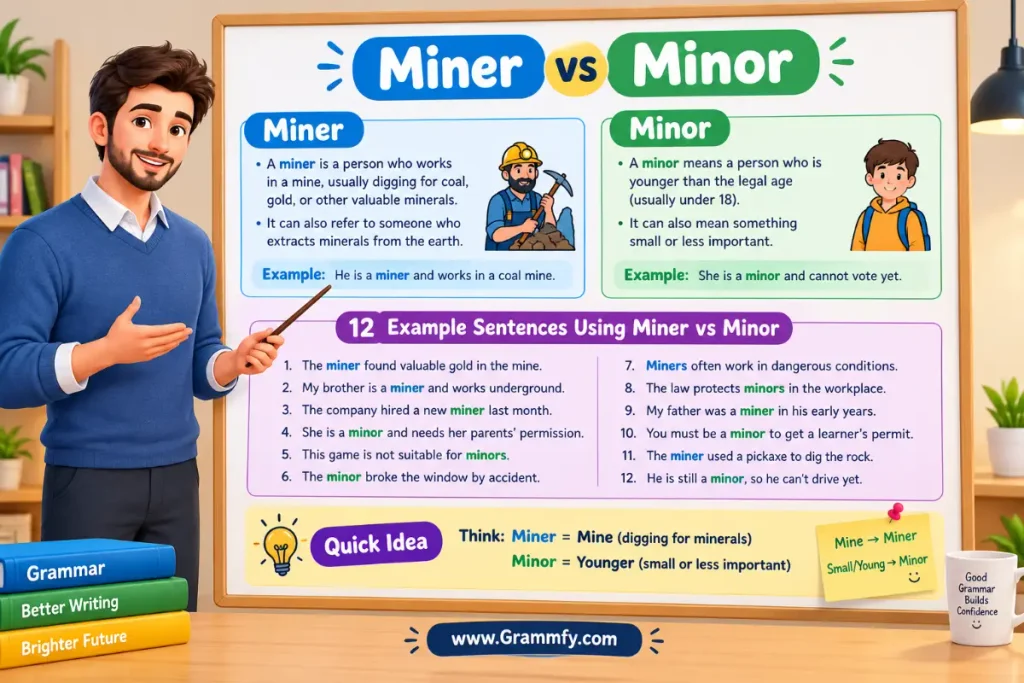
What Are 12 Example Sentences Using Miner vs Minor?
The best way to remember a confusing word pair is to see each word in different situations.
Examples using miner
- The miner checked his helmet before entering the underground tunnel.
- A gold miner searched the riverbank for valuable deposits.
- The company trained every miner to follow emergency procedures.
- Her grandfather worked as a coal miner for most of his career.
- The documentary followed a miner through a typical workday.
- Each miner received protective clothing and safety equipment.
Examples using minor
- The teacher found a minor punctuation error in my essay.
- We made a minor adjustment to the website’s navigation menu.
- The doctor said the cut was minor and required basic care.
- The student chose history as a minor alongside her English major.
- A minor may need a guardian’s consent for certain activities.
- The musician performed a song in a minor key.
More examples from real-life situations
- The inspector identified a minor defect before the building opened.
- The mining company hired an experienced miner to train new workers.
- A minor delay pushed the meeting back by ten minutes.
- The lawyer explained the rights that applied to the minor in the case.
- The miner reported loose rock near the entrance to the tunnel.
- We fixed a minor formatting problem before publishing the article.
Each sentence gives clues about the intended meaning. Words such as helmet, tunnel, coal, and mining company point toward miner. Words such as error, delay, defect, and adjustment often point toward minor.
What Are the Most Common Miner vs Minor Mistakes?
People often confuse these words because they sound alike. The solution is to check the meaning before choosing the spelling.
Mistake 1: Using miner for a small problem
Incorrect: “We found a miner error in the report.”
Correct: “We found a minor error in the report.”
Why? The sentence describes an error that is small or relatively unimportant. It does not refer to a mining worker.
Mistake 2: Using minor for a mining worker
Incorrect: “The minor entered the coal mine for his shift.”
Correct: “The miner entered the coal mine for his shift.”
Why? The sentence refers to a person whose job involves mining.
The word minor could describe a young person in some contexts, but it is not the correct occupation term here.
Mistake 3: Assuming minor always means unimportant
A minor problem is relatively small, but it may still deserve attention.
For example, a minor error in a legal document may need correction before the document is signed. A minor equipment fault may require inspection before machinery is used.
The word describes the issue’s relative scale or seriousness. It does not automatically mean the issue can be ignored.
Mistake 4: Using minor to describe an inexperienced worker
Incorrect: “He is a minor employee at the company.”
Better: “He is a junior employee at the company.”
Why? Minor is not the usual term for a lower-ranking or inexperienced employee. Depending on the situation, use junior, entry-level, trainee, or new employee.
Mistake 5: Treating miner and minor as interchangeable nouns
Both words can function as nouns, but they refer to different things.
- The miner inspected the tunnel.
- The minor needed permission from a guardian.
The first noun identifies an occupation. The second identifies a person below the relevant legal age threshold.
When should you NOT use minor?
Avoid minor when another word expresses your meaning more accurately.
- Use junior for a lower professional rank.
- Use temporary for something that will not last.
- Use inexperienced for someone who lacks experience.
- Use small when you mean physical size.
- Use limited when you mean restricted scope.
- Use insignificant when you specifically mean that something has little importance or effect.
Similarly, avoid miner unless you mean a person involved in mining. A person who digs a garden, repairs a road, or operates a construction excavator is not automatically a miner.
What Are the Antonyms of Miner and Minor?
An antonym is a word with an opposite meaning. The word minor has several possible opposites because it has multiple meanings.
| Word | Possible opposite | Example |
|---|---|---|
| Minor, meaning less important | Major | It was a major change, not a minor one. |
| Minor, meaning small in degree | Significant | The results showed a significant improvement. |
| Minor, meaning not serious | Serious | The doctor ruled out a serious injury. |
| Minor, meaning below legal adulthood | Adult | The program serves both minors and adults. |
| Minor, meaning a secondary field of study | Major | She changed her major but kept her minor. |
| Minor, in music | Major | The melody moves from a minor key to a major key. |
Miner does not have one direct antonym because it names an occupation. Depending on the contrast, you might refer to a mine owner, mining engineer, or mine supervisor, but these are different roles rather than strict opposites.
Are Miner and Minor Different in American and British English?
The meanings of miner and minor are broadly similar in American and British English. Both varieties use miner for a person who works in a mine and minor for something less important or a person below the relevant legal age.
The main differences are related to context, terminology, and legal systems.
American English
In the United States, minor is common in legal documents, school policies, and everyday conversation.
Examples:
- The minor needs a parent or guardian’s consent.
- The report contains a minor error.
- He works as a coal miner.
The legal age of majority is generally 18 in most states, but exceptions and specific rules can vary.
British English
British English uses the same basic word meanings.
Examples:
- The miner worked in a coal mine.
- The report contains a minor error.
- The law provides specific protections for minors.
The legal meaning of minor depends on the relevant law and context. Do not assume that every legal rule is identical in the UK and the US.
Does the spelling change by region?
No. Unlike pairs such as color and colour, the spelling of miner and minor does not normally change between American and British English.
| Meaning | American English | British English |
|---|---|---|
| Person working in a mine | Miner | Miner |
| Small or less important | Minor | Minor |
| Person below the relevant legal age | Minor | Minor |
| Secondary college subject | Minor, where the system uses this term | Usage depends on the education system |
In British higher education, the structure and terminology of degree programs may differ from American majors and minors. Check the institution’s own terminology when describing a qualification.
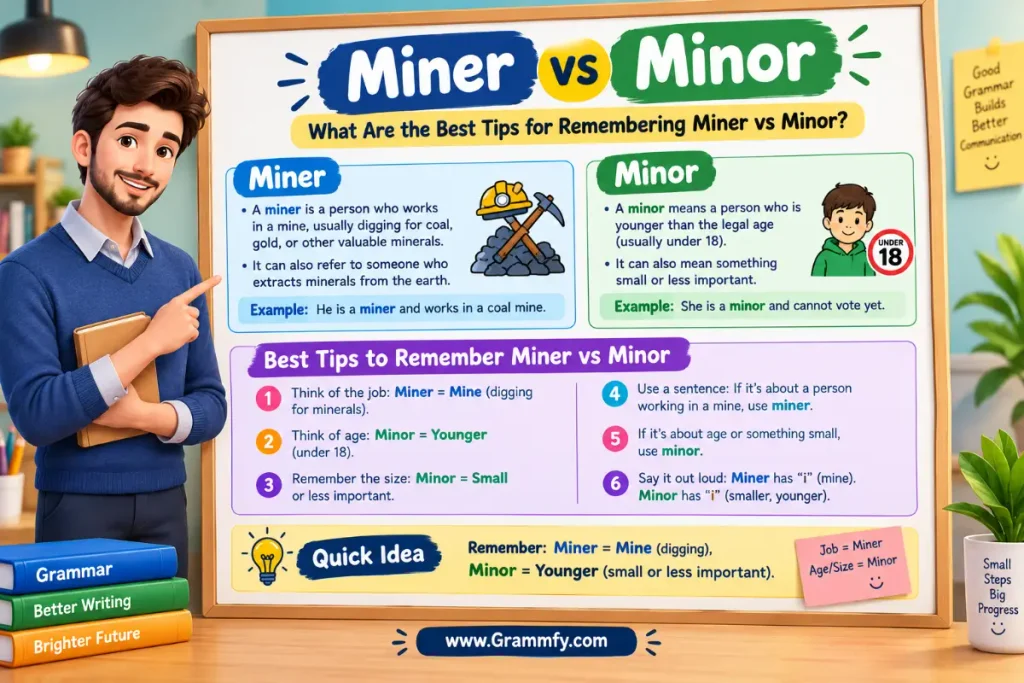
What Are the Best Tips for Remembering Miner vs Minor?
You do not need to memorize every dictionary definition. A few simple checks can help you choose the correct word quickly.
Tip 1: Connect miner with mine
A miner works in a mine.
If your sentence refers to coal, gold, tunnels, minerals, or underground work, miner is likely the correct choice.
Example: “The miner inspected the tunnel.”
Tip 2: Connect minor with smaller
A minor problem is usually a smaller or less serious problem.
Example: “We found a minor mistake in the document.”
Remember that this association applies to one common meaning. In legal, academic, and musical contexts, minor has other specific meanings.
Tip 3: Replace the word with a simple definition
Ask yourself what the sentence is trying to say.
- Does it mean “a person who works in a mine”? Choose miner.
- Does it mean “small or less important”? Choose minor.
- Does it mean “a person below the relevant legal age”? Choose minor.
- Does it mean “a secondary academic subject”? Choose minor.
If the replacement fits naturally, you’ve probably chosen the right word.
Tip 4: Look at the surrounding nouns
Certain words provide strong clues.
| If you see… | The likely choice is… |
|---|---|
| Coal, gold, tunnel, extraction | Miner |
| Typo, error, correction | Minor |
| Legal age, guardian, parental consent | Minor |
| College, academic subject, degree | Minor |
| Musical key, scale, chord | Minor |
| Mining equipment, underground shift | Miner |
These clues are helpful, but always consider the full sentence.
Tip 5: Use a spelling check
Spell-check tools may not catch this error because both words are correctly spelled English words. A grammar checker might also miss it if the sentence remains grammatically valid.
Read the sentence for meaning, not just spelling.
For example, “The miner mistake was corrected” may pass a basic spelling check, even though minor mistake is the intended phrase.
Can You Test Your Knowledge of Miner vs Minor?
Try these practice questions before checking the answers.
Fill in the blanks
Choose miner or minor for each sentence.
- The ______ put on his safety helmet before entering the mine.
- We found a ______ spelling mistake in the article.
- The student chose history as her college ______.
- The company hired an experienced ______ for the underground operation.
- The doctor described the injury as ______.
- A parent or guardian may need to provide consent for a ______ in certain situations.
- The editor made a ______ change to the introduction.
- The ______ reported a problem with the mining equipment.
Answers and explanations
| Question | Answer | Explanation |
|---|---|---|
| 1 | Miner | The person works in a mine. |
| 2 | Minor | The mistake is small. |
| 3 | Minor | It refers to a secondary field of study. |
| 4 | Miner | The person works in mining. |
| 5 | Minor | The injury is described as not serious. |
| 6 | Minor | The sentence refers to a person below the relevant legal age. |
| 7 | Minor | The change is limited in scope. |
| 8 | Miner | The person reports a workplace issue. |
If you answered all eight correctly, you understand the main distinction. If you missed a few, review the surrounding words and ask whether the sentence refers to a worker or to something small, secondary, or age-related.
Conclusion:
The easiest way to remember Miner vs Minor is to focus on the meaning rather than the sound. A miner works in a mine and may extract coal, gold, or other natural resources. A minor can describe a small problem, a secondary academic subject, a musical feature, or a person who has not reached the relevant legal age.
Before choosing either word, read the full sentence and ask what you want to describe. If the sentence is about a worker, miner is usually the right choice. If it is about something small, less serious, or secondary, minor is often correct.
Both words are useful in everyday conversation and professional writing. With a little practice, you’ll recognize the difference quickly and avoid confusing these similar-sounding words in emails, essays, and other writing.
Frequently Asked Questions
What is the difference between miner and minor?
A miner is a person who extracts resources from the earth, while a minor is something less important or a person below the relevant legal age. The words are pronounced alike in standard American English.
Is a miner a person who works in a mine?
Yes, a miner is someone who works in mining, often extracting coal, gold, or other minerals. The term can refer to workers in underground mines or other mining operations.
Does minor mean small or unimportant?
Yes, minor often means small, limited, or less serious compared with something else. For example, a minor mistake is usually less serious than a major error.
Are miner and minor homophones?
Yes, they are generally homophones in American English because they have the same pronunciation but different spellings and meanings. Context helps listeners understand which word is intended.
What’s another way to say minor?
You can use small, slight, limited, modest, or less serious, depending on the sentence. In formal writing, negligible or insignificant may fit when the effect or importance is very low.
Is a minor always someone under 18?
No, not in every legal context or jurisdiction. Eighteen is the general age of majority in many US states, but laws, exceptions, and specific legal requirements vary.
Can minor describe a college subject?
Yes, in American higher education, a minor is a secondary field of study pursued alongside a major. For example, a student might major in English and minor in history.

Tylerbrooks is a US-based English grammar writer and contributor at Grammfy. He writes helpful articles about grammar, spelling, commonly confused words, and vocabulary. His goal is to explain English topics in simple language with clear examples and practical tips. Through his articles, he helps readers improve their writing and everyday English skills.