
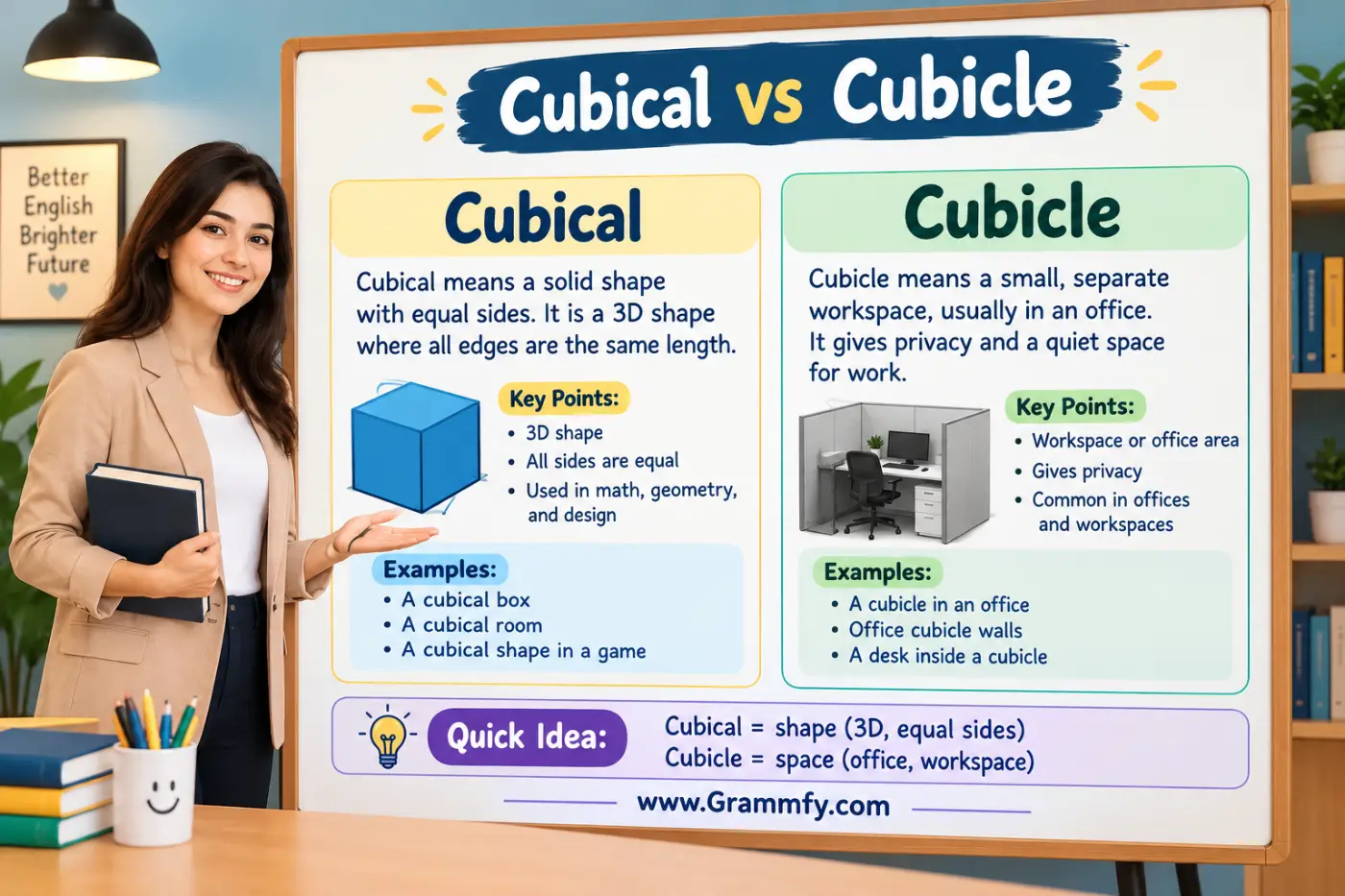
You’re writing an email about your office, updating your resume, or describing a workspace, and suddenly you pause: should you write cubical vs cubicle? These words look almost identical, so it’s easy to mix them up. However, they don’t have the same meaning, and one is much more common when you’re talking about an office workspace.
- Answer box: Cubicle is the standard English word for a small, enclosed workspace, especially in an office. Cubical is an adjective meaning “cube-shaped” or “related to a cube.”
The difference is simple once you know what role each word plays. This guide explains the meanings, origins, related words, examples, common mistakes, US and UK usage, and the best choice for emails, resumes, essays, texting, and everyday speech.
These words are easy to mix up, so read our guide to the difference between Analogy vs Allegory to see their meanings and examples side by side.
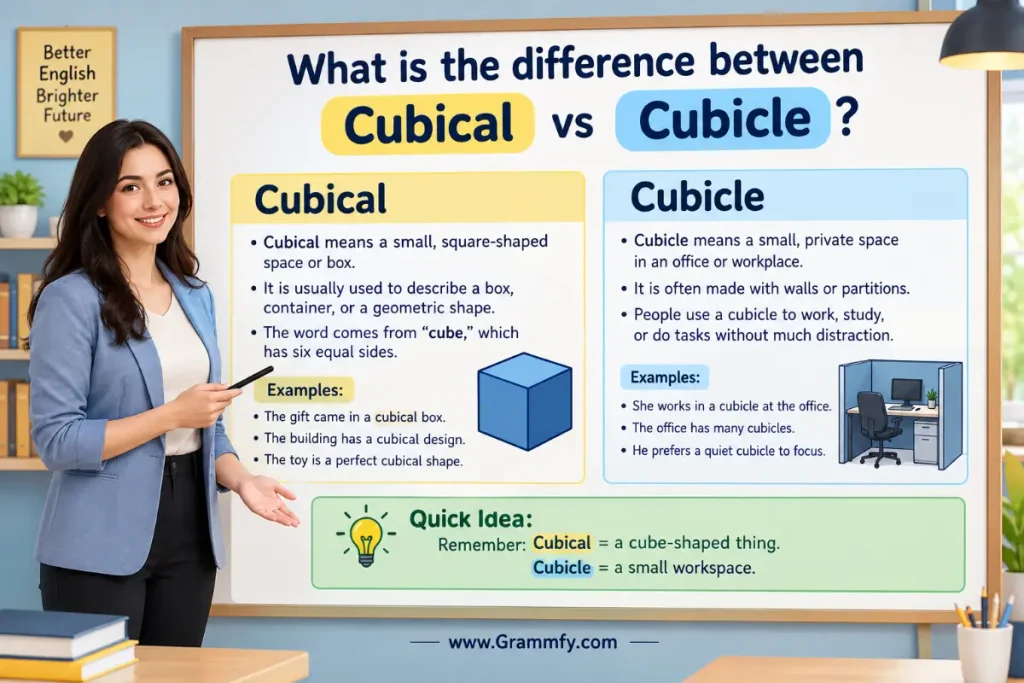
What is the difference between Cubical vs Cubicle?
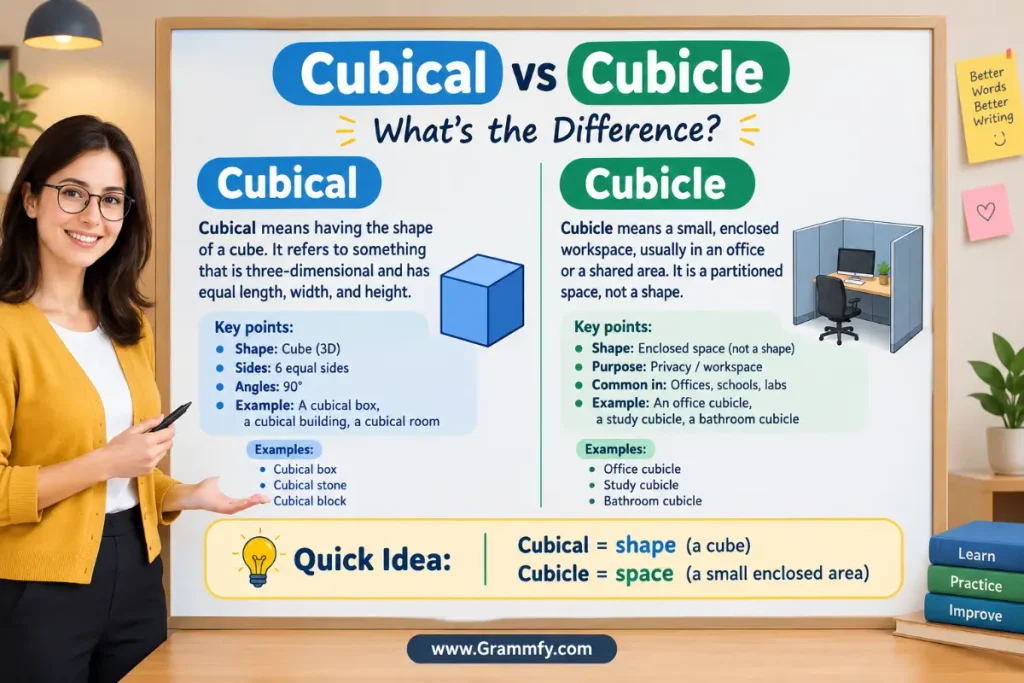
The main difference is part of speech and meaning.
Cubicle is usually a noun. It names a small enclosed space, especially a workspace separated from other areas by low walls or partitions.
Cubical is usually an adjective. It describes something that has the shape or general form of a cube.
| Word | Part of speech | Main meaning | Example |
|---|---|---|---|
| Cubicle | Noun | A small enclosed or divided space | I work in a cubicle. |
| Cubical | Adjective | Cube-shaped or related to a cube | The box has a cubical shape. |
So, if you’re talking about your place at an office, the correct word is usually cubicle. “I have a small cubicle near the window”.
If you’re describing the shape of an object, cubical may be appropriate. “The sculpture has a cubical design”.
This is the key distinction to remember:
- Cubicle = a space or compartment.
- Cubical = cube-shaped.
What does cubicle mean in plain English?
A cubicle is a small space that is separated from surrounding spaces, usually by partial walls or partitions.
The word is especially common in offices.
For example:
- Sarah works in a cubicle near the reception area.
Here, cubicle is the name of Sarah’s workspace.
Cubicles can also appear in other places. Depending on the context, a cubicle may be:
- An office workspace
- A changing area
- A shower area
- A study or work compartment
- A small private section of a larger room
- A partitioned booth or space
The exact design varies. Some cubicles have very low walls, while others provide more privacy.
What is an office cubicle?
An office cubicle is a workspace separated from nearby work areas by partitions.
A typical office cubicle may contain:
- A desk
- A computer
- A chair
- Storage drawers
- Shelves
- Office supplies
- Partition walls
For example:
The company gave each employee a cubicle with a desk and computer.
The word describes the space, not the shape.
That’s why “cubical” isn’t normally the right word for an office workstation.
What does cubical mean in plain English?
Cubical is an adjective that means cube-shaped or having the characteristics of a cube.
A cube has equal-length sides and a three-dimensional shape. Something described as cubical resembles that form.
For example:
The building has a simple cubical design.
Here, cubical describes the building’s shape or design.
Another example:
The artist created a cubical sculpture.
The sculpture is being described as having a cube-like form.
Is cubical a common everyday word?
It is a real English word, but it isn’t as common in everyday conversation as cube-shaped or cubic.
You might see cubical in:
- Mathematics
- Architecture
- Engineering
- Art
- Design
- Technical writing
- Scientific descriptions
In casual English, someone might simply say: “The box is cube-shaped”.
Instead of: “The box is cubical”.
Both can work, but the first sounds more natural in many everyday situations.
Where did the word cubicle come from?
The history of cubicle helps explain why the word refers to a small compartment.
The word comes from Latin cubiculum, meaning a chamber, bedroom, or sleeping room. It is related to the Latin verb cubare, meaning “to lie down.”
Over time, English developed cubicle as a word for a small room or compartment.
Today, the word has several uses, but the office meaning is especially familiar.
Interestingly, an office cubicle doesn’t have to be shaped like a cube. The modern word is connected more with the idea of a small divided space than with a perfect geometric cube.
That is one reason spelling it cubical can be misleading.
Where did the word cubical come from?
Cubical is formed from cube plus the adjective-forming ending -ical.
Its basic meaning is therefore connected to the form or qualities of a cube.
Compare:
- Cube → cubical
- Sphere → spherical
- Cylinder → cylindrical
- Triangle → triangular
So cubical describes something related to a cube or shaped like one.
This makes its grammatical role different from cubicle.
Why do people confuse cubical vs cubicle?
The spelling is the biggest reason.
The two words share almost all their letters:
- cubical
- cubicle
Only a few letters change, but that small difference changes the meaning.
There is also a connection between the words because cubicle may remind people of cube. When someone sees an enclosed office space, they may think “cube” and accidentally write cubical.
Another reason is pronunciation. Depending on the speaker’s accent and speed, the words can sound similar enough to cause confusion.
The best solution is to remember their jobs:
- Cubicle names a thing.
- Cubical describes a thing.
Cubical vs Cubicle: a quick grammar test
Try placing the word after a. “I work in a cubicle”.
This works because cubicle is a noun.
Now try: “I work in a cubical”.
This usually sounds incomplete if you’re talking about an office space. Cubical is normally an adjective, so it needs a noun to describe.
For example:
- I work in a cubical office.
That sentence is grammatically possible, but it means the office is cube-shaped. It does not simply mean “office cubicle.”
Now try: “The structure is cubical”.
That works because cubical is describing the structure.
This quick test can help you catch the mistake.
What are the parts of speech?
Understanding the grammar makes Cubical vs Cubicle much easier.
Cubicle is a noun
A noun names a person, place, thing, or idea.
Cubicle names a physical space or compartment.
Examples:
- My cubicle is near the door.
- Her cubicle has a large monitor.
- The office has twenty cubicles.
- I decorated my cubicle.
- His cubicle is next to mine.
Cubical is an adjective
An adjective describes a noun.
Examples:
- a cubical structure
- a cubical building
- a cubical design
- a cubical object
- a cubical shape
For example:
The architect created a cubical building.
Here, cubical describes building.
What are the main synonyms for cubicle?
There isn’t one perfect synonym for cubicle in every situation. The best alternative depends on the type of space you’re describing.
Simple and everyday words
| Word | Meaning | Tone | Example |
|---|---|---|---|
| Compartment | A separate section of a larger space | Neutral | Each worker has a small compartment. |
| Space | An available area | Very common | I have my own workspace. |
| Workspace | An area used for work | Professional | My workspace is near the window. |
| Work area | A place where someone works | Everyday | Her work area is organized. |
| Section | A divided part of a larger area | Neutral | His section is at the back. |
| Area | A particular part of a place | Everyday | My work area is small. |
| Booth | A small enclosed or partly enclosed space | Everyday | We sat in a booth during lunch. |
| Stall | A small divided space | Everyday | The changing room has several stalls. |
Formal and professional alternatives
| Word | Meaning | Tone | Example |
|---|---|---|---|
| Workspace | An area designed for working | Professional | Each employee has a dedicated workspace. |
| Workstation | A specific place equipped for work | Professional | Her workstation includes two monitors. |
| Office | A room or workplace used for professional activity | Professional | He moved to a private office. |
| Compartment | A separated section within a larger area | Formal | The train has separate compartments. |
| Enclosure | A space surrounded by a boundary | Formal | The equipment sits inside an enclosure. |
| Partitioned area | A space divided by barriers | Formal | Employees work in partitioned areas. |
| Work bay | A designated working section | Professional/Technical | The technician has a dedicated work bay. |
| Station | A designated place for a particular activity | Professional | Please return to your workstation. |
More informal terms
| Word or phrase | Meaning | Tone | Example |
|---|---|---|---|
| Desk space | Area around a desk | Casual | I need more desk space. |
| Work spot | A place where someone works | Casual | This is my usual work spot. |
| Corner | A particular part of a room | Casual | I work in the corner near the window. |
| Booth | A small separated area | Casual | She works in a booth-style space. |
| Little office | A small work area | Informal | He calls his cubicle his little office. |
| Desk area | The area surrounding a desk | Everyday | Keep your desk area clean. |
Terms related to a cube-shaped object
If you’re looking for alternatives to cubical, the choices are different.
| Word | Meaning | Tone | Example |
|---|---|---|---|
| Cube-shaped | Having the shape of a cube | Everyday | The container is cube-shaped. |
| Cubic | Related to a cube or its dimensions | Technical | The room has a large cubic volume. |
| Box-shaped | Resembling a box | Everyday | The building is box-shaped. |
| Square | Having an equal-sided flat shape | Everyday | The table has a square top. |
| Block-like | Resembling a solid block | Descriptive | The structure has a block-like design. |
| Geometric | Related to geometric shapes | General/Academic | The design uses geometric forms. |
| Three-dimensional | Having height, width, and depth | Technical | The model is three-dimensional. |
| Rectangular | Having four sides with right angles | Technical/Everyday | The room is rectangular rather than cubical. |
Be careful with these alternatives. Cubic, cubical, square, and rectangular don’t mean exactly the same thing.
What are synonyms by intensity?
Unlike words such as “happy” or “angry,” cubicle and cubical don’t have a natural mild-to-strong synonym scale.
Instead, you can organize related workspace terms by privacy and size.
Open or low-privacy
- Desk
- Work area
- Workstation
- Shared workspace
- Open workspace
These terms don’t necessarily suggest walls.
Moderately separated
- Cubicle
- Partitioned workspace
- Work bay
- Booth
- Compartment
These suggest some form of separation.
More private
- Private office
- Enclosed office
- Individual office
- Small office
- Private workspace
These usually suggest more privacy than a traditional cubicle.
The distinction matters in professional writing. Calling something a private office when it is actually an open cubicle can give the reader the wrong picture.
What are synonyms by part of speech?
Noun alternatives for cubicle
Use these when you need to name a space:
- Workspace
- Workstation
- Compartment
- Booth
- Section
- Work area
- Office
- Enclosure
- Work bay
Adjective alternatives for cubical
Use these when you need to describe shape:
- Cube-shaped
- Cubic
- Box-shaped
- Geometric
- Block-like
- Three-dimensional
Remember that cube-shaped is often the clearest choice for general readers.
Is cubical or cubicle correct for an office?
Cubicle is correct when you mean a small office workspace separated by partitions.
For example:
- I spend most of my day in my cubicle.
- The company installed new cubicles.
- Her cubicle is beside the conference room.
Cubical is not the standard noun for an office workspace.
You might see someone write: “I work in a cubical”.
They almost certainly mean cubicle if they’re describing an office workstation.
The corrected version is: “I work in a cubicle”.
Which word should you use in a resume?
Use “cubicle” when describing a physical workspace
A resume might mention a cubicle if the physical workspace matters to the job description, but it’s usually more professional to focus on what you did there.
Instead of:
- Worked in a cubicle and answered customer questions.
A stronger resume sentence is:
- Provided customer support and resolved client questions in a fast-paced office environment.
If the workspace itself is relevant, cubicle is still the correct noun.
- Managed daily administrative tasks from an assigned office cubicle.
Don’t use “cubical” for a workstation
Avoid: “Worked from a cubical“.
Use: “Worked from a cubicle“.
Or, depending on the context:
- Worked from a dedicated workstation.
Workstation can sound more professional when describing an equipped place where someone performs a job.
Which word should you use in an essay?
Use cubicle when describing an office space
The employees sat in separate cubicles.
This is clear and natural.
Use cubical when describing shape
The architect designed a cubical structure with clean geometric lines.
Here, cubical is appropriate because it describes the structure.
In an academic essay, precision matters. Don’t choose the word just because it looks similar to the other one.
Which word should you use in a text message?
Text messages are informal, but the spelling difference still matters.
If you’re talking about work:
I’m stuck in my cubicle all afternoon.
If you’re describing an object: “The new design is basically cubical“.
In casual texting, people sometimes make spelling mistakes because they type quickly. However, the standard spelling remains cubicle for the workspace.
Which word should you use in an email?
For an office workspace, use cubicle
- I left the documents in my cubicle.
- The meeting is near my cubicle.
- Please send the forms to my cubicle.
For a shape, use cubical
The proposed structure has a cubical design.
If the email is professional, don’t rely on context to fix a spelling mistake. Using the correct form makes the message clearer.
Which word should you use when speaking?
When speaking, context usually makes the meaning clear.
You might say:
- “My cubicle is on the second floor”.
Or:
- The new building has a cubical design.
If you’re not sure whether the listener will understand a technical description, cube-shaped may be easier than cubical.
For example:
- The building is basically cube-shaped.
That’s very natural in everyday American English.
15+ original example sentences
Here are examples showing how the two words work in different situations.
- I keep my notebook on the desk in my cubicle.
- The manager moved to a larger cubicle near the window.
- Our office has rows of cubicles separated by fabric panels.
- She decorated her cubicle with a few small plants.
- The company replaced the old cubicles with adjustable workstations.
- I left the report on your desk in the cubicle across from mine.
- His cubicle is close to the break room.
- The designer created a cubical sculpture for the lobby.
- The building has a simple cubical shape.
- The artist used cubical forms throughout the installation.
- The architect wanted a clean, cubical structure.
- The storage unit has a nearly cubical shape.
- The classroom model includes several cubical blocks.
- The new office layout gives each employee a larger cubicle.
- I spent the morning organizing files in my cubicle.
- The package has a cubical design that makes it easy to stack.
- The employee placed a small lamp inside her cubicle.
- The architect rejected the first design because its cubical form looked too rigid.
Notice the pattern: cubicle names the workspace, while cubical describes shape.
Cubicle vs workstation — what’s the difference?
Cubicle and workstation are related, but they aren’t exact synonyms.
A workstation is a place equipped for a person to work. It may include a desk, computer, monitor, tools, or other equipment.
A cubicle is a type of separated workspace.
So one workstation can be inside a cubicle.
| Cubicle | Workstation |
|---|---|
| Usually describes a divided physical space | Describes a place equipped for work |
| Often has partitions | May have no partitions |
| Common in offices | Common in offices, labs, factories, and technical settings |
| Focuses on the space | Focuses on the working setup |
Example:
- My workstation is inside my cubicle.
Both words are correct because they describe different aspects of the same area.
Cubicle vs compartment — what’s the difference?
A compartment is a separated section of a larger space.
It can describe many things:
- A train section
- A storage section
- A changing area
- A vehicle section
- An office area
A cubicle is more specific in many office contexts.
For example:
- The office has several cubicles.
sounds more natural than:
- The office has several compartments.
But if you’re talking about a train:
- The train has several compartments.
is the normal choice.
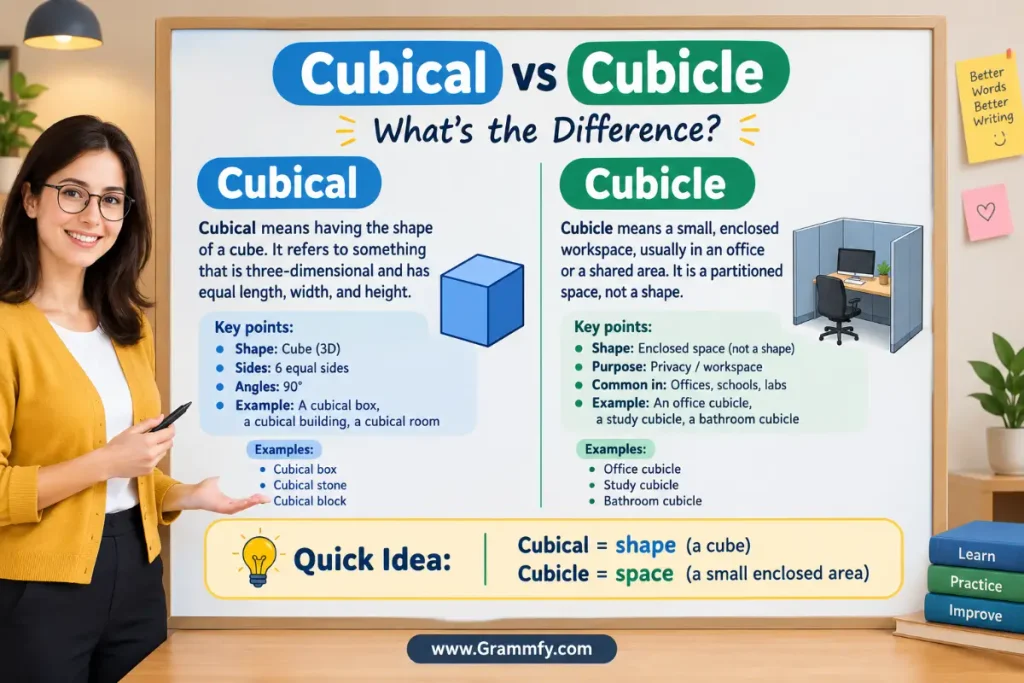
Cubical vs cubic — what’s the difference?
These two adjectives are closely related, but they can be used differently.
Cubical generally means cube-shaped or resembling a cube.
Cubic has broader technical meanings. It can refer to a cube, a three-dimensional measurement, or mathematical relationships involving the third power.
For example:
- The sculpture has a cubical shape.
But:
- The room has a volume of 100 cubic meters.
You wouldn’t normally replace cubic with cubical in a measurement.
Simple rule
Use cubical when describing something as cube-shaped.
Use cubic when discussing mathematical, geometric, or volume-related concepts.
What are common mistakes with these words?
Mistake 1: Writing “cubical” for an office workspace
Incorrect:
- I sit in a cubical at work.
Standard:
- I sit in a cubicle at work.
Mistake 2: Assuming every cube-related word is “cubical”
If you’re talking about volume, cubic may be the correct technical term.
- The box has a volume of two cubic feet.
Mistake 3: Thinking cubicle must be cube-shaped
A cubicle doesn’t have to be a perfect cube.
The word commonly refers to a small partitioned space, especially in an office.
Mistake 4: Using cubical as a noun
Incorrect in standard usage:
- My cubical is next to the window.
Correct:
- My cubicle is next to the window.
Mistake 5: Using “cube” when you mean an office cubicle
You could say:
- My cube is near the window.
This informal expression is sometimes used in office conversations, especially in American English, but cubicle is the clearer standard word for general writing.
When should you NOT use cubicle?
Don’t use cubicle if you simply mean a desk.
A desk may be in a cubicle, but the two aren’t identical.
- My desk is messy.
doesn’t necessarily mean:
- My cubicle is messy.
Likewise, don’t use cubicle for every small room. A bedroom, office, classroom, or storage room may not be called a cubicle.
Use the word when the space is genuinely small, divided, or compartmentalized.
When should you NOT use cubical?
Don’t use cubical when you’re simply talking about an office partition.
Incorrect:
- She decorated her cubical.
Correct:
- She decorated her cubicle.
Also avoid cubical if you mean “related to a cube” in a technical mathematical context where cubic is the established term.
For example:
- cubic volume
is standard.
What are the antonyms of cubicle?
Cubicle doesn’t have one exact opposite.
Depending on context, possible contrasts include:
- Open space
- Open-plan office
- Shared area
- Unpartitioned workspace
- Open workspace
- Large room
For example:
- The company replaced private cubicles with an open-plan office.
Here, open-plan office provides a useful contrast.
What are the antonyms of cubical?
Again, there isn’t one universal opposite.
Possible contrasts include:
- Non-cubical
- Irregular
- Curved
- Spherical
- Cylindrical
- Flat
- Two-dimensional
The correct opposite depends on the shape you’re discussing.
For example, if a cubical object is contrasted with a sphere, spherical is the relevant term.
How do US and UK English use these words?
There is no major spelling difference between American and British English for cubicle and cubical.
Both varieties use:
- cubicle for a small compartment or office workspace
- cubical for something cube-shaped or related to a cube
The office meaning of cubicle is particularly common in American workplace English, but the word is also understood and used in British English.
Regional workplace vocabulary can vary. In some settings, speakers may prefer terms such as:
- workstation
- office
- desk
- booth
- work area
But the spelling distinction stays the same.
Is “cubical” ever correct for an office?
Usually, no.
If you mean:
A small office space separated by partitions
then cubicle is the standard word.
However, cubical could technically describe an office if you specifically mean the office is cube-shaped.
For example:
- The architect designed a cubical office with equal dimensions.
That’s different from: “I work in a cubicle”.
The first sentence describes shape.
The second sentence identifies a workspace.
Is “cubicle” always related to an office?
No.
An office is probably the most familiar modern use, but a cubicle can be any small divided or enclosed space.
Examples include :
- a changing cubicle
- a toilet cubicle
- an office cubicle
The exact meaning comes from context.
What is the easiest memory trick?
Use this:
CUBICLE = COMPARTMENT
Both words describe a space or section.
Think:
Cubicle → compartment
CUBICAL = CUBE
Both words are connected with the shape of a cube.
Think:
Cubical → cube-shaped
You can also remember the grammar:
- A cubicle = a thing.
- A cubical object = a described thing.
This small distinction will prevent most spelling errors.
Quick tips for choosing the right word
- Talking about an office workspace? Use cubicle.
- Talking about a shower or changing space? Use cubicle.
- Naming a small divided area? Use cubicle.
- Describing something shaped like a cube? Use cubical.
- Talking about volume or mathematical measurement? Consider cubic.
- Want the clearest everyday phrase for shape? Use cube-shaped.
- Writing a resume? Workstation may be more professional depending on context.
- Writing an academic paper? Choose the term that matches the exact physical or geometric meaning.
- Writing an email? Use cubicle for an office space.
- Texting about your desk area? Cubicle is still the standard spelling.
A final comparison chart
| Question | Cubicle | Cubical |
|---|---|---|
| What is it? | Noun | Adjective |
| What does it describe? | A small space or compartment | A cube-like shape |
| Common office use? | Yes | No, unless describing shape |
| Can it follow “a”? | Yes: a cubicle | Usually no: “a cubical” needs a noun |
| Example | I work in a cubicle. | It has a cubical shape. |
| Related word | Compartment | Cube |
| Common alternative | Workstation | Cube-shaped |
| Main idea | Space | Shape |
Why the correct spelling matters
A one-letter spelling difference can change the grammatical role of a word.
Compare:
- I work in a cubicle.
with:
- The building has a cubical design.
The first tells us where someone works.
The second tells us what something looks like.
This kind of distinction matters in professional writing because readers use grammar and context to understand exactly what you mean.
If you’re describing an office, a resume, a company layout, or a workplace conversation, cubicle is almost certainly the word you need.
If you’re describing geometry, architecture, design, or shape, cubical may be appropriate.
And if you’re talking about volume or mathematical measurement, check whether cubic is the better choice.
Conclusion
The easiest way to remember Cubical vs Cubicle is to connect each word with its job. Cubicle is a noun for a small separated space, especially an office workspace. Cubical is an adjective for something shaped like a cube or related to a cube. If you can replace the word with “workspace” or “compartment,” choose cubicle. If you can replace it with “cube-shaped,” cubical may be the right choice. Also remember cubic, which is often preferred in mathematical and measurement-related contexts. Once you connect each spelling with its meaning, this common mix-up becomes much easier to avoid in emails, essays, resumes, and everyday writing.
Frequently Asked Questions
Is cubical or cubicle correct for an office?
Cubicle is correct for a small office workspace separated by partitions. Cubical is an adjective describing something cube-shaped.
What does cubical mean in simple English?
Cubical means shaped like a cube or having a form related to a cube. For everyday writing, “cube-shaped” is often an easier alternative.
What does cubicle mean in a sentence?
Cubicle means a small separated space or compartment, especially a workspace. For example, “My cubicle is next to the window.”
What’s another way to say cubicle?
Common alternatives include workspace, workstation, work area, compartment, and booth, depending on the setting. They aren’t always exact substitutes.
Is cubical a noun or an adjective?
Cubical is normally an adjective. It describes a noun, as in “a cubical structure” or “a cubical design.”
Is cubicle only used for offices?
No, cubicle can describe several kinds of small separated spaces. Examples include office cubicles, shower cubicles, and changing cubicles.
Is Cubical vs Cubicle a spelling difference or a meaning difference?
It is both a spelling and meaning difference. “Cubicle” is mainly a noun for a small compartment, while “cubical” is an adjective connected with cube shape.

Tylerbrooks is a US-based English grammar writer and contributor at Grammfy. He writes helpful articles about grammar, spelling, commonly confused words, and vocabulary. His goal is to explain English topics in simple language with clear examples and practical tips. Through his articles, he helps readers improve their writing and everyday English skills.