
Writing an email, polishing a school essay, or sending a quick text can feel easy until you stop at two words that look almost the same. That’s exactly what happens with defuse vs diffuse. Many people mix them up because they sound alike, but they have very different meanings.
If you’ve ever wondered which one belongs in your sentence, you’re not alone. Even experienced writers sometimes choose the wrong word. The good news is that once you understand the difference, it’s easy to remember.
Quick Answer:
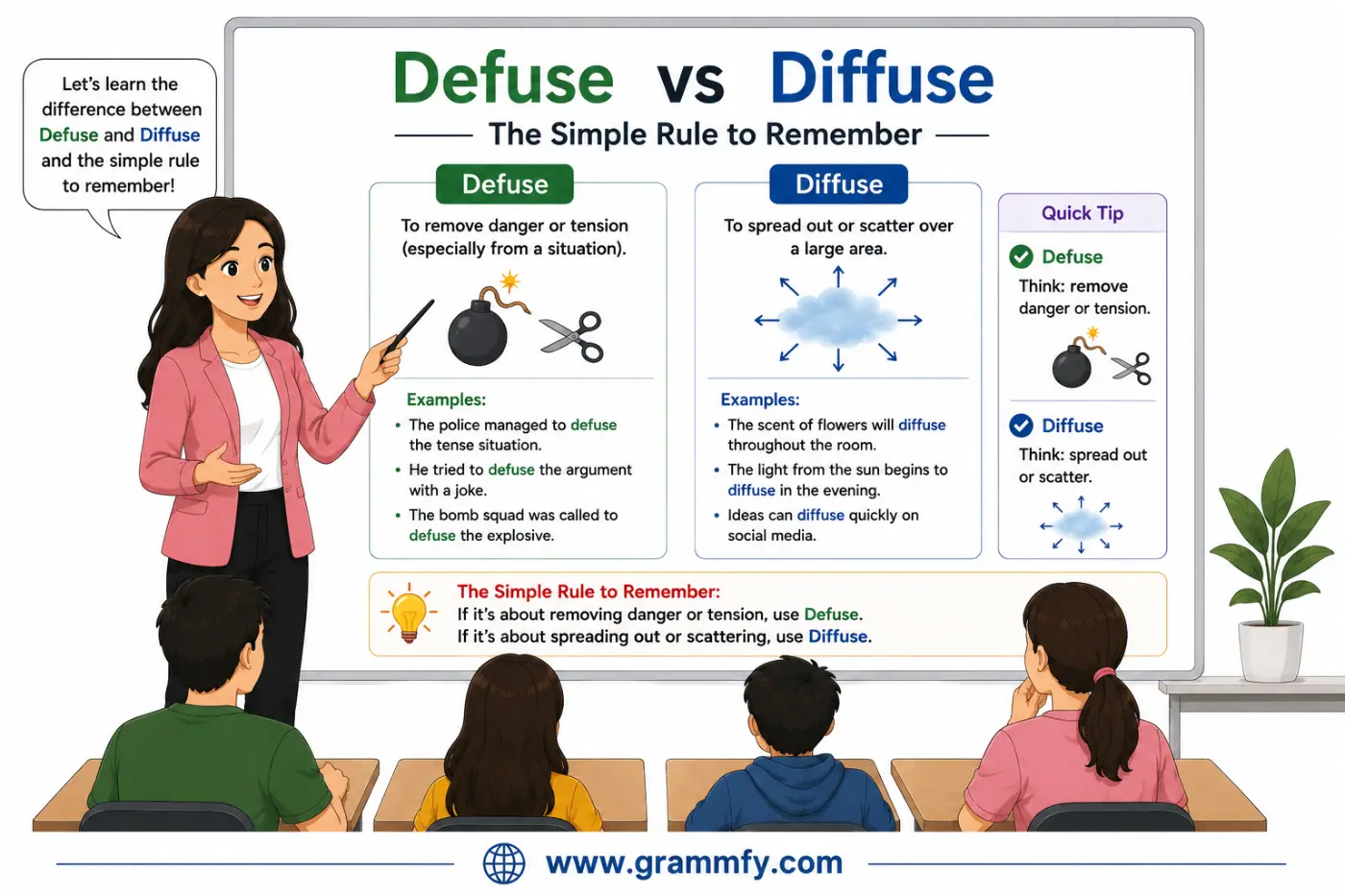
Defuse means to make a tense, dangerous, or difficult situation calmer or less harmful. Diffuse means to spread something over a wide area or among many people.
This guide explains defuse vs diffuse in plain English. You’ll learn where each word came from, what each one means, how to choose the right word, and which synonyms work best in different situations.
Still unsure about similar English words? Our guide to [eminent vs imminent] can help.
What Does “Defuse vs Diffuse” Mean?
Although these two words look and sound similar, they are not interchangeable.
| Word | Simple Meaning | Easy Memory Trick |
|---|---|---|
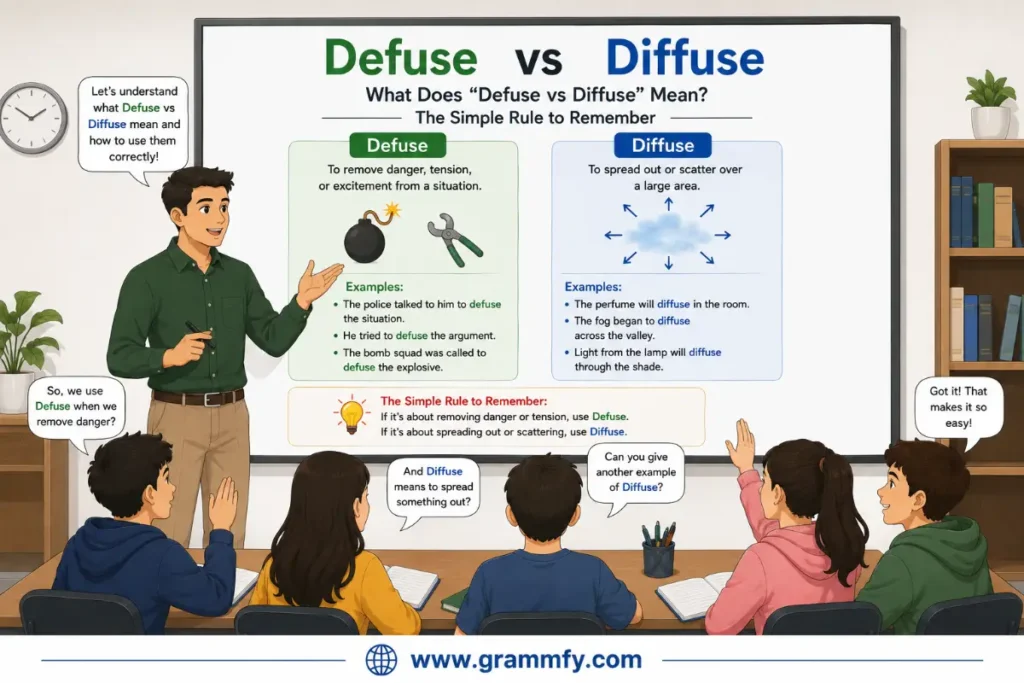
| Defuse | To remove danger or reduce tension | Think of removing the fuse from a bomb |
| Diffuse | To spread or scatter | Think of perfume spreading through a room |
Quick Examples
- The manager defused the argument before it became a fight.
- Sunlight became diffused by the morning fog.
- Good leadership can defuse conflict.
- News can diffuse quickly through social media.
One word reduces danger. The other spreads something around.
Word Origin and Plain-English Meaning
Many articles simply tell you which word is correct. Knowing where each word came from makes them much easier to remember.
Where Does “Defuse” Come From?
The word defuse first referred to removing the fuse from an explosive device.
Imagine an old bomb with a burning fuse. Taking away that fuse stopped the explosion. Over time, people started using the word for situations that weren’t physical bombs.
Today, defuse often means:
- calm an angry person
- reduce conflict
- prevent trouble
- stop a crisis from getting worse
- make something less dangerous
Plain-English Definition
Defuse = make danger, stress, or conflict smaller.
Examples
- She defused the disagreement with a joke.
- Police worked to defuse the situation peacefully.
- Taking a short break helped defuse everyone’s frustration.
Where Does “Diffuse” Come From?
The word diffuse comes from the Latin word diffundere, meaning “to pour out” or “spread.”
Instead of removing danger, diffuse describes something moving outward until it covers a larger space.
It can describe:
- light
- heat
- gas
- smells
- information
- ideas
- responsibility
- emotions
Plain-English Definition
Diffuse = spread something over a larger area.
Examples
- The scent of coffee diffused through the kitchen.
- Clouds diffused the sunlight.
- Knowledge diffused across the industry.
- The company wants to diffuse new technology worldwide.
The Biggest Difference Between “Defuse vs Diffuse”
Think about the action each word describes.
Defuse changes the level of danger.
Diffuse changes the area something covers.
For example:
- The teacher defused the classroom conflict.
- The loud laughter diffused throughout the hallway.
The first sentence is about reducing tension.
The second is about spreading sound.
An Easy Memory Trick “Defuse vs Diffuse”
Still unsure which word to choose?
Try this.
Defuse
Think:
Bomb → Fuse → Remove it
Removing the fuse makes something safer.
So defuse means:
- calm
- reduce danger
- prevent conflict
- ease tension
Diffuse
Think:
Fog spreads everywhere.
Fog doesn’t calm anything.
It spreads.
So diffuse means:
- spread
- scatter
- distribute
- disperse
Can They Ever Mean the Same Thing “Defuse vs Diffuse”?
Almost never.
People confuse these words because they sound similar.
Compare these sentences:
✔ The negotiator defused the crisis.
✔ Smoke diffused throughout the building.
Now switch them.
✘ The negotiator diffused the crisis.
✘ Smoke defused throughout the building.
Both sound awkward because the meanings don’t match.
Master Synonym List 0f “Defuse vs Diffuse”
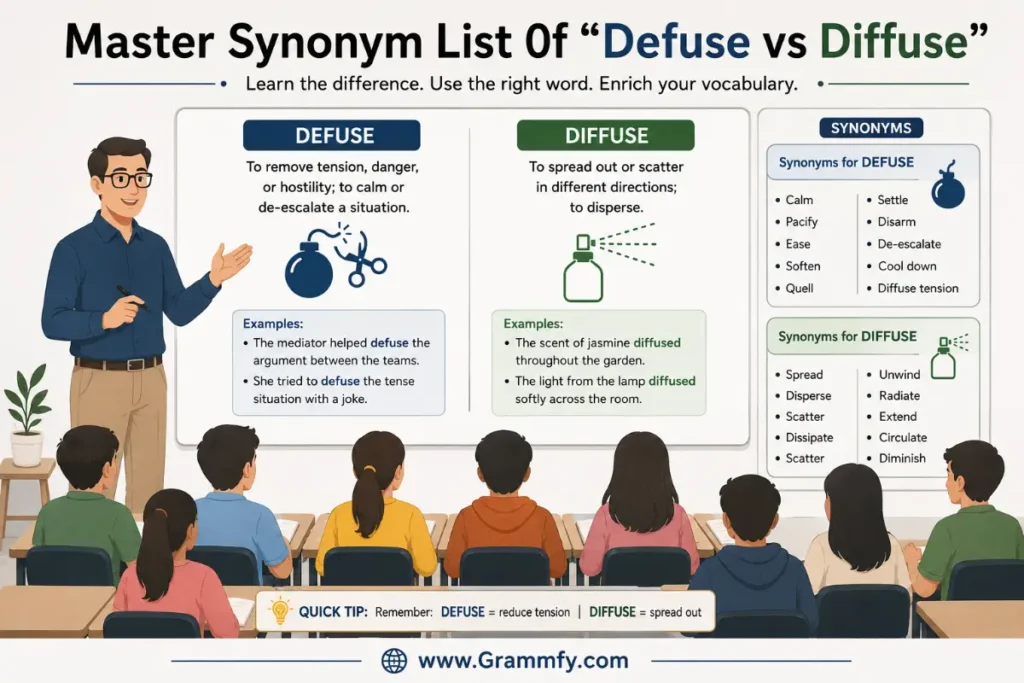
Many online guides stop after listing five or six synonyms. In real writing, you need options that fit different situations.
The tables below group synonyms by tone so you can quickly find the best choice.
Defuse Synonyms
Simple and Everyday Words
| Word | Meaning | Tone | Example |
|---|---|---|---|
| Calm | Make less upset | Everyday | She calmed the child. |
| Ease | Make less severe | Everyday | A smile eased the tension. |
| Relax | Make less stressed | Casual | Music relaxed everyone. |
| Settle | Bring back to normal | Everyday | They settled the dispute. |
| Quiet | Reduce noise or conflict | Everyday | The teacher quieted the class. |
| Cool down | Reduce anger | Casual | Let’s cool things down. |
Formal Synonyms
| Word | Meaning | Tone | Example |
|---|---|---|---|
| Mitigate | Make less severe | Formal | New rules mitigated the risk. |
| Resolve | Find a solution | Formal | The committee resolved the conflict. |
| Pacify | Calm someone angry | Formal | Officials pacified the crowd. |
| Neutralize | Remove harmful effects | Formal | The team neutralized the threat. |
| Disarm | Remove hostility | Formal | Humor disarmed the audience. |
Casual and Slang Alternatives
| Word | Meaning | Tone | Example |
|---|---|---|---|
| Chill | Calm down | Slang | Everyone needs to chill. |
| Tone down | Make less intense | Casual | Tone down your comments. |
| Cool off | Become calmer | Casual | Let’s cool off first. |
| Patch up | Repair a relationship | Casual | They patched things up. |
| Fix | Solve a problem | Casual | We fixed the issue quickly. |
| Work out | Solve successfully | Casual | They worked everything out. |
Diffuse Synonyms
Simple and Everyday Words
| Word | Meaning | Tone | Example |
|---|---|---|---|
| Spread | Move over an area | Everyday | The smell spread quickly. |
| Scatter | Go in many directions | Everyday | Leaves scattered across the yard. |
| Disperse | Move apart | Everyday | The crowd dispersed after the game. |
| Travel | Move from place to place | Everyday | News traveled fast. |
| Fill | Occupy space | Everyday | Music filled the room. |
Formal Synonyms
| Word | Meaning | Tone | Example |
|---|---|---|---|
| Disseminate | Spread information | Formal | Researchers disseminated the findings. |
| Circulate | Pass among many people | Formal | The memo circulated widely. |
| Distribute | Give or spread | Formal | Volunteers distributed supplies. |
| Radiate | Spread outward | Formal | Heat radiated from the fireplace. |
| Emit | Give off | Formal | The lamp emitted soft light. |
| Permeate | Spread through completely | Formal | Optimism permeated the office. |
Casual Alternatives
| Word | Meaning | Tone | Example |
|---|---|---|---|
| Get around | Become widely known | Casual | The rumor got around fast. |
| Go around | Spread among people | Casual | The flu went around school. |
| Pass around | Share with many people | Casual | They passed around the photos. |
| Reach | Arrive widely | Casual | The message reached thousands. |
| Fan out | Spread outward | Casual | The search teams fanned out. |
Synonyms by Intensity (Mild → Strong)
Choosing the right synonym often depends on how strong you want your sentence to sound.
For Defuse
| Intensity | Word | Typical Use |
|---|---|---|
| Very Mild | Calm | Everyday conversations |
| Mild | Ease | Small worries |
| Mild | Soften | Gentle disagreements |
| Medium | Settle | Arguments or disputes |
| Medium | Smooth over | Social situations |
| Medium | Resolve | Workplace issues |
| Strong | Mitigate | Serious risks |
| Strong | Neutralize | Threats or dangers |
| Very Strong | Pacify | Angry crowds or major conflict |
| Very Strong | De-escalate | Emergencies and crises |
For Diffuse
| Intensity | Word | Typical Use |
|---|---|---|
| Very Mild | Spread | General writing |
| Mild | Extend | Physical movement |
| Mild | Flow | Liquids and gases |
| Medium | Scatter | Objects moving apart |
| Medium | Disperse | Crowds, smoke, particles |
| Medium | Circulate | Information |
| Strong | Disseminate | Research and education |
| Strong | Propagate | Ideas and beliefs |
| Very Strong | Permeate | Completely fills something |
| Very Strong | Radiate | Energy or heat spreading |
Synonyms by Part of Speech “Defuse vs Diffuse”
Understanding grammar helps you choose the correct word naturally.
Defuse
Verb
- calm
- ease
- settle
- soften
- resolve
- mitigate
- alleviate
- pacify
- neutralize
- reconcile
- de-escalate
- disarm
- smooth over
- fix
- work out
Related Nouns
- peace
- resolution
- settlement
- reconciliation
- mediation
- compromise
- relief
- mitigation
- de-escalation
- calmness
Related Adjectives
- calm
- peaceful
- resolved
- stable
- controlled
- manageable
- reconciled
- neutralized
Diffuse
Verb
- spread
- scatter
- disperse
- distribute
- disseminate
- circulate
- propagate
- radiate
- permeate
- emit
- extend
- flow
- broadcast
- reach
- fan out
Related Nouns
- distribution
- dispersion
- circulation
- dissemination
- spread
- propagation
- radiation
- emission
- diffusion
- expansion
Related Adjectives
- widespread
- scattered
- dispersed
- distributed
- broad
- extensive
- far-reaching
- diffused
US vs. UK Usage: Is There Any Difference “Defuse vs Diffuse”?
Unlike some English words that change spelling between American and British English, defuse and diffuse are spelled the same in both countries.
The meanings also stay the same.
| Word | US English | UK English | Notes |
|---|---|---|---|
| Defuse | ✅ Common | ✅ Common | Used for reducing danger, conflict, or tension |
| Diffuse | ✅ Common | ✅ Common | Used for spreading light, ideas, smells, and more |
The only small difference is preference in certain industries.
- British news reports often use defuse tensions when covering politics or diplomacy.
- American writers may say de-escalate the situation more often in business or law enforcement contexts.
- Scientific writing in both countries commonly uses diffuse or diffusion when discussing gases, liquids, heat, or light.
No matter where you’re writing, the meanings do not change.
Which Word Should You Use in Different Situations “Defuse vs Diffuse”?
Choosing the right word isn’t just about knowing the definition. It’s also about matching the tone and purpose of your writing.
Best Word for a Resume
A resume should sound professional and show results.
Instead of writing:
Helped solve customer complaints.
You could write:
Defused difficult customer situations while maintaining positive client relationships.
Other strong resume alternatives include:
- resolved
- mitigated
- reconciled
- de-escalated
- neutralized
Resume Example
Successfully defused customer concerns, improving satisfaction scores by 18%.
Avoid using diffuse unless your work actually involved spreading information, technology, or materials.
Best Word for an Essay “Defuse vs Diffuse”
Essays often require precise language.
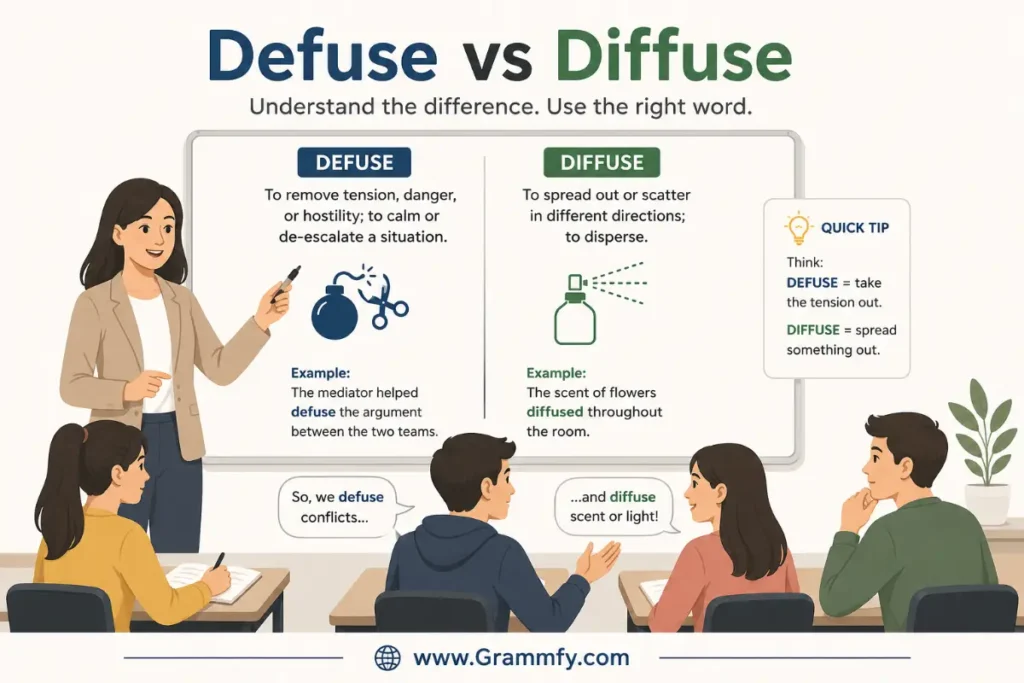
Use defuse when discussing:
- conflict
- arguments
- politics
- diplomacy
- emotional tension
Example:
The peace agreement helped defuse tensions between neighboring countries.
Use diffuse when discussing:
- light
- science
- ideas
- culture
- technology
- information
Example:
The invention gradually diffused throughout Europe.
Best Word for an Email “Defuse vs Diffuse”
Professional emails should be clear and natural.
Good examples:
I’d like to defuse any misunderstanding before our meeting.
Let’s discuss this early so we can defuse the issue.
If you’re sharing information:
Please diffuse this update to all department managers.
Even better in business writing:
Please distribute this update to all department managers.
In many workplace emails, distribute sounds more natural than diffuse.
Best Word for Text Messages “Defuse vs Diffuse”
People rarely use either word in casual texting.
Instead they usually write:
defuse:
- calm things down
- fix it
- smooth things over
- work it out
diffuse:
- spread
- send around
- pass along
- share
Example:
Let’s calm things down before anyone gets upset.
That sounds much more natural than:
Let’s defuse the interpersonal conflict.
Best Word for Speaking “Defuse vs Diffuse”
In everyday conversation, simple words often sound better.
Instead of saying:
We need to mitigate the disagreement.
Most people say:
We need to calm things down.
Likewise:
Instead of:
The fragrance diffused throughout the house.
People often say:
The smell spread through the house.
Simple language usually sounds friendlier.
Real-Life Example Sentences
Seeing words in real situations is one of the fastest ways to remember them.
Using Defuse
- The teacher defused the argument before it interrupted the lesson.
- A sincere apology helped defuse the tension.
- Security officers quickly defused the situation.
- Humor can sometimes defuse an awkward conversation.
- The manager stayed calm and defused the complaint.
- Talking openly helped defuse months of frustration.
Using Diffuse
- Morning sunlight diffused through the curtains.
- The smell of fresh bread diffused across the bakery.
- The company’s new ideas slowly diffused through the market.
- Heat diffused from the fireplace into every room.
- The announcement diffused rapidly across social media.
- Blue light became diffused by the frosted glass.
Close-Synonym Comparisons
Understanding similar words helps you choose the most accurate one.
Defuse vs Resolve
Although these words are related, they are not identical.
| Defuse | Resolve |
|---|---|
| Makes a situation calmer | Completely solves the problem |
| May only reduce tension | Ends the issue |
| Often temporary | Usually permanent |
Example:
The manager defused the argument by separating the employees.
Later, HR resolved the conflict through mediation.
Think of defuse as the first step.
Resolve is the final step.
Diffuse vs Disperse
These words both involve spreading, but they focus on different actions.
| Diffuse | Disperse |
|---|---|
| Gradual spreading | Moving apart quickly |
| Often fills an area | Often separates people or objects |
| Common with light, smells, ideas | Common with crowds, smoke, animals |
Examples:
The perfume diffused throughout the room.
Police asked the crowd to disperse.
Diffuse vs Disseminate
These words overlap when talking about information.
| Diffuse | Disseminate |
|---|---|
| General spreading | Intentional spreading |
| Natural or planned | Usually planned |
| Works with light, heat, ideas | Mostly information or research |
Example:
The internet helped diffuse new trends.
Scientists disseminated their findings through journals.
Common Mistakes to Avoid
Many writing mistakes happen because the two words sound alike.
Here are the most common errors.
Mistake 1
❌ The manager diffused the conflict.
✅ The manager defused the conflict.
Conflict becomes calmer.
It doesn’t spread.
Mistake 2
❌ The sunlight defused through the clouds.
✅ The sunlight diffused through the clouds.
Light spreads.
It doesn’t become calmer.
Mistake 3
❌ We need to diffuse the argument.
✅ We need to defuse the argument.
Mistake 4
❌ Smoke defused across the room.
✅ Smoke diffused across the room.
Mistake 5
Using diffuse because it sounds more formal.
Many writers accidentally choose the longer-looking word.
Always ask yourself:
Am I reducing danger?
Use defuse.
Am I spreading something?
Use diffuse.
Antonyms
Knowing opposites makes meanings even clearer.
Antonyms of Defuse
- worsen
- inflame
- intensify
- provoke
- escalate
- aggravate
- stir up
- trigger
Example:
Instead of defusing the disagreement, he escalated it.
Antonyms of Diffuse
- collect
- gather
- concentrate
- centralize
- condense
- unite
- focus
- cluster
Example:
The fog began to concentrate in the valley instead of spreading.
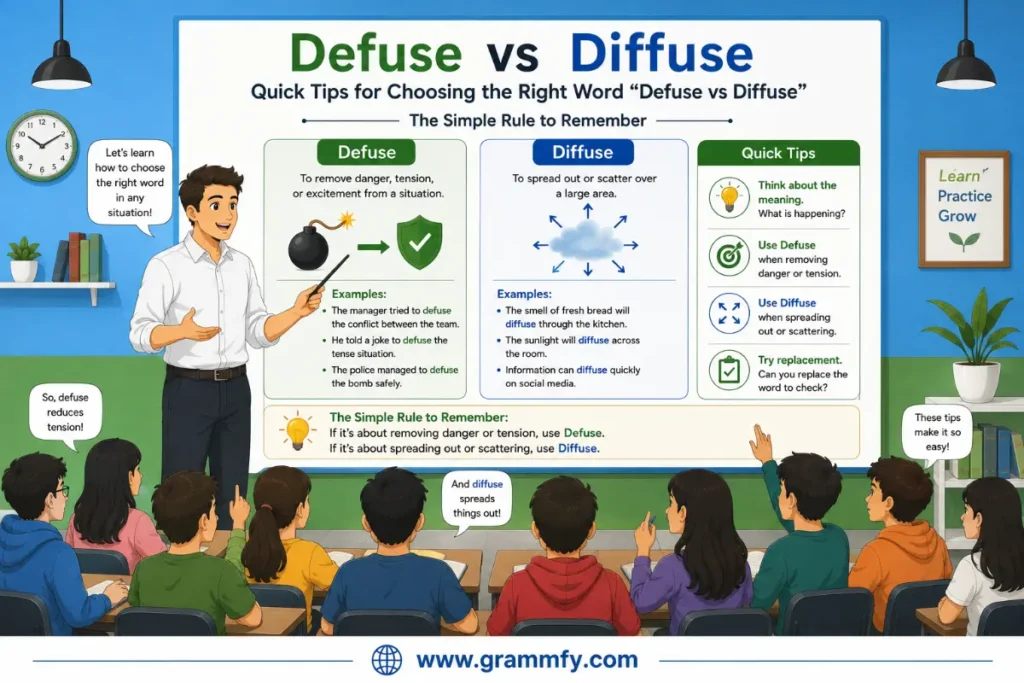
Quick Tips for Choosing the Right Word “Defuse vs Diffuse”
Keep these simple rules in mind whenever you’re writing.
- Defuse = remove danger or reduce tension.
- Diffuse = spread over an area.
- Think of a bomb when you see defuse.
- Think of perfume, light, smoke, or ideas when you see diffuse.
- In everyday writing, use simple alternatives if they sound more natural.
- Read the sentence aloud. If the action is “calm,” choose defuse. If the action is “spread,” choose diffuse.
- When writing professionally, choose the word that best matches the situation instead of the one that sounds more advanced.
Conclusion
Understanding defuse vs diffuse doesn’t have to be difficult. The key is remembering what each word does. Defuse is about reducing danger, conflict, or tension, while diffuse is about spreading something across an area, whether it’s light, information, heat, or even ideas. Once you connect defuse with removing a bomb’s fuse and diffuse with something spreading outward, the choice becomes much easier. Before you finish your next email, essay, report, or text message, take a second to ask yourself whether you’re calming a situation or describing something that spreads. That one quick question will help you choose the correct word with confidence every time.
Frequently Asked Questions
What is the difference between defuse vs diffuse?
Defuse means to reduce danger or calm a tense situation, while diffuse means to spread something over a wide area. They sound similar but have different meanings and should not be used interchangeably.
Which is correct: “defuse the situation” or “diffuse the situation”?
Defuse the situation is correct. You reduce or calm a tense situation rather than spread it.
What’s another way to say “defuse”?
Some common alternatives include calm, ease, resolve, mitigate, de-escalate, neutralize, and smooth over. The best choice depends on your context and tone.
Can diffuse mean calm down?
No. Diffuse does not mean to calm a person or reduce conflict. It refers to spreading something like light, heat, gas, information, or ideas.
Why do people confuse defuse vs diffuse?
People often mix them up because they have similar spellings and nearly identical pronunciation. Their meanings, however, are completely different.
Is defuse a formal word?
No. Defuse works well in both everyday conversation and formal writing. It’s common in news reports, business communication, and academic writing.
Is diffuse mostly used in science?
No. While it’s common in science, diffuse is also used in everyday English to describe light, smells, sounds, news, trends, and ideas spreading naturally.
