
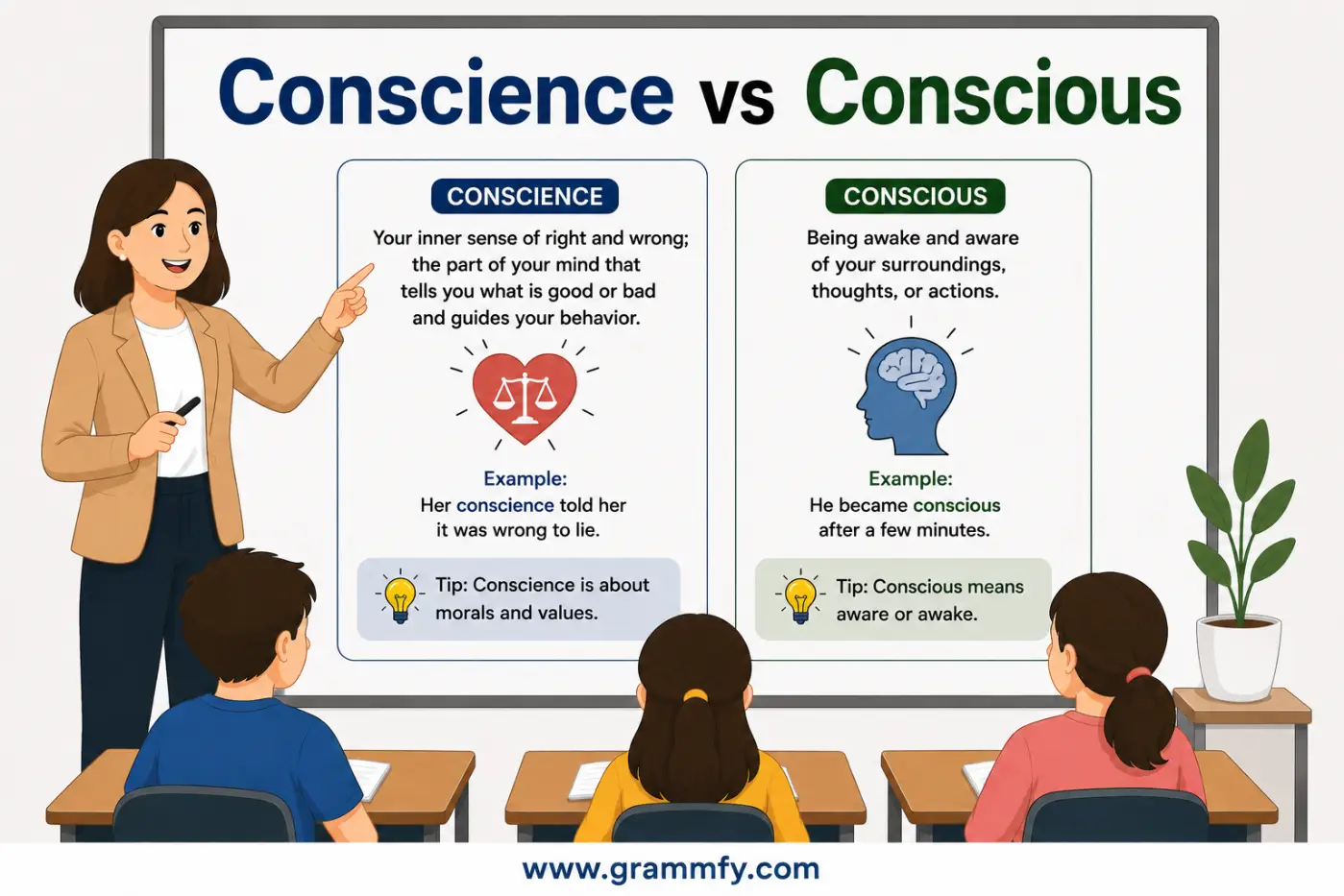
You’re writing an email, finishing a school essay, updating your resume, or sending a quick text. Then you stop and wonder which word is right: conscience vs conscious. They look similar, sound alike, and often confuse even skilled writers.
If you’ve ever typed one, deleted it, and tried the other, you’re not alone. These two words have different meanings, even though they’re only a few letters apart. Once you understand what each one means, choosing the right word becomes much easier.
Quick Answer:
Conscience is your inner sense of right and wrong. Conscious means awake, aware, or noticing what’s happening around you.
In this guide, you’ll learn the difference between conscience vs conscious, where each word came from, when to use them, their best synonyms, common mistakes, and plenty of real-world examples.
Another commonly confused pair worth knowing is [defuse vs diffuse].
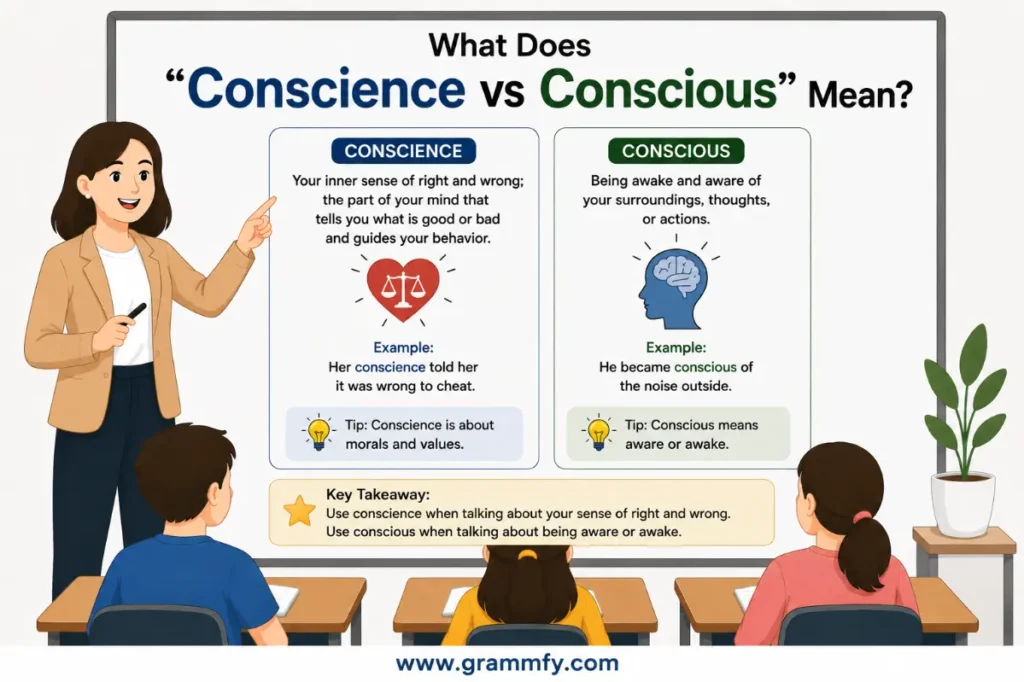
What Does “Conscience vs Conscious” Mean?
Although these words share similar spelling and pronunciation, they describe completely different ideas.
| Word | Simple Meaning | Easy Memory Trick |
|---|---|---|
| Conscience | Your inner voice that tells you right from wrong | Think of your moral compass |
| Conscious | Awake, aware, or alert | Think of opening your eyes |
Quick Examples
- His conscience told him to return the lost wallet.
- She remained conscious after the accident.
- My conscience wouldn’t let me lie.
- Be conscious of your surroundings while walking.
One word is about morality.
The other is about awareness.
Word Origin and Plain-English Meaning
Knowing where these words came from makes them much easier to remember.
Where Does “Conscience” Come From?
The word conscience comes from the Latin word conscientia, meaning shared knowledge or knowing within yourself.
Over time, the meaning changed to describe a person’s inner feeling that helps them judge whether something is right or wrong.
Today, conscience usually refers to your moral judgment.
It reminds you to:
- tell the truth
- keep promises
- help others
- admit mistakes
- avoid doing wrong
Plain-English Definition
Conscience = your inner voice that guides your choices.
Examples
- His conscience made him apologize.
- She followed her conscience instead of the crowd.
- A guilty conscience kept him awake all night.
Where Does “Conscious” Come From?
The word conscious comes from the Latin word conscius, meaning knowing or aware.
Unlike conscience, this word has nothing to do with morality.
Instead, it describes someone who is:
- awake
- alert
- aware
- paying attention
- able to think and respond
Plain-English Definition
Conscious = awake or aware of what’s happening.
Examples
- He stayed conscious during the entire trip.
- Drivers should remain conscious of road conditions.
- She became conscious of the noise outside.
The Biggest Difference of “Conscience vs Conscious”
The easiest way to remember these words is to ask one question.
Am I talking about right and wrong?
Use conscience.
Am I talking about awareness or being awake?
Use conscious.
For example:
- My conscience told me not to cheat.
- I became conscious that someone was calling my name.
The first sentence is about morals.
The second is about awareness.
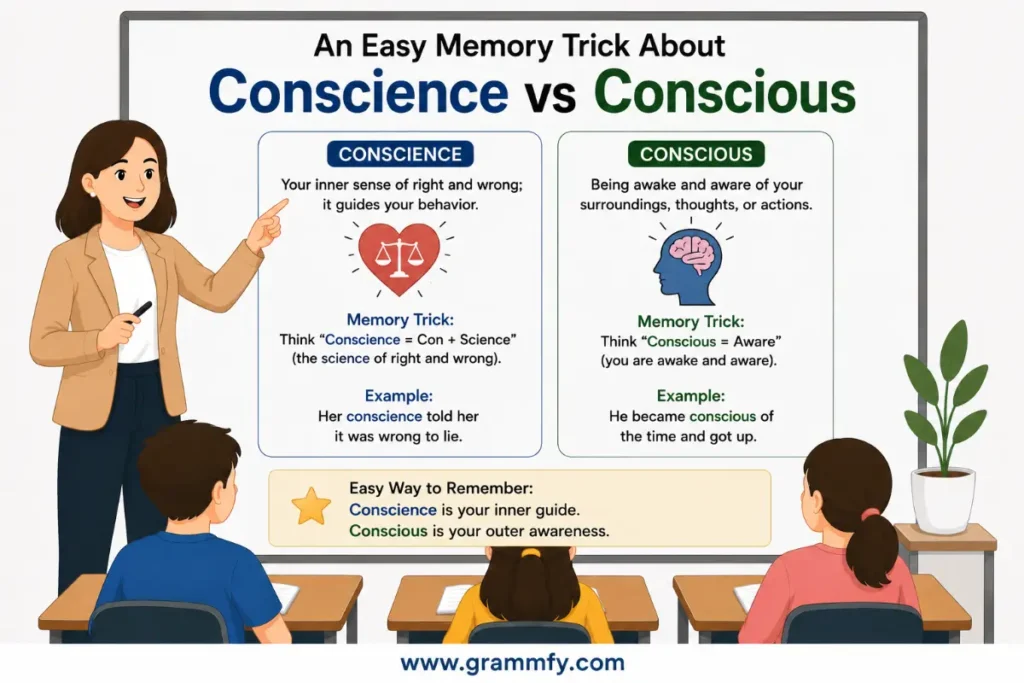
An Easy Memory Trick About “Conscience vs Conscious”
If you still mix them up, try these simple tricks.
Conscience
Think:
Science of doing what’s right.
While this isn’t the true origin, it helps many people remember that conscience guides your decisions.
Another memory trick:
Your conscience speaks inside your mind.
Conscious
Think:
Eyes open = conscious.
If you’re awake, alert, or aware, you’re conscious.
Imagine someone waking up after sleeping.
They’re now conscious.
What’s the Difference Between “Conscience vs Conscious”
Almost never.
These words belong in different situations.
Compare these sentences.
✔ My conscience wouldn’t let me copy the answers.
✔ She remained conscious after fainting.
Now switch them.
✘ My conscious wouldn’t let me copy the answers.
✘ She remained conscience after fainting.
Both sentences sound incorrect because the meanings don’t fit.
Master Synonym List
A strong vocabulary gives you more ways to express yourself. The tables below group synonyms by tone and usage.
Conscience Synonyms
Simple and Everyday Words
| Word | Meaning | Tone | Example |
|---|---|---|---|
| Morals | Personal beliefs about right and wrong | Everyday | His morals guided his decision. |
| Values | Principles you believe in | Everyday | Family values mattered to her. |
| Ethics | Standards of right behavior | Everyday | Ethics should guide business. |
| Principles | Basic moral rules | Everyday | He stood by his principles. |
| Honor | Strong moral character | Everyday | She acted with honor. |
| Integrity | Doing the right thing | Everyday | Integrity builds trust. |
| Decency | Fair and kind behavior | Everyday | Common decency matters. |
| Fairness | Treating people equally | Everyday | Fairness was important. |
Formal Synonyms
| Word | Meaning | Tone | Example |
|---|---|---|---|
| Moral compass | Internal guide for right and wrong | Formal | His moral compass stayed strong. |
| Ethical judgment | Ability to judge morally | Formal | Ethical judgment is essential. |
| Moral sense | Feeling of right and wrong | Formal | She has a strong moral sense. |
| Rectitude | Moral correctness | Formal | Rectitude earned respect. |
| Virtue | Moral excellence | Formal | Honesty is a virtue. |
| Probity | Complete honesty | Formal | The judge was known for probity. |
| Righteousness | Acting morally | Formal | Righteousness shaped his choices. |
| Scruples | Moral concerns | Formal | Her scruples prevented cheating. |
Casual and Slang Alternatives
| Word | Meaning | Tone | Example |
|---|---|---|---|
| Heart | Inner feelings | Casual | Follow your heart. |
| Gut feeling | Strong inner instinct | Casual | My gut feeling said no. |
| Good side | Better nature | Casual | Show your good side. |
| Better judgment | Sensible thinking | Casual | Use your better judgment. |
| Inner voice | Personal moral guide | Casual | Listen to your inner voice. |
| Do the right thing | Moral choice | Casual | Just do the right thing. |
Conscious Synonyms
Simple and Everyday Words
| Word | Meaning | Tone | Example |
|---|---|---|---|
| Aware | Knowing what’s happening | Everyday | Stay aware of traffic. |
| Awake | Not sleeping | Everyday | He’s finally awake. |
| Alert | Paying attention | Everyday | Stay alert while driving. |
| Attentive | Carefully watching | Everyday | She remained attentive. |
| Mindful | Paying close attention | Everyday | Be mindful of others. |
| Observant | Notices details | Everyday | He’s very observant. |
| Watchful | Looking carefully | Everyday | Guards stayed watchful. |
Formal Synonyms
| Word | Meaning | Tone | Example |
|---|---|---|---|
| Cognizant | Fully aware | Formal | She was cognizant of the risks. |
| Perceptive | Quick to notice | Formal | A perceptive reader spotted the mistake. |
| Responsive | Able to react | Formal | The patient remained responsive. |
| Sentient | Able to feel or perceive | Formal | Humans are sentient beings. |
| Self-aware | Understands oneself | Formal | Self-aware leaders improve faster. |
| Conscious-minded | Intentionally aware | Formal | He made a conscious-minded effort. |
| Deliberate | Done intentionally | Formal | It was a deliberate choice. |
| Intentional | Done with purpose | Formal | Their intentional actions helped. |
Casual Alternatives
| Word | Meaning | Tone | Example |
|---|---|---|---|
| Tuned in | Paying attention | Casual | Stay tuned in during class. |
| On the ball | Alert and ready | Casual | She’s always on the ball. |
| Wide awake | Fully awake | Casual | I’m wide awake now. |
| Paying attention | Focused | Casual | Are you paying attention? |
| Switched on | Quick-thinking | Casual | He’s really switched on. |
Synonyms by Intensity (Mild → Strong)
Some synonyms express a lighter idea, while others sound much stronger.
For Conscience
| Intensity | Word | Typical Use |
|---|---|---|
| Very Mild | Values | Everyday conversations |
| Mild | Morals | General writing |
| Mild | Ethics | School and work |
| Medium | Principles | Essays and speeches |
| Medium | Integrity | Professional writing |
| Strong | Moral compass | Leadership and character |
| Strong | Virtue | Literature |
| Very Strong | Rectitude | Academic writing |
| Very Strong | Probity | Legal or formal contexts |
For Conscious
| Intensity | Word | Typical Use |
|---|---|---|
| Very Mild | Awake | Everyday speech |
| Mild | Aware | Daily writing |
| Mild | Alert | Safety situations |
| Medium | Mindful | Personal growth |
| Medium | Observant | Descriptive writing |
| Strong | Cognizant | Formal writing |
| Strong | Perceptive | Academic or literary writing |
| Very Strong | Sentient | Science or philosophy |
| Very Strong | Self-aware | Psychology and leadership |
Synonyms by Part of Speech
Because conscience is a noun and conscious is an adjective, their related words differ.
Conscience
Related Nouns
- morals
- ethics
- integrity
- values
- principles
- virtue
- honor
- fairness
- decency
- scruples
- probity
- righteousness
- moral compass
- ethical judgment
- moral sense
Related Adjectives
- moral
- ethical
- honest
- principled
- honorable
- fair
- trustworthy
- upright
Conscious
Related Adjectives
- aware
- awake
- alert
- attentive
- observant
- mindful
- perceptive
- responsive
- cognizant
- intentional
- deliberate
- self-aware
- sentient
Related Nouns
- awareness
- consciousness
- attention
- mindfulness
- perception
- alertness
- wakefulness
- cognition
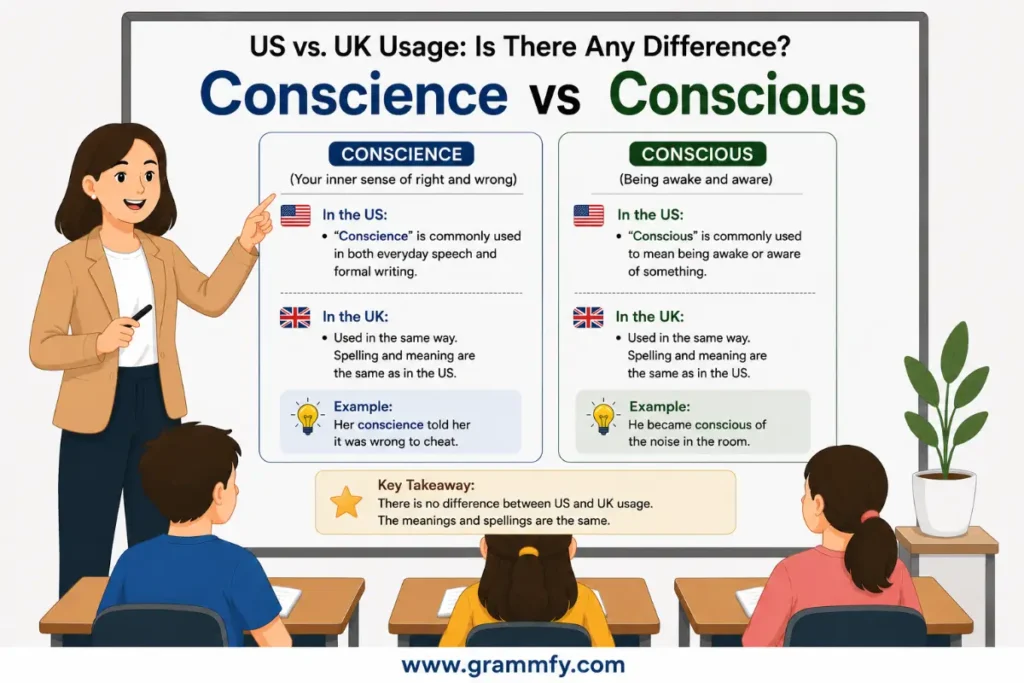
US vs. UK Usage: Is There Any Difference?
The good news is that conscience and conscious are spelled the same in both American and British English.
Their meanings also stay exactly the same.
| Word | US English | UK English | Notes |
|---|---|---|---|
| Conscience | ✅ Common | ✅ Common | Refers to your sense of right and wrong |
| Conscious | ✅ Common | ✅ Common | Means awake or aware |
You may notice small style differences between US and UK writers, but they don’t change the meaning.
For example:
- American writers often use self-aware in business and personal development.
- British writers may use mindful or aware a little more often in everyday writing.
- Medical professionals in both countries commonly use conscious when describing a patient’s condition.
Whether you’re writing for a US or UK audience, you can use both words with confidence.
Which Word Should You Use in Different Situations?
Knowing the meaning is only half the job. You also need to choose the word that fits your audience and purpose.
Best Word for a Resume
A resume should highlight your character, skills, and achievements.
Use conscience only if you’re describing honesty or ethical decision-making.
Example:
Demonstrated strong conscience by following company ethics and compliance standards.
However, words like integrity or ethical judgment often sound stronger on a resume.
Example:
Maintained high standards of integrity while handling confidential information.
Use conscious when discussing awareness, attention, or intentional actions.
Example:
Remained conscious of customer needs during every stage of the sales process.
Best Word for an Essay
Academic writing often uses both words.
Use conscience when discussing:
- ethics
- morality
- justice
- religion
- philosophy
- character
Example:
A person’s conscience often influences difficult moral decisions.
Use conscious when discussing:
- awareness
- psychology
- biology
- health
- perception
Example:
Humans are conscious of their surroundings and emotions.
Best Word for an Email
Business emails usually favor simple language.
Good examples:
I wanted to follow my conscience and let you know about the mistake.
Please remain conscious of tomorrow’s deadline.
Both sound natural and professional.
Best Word for Text Messages
In casual texting, people often replace these words with simpler expressions.
Instead of conscience, people say:
- do the right thing
- follow your heart
- trust your gut
Instead of conscious, people say:
- awake
- paying attention
- aware
Example:
Just follow your heart.
Example:
Stay aware when you’re driving.
These phrases sound more natural in everyday conversations.
Best Word for Speaking
When speaking, shorter words usually sound smoother.
Instead of saying:
My conscience encouraged honesty.
Most people simply say:
I knew it was the right thing to do.
Instead of:
Please remain conscious of your surroundings.
Many people naturally say:
Stay aware of what’s around you.
Simple language often communicates your message more clearly.
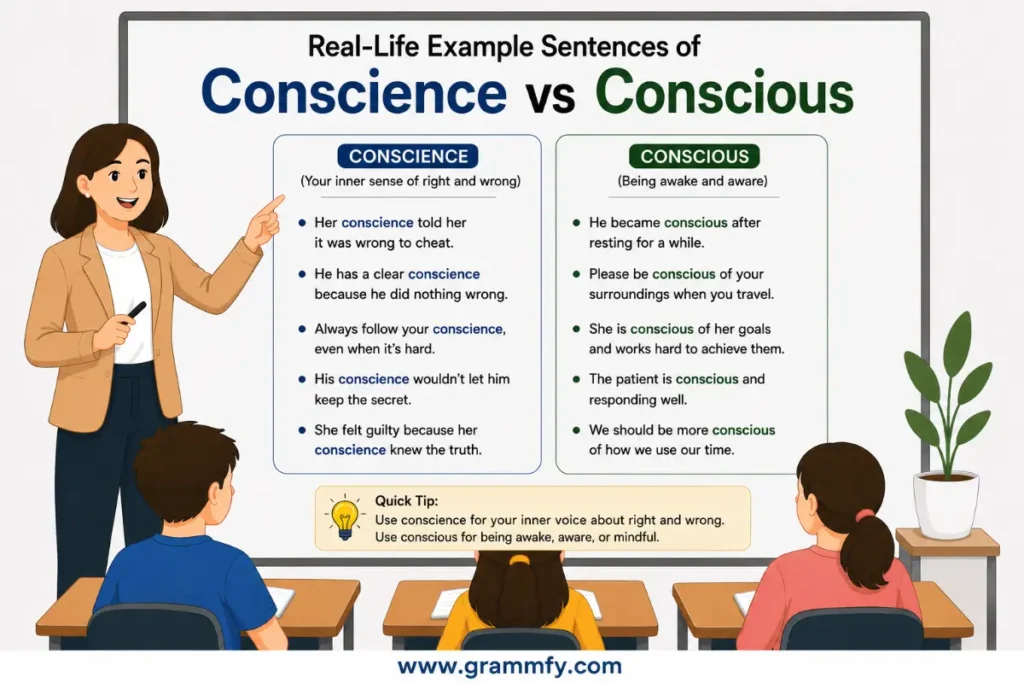
Real-Life Example Sentences of “Conscience vs Conscious”
Here are practical examples you can use as models.
- Her conscience wouldn’t let her keep the extra change.
- A guilty conscience made him admit the truth.
- He followed his conscience even when it was difficult.
- My conscience tells me to help people whenever I can.
- She acted according to her conscience, not public opinion.
- His conscience reminded him to apologize.
- The patient remained conscious after the surgery.
- Drivers should stay conscious of changing road conditions.
- She suddenly became conscious of everyone watching her.
- Try to stay conscious of your spending habits.
- The child was fully conscious during the examination.
- We should all be conscious of how our words affect others.
Close-Synonym Comparisons
Conscience vs Morals
These words are closely related but not identical.
| Conscience | Morals |
|---|---|
| Personal inner guide | General beliefs about right and wrong |
| Individual feeling | Shared values or standards |
| Often influences decisions | Often shaped by family or culture |
Example:
His conscience told him to confess.
His morals taught him that honesty matters.
Conscious vs Aware
Many people use these interchangeably, but there is a slight difference.
| Conscious | Aware |
|---|---|
| Can mean awake or aware | Means knowing something |
| Used in medicine and psychology | Used in everyday conversation |
| Broader meaning | More specific meaning |
Example:
The patient remained conscious after the accident.
I wasn’t aware of the schedule change.
Conscious vs Mindful
These words overlap but focus on different ideas.
| Conscious | Mindful |
|---|---|
| Simply aware | Carefully paying attention |
| General awareness | Intentional awareness |
| Neutral meaning | Often linked to kindness or focus |
Example:
Be conscious of the time.
Be mindful of other people’s feelings.
Common Mistakes to Avoid About “Conscience vs Conscious”
Many writers confuse these words because their spellings are so similar.
Mistake 1
❌ My conscious told me to apologize.
✅ My conscience told me to apologize.
Your inner moral guide is your conscience.
Mistake 2
❌ She lost her conscience after the accident.
✅ She lost consciousness after the accident.
People lose consciousness, not conscience.
Mistake 3
❌ Please be conscience of your language.
✅ Please be conscious of your language.
When you mean “aware,” choose conscious.
Mistake 4
❌ He has a guilty conscious.
✅ He has a guilty conscience.
This is one of the most common grammar mistakes.
Mistake 5
Using conscious whenever you mean something related to ethics.
Ask yourself:
Am I talking about right and wrong?
Choose conscience.
Am I talking about awareness?
Choose conscious.
Antonyms
Learning opposites helps reinforce the meaning.
Antonyms of Conscience
- dishonesty
- corruption
- immorality
- wrongdoing
- selfishness
- injustice
- deceit
Example:
Ignoring your conscience can lead to dishonest choices.
Antonyms of Conscious
- unconscious
- unaware
- asleep
- oblivious
- inattentive
- unresponsive
Example:
He was unconscious for several minutes after the fall.
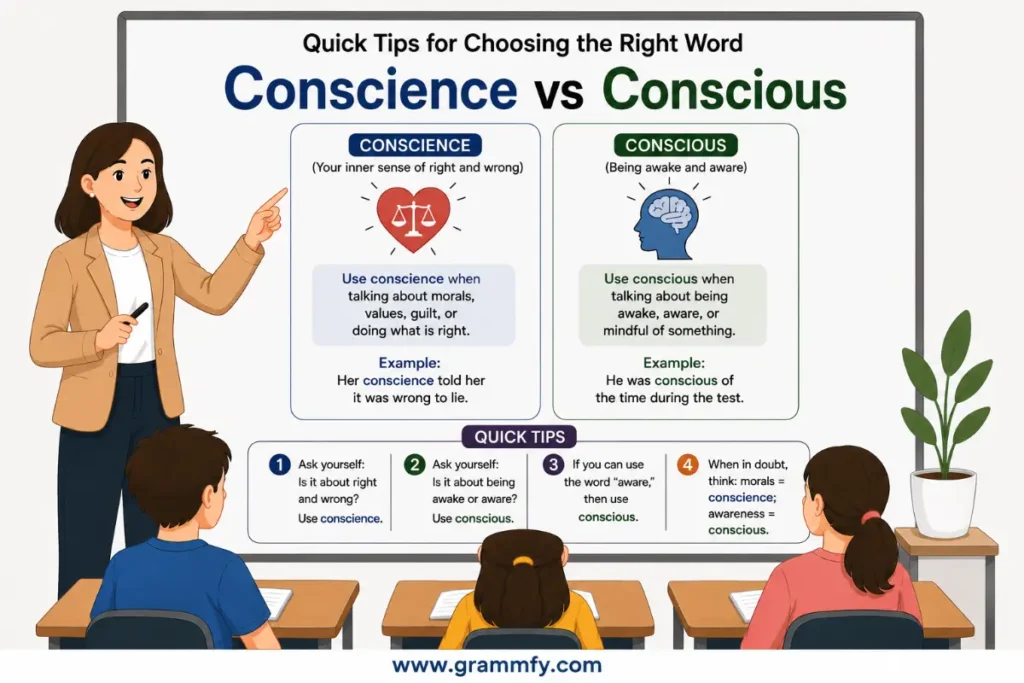
Quick Tips for Choosing the Right Word “Conscience vs Conscious”
Keep these easy rules in mind whenever you’re writing.
- Conscience is your inner sense of right and wrong.
- Conscious means awake, alert, or aware.
- Think of conscience whenever you’re making a moral decision.
- Think of conscious whenever you’re noticing something around you.
- If you’re talking about honesty, fairness, or ethics, choose conscience.
- If you’re talking about awareness, health, or attention, choose conscious.
- Read your sentence aloud. If you could replace the word with aware, use conscious. If you could replace it with moral sense, use conscience.
Conclusion
Understanding conscience vs conscious becomes much easier once you focus on the core difference. Conscience is your inner moral guide that helps you decide what is right or wrong, while conscious describes being awake, aware, or alert. Although the two words look and sound similar, they belong in very different situations. Before you use either one, ask yourself whether you’re talking about ethics or awareness. That quick check will help you choose the correct word every time. With a little practice, you’ll feel confident using both words in emails, essays, conversations, and professional writing.
Frequently Asked Questions
What is the difference between conscience vs conscious?
Conscience is your inner sense of right and wrong, while conscious means being awake or aware. They have different meanings and are not interchangeable.
Which is correct: “guilty conscience” or “guilty conscious”?
Guilty conscience is correct. The phrase refers to feeling guilty because your moral sense tells you you’ve done something wrong.
What’s another way to say conscience?
Some common alternatives include moral compass, integrity, ethics, principles, values, honor, and inner voice. The best choice depends on your sentence and tone.
Can conscious mean morally right?
No. Conscious relates to awareness or being awake, not to morality. If you’re talking about ethics, use conscience instead.
Why do people confuse conscience vs conscious?
People confuse conscience vs conscious because the words have similar spelling and pronunciation. Their meanings, however, are completely different.
Is conscious only used in medicine?
No. While doctors often use conscious to describe a patient’s condition, it’s also common in everyday English when talking about awareness, attention, and intentional actions.
How can I remember the difference quickly?
Remember that conscience contains the idea of your moral sense, while conscious is closely related to awareness. If the sentence is about right and wrong, choose conscience. If it’s about being aware, choose conscious.
