
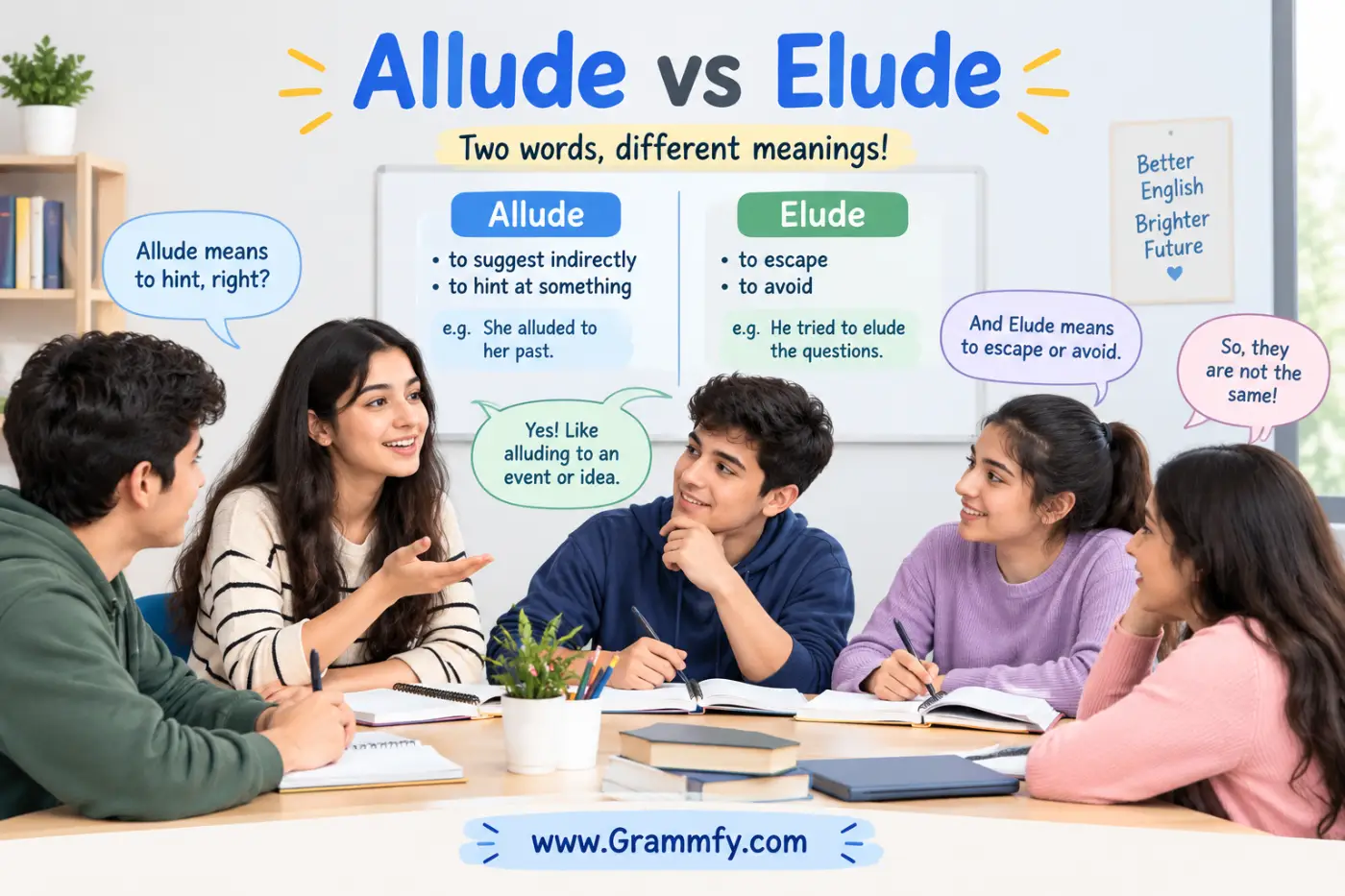
Writing an email, essay, resume, or text can bring up a tricky question: should you write allude vs elude? These words look and sound similar, but they have very different meanings. Using the wrong one can change your sentence completely.
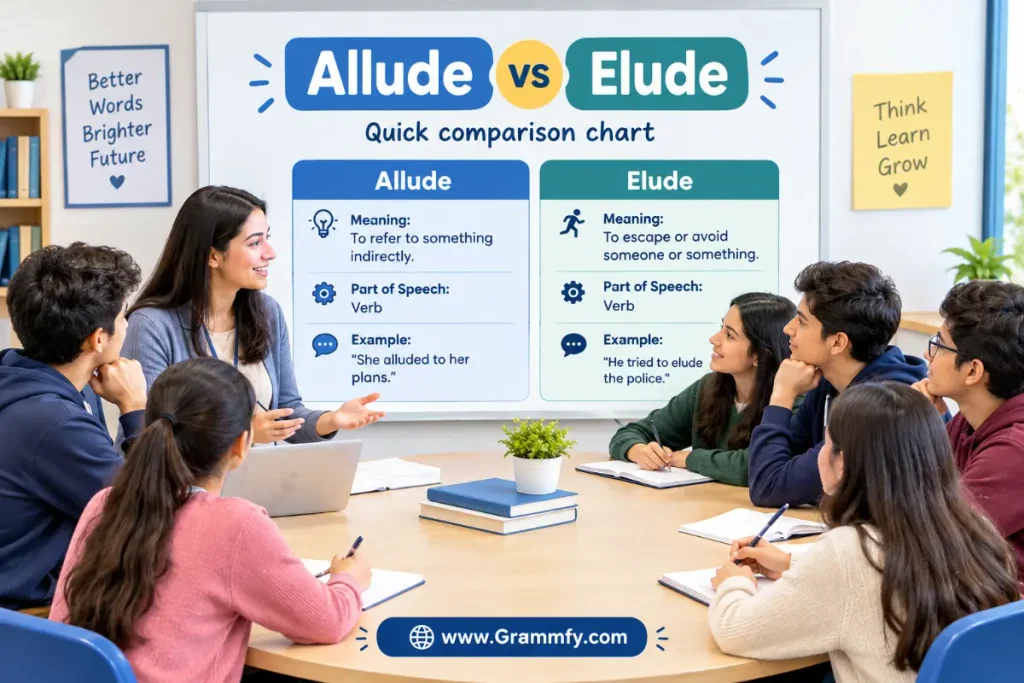
Allude means to refer to something indirectly, while elude means to escape, avoid, or remain difficult to understand or remember.
The confusion is easy to understand. Both words begin with “al-” or “el-” and contain the same letters in a different order. However, they describe two very different ideas: one involves reference, and the other involves escape or avoidance.
This guide explains the meanings, origins, synonyms, grammar, examples, common mistakes, and differences between these words. You’ll also learn which word works best in professional writing, academic essays, casual texts, and everyday speech.
Build stronger spelling skills with our guide to Choosing or Chosing.
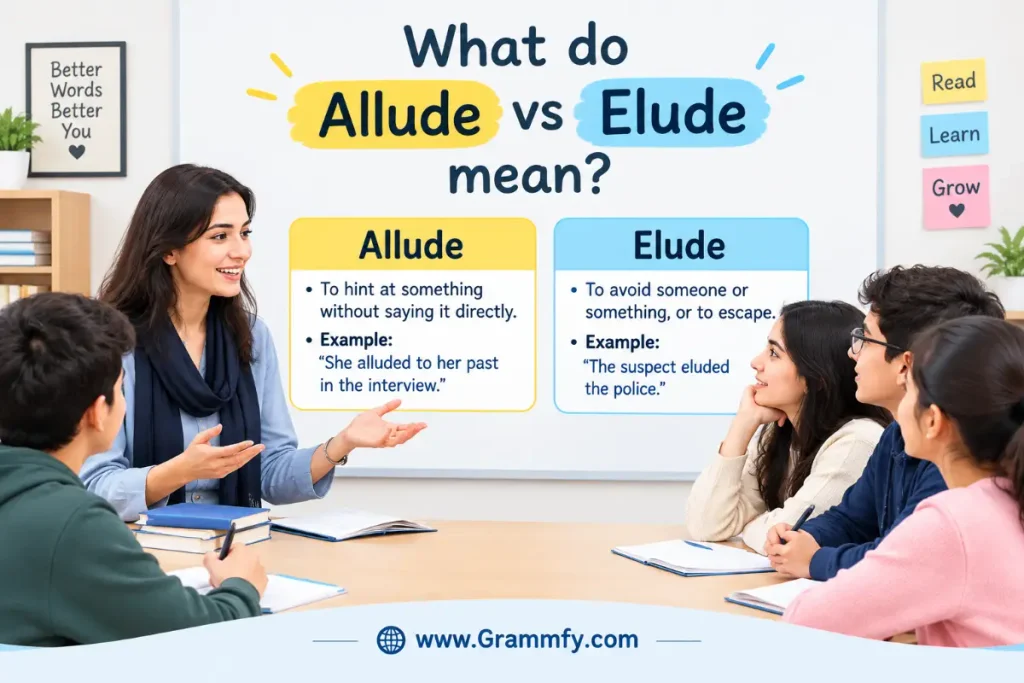
What do Allude vs Elude mean?
The simplest distinction is this:
- Allude = refer to something indirectly.
- Elude = escape from someone or something, or remain difficult to understand, find, or remember.
Allude
When you allude to something, you mention it without explaining it directly.
- The speaker alluded to a disagreement with her manager.
The speaker referred to the disagreement, but didn’t explain it clearly.
The usual structure is:
allude to + noun
Examples:
- He alluded to his previous experience.
- She alluded to a problem at work.
- The article alludes to an older tradition.
Elude
When something eludes you, it escapes you or remains beyond your ability to catch, find, understand, or remember it.
The police officer tried to catch the suspect, but he eluded them.
It can also describe an idea that is difficult to understand:
The meaning of the poem eluded me.
Here, eluded means that the meaning remained difficult for the speaker to understand.
Allude vs Elude: What’s the main difference?
The key difference is reference versus escape.
| Word | Basic meaning | Common structure | Example |
|---|---|---|---|
| Allude | Refer to something indirectly | allude to | She alluded to her past. |
| Elude | Escape, avoid, or remain difficult to grasp | elude someone | The answer eluded me. |
A quick memory trick:
Allude → alludes to an idea
Elude → escapes
Think of allude as pointing toward something without naming it directly.
Think of elude as something getting away from you.
Where do allude and elude come from?
Both words have roots in Latin, which helps explain why they look so similar.
The origin of “allude”
Allude comes from the Latin verb alludere, meaning to play with, make reference to, or hint at something. The word entered English through French and developed the modern sense of making an indirect reference.
The important idea is reference.
When you allude to something, you’re pointing toward it without giving a full explanation.
For example:
- The writer alludes to Greek mythology throughout the novel.
The writer doesn’t necessarily explain every myth. Instead, the text makes indirect references to them.
The origin of “elude”
Elude comes from the Latin eludere, meaning to escape, evade, or avoid. It developed into the English verb we use today for something that escapes capture or remains difficult to grasp.
The important idea is getting away.
For example:
- The criminal eluded the police.
The person escaped capture.
The meaning later expanded beyond physical escape. We can say that an answer, memory, opportunity, or solution eludes someone when it remains out of reach.
What does “allude” mean in plain English?
Allude means to mention or refer to something indirectly instead of stating it openly.
Suppose your friend says:
I’m not going to explain what happened at the party, but you know what I mean.
Your friend is alluding to an event.
The reference is indirect.
Allude often needs “to”
One of the most important grammar points is that allude is normally followed by to when you identify the thing being referenced.
Correct:
She alluded to the problem.
Incorrect:
She alluded the problem.
Correct:
The politician alluded to the controversy.
Incorrect:
The politician alluded the controversy.
This makes allude to an especially useful phrase to remember.
What does “elude” mean in plain English?
Elude means to escape, avoid, or remain difficult to catch, find, understand, or remember.
- It can describe physical escape:
The fox eluded the hunters.
- It can describe something difficult to understand:
The meaning of the message eluded him.
- It can describe something difficult to remember:
Her name eluded me.
- It can also describe something difficult to achieve:
Victory continued to elude the team.
The central idea is that something is out of reach.
What are the best synonyms for allude and elude?
These words have different synonym groups. A synonym for allude usually involves mentioning, suggesting, or referring. A synonym for elude usually involves escaping, avoiding, or remaining difficult to grasp.
| Word | Meaning | Tone | Example |
|---|---|---|---|
| Mention | Say something briefly | Everyday | She mentioned the meeting. |
| Refer to | Direct attention to something | Neutral | He referred to the report. |
| Hint | Suggest without saying directly | Everyday | She hinted at a problem. |
| Suggest | Put an idea forward indirectly | Neutral | His comments suggested a concern. |
| Imply | Communicate without saying directly | Formal/Neutral | Her words implied disagreement. |
| Indicate | Show or point toward something | Formal | The data indicates a change. |
| Touch on | Discuss briefly | Everyday | The article touches on history. |
| Cite | Refer to a source or example | Formal | The paper cites several studies. |
| Point to | Direct attention toward | Neutral | The evidence points to a problem. |
| Escape | Get away from something | Neutral | The suspect escaped the officers. |
| Evade | Avoid capture, responsibility, or a question | Formal/Neutral | The suspect evaded the police. |
| Avoid | Stay away from something | Everyday | He avoided the difficult question. |
| Dodge | Avoid something quickly or skillfully | Casual | She dodged the question. |
| Flee | Run away from danger or capture | Formal/Neutral | The suspect fled the scene. |
| Slip away | Leave or escape quietly | Everyday | The thief slipped away. |
| Get away | Escape | Casual | The prisoner got away. |
| Outrun | Escape by running faster | Everyday | The runner outran his pursuers. |
| Escape notice | Remain unnoticed | Neutral | The mistake escaped notice. |
| Baffle | Be difficult to understand | Neutral | The puzzle baffled me. |
| Confound | Confuse or puzzle | Formal | The result confounded researchers. |
| Bewilder | Make someone very confused | Formal | The instructions bewildered him. |
| Frustrate | Prevent success or understanding | Neutral | The answer frustrated the students. |
| Remain beyond reach | Stay impossible to obtain | Formal | The goal remained beyond reach. |
| Slip one’s mind | Be forgotten | Everyday | Her name slipped my mind. |
| Escape memory | Be difficult to remember | Neutral | His name escaped my memory. |
Some of these alternatives overlap, but they aren’t perfect replacements. The right synonym depends on what you want to emphasize.
Which synonyms are mild, moderate, or strong?
Not all words carry the same force.
Mild alternatives for allude
Use these when the reference is subtle:
- hint
- mention
- touch on
- suggest
- point to
Example:
She hinted at a possible change.
This doesn’t necessarily mean she openly discussed the change.
Stronger alternatives for allude
These can suggest a more deliberate or formal reference:
- imply
- invoke
- evoke
- reference
- cite
Example:
The author invokes the image of a storm to represent conflict.
This sounds more deliberate and literary than simply saying mentions.
Mild alternatives for elude
These describe ordinary avoidance:
- avoid
- dodge
- slip away
- get away
Example:
He dodged the question.
Stronger alternatives for elude
These can suggest deliberate escape or repeated failure to capture something:
- evade
- escape
- flee
- outrun
- outmaneuver
Example:
The suspect evaded capture for several months.
For abstract situations, stronger alternatives may include:
- baffle
- confound
- frustrate
- remain beyond reach
Example:
A clear explanation continued to elude the researchers.
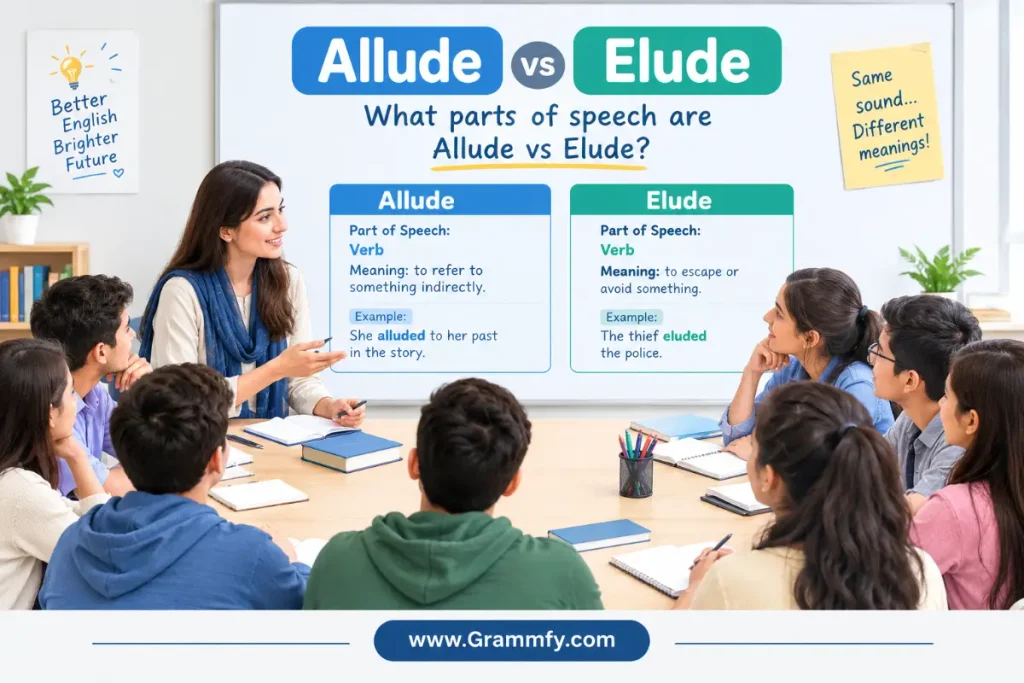
What parts of speech are Allude vs Elude?
Both allude and elude are verbs.
Forms of allude
| Form | Example |
|---|---|
| Base form | allude |
| Third-person singular | alludes |
| Present participle | alluding |
| Past tense | alluded |
| Past participle | alluded |
Examples:
- I allude to the issue.
- She alludes to the issue.
- He is alluding to the issue.
- They alluded to the issue.
Forms of elude
| Form | Example |
|---|---|
| Base form | elude |
| Third-person singular | eludes |
| Present participle | eluding |
| Past tense | eluded |
| Past participle | eluded |
Examples:
- The suspect may elude the police.
- The suspect eludes the police.
- The suspect is eluding the police.
- The suspect eluded the police.
What is the best word for a resume?
For a resume, allude is less common because resumes usually state achievements directly. Words such as referenced, identified, highlighted, or demonstrated may be clearer.
However, elude can be useful in a sentence about something that has remained difficult to achieve.
For example:
A promotion had eluded me despite strong performance.
This is grammatically correct, but a resume usually benefits from positive, direct language.
Instead of focusing on something that eluded you, you could write:
Earned a promotion after leading three successful projects.
For professional writing, direct wording usually has more impact.
What is the best word for an essay?
Both words can be useful in essays, especially literature, history, and analytical writing.
Use allude when an author, speaker, or source makes an indirect reference.
The poet alludes to biblical imagery throughout the poem.
Use elude when an idea, meaning, or answer is difficult to understand or obtain.
The poem’s central meaning may elude readers on a first reading.
These words can make academic writing more precise when they’re used correctly.
What is the best word for texting?
In casual texting, simpler words are usually better.
Instead of:
Are you alluding to something?
You could say:
Are you hinting at something?
Instead of:
The answer eludes me.
You could say:
I can’t figure it out.
Still, both words are correct in texts if they fit the speaker’s style.
What is the best word for an email?
In a professional email, allude to can be useful when discussing something indirectly.
I believe you were alluding to the changes mentioned in yesterday’s meeting.
Elude is less common, but it can describe something difficult to find or achieve.
The source of the error has continued to elude our team.
For everyday business emails, though, simpler alternatives may sound more natural:
I believe you were referring to the changes mentioned yesterday.
What is the best word for speaking?
In ordinary speech, hint, mention, refer to, avoid, and escape are more common than allude and elude.
Still, educated speakers use both words regularly.
For example:
- Are you alluding to what happened yesterday?
Or:
- The answer is completely eluding me.
The second sentence is especially natural when someone can’t remember something.
What are some examples of allude vs elude in real situations?
Here are original examples showing how each word works.
Examples with allude
- The teacher alluded to an upcoming test but didn’t give the date.
- During the interview, she alluded to her previous experience in marketing.
- The novel alludes to several famous historical events.
- He alluded to financial problems without giving any details.
- The speaker alluded to the disagreement during her presentation.
- The song seems to allude to the singer’s childhood.
- My manager alluded to possible changes in the schedule.
- The article alludes to a connection between sleep and memory.
- She alluded to the surprise without revealing what it was.
- The movie alludes to several classic science-fiction stories.
Examples with elude
- The escaped dog eluded its owner for two hours.
- The correct answer continued to elude me.
- The suspect eluded police officers by leaving through a side door.
- A clear explanation has eluded researchers for years.
- Her name suddenly eluded me.
- The team worked hard, but victory continued to elude them.
- The small bird eluded the cat by flying through an open window.
- The meaning of the final paragraph eluded many readers.
- The source of the strange noise eluded the investigators.
- Despite several attempts, the athlete couldn’t achieve the record that had long eluded him.
How can you tell whether you need Allude vs Elude?
Ask one simple question:
Is someone referring to something, or is something getting away?
If the answer is referring, use allude.
The writer alludes to a famous legend.
If the answer is getting away or remaining out of reach, use elude.
The solution eluded the scientists.
This test works for most everyday sentences.
Allude vs elude in literature
Literature often uses both words in ways that can be confusing.
Allude in literary analysis
Authors frequently make indirect references to:
- mythology
- religion
- history
- other books
- famous people
- cultural traditions
- earlier events
For example:
- The author alludes to Shakespeare’s Romeo and Juliet.
The author doesn’t necessarily mention the entire play. A character, phrase, event, or image may remind readers of it.
Elude in literary analysis
Literary critics can use elude when a text has a meaning that is difficult to understand.
- The novel’s true message eludes the reader until the final chapter.
Here, the meaning is not physically escaping. It is simply difficult to grasp.
This figurative use is common in sophisticated writing.
Allude vs imply: what’s different?
Allude means making an indirect reference.
Imply means communicating an idea without directly stating it.
Compare:
- The speaker alluded to his old employer.
This means the speaker indirectly referred to the employer.
- The speaker implied that his old employer was unfair.
This means the speaker communicated the idea that the employer was unfair without saying it directly.
A sentence can contain both:
- She alluded to her previous job and implied that her manager had treated her unfairly.
The first action is a reference. The second communicates an unstated meaning.
Allude vs mention: what’s different?
Mention is much broader and usually more direct.
She mentioned her old school.
This means she talked about it or named it.
She alluded to her old school.
This suggests that she referred to it indirectly.
For example, imagine someone says:
I had a difficult experience at my old school.
They might be alluding to a specific event without explaining it.
If they say:
I was bullied at my old school.
They are directly mentioning the experience.
Elude vs evade: what’s different?
Elude and evade can both involve escape, but their usage differs.
Evade often suggests deliberately avoiding something.
The suspect evaded the police.
Elude can describe successful escape from capture, but it can also describe abstract things that are difficult to grasp.
The suspect eluded the police.
The answer eluded me.
The second sentence shows why elude has a wider figurative use.
You can say:
He evaded the question.
But you generally wouldn’t say:
He eluded the question.
The natural expression is evaded the question.
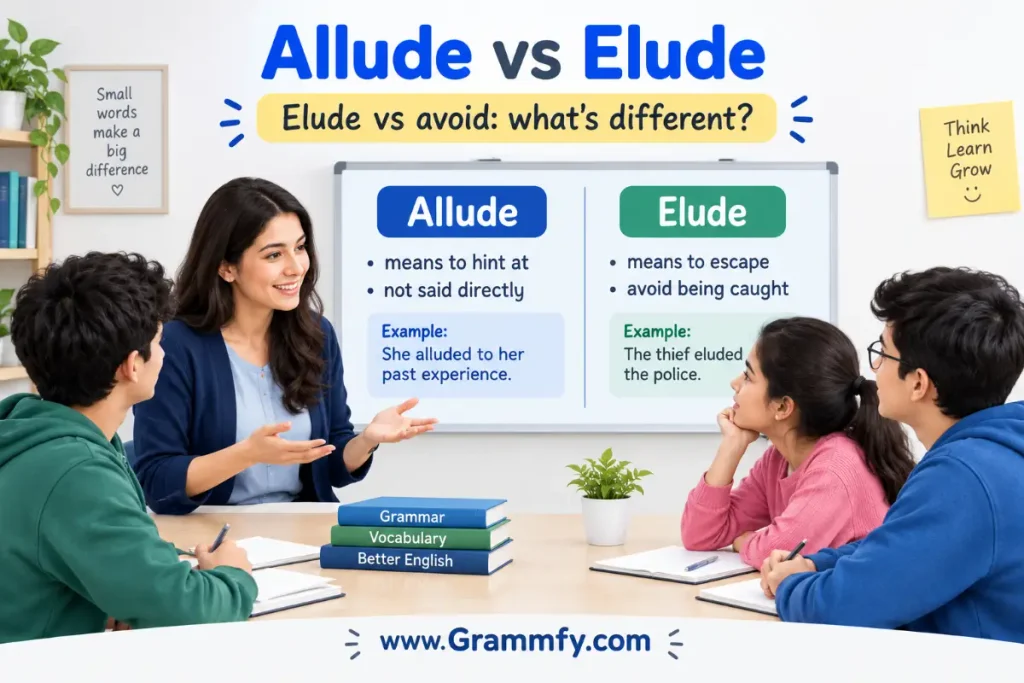
Elude vs avoid: what’s different?
Avoid means deliberately staying away from something.
She avoided the crowded restaurant.
Elude suggests that something escapes capture, understanding, memory, or achievement.
The exact cause of the problem eluded the team.
The team wasn’t necessarily choosing to avoid the cause. They simply couldn’t identify it.
This distinction is important.
Avoid
The person or thing actively stays away.
Elude
The person trying to catch, understand, remember, or achieve something can’t quite reach it.
Common mistakes with allude
Mistake 1: Using “allude” without “to”
Incorrect:
He alluded the problem.
Correct:
He alluded to the problem.
The standard construction is allude to something.
Mistake 2: Using allude when you mean mention directly
She alluded to her new job.
This suggests an indirect reference.
If she openly talked about the job, use:
She mentioned her new job.
Mistake 3: Confusing allude with elude
Incorrect:
The author eludes to an earlier chapter.
Correct:
The author alludes to an earlier chapter.
Alludes to is the correct phrase for an indirect reference.
Common mistakes with elude
Mistake 1: Using elude to mean “refer to”
Incorrect:
The writer eludes to a historical event.
Correct:
The writer alludes to a historical event.
Mistake 2: Assuming elude only means physical escape
Elude can describe abstract things.
- Correct:
The answer eluded me.
- Correct:
Her name eluded me.
- Correct:
A solution has eluded the researchers.
Mistake 3: Confusing elude with avoid
These words aren’t always interchangeable.
He avoided the meeting.
This means he deliberately stayed away.
The answer eluded him.
This means he couldn’t find or understand the answer.
When should you not use allude?
Don’t use allude simply because you want a more sophisticated word for mention.
If you’re directly naming or discussing something, mention or refer to may be clearer.
Instead of:
The email alluded to the deadline.
if the email clearly stated the deadline, write:
The email mentioned the deadline.
Use allude when the reference is indirect or suggestive.
When should you not use elude?
Don’t use elude when you simply mean avoid unless the context involves escaping or remaining out of reach.
For example:
She avoided talking about the problem.
is more natural than:
She eluded talking about the problem.
Also, elude doesn’t normally mean simply ignore.
He ignored my message.
is not the same as:
He eluded my message.
The second sentence sounds unnatural because elude isn’t normally used that way.
What are the antonyms of Allude vs Elude?
Antonyms of allude
Because allude means making an indirect reference, possible opposites include:
- state directly
- explain
- clarify
- specify
- identify
- name
- declare
- describe explicitly
Example:
Instead of alluding to the problem, she explained it directly.
Antonyms of elude
Possible opposites include:
- capture
- catch
- find
- discover
- understand
- grasp
- achieve
- obtain
Examples:
- The police finally captured the suspect.
- I finally understood the answer.
- The team finally achieved its goal.
The best opposite depends on the meaning of elude in the sentence.
How do Allude vs Elude work with abstract nouns?
This is where the distinction becomes especially useful.
Allude can refer indirectly to an idea, event, person, or topic.
The speech alluded to political change.
Elude can describe something that remains difficult to obtain or understand.
Political stability has eluded the region.
Notice the difference:
- alluded to political change = referred to it indirectly
- stability has eluded the region = stability has remained difficult to achieve
The same topic can work with both words, but the meaning changes.
Can Allude vs Elude describe people?
Yes, but in very different ways.
Allude to a person
The speaker alluded to her former teacher.
The speaker referred indirectly to the teacher.
Elude a person
The suspect eluded the police.
The suspect escaped the police.
You can remember the contrast this way:
allude to someone = refer to them
elude someone = escape them
Can you use allude in the past tense?
Yes.
The past tense is alluded.
Examples:
- She alluded to the issue yesterday.
- The author alluded to the event in the final chapter.
- He alluded to his previous employer during the interview.
- Don’t write allude when the sentence requires the past tense.
Can you use elude in the past tense?
Yes.
The past tense is eluded.
Examples:
- The suspect eluded the officers.
- The answer eluded me.
- Victory eluded the team again.
The spelling changes from elude to eluded when forming the past tense.
What is the easiest memory trick?
Try these two associations:
Allude = allude to an idea
The word allude usually appears with to.
allude to something
Think: A = allude = an indirect reference.
Elude = escape
Think of elude as something that escapes.
The suspect eluded the police.
If you can remember escape, you’ll usually know when to use elude.
Quick comparison chart about Allude vs Elude
| Feature | Allude | Elude |
|---|---|---|
| Part of speech | Verb | Verb |
| Main idea | Indirect reference | Escape or remain out of reach |
| Common pattern | allude to | elude someone/something |
| Can be figurative? | Yes | Yes |
| Physical meaning? | Usually no | Yes |
| Abstract meaning? | Yes | Yes |
| Common synonym | hint | escape |
| Common confusion | elude | allude |
| Example | She alluded to the problem. | The answer eluded her. |
Quick tips for choosing the right word
Use these tips when you’re writing quickly.
- If you mean refer indirectly, use allude.
- If you mean escape, use elude.
- Remember that allude commonly takes to.
- If something is difficult to remember, it can elude you.
- If an author makes an indirect reference, the author alludes to something.
- If a suspect escapes capture, the suspect eludes the police.
- If you’re directly naming something, mention may be better than allude.
- If someone deliberately stays away, avoid may be better than elude.
- If you’re describing an unstated meaning, imply may be more precise than allude.
- If you’re describing a difficult-to-understand idea, elude can work well.
- Don’t write elude to when you mean “refer to.”
- Don’t write allude someone when you mean “escape someone.”
A quick practice test
Choose the correct word in each sentence.
1. The author ________ to an ancient legend.
The answer is alluded because the author is making an indirect reference.
2. The escaped prisoner ________ the police.
The answer is eluded because the prisoner escaped capture.
3. She ________ to a problem with the project.
The answer is alluded because she referred to the problem indirectly.
4. The answer ________ me during the exam.
The answer is eluded because the speaker couldn’t remember or understand it.
5. The speaker ________ to the earlier disagreement.
The answer is alluded because the speaker made an indirect reference.
6. The team’s championship goal continued to ________ them.
The answer is elude because the goal remained out of reach.
7. The report ________ to possible safety concerns.
The answer is alluded because the report indirectly referred to those concerns.
8. Her name ________ me for several minutes.
The answer is eluded because she couldn’t remember the name.
Why does this confusion happen so often?
English has many pairs of words that look or sound alike but have different meanings. Allude and elude are especially confusing because their spellings differ by only one letter.
The problem becomes harder because both can appear in formal writing, and both can describe abstract ideas.
For example:
The author alludes to the problem.
and:
The solution eludes the author.
Both sentences may appear in the same essay, but the verbs perform completely different jobs.
The first says the author refers to something.
The second says the author cannot find or understand something.
Knowing the basic image behind each word makes the distinction easier than memorizing spelling alone.
A useful way to improve your writing
When you’re unsure between similar words, don’t just ask which one “sounds right.” Ask what action the word describes.
For allude, the action is pointing toward an idea indirectly.
For elude, the action is getting away or staying beyond reach.
Then check the grammar.
If you can naturally write:
allude to something
you’re probably using allude correctly.
If someone or something can escape, avoid capture, or remain difficult to grasp, elude may be the correct choice.
This approach works with many confusing word pairs because meaning comes before spelling.
Conclusion
The difference between allude vs elude becomes much easier when you focus on the main action behind each word. Allude is about making an indirect reference, usually with the structure allude to something. Elude is about escape, avoidance, or something remaining beyond reach.
Use allude when a writer, speaker, or person points toward an idea without stating it directly. Use elude when a person escapes capture or when an answer, memory, solution, opportunity, or goal remains difficult to obtain or understand.
When you’re unsure, remember two simple words: reference and escape. Reference points you toward allude; escape points you toward elude. With that distinction in mind, you’ll be able to use both words clearly in essays, emails, professional writing, and everyday conversation.
Frequently Asked Questions
What is the difference between allude and elude?
Allude means to refer to something indirectly, while elude means to escape or remain difficult to catch, understand, remember, or achieve. The easiest distinction is reference versus escape.
Is it “allude to” or “elude to”?
The correct phrase for an indirect reference is allude to. For example, “The speaker alluded to the problem”; elude to is incorrect when you mean “refer to.”
What’s another way to say allude?
Another way to say allude is refer to, hint at, mention indirectly, or suggest. The best synonym depends on how direct the reference is.
Can “elude” mean “be difficult to understand”?
Yes, elude can mean that something remains difficult to understand or grasp. For example, “The meaning of the poem eluded me.”
Is allude formal English?
Allude is standard English and is somewhat more formal than everyday words such as mention or hint. It’s especially common in academic, literary, and professional writing.
What is an easy trick to remember allude vs elude?
Think allude = allude to a reference and elude = escape. If something is being referred to indirectly, choose allude; if something is getting away or staying out of reach, choose elude.
Is “allude” the same as “imply”?
No, they’re related but different. Allude means to make an indirect reference, while imply means to communicate an idea without directly stating it.
