
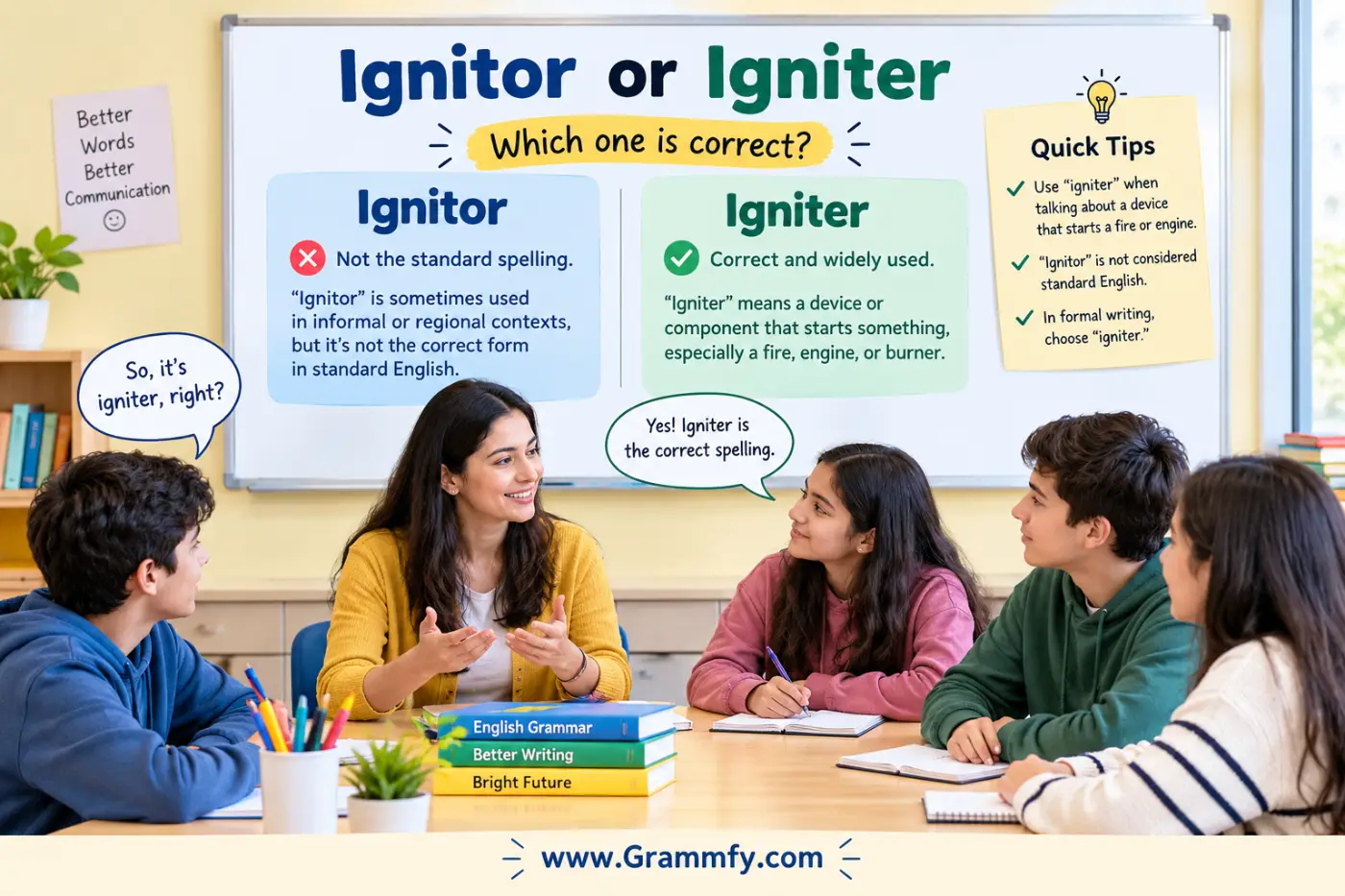
Writing an email about a broken oven, filling out a repair form, or describing a car problem can lead to a small spelling question: should you write Ignitor or Igniter? Both forms appear in English, and the difference is easy to miss.
Igniter is the standard spelling to use in most modern English writing. Ignitor is also a recognized variant, so it isn’t simply a spelling mistake. Merriam-Webster lists igniter as the main noun and ignitor as a variant.
Answer box: An igniter is something that causes ignition, such as a device that starts a flame or fuel-burning process. Ignitor is an accepted variant spelling, but igniter is usually the safer choice for general American English.
This guide explains the meaning, origin, spelling difference, related words, regional usage, common mistakes, and the best choice for emails, resumes, essays, texts, and technical writing.
For another common spelling question, check out [Fourty or Forty].
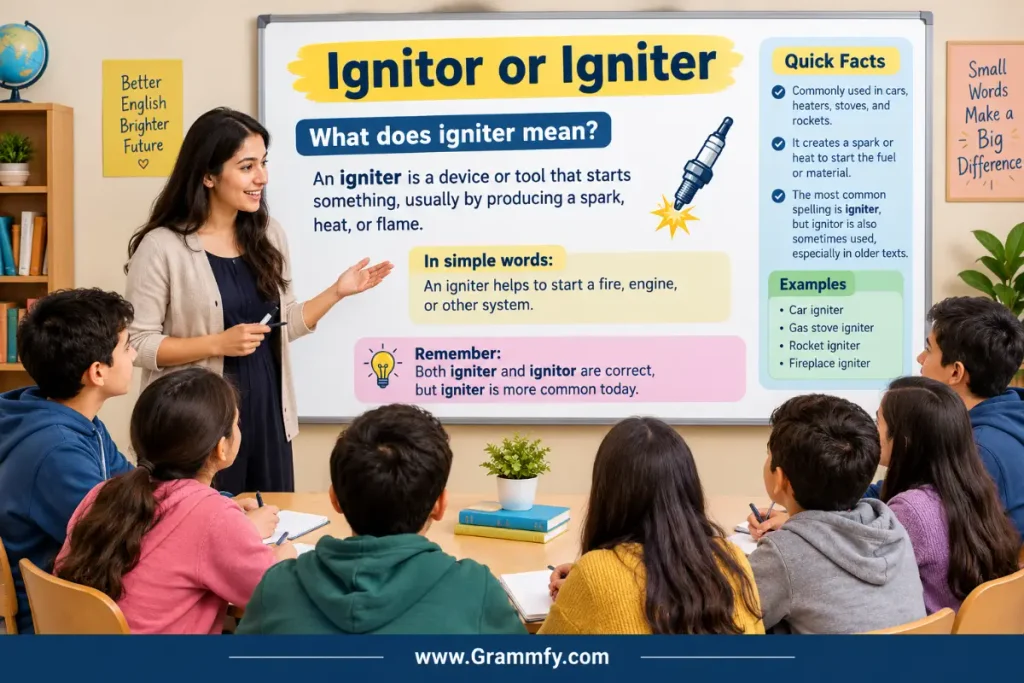
What does igniter mean?
An igniter is a person or thing that causes something to ignite. In practical use, the word usually refers to a device that creates the initial spark, heat, or other trigger needed to start combustion.
For example, an oven may have an electrical igniter that helps start the burner. A gas appliance can also contain an ignition component that creates the spark needed to light the fuel.
The word can also be used figuratively. A person, event, or idea may be called an igniter when it starts a strong reaction or creates sudden interest.
For example:
- The new coach was an igniter for the team’s comeback.
- The spark plug system includes an important ignition component.
- The oven’s igniter needs to be replaced.
- Her speech became an igniter for public discussion.
Merriam-Webster defines igniter as something that ignites and includes uses involving fuel mixtures and specialized electrical equipment.
Is igniter a noun or a verb?
Igniter is a noun. It names a person or thing that ignites something.
The related verb is ignite.
| Word | Part of speech | Meaning |
|---|---|---|
| ignite | Verb | To start burning or cause something to burn |
| igniter | Noun | A person or thing that causes ignition |
| ignitor | Noun | Variant spelling of igniter |
| ignition | Noun | The act or process of starting combustion |
| ignitable | Adjective | Able to be ignited |
For example:
- The fuel may ignite.
- The igniter starts the process.
- The ignition system controls the starting process.
- The material is highly ignitable.
Merriam-Webster lists igniter as a noun and gives ignitor as a less common variant.
Where does the word igniter come from?
The word comes from the verb ignite plus the suffix -er.
The suffix -er is commonly used to create nouns for people or things that perform an action. For example:
- write → writer
- drive → driver
- heat → heater
- light → lighter
- ignite → igniter
The deeper history goes back to Latin. Merriam-Webster traces ignite to Latin ignitus, related to ignire, meaning “to set on fire,” and ignis, meaning “fire.”
Collins dates the noun igniter to around 1880–85 and also explains it as a formation from ignite plus the suffix -er.
So the spelling igniter follows a familiar English word-building pattern.
Why does ignitor exist?
English has many words with competing endings, and ignitor developed as an alternative form.
The ending -or is also common in English nouns:
- act → actor
- inspect → inspector
- operate → operator
- ignite → ignitor
Igniter vs. ignitor: what’s the difference?
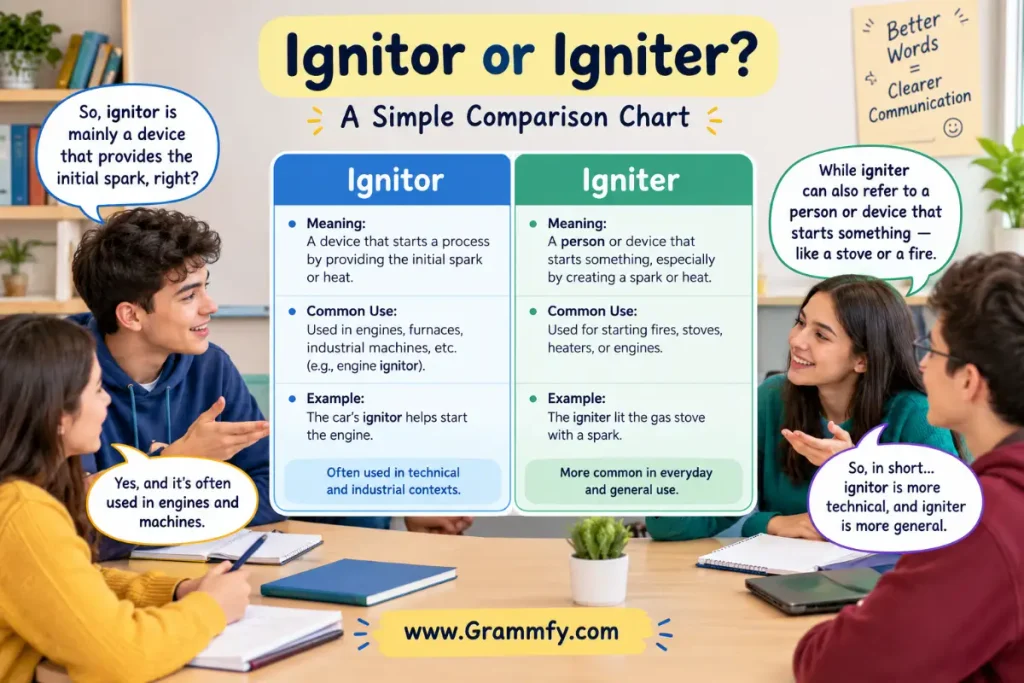
The main difference is spelling preference, not basic meaning.
| Form | Status | Meaning | Best general choice? |
|---|---|---|---|
| Igniter | Standard noun | Something that ignites | Yes |
| Ignitor | Variant noun | Something that ignites | Acceptable |
| Ignite | Verb | To start burning | Yes |
| Ignition | Noun | The process of starting combustion | Yes |
In most general American English writing, igniter is the better choice.
That does not mean ignitor should always be changed. If you are copying an official product name, model description, manual, or established technical terminology, keeping the original spelling can be the better option.
The important point is that these two forms normally refer to the same basic idea. Merriam-Webster treats ignitor as a variant rather than as a separate word with a different definition.
Why is igniter usually the safer spelling?
There are several reasons to prefer igniter in ordinary writing.
First, it follows the common pattern of adding -er to a verb to name the thing that performs the action.
Second, major dictionaries present igniter as the main entry. Merriam-Webster’s dictionary entry is headed igniter, with ignitor listed as a variant.
Third, igniter works naturally in everyday sentences:
- The oven igniter isn’t working.
- The technician replaced the igniter.
- Check the igniter before using the appliance.
- The engine’s ignition system needs attention.
If you’re unsure which spelling to choose, igniter is the simple default.
When is ignitor acceptable?
Ignitor is acceptable when a source, brand, product, or technical document specifically uses that spelling.
For example, suppose a manufacturer calls a particular component an ignitor. Changing the word in a quotation or product reference may create inconsistency.
The same principle applies to technical documentation. If an organization’s official terminology consistently uses ignitor, follow that terminology within the document.
This is especially useful when accuracy and consistency matter more than choosing your preferred spelling.
A practical rule is:
Use igniter for general writing unless a specific source or established terminology calls for ignitor.
What are the main synonyms and related words?
There isn’t one perfect synonym for igniter in every situation. A kitchen appliance, engine, and figurative discussion may use different terms.
The following table groups useful alternatives and related terms by tone and context. Some are close synonyms, while others are context-specific alternatives rather than exact replacements.
| Word | Meaning | Tone | Example |
|---|---|---|---|
| Starter | Something that starts a process | Simple | The starter begins the process. |
| Lighter | A tool used to create a flame | Everyday | She used a lighter to start the candle. |
| Fire starter | Something used to start a fire | Everyday | The kit includes a fire starter. |
| Spark source | Something that produces a spark | Neutral | The spark source needs inspection. |
| Flame starter | Something that begins a flame | Everyday | The flame starter stopped working. |
| Stove igniter | Device that starts a stove flame | Everyday | The stove igniter is faulty. |
| Grill starter | Device or tool used to start a grill | Everyday | The grill starter needs cleaning. |
| Ignition device | Device that initiates ignition | Formal | The ignition device was inspected. |
| Ignition unit | A component involved in ignition | Technical | The ignition unit was replaced. |
| Ignition system | System responsible for starting combustion | Technical | The ignition system needs service. |
| Spark generator | Component that creates a spark | Technical | The spark generator produces the initial spark. |
| Spark generator unit | A unit that generates ignition sparks | Technical | The unit includes a spark generator. |
| Starting device | A device used to begin operation | Neutral | The starting device was tested. |
| Initiating device | Device that starts a process | Formal | The initiating device was identified. |
| Kindler | Something that starts or encourages burning | Literary/Formal | The kindler helped start the fire. |
| Fire starter | Something that helps begin a fire | Everyday | The camping kit has a fire starter. |
| Spark starter | Device or tool that begins ignition with a spark | Neutral | The spark starter is easy to use. |
Simple alternatives
For basic writing, words such as starter, lighter, fire starter, and flame starter are easier for most readers.
For example:
- The starter helped begin the process.
- Keep a lighter nearby.
- The camping kit contains a fire starter.
- The appliance has a built-in flame starter.
These alternatives aren’t interchangeable in every technical sentence. A lighter, for instance, is a specific handheld tool, while an igniter can be a built-in component.
Everyday alternatives
Everyday English often uses a more specific term instead of the general noun.
For example:
- stove igniter
- grill starter
- spark starter
- fire starter
- flame starter
The best choice depends on the object you’re describing.
“The stove igniter is broken” sounds more natural than “The fire starter is broken” when you are specifically discussing a stove component.
Formal and technical alternatives
Technical writing may use terms such as:
- ignition device
- ignition component
- ignition unit
- ignition assembly
- ignition system
- ignition source
- spark generator
- electrode
- starting device
These terms can be more precise, but they don’t always mean exactly the same thing.
For example, an ignition system may include several components. An igniter may be only one part of that system.
Informal or descriptive alternatives
Casual speech doesn’t have many true slang synonyms for igniter. Speakers are more likely to use descriptive phrases such as:
- fire starter
- spark starter
- flame starter
- something that starts the flame
- the starter
In figurative writing, you may also hear words such as spark or catalyst.
For example:
- Her question was the spark that started the discussion.
- The new idea became a catalyst for change.
These are figurative alternatives, not technical synonyms.
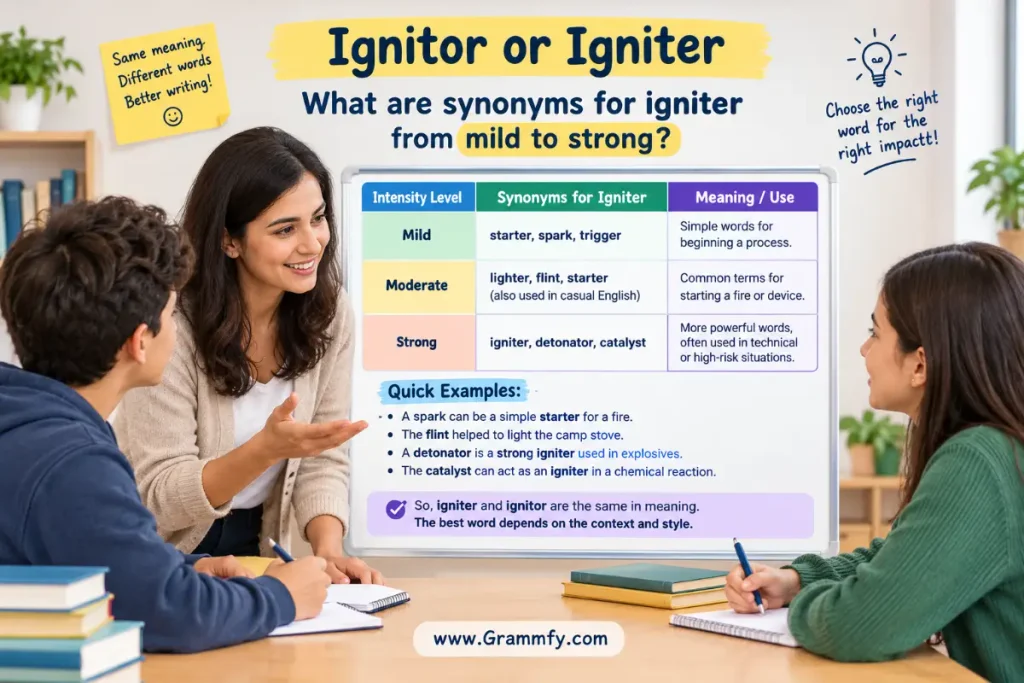
What are synonyms for igniter from mild to strong?
The right alternative can depend on how directly something causes a reaction.
| Intensity | Word | Typical use |
|---|---|---|
| Mild | starter | Begins a process |
| Mild | trigger | Causes an initial response |
| Mild | spark | Starts interest or discussion |
| Moderate | catalyst | Produces or speeds up change |
| Moderate | initiator | Starts an action or process |
| Moderate | instigator | Starts an action, often negative |
| Strong | driver | Strongly influences an outcome |
| Strong | catalyst | Creates major change |
| Strong | flashpoint | Point where conflict suddenly begins |
| Strong | provocation | Action that causes a strong reaction |
For physical ignition, starter, spark source, and ignition device are more appropriate.
For figurative use, spark, catalyst, trigger, and initiator may work better.
What is the difference between igniter and lighter?
An igniter starts ignition, while a lighter is a specific tool that produces a flame.
The two words overlap in some situations, but they aren’t exact synonyms.
| Igniter | Lighter |
|---|---|
| Broad term | More specific |
| Can be built into equipment | Usually a handheld tool |
| May produce a spark or another ignition effect | Usually produces a small flame |
| Common in technical contexts | Common in everyday speech |
For example:
- The oven igniter is not working.
- He used a lighter to light the candle.
Calling an oven’s built-in component a “lighter” would sound less precise.
Igniter vs. ignition system: what’s different?
An igniter is usually one component or device. An ignition system refers to the larger system responsible for starting the combustion process.
Think of it this way:
Igniter = one part
Ignition system = the broader system
For example:
The technician replaced the igniter.
This sentence points to a specific component.
The technician inspected the ignition system.
This sentence refers to the larger collection of parts and functions.
Using the broader term when you mean one component can make technical writing less precise.
Igniter vs. catalyst: what’s different?
An igniter starts ignition directly or provides the means for ignition. A catalyst is a broader word for something that causes or speeds up change.
The difference becomes especially clear in figurative writing.
| Word | Main idea | Example |
|---|---|---|
| Igniter | Starts ignition or a reaction | The device acts as an igniter. |
| Catalyst | Causes or speeds up change | The announcement was a catalyst for reform. |
| Spark | Starts interest, emotion, or discussion | Her comment sparked a debate. |
| Trigger | Causes a particular response | The news triggered concern. |
You shouldn’t automatically replace igniter with catalyst. Choose based on the meaning you need.
Is igniter used in American English?
Yes. Igniter is a standard English noun and is a good choice for American English.
So American writers don’t need to avoid igniter. In fact, it is the safest default when you want a familiar standard spelling.
Is igniter used in British English?
Yes. Igniter is also used in British English.
The main issue isn’t a simple US-versus-UK spelling rule. Unlike some clear differences such as color/colour, the choice between igniter and ignitor is better understood as a variant spelling issue.
That means you shouldn’t assume that ignitor is the British form and igniter is the American form.
Which spelling should I use in the US?
For general US writing, use igniter.
It is especially suitable for:
- school assignments
- essays
- emails
- resumes
- blog posts
- general articles
- product explanations
- everyday communication
Example:
The technician said the oven igniter needs to be replaced.
This is clear, natural, and easy to understand.
Which spelling should I use in a technical manual?
Follow the terminology used by the manufacturer, organization, or technical standard when one is clearly established.
If the manual consistently says ignitor, don’t randomly switch between ignitor and igniter. Consistency is important in technical documentation.
If you’re writing a new document and have no required terminology to follow, igniter is a strong general choice.
What is the best word for a resume?
For a resume, use the exact technical term that matches the job, equipment, or experience you’re describing.
If your industry documentation uses igniter, use that spelling consistently.
For example:
Inspected and replaced faulty ignition components and igniters.
A resume should prioritize accuracy over trying to make a word sound more sophisticated.
If a specific employer uses ignitor in the job description, matching that established terminology can also make sense, especially for technical roles.
What is the best word for an essay?
For a general school or college essay, igniter is usually the better choice.
It is familiar, standard, and easy to understand.
Example:
The invention became an igniter for public interest in the new technology.
However, if you’re writing about a technical subject, make sure the word actually fits the meaning. Sometimes catalyst, trigger, or spark will be more natural for a figurative argument.
For example:
The speech became a catalyst for political change.
That may be better than:
The speech became an igniter for political change.
Both can communicate a similar idea, but catalyst is more natural in many formal contexts.
What is the best word for texting?
In casual texting, igniter is fine when you are talking about an actual device.
For example:
The oven igniter stopped working again.
If your friends know what you’re talking about, you might simply say:
The starter isn’t working.
The shorter option can sound more natural in conversation.
For figurative meanings, texting often favors simple words:
That was the spark that started everything.
rather than:
That was the igniter of the whole situation.
What is the best word for an email?
In a professional email, choose igniter when you’re naming the actual component.
For example:
The oven igniter appears to be faulty.
If you’re unsure whether the specific equipment uses igniter or ignitor, check its manual or product documentation before sending a technical message.
For general business communication, avoid switching between the two forms without a reason.
15+ examples of igniter in real situations
The following examples show how the word works in different contexts.
- The oven igniter stopped working during dinner preparation.
- The technician tested the appliance’s igniter before replacing it.
- A faulty igniter can prevent an appliance from starting normally.
- The repair guide explains how to check the ignition component.
- The engineer inspected the igniter as part of routine maintenance.
- The car’s ignition system was checked after the engine developed starting problems.
- The new design includes a more reliable ignition component.
- The technician ordered a replacement igniter for the appliance.
- The manual identifies the part as an ignition device.
- Her first question was the spark that started a long discussion.
- The coach became an igniter for the team’s renewed confidence.
- The article served as a catalyst for further research.
- The announcement triggered a wave of public interest.
- His idea sparked a debate among the students.
- The new policy became a catalyst for major changes.
- The technician checked every major ignition component before completing the repair.
- The appliance manufacturer recommends using the correct replacement part.
- The repair company confirmed that the ignition component was worn.
These examples also show why a single synonym doesn’t work everywhere. A technical sentence may need igniter, while a figurative sentence may sound better with spark or catalyst.
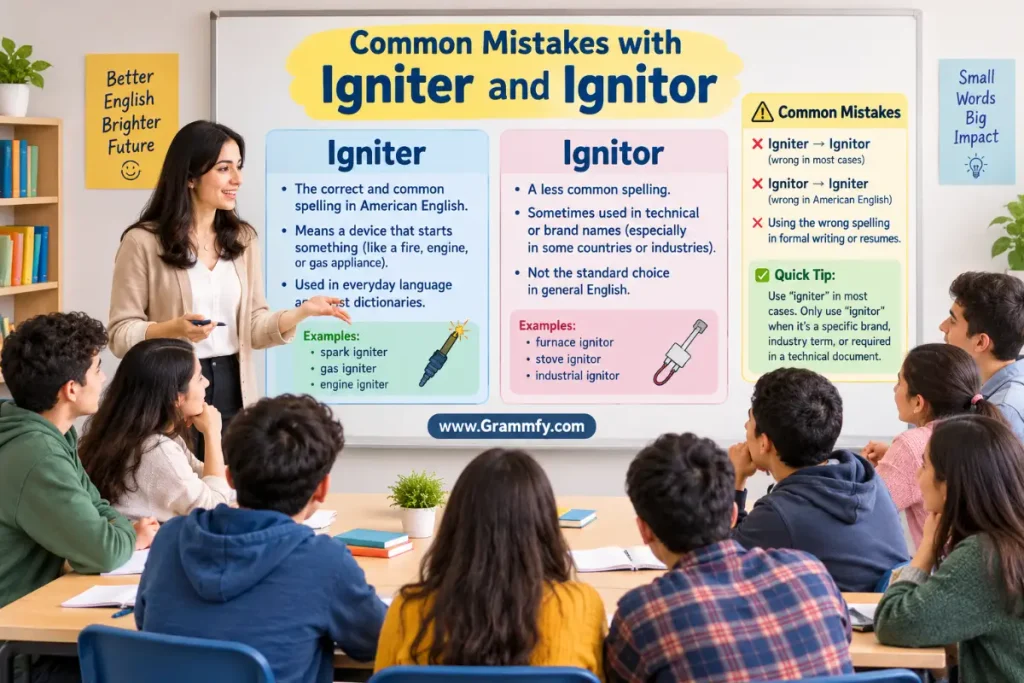
Common mistakes with igniter and ignitor
Mistake 1: Saying ignitor is always wrong
This is one of the biggest mistakes.
So don’t automatically label every use of ignitor as incorrect.
Mistake 2: Assuming both spellings have different meanings
Usually, they don’t.
The two forms generally refer to something that ignites.
The difference is mainly spelling preference and usage.
Mistake 3: Switching spellings in the same document
Consistency matters.
For example, avoid writing:
The igniter was tested. The ignitor was then replaced.
If both sentences refer to the same type of component, pick one spelling and stay with it unless you’re quoting a source that uses the other form.
A better version is:
The igniter was tested. The igniter was then replaced.
Mistake 4: Using igniter when you mean ignition
These words are related but not identical.
- Igniter = something that causes ignition.
- Ignition = the process or system of starting combustion.
Compare:
The igniter is faulty.
and:
The ignition system is faulty.
Both can be correct, but they point to different things.
Mistake 5: Using a technical word when a simple word is better
In casual writing, igniter may be more technical than necessary.
For example:
I need a fire starter.
may be more natural than:
I need an ignition device.
Good writing isn’t about using the most technical word. It’s about choosing the clearest word for the situation.
When should you NOT use igniter?
Don’t use igniter simply because something starts an event.
Sometimes another word is much more natural.
- Use spark for a sudden beginning
Her comment sparked a conversation.
- Use catalyst for major change
The discovery became a catalyst for further research.
- Use trigger for a specific response
The announcement triggered concern.
- Use starter for a simple beginning
The starter helped begin the process.
- Use lighter for a handheld flame-producing tool
He used a lighter to light the candle.
Choosing the right word makes your sentence more precise.
What are the antonyms of igniter?
Because igniter is a noun for something that starts ignition, it doesn’t have one perfect everyday antonym.
Depending on context, possible contrasting terms include:
- extinguisher
- suppressor
- stopper
- inhibitor
- deactivator
- shutdown device
These aren’t direct dictionary opposites in every situation.
For example:
An igniter starts a flame.
The contrasting object might be:
An extinguisher puts out a flame.
In a chemical or technical context, inhibitor may be a better contrast because it prevents or slows a process.
How do I remember the correct spelling?
A simple memory trick is to connect igniter with other common -er words.
Think:
- write → writer
- drive → driver
- heat → heater
- ignite → igniter
The word describes something that does the action.
You can also remember the basic pattern:
ignite + er = igniter
This isn’t the only way English forms nouns, but it makes the preferred spelling easier to remember.
If you see ignitor, don’t assume you have found a completely different word. It is an accepted variant.
Quick tips for choosing the right word
Keep these points in mind when writing:
- Use igniter as your default spelling.
- Remember that ignitor is also an accepted variant.
- Use the spelling required by a product manual or organization when necessary.
- Don’t switch between the two spellings without a reason.
- Use ignition when you mean the process or system.
- Use lighter for a specific handheld flame-producing tool.
- Use spark for many figurative situations.
- Use catalyst when you mean something that causes or speeds up change.
- Use trigger when you mean something that causes a particular response.
- Use starter when a simple everyday term is more natural.
- In technical writing, favor precision over variety.
- In general writing, favor clarity over jargon.
A simple comparison chart
| Word | What it means | Example |
|---|---|---|
| Igniter | Something that ignites | The igniter needs replacement. |
| Ignitor | Variant of igniter | The manual uses the word ignitor. |
| Ignite | To start burning | The fuel can ignite. |
| Ignition | The act/system of starting combustion | The ignition system was checked. |
| Lighter | Tool that produces a flame | He used a lighter. |
| Starter | Something that starts a process | The starter began the process. |
| Spark | A small flash or figurative beginning | Her idea sparked a debate. |
| Catalyst | Something that causes or speeds change | The event was a catalyst for reform. |
| Trigger | Something that causes a response | The news triggered concern. |
| Extinguisher | Something used to put out a fire | The extinguisher stopped the flames. |
Why context matters when choosing a synonym
A dictionary definition gives you the core meaning, but context tells you which word sounds natural.
Consider this sentence:
The oven ___ is broken.
Igniter is the natural technical choice.
Now consider:
Her question ___ a debate.
Sparked is much more natural.
Now try:
The event was a ___ for change.
Catalyst fits well.
And:
He used a ___ to light the candle.
Lighter is the natural choice.
All four sentences involve starting something, but English uses different words because the situations are different.
That is why replacing every occurrence with a synonym can actually make writing worse.
Does ignitor have the same pronunciation as igniter?
Yes. The two spellings normally represent the same pronunciation because they are variant forms of the same noun.
The important difference is what you see in writing, not a major difference in meaning or pronunciation.
Can igniter describe a person?
Yes. The noun can describe a person or thing that ignites something.
However, this use is less common in everyday speech than the use for a device.
For example:
She was the igniter of the discussion.
This is understandable, but many writers would choose:
She sparked the discussion.
or:
She was the catalyst for the discussion.
The alternative may sound more natural depending on the style.
Can igniter be used figuratively?
Yes, although figurative alternatives such as spark, catalyst, or trigger are often more natural.
For example:
The teacher’s question became an igniter for a lively classroom debate.
This is grammatically possible.
A more natural version might be:
The teacher’s question sparked a lively classroom debate.
The second sentence is shorter and more idiomatic.
So figurative use is possible, but don’t force igniter into a sentence when another word communicates the idea better.
Is igniter one word or two?
Igniter is one word.
Don’t write:
- ignite-er
- ignite er
- ignition er
The standard noun is igniter.
The variant form is also one word:
- ignitor
Is “igniter” a good word for SEO writing?
Yes, when the topic genuinely concerns the word or the object it describes.
For an educational spelling article, it works especially well because readers may search for questions such as:
- Is igniter or ignitor correct?
- How do you spell igniter?
- Is ignitor a word?
- What does igniter mean?
- What is another word for igniter?
- Igniter vs. ignitor
- Igniter definition
- Igniter spelling
The key is to answer these questions naturally rather than repeating the same phrase in every paragraph.
For general SEO writing, related terms such as ignition device, ignition component, starter, spark source, and ignition system can add useful semantic coverage when they accurately fit the subject.
A practical decision rule
When you’re stuck between the two spellings, use this three-step test.
Step 1: Are you writing general English?
Choose igniter.
Step 2: Does an official source use ignitor?
Keep ignitor if you’re following that source’s terminology.
Step 3: Are you describing a different concept?
Check whether you really need ignition, lighter, starter, spark, or catalyst instead.
This prevents both spelling errors and word-choice errors.
Conclusion:
For American English, schoolwork, general articles, emails, and most everyday writing, igniter is the best default. When a manufacturer, technical document, or organization consistently uses ignitor, follow that established spelling instead of changing it without a reason.
The bigger lesson is that spelling and word choice are connected. Igniter, ignition, lighter, starter, spark, and catalyst may relate to starting something, but they don’t all mean the same thing. Choose the word that matches the exact context.
If you’re unsure, remember the simple rule: ignite → igniter. That will give you the most useful default in general English.
Frequently Asked Questions
Is igniter or ignitor the correct spelling?
What does an igniter do?
An igniter starts ignition. It can be a device or component that helps begin a flame or fuel-burning process.
What’s another way to say igniter?
Depending on the context, you can use starter, ignition device, spark source, flame starter, or ignition component. For figurative meanings, spark or catalyst may sound more natural.
Should I use igniter in American English?
Is igniter the same as ignition?
No, igniter and ignition are related but different nouns. An igniter is something that causes ignition, while ignition refers to the process or system involved in starting combustion.
How can I remember the spelling of igniter?
Remember the pattern “ignite + er = igniter.” The ending follows the familiar pattern found in words such as writer, driver, and heater.
