
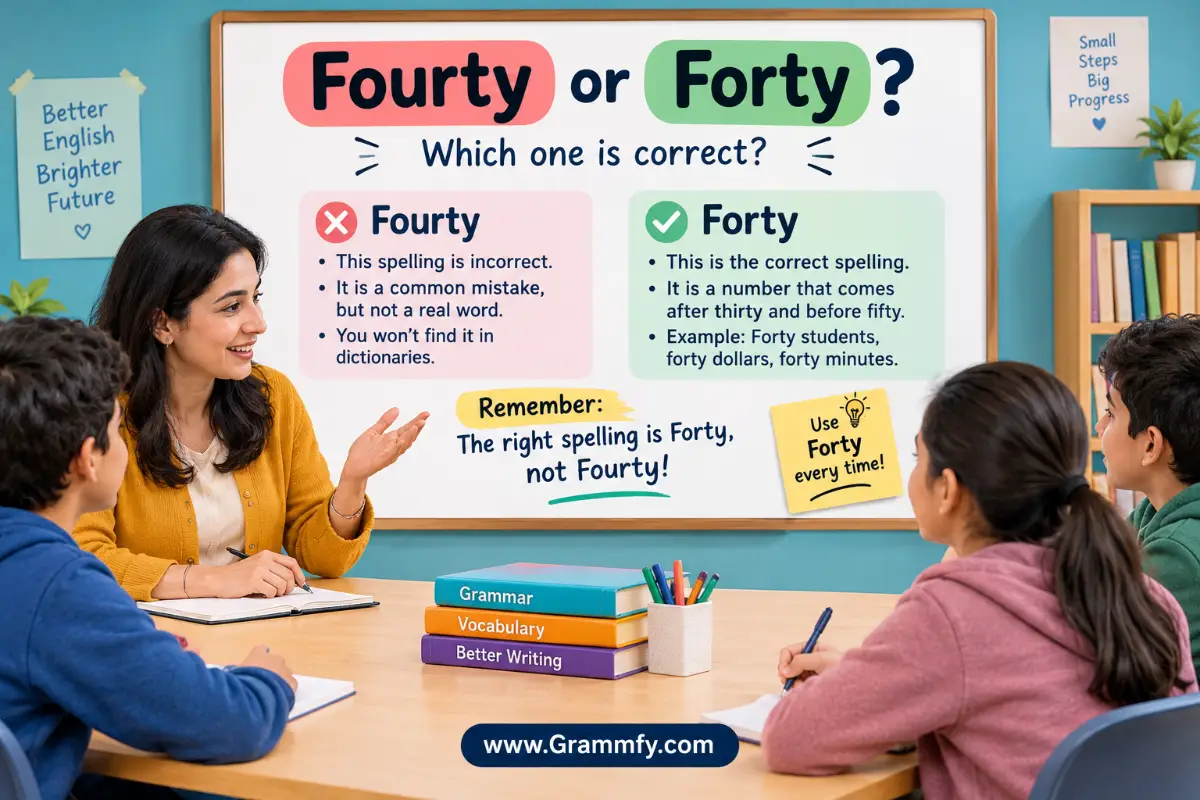
Imagine you’re writing a resume, school essay, email, or text and need to write the number 40. You type Fourty or Forty, then stop and wonder which spelling is correct. It’s an easy mistake because the pronunciation can make the incorrect form look reasonable.
The correct spelling is forty. The form fourty is a common spelling mistake. Even though the number four is spelled four, the word for 40 drops the u and becomes forty.
The correct spelling is “forty.” “Fourty” is incorrect in standard English.
This spelling can be confusing because many related number words keep the u in “four,” such as fourteen and fourth. The spelling of forty, however, is different and needs to be memorized.
This guide explains why the spelling is forty, where the word comes from, how to use it in different types of writing, common mistakes, related number expressions, examples, and simple tricks that make the correct spelling easier to remember.
For more examples of tricky plurals, see [Inbetween or In Between].
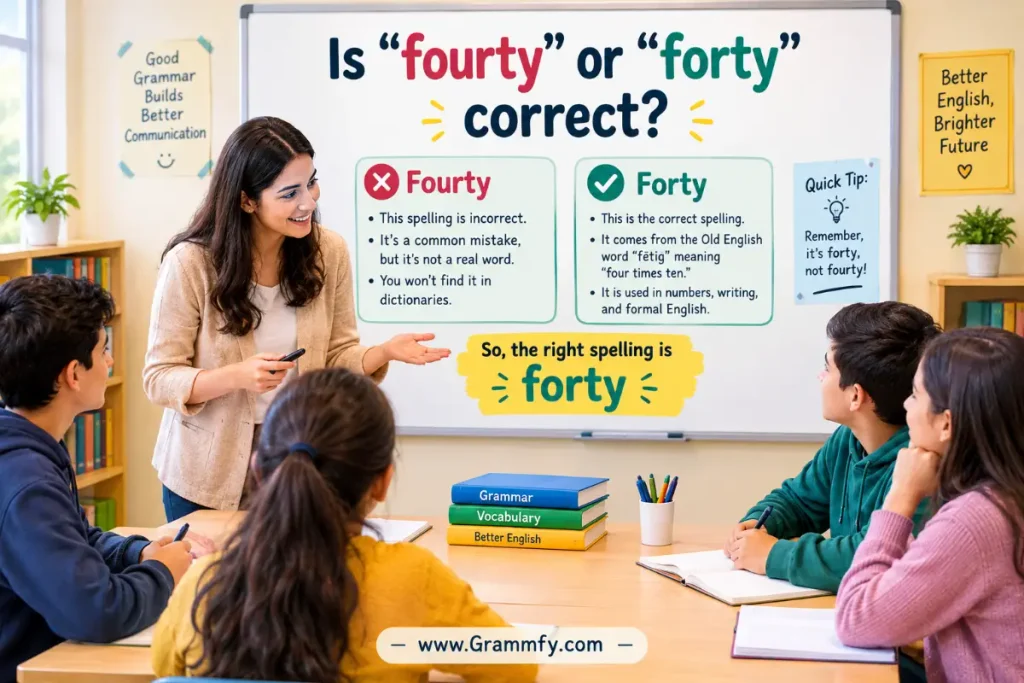
Is “fourty” or “forty” correct?
Forty is the correct spelling of the number 40.
Fourty is a misspelling and should not be used in standard English.
Compare:
| Spelling | Correct? | Example |
|---|---|---|
| forty | Yes | She is forty years old. |
| fourty | No | Avoid this spelling. |
| 40 | Yes | She is 40 years old. |
| four | Yes | I have four books. |
| fourteen | Yes | He has fourteen tickets. |
| fourth | Yes | This is my fourth attempt. |
The unusual part is that forty does not follow the spelling pattern many people expect.
A simple rule is:
Four = 4, but forty = 40.
Don’t add the u from four when spelling the number 40.
Why is “fourty” a common spelling mistake?
The mistake is easy to understand.
When people hear forty, they often connect it directly to four:
- four
- four + ty
- fourty
That seems logical at first.
But English spelling doesn’t always work by simply adding an ending to the base number. The standard spelling of the number 40 developed as forty, without the u.
This means you shouldn’t build the word from four when spelling it. Treat forty as its own spelling.
The same issue doesn’t happen with every number connected to four.
For example:
- four
- fourteen
- forty
- fourth
- forty-four
Notice that fourteen keeps the u, while forty doesn’t.
That’s why learners often need to memorize this particular spelling.
What does “forty” mean?
Forty is the number that comes after 39 and before 41.
It can represent a quantity, age, measurement, position, or number in a larger expression.
Examples:
I have forty dollars.
She bought forty notebooks.
He is forty years old.
The class has forty students.
We waited forty minutes.
In mathematics, forty is represented by the numeral 40.
What number is forty?
Forty means 40.
It is an even number and can be divided equally by 1, 2, 4, 5, 8, 10, 20, and 40.
It is also four tens:
4 × 10 = 40
The number comes between 39 and 41.
How do you write forty in words?
Write:
forty
Do not write:
fourty
The correct written form always drops the u.
Where does the word “forty” come from?
The spelling of forty has an interesting history.
The modern English word comes from older forms related to the number four and the idea of four tens. Over time, English spelling changed, and the modern form became forty rather than fourty.
Historical spelling helps explain why the word doesn’t look exactly like four.
English has many words whose modern spellings developed from older forms. A word may keep an unusual spelling even when its relationship to another word is obvious.
That’s what happened with forty.
The important point for modern writers is simple: historical development does not change the standard spelling used today.
Why does “forty” lose the “u”?
The exact historical development is more complicated than simply saying that English speakers decided to remove one letter.
Older forms of the number varied, and spelling changed over centuries. The modern spelling forty became established in English.
Today, there is no spelling rule that lets you predict this from four alone.
That means the best approach is to remember the standard form:
FORTY = 40
A useful memory trick is to think:
Forty has four letters before the ending?
Actually, the key is even simpler: forty is the exception you memorize instead of trying to spell it as four + ty.
Why is “four” spelled differently from “forty”?
The words are related, but English spelling does not always preserve every letter when words develop historically.
Compare:
- four
- fourteen
- forty
- forty-one
- forty-two
- forty-five
The word four keeps its u, while forty does not.
Once you know the base form of the compound numbers, the pattern becomes easy:
forty-one
forty-two
forty-three
forty-four
forty-five
The forty part remains unchanged.
How do you spell numbers from 40 to 49?
Once you know forty, the rest of the numbers in this group are straightforward.
| Number | Correct spelling |
|---|---|
| 40 | forty |
| 41 | forty-one |
| 42 | forty-two |
| 43 | forty-three |
| 44 | forty-four |
| 45 | forty-five |
| 46 | forty-six |
| 47 | forty-seven |
| 48 | forty-eight |
| 49 | forty-nine |
The important point is that all of these begin with forty, not fourty.
Incorrect:
fourty-one
Correct:
forty-one
Incorrect:
fourty-eight
Correct:
forty-eight
Once the first part is correct, the rest is easy.
How is “forty” used in a sentence?
Forty can function as a number word that describes a quantity or amount.
Examples:
Forty students attended the lecture.
I saved forty dollars.
The road is forty miles long.
She read forty pages.
He waited forty minutes.
The word can appear before a noun:
forty books
forty people
forty minutes
forty years
It can also appear after a verb:
The tickets cost forty dollars.
The distance is forty miles.
Should you write “forty” or “40”?
Both are correct, but the choice depends on the type of writing.
In ordinary prose, spelling out numbers can often make the text easier to read.
Example:
She is forty years old.
In charts, statistics, technical documents, measurements, and some professional formats, numerals may be more practical:
The survey included 40 participants.
Style guides can have different rules about when numbers should be written as words or numerals. If you’re following a specific school, company, publication, or academic style guide, use its rules.
The spelling itself doesn’t change:
40 = forty
Should you write “forty” in a resume?
Yes, when the number is written as a word, the correct spelling is forty.
For example:
Managed a team of forty employees.
However, resumes often favor concise formatting, so a numeral may be more useful:
Managed a team of 40 employees.
Both can be grammatically correct. The choice depends on the resume’s overall style and the formatting guidelines you’re following.
Never use fourty in a professional resume.
A spelling error in a resume can distract from otherwise strong information.
Resume example
Correct:
Trained forty new employees during the first year.
Also correct:
Trained 40 new employees during the first year.
Incorrect:
Trained fourty new employees during the first year.
Is “forty” correct in an essay?
Yes. Forty is the standard spelling for the number 40.
Example:
Forty students participated in the research project.
If you’re writing an academic essay, follow the style guide required by your school or institution. Some styles have specific rules for spelling out numbers versus using numerals.
The spelling remains the same either way.
forty students
40 students
Not:
fourty students
Is “forty” correct in an email?
Yes.
Examples:
We expect about forty guests.
The project should take forty days.
I received forty responses.
In a professional email, consistency matters more than choosing one form in every situation. If your message contains several statistics, numerals may make the information easier to scan.
For example:
We received 40 applications and selected 10 finalists.
But in a sentence with a more narrative style, words may work well:
About forty people attended the meeting.
Should you use “forty” in texting?
Yes, if you spell the number out.
For example:
I waited forty minutes.
You can also use:
I waited 40 minutes.
Texting is informal, but fourty is still a spelling mistake in standard English.
A casual message doesn’t require perfect formal style, but using the correct spelling is still a good habit.
How do you use “forty” when talking about age?
Forty commonly describes someone’s age.
Examples:
My father is forty years old.
She turned forty last month.
He is almost forty.
They are both forty.
You can also write:
She is 40 years old.
Don’t write:
She is fourty years old.
Is it “forty years old” or “forty-year-old”?
Both can be correct, but they have different grammatical roles.
Use forty years old after a linking verb:
She is forty years old.
Use forty-year-old before a noun as a compound adjective:
She is a forty-year-old teacher.
Notice the hyphens in the second construction.
More examples:
He is forty years old.
He is a forty-year-old engineer.
The hyphenated version works because the complete phrase modifies the noun engineer.
How do you write “forty” with another number?
Compound numbers from 21 to 99 that are not exact tens are normally hyphenated when written as words.
Examples:
- forty-one
- forty-two
- forty-three
- forty-four
- forty-five
- forty-six
- forty-seven
- forty-eight
- forty-nine
The hyphen connects the tens and ones.
Correct:
forty-two
Incorrect:
forty two
Incorrect:
fourty-two
The same pattern applies to other tens:
- twenty-one
- thirty-five
- fifty-six
- sixty-seven
- seventy-eight
- ninety-nine
Is “forty” hyphenated?
Forty by itself is not hyphenated.
Correct:
forty
When combined with a single-digit number, a hyphen is used:
forty-one
forty-seven
forty-nine
So:
| Form | Correct? |
|---|---|
| forty | Yes |
| forty-one | Yes |
| forty five | No, when written as a compound number |
| forty-five | Yes |
| fourty | No |
| fourty-five | No |
What are common phrases with “forty”?
The number appears in many everyday expressions.
- Forty years
The company has operated for forty years.
- Forty days
The course lasts forty days.
- Forty minutes
The meeting took forty minutes.
- Forty dollars
The book costs forty dollars.
- Forty percent
Forty percent of the students chose option A.
- Forty miles
The town is forty miles away.
- Forty people
Forty people attended the event.
- Forty times
I’ve told you forty times.
The last example is often an exaggeration rather than an exact count.
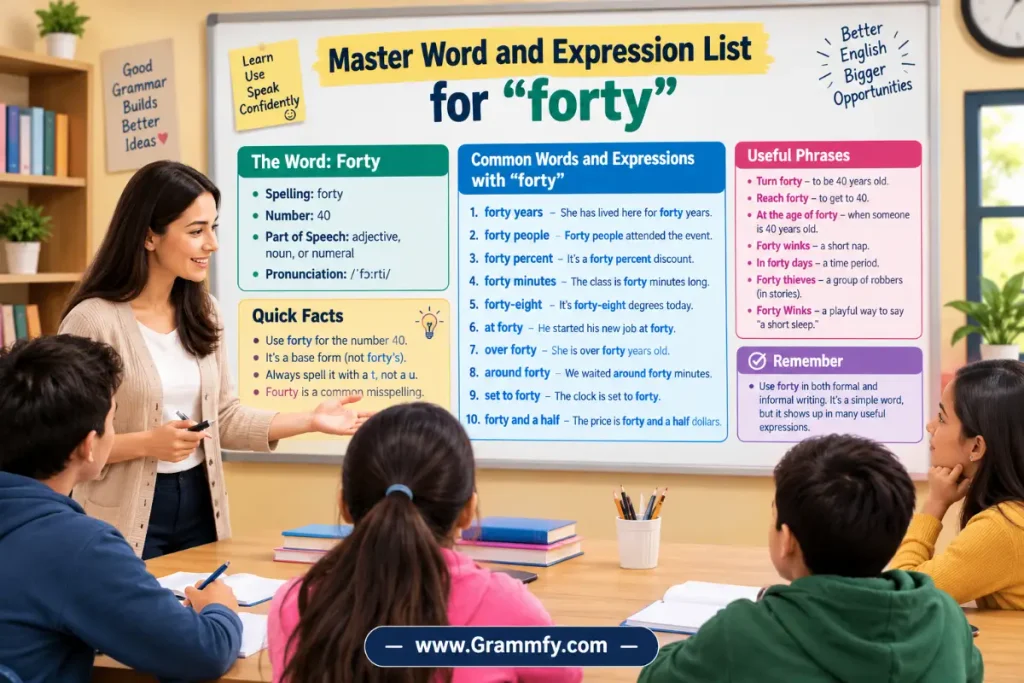
Master word and expression list for “forty”
Because forty is a specific number, it does not have 20–30 true synonyms in the same way that a word like happy or large does. However, several expressions can communicate the same quantity or a closely related idea.
| Group | Word or expression | Meaning | Tone | Example |
|---|---|---|---|---|
| Simple | 40 | The numeral for forty | Neutral | We need 40 chairs. |
| Simple | forty | The written number | Neutral | We need forty chairs. |
| Simple | four tens | Four groups of ten | Educational | Forty is four tens. |
| Everyday | about forty | Approximately 40 | Casual | About forty people came. |
| Everyday | over forty | Above 40 | Everyday | Over forty people voted. |
| Everyday | a total of forty | 40 altogether | Neutral | A total of forty entries arrived. |
| Formal | 40 units | Forty individual units | Formal/technical | The study used 40 units. |
| Formal | four tens | Four sets of ten | Educational | The value represents four tens. |
| Formal | forty items | A quantity of 40 | Formal | Forty items were inspected. |
| Formal | forty percent | 40 out of 100 | Formal | Forty percent responded. |
| Formal | fortyfold | Forty times as much | Formal | The amount increased fortyfold. |
| Formal | four-score | Eighty, not forty | Historical | Four-score means eighty. |
| Casual | about 40 | Approximately 40 | Casual | There were about 40 people. |
| Casual | forty-ish | Around 40 | Very informal | He’s forty-ish. |
Not every expression in this table is a direct synonym. Some are approximations, mathematical descriptions, or ways of discussing a quantity near 40.
For precise writing, use forty or 40.
What words describe amounts close to forty?
Sometimes you don’t need an exact number.
If the quantity is approximate, you can use:
- about forty
- around forty
- roughly forty
- nearly forty
- close to forty
- approximately forty
- just under forty
- more than forty
- over forty
These expressions are useful when the exact count isn’t known or isn’t important.
Compare:
Forty people attended.
This means exactly 40.
About forty people attended.
This means approximately 40.
Nearly forty people attended.
This usually means slightly fewer than 40.
More than forty people attended.
This means the number was above 40.
Synonyms by intensity and precision
Since forty is an exact number, “intensity” is better understood as precision.
| Precision | Expression | Meaning |
|---|---|---|
| Exact | forty | Exactly 40 |
| Exact | 40 | Exactly 40 |
| Exact | exactly forty | Precisely 40 |
| High | forty people | Exactly 40 people |
| Approximate | about forty | Near 40 |
| Approximate | around forty | Near 40 |
| Approximate | roughly forty | Near 40 |
| Below 40 | nearly forty | Close to but below 40 |
| Below 40 | just under forty | Slightly below 40 |
| Above 40 | over forty | More than 40 |
| Above 40 | more than forty | More than 40 |
| Broad | dozens | Several groups of ten; not exact |
This distinction matters when accuracy is important.
If a report says:
Forty customers responded.
readers normally understand that the count was 40.
If it says:
About forty customers responded.
the exact number could be 37, 39, 42, or another nearby figure.
What part of speech is “forty”?
Forty is a number word. In grammar, number words can work in different ways depending on the sentence.
As a determiner
Forty students attended.
It tells us how many students there were.
As a noun
Forty is an even number.
Here, the number itself is being discussed.
As part of a compound adjective
She bought a forty-dollar jacket.
Here, forty-dollar describes jacket.
As part of an age expression
He is a forty-year-old man.
The compound phrase describes the noun man.
What is the difference between “forty” and “four”?
The two words represent different numbers.
| Word | Number |
|---|---|
| four | 4 |
| forty | 40 |
| fourteen | 14 |
| fourth | 4th |
The connection between four and forty can cause spelling mistakes, but they shouldn’t be treated as the same word with a simple suffix.
Remember:
four = 4
forty = 40
What is the difference between “forty” and “fourteen”?
This is a particularly useful comparison.
Fourteen means 14.
Forty means 40.
They also have different spellings.
| Number | Correct spelling |
|---|---|
| 4 | four |
| 14 | fourteen |
| 40 | forty |
Notice the important spelling difference:
fourteen
has the u from four.
forty
does not.
This is one reason learners sometimes write fourty by mistake.
What is the difference between “forty” and “fourth”?
These words represent different ideas.
Forty is a cardinal number. It tells you how many.
Forty students attended.
Fourth is an ordinal number. It tells you position in a sequence.
She finished fourth.
Compare:
| Word | Meaning | Example |
|---|---|---|
| four | Number 4 | I have four books. |
| fourteen | Number 14 | She is fourteen. |
| forty | Number 40 | He is forty. |
| fourth | Position 4 | He finished fourth. |
The spelling and meaning should not be mixed.
What is the difference between “forty” and “forties”?
Forty refers to the specific number 40.
Forties can refer to the numbers from 40 through 49 or to a period associated with that range.
Examples:
The answer is forty.
She is in her forties.
The temperature reached the forties.
When discussing age, in her forties means her age is somewhere from 40 to 49.
You don’t normally write:
She is in her fourtys.
The correct plural is:
forties
Notice that the y changes to ie before s.
How do you spell “forties”?
The plural form is:
forties
Not:
fourties
Not:
fortys
The spelling follows the standard plural pattern for words ending in y.
Compare:
- forty → forties
- party → parties
- city → cities
- story → stories
Examples:
He is in his forties.
Sales increased during the forties.
The temperatures stayed in the forties.
How do you write “forty” in an age range?
For an age range, you can write:
people in their forties
This means people aged 40 to 49.
You can also say:
people aged forty to forty-nine
Or use numerals:
people aged 40–49
The exact style depends on the context.
Example
The survey included adults in their forties.
This doesn’t mean everyone was exactly 40. It means their ages fell somewhere in the 40–49 range.
Can “forty” be used before a noun?
Yes.
Examples:
forty students
forty books
forty dollars
forty minutes
forty years
forty questions
The number tells the reader how many of the following noun there are.
When the number is part of a compound adjective, hyphenation may be required:
a forty-page report
a forty-minute meeting
a forty-year career
The hyphen connects the number and measurement unit when they work together as a compound modifier before a noun.
Why do we say “forty dollars” but “forty-dollar bill”?
The grammar changes depending on the role of the measurement.
Normal quantity:
The bill is worth forty dollars.
Compound adjective:
It is a forty-dollar bill.
In the second sentence, forty-dollar describes bill, so the compound is hyphenated.
The same pattern applies to:
forty minutes
but:
a forty-minute meeting
And:
forty years
but:
a forty-year career
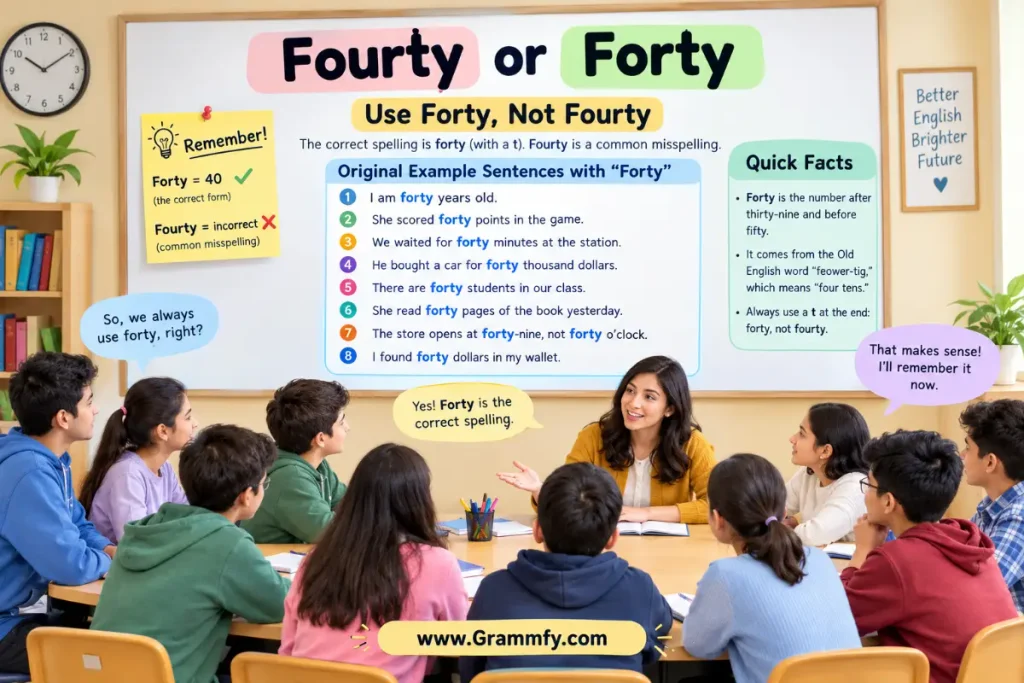
15+ original example sentences with “forty”
1. Age
My aunt turned forty last summer.
The number describes her age.
2. Quantity
We ordered forty notebooks for the workshop.
The number tells us how many notebooks were ordered.
3. Time
The train arrived forty minutes late.
The number describes the length of the delay.
4. Money
The jacket costs forty dollars.
The number describes the price.
5. Distance
The village is forty miles from the city.
The number describes distance.
6. People
Forty students joined the competition.
The number describes the group size.
7. Questions
The test contains forty questions.
The number describes the total number of questions.
8. Pages
I read forty pages before going to bed.
The number describes the quantity of pages.
9. Years
The museum has been open for forty years.
The number describes a period of time.
10. Percentage
Forty percent of the class chose the first option.
The number describes a percentage.
11. Measurements
The box is forty centimeters wide.
The number describes a measurement.
12. Temperature
The temperature reached forty degrees yesterday.
The number describes a temperature.
13. Sports
The player scored forty points in the game.
The number describes the score.
14. Work
The employee works forty hours each week.
The number describes weekly working hours.
15. Travel
We drove forty miles before stopping for lunch.
The number describes the distance traveled.
16. Shopping
She bought forty candles for the event.
The number describes the quantity purchased.
17. Education
Forty applicants applied for the scholarship.
The number describes the number of applicants.
18. Time period
The project took forty days to complete.
The number describes the duration.
Common mistakes with “forty”
Mistake 1: Writing “fourty”
Incorrect:
I have fourty books.
Correct:
I have forty books.
This is the most common error.
Mistake 2: Assuming “four” keeps all its letters
It may feel logical to write:
four + ty = fourty
But English spelling doesn’t work that way here.
The standard form is simply:
forty
Mistake 3: Writing “fourty-one”
Incorrect:
She is fourty-one years old.
Correct:
She is forty-one years old.
The compound number starts with forty.
Mistake 4: Writing “fourty-five”
Incorrect:
The class has fourty-five students.
Correct:
The class has forty-five students.
Mistake 5: Writing “forty five”
When spelling out a compound number, use a hyphen:
forty-five
Not:
forty five
Mistake 6: Writing “fortys”
Incorrect:
He is in his fortys.
Correct:
He is in his forties.
Mistake 7: Confusing “forty” and “fourteen”
Incorrect:
The child is forty years old when you mean 14.
Correct:
The child is fourteen years old.
These numbers sound somewhat similar, so double-check the intended age or quantity.
How do you avoid the “fourty” spelling mistake?
The easiest method is to memorize one short fact:
Forty has no “u.”
Think:
FOUR → FORTY
The u disappears.
You can write the correct form several times:
forty
forty
forty
Then use it in short sentences:
Forty people came.
I need forty dollars.
She turned forty.
The trip takes forty minutes.
Repeated exposure helps the correct spelling become automatic.
A simple memory trick for “forty”
Try this:
“Four has a U, forty does not.”
That’s the key.
You can also remember the visual difference:
FOUR
FORTY
The second word has no u.
If you’re unsure while writing, don’t build the word from four. Think directly of the number:
40 → forty
This is often easier than trying to transform four into another word.
Is “fourty” ever acceptable?
For standard English writing, fourty should be treated as incorrect.
You may see it in:
- spelling mistakes
- informal online posts
- user-generated content
- old or unusual texts
- names or intentionally altered wording
A nonstandard spelling can appear somewhere without becoming the standard English form.
If you’re writing a school assignment, resume, email, article, report, or professional document, use forty.
What should you use in formal writing?
For formal writing, accuracy is especially important.
Use:
forty
or:
40
depending on the style requirements.
Avoid:
fourty
If the number is part of a formal statistic, numeral forms can make data easier to scan:
The survey included 40 participants.
If the number is part of ordinary prose:
Forty participants joined the study.
The choice between the word and numeral depends on the style, but the spelling forty never changes.
What should you use in casual writing?
Casual writing also uses forty.
Examples:
I’m forty minutes away.
There were about forty people.
She just turned forty.
You can also use 40 in texts and messages.
The important point is that informal writing does not make fourty the correct spelling.
What are antonyms of “forty”?
A number doesn’t have a true antonym in the same way an adjective like hot has the opposite cold.
However, you can contrast 40 with other quantities depending on the context.
Examples:
- fewer than forty
- more than forty
- below forty
- above forty
- zero
- another number
For example:
Fewer than forty people attended.
versus:
More than forty people attended.
These expressions describe quantities relative to 40 rather than serving as true antonyms.
What related number words should you know?
Learning nearby number words can make spelling easier.
| Number | Word |
|---|---|
| 4 | four |
| 14 | fourteen |
| 24 | twenty-four |
| 34 | thirty-four |
| 40 | forty |
| 41 | forty-one |
| 44 | forty-four |
| 49 | forty-nine |
| 50 | fifty |
| 54 | fifty-four |
| 90 | ninety |
| 94 | ninety-four |
Notice that the spelling of the tens words can vary:
- forty
- fifty
- sixty
- seventy
- eighty
- ninety
Each should be learned as a standard spelling rather than guessed from another number.
How does “forty” compare with other tens?
The tens from 20 to 90 have their own spellings.
| Number | Correct word |
|---|---|
| 20 | twenty |
| 30 | thirty |
| 40 | forty |
| 50 | fifty |
| 60 | sixty |
| 70 | seventy |
| 80 | eighty |
| 90 | ninety |
This table reveals an important point: number words often don’t follow a perfectly predictable spelling pattern.
For example:
four → forty
five → fifty
eight → eighty
So memorizing the common tens can prevent mistakes.
What is the best word for a resume, essay, text, email, or speech?
Resume
Use forty when spelling out the number or 40 when numerals fit the resume style.
Example:
Managed a team of 40 employees.
Essay
Use forty when the writing style calls for spelled-out numbers.
Example:
Forty students participated in the study.
Follow your required academic style guide for number formatting.
Texting
Either forty or 40 works.
Example:
I’ll be there in 40 minutes.
Both forms can work.
Example:
We expect around forty guests.
For statistics, numerals may be easier to scan:
We received 40 applications.
Speaking
The pronunciation is the same regardless of whether you write forty or 40.
When writing dialogue, however, choose the spelling appropriate to your writing style.
How should “forty” appear in a website article?
For a grammar or spelling article, it is useful to show both the correct and incorrect forms clearly.
For example:
Correct: forty
Incorrect: fourty
You can also explain the reason behind the confusion.
A good educational explanation should not simply say “forty is correct.” It should show readers why the mistake happens and give examples that make the rule easier to remember.
This helps learners recognize the mistake when they see it again.
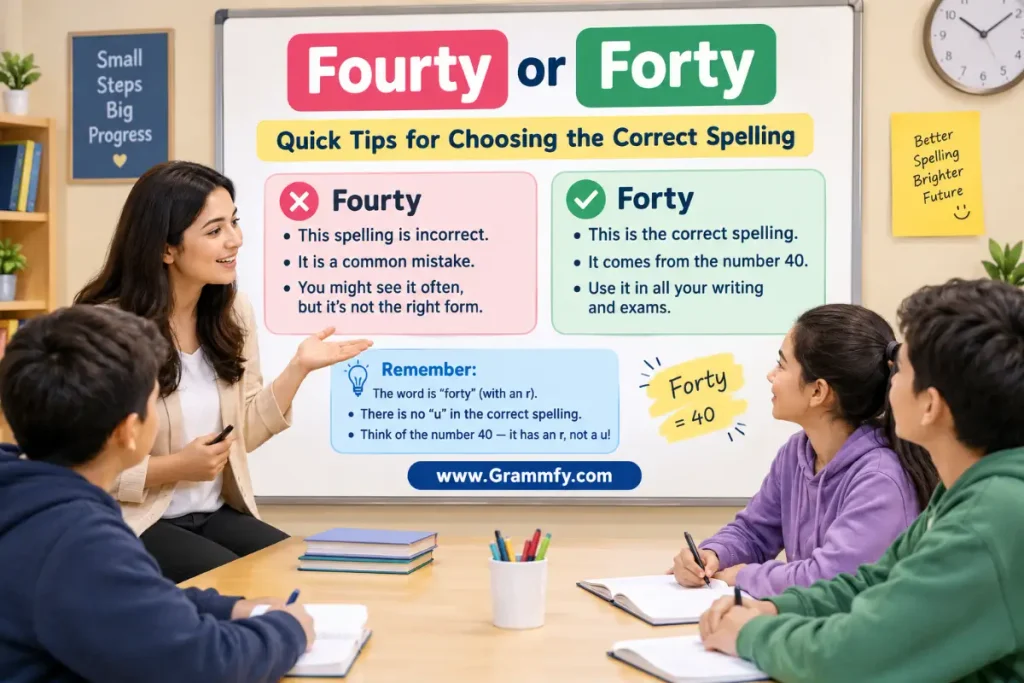
Quick tips for choosing the correct spelling
- Remember that 40 is spelled “forty.”
- Don’t add the “u” from “four.”
- Never write “fourty” in standard English.
- Use “forty-one,” “forty-two,” and similar forms for numbers from 41 to 49.
- Use a hyphen in compound numbers such as “forty-five.”
- Use “forties” when referring to the 40–49 age range.
- Remember that “forty” and “fourteen” are different numbers.
- For exact quantities, use “forty” or “40.”
- For approximate quantities, use “about forty,” “around forty,” or “roughly forty.”
- For professional writing, proofread number words carefully.
- Don’t assume every number related to four keeps the same spelling.
- Use the numeral 40 if you’re unsure about spelling, but learn the correct word too.
Quick correction chart
| Incorrect | Correct |
|---|---|
| fourty | forty |
| fourty-one | forty-one |
| fourty-two | forty-two |
| fourty-three | forty-three |
| fourty-four | forty-four |
| fourty-five | forty-five |
| fourty-six | forty-six |
| fourty-seven | forty-seven |
| fourty-eight | forty-eight |
| fourty-nine | forty-nine |
| fourtys | forties |
| fourty-year-old | forty-year-old |
A quick test: which sentence is correct?
Example 1
A. She is fourty years old.
B. She is forty years old.
Answer: B
The standard spelling is forty.
Example 2
A. We need forty chairs.
B. We need fourty chairs.
Answer: A
Example 3
A. He bought forty-five tickets.
B. He bought fourty-five tickets.
Answer: A
Example 4
A. She is in her forties.
B. She is in her fourties.
Answer: A
Example 5
A. The meeting lasted 40 minutes.
B. The meeting lasted fourty minutes.
Answer: A
The numeral 40 avoids the spelling issue, while the word form should be forty.
Conclusion
The correct spelling of the number 40 is forty, not fourty. The mistake happens because the word looks closely related to four, making it tempting to keep the u. However, modern standard English uses forty without that letter. The same spelling appears in compound numbers such as forty-one, forty-five, and forty-nine. When discussing ages from 40 to 49, use forties. You can also use the numeral 40 when your writing style calls for numbers instead of words. The easiest memory trick is simple: four has a “u,” but forty does not. Keep that small difference in mind, and you’ll avoid one of the most common number-spelling mistakes in English.
Frequently Asked Questions
Is “fourty” or “forty” the correct spelling?
Forty is the correct spelling for the number 40. Fourty is a common misspelling and should be avoided in standard English.
Why is forty spelled without the “u”?
Forty developed from older English number forms, and its standard modern spelling does not retain the u found in four. The easiest approach is to memorize forty as the standard form.
How do you spell 40 in English?
40 is spelled “forty.” The related numbers are written as forty-one, forty-two, forty-three, and so on.
What’s another way to write forty?
You can write 40 instead of forty when numerals are appropriate. Expressions such as about forty, around forty, and roughly forty can also describe a quantity close to 40.
Is it “forty” or “fourty” years old?
Forty years old is correct. For example, “She is forty years old” uses the standard spelling.
Is “forty-five” written with a hyphen?
Yes, forty-five is normally hyphenated when written as a compound number. The same applies to forty-one through forty-nine.
How do you spell the plural “forties”?
Forties is the correct plural form. For example, “He is in his forties” refers to an age from 40 through 49.
