
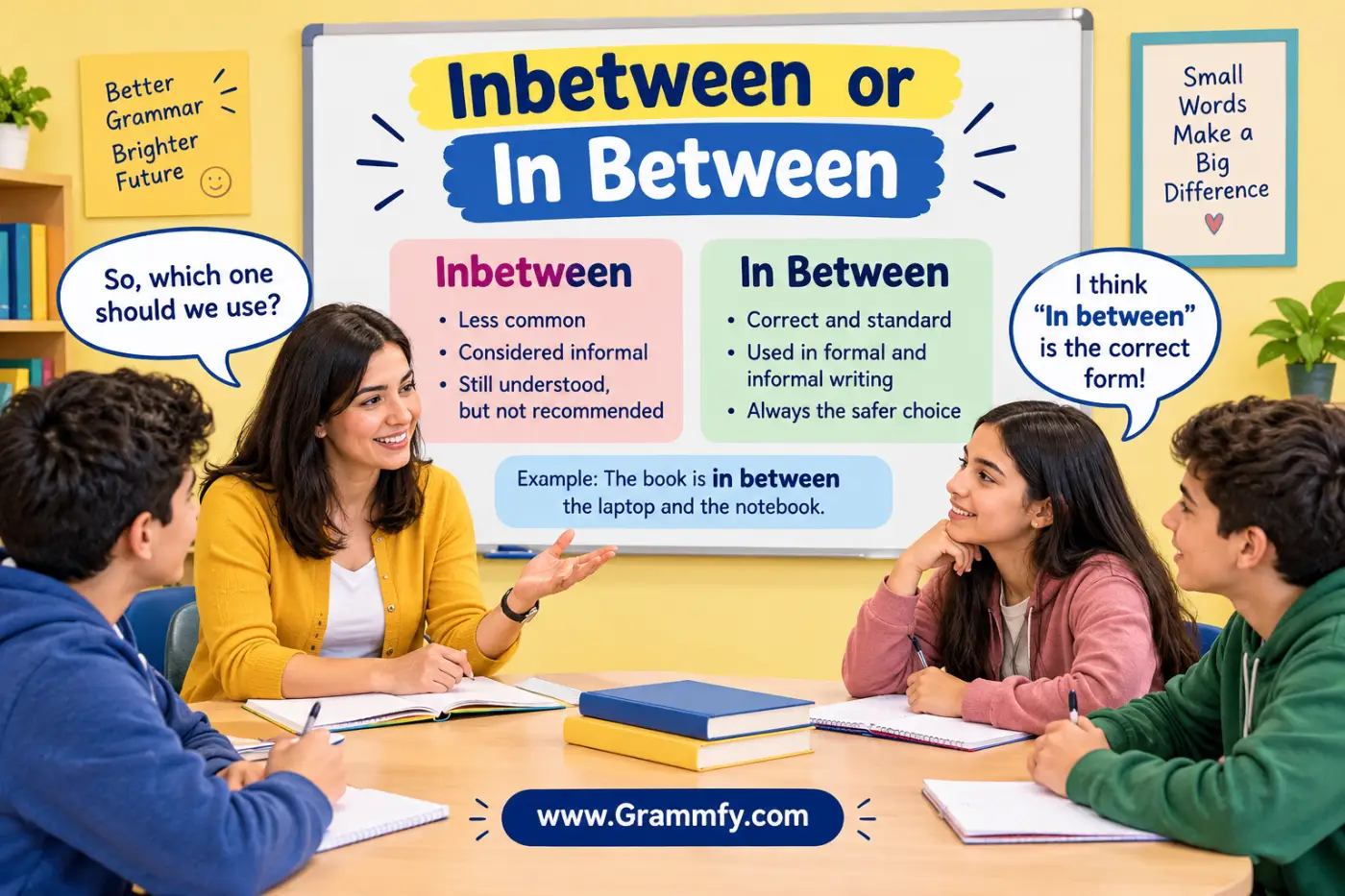
When you’re writing an email, essay, resume, or text, you may pause over a small spelling question: Inbetween or In Between? Both forms look almost identical, but standard English does not treat them the same way. One is generally written as two words, while the other is usually considered a nonstandard spelling.
The correct form in most situations is in between. It means in the middle of two things, people, places, times, or ideas. You may also see in-between when the phrase works as an adjective or noun in certain contexts.
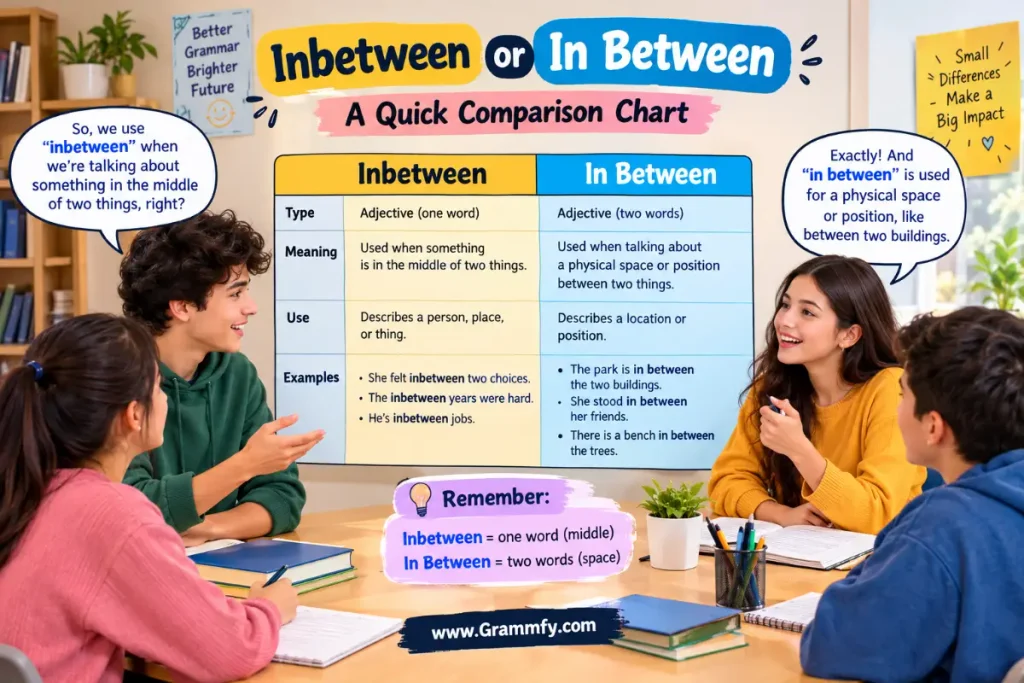
“In between” is the standard two-word form when you mean “in the middle of” or “between two things.” “Inbetween” is generally not standard English.
For example, you can sit in between two friends, choose a color in between blue and green, or find a time in between two appointments. The spelling can seem confusing because English has many compounds that eventually become one word.
This guide explains the meaning, history, grammar, correct spelling, synonyms, examples, common mistakes, and differences between related expressions. You’ll also learn which form works best in resumes, essays, emails, texts, and everyday speech.
If this spelling rule helped, you may also want to check out [Pick Up or Pickup].
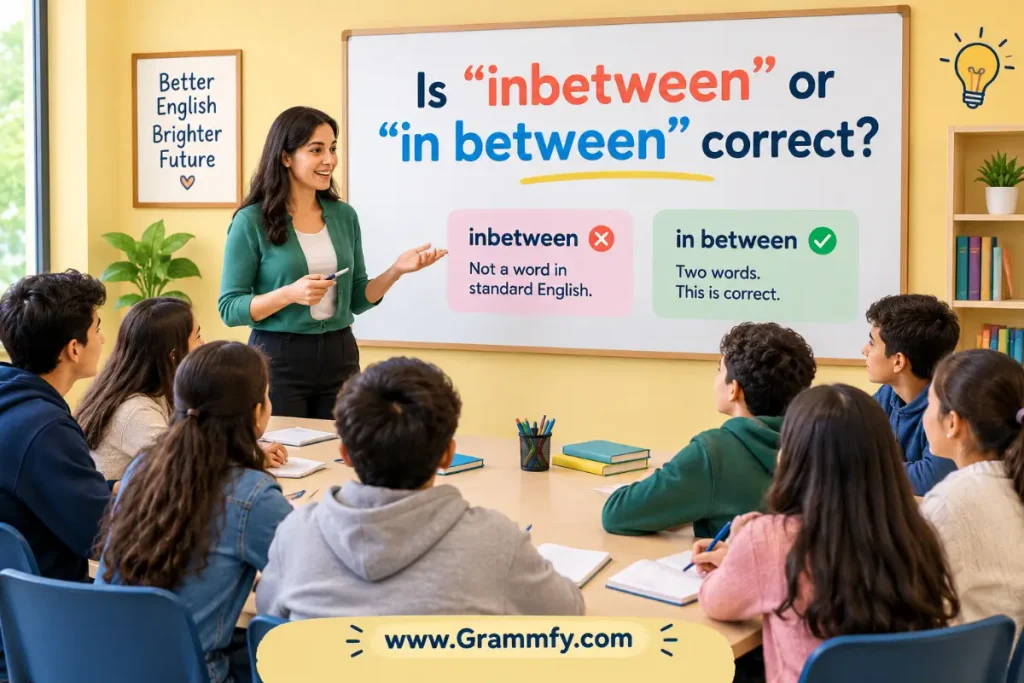
Is “inbetween” or “in between” correct?
In between is the standard form in general English.
The phrase is normally written as two separate words when it means “between” or “in the middle of.”
Examples:
- The library is in between the bank and the post office.
- She sat in between her two sisters.
- I’ll call you in between meetings.
- There is a small difference in between the two options.
The single-word spelling inbetween is generally not used in standard edited English. You may occasionally see it in informal writing, names, websites, or creative contexts, but that does not make it the preferred standard spelling.
What about “in-between”?
You may also see in-between with a hyphen.
This form can be used when the expression functions as an adjective or noun, especially when describing something intermediate or occupying a middle position.
Examples:
- She chose an in-between size.
- The character lives in an in-between state.
- There was no clear choice, only an in-between.
However, the two-word in between is the normal choice when the phrase functions as an adverb or preposition.
A useful basic rule is:
| Form | Common use | Example |
|---|---|---|
| in between | Standard phrase | She sat in between us. |
| in-between | Adjective or noun in certain uses | He chose an in-between option. |
| inbetween | Generally nonstandard | Avoid it in standard writing. |
What does “in between” mean?
In between means in the middle of two things or at a position separating two things.
The two things can be physical objects:
The ball is in between the chairs.
They can be people:
Maya sat in between Ali and Sara.
They can be places:
The café is in between the school and the library.
The people can also be times:
I’ll see you in between classes.
Or they can be ideas, levels, or choices:
The color is somewhere in between blue and green.
The phrase can therefore describe both physical and abstract positions.
How does “in between” work in a sentence?
The phrase often comes before a noun or pronoun that identifies the two things involved.
Examples:
The shop is in between the bank and the hotel.
She stood in between them.
We met in between classes.
It can also appear at the end of a sentence when the context already makes the meaning clear.
There are two buildings, with a parking lot in between.
The phrase does not always need to be followed immediately by the names of two things.
Why is “inbetween” confusing?
The confusion comes from the way English creates compound words.
Many common English expressions began as separate words and later developed hyphenated or closed forms.
For example:
- in side → inside
- some where → somewhere
- every where → everywhere
Because English contains many one-word compounds, writers sometimes assume that in between should also be combined.
But spelling patterns are not always predictable. The standard form remains in between when the phrase is used in its ordinary sense.
The safest approach is to learn the expression as a fixed phrase rather than trying to spell it based on how it sounds.
Where did “in between” come from?
The word between has very old roots in English. It comes from Old English forms related to the idea of being in the space separating two things.
The prefix-like word in adds the idea of being inside or within a particular position or space.
Together, in between developed as an expression for something located in the middle or separating two points.
Its meaning expanded beyond physical location. Modern English uses it for:
- physical position
- time
- relationships
- choices
- levels
- stages
- conditions
- opinions
- categories
For example:
The house stands in between two larger buildings.
This is physical.
I studied in between classes.
This relates to time.
His opinion falls somewhere in between the two extremes.
This is abstract.
The basic idea remains the same: something occupies a middle position.
What is the plain-English meaning of “in between”?
In simple English, in between means:
“In the middle of two things.”
You can think of it as a position that is neither fully on one side nor fully on the other.
For example:
The number 5 is in between 4 and 6.
Tuesday is in between Monday and Wednesday.
A medium shirt is in between a small and a large.
The phrase can describe a location, time, size, level, or condition.
What is the difference between “between” and “in between”?
These expressions are closely related, but their sentence patterns can differ.
Between is a preposition that commonly introduces the things being compared or separated.
The store is between the bank and the school.
In between emphasizes the position or location in the middle.
The store is in between the bank and the school.
Both can be correct.
Compare:
| Between | In between |
|---|---|
| The house is between two trees. | The house is in between two trees. |
| She sat between her friends. | She sat in between her friends. |
| The meeting is between lunch and dinner. | The meeting is in between lunch and dinner. |
In many everyday sentences, the meanings overlap.
When is “between” enough?
If you’re simply describing a relationship or position separating two things, between is often the cleaner choice.
The school is between the bank and the library.
You don’t always need the extra word in.
When does “in between” sound natural?
In between often feels more conversational and emphasizes being located within the middle space or period.
She stood in between the two chairs.
I’ll finish it in between meetings.
There was a small table in between the sofas.
Both forms can be natural depending on the sentence.
What is the difference between “in between” and “among”?
These words are not interchangeable.
Between is traditionally associated with separate, distinct items, especially two items.
The agreement was made between the two companies.
Among generally refers to being surrounded by or included within a group.
She was sitting among her classmates.
Compare:
| Phrase | Typical meaning | Example |
|---|---|---|
| Between | Separating or relating distinct things | The shop is between two buildings. |
| In between | In the middle of two things | The shop is in between two buildings. |
| Among | Within a group | She was among her friends. |
Although modern English can use between with more than two distinct entities, among remains common when the focus is on a group rather than individual relationships.
Master synonym list for “in between”
There is no perfect synonym for every use of in between. The best replacement depends on whether you’re describing physical position, time, level, or an intermediate condition.
| Group | Word/Phrase | Meaning | Tone | Example |
|---|---|---|---|---|
| Simple | Middle | Central position | Everyday | The café is in the middle. |
| Simple | Between | Separating two things | Neutral | The house is between two trees. |
| Simple | Center | Central point | Neutral | The bench is near the center. |
| Simple | Halfway | Equal distance between points | Everyday | We’re halfway there. |
| Simple | Intermediate | Between basic and advanced | Neutral | She took an intermediate course. |
| Simple | Middle ground | Position between extremes | Neutral | We found a middle ground. |
| Everyday | In the middle | Located between things | Everyday | He stood in the middle. |
| Everyday | In the center | At a central position | Everyday | She sat in the center. |
| Formal | Intermediate | Existing between two levels | Formal/Neutral | Choose an intermediate level. |
| Formal | Middle ground | A compromise or moderate position | Formal/Neutral | They reached middle ground. |
| Formal | Transitional | Relating to a change between stages | Formal | This is a transitional phase. |
| Formal | Central position | Position at the center | Formal | The issue occupies a central position. |
| Slang | Somewhere in the middle | Not clearly one side or another | Casual | I’m somewhere in the middle. |
| Slang | Halfway-ish | Roughly halfway | Very casual | We’re halfway-ish there. |
| Slang | Kind of between | Not exactly one category | Casual | It’s kind of between the two. |
| Slang | In the middle-ish | Roughly central | Very casual | It’s middle-ish in size. |
Some alternatives are direct replacements, while others only work in specific contexts. Middle, between, midway, and halfway are useful for location or position. Intermediate works better for levels or stages. Middle ground often describes opinions or compromises.
Which synonyms work for different situations?
For physical location
Good choices include:
- between
- in the middle
- midway
- halfway between
- at the center
Example:
The hotel is in between the station and the airport.
Possible alternatives:
The hotel is between the station and the airport.
The hotel is midway between the station and the airport.
The second and third versions may sound more concise.
For time
Useful alternatives include:
- between
- during the interval
- in the middle
- midway through
- between periods
Example:
I usually exercise in between classes.
You could say:
I usually exercise between classes.
Or:
I exercise during the break between classes.
The last version gives more specific information.
For levels
Use words such as:
- intermediate
- middle
- moderate
- midway
- medium
Example:
She chose a level in between beginner and advanced.
A more concise alternative is:
She chose an intermediate level.
For opinions
Useful alternatives include:
- middle ground
- moderate position
- compromise
- balanced position
- intermediate position
Example:
His opinion is somewhere in between the two sides.
A more formal version could be:
His opinion takes a middle-ground position.
How strong are the synonyms?
The phrase in between is neutral. Other expressions can add different levels of precision.
| Strength/Precision | Expression | Use |
|---|---|---|
| Very general | In between | Broad middle position |
| General | Middle | Central position |
| Moderate | Somewhere between | Approximate middle |
| More precise | Midway | Near the middle |
| Very precise | Halfway | Equal distance or progress |
| Technical | Midpoint | Exact mathematical middle |
| Abstract | Middle ground | Position between opposing views |
| Formal | Intermediate | Between two levels or stages |
For example:
The café is in between the two stations.
This is general.
The café is halfway between the two stations.
This suggests a more exact middle point.
The midpoint between the stations is near the café.
This is more technical.
What parts of speech are involved?
Understanding grammar is one of the easiest ways to choose the correct spelling.
“In between” as a prepositional phrase
The phrase can show the relationship between a location and two other things.
The house is in between the trees.
She sat in between her parents.
“In between” as an adverbial expression
It can also describe an action or position without directly introducing two objects.
The children ran outside, while their parents talked in between.
There are several stops in between.
“In-between” as an adjective
The hyphenated form can describe something that is intermediate.
She needs an in-between size.
It was an in-between stage.
“In-between” as a noun
In some contexts, the hyphenated expression can refer to an intermediate state or category.
He felt stuck in an in-between.
This use is less common and often depends on style and context.
“Inbetween” as a standard form
The closed form is generally not preferred in standard English when you mean the ordinary phrase in between.
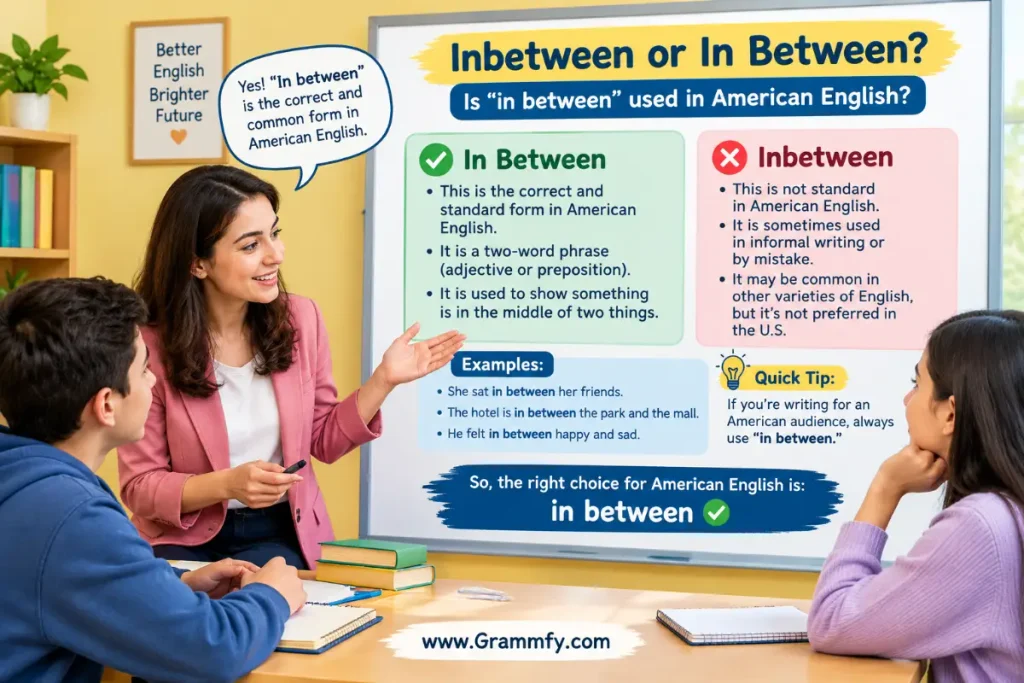
Is “in between” used in American English?
Yes. In between is common and standard in American English.
Examples include:
- in between classes
- in between meetings
- in between two buildings
- somewhere in between
- caught in between
- somewhere in between the two choices
American English also uses in-between as an adjective or noun in certain contexts.
The same general distinction applies in British English.
Is there a UK vs. US difference?
There is no major spelling difference between American and British English for the ordinary phrase.
Both varieties commonly use:
The house is in between two buildings.
Both can also use:
an in-between stage
The main variation you may notice is stylistic. Different dictionaries, publishers, and style guides may handle hyphenated compounds slightly differently.
For general writing, the safest choice is straightforward:
Use “in between” as two words for the ordinary phrase.
Is “in between” one word?
No. In standard general usage, the ordinary phrase is written as in between, with a space.
Incorrect in standard writing:
The shop is inbetween the buildings.
Correct:
The shop is in between the buildings.
The closed form may appear in informal or creative contexts, but it should not be your choice for normal academic, professional, or website writing.
Is “in-between” hyphenated?
It can be, especially when it acts as an adjective before a noun or as a noun in certain expressions.
Examples:
an in-between size
an in-between stage
an in-between option
However, don’t automatically add a hyphen every time you see the phrase.
For example:
She sat in between her parents.
The normal form is in between, not in-between.
Why does the hyphen matter?
A hyphen can show that two words are working together as a compound modifier.
Compare:
The two buildings have a space in between.
Here, in between is a phrase.
Now:
We need an in-between solution.
Here, in-between acts as a compound adjective describing solution.
The hyphen helps readers see that the two words function together before the noun.
This is similar to expressions such as:
- high-quality product
- long-term plan
- well-known writer
- middle-aged person
Hyphenation can vary with style, but the grammatical difference is useful.
What is the best form for a resume Inbetween or In Between?
For a resume, in between is usually the correct form when you need to describe time, location, or a middle position.
Examples:
Managed customer requests in between scheduled appointments.
Communicated with clients in between meetings.
However, resumes often benefit from concise wording. If in between can be replaced with a stronger phrase, consider doing so.
Instead of:
Completed tasks in between other assignments.
You might write:
Completed additional tasks during available work periods.
That sounds more professional and specific.
If you’re describing an intermediate level, intermediate may be better:
Intermediate knowledge of Microsoft Excel.
This is more concise than:
Knowledge in between beginner and advanced levels.
Resume example
Coordinated deliveries in between scheduled service appointments.
This is grammatically correct, but a stronger version could be:
Coordinated deliveries between scheduled service appointments.
The second version is shorter without changing the meaning.
What is the best form for an essay Inbetween or In Between?
In between is correct in essays when you’re describing a middle position or period.
Examples:
The village lies in between two major cities.
Students often balance work and study in between classes.
For formal essays, between, midway, intermediate, or middle ground may sometimes be more precise.
For example:
The country occupies a position in between the two major powers.
A more formal alternative:
The country occupies a position between the two major powers.
Or:
The country takes a middle-ground position.
The best choice depends on what you’re trying to communicate.
What is the best form for texting Inbetween or In Between?
Texting is informal, but in between is still the normal spelling.
Examples:
I’m in between classes rn.
Meet me somewhere in between.
It’s in between the two stores.
Even though texting allows abbreviations and casual spelling, using inbetween can still look like a spelling mistake.
If you’re writing a message for school or work, definitely use the standard form.
What is the best form for an email Inbetween or In Between?
In professional emails, use in between.
Examples:
I can call you in between meetings.
Please let me know if you have any availability in between those times.
The office is located in between the main entrance and the reception desk.
For polished business writing, between is often even more concise:
I can call you between meetings.
The meaning stays clear.
What is the best form when speaking Inbetween or In Between?
In conversation, in between is very natural.
You might say:
I’ll call you in between classes.
It’s somewhere in between.
She was sitting in between us.
The restaurant is in between the hotel and the station.
Since speech doesn’t show spaces or spelling, the distinction matters most when you write the phrase.
15+ original example sentences
Location
The pharmacy is in between the supermarket and the bank.
The phrase shows the pharmacy’s position relative to two places.
Seating
I sat in between my two friends during the movie.
The speaker occupied the middle seat.
Time
She finished her homework in between her evening classes.
The activity happened during the period separating the classes.
Travel
We stopped in between the two cities for lunch.
The stop happened at an intermediate point.
Color
The fabric is a shade in between blue and purple.
The color falls between two other colors.
Size
This jacket is an in-between size, so neither option fits perfectly.
Here, the hyphenated form works as an adjective before size.
Age
The program is designed for children in between six and eight years old.
A more natural version is often:
The program is designed for children between six and eight years old.
This shows that in between isn’t always the best choice even when it is understandable.
Work
I answer personal messages in between work tasks.
The phrase describes short periods separating tasks.
School
Students often chat in between lessons.
The activity happens during the gap between lessons.
Sports
The coach spoke to the players in between the two halves.
The conversation happened during the break.
Shopping
We found a small café in between two clothing stores.
The café was located between the stores.
Relationships
He felt caught in between his friends during the argument.
The expression is figurative. He felt positioned between two sides.
Decisions
I’m somewhere in between the two choices.
The speaker does not fully support either option.
Opinions
Her view falls somewhere in between the two extreme positions.
The opinion is moderate rather than extreme.
Mathematics
Five is in between four and six.
The number occupies the middle position.
Progress
We’re halfway between the starting point and the finish line.
Here, halfway between gives a more precise sense of position.
Seasons
The weather changes quickly in between seasons.
The phrase refers to a transition period.
Meetings
I usually have a few minutes in between meetings.
The speaker has a short free period separating appointments.
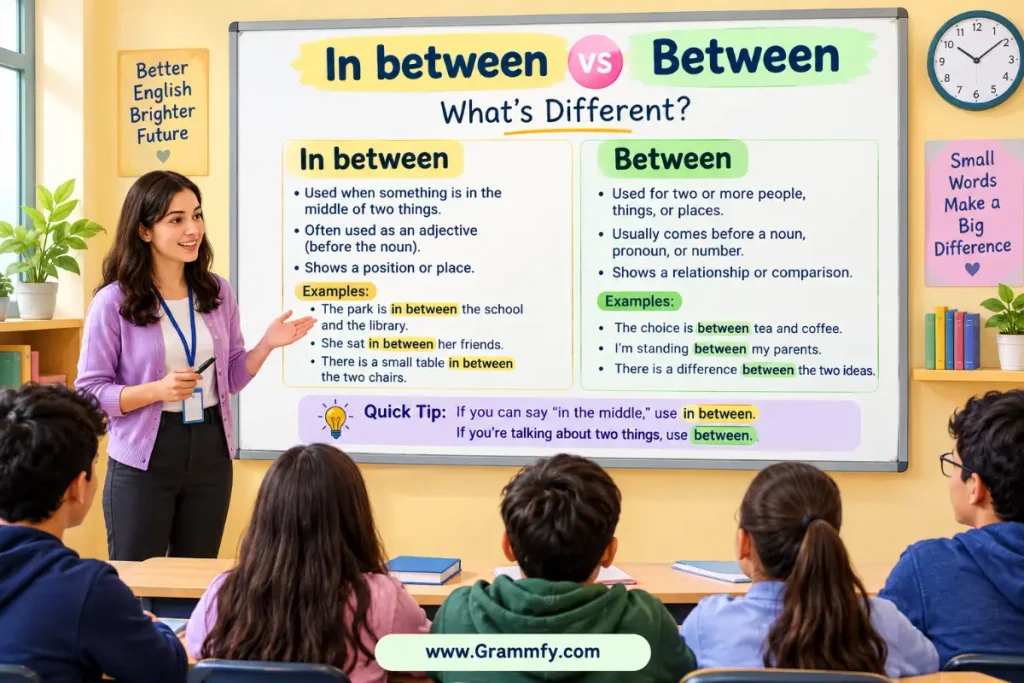
In between vs between: what’s different?
The two expressions often overlap, but between is usually simpler and more direct.
| In between | Between |
|---|---|
| More conversational in some contexts | Often more concise |
| Emphasizes middle position | Shows a relationship or separation |
| She sat in between them. | She sat between them. |
| The café is in between two stores. | The café is between two stores. |
| I’ll call in between meetings. | I’ll call between meetings. |
In many sentences, both forms are correct.
For formal writing, between can often be the cleaner choice.
For everyday speech, in between is perfectly natural.
In between vs among: what’s different?
Between focuses on separate items or positions. Among focuses on a group.
Compare:
She stood in between her two brothers.
The sentence identifies two specific people.
She stood among her classmates.
The sentence places her within a larger group.
Another example:
The house is between the trees.
This emphasizes the relationship between the house and the trees.
The house is among the trees.
This means trees surround or are distributed around the house.
The choice depends on the relationship you’re describing.
In between vs middle: what’s different?
Middle is a noun or adjective, while in between is a phrase.
Compare:
The café is in the middle of the street.
The café is in between two buildings.
The first describes a central position within one area.
The second describes a position separating two specific things.
You can also say:
She stood in the middle.
But:
She stood in between.
usually feels incomplete unless the listener already knows what she is between.
For example:
She stood in between the two chairs.
The objects complete the idea.
In between vs midway: what’s different?
Midway means approximately or exactly halfway between two points.
The hotel is midway between the airport and downtown.
This is more precise than:
The hotel is in between the airport and downtown.
In between simply identifies an intermediate position.
Midway highlights the middle point or approximate halfway position.
In between vs intermediate: what’s different?
Intermediate is especially useful for levels, stages, and degrees.
She is at an intermediate level in Spanish.
This sounds more natural than:
She is at a level in between beginner and advanced in Spanish.
Use in between when describing a position generally.
Use intermediate when there is a recognized level between two stages.
Examples:
an intermediate course
an intermediate learner
an intermediate stage
Common mistakes with “in between”
Mistake 1: Writing “inbetween”
Incorrect:
The school is inbetween the two buildings.
Correct:
The school is in between the two buildings.
The standard phrase is written as two words.
Mistake 2: Using “in between” when “between” is cleaner
This isn’t always a spelling error, but it can create unnecessary wording.
Wordy:
The hotel is located in between the airport and the city center.
Cleaner:
The hotel is located between the airport and the city center.
Both can be understood, but the second is more concise.
Mistake 3: Adding a hyphen everywhere
Incorrect for ordinary phrase use:
She sat in-between her friends.
Better:
She sat in between her friends.
The hyphenated form is more appropriate when the words act as a compound modifier or noun in contexts where that spelling is used.
Mistake 4: Forgetting the two things being compared
Sometimes writers use in between without making the relationship clear.
Unclear:
The store is in between.
Clear:
The store is in between the bank and the post office.
If the context is already obvious, the shorter version can work:
There is a café, and the store is in between.
Mistake 5: Using it with an unnecessary “of”
Incorrect:
The shop is in between of the bank and the school.
Correct:
The shop is in between the bank and the school.
Or more simply:
The shop is between the bank and the school.
Don’t add of after in between.
Mistake 6: Confusing “in between” with “in the middle of”
These expressions often overlap, but they have slightly different patterns.
Correct:
She sat in between her parents.
Correct:
She sat in the middle of her parents.
The second sentence sounds less natural in some contexts because in the middle of often refers to a space, activity, or group rather than specifically two people.
When should you NOT use “in between”?
Avoid the phrase when another expression is more natural or precise.
Use “between” when it is shorter and clearer
Instead of:
The town is in between two mountains.
You can write:
The town is between two mountains.
Use “midway” when you mean halfway
We stopped midway through the journey.
This is better than a vague phrase when exact progress matters.
Use “intermediate” for recognized levels
He is an intermediate learner.
This is cleaner than:
He is in between beginner and advanced.
Use “among” for groups
She was among her classmates.
Not:
She was in between her classmates.
unless you specifically mean she was physically positioned between particular classmates.
Is “inbetween” ever acceptable?
You may encounter inbetween in informal writing, creative names, usernames, titles, brand names, or other contexts where spelling is intentionally modified.
For example, a business or artistic project might choose Inbetween as its name.
That doesn’t change the general grammar rule for standard English.
If you’re writing:
- an essay
- a resume
- an email
- a report
- a school assignment
- a website article
- a professional message
use in between for the ordinary phrase.
What are the antonyms of “in between”?
Possible opposites depend on context.
For physical position:
- outside
- beside
- apart
- at either end
- beyond
For a scale or level:
- extreme
- maximum
- minimum
- beginning
- end
And For a process:
- start
- finish
- beginning
- completion
Example:
The store is in between the two buildings.
An opposite position might be:
The store is outside the area between the buildings.
There is no single universal antonym for in between because its meaning changes with context.
How can you remember the correct spelling?
Use a simple visual trick:
Think: “in + between”
The phrase literally contains the word between, so keep the two words separate:
in + between = in between
You can also remember:
I am in between two things.
The word in stays separate from between.
Another useful sentence is:
The café is in between the bank and the school.
If you’re describing a middle position, start with the standard two-word form.
Remember the hyphen rule
If the phrase directly describes a noun as a compound adjective, a hyphen may be appropriate:
an in-between size
But when you’re describing a position or action:
She sat in between us.
This distinction can help you avoid unnecessary hyphens.
Quick tips for choosing the right form
- Use “in between” for the ordinary phrase.
This is the standard form. - Avoid “inbetween” in formal and standard writing.
It is generally considered nonstandard. - Use “in-between” when it functions as a compound adjective or noun where that form is appropriate.
- Consider “between” first.
If the sentence works without in, the shorter version may be better. - Use “midway” for halfway positions.
- Use “intermediate” for levels and stages.
- Use “among” when you’re talking about a group.
- Never add “of” after “in between.”
Say “in between the two buildings,” not “in between of the two buildings.” - Read the sentence aloud.
Then check the written form separately because pronunciation won’t tell you whether the words should be joined. - For school or professional writing, choose the standard form.
When in doubt, write in between.
A quick comparison chart
| Form | Correct? | Main use | Example |
|---|---|---|---|
| in between | Yes | Standard phrase | She sat in between us. |
| in-between | Yes, in certain uses | Compound adjective/noun | We need an in-between option. |
| inbetween | Generally no | Avoid in standard writing | — |
| between | Yes | Direct alternative | She sat between us. |
| midway | Yes | Halfway position | We stopped midway. |
| intermediate | Yes | Middle level/stage | He is an intermediate learner. |
| among | Yes | Within a group | She sat among her friends. |
How should you use “in between” in professional writing?
Professional writing should favor clarity and economy.
Consider:
I will be available in between my meetings.
This is correct.
But:
I will be available between my meetings.
is shorter and equally clear.
For business communication, don’t avoid in between simply because it sounds conversational. It’s a standard phrase. Just avoid unnecessary wording when a simpler construction works.
Another example:
The office is in between the reception area and the conference room.
This is fine.
A more concise version:
The office is between the reception area and the conference room.
Both communicate the same basic idea.
How should you use “in between” in creative writing?
Creative writing gives you more freedom with rhythm and tone.
For example:
She felt caught in between two worlds.
This is natural and expressive.
Another example:
There was a quiet space in between the noise and the silence.
The phrase can help describe emotional or abstract states, not just physical locations.
You can also use in-between as a descriptive adjective:
He was living through an in-between phase of his life.
This suggests a transitional period.
Can “in between” describe time?
Yes. This is one of its most common uses.
Examples:
- in between classes
- in between meetings
- in between appointments
- in between meals
- in between jobs
- in between shifts
- in between activities
For example:
I usually read in between classes.
The reading happens during the period separating the classes.
However, between is often shorter:
I usually read between classes.
Both are natural.
Can “in between” describe emotions or ideas?
Yes. The phrase can be used figuratively.
Examples:
She felt caught in between two cultures.
His opinion is somewhere in between the two extremes.
I’m in between excitement and nervousness.
The story explores the space in between childhood and adulthood.
These uses extend the physical idea of being in a middle position into abstract situations.
Can “in between” describe size?
Yes.
For example:
I need something in between small and medium.
You can also use the adjective form:
I need an in-between size.
In clothing, in-between size can be useful when a person doesn’t fit neatly into standard categories.
Other possibilities include:
- medium
- mid-size
- intermediate
- moderate
The best word depends on the specific situation.
Can “in between” describe age?
Yes, but there are often more natural alternatives.
You might say:
She is somewhere in between childhood and adolescence.
Or:
The program is for children between six and eight.
The second version is more concise when you simply need to give an age range.
Avoid forcing in between into every sentence just because the meaning involves two points.
Can “in between” describe two choices?
Yes.
Examples:
I can’t decide because I’m somewhere in between the two choices.
Her opinion falls in between the two positions.
For a formal discussion, middle ground may be better:
The committee tried to find a middle ground.
This suggests compromise rather than merely physical or abstract position.
Conclusion
The main rule for Inbetween or In Between is simple: use in between when the phrase means being in the middle of two things, times, places, levels, or ideas. The single-word inbetween is generally not standard English, so it should be avoided in essays, resumes, emails, and other polished writing. You may also see in-between when the expression works as a compound adjective or noun, such as “an in-between size.” When a shorter option works, between is often the cleanest choice. For more specific meanings, words like midway, halfway, intermediate, or middle ground can make your sentence more precise. Once you connect the spelling to the grammatical role, this small but common word-choice problem becomes much easier to handle.
Frequently Asked Questions
Is “inbetween” one word or two?
In between is normally written as two words in standard English. The closed form inbetween should generally be avoided in formal and edited writing.
Is “in-between” grammatically correct?
In-between can be correct when it functions as a compound adjective or noun in certain contexts. For example, “an in-between size” is a common type of construction.
Is it “in between” or “between”?
Both can be correct, but between is often shorter and more direct. For example, “The shop is between the bank and the school” is a clean alternative to “The shop is in between the bank and the school.”
What’s another way to say “in between”?
Good alternatives include between, in the middle, midway, halfway, intermediate, middle ground, and somewhere between. The best option depends on whether you’re describing location, time, level, or an abstract position.
Is “inbetween” acceptable in an essay?
No, inbetween is generally not the standard choice for an essay. Use in between instead when you mean a position separating two things.
Can I say “in between of”?
No, “in between of” is incorrect in standard English. Say “in between the two buildings” or simply “between the two buildings.”
Is “in between” used in American English?
Yes, in between is standard and common in American English. British English also uses the same basic form, although hyphenation can vary in some compound uses.
