
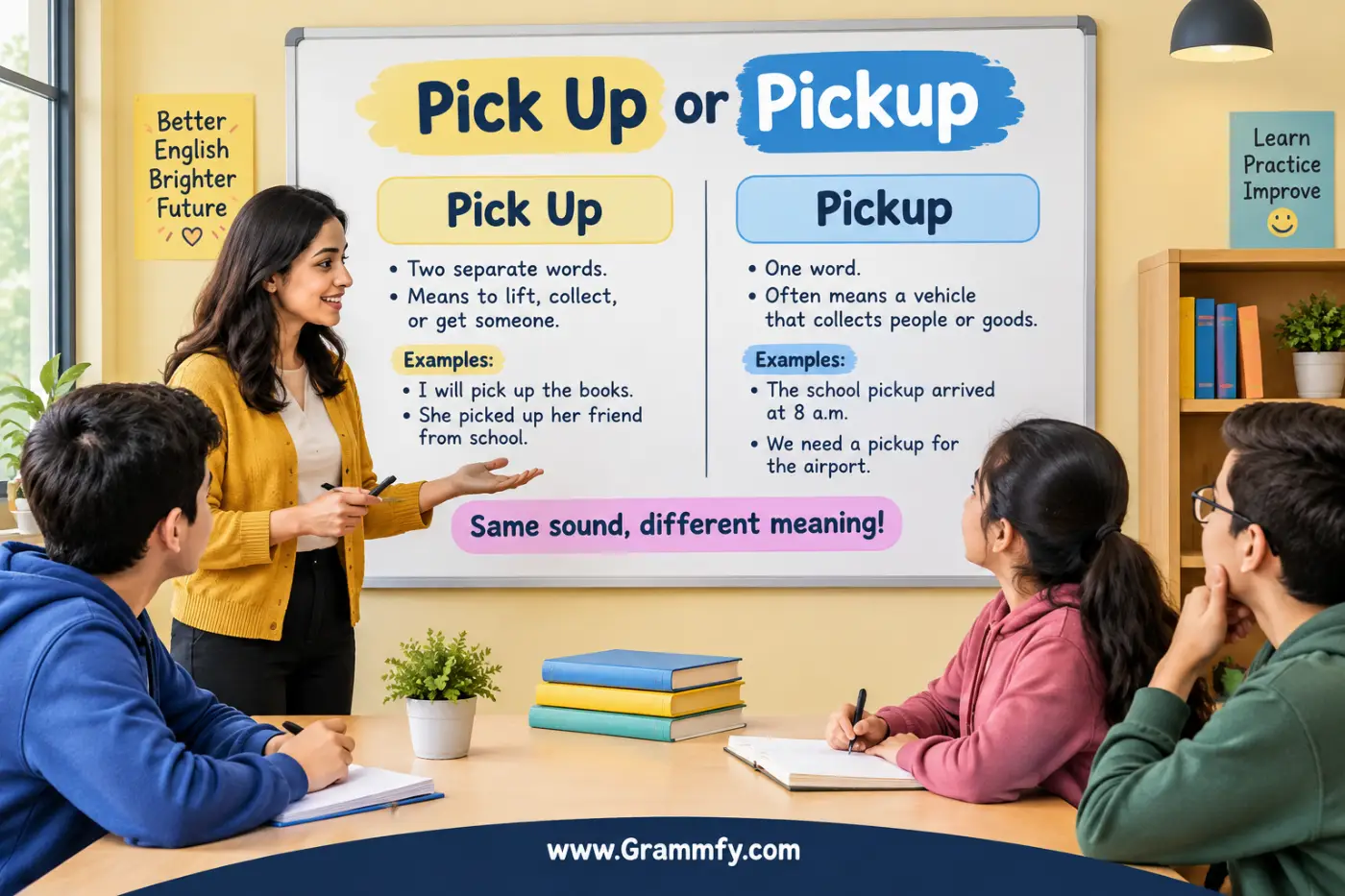
Have you ever stopped while writing an email, essay, resume, or text because you weren’t sure whether to write Pick Up or Pickup? You’re not alone. These two forms look almost identical, and both are correct in English. The tricky part is knowing when to use the two-word verb pick up and when to use the one-word noun or adjective pickup.
Pick up is usually a verb meaning to collect, lift, learn, improve, or give someone a ride. Pickup is usually a noun or adjective describing the thing, event, vehicle, or arrangement connected with that action.
For example, you might pick up a package, pick up your child from school, or pick up a new skill. However, you might arrange a pickup time, drive a pickup truck, or talk about a pickup location.
The difference becomes much easier once you look at the grammatical role of each form. This guide explains the meanings, word history, grammar rules, synonyms, examples, regional differences, common mistakes, and the best choice for professional and casual writing.
You may also want to learn the difference between [Waste vs Waist].
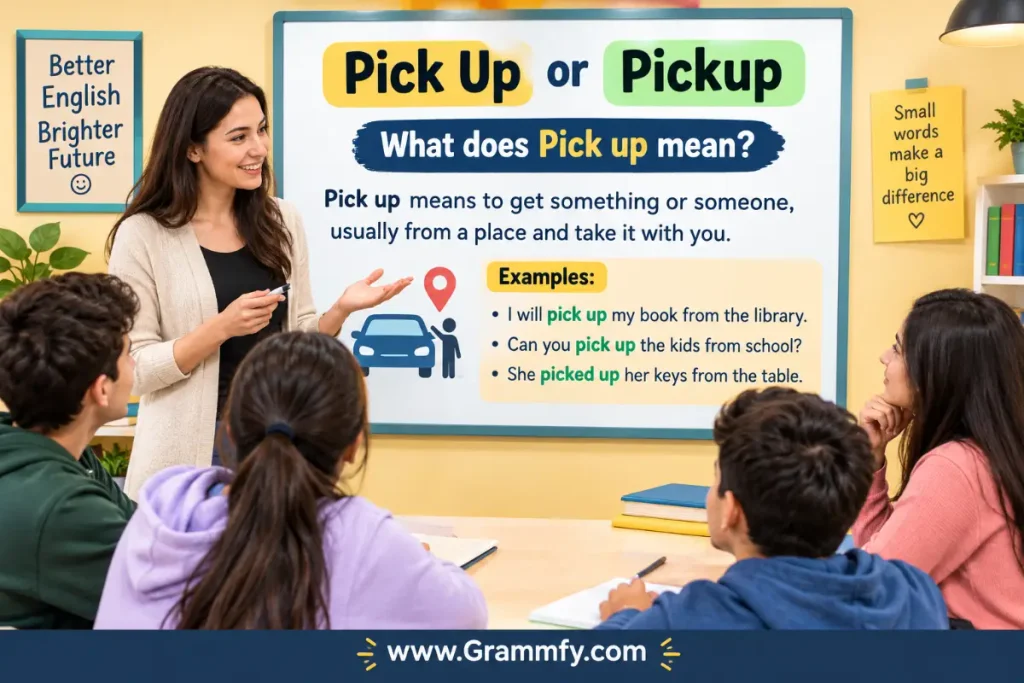
What does Pick up mean?
Pick up is a phrasal verb. A phrasal verb combines a verb with another small word, such as an adverb or preposition, to create a meaning that may differ from the original verb.
The verb pick up has many meanings. Its exact meaning depends on the context.
Here are some of the most common uses:
| Meaning | Example |
|---|---|
| Lift something | Please pick up the book. |
| Collect something | I’ll pick up the package tomorrow. |
| Collect someone by car | Can you pick me up at six? |
| Buy something casually | I picked up some groceries. |
| Learn something | She picked up Spanish quickly. |
| Improve | Business is picking up. |
| Answer a phone | He didn’t pick up the phone. |
| Notice or detect | The microphone picked up a strange sound. |
| Resume something | Let’s pick up where we left off. |
| Remove something | Pick up the toys from the floor. |
Because pick up has so many meanings, it is one of the most useful everyday phrasal verbs in English.
How does Pick up work as a verb?
The word pick remains separate from up when the expression functions as a verb.
For example:
I will pick up the documents.
Here, pick up describes an action.
You can change its tense:
- I pick up my sister at 5 p.m.
- I picked up my sister yesterday.
- I am picking up my sister now.
- I will pick up my sister tomorrow.
The two words stay separate.
What does pickup mean?
Pickup is generally used as a noun or adjective.
As a noun, it can refer to the act or arrangement of collecting someone or something.
Examples include:
The package is ready for pickup.
Pickup is available after 4 p.m.
Please choose a pickup time.
In American English, pickup can also refer to a type of truck.
He drives a pickup.
As an adjective, it can describe something related to collection or a pickup truck.
Examples include:
pickup location
pickup time
pickup order
pickup truck
The important point is grammatical: when the word is acting as a verb, write pick up. When it functions as a noun or adjective, pickup is commonly written as one word.
Why are Pick up vs Pickup confusing?
The confusion comes from English word formation.
Phrasal verbs often begin as separate words. Over time, some combinations become nouns or adjectives and develop their own spelling.
For example:
- pick up = verb
- pickup = noun
- pickup = adjective
This pattern appears with several other English expressions:
| Verb | Noun/Adjective |
|---|---|
| log in | login |
| set up | setup |
| back up | backup |
| check out | checkout |
| break down | breakdown |
| work out | workout |
| take off | takeoff |
| follow up | follow-up |
English does not apply this pattern perfectly to every word, so you need to learn the common form used for each expression.
Where did pick up come from?
The verb pick is very old. It developed from words in earlier forms of English and related Germanic languages that referred to picking, plucking, or selecting something.
The word up is also an old English word associated with a higher position or movement toward a higher place.
The combination pick up gradually developed several figurative meanings beyond physically lifting something.
For example, the idea of lifting something led naturally to the meaning of collecting an object. From there, pick up developed other meanings, such as collecting people, learning information, improving, detecting sounds, and continuing an activity.
The noun pickup developed later from the verb phrase. Modern English uses the noun in several specialized ways, including collection arrangements and pickup trucks.
What is the basic grammar rule?
The easiest rule is:
Use “pick up” when it is an action. Use “pickup” when it is a noun or adjective.
Compare these sentences:
I need to pick up my order.
The pickup is scheduled for noon.
The first sentence describes what someone will do. The second names an arrangement or event.
Another pair:
She will pick up the children after school.
The pickup time is 3:30 p.m.
The meaning is related, but the grammatical function is different.
Can pick up be separated?
Yes. As a phrasal verb, pick up can often be separated when the object is a noun.
You can say:
Pick up the phone.
or:
Pick the phone up.
Both are grammatically acceptable.
With a pronoun, separation is normally required:
Pick it up.
Not:
Pick up it.
Here are more examples:
- Pick up the papers.
- Pick the papers up.
- Pick them up.
- Pick up the children.
- Pick the children up.
- Pick them up.
This is an important feature of the phrasal verb.
What are the main meanings of pick up?
Pick up means to lift something
This is the most literal meaning.
Please pick up that pencil.
She picked up the box from the floor.
He bent down to pick up the keys.
The action involves moving something from a lower position into your hands or another higher position.
Pick up means to collect something
This use is extremely common.
I’ll pick up the package after work.
She picked up her prescription from the pharmacy.
We need to pick up the documents before the office closes.
Here, pick up means to go somewhere and collect something.
Pick up means to collect a person
The expression is also used for giving someone a ride.
Can you pick me up at the station?
Dad will pick us up after school.
I’ll pick you up at seven.
This does not necessarily mean lifting the person. It means arriving somewhere to collect them, usually by car.
Pick up means to buy something
In casual English, pick up can mean to obtain or buy something, especially while you’re already somewhere.
I’ll pick up some milk on my way home.
She picked up a new notebook at the store.
Can you pick up some bread?
This use is common in everyday American English.
Pick up means to learn something informally
You can pick up a language, habit, skill, fact, or expression without studying it in a formal way.
He picked up a few French phrases while traveling.
Children often pick up new words quickly.
I picked up some useful tips from my coworker.
The idea is that you acquire the information naturally or casually.
Pick up means to improve
The expression can describe an increase in activity, speed, business, or energy.
Sales are starting to pick up.
The wind picked up during the afternoon.
Business usually picks up during the holidays.
Here, pick up means to become stronger, faster, busier, or more active.
Pick up means to answer a phone
In everyday speech, pick up can mean answering a phone call.
Why didn’t you pick up?
She picked up after the third ring.
Please pick up the phone.
This meaning is especially common in informal conversation.
Pick up means to detect something
A device can pick up a sound, signal, smell, or other information.
The microphone picked up background noise.
The radio picked up a weak signal.
The sensor picked up movement.
This use means to detect or receive something.
Pick up means to continue
The expression can also mean to continue from a previous point.
Let’s pick up where we left off yesterday.
We’ll pick up the discussion tomorrow.
Here, the activity stopped temporarily and is now continuing.
What does pickup mean as a noun?
The noun pickup has several meanings.
Pickup can mean the collection of something
Your order is ready for pickup.
We offer free pickup.
The pickup will take place between 2 and 4 p.m.
Here, pickup names the collection process or arrangement.
Pickup can mean the collection of a person
In some contexts, pickup can describe the act or arrangement of collecting someone.
The children’s pickup is at 3 p.m.
We need to arrange a pickup from the airport.
In casual speech, people often use the phrasal verb instead:
I’ll pick you up at 3 p.m.
The noun is useful when discussing a schedule, service, or arrangement.
Pickup can mean a pickup truck
In American English, a pickup can mean a pickup truck.
He bought a new pickup.
That pickup has a large bed.
She drives a pickup truck to work.
The shortened noun pickup is especially common in American speech.
Pickup can describe a physical improvement
The noun can also describe an increase or improvement.
The team got a pickup after halftime.
This use is more specialized and depends heavily on context.
Master synonym list for pick up or pickup
The best synonym depends on the meaning. Since pick up has many uses, there is no single replacement that works in every sentence.
| Word/Phrase | Meaning | Tone | Example |
|---|---|---|---|
| Lift | Raise something | Everyday | Lift the box carefully. |
| Collect | Get something from a place | Neutral | I’ll collect the package. |
| Retrieve | Get something back | Formal | Please retrieve the file. |
| Get | Receive or obtain | Everyday | I’ll get the package. |
| Acquire | Gain or obtain | Formal | He acquired a new skill. |
| Buy | Purchase something | Everyday | I’ll buy some bread. |
| Learn | Gain knowledge | Everyday | She learned Spanish quickly. |
| Notice | Become aware of something | Everyday | Did you notice that sound? |
| Detect | Discover a signal or problem | Formal | The device detected movement. |
| Answer | Respond to a call | Everyday | Please answer the phone. |
| Resume | Continue after a pause | Formal | We resumed the meeting. |
| Improve | Become better | Neutral | Sales improved in June. |
| Increase | Become greater | Neutral/Formal | Demand increased sharply. |
| Recover | Return to a better state | Neutral | The market recovered. |
| Rise | Move to a higher level | Neutral | Prices began to rise. |
| Grow | Become greater | Neutral | Interest continued to grow. |
| Collect | Take something from someone | Neutral | The courier collects returns. |
| Retrieve | Recover something | Formal | The system retrieved the data. |
| Pickup | Collection arrangement | Neutral | The pickup is at noon. |
| Checkout | Place where goods are paid for | Everyday | Meet me at checkout. |
| Collection | Act of collecting | Neutral/Formal | The collection is scheduled. |
| Retrieval | Act of getting something back | Formal | Data retrieval was successful. |
| Acquisition | Act of obtaining something | Formal | The acquisition took months. |
Some of these words overlap only with one particular meaning. For example, lift can replace pick up when you mean physically raising an object, but it cannot replace pick up in every context.
Which synonyms work for each meaning?
If pick up means lift
Good alternatives include:
- lift
- raise
- take
- retrieve
Example:
Pick up the bag.
Possible alternative:
Lift the bag.
If pick up means collect
Useful alternatives include:
- collect
- retrieve
- get
- obtain
- fetch
Example:
I’ll pick up the documents.
Alternative:
I’ll collect the documents.
If pick up means buy
Use:
- buy
- purchase
- get
Example:
I’ll pick up some groceries.
Alternative:
I’ll buy some groceries.
The original expression sounds more casual.
If pick up means learn
Use:
- learn
- acquire
- absorb
- develop
Example:
She picked up the language quickly.
Alternative:
She learned the language quickly.
If pick up means improve
Possible alternatives include:
- improve
- increase
- rise
- grow
- recover
Example:
Business is picking up.
Alternative:
Business is improving.
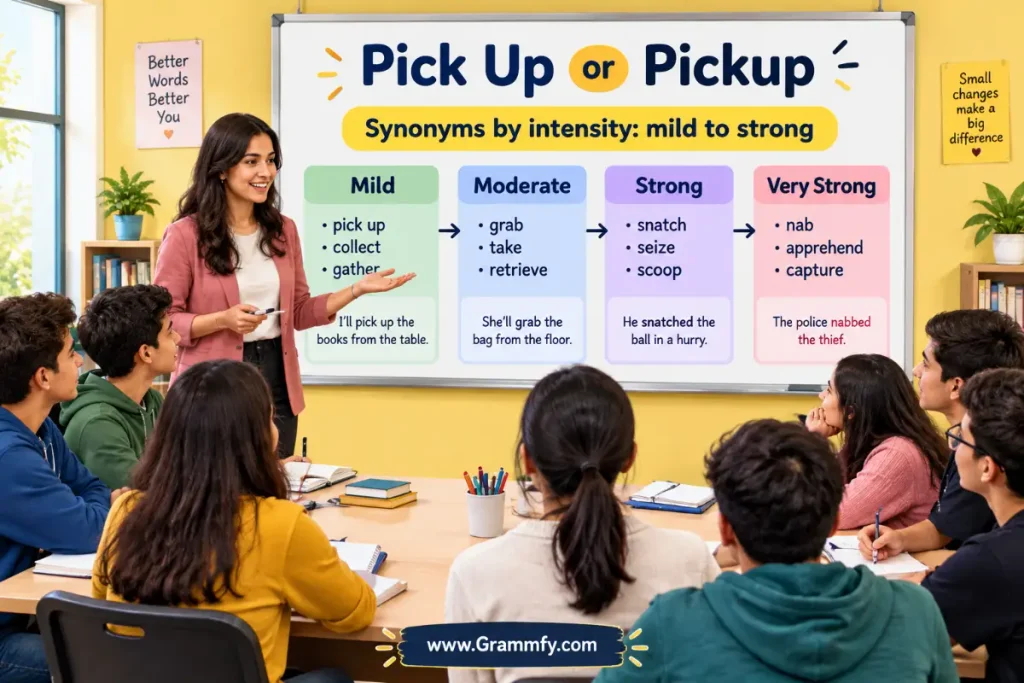
Synonyms by intensity: mild to strong
The right synonym can change the strength and tone of your sentence.
| Intensity | Word | Typical effect |
|---|---|---|
| Mild | Get | Very general |
| Mild | Take | General |
| Mild | Pick up | Casual and flexible |
| Mild | Collect | Clear and neutral |
| Moderate | Retrieve | More precise |
| Moderate | Obtain | More formal |
| Strong/Formal | Acquire | Suggests gaining something valuable |
| Strong/Formal | Recover | Suggests getting something back after loss |
For example:
I got the documents.
This is simple and casual.
I picked up the documents.
This suggests you went somewhere or took action to collect them.
I retrieved the documents.
This sounds more formal and may suggest that the documents had been stored or needed to be recovered.
What part of speech is pick up?
Pick up is primarily a phrasal verb.
Examples:
- pick up a package
- pick up a person
- pick up a skill
- pick up information
- pick up a phone
- pick up speed
It can also appear in different verb forms:
| Form | Example |
|---|---|
| Base | pick up |
| Third person | picks up |
| Past | picked up |
| Present participle | picking up |
| Infinitive | to pick up |
Examples:
She picks up her son at four.
She picked up her son yesterday.
She is picking up her son now.
She plans to pick up her son later.
Pickup, by contrast, is generally a noun or adjective.
Is pickup an adjective?
Yes. Pickup can work as a noun modifier in compounds.
Examples:
- pickup truck
- pickup location
- pickup time
- pickup order
- pickup service
- pickup point
In these expressions, pickup describes the following noun.
For example:
Please go to the pickup location.
The word tells you what kind of location it is.
What’s the pickup time?
Here, it identifies the time connected with collection.
Is pickup always one word?
Not in every related construction.
English spelling can depend on the exact grammatical use and the style of a particular expression. Pickup is widely used as a noun and attributive adjective, while pick up remains the standard phrasal verb.
You may also encounter pick-up in some older, specialized, or style-dependent writing. However, modern general American English commonly uses pickup as the noun and adjective.
For ordinary writing, the safest rule is:
- pick up = verb
- pickup = noun/adjective
US vs. UK usage: what should you know?
The basic verb pick up is common in both American and British English.
For example, both varieties commonly use:
I’ll pick you up at eight.
The noun pickup also exists in both varieties, but some specific uses are more strongly associated with American English.
One notable example is pickup truck, which is especially common in American English.
British English often uses pick-up truck or pickup truck, depending on the publication or style guide.
There are also regional differences in vocabulary around transportation and collection. However, the basic grammar rule remains useful across English varieties:
Pick up functions as the verb.
Pickup commonly functions as a noun or modifier.
What is the best form for a resume Pick Up or Pickup?
A resume usually benefits from clear, professional language.
Use pick up when you’re describing an action.
Pick up and deliver customer orders.
However, if you’re naming a process or service, pickup may be appropriate.
Managed daily customer pickup operations.
Coordinated pickup schedules for more than 50 orders per day.
For a resume, consider whether a more precise verb would be stronger.
Instead of:
Picked up customer orders.
You could write:
Collected and processed customer orders.
Instead of:
Picked up new skills quickly.
You could write:
Quickly acquired new technical skills.
The best choice depends on what you actually did and how formal the resume needs to sound.
What is the best form for an essay Pick Up or Pickup?
In an academic essay, pick up is correct when the expression functions as a verb, but the phrase can sound informal in some contexts.
For example:
Children pick up language through regular interaction.
This is natural and understandable.
In a formal essay, you might choose:
Children acquire language through regular interaction.
The second version is more academic.
For a noun, pickup may still be appropriate when the subject requires it.
The study examined customer pickup patterns.
Always choose the form based on grammar first, then consider whether the vocabulary matches the level of formality.
What is the best form for texting Pick Up or Pickup?
Texting is informal, so pick up is extremely common.
Examples:
Can you pick me up?
I’ll pick up food on the way.
Why didn’t you pick up?
I’ll pick you up at 7.
Use pickup when it acts as a noun:
What time is pickup?
The pickup is at 6.
Because texting often leaves out words, context is especially important.
What is the best form for an email Pick Up or Pickup?
For a professional email, use pick up as the verb.
I will pick up the documents tomorrow morning.
Use pickup when you’re referring to a scheduled collection, location, or service.
Your pickup is scheduled for 10 a.m.
Please visit the pickup location before 5 p.m.
If you want a more formal tone, collect can replace the verb:
I will collect the documents tomorrow morning.
That may sound more professional in some business situations.
What is the best form when speaking Pick Up or Pickup?
In everyday speech, pick up is one of the most natural choices.
You might say:
Can you pick me up from work?
I’ll pick up dinner.
Did you pick up the package?
Business is picking up.
Native speakers use this phrasal verb in many ordinary situations, so it is useful to learn several meanings rather than memorizing only one definition.
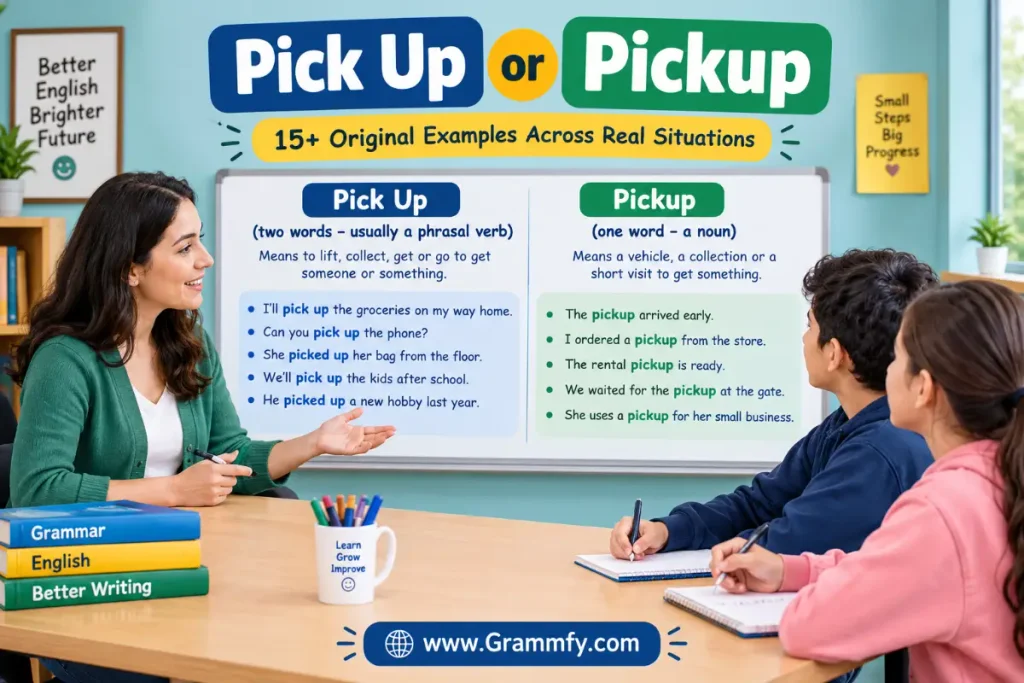
15+ original examples across real situations
At school
I need to pick up my books before I leave.
Here, pick up means physically collect or lift the books.
At work
I’ll pick up the documents from the front desk.
The speaker plans to collect the documents.
At a store
Can you pick up some milk on your way home?
The expression means buy or obtain something while traveling somewhere.
At a restaurant
I’ll pick up the order at six.
The speaker will collect the prepared food.
With family
Mom will pick me up after class.
The expression means come to collect someone, usually by vehicle.
At an airport
My brother is picking me up at the airport.
He will arrive and collect the speaker.
On the phone
I called her twice, but she didn’t pick up.
Here, the meaning is answer the phone.
Learning a language
He picked up several new English expressions during his trip.
He learned them informally.
At work training
She picked up the new software very quickly.
She learned how to use it quickly.
During a busy season
The restaurant gets much busier when tourism picks up.
The business becomes more active.
Weather
The wind picked up after sunset.
The wind became stronger.
Technology
The microphone picked up every small sound.
The microphone detected or recorded the sounds.
Conversation
Let’s pick up this conversation tomorrow.
The speakers plan to continue later.
Online shopping
Your order is ready for pickup.
Here, pickup is a noun describing the collection arrangement.
Retail
Please choose a pickup time during checkout.
The noun identifies the scheduled time for collecting an order.
Transportation
He bought a used pickup last year.
Here, pickup refers to a pickup truck.
Customer service
Free pickup is available for returned items.
The noun refers to a collection service.
Pick up vs get: what’s different?
Both expressions can mean obtaining something, but they aren’t always identical.
Get is extremely broad. It can mean receive, buy, obtain, understand, become, or fetch something.
Pick up often suggests an action involving collection or casual acquisition.
Compare:
| Pick up | Get |
|---|---|
| I’ll pick up the package. | I’ll get the package. |
| Pick up some milk. | Get some milk. |
| She picked up a new skill. | She learned/got a new skill. |
In the first example, pick up strongly suggests going somewhere to collect the package.
Get is more general.
Pick up vs collect: what’s different?
Collect is usually more precise and can sound more formal.
I’ll pick up the package.
I’ll collect the package.
Both can be correct.
The first sounds natural in everyday conversation. The second may fit better in formal instructions, customer service, or business writing.
For example:
Customers can collect their orders between 9 a.m. and 5 p.m.
This sounds more formal than:
Customers can pick up their orders between 9 a.m. and 5 p.m.
Neither is wrong.
Pick up vs retrieve: what’s different?
Retrieve often suggests getting something that is stored, lost, or located somewhere specific.
I need to retrieve the file from the server.
I need to pick up the file from the office.
The first sounds technical or formal.
The second sounds like the speaker will physically collect something.
Use retrieve when precision matters. Use pick up when natural everyday language is better.
Pickup vs collection: what’s different?
As nouns, pickup and collection can overlap.
The pickup is scheduled for Monday.
The collection is scheduled for Monday.
Both can describe an arrangement to take something away.
However, collection is often more formal or general, while pickup is especially common in retail, delivery, transportation, and customer-service contexts.
For example:
Store pickup is available.
This is very natural in American retail language.
Pickup vs delivery: what’s different?
These terms describe opposite sides of many transactions.
Pickup means the customer or another person goes to collect the item.
Delivery means the item is brought to the customer.
Compare:
Your order is ready for pickup.
The customer needs to collect it.
Your order is out for delivery.
The item is being brought to the customer.
This distinction is especially useful when shopping online.
Common mistakes with pick up or pickup
Mistake 1: Using pickup as a verb
Incorrect:
I will pickup the package tomorrow.
Correct:
I will pick up the package tomorrow.
The expression is functioning as a verb, so the words remain separate.
Mistake 2: Writing pick up as a noun
Less standard in modern general usage:
The pickup is scheduled for noon.
This sentence needs the noun form:
The pickup is scheduled for noon.
The one-word form clearly identifies pickup as the noun.
Mistake 3: Confusing “pick me up” with “pickup me”
Incorrect:
Can you pickup me?
Correct:
Can you pick me up?
With a pronoun, the object comes between pick and up.
Mistake 4: Using “pick up it”
Incorrect:
Pick up it.
Correct:
Pick it up.
Pronouns normally go between the verb and particle.
Mistake 5: Assuming the noun always needs two words
Incorrect:
The pick up is scheduled for noon.
For modern general American English, the standard noun spelling is:
The pickup is scheduled for noon.
Mistake 6: Treating every meaning the same way
The phrase has many meanings.
Sales are picking up.
In this sentence, it means improving.
Pick up the box.
Here, it means lift.
Pick up some bread.
Here, it means buy or obtain.
Understanding the context is essential.
When should you NOT use pick up?
Avoid pick up when a more exact verb communicates your meaning better, especially in formal writing.
For example:
The company acquired a new division.
This may be better than:
The company picked up a new division.
Likewise:
The researchers detected a change in temperature.
is more precise than:
The researchers picked up a change in temperature.
In casual speech, pick up is often perfectly natural. In technical, academic, or professional writing, a specific verb may be clearer.
When should you NOT use pickup?
Don’t use pickup simply because the word sounds like the verb.
If you’re describing an action, use pick up.
Incorrect:
Please pickup your order at the counter.
Correct:
Please pick up your order at the counter.
But if you’re naming the service or arrangement, pickup is appropriate:
Please choose a pickup option.
The grammar of the sentence tells you which form you need.
What are the antonyms of pick up?
There is no single opposite because pick up has many meanings.
When it means lift, possible opposites include:
- put down
- drop
- lower
Example:
Pick up the box.
Opposite:
Put down the box.
When it means collect, possible opposites include:
- leave
- abandon
- drop off
Example:
I’ll pick you up at six.
Possible opposite action:
I’ll drop you off at six.
When it means improve, possible opposites include:
- decline
- weaken
- slow down
- decrease
Example:
Business is picking up.
Opposite:
Business is slowing down.
When it means learn, possible opposites might include:
- forget
- lose
- unlearn
The correct opposite always depends on the meaning.
Quick tips for choosing the right form “Pick Up or Pickup”
Tip 1: Ask whether it describes an action
If someone is doing something, you probably need pick up.
I will pick up the order.
Tip 2: Look for a noun
If the word names a collection arrangement, service, or truck, pickup is likely correct.
The pickup is at 5 p.m.
Tip 3: Check whether a pronoun follows
With a pronoun, use:
pick it up
pick me up
pick them up
Not:
pickup it
pickup me
Tip 4: Look at the words around it
Phrases such as pickup time, pickup location, and pickup truck use the noun/adjective form.
Tip 5: Think about formality
In casual speech, pick up is very natural. In formal writing, consider whether collect, retrieve, acquire, or another precise verb would communicate the idea more clearly.
Tip 6: Remember the simple grammar test
Try putting will before the expression.
I will pick up the package.
That signals a verb.
Now try putting the before it:
The pickup is scheduled for noon.
That signals a noun.
This isn’t a perfect test for every sentence, but it’s a useful shortcut.
A quick decision chart
| If you mean… | Use | Example |
|---|---|---|
| Lift something | pick up | Pick up the box. |
| Collect an item | pick up | Pick up your order. |
| Collect a person | pick up | Pick me up at six. |
| Buy something casually | pick up | Pick up some milk. |
| Learn informally | pick up | Pick up a few phrases. |
| Improve | pick up | Sales are picking up. |
| Answer a phone | pick up | Why didn’t you pick up? |
| Detect something | pick up | The microphone picked up noise. |
| Continue | pick up | Let’s pick up tomorrow. |
| Collection arrangement | pickup | Pickup is available. |
| Collection time | pickup | Check the pickup time. |
| Collection location | pickup | Go to the pickup location. |
| Truck | pickup | He owns a pickup truck. |
| Collection service | pickup | Free pickup is offered. |
A simple memory trick
Think of pick up as something you do.
You pick up:
- a phone
- a package
- a person
- groceries
- a skill
- information
Think of pickup as something you can name.
You can have:
- a pickup time
- a pickup location
- a pickup order
- a pickup service
- a pickup truck
Another useful sentence is:
I will pick up my order at the pickup location.
The first form is a verb. The second is a noun used to describe the location.

Conclusion
The key to Pick Up or Pickup is grammar. When you’re describing an action, use the two-word phrasal verb pick up. It can mean lifting something, collecting an item, giving someone a ride, buying something, learning informally, answering a phone, detecting a sound, improving, or continuing an activity. The one-word pickup usually works as a noun or adjective, especially for collection arrangements, pickup services, pickup locations, and pickup trucks. When you’re unsure, look at what the word is doing in the sentence. If someone is performing an action, separate the words. If you’re naming a thing, service, arrangement, or type of vehicle, the one-word form is often right. Once you connect spelling with grammar, this common confusion becomes much easier to avoid.
Frequently Asked Questions
Is it pick up or pickup?
Pick up is normally the verb, while pickup is normally a noun or adjective. For example, “I will pick up the order” uses the verb, while “The pickup is ready” uses the noun.
Is pickup one word or two words?
Pickup is generally one word when it functions as a noun or adjective. The phrasal verb remains two words: pick up.
Should I write “I will pickup my order”?
No, write “I will pick up my order.” The expression is functioning as a verb, so it stays as two words.
What’s another way to say pick up?
Another way to say pick up depends on the meaning. You can use lift, collect, retrieve, buy, learn, notice, answer, continue, or improve in different contexts.
Is it “pick me up” or “pickup me”?
The correct phrase is “pick me up.” When the object is a pronoun such as me, him, her, or them, it normally goes between pick and up.
Is pickup American English?
Pickup is used in American English, especially in expressions such as pickup truck and store pickup. The verb pick up is common in both American and British English.
Can pickup be used as an adjective?
Yes, pickup can modify another noun in compounds such as pickup truck, pickup time, pickup location, and pickup order. Its exact usage can vary by context and style.
