
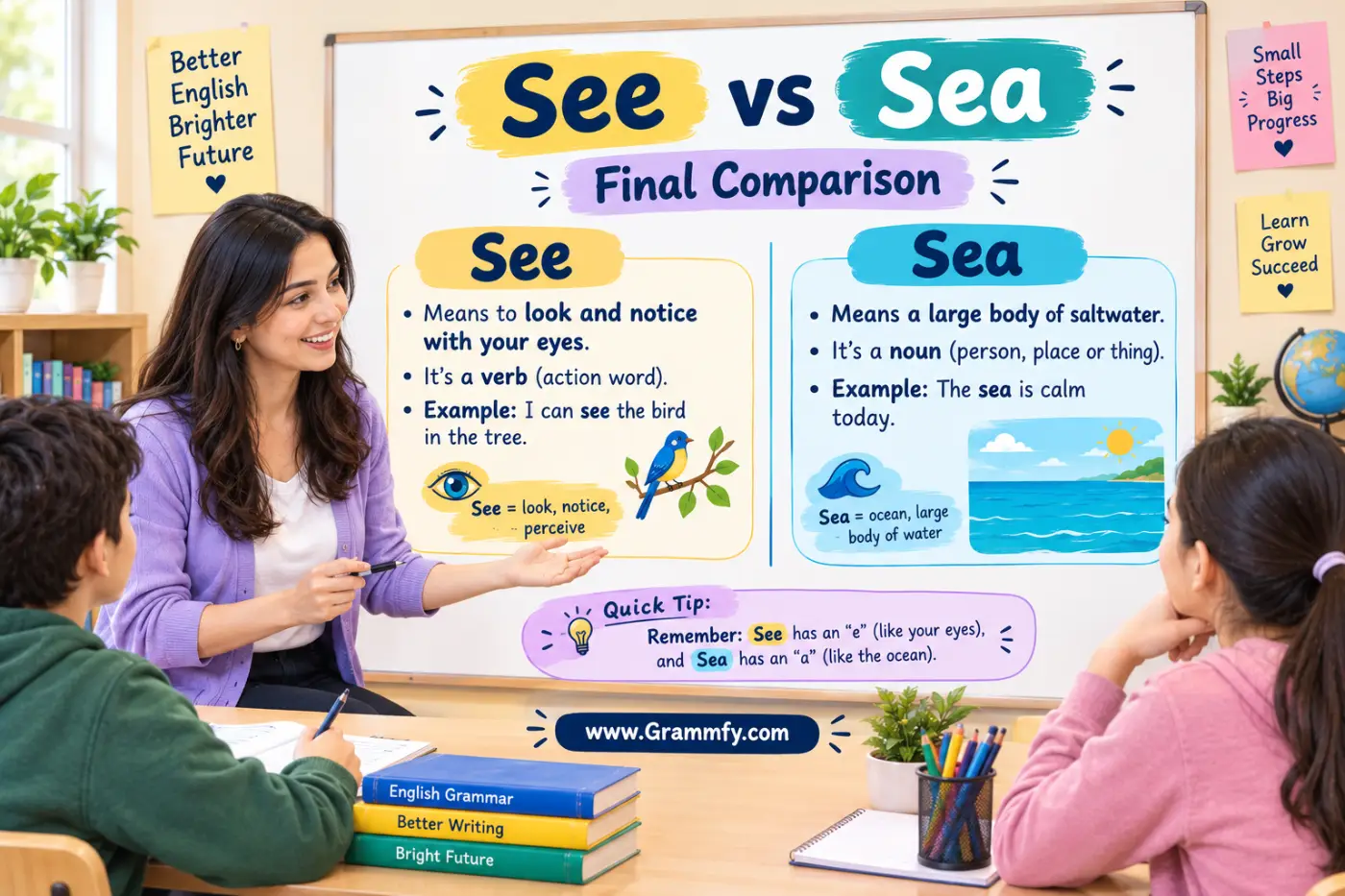
You’re writing an email, essay, text, or school assignment, and you suddenly wonder whether you should write see vs sea. The two words sound exactly alike in standard English, but their meanings are completely different. One is about vision, while the other is a large body of salt water.
Answer Box: See is a verb that means to notice, look at, understand, or experience something. Sea is a noun that means a large body of salt water, usually smaller than an ocean or connected to one.
The confusion happens because these words are homophones. They have the same pronunciation but different spellings and meanings. You can’t choose between them by sound alone, so you need to look at the sentence and ask what you mean.
This guide explains See vs Sea with clear definitions, word origins, grammar patterns, synonyms, examples, common mistakes, regional notes, and practical tips for choosing the correct word in school, work, texting, and everyday conversation.
This is one of many English word pairs that learners confuse; see [Full vs Fill] for another example.
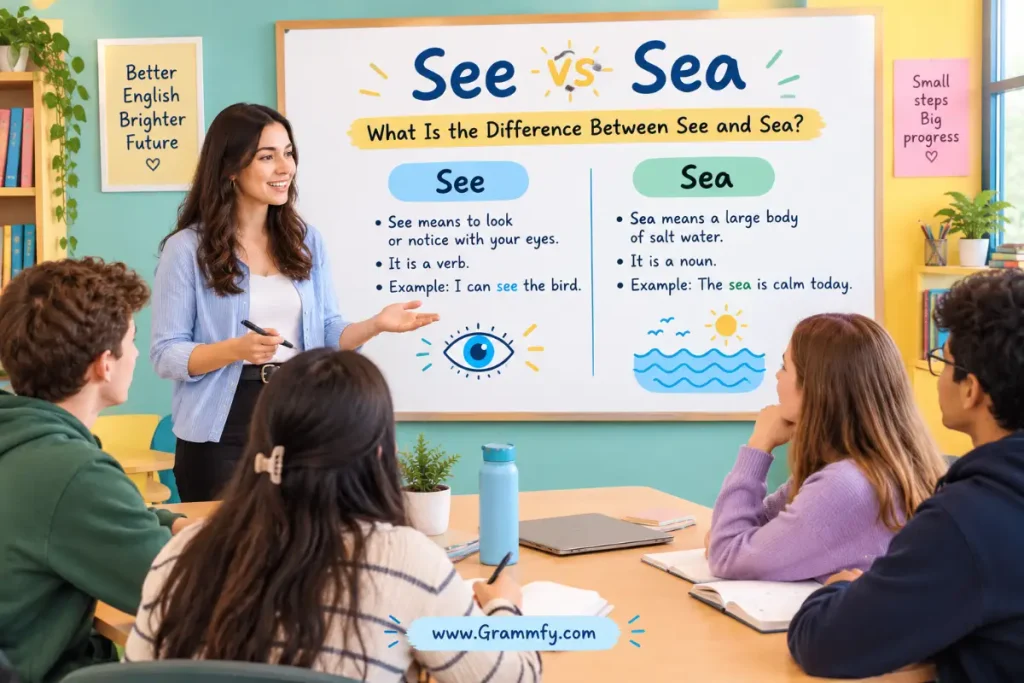
What Is the Difference Between See vs Sea?
The basic difference is very simple:
- See = to notice something with your eyes, understand something, meet someone, or experience something.
- Sea = a large area of salt water.
Here are two easy examples:
I can see the mountains from my window.
We spent the afternoon beside the sea.
In the first sentence, see is about vision.
In the second sentence, sea is a body of water.
The words sound the same:
see = /siː/
sea = /siː/
But their spellings and meanings are different.
A useful memory trick is:
See has “ee” like eyes can see. Sea has “sea” like the water.
What Does “See” Mean in Plain English?
See is a common English verb with several meanings. Its central meaning is to notice something through your eyes.
For example:
I can see a bird.
This means your eyes detect the bird.
But see can also mean much more than physical vision.
See Means to Notice Something
Did you see that car?
I saw your message.
She can see the mountains from her room.
Here, see means to notice or become aware of something.
See Means to Understand
English speakers often use see when they mean understand.
“Oh, I see what you mean.”
This doesn’t mean that the speaker is looking at something. It means:
“Now I understand.”
Another example:
“I see why you’re upset.”
The speaker understands the reason.
See Means to Meet Someone
See can also mean to visit or meet someone.
I’m going to see my friend tomorrow.
She sees her parents every weekend.
This use is common in everyday English.
See Means to Experience Something
You can also use see for events, performances, places, or situations.
We saw a great movie last night.
I want to see the new museum.
Did you see the game?
In these sentences, see can mean watch, attend, or experience.
See Can Mean to Realize
Sometimes see means to recognize a fact.
I can now see why the plan failed.
This means:
I now understand why the plan failed.
The meaning comes from context.
What Does “Sea” Mean in Plain English?
Sea is a noun. It refers to a large body of salt water.
For example:
The ship sailed across the sea.
We watched the sunset over the sea.
The sea was calm this morning.
The word normally refers to salt water connected to an ocean or forming a large area of water.
Examples of named seas include:
- the Mediterranean Sea
- the Caribbean Sea
- the Red Sea
- the Black Sea
- the Arabian Sea
- the North Sea
- the Baltic Sea
A sea is generally smaller than an ocean, although geographical definitions can vary.
Sea Can Also Be Used Figuratively
Writers sometimes use sea as a metaphor for a large amount of something.
For example:
A sea of people filled the stadium.
This doesn’t mean the stadium was full of actual water. It means there were so many people that they looked like a vast moving body.
You might also see:
A sea of stars covered the night sky.
Again, this is figurative language.
Why Are See vs Sea Called Homophones?
See and sea are homophones because they have the same pronunciation but different meanings and spellings.
Other common English homophones include:
- to / too / two
- hear / here
- right / write
- their / there / they’re
- buy / by / bye
- flower / flour
- pair / pear
- weather / whether
Homophones can be difficult because spoken English doesn’t always reveal the correct spelling.
If someone says:
“I want to see the sea.”
You hear the same vowel sound in both words, but the meaning tells you which spelling belongs in each position.
Where Did the Word “See” Come From?
See has very old Germanic roots. It comes from Old English sēon, meaning to see or perceive with the eyes.
The word has related forms in several Germanic languages. Over centuries, its spelling and pronunciation changed into the modern English see.
Its basic idea has remained remarkably stable: noticing or perceiving something.
The modern word has also developed many figurative meanings, including:
- understand
- realize
- meet
- visit
- watch
- experience
- consider
This is why see is one of the most flexible everyday verbs in English.
Where Did the Word “Sea” Come From?
Sea also has Old English and Germanic roots. Old English used sǣ for a large body of water.
The word is related to similar terms in other Germanic languages.
Unlike see, the noun sea has remained strongly connected to water throughout its history.
Today, you can find it in many compound words and expressions:
- seashore
- seaside
- seafood
- seaport
- seafront
- sea level
- sea water
- sea voyage
- sea life
Is See a Verb or a Noun?
See is mainly a verb.
Examples:
I see a bird.
She sees the problem.
We saw the movie.
They have seen the results.
However, see can also function as a noun in certain expressions and specialized contexts.
For example:
“The bishop’s see is located in the city.”
This is a specialized religious or historical use and isn’t the meaning most English learners need for everyday writing.
For ordinary communication, remember:
See = usually a verb.
Is Sea a Verb or a Noun?
Sea is a noun.
It names a thing: a large body of salt water.
Examples:
The sea is calm.
We crossed the sea.
The sea looks beautiful today.
Unlike see, you don’t normally use sea as an everyday verb.
This grammatical difference is one of the easiest ways to distinguish the words.
What Are the Main Forms of See?
Because see is an irregular verb, its forms don’t follow the regular “-ed” pattern.
| Form | Word | Example |
|---|---|---|
| Base form | see | I see the house. |
| Third person | sees | She sees the house. |
| Past tense | saw | We saw the house. |
| Past participle | seen | We have seen the house. |
| -ing form | seeing | I am seeing the house. |
The most important forms to remember are:
see → saw → seen
Not:
see → seed → seen
For example:
I saw him yesterday.
I have seen him before.
What Is the Plural of Sea?
The plural of sea is seas.
Examples:
The world’s seas are important ecosystems.
Different seas have different temperatures.
Several seas surround Europe.
The spelling simply adds -s.
Compare:
- sea → seas
- tree → trees
- key → keys
What Are Synonyms for See?
The best synonym depends on what see means in the sentence.
Simple Synonyms for See
| Word | Meaning | Tone | Example |
|---|---|---|---|
| Notice | Become aware of something | Neutral | I noticed the sign. |
| Look | Direct your eyes toward something | Simple | Look at the picture. |
| Watch | Look at something for a period of time | Everyday | We watched the movie. |
| View | Look at something | Neutral | We viewed the artwork. |
| Spot | Notice something, often quickly | Everyday | I spotted my friend. |
| Notice | Detect or recognize | Neutral | She noticed the change. |
| Find | Discover or locate | Simple | I found the missing book. |
| Observe | Watch carefully | Formal | We observed the experiment. |
Everyday Synonyms for See
| Word | Meaning | Tone | Example |
|---|---|---|---|
| Look at | Direct your eyes toward | Everyday | Look at this photo. |
| Watch | Look at something over time | Everyday | Watch the children play. |
| Spot | Notice something | Casual | I spotted him in the crowd. |
| Catch sight of | Briefly notice | Everyday | I caught sight of a deer. |
| Check out | Look at or examine | Informal | Check out this new website. |
| Meet | Spend time with someone | Everyday | I’ll meet her tomorrow. |
| Visit | Go to see someone or somewhere | Everyday | We visited our grandparents. |
| Experience | Take part in or encounter | Neutral | We experienced a beautiful sunset. |
Formal Synonyms for See
| Word | Meaning | Tone | Example |
|---|---|---|---|
| Observe | Watch carefully | Formal | Researchers observed the behavior. |
| Examine | Look at closely | Formal | The doctor examined the image. |
| Perceive | Become aware through the senses | Formal | The change was perceived quickly. |
| Inspect | Examine carefully | Formal | The engineer inspected the structure. |
| Witness | See an event happen | Formal | Several people witnessed the accident. |
| Recognize | Identify from familiarity | Neutral/formal | She recognized his voice. |
| Discern | Notice or recognize something difficult to see | Formal | We could barely discern the shape. |
| Identify | Recognize what something is | Formal | The witness identified the suspect. |
Informal or Slang Alternatives for See
| Word | Meaning | Tone | Example |
|---|---|---|---|
| Check out | Look at something | Informal | Check out this video. |
| Catch | Notice or see briefly | Casual | Did you catch that? |
| Spot | Notice | Casual | I spotted your car. |
| Take a look | Look at something | Casual | Take a look at this. |
| Scope out | Look over or inspect | Slang/informal | We scoped out the new place. |
| Peek at | Look quickly | Informal | I peeked at the message. |
| Check | Look at or verify | Casual | Check this out. |
| Get a look at | Manage to see | Casual | I finally got a look at it. |
These alternatives aren’t interchangeable in every sentence. For example, watch usually involves looking for a period of time, while spot often means noticing something quickly.
What Are Synonyms for Sea?
The word sea has fewer exact everyday synonyms than see, but several words can describe related bodies of water or ocean environments.
Simple and Everyday Terms
| Word | Meaning | Tone | Example |
|---|---|---|---|
| Ocean | Vast body of salt water | Neutral | We sailed across the ocean. |
| Water | General term for the substance | Simple | The water was cold. |
| Coast | Land beside the sea | Everyday | We walked along the coast. |
| Shore | Land at the edge of a body of water | Everyday | We sat on the shore. |
| Seaside | Area beside the sea | Everyday | They spent summer at the seaside. |
| Waterfront | Land beside water | Everyday | The restaurant is near the waterfront. |
| Bay | Part of a sea partly enclosed by land | Neutral | The boat entered the bay. |
| Gulf | Large area of sea partly enclosed by land | Neutral | The gulf is warm. |
Formal or Geographical Terms
| Word | Meaning | Tone | Example |
|---|---|---|---|
| Marine environment | Ocean or sea ecosystem | Formal | The marine environment needs protection. |
| Maritime region | Area connected to the sea | Formal | The city has a strong maritime history. |
| Coastal waters | Water near a coast | Formal | Fishing is restricted in coastal waters. |
| Body of water | General geographical term | Formal | The lake is a large body of water. |
| Inland sea | Large body of water surrounded mostly by land | Geographical | The Caspian Sea is often described as an inland sea. |
| Oceanic waters | Waters associated with the open ocean | Formal | The species lives in oceanic waters. |
These are related terms, not perfect replacements. You can’t always replace “sea” with “shore,” because the shore is the land beside the water.
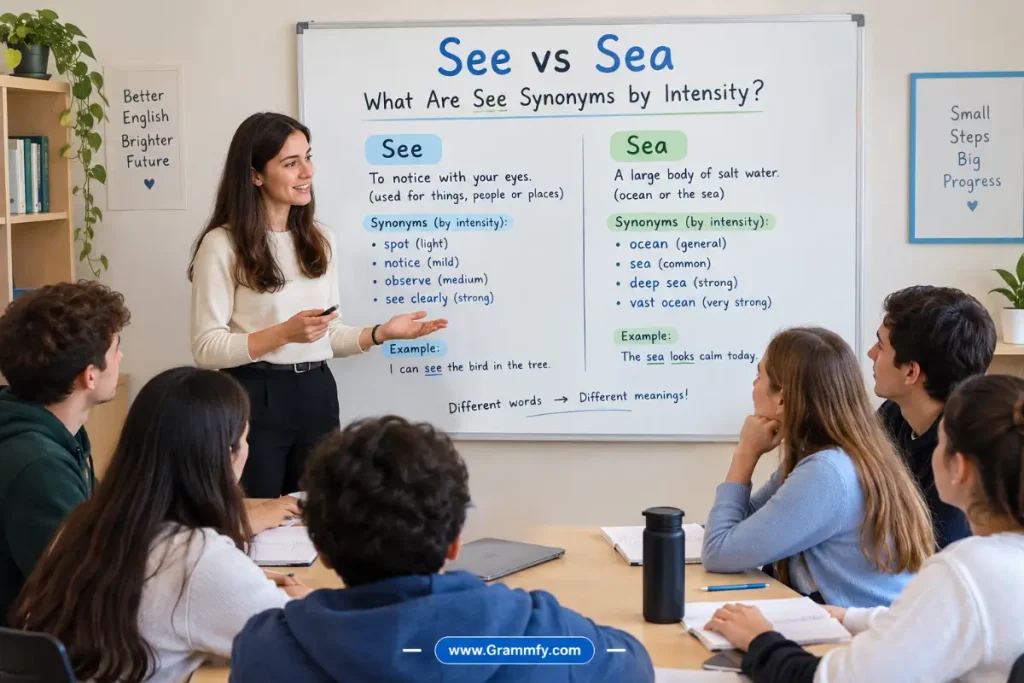
What Are See Synonyms by Intensity?
The word you choose can change the strength and precision of the sentence.
Mild or General
Use:
- look
- notice
- view
- observe
- see
Example:
“I noticed a small mark on the wall.”
More Focused
Use:
- examine
- inspect
- watch
- study
- observe
Example:
“The scientist examined the sample carefully.”
Strong or Event-Based
Use:
- witness
- experience
- encounter
- recognize
- perceive
Example:
“Thousands of people witnessed the event.”
Each word adds a slightly different idea.
What Are See Synonyms by Part of Speech?
Because see is mainly a verb, most of its direct alternatives are verbs.
| Verb | Main Meaning |
|---|---|
| See | Notice or perceive |
| Look | Direct your eyes |
| Watch | Observe over time |
| Notice | Become aware |
| Observe | Watch carefully |
| View | Look at |
| Spot | Notice quickly |
| Examine | Look closely |
| Inspect | Check carefully |
| Witness | See an event happen |
| Recognize | Identify someone or something familiar |
| Discern | Notice something difficult to detect |
There are also nouns related to the act of seeing:
- sight
- vision
- view
- observation
- perception
- glimpse
For example:
“I caught a glimpse of the mountain.”
Here, glimpse is a noun.
What Are Sea-Related Words by Part of Speech?
Sea is a noun, but English has many related nouns and adjectives.
Nouns
- sea
- ocean
- shore
- coast
- beach
- bay
- gulf
- harbor
- wave
- tide
- island
- reef
Adjectives
- marine
- coastal
- maritime
- oceanic
- seaside
- seafaring
Examples:
Marine life is affected by water pollution.
The coastal town attracts many visitors.
She has a strong maritime background.
These words describe different aspects of the sea rather than serving as exact synonyms.
How Do See and Sea Sound the Same?
In standard English, see and sea are pronounced the same:
/siː/
The vowel sound is the long “ee” sound found in words such as:
- tree
- free
- green
- three
- key
The spelling is different, but the pronunciation is the same.
This is why spelling can be difficult when you’re writing from something you heard.
For example, someone might say:
“I see the sea.”
Without seeing the written sentence, you can’t know which spelling belongs to each word.
The context provides the answer.
Is See vs Sea Different in American and British English?
The basic distinction is the same in both American and British English.
See means to perceive, notice, understand, meet, or experience.
Sea means a large body of salt water.
Both varieties pronounce the two words as homophones in standard speech.
Regional accents can change many English sounds, but there is no major American-versus-British spelling difference for these two words.
So whether you’re writing for a US or UK audience:
See = vision or related meanings.
Sea = salt water.
What Is the Best Word for a Resume?
A resume usually benefits from precise action verbs.
Instead of repeatedly using see, consider stronger words when appropriate:
- observe
- analyze
- identify
- recognize
- inspect
- monitor
- evaluate
- review
For example:
Weak:
“I saw problems in the process.”
Stronger:
“I identified problems in the process.”
Or:
“I analyzed the process and identified several areas for improvement.”
However, don’t replace every simple word with a complicated one. Choose a word that accurately describes what you did.
Sea is rarely relevant to a resume unless your work involves marine science, shipping, tourism, fishing, coastal management, or another sea-related field.
Example:
“Conducted marine surveys in coastal waters.”
What Is the Best Word for an Essay?
For essays, see can be useful, especially when discussing visual evidence or ideas.
Examples:
“Readers can see how the character changes throughout the novel.”
“We can see the effects of climate change in coastal communities.”
In formal academic writing, you may sometimes prefer:
- observe
- identify
- recognize
- understand
- demonstrate
- indicate
For example:
“The results demonstrate a clear relationship between the two variables.”
This can be more precise than:
“We can see a clear relationship.”
If your essay is about geography, oceans, or marine environments, sea is the correct noun.
What Is the Best Word for Texting?
For texting, see is extremely common.
Examples:
“Did you see my message?”
“See you later!”
“I can see it now.”
For water:
“The sea looks amazing today.”
Texting doesn’t usually require formal synonyms. Natural language is best.
You might also see playful abbreviations such as:
“C u later.”
But in normal writing, see is clearer and more appropriate.
What Is the Best Word for an Email?
In a professional email, use see when you’re directing someone to information or referring to something they can review.
Examples:
“Please see the attached document.”
“You can see the updated figures in the table below.”
You can also use review when you want to sound more precise:
“Please review the attached report.”
Be careful with:
“Please sea the attached document.”
That spelling is incorrect.
Sea refers to water, so it doesn’t belong in that sentence.
What Is the Best Word for Speaking?
In everyday speech, see is usually the natural choice.
Examples:
“I see what you mean.”
“Did you see that?”
“I’ll see you tomorrow.”
When you’re talking about the ocean or another large body of salt water, use sea.
Examples:
“We walked by the sea.”
“The sea was rough.”
The context makes the difference clear when speaking, even though the pronunciation is identical.
What Are the Most Common Expressions With See?
Learning common phrases can make the word easier to remember.
See You Later
“See you later!”
This means you expect to meet the person again later.
See You Soon
“I’ll see you soon.”
This means you expect to meet again in the near future.
See What I Mean
“Now you see what I mean.”
This means “now you understand.”
See for Yourself
“Go and see for yourself.”
This means to examine or experience something personally.
Let Me See
“Let me see.”
This can mean “let me look” or “let me think.”
As You Can See
“As you can see, the results are different.”
This introduces something visible or evident.
See to It
“I’ll see to it.”
This means “I’ll make sure it happens.”
These expressions show why see is much broader than simply using your eyes.
What Are Common Expressions With Sea?
By the Sea
“They live by the sea.”
This means they live near the coast.
At Sea
“The sailors spent months at sea.”
This means they were on the ocean or sea rather than on land.
Across the Sea
“Her family moved across the sea.”
This describes traveling over a large body of water.
Sea Level
“The city is only a few meters above sea level.”
This is a common geographical expression.
Sea Life
“Plastic pollution can harm sea life.”
This refers to animals and plants living in marine environments.
Sea Change
A sea change means a major transformation.
“The company has undergone a sea change in its approach.”
This expression is figurative and doesn’t literally mean that the sea changed.
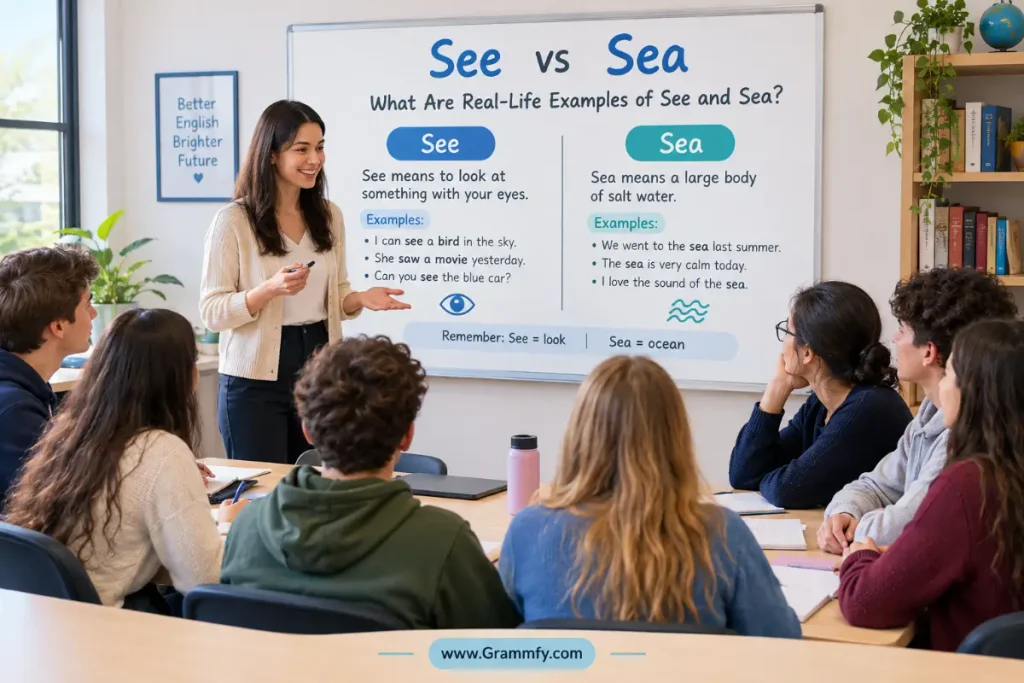
What Are 15 Real-Life Examples of See vs Sea?
Example 1
I can see the mountains from here.
See refers to vision.
Example 2
The sea was calm at sunrise.
Sea refers to salt water.
Example 3
Did you see my email?
Here, see means notice or read.
Example 4
We walked along the sea for an hour.
The sentence describes a walk beside the water.
Example 5
I’ll see you after work.
Here, see means meet.
Example 6
The boat disappeared into the sea.
Here, sea is the body of water.
Example 7
I can see why you’re worried.
Here, see means understand.
Example 8
The fishermen went out to sea early.
Sea refers to the waters away from land.
Example 9
We saw a beautiful sunset.
The past tense of see is saw.
Example 10
The waves moved across the sea.
The noun refers to the water.
Example 11
She couldn’t see the sign from that distance.
This is about visual perception.
Example 12
The island is surrounded by the sea.
This is about geography.
Example 13
Did you see who called?
Here, see means notice or find out.
Example 14
They spent their vacation beside the sea.
The sentence refers to a coastal location.
Example 15
Once you see the pattern, the problem becomes easier.
Here, see means understand or recognize.
Example 16
The ship crossed the sea during the night.
The noun describes the body of water.
What Are Common Mistakes With See vs Sea?
Mistake 1: Using Sea for Vision
Incorrect:
I can sea the car.
Correct:
I can see the car.
The sentence is about vision, so use see.
Mistake 2: Using See for Water
Incorrect:
We sat beside the see.
Correct:
We sat beside the sea.
The sentence is about salt water, so use sea.
Mistake 3: Confusing “See You”
Incorrect:
Sea you tomorrow!
Correct:
See you tomorrow!
The expression means “I will meet you tomorrow.”
Mistake 4: Confusing “By the Sea”
Incorrect:
They have a house by the see.
Correct:
They have a house by the sea.
The sentence refers to a coastal location.
Mistake 5: Spelling “Saw” Incorrectly
Because see is irregular:
I saw him yesterday.
Not:
I seed him yesterday.
Mistake 6: Using “Seen” Without the Right Auxiliary
Incorrect:
I seen that movie yesterday.
Standard English:
I saw that movie yesterday.
Or:
I have seen that movie before.
Saw is the simple past form. Seen is normally used with an auxiliary verb such as have, has, or had.
When Should You NOT Use See?
You shouldn’t automatically use see whenever you’re talking about looking.
Choose a more precise verb when the action is specific.
For example:
“I watched the movie.”
is more precise than:
“I saw the movie.”
Both can be correct, but watched emphasizes the activity over a period of time.
Similarly:
“I examined the document.”
is more precise than:
“I saw the document.”
If you carefully checked the document, examined tells the reader more.
When Should You NOT Use Sea?
Don’t use sea for every body of water.
Lake
A lake is generally an inland body of water surrounded by land.
We swam in the lake.
River
A river is a flowing body of water.
The river runs through the city.
Ocean
An ocean is generally larger than a sea.
They sailed across the Atlantic Ocean.
Pond
A pond is a small body of still water.
Ducks were swimming in the pond.
Using sea for these bodies of water would normally be inaccurate unless you’re using the word figuratively.
See vs Watch — What’s the Difference?
See can mean simply noticing or experiencing something. Watch usually means looking at something for a period of time.
| See | Watch |
|---|---|
| Notice something | Look continuously |
| Can be brief | Usually takes time |
| Often involuntary | Usually intentional |
| “I saw a bird.” | “I watched the bird.” |
Compare:
I saw a bird in the garden.
You noticed it.
I watched the bird in the garden.
You spent time observing it.
This distinction can make your writing more precise.
See vs Look — What’s the Difference?
See usually describes what your eyes perceive. Look usually describes directing your eyes toward something.
Compare:
I can see the mountains.
You perceive them.
Look at the mountains.
You are directing someone’s attention toward them.
A useful pattern is:
look at something
Look at that painting.
But:
see something
I can see that painting.
You can also say:
“I looked at the painting.”
The two verbs are related but perform different jobs.
Sea vs Ocean — What’s the Difference?
A sea is generally a large body of salt water that is smaller than an ocean and often partly enclosed by land. An ocean is a much larger continuous body of salt water.
Examples:
The Mediterranean Sea.
The Atlantic Ocean.
The terms can sometimes be used loosely in everyday speech, but geography usually distinguishes them by size and location.
A simple memory aid:
Ocean = larger. Sea = generally smaller or more enclosed.
What Are the Antonyms of See?
There isn’t one perfect opposite of see because the verb has several meanings.
For physical vision, possible opposites include:
- miss
- overlook
- ignore
- fail to notice
- be unable to see
Example:
I saw the sign.
Opposite idea:
I missed the sign.
For understanding:
I see the problem.
Possible opposite:
I don’t understand the problem.
For meeting:
I’ll see her tomorrow.
The opposite might be:
I won’t meet her tomorrow.
So the best opposite depends on the meaning.
What Are the Antonyms of Sea?
Sea is a noun, so it doesn’t have a direct antonym in the same way an adjective such as “hot” has “cold.”
Depending on context, contrasting concepts can include:
- land
- shore
- inland
- dry land
- desert
For example:
The sailors returned from the sea to land.
Here, land provides the natural contrast.
But don’t treat “land” as a dictionary antonym of sea in every context. A coast, island, lake, or river can also provide different geographical contrasts.
How Can You Choose the Right Word Quickly?
Ask yourself one question:
Am I talking about vision or water?
If you’re talking about vision, understanding, meeting, watching, or experiencing:
SEE
If you’re talking about a large body of salt water:
SEA
Examples:
Can you see the boat?
The boat is on the sea.
This works because the meanings are completely different even though the sounds are identical.
What Memory Tricks Help With See vs Sea?
Trick 1: Eyes
Think:
See = eyes
The word see has two “e” letters, just as you use your eyes to see.
Trick 2: Water
Think:
Sea = water
The spelling itself contains the familiar word sea that refers to salt water.
Trick 3: Use a Sentence Pair
Memorize:
I see the sea.
This short sentence contains both words and makes their difference clear.
Another useful pair is:
I can see the sea.
The first word is about vision. The second is the body of water.
Trick 4: Ask “Can I Put Water There?”
If the word refers to a large body of salt water, use sea.
If it refers to noticing something, use see.
How Can Students Avoid This Spelling Mistake?
Students can improve by learning homophones in groups.
Instead of memorizing only:
see = vision
sea = water
learn them in sentences:
I can see the sea.
We see the boats on the sea.
She wants to see the sea.
Writing several sentences helps connect spelling with meaning.
You can also create a two-column vocabulary card:
| SEE | SEA |
|---|---|
| Vision | Salt water |
| Verb | Noun |
| See a bird | Sea water |
| See a movie | Sea shore |
| See a friend | Sea level |
This makes the distinction easy to review before a test or writing assignment.
How Can Teachers Explain See vs Sea?
A simple classroom activity is to write these two sentences on the board:
I can see the sea.
Then ask students:
- Which word is about seeing?
- Which word is about water?
- What part of speech is each word?
- Can students create another sentence using both?
For example:
“I saw a boat on the sea.”
Students can then replace saw with other forms:
“I see a boat on the sea.”
“I have seen a boat on the sea.”
This activity teaches spelling, vocabulary, grammar, and context together.
How Should You Use See vs Sea in SEO Content?
If you’re writing online content, search engines understand that see vs sea are different words and concepts.
When your topic is about the spelling difference, make the intent clear through:
- definitions
- examples
- headings
- related terms
- sentence comparisons
- grammar explanations
- homophone information
For example, a useful heading is:
“What Is the Difference Between See and Sea?”
Then explain both meanings directly.
Don’t repeat the exact phrase unnecessarily. Natural language and helpful examples are more useful than keyword stuffing.
Related terms such as homophones, ocean, water, vision, sight, look, watch, shore, and sea level can provide useful semantic context.
Quick Tips for Choosing See vs Sea
Use these final checks before submitting your writing:
- See is usually a verb.
- Sea is a noun.
- See relates to vision and several related ideas.
- Sea relates to salt water.
- Both words sound the same.
- Look at the meaning, not just the pronunciation.
- Use saw for the simple past of see.
- Use seen with an auxiliary such as have, has, or had.
- Use sea in phrases such as “by the sea” and “at sea.”
- Use see in phrases such as “see you later” and “I see.”
- Don’t use “sea” when you mean “see.”
- Don’t use “see” when you’re naming the body of water.
- Remember: I see the sea.
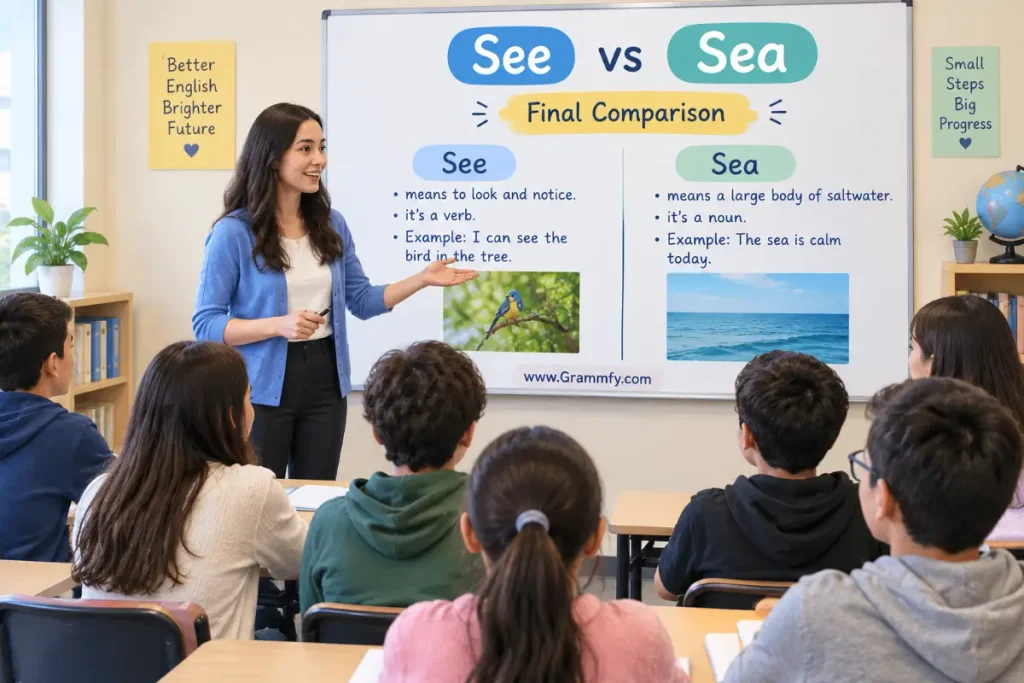
See vs Sea: Final Comparison
| Feature | See | Sea |
|---|---|---|
| Part of speech | Mainly verb | Noun |
| Pronunciation | /siː/ | /siː/ |
| Main meaning | Notice with the eyes | Large body of salt water |
| Other meanings | Understand, meet, experience | Can be used figuratively |
| Past tense | Saw | Not applicable |
| Past participle | Seen | Not applicable |
| Example | I see a bird. | The sea is calm. |
| Common phrase | See you later. | By the sea. |
| Memory clue | Eyes | Water |
The spelling becomes easy once you connect each word to its meaning.
Conclusion
The key to See vs Sea is to focus on meaning rather than sound. See is mainly a verb connected with vision, but it can also mean understand, meet, watch, or experience something. Sea is a noun that refers to a large body of salt water. Because both words are pronounced the same, spelling them correctly depends on understanding the sentence.
When you’re unsure, ask whether you’re talking about eyes or water. If you’re describing something you notice, understand, or experience, choose see. If you’re talking about salt water, choose sea. The simple sentence “I see the sea” is an easy way to remember the difference. With a little practice and attention to context, these homophones become much easier to use correctly in essays, emails, texts, and everyday writing.
Frequently Asked Questions
What is the difference between see and sea?
See is mainly a verb related to vision, understanding, meeting, or experiencing something, while sea is a noun for a large body of salt water. They sound the same but have different meanings and spellings.
What’s another way to remember see vs sea?
A simple trick is “see = eyes” and “sea = water.” You can also remember the sentence “I see the sea,” which uses both words correctly.
Is see a verb or a noun?
See is mainly used as a verb in everyday English. It can have specialized noun uses, but learners usually encounter it as a verb meaning to notice, understand, meet, or experience.
Is sea a noun?
Yes, sea is a noun. It names a large body of salt water and appears in phrases such as “the sea,” “sea level,” and “by the sea.”
Are see and sea homophones?
Yes, see and sea are homophones in standard English. They have the same pronunciation but different spellings and meanings.
Which is correct: “I can see the sea” or “I can sea the see”?
“I can see the sea” is correct. The first word describes vision, while the second refers to the body of salt water.
What is the past tense of see?
The past tense of see is “saw.” For example, “I saw the movie yesterday,” while the past participle is “seen,” as in “I have seen that movie before.”

1 thought on “See vs Sea: Simple Guide to the Difference”