
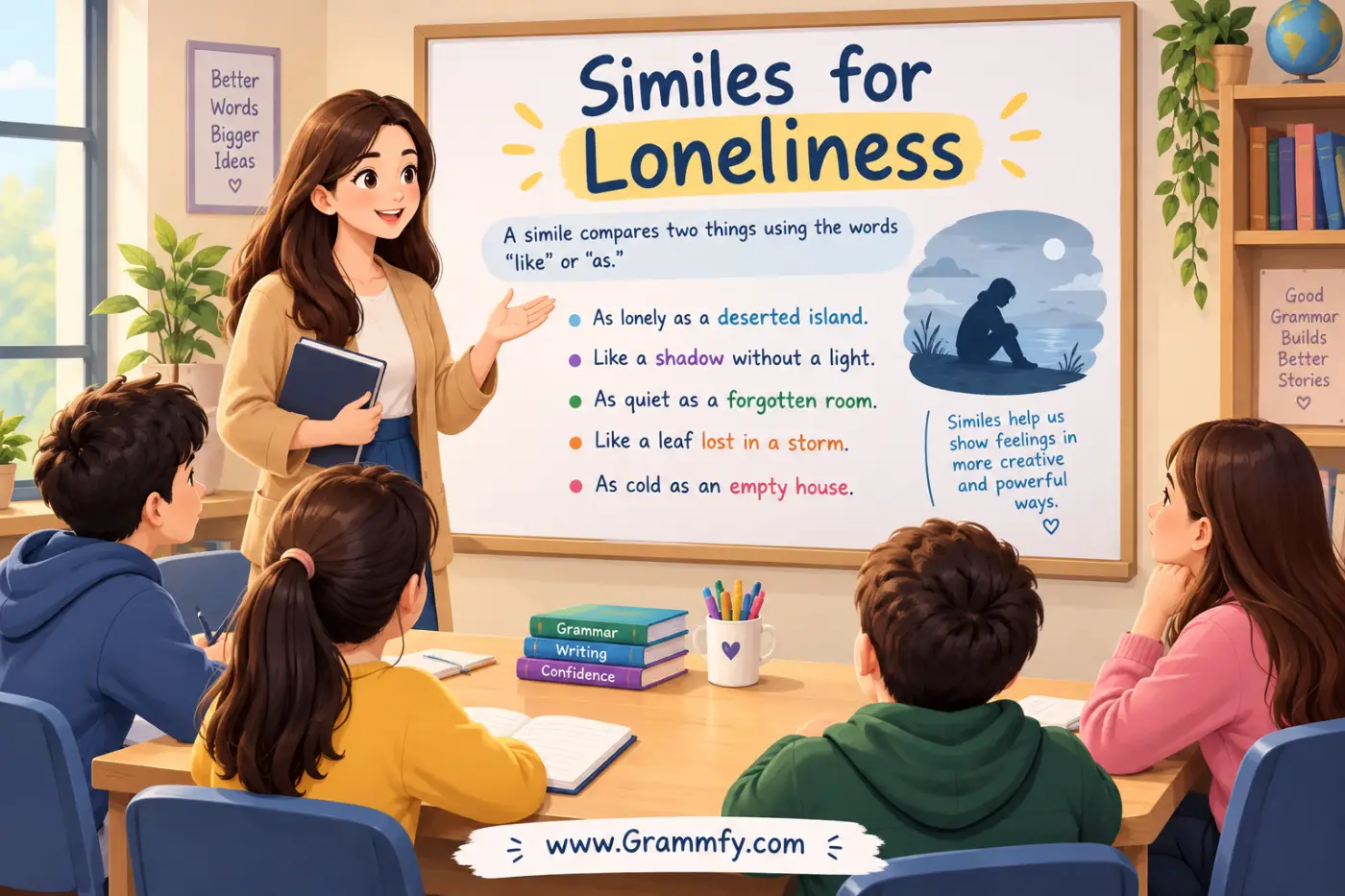
Writing an email, essay, text, or personal message about loneliness can be harder than it seems. Saying “I feel lonely” is clear, but sometimes you want your words to show what loneliness actually feels like. A good simile can turn that quiet emotion into an image readers can see and feel. If you’re looking for Similes for Loneliness, these creative comparisons can help you express feelings of isolation, sadness, and being alone in a clear and memorable way.
Answer Box: Similes for loneliness compare loneliness to a person, place, object, or experience that helps readers understand the feeling more clearly. Examples include “lonely as a single star in a dark sky” and “like an empty chair at a crowded table.”
The best comparisons don’t simply say that someone is alone. They show the emotional weight of being alone, forgotten, disconnected, or separated from others. Some comparisons can sound gentle and thoughtful, while others can make loneliness feel deep, painful, or overwhelming.
This guide explains how to create and use strong comparisons for loneliness. You’ll find original examples, related words by tone and intensity, context-based choices, common mistakes, close comparisons, and practical tips for choosing the right expression.
If you’re working on choosing the right word, explore [Too Many or To Many].
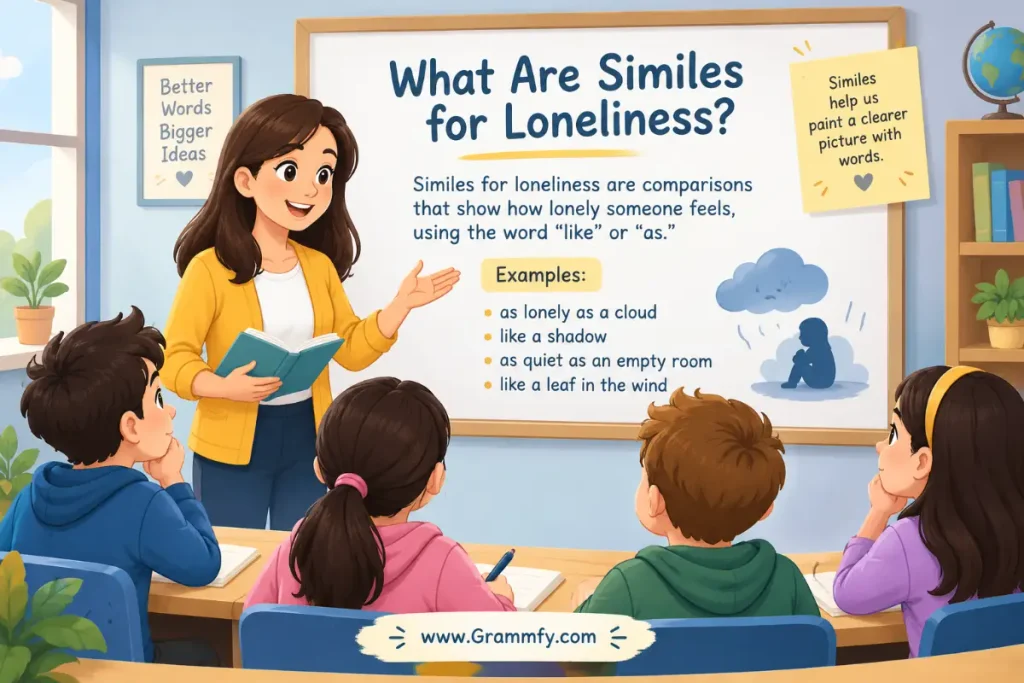
What Are Similes for Loneliness?
A simile is a comparison that usually uses “like” or “as.” It connects one thing to another to make an idea easier to picture.
For example:
- “She felt as lonely as a lighthouse surrounded by endless sea.”
- “He stood like a forgotten book on an empty shelf.”
- “The old house felt as lonely as a deserted station.”
These sentences don’t define loneliness directly. Instead, they create an image that represents it.
The comparison gives the reader something familiar to imagine. A lighthouse standing alone in the sea can suggest distance and isolation. A forgotten book can suggest being ignored. An empty station can suggest silence and separation.
That’s why figurative language can be useful when ordinary words don’t seem strong enough.
What Does Loneliness Mean in Plain English?
Loneliness is the feeling of being emotionally or socially disconnected from other people.
A person can be physically alone without feeling lonely. Someone may enjoy spending an afternoon alone and feel perfectly happy. On the other hand, a person can be surrounded by friends and still feel lonely if they don’t feel understood or connected.
In simple terms:
Loneliness is not just being alone; it’s feeling that meaningful connection is missing.
This difference matters when choosing a comparison.
For example, “alone like a student studying in a quiet library” may describe solitude. It doesn’t necessarily sound painful.
But “like a single voice lost in a noisy crowd” suggests emotional isolation.
Where Does the Word “Loneliness” Come From?
The word loneliness comes from lonely, which developed from the idea of being alone or solitary. The ending “-ness” turns the adjective “lonely” into the name of a state or condition.
The word “alone” has much older roots and is connected to the idea of being by oneself. Over time, English developed several related words to describe different forms of separation, solitude, isolation, and emotional disconnection.
This history helps explain why loneliness can have several meanings.
Feeling alone can describe a physical situation.
Being isolated can suggest separation from other people.
Feeling lonely usually focuses on the emotional experience.
Being solitary can sound neutral or even intentional.
So, when writing a simile, think about whether you’re describing physical separation, emotional pain, social disconnection, or peaceful solitude.
Why Do Writers Use Comparisons for Loneliness?
Loneliness is an invisible emotion. Readers can’t see it directly.
A comparison gives that emotion a physical image.
Compare these two sentences:
Plain:
“I felt lonely after everyone left.”
With a simile:
“I felt like an empty chair after everyone had gone home.”
The second sentence creates a picture. The reader can imagine the empty chair and connect it with the speaker’s feeling.
Strong comparisons can help you:
- create an emotional image
- make writing more memorable
- avoid repetitive words
- show instead of simply tell
- add depth to poetry and stories
- make personal writing more expressive
- communicate subtle emotions
35+ Similes for Loneliness With Meanings
Here are original comparisons you can use or adapt for essays, stories, poems, texts, and creative writing.
| # | Simile | What It Suggests |
|---|---|---|
| 1 | Lonely as a single star in a dark sky | Isolation and distance |
| 2 | Like an empty chair at a crowded table | Feeling excluded |
| 3 | As lonely as a lighthouse in a storm | Separation and helplessness |
| 4 | Like a forgotten book on an empty shelf | Being overlooked |
| 5 | As quiet as a house after everyone leaves | Silence and emptiness |
| 6 | Like a lost voice in a crowded room | Feeling unheard |
| 7 | As distant as a ship disappearing beyond the horizon | Emotional separation |
| 8 | Like a shadow with no one to follow | Lack of connection |
| 9 | As lonely as a road stretching through a desert | Long-lasting isolation |
| 10 | Like a window facing an empty street | Waiting and emptiness |
| 11 | As alone as the moon above a sleeping town | Solitude |
| 12 | Like a message that never receives a reply | Rejection or disconnection |
| 13 | As lonely as a tree standing alone in a field | Physical isolation |
| 14 | Like a song playing in an empty room | Emotional emptiness |
| 15 | As forgotten as an old photograph in a drawer | Feeling ignored |
| 16 | Like a boat drifting without a shore | Uncertainty and isolation |
| 17 | As cold as an empty hallway at midnight | Emotional emptiness |
| 18 | Like a puzzle piece left outside the box | Not belonging |
| 19 | As small as a whisper in a thunderstorm | Feeling unnoticed |
| 20 | Like a candle burning in an abandoned house | Quiet sadness |
| 21 | As lonely as a bench in a closed park | Stillness and separation |
| 22 | Like footsteps fading down an empty corridor | Someone leaving |
What Are Some Simple Similes for Loneliness?
If you’re writing for younger students or want easy English, use familiar objects and situations.
Good simple comparisons include:
- Lonely like an empty chair.
- Like a bird without its flock.
- As lonely as a tree in an empty field.
- Like a single star in the night sky.
- As quiet as an empty classroom.
- Like a lost child in a crowd.
- As alone as a boat on the sea.
- Like a phone that never rings.
- As lonely as an empty house.
- Like a book nobody reads.
These examples work because the images are easy to understand.
You don’t need complicated vocabulary to create emotional writing. A familiar image can sometimes be more powerful than an unusual one.
What Are Everyday Words Related to Loneliness?
A large synonym list is useful, but not every related word means exactly the same thing. Some words describe the feeling itself, while others describe a situation that can cause it.
The following list groups useful alternatives by tone.
Simple Words for Loneliness
| Word | Meaning | Tone | Example |
|---|---|---|---|
| Alone | Without other people | Neutral | I was alone at home. |
| Lonely | Sad because of a lack of connection | Emotional | She felt lonely after moving. |
| Sad | Unhappy or unhappy emotionally | General | He felt sad that night. |
| Quiet | Having little sound or activity | Neutral | The room was quiet. |
| Empty | Lacking people or emotion | Emotional | The house felt empty. |
| Left out | Not included | Informal | I felt left out of the group. |
| Lost | Without direction or connection | Emotional | She felt lost without her friends. |
Everyday Words and Phrases
| Word/Phrase | Meaning | Tone | Example |
|---|---|---|---|
| Isolated | Separated from others | Neutral | He felt isolated after the move. |
| Shut out | Prevented from joining | Informal | She felt shut out by the group. |
| Forgotten | Not remembered or considered | Emotional | He felt forgotten by his old friends. |
| Unnoticed | Not seen or recognized | Neutral | She felt unnoticed in the crowd. |
| Disconnected | Lacking a meaningful link | Modern/neutral | I feel disconnected from everyone. |
| Distant | Emotionally far away | Neutral | They became emotionally distant. |
| Separate | Kept apart from others | Neutral | The students sat separate from the group. |
| On my own | By myself | Conversational | I had to handle it on my own. |
Formal Words Related to Loneliness
| Word | Meaning | Tone | Example |
|---|---|---|---|
| Isolation | Separation from others | Formal | Long isolation affected his mood. |
| Solitude | The state of being alone | Neutral/formal | She enjoyed solitude while writing. |
| Alienation | Feeling separated from a group | Formal | The character experiences alienation. |
| Seclusion | Being away from other people | Formal | He lived in seclusion. |
| Detachment | Emotional distance | Formal | Her emotional detachment was noticeable. |
| Estrangement | Separation from someone once close | Formal | Their estrangement lasted years. |
| Exclusion | Being deliberately kept out | Formal | His exclusion hurt him. |
| Disconnection | Lack of emotional or social connection | Formal/modern | The story explores social disconnection. |
Informal or Slang-Style Expressions
| Word/Phrase | Meaning | Tone | Example |
|---|---|---|---|
| Left out | Not included | Informal | I felt left out. |
| On my own | By myself | Casual | I’m on my own tonight. |
| Out of the loop | Not included or informed | Casual | I feel out of the loop. |
| Ghosted | Suddenly ignored online | Slang/informal | She felt bad after being ghosted. |
| Cut off | Separated from people | Informal | He felt cut off from his friends. |
| No one around | Nobody nearby | Casual | There was no one around. |
| Flying solo | Doing something alone | Casual | I’m flying solo this weekend. |
What Are the Synonyms for Loneliness by Intensity?
Not every word carries the same emotional strength.
Choosing a word that matches the situation can make your writing sound more natural.
Mild
These words can describe a light or temporary sense of separation:
- alone
- quiet
- separate
- solitary
- distant
- on your own
- by yourself
Example:
“After the party ended, I felt a little alone.”
This doesn’t necessarily suggest serious emotional pain.
Moderate
These words suggest a stronger emotional or social gap:
- lonely
- disconnected
- left out
- unnoticed
- forgotten
- isolated
- distant
Example:
“She felt disconnected from her classmates.”
Strong
These words can suggest deeper or more painful separation:
- alienated
- estranged
- abandoned
- deeply isolated
- shut out
- completely disconnected
- emotionally alone
Example:
“After years away from his family, he felt completely estranged.”
Use strong words carefully. If the situation is only mildly uncomfortable, “abandoned” may sound too dramatic.
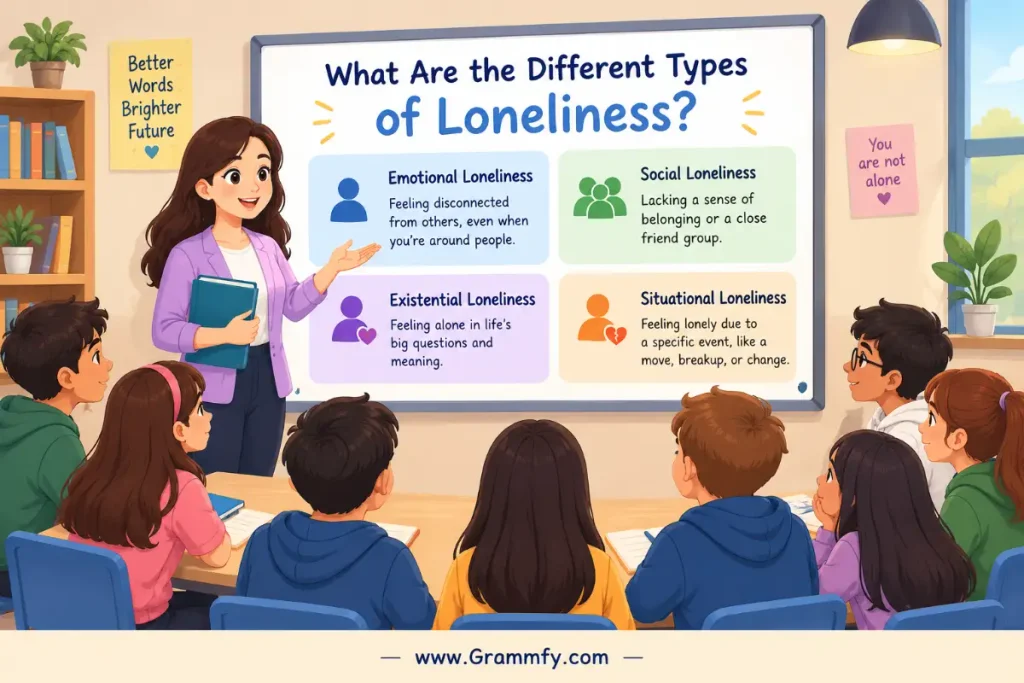
What Are the Different Types of Loneliness?
Loneliness isn’t always the same.
Understanding the type can help you choose a better comparison.
Physical Loneliness
This happens when someone is physically separated from other people.
Examples:
- a traveler alone in a distant place
- someone living in an empty house
- a person sitting alone in a park
A suitable simile might be:
“He felt as lonely as a boat drifting far from shore.”
Social Loneliness
Social loneliness involves a lack of friends, companionship, or belonging.
Example:
“She felt like an empty chair at a crowded table.”
The person is surrounded by others but doesn’t feel included.
Emotional Loneliness
Emotional loneliness happens when someone lacks a deep emotional connection.
A person may have many acquaintances but still feel emotionally alone.
Example:
“He felt like a locked room that nobody had entered for years.”
Situational Loneliness
Sometimes loneliness is temporary and connected to a particular event.
Moving to a new city, starting at a new school, or losing contact with friends can create this feeling.
Example:
“Starting at the new school felt like being a single star in an unfamiliar sky.”
What Are the Best Similes for Loneliness in an Essay?
For an essay, choose comparisons that are clear, mature, and easy to explain.
Avoid overly dramatic expressions unless the topic calls for them.
Example 1: Social Isolation
“The new student felt like an empty chair at a crowded table.”
This works well because the crowded table represents the social group, while the empty chair represents exclusion.
Example 2: Moving Away
“After moving across the country, she felt like a tree standing alone in a huge field.”
The tree represents someone who has been separated from familiar surroundings.
Example 3: Emotional Disconnection
“He felt like a voice lost in a crowded room.”
This comparison suggests that other people are present, but nobody understands or hears him.
Example 4: Waiting for Connection
“Her loneliness was like a phone that never rang.”
This is especially useful when writing about waiting for messages, calls, or attention.
What Are the Best Similes for Loneliness in a Resume?
A resume usually isn’t the right place for emotional figurative language.
If you’re describing a professional experience, use direct words instead.
Instead of:
“I worked like a lonely lighthouse.”
Use:
“I independently managed the project from planning through completion.”
If you need to describe working alone, useful words include:
- independently
- self-directed
- autonomous
- individually
- without direct supervision
A resume should focus on skills and results rather than emotional loneliness.
What Are the Best Similes for Loneliness in an Email?
The right choice depends on the email.
For a personal email, a gentle comparison can work:
“Since you moved away, the house feels like an empty classroom after the final bell.”
For a friendly message:
“The group chat feels like a party where everyone forgot to invite me.”
The second example is more casual and humorous.
What Are the Best Similes for Loneliness in Texting?
Text messages usually need short, natural language.
You could write:
- “I feel like a single star tonight.”
- “This place feels like an empty room without you.”
- “I’m surrounded by people but feel like a voice nobody hears.”
- “It’s like having a phone that never rings.”
- “Tonight feels as quiet as an empty street.”
For texting, don’t force a poetic comparison into every message. A simple sentence can sound more genuine.
What Are the Best Similes for Loneliness in Speaking?
When speaking, familiar comparisons usually work best.
You might say:
“Sometimes I feel like I’m standing in a crowded room where nobody can hear me.”
Or:
“Moving here made me feel like a tree planted in a field where I knew nobody.”
These are easy to understand when heard aloud.
Short comparisons are often stronger in conversation because listeners don’t have time to reread them.
12 Original Examples in Real Situations
1. After Moving to a New City
“When I first moved, I felt like a single tree standing in a field of strangers.”
2. After Friends Leave
“The house felt as empty as a classroom after the final bell.”
3. At a Large Party
“Even at the party, I felt like an empty chair at a crowded table.”
4. Waiting for a Message
“My phone felt like a silent door that nobody wanted to open.”
5. After a Friendship Ends
“Her absence felt like a song playing in an empty room.”
6. A Student at a New School
“He felt like a lost voice in a hallway full of unfamiliar faces.”
7. An Elderly Person Living Alone
“The evenings stretched like a long road through an empty desert.”
8. Someone Far From Home
“He felt like a boat drifting far from its shore.”
9. A Character in a Novel
“She stood by the window like a lighthouse surrounded by dark water.”
10. After an Argument
“The silence between them felt like an empty hallway at midnight.”
11. Feeling Ignored Online
“His messages sat there like unopened letters.”
12. Being Surrounded but Unheard
“She felt like a whisper swallowed by a thunderstorm.”
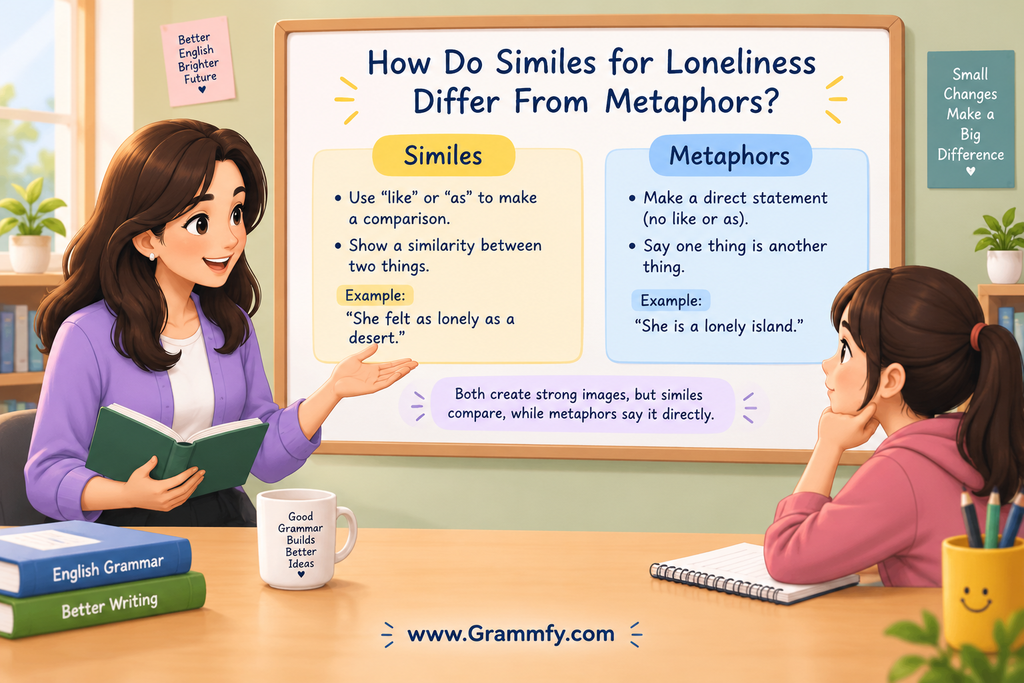
How Do Similes for Loneliness Differ From Metaphors?
A simile directly compares two things using words such as like or as.
A metaphor makes the comparison more directly.
| Simile | Metaphor |
|---|---|
| She felt like an empty chair. | She was an empty chair. |
| He was as lonely as a lighthouse. | He was a lonely lighthouse. |
| Her heart felt like a locked room. | Her heart was a locked room. |
| He felt like a lost bird. | He was a lost bird. |
Similes often make comparisons easier to recognize.
Metaphors can sound stronger or more poetic because they present the comparison as an identity.
“Alone” vs “Lonely” — What’s Different?
Alone describes being without other people. Lonely describes an unwanted feeling of emotional or social disconnection.
| Alone | Lonely |
|---|---|
| Focuses on situation | Focuses on emotion |
| Can be positive | Usually suggests sadness or lack of connection |
| Can be intentional | Often unwanted |
| “I spent the evening alone.” | “I felt lonely all evening.” |
For example, someone reading quietly at home may be alone but not lonely.
A person at a crowded party may be surrounded by people but still feel lonely.
This distinction is important when creating comparisons.
“Solitude” vs “Loneliness” — What’s Different?
Solitude usually means being alone by choice or being comfortable with your own company. Loneliness usually suggests that meaningful connection is missing.
| Solitude | Loneliness |
|---|---|
| Often intentional | Often unwanted |
| Can feel peaceful | Often feels painful |
| Can encourage reflection | Can create emotional emptiness |
| “She enjoyed solitude.” | “She struggled with loneliness.” |
For example:
“He sat alone by the lake, enjoying the solitude.”
This sounds peaceful.
Compare it with:
“He sat alone by the lake, feeling as lonely as a forgotten boat.”
The second sentence creates emotional pain.
“Isolation” vs “Loneliness” — What’s Different?
Isolation focuses more on separation, while loneliness focuses more on the emotional experience of lacking connection.
A person can be isolated because of location, circumstances, or social barriers.
Loneliness describes how that lack of connection feels.
For example:
“The cabin was isolated from the nearest town.”
This is a physical fact.
“Living there made him feel lonely.”
This describes his emotional response.
Both ideas can appear together, but they aren’t interchangeable.
What Are Common Mistakes When Writing About Loneliness?
Mistake 1: Confusing Being Alone With Being Lonely
Don’t assume that every person who is alone feels lonely.
Instead of:
“She was alone, so she was lonely.”
Write:
“Although she was alone, she enjoyed the quiet.”
Or:
“She was surrounded by people but still felt lonely.”
Mistake 2: Making Every Comparison Extremely Sad
Not every lonely moment needs to sound tragic.
For a mild situation:
“The room felt as quiet as an empty library.”
For deeper pain:
“She felt like a voice trapped inside a silent room.”
Match the emotional strength to the situation.
Mistake 3: Using Too Many Comparisons
A paragraph filled with similes can become distracting.
Weak:
“I was like a bird, like a tree, like a boat, like a star, and like an empty room.”
Better:
“I felt like a single star in a sky full of darkness.”
One strong image is often enough.
Mistake 4: Choosing an Unclear Image
Your comparison should help the reader understand the emotion.
Avoid comparisons that require a long explanation.
A familiar image such as an empty chair is easier to understand than an obscure reference.
Mistake 5: Using a Cliché Without Adding Meaning
Expressions such as “alone as a cloud” may feel familiar because readers have encountered similar imagery many times.
Try creating a more specific image:
“Like the last chair left after a crowded meeting.”
Specific details can make a comparison feel fresher.
Mistake 6: Using “Lonely” When You Mean “Quiet”
Quiet doesn’t always mean lonely.
An empty room can be peaceful, boring, frightening, or lonely depending on context.
Show the emotion instead of assuming the reader will interpret it the same way.
When Should You NOT Use a Simile for Loneliness?
Figurative language isn’t appropriate for every situation.
In Legal or Official Writing
Use direct language.
Instead of:
“The employee felt like a forgotten island.”
Write:
“The employee reported feeling excluded from the team.”
In a Resume
Use professional descriptions rather than emotional comparisons.
In Academic Definitions
If you’re defining loneliness, give the direct meaning first. A simile can follow as an example if appropriate.
In Emergency or Safety Communication
Clear information is more important than creative language.
When the Reader Needs Exact Information
Don’t replace a clear fact with an artistic comparison.
The goal is to use figurative language where it improves communication, not simply where it can be added.
What Are the Antonyms of Loneliness?
Common opposites and contrasting ideas include:
- companionship
- connection
- friendship
- belonging
- community
- togetherness
- closeness
- inclusion
- social connection
- acceptance
For example:
“The lonely room felt completely different once her friends arrived.”
You can also contrast images:
“He had once felt like a single star, but now he was part of a bright constellation.”
This creates a natural emotional shift from isolation to belonging.
How Can You Choose the Right Simile for Loneliness?
Start by identifying why the person feels lonely.
If They Feel Ignored
Use an image involving something forgotten:
“Like an old photograph in a drawer.”
If They Feel Excluded
Use an image involving something left outside:
“Like a puzzle piece outside the box.”
If They Feel Far Away
Use distance:
“Like a ship disappearing beyond the horizon.”
If They Feel Unheard
Use sound:
“Like a whisper lost in a storm.”
If They Are Waiting for Someone
Use an image of waiting:
“Like a phone that never rings.”
If They Feel Emotionally Empty
Use an empty space:
“Like a room after everyone has left.”
If They Want to Belong
Use an image of separation:
“Like a bird outside a closed window.”
The best comparison usually comes from the specific reason behind the loneliness.
How Can You Make a Loneliness Simile More Original?
Start with an ordinary image and add one specific detail.
Basic:
“She felt like an empty room.”
More specific:
“She felt like an empty classroom after the final bell.”
Even better:
“She felt like an empty classroom after the final bell, with the last echoes fading from the walls.”
The extra detail gives the reader something to experience.
Try thinking about:
- sounds
- weather
- light
- distance
- objects
- empty spaces
- forgotten places
- waiting
- crowds
- nature
These areas can produce strong comparisons without using complicated vocabulary.
How Does Setting Change the Meaning?
The same comparison can feel different depending on the setting.
A Quiet Library
“He felt like a single book on a shelf.”
This may suggest peaceful solitude or being overlooked.
A Crowded Stadium
“He felt like a whisper in a stadium.”
This suggests being surrounded by people but unable to connect.
A Desert
“She felt like a traveler crossing an endless desert.”
This suggests a long, difficult period of isolation.
A Winter Street
“He felt like the last light on an empty winter street.”
This creates a colder and darker emotional mood.
The Ocean
“She felt like a small boat far from shore.”
This suggests distance, uncertainty, and vulnerability.
How Do Light and Darkness Affect Loneliness?
Light can represent hope or connection, while darkness can represent uncertainty or emotional emptiness.
Compare:
“He felt like a candle burning alone in an empty house.”
This sounds sad but includes a small source of light.
Now compare:
“She felt like the last light disappearing beyond the horizon.”
This sounds more final and intense.
You can use light carefully to show emotional change.
For example:
“At first, the room felt like a dark, empty street. Then her friend’s message arrived like a light turning on.”
The second comparison shows loneliness changing into connection.
How Can You Show Loneliness Without Using the Word “Lonely”?
This is one of the most useful techniques in creative writing.
Instead of writing:
“He was lonely.”
Show it:
“He checked his phone again. No new messages.”
Or:
“At the crowded table, he listened to everyone laugh while his untouched chair remained slightly apart from the group.”
The reader understands the emotion without being told directly.
A simile can strengthen this technique:
“He felt like an unopened letter sitting at the bottom of a drawer.”
The image communicates emotional neglect without directly saying “lonely.”
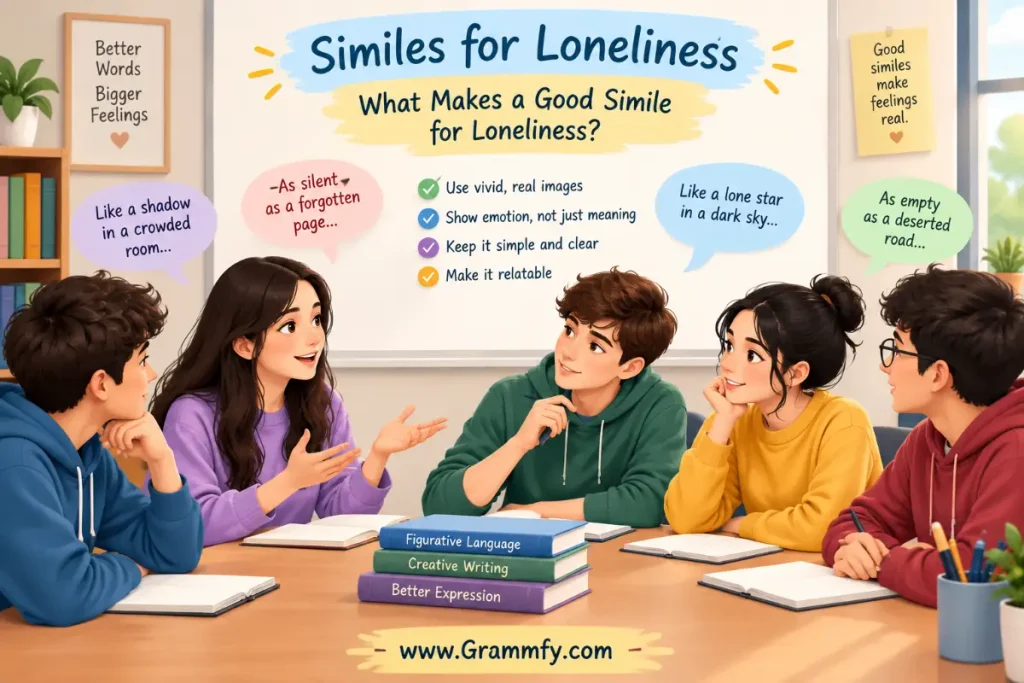
What Makes a Good Simile for Loneliness?
A strong comparison usually has four qualities.
1. It Is Easy to Picture
Readers should quickly understand the image.
2. It Matches the Emotion
A peaceful comparison shouldn’t be used for intense emotional pain unless that contrast is intentional.
3. It Adds Something New
Don’t use a comparison just because it sounds poetic. It should reveal something about the person’s experience.
4. It Fits the Audience
A children’s story, school essay, personal text, and literary poem can all use different levels of figurative language.
Quick Tips for Choosing the Right Expression
- Decide whether the loneliness is mild or intense.
- Ask whether the person is physically alone or emotionally disconnected.
- Consider whether the loneliness is temporary or lasting.
- Use familiar images for school writing.
- Use specific details for creative writing.
- Don’t confuse solitude with loneliness.
- Avoid forcing a simile into formal writing.
- Keep the comparison connected to the main idea.
- Prefer one strong image over several weak ones.
- Read the sentence aloud to check whether it sounds natural.
- Think about the mood before choosing an image.
- Use light and darkness to suggest emotional changes.
- Use crowds to show social loneliness.
- Use distance to show separation.
- Use empty spaces to show absence.
- Use sound to show feeling unheard.
Conclusion
Good Similes for Loneliness do more than decorate a sentence. They give an invisible emotion a shape, sound, place, or object that readers can imagine. An empty chair can show exclusion, a distant ship can represent separation, and a silent phone can capture the pain of waiting for connection.
The best comparison depends on the situation. First decide whether the feeling comes from being physically alone, feeling ignored, being excluded, missing someone, or lacking a deeper connection. Then choose an image that matches that emotion.
Keep your language clear and specific. You don’t need complicated words to make loneliness powerful. Sometimes a simple image, such as a single star in a dark sky, says more than a long explanation. Choose one strong comparison, make it fit your context, and let the image carry the emotion.
Frequently Asked Questions
What are some good similes for loneliness?
Good similes for loneliness include “like an empty chair at a crowded table,” “like a single star in a dark sky,” and “like a phone that never rings.” Each comparison shows a different type of emotional separation.
What’s another way to say “lonely”?
Another way to say “lonely” is isolated, disconnected, alone, left out, distant, or emotionally separated, depending on the context. “Solitary” can also work, but it doesn’t always imply sadness.
What is a simile for feeling alone in a crowd?
A strong simile is “like a lost voice in a crowded room.” It shows that people are nearby, but the speaker still feels unseen or unheard.
What is the difference between alone and lonely?
Being alone means being without other people, while being lonely usually means feeling unhappy because meaningful connection is missing. A person can be alone without feeling lonely.
What is a good simile for deep loneliness?
One strong choice is “as lonely as a lighthouse surrounded by endless sea.” The lighthouse is separated from everything around it, creating an image of distance and isolation.
Can I use Similes for Loneliness in an essay?
Yes, you can use Similes for Loneliness in an essay when the assignment allows figurative language. Choose a clear comparison and explain how the image supports your main point.
Are solitude and loneliness the same thing?
No, solitude and loneliness aren’t exactly the same. Solitude can be peaceful and intentional, while loneliness usually describes an unwanted lack of emotional or social connection.

1 thought on “Similes for Loneliness: 35+ Simple and Powerful Examples”