
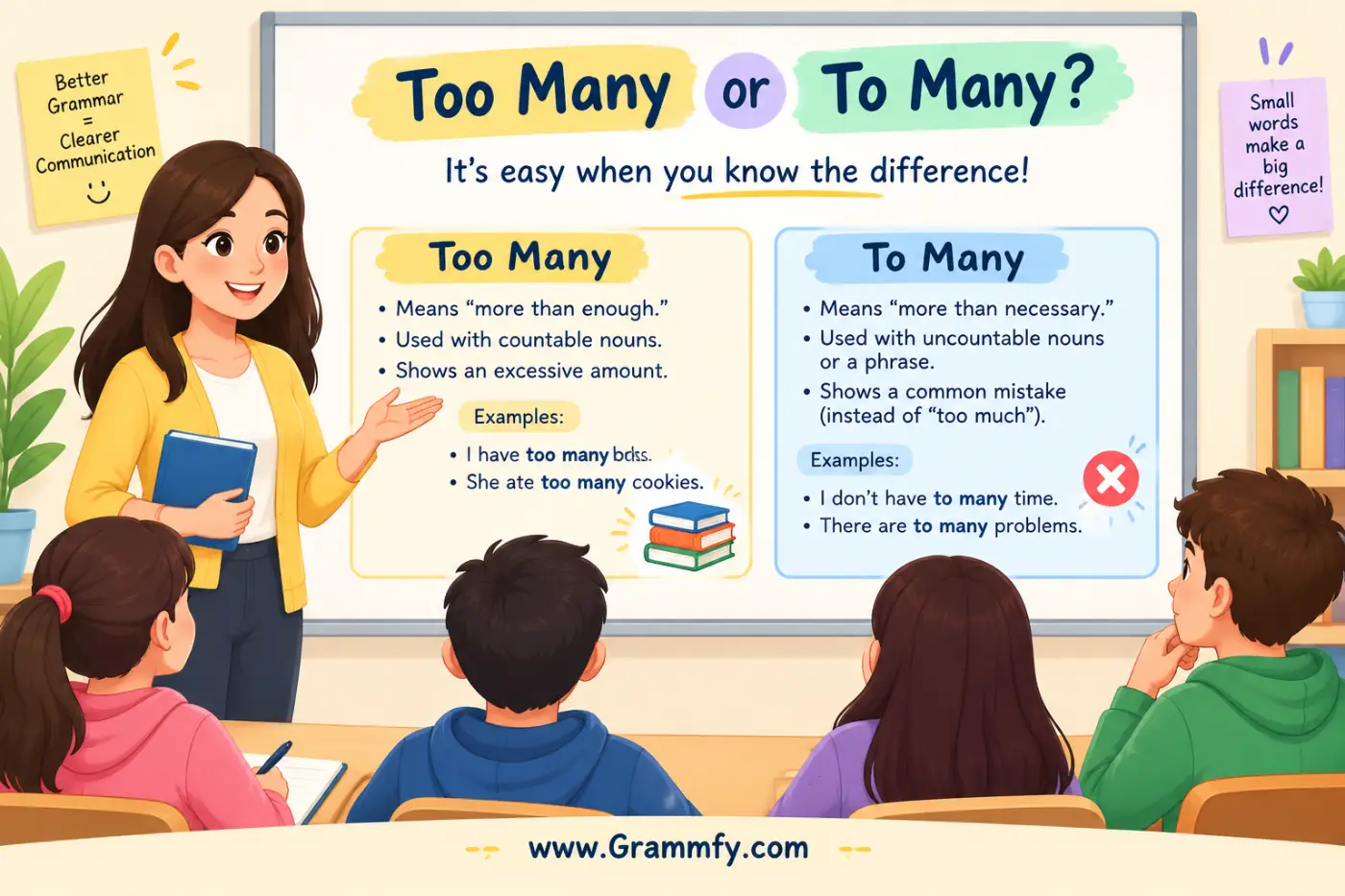
Have you ever been writing an email, essay, resume, or quick text and suddenly wondered whether Too Many or To Many is correct? The two phrases sound almost identical when spoken, so it’s easy to type the wrong one. The good news is that the rule is simple once you understand what too means.
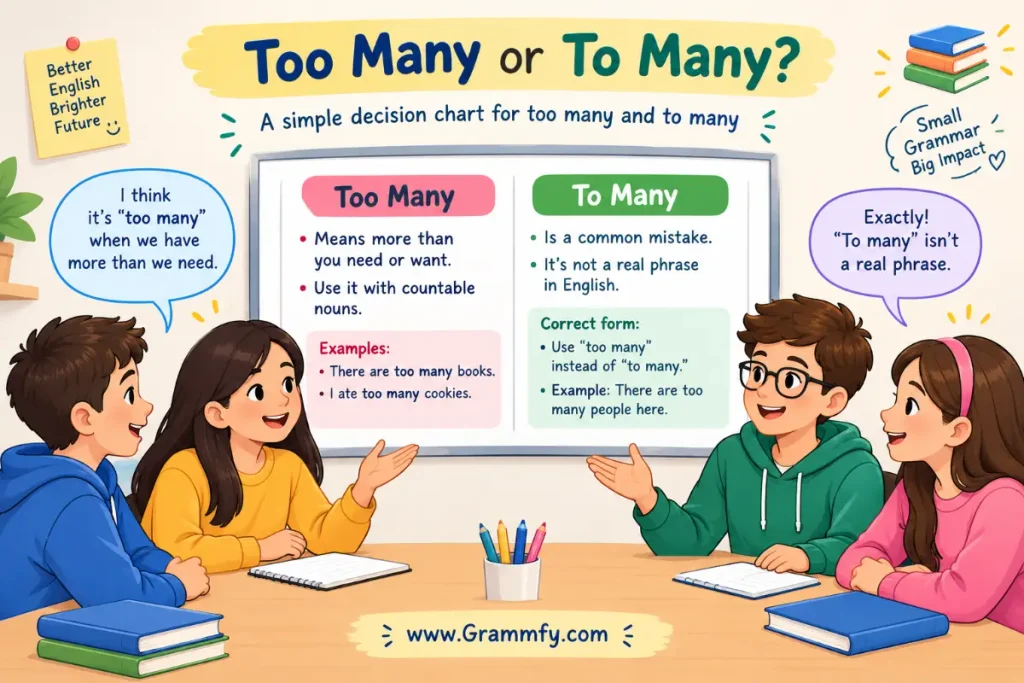
Too many is the correct phrase when you mean an amount that is more than needed, expected, or wanted. To many is usually incorrect when used to express excessive quantity, although to can appear before many in certain grammatical structures where it has a different job.
Answer: Use too many when you mean “more than necessary” or “more than is wanted.” To many is not the standard phrase for expressing an excessive number.
This small difference matters because to and too have different meanings and grammatical roles. One is commonly used for direction, connection, or infinitives, while the other can mean “also” or “more than necessary.”
This guide explains the difference, the history of these words, useful synonyms, common mistakes, sentence patterns, examples, regional notes, and the best choice for emails, resumes, essays, texts, and everyday speech.
You may also find our guide to [Color or Colour] useful when writing.
What is the difference between Too Many or To Many?
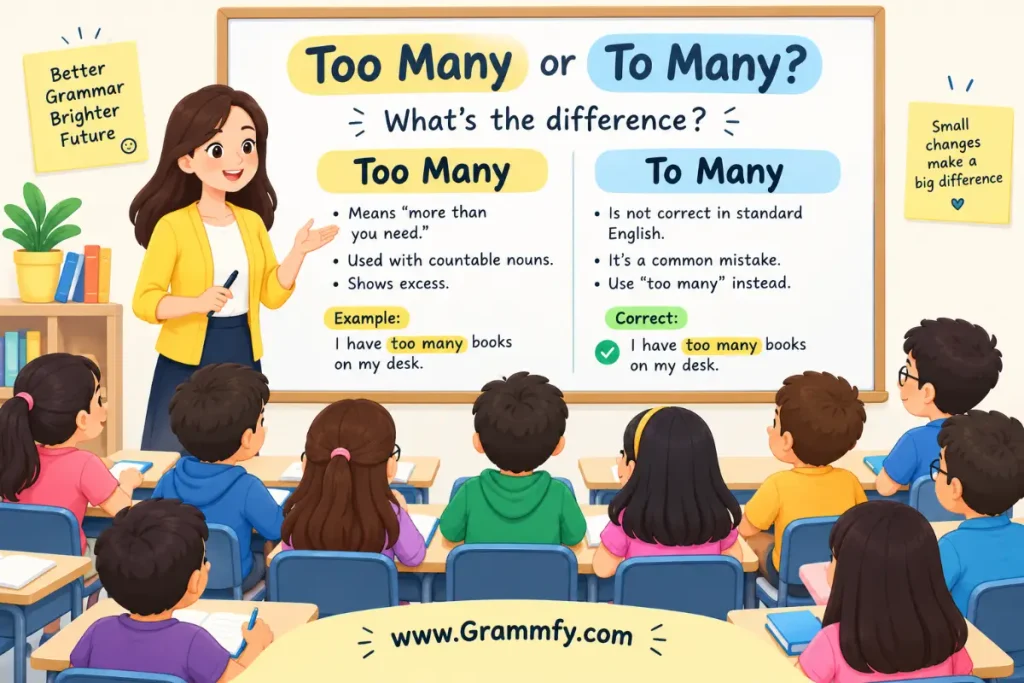
The main difference is the meaning and grammatical function of too and to.
Too many means more than is needed, wanted, or reasonable.
Examples:
- There are too many people here.
- I made too many mistakes.
- She has too many assignments.
- We bought too many snacks.
The phrase to many does not normally express excessive quantity.
For example:
There are to many people here.
is incorrect.
The correct sentence is:
There are too many people here.
A quick way to remember the difference is:
Too = more than enough.
To = direction, connection, or part of an infinitive.
Why is “too many” correct?
The word too can act as an adverb meaning more than is desirable, necessary, or acceptable.
When it comes before a plural countable noun, we use:
too + many + plural noun
Examples:
- too many books
- too many questions
- too many students
- too many emails
- too many cars
- too many problems
The word many tells us that we’re talking about a countable quantity.
Why is “to many” usually wrong?
The word to does not mean “more than necessary.”
It is commonly used to show:
- direction
- movement
- a relationship
- a recipient
- an infinitive verb
Examples:
- Go to school.
- Give the book to Sarah.
- I want to study.
- She went to the store.
Therefore, writing to many when you mean “an excessive number” is a spelling and grammar mistake.
What does too mean in plain English?
Too has two major meanings in everyday English.
Too can mean “more than necessary”
This is the meaning used in too many.
There are too many people in the room.
The sentence suggests that the number of people is higher than is comfortable, suitable, or expected.
Another example:
I ate too much cake.
The amount was more than was appropriate.
Too can mean “also”
Too can also mean also or as well.
Examples:
- I want to come too.
- She likes coffee too.
- He is a student too.
This meaning has nothing to do with quantity.
That’s why context is important.
Compare:
There are too many chairs.
Here, too means more than needed.
I want a chair too.
Here, too means also.
What does to mean in plain English?
To is one of the most common words in English. It has several grammatical functions.
To shows direction
We went to school.
She drove to the office.
He walked to the park.
Using “To” for the Receiver
Give the letter to your teacher.
I sent the email to my manager.
To forms an infinitive
The word to commonly comes before the base form of a verb.
Examples:
- to eat
- to read
- to write
- to study
- to learn
- to work
- to sleep
Sentences include:
I want to learn English.
She plans to study tonight.
To can show a relationship or connection
The answer to the question is simple.
What’s the solution to this problem?
In these examples, to isn’t related to quantity at all.
Where did too come from?
The word too has a long history in English. It developed from an Old English word associated with the ideas of “also,” “in addition,” and “to an excessive degree.”
Over time, its meanings became established in modern English.
Today, the two major uses are easy to recognize:
- also
- excessively or more than necessary
Examples:
She wants to come too.
The bag is too heavy.
The spelling helps distinguish too from the much more common preposition to.
Where did to come from?
To is also an old English word. It has roots in Old English and has long been used to express movement, direction, relationships, and purpose.
Modern English uses to in many structures.
For example:
- go to work
- talk to someone
- give it to me
- want to leave
- need to study
- learn to drive
Because to appears so frequently, it is easy to type it automatically when you actually need too.
How does too many work grammatically?
The basic structure is:
too + many + plural countable noun
Examples:
- too many books
- too many people
- too many questions
- too many assignments
- too many messages
- too many choices
The noun after many should normally be plural because many is used with countable nouns.
Correct:
too many books
Incorrect:
too many book
The same structure appears with other quantity expressions.
| Structure | Example |
|---|---|
| Too many + plural count noun | too many emails |
| Too much + uncountable noun | too much water |
| Many + plural count noun | many students |
| Much + uncountable noun | much information |
| A lot of + count/uncountable | a lot of work |
What is the difference between Too Many or To Many?
This is one of the most useful grammar rules to learn.
Use too many with countable plural nouns.
There are too many books on the desk.
Use too much with uncountable nouns.
There is too much water in the glass.
Compare:
| Countable | Uncountable |
|---|---|
| too many apples | too much juice |
| too many chairs | too much furniture |
| too many questions | too much information |
| too many students | too much homework |
| too many emails | too much work |
A simple test is to ask whether you can normally count the noun as separate items.
You can count:
- one book, two books
- one chair, two chairs
- one question, two questions
You don’t normally count:
- one information
- two furnitures
- three homeworks
Therefore:
too many questions
but:
too much information
What are synonyms for too many?
There are many ways to express excessive quantity. The best choice depends on how strong, formal, or casual you want your sentence to sound.
Master synonym list
| Word/Phrase | Meaning | Tone | Example |
|---|---|---|---|
| Excessive | More than reasonable | Formal | The fees are excessive. |
| Numerous | A large number | Formal | Numerous issues were reported. |
| Countless | Too many to count easily | Strong/descriptive | Countless stars filled the sky. |
| Several | More than two but not a large amount | Neutral | Several students stayed. |
| Many | A large number | Neutral | Many people attended. |
| A lot of | A large amount/number | Everyday | A lot of people came. |
| Lots of | A large amount/number | Casual | Lots of students joined. |
| Plenty of | More than enough | Positive/neutral | We have plenty of chairs. |
| An excess of | More than needed | Formal | An excess of sugar can affect taste. |
| A surplus of | More than required | Formal/business | There is a surplus of stock. |
| Overload | Too much to handle | Neutral | We received an overload of requests. |
| High number | A relatively large quantity | Neutral/formal | A high number of errors occurred. |
| Excess | More than necessary | Formal/neutral | The excess items were removed. |
| Surfeit | An excessive amount | Formal/literary | A surfeit of choices made the decision harder. |
| Plethora | A very large number or amount | Formal | The website offers a plethora of options. |
| Loads of | A large amount or number | Informal | We have loads of work today. |
| Tons of | A large amount or number | Casual | She has tons of books. |
| A flood of | A sudden large amount | Descriptive | A flood of emails arrived. |
| A wave of | A large number arriving together | Descriptive | A wave of complaints followed. |
| A pile of | A large physical amount | Everyday | There’s a pile of papers here. |
| More than enough | More than is required | Neutral | We have more than enough chairs. |
| Overly numerous | Excessively large in number | Formal | The examples were overly numerous. |
These alternatives are not exact replacements in every sentence. Numerous, for example, means many but does not necessarily mean excessive.
Compare:
The report contains numerous examples.
This doesn’t say the examples are a problem.
The report contains too many examples.
This clearly suggests that the number is excessive.
Which synonyms are mild and which are strong?
Not every expression communicates the same level of excess.
Mild
These suggest a noticeable but not necessarily serious amount:
- many
- several
- a lot of
- quite a few
- plenty of
Example:
There are quite a few options available.
This doesn’t necessarily suggest a problem.
Moderate
These suggest a larger amount:
- numerous
- a large number
- a high number
- a great many
- a large quantity
Example:
The survey received a large number of responses.
Strong
These clearly suggest excess:
- excessive
- an excess of
- an overload of
- overwhelming number
- overabundance
- countless
Example:
The application contains an excessive number of unnecessary sections.
Very strong or expressive
These can create a dramatic or emotional effect:
- tons of
- loads of
- heaps of
- a flood of
- a mountain of
- countless
Example:
I have a mountain of paperwork to finish.
This is usually figurative rather than literal.
Which synonyms are formal and which are casual?
The right expression depends on your audience.
Formal choices
For reports, academic writing, and professional documents:
- excessive
- numerous
- an excess of
- a surplus of
- an abundance of
- overabundance
- overwhelming number
- large number
Example:
The study identified an excessive number of errors.
Everyday choices
For normal conversation and general writing:
- many
- a lot of
- plenty of
- more than enough
- a large number of
Example:
We have more than enough chairs.
Casual choices
For texts and friendly conversations:
- lots of
- loads of
- tons of
- heaps of
Example:
I’ve got tons of homework tonight.
These informal expressions are common, but they may not belong in a formal report.
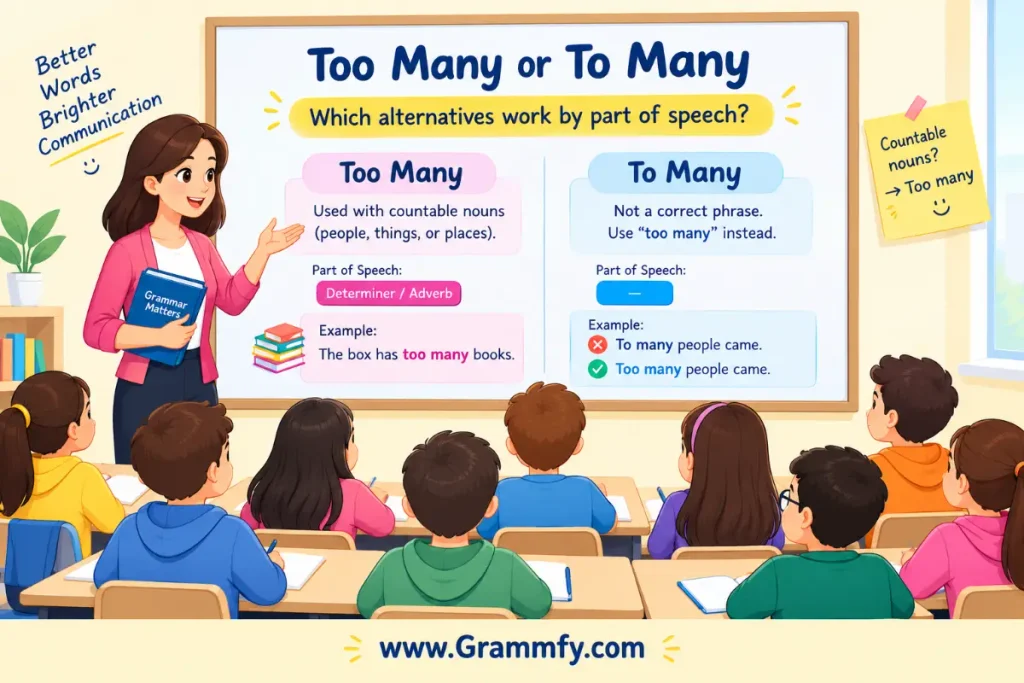
Which alternatives work by part of speech?
Quantity expressions can appear in different grammatical forms.
Determiners and quantity words
Examples:
- many
- several
- numerous
- countless
Many students attended.
Noun phrases
Examples:
- an excess
- a surplus
- an abundance
- an overload
An excess of sugar can affect the recipe.
Adjectives
Examples:
- excessive
- numerous
- countless
The company received numerous complaints.
Informal phrases
Examples:
- loads of
- tons of
- heaps of
We have loads of work.
Understanding the grammar of each alternative prevents awkward substitutions.
Is too many used only with countable nouns?
Yes, too many is used with plural countable nouns.
Examples:
- too many books
- too many cars
- too many students
- too many questions
- too many mistakes
For uncountable nouns, use too much.
Examples:
- too much water
- too much noise
- too much information
- too much homework
- too much traffic
One useful test is whether the noun can naturally have a plural form.
books → countable → too many books
information → uncountable → too much information
Can too many be used without a noun?
Yes. The noun can sometimes be understood from context.
For example:
I don’t want any more cookies. I’ve already eaten too many.
The word cookies is understood even though it isn’t repeated.
Another example:
We ordered too many.
The listener understands what was ordered from the conversation.
This is natural English because context fills in the missing noun.
Can too many be used with people?
Yes. Too many commonly appears with people and groups.
Examples:
- There are too many people here.
- Too many students missed the class.
- Too many customers complained.
- We invited too many guests.
- Too many workers were assigned to the task.
The phrase doesn’t always sound negative. Its tone depends on the context.
For example:
We have too many volunteers for this small project.
This could be a positive problem because it means many people want to help.
Can too many be used with abstract nouns?
Yes, as long as the noun is countable in that context.
Examples:
- too many mistakes
- too many questions
- too many choices
- too many ideas
- too many rules
- too many problems
- too many interruptions
For uncountable abstract nouns, use too much:
- too much stress
- too much confusion
- too much information
- too much pressure
The distinction is based on countability, not whether the noun is physical.
Too many vs many: what’s the difference?
Many simply indicates a large number.
Too many says that the number is more than desired or appropriate.
Compare:
Many students joined the club.
This is neutral.
Too many students joined the club.
This suggests that the number caused or may cause a problem.
The difference is important.
| Phrase | Meaning |
|---|---|
| Many | A large number |
| Too many | More than necessary or wanted |
| So many | A surprisingly large number |
| Very many | A large number, often less common |
| How many | Asking about quantity |
Too many vs so many: what’s the difference?
So many emphasizes a large or surprising number.
Too many suggests excess.
Compare:
There are so many beautiful places to visit.
The speaker is impressed.
There are too many places to visit in one day.
The speaker thinks the number is more than can reasonably be handled.
This small distinction changes the feeling of the sentence.
Too many vs a lot of: what’s the difference?
A lot of means a large quantity or number, but it doesn’t automatically suggest a problem.
She has a lot of books.
This is neutral.
She has too many books.
This suggests that the number is excessive.
A writer should choose based on the intended meaning.
If you’re simply describing quantity, use a lot of.
If you’re saying the quantity is beyond a reasonable limit, use too many.
Too many vs numerous: what’s the difference?
Numerous means many or a large number. It doesn’t necessarily mean that there are more than necessary.
The article contains numerous examples.
This can be positive.
The article contains too many examples.
This suggests that the article may be longer or more complicated than necessary.
For formal writing, numerous can be useful when you want to emphasize quantity without criticizing it.
Too many vs countless: what’s the difference?
Countless means so many that counting them would be difficult or impossible.
It often creates a strong or dramatic impression.
She has countless memories of her childhood.
Too many has a different focus. It suggests that the number is beyond what is appropriate.
She has too many responsibilities.
The first sentence emphasizes a huge number. The second emphasizes excess.
How should you use too many in a resume?
A resume usually shouldn’t contain negative phrases such as too many mistakes unless you’re discussing a specific improvement or professional problem.
Instead, use precise quantity language.
For example:
Managed a large number of customer accounts.
Processed numerous applications each month.
Reduced the number of processing errors.
If you need to describe an excessive workload, you can write:
Managed a high volume of customer requests while maintaining response times.
This sounds more professional than:
Handled too many customer requests.
Resume examples
- Processed a large number of customer orders each week.
- Managed numerous client accounts.
- Reduced unnecessary steps in the reporting process.
- Handled a high volume of support requests.
- Organized a large database of customer records.
The phrase too many is grammatically correct, but it often carries a negative meaning. Professional resumes usually focus on achievements rather than complaints.
How should you use too many in an essay?
In an essay, too many can be useful when you’re making an argument about excess.
Examples:
Too many students struggle to find enough time for extracurricular activities.
Using too many technical terms can make an article difficult to understand.
Too many advertisements can distract readers from the main message.
Academic writing may sometimes benefit from more precise alternatives such as an excessive number of, especially when the tone needs to be formal.
Compare:
Too many people rely on social media for news.
with:
An excessive number of users may rely on social media for news.
The first is simpler and more direct. The second sounds more formal.
How should you use too many in texting?
In texts, too many is completely natural.
Examples:
I have too many assignments 😭
There are too many people here.
You have too many shoes 😂
That’s too many snacks for one person!
Casual writing often uses contractions, emojis, and informal vocabulary around the phrase.
The grammar rule doesn’t change just because the message is informal.
How should you use too many in an email?
Professional emails can use too many when the meaning is appropriate.
For example:
There are too many files attached to the message.
However, when you want to sound diplomatic, you might soften the wording.
Instead of:
There are too many steps in the process.
Try:
The process may contain more steps than necessary.
This version sounds less blunt.
Email examples
We received too many applications to review them all today.
There are too many attachments in the current email.
The report includes too many details for a short summary.
Could we reduce the number of fields on the form?
The best wording depends on how direct you want to be.
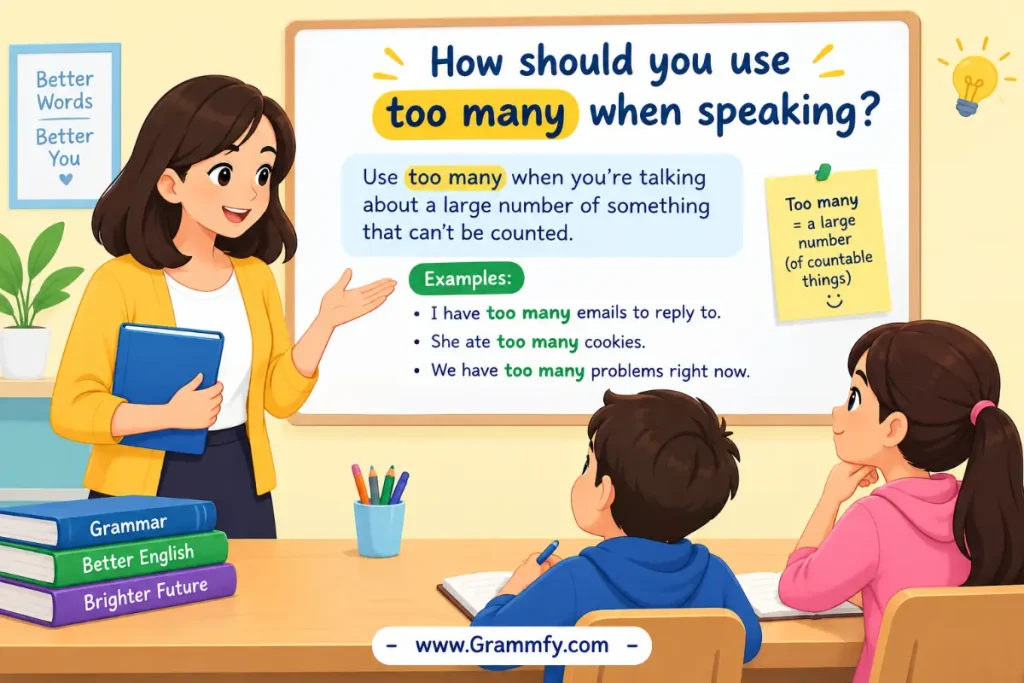
How should you use too many when speaking?
In everyday speech, too many is extremely common.
Examples:
I’ve eaten too many cookies.
There are too many cars on this road.
You ask too many questions!
We have too many things to do today.
Tone matters. A sentence like “You ask too many questions!” can sound playful or annoyed depending on the speaker’s voice.
What are common mistakes with too many and to many?
Mistake 1: Writing “to many” for excessive quantity
Incorrect:
There are to many people here.
Correct:
There are too many people here.
The word too means more than necessary.
Mistake 2: Using too much with countable plural nouns
Incorrect:
There are too much books.
Correct:
There are too many books.
Books can be counted, so use many.
Mistake 3: Using too many with an uncountable noun
Incorrect:
There is too many information.
Correct:
There is too much information.
Information is normally uncountable.
Mistake 4: Confusing too with two
Two is the number 2.
I have two books.
Too can mean also or excessively.
I have too many books.
The three words sound alike or nearly alike in many varieties of English, which makes them common spelling traps.
Mistake 5: Thinking too always means excessive
Not always.
I want to come too.
Here, too means “also.”
The coffee is too hot.
Here, too means excessively.
Context determines the meaning.
When should you NOT use too many?
Don’t use too many when you’re simply trying to say that a large number exists and you don’t mean the quantity is excessive.
Instead of:
There are too many students in the program.
If you simply mean the program has a large enrollment, write:
There are many students in the program.
Or:
The program has a large number of students.
Use too many when the quantity goes beyond an expected, useful, or acceptable level.
When should you NOT use to many?
Don’t use to many as a replacement for too many.
Incorrect:
I have to many assignments.
Correct:
I have too many assignments.
However, to and many can appear next to each other naturally when they belong to separate grammatical structures.
For example:
I spoke to many students during the event.
Here, to is a preposition meaning that you spoke with the students. It does not combine with many to form a quantity phrase.
Another example:
This advice applies to many people.
Again, to belongs to the verb or phrase before it, while many modifies people.
This distinction is important.
Can “to many” ever be grammatically correct?
Yes. To many can be correct when to has its normal grammatical function and many is simply a quantity word.
Consider:
The rule applies to many students.
Here:
- to = preposition
- many = determiner
- students = plural noun
Another example:
She spoke to many people.
The phrase is correct because to means that the action was directed toward those people.
So saying that to many is “always wrong” would be inaccurate. It is wrong when someone intends it to mean more than necessary.
What are the most useful sentence patterns?
Learning patterns is often easier than memorizing isolated rules.
Too many + plural noun
There are too many cars on the road.
Too many + verb
Too many people arrived at once.
Have + too many + noun
I have too many assignments.
There are + too many + noun
There are too many options.
Too many + noun + to + verb
There are too many books to read in one day.
Too many + noun + for + noun
There are too many tasks for one person.
Verb + too many
We ordered too many.
The final noun can be omitted when everyone understands what it refers to.
What are 15+ original example sentences?
- I have too many emails to answer today.
- There are too many cars on this narrow road.
- She bought too many books at the store.
- We received too many applications this week.
- My brother asks too many questions during movies.
- The teacher gave us too many assignments for one night.
- There are too many choices on the menu.
- He made too many spelling mistakes in the essay.
- The website has too many pop-ups.
- We invited too many people to the small room.
- She has too many clothes in her closet.
- The report contains too many technical terms.
- I ate too many cookies after dinner.
- The meeting included too many unnecessary topics.
- There are too many notifications on my phone.
- He opened too many tabs on his computer.
- The instructions have too many steps.
- We printed too many copies of the document.
- The city has too many advertisements along the highway.
- I have too many things to finish before Friday.
What are examples using to many correctly?
Although to many isn’t the phrase used to express excessive quantity, it can occur naturally when to is a preposition.
Examples:
- The message was sent to many students.
- This problem is important to many people.
- She spoke to many customers during the event.
- The new policy applies to many businesses.
- The change came as a surprise to many readers.
- The teacher explained the rule to many students.
- This service is available to many users.
- The news was disappointing to many fans.
- The opportunity is valuable to many families.
- The book is familiar to many readers.
These examples show why the two-word sequence to many isn’t inherently ungrammatical. The problem occurs when a writer uses it where too many is required.
How can you remember too many quickly?
Try the extra O trick.
The word too has an extra o.
Think of the extra o as meaning extra.
Too many = extra many
The spelling isn’t a formal grammar rule, but it’s a useful memory trick.
You can also remember:
- to → direction or action
- too → extra or also
- two → number 2
For example:
I went to school.
I have too many books.
I have two books.
These three sentences make the difference easy to see.
How does too many compare with excessive?
Both express an amount beyond a reasonable level, but they have different styles.
Too many is simple and conversational.
There are too many advertisements.
Excessive is more formal.
The number of advertisements is excessive.
For a school essay, either may work depending on the tone. For everyday communication, too many is usually clearer.
How does too many compare with an excess of?
Too many is shorter and more natural in everyday English.
There are too many unnecessary meetings.
An excess of is more formal.
There is an excess of unnecessary paperwork.
The second version may fit a formal report, but it can sound unnecessarily complicated in casual writing.
Good writing isn’t about choosing the longest expression. Choose the clearest one for your audience.
How does too many compare with an abundance of?
An abundance of often has a positive or neutral feeling.
The garden has an abundance of flowers.
Too many usually suggests that the quantity has crossed a useful limit.
The garden has too many flowers for the small space.
The first celebrates quantity. The second points out a problem.
What are the antonyms of too many?
The opposite of too many can be expressed in several ways depending on the meaning.
Common alternatives include:
- too few
- not enough
- a small number
- few
- fewer than needed
- just enough
- an appropriate number
Examples:
There are too many chairs.
Opposite:
There are too few chairs.
Another example:
We have too many volunteers.
Opposite:
We don’t have enough volunteers.
The exact opposite depends on whether you’re comparing quantity, adequacy, or shortage.
Too many vs too few: what’s the difference?
When the number is higher than necessary, we say too many. If the number is lower than necessary, too few is the right choice.
| Phrase | Meaning | Example |
|---|---|---|
| Too many | More than necessary | We have too many chairs. |
| Too few | Fewer than necessary | We have too few chairs. |
| Enough | The right amount | We have enough chairs. |
| Not enough | Less than needed | We don’t have enough chairs. |
These expressions are useful when discussing quantities and limits.
How do US and UK English use too many?
The phrase too many is standard in both American and British English.
There is no major regional spelling difference here.
American:
There are too many people here.
British:
There are too many people here.
The words too and many are spelled the same in both varieties.
The same applies to:
- too much
- too few
- too little
- many
- much
- several
- enough
Regional vocabulary may differ in some contexts, but this grammar rule remains stable.
Which word is best for a formal report?
For a formal report, too many is perfectly acceptable when the meaning is clear.
Example:
Too many applications were submitted after the deadline.
If you want a more formal tone, you could write:
An excessive number of applications were submitted after the deadline.
The first is easier to read. The second sounds more formal.
Don’t replace simple words with complex ones unless the change adds useful precision.
Which word is best for a school essay?
For a school essay, too many is often a good choice because it’s clear and natural.
Example:
Too many distractions can make it difficult for students to focus.
If your teacher expects formal academic vocabulary, you could write:
Excessive distractions can make it difficult for students to focus.
Both are grammatically correct.
Which word is best for a resume?
A resume usually benefits from positive and precise wording.
Instead of saying:
I handled too many customer complaints.
Try:
Managed a high volume of customer complaints while maintaining strong response times.
This focuses on your ability rather than the problem.
When describing quantity in a resume, useful alternatives include:
- high volume
- large number
- numerous
- multiple
- extensive
Which word is best for texting?
For texts, too many is the most natural choice when you’re talking about excess.
Examples:
That’s too many!
I have too many assignments.
You bought too many snacks 😂
Simple language is best for casual communication.
Which word is best for an email?
In an email, too many works well when you need to be direct.
There are too many attachments in the current email.
For a softer professional tone, consider:
There may be more attachments than necessary.
That wording can be useful when you want to point out an issue without sounding critical.
Which word is best when speaking?
In normal conversation, too many is the natural phrase.
You might say:
I have too many things to do today.
There are too many people waiting.
We ordered too many pizzas.
There’s no need to use a formal synonym unless the situation calls for it.
What are quick tips for choosing the right word?
Use these rules whenever you’re unsure:
- Use too many for an excessive number.
- There are too many students.
- Use too much for an excessive amount of an uncountable noun.
- There is too much noise.
- Use many for a large number without saying it’s excessive.
- Many students attended.
- Use too when you mean “also.”
- I want to come too.
- Use to for direction or an infinitive.
- I want to go to school.
- Use two for the number 2.
- I have two books.
- Check the noun after many.
- too many books
- too many questions
- Don’t automatically replace too with to.
- Remember the extra “o.”
- Use formal alternatives when your audience needs them.
- excessive number
- large number
- numerous
- Ask whether the quantity is actually a problem.
- If not, use many, several, or a lot of.
A simple decision chart for too many or to many
| What do you mean? | Correct choice | Example |
|---|---|---|
| More than necessary | Too many | There are too many cars. |
| A large number | Many | Many cars passed. |
| More than desired, informal | Too many | I have too many tasks. |
| Direction | To | I went to the office. |
| Recipient | To | I sent it to many people. |
| Infinitive | To | I want to study. |
| Number 2 | Two | I have two books. |
| Also | Too | I want one too. |
What should you check before publishing?
Before submitting an essay, sending an email, or publishing an article, scan for to many.
If you find it, ask what you intended to say.
If you mean:
more than necessary
change it to:
too many
If to is showing direction, a recipient, or an infinitive, keep to.
Examples:
I sent the invitation to many people.
Correct.
I invited too many people.
Also correct.
The difference comes from the role of to in the first sentence and the meaning of too in the second.
Why is this mistake so common?
The biggest reason is pronunciation. In many varieties of English, to, too, and two sound the same or nearly the same when spoken.
That means a listener can understand the sentence without knowing which spelling the speaker would use.
Writing is different.
When you type:
I have to many books.
the reader sees a spelling error immediately.
English learners often make this mistake because they hear the correct phrase before they see it written. Memorizing common patterns can help.
Useful patterns include:
- too many people
- too many books
- too many questions
- too many mistakes
- too many choices
- too many emails
- too many tasks
The more you see these expressions, the easier the spelling becomes.
Conclusion
The key to Too Many or To Many is understanding what you want the sentence to mean. When you want to say that a number is greater than necessary, wanted, or reasonable, use too many. The structure is too + many + plural countable noun, as in “too many books” or “too many questions.” By contrast, to is used for direction, recipients, relationships, and infinitive verbs. That’s why “I sent the message to many people” is correct, while “There are to many people here” is not.
Remember the extra o in too as a simple memory trick for “extra.” With regular practice, you’ll quickly recognize whether the sentence needs too, to, or even two. Keep the rule simple, check the noun, and choose the word that matches your meaning.
Frequently Asked Questions
Is “to many” grammatically correct?
To many can be grammatically correct when to is a preposition, as in “This rule applies to many students.” It is incorrect when you mean “more than necessary.”
What is the difference between too many and to many?
Too many means more than necessary or wanted, while to many usually contains the preposition to followed by the quantity word many. For excessive quantity, always choose too many.
Should I say “too many” or “too much”?
Use too many with plural countable nouns, such as “too many books.” Use too much with uncountable nouns, such as “too much information.”
Why do people confuse to and too?
To and too usually sound the same in speech, so writers can easily choose the wrong spelling. The extra o in too can be remembered as a clue for “extra” or “also.”
What’s another way to say “too many”?
You can say an excessive number, numerous, a large number, an abundance of, an excess of, countless, or a high volume of, depending on the context and tone.
Is “too many” correct in formal writing?
Yes, too many is grammatically correct in formal writing. A phrase such as an excessive number of may sound more formal, but the simpler expression is often clearer.
Can “to many” ever be correct?
Yes. For example, “She spoke to many students” is correct because to functions as a preposition. The phrase is not being used to mean “more than necessary.”

1 thought on “Too Many or To Many: Best Easy Grammar Guide”