
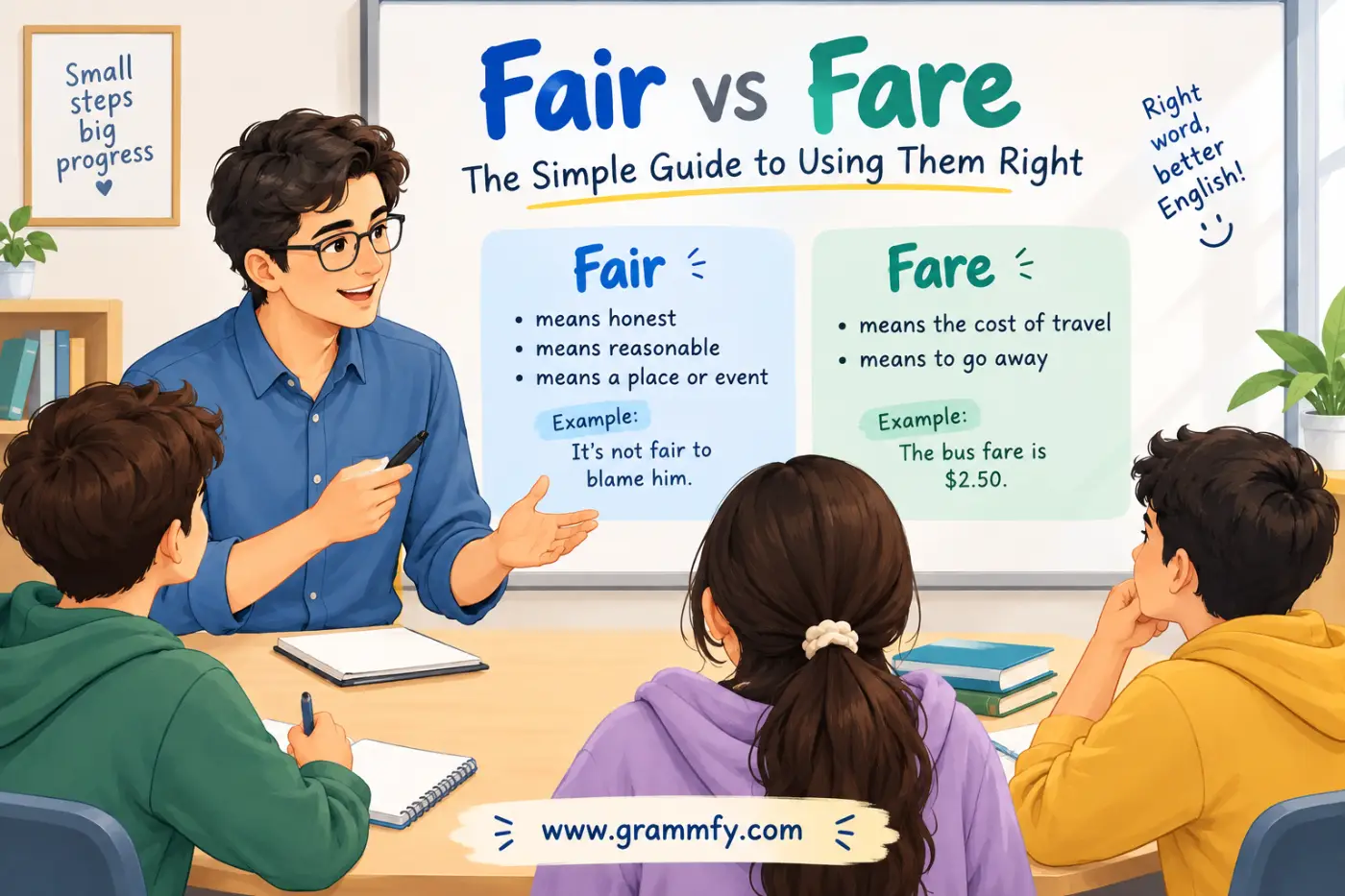
Have you ever been writing an email, essay, text, or travel message and stopped because you weren’t sure whether to write Fair vs Fare? These two words sound exactly alike in many varieties of English, but they have very different meanings. Choosing the wrong one can change your sentence completely.
Fair can describe something reasonable, equal, pleasant, or attractive. It can also refer to an event where people gather to buy, sell, or enjoy things. Fare usually refers to the price of a trip or the food served during a journey, although it has other uses too.
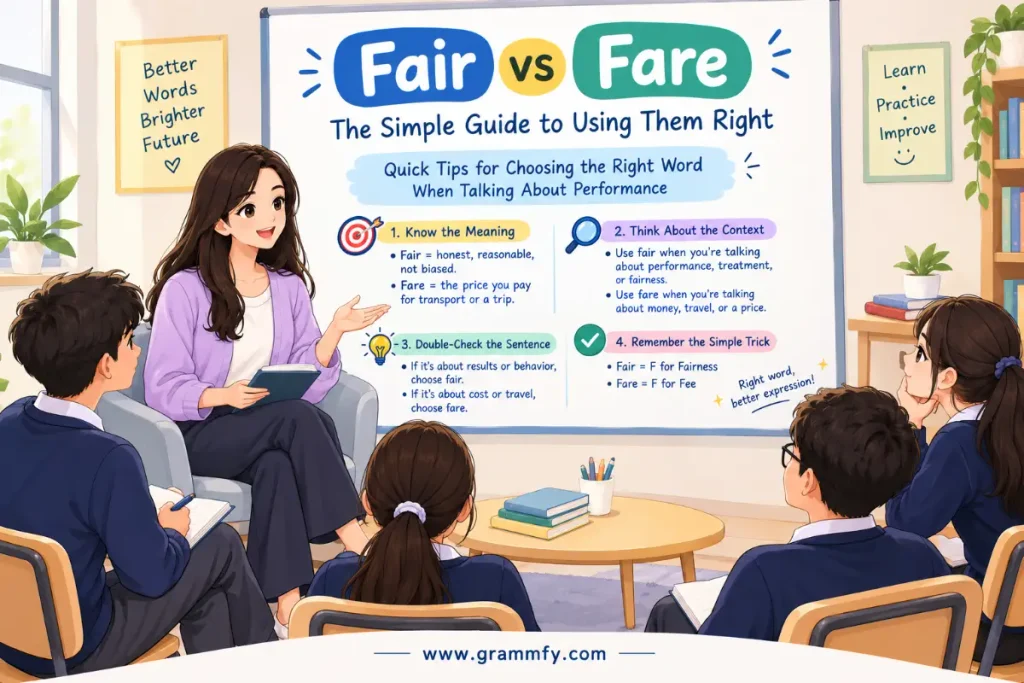
Answer box: Fair usually means reasonable, equal, or just, while fare commonly means the price of transportation or how someone performs. They are homophones, so they sound alike but have different spellings and meanings.
The easiest way to remember them is to connect fare with travel and fair with equal or reasonable. Once you understand their meanings, common expressions, word origins, examples, and grammar patterns, the difference becomes much easier.
Want to strengthen your grammar skills? Explore [every person or every people].
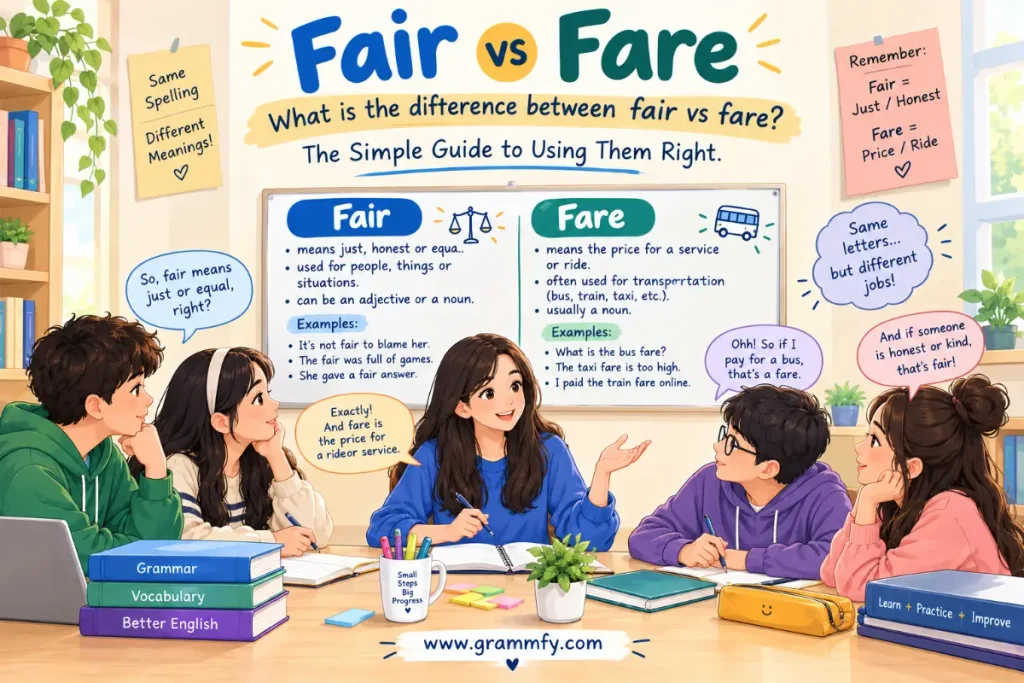
What is the difference between fair vs fare?
Fair vs fare are homophones. That means they sound the same in many English accents but have different spellings and meanings.
The word fair has several major meanings:
- Reasonable or just
- Equal or impartial
- Moderately good
- Light in color
- Attractive or pleasant
- A public event or market
The word fare has several important meanings:
- The price paid for transportation
- Food or a type of food
- To perform or manage in a particular situation
Here is the basic distinction:
| Word | Main meaning | Example |
|---|---|---|
| Fair | Reasonable or just | That was a fair decision. |
| Fair | An event | We visited the county fair. |
| Fair | Light-colored | She has fair hair. |
| Fair | Moderately good | The weather was fair. |
| Fare | Transportation price | The bus fare is $3. |
| Fare | Food | Traditional fare was served. |
| Fare | Perform or do | How did you fare on the test? |
A quick check can prevent most mistakes:
If you’re talking about a reasonable decision, use “fair.”
If you’re talking about a transportation price, use “fare.”
Why do fair vs fare sound the same?
The words are pronounced the same in standard American English and many other English varieties.
Both are commonly pronounced like:
/fer/
That makes them easy to confuse when you’re listening rather than reading.
Homophones create many common spelling problems in English. Other examples include:
- there / their / they’re
- hear / here
- buy / by / bye
- brake / break
- right / write
- weather / whether
- allowed / aloud
With fair and fare, context is usually enough to tell which spelling you need.
For example:
The taxi fare was expensive.
You know fare is correct because the sentence concerns transportation.
Now consider:
The teacher gave everyone a fair chance.
Here, fair means equal or reasonable.
What does fair mean in plain English?
Fair generally describes something that is reasonable, just, equal, acceptable, or pleasant.
Its exact meaning depends on the sentence.
Fair meaning “reasonable”
The manager made a fair decision.
The decision was reasonable and just.
Fair meaning “equal”
Everyone should receive a fair chance.
Each person should have an equal opportunity.
Fair meaning “impartial”
The judge tried to remain fair.
The judge attempted to avoid favoritism.
Fair meaning “moderately good”
I received a fair score on the exam.
The score was acceptable but not excellent.
Fair meaning “light-colored”
He has fair skin and light hair.
Here, fair describes appearance or color.
Fair meaning “pleasant”
We had fair weather during the trip.
Here, fair can mean reasonably pleasant or clear.
Fair meaning “an event”
We went to the county fair.
In this case, fair is a noun describing a public event.
What does fare mean in plain English?
Fare is most commonly used as a noun for the amount of money paid for transportation.
Examples include:
The bus fare increased this year.
What’s the train fare to Boston?
I paid my taxi fare with a card.
The word can also describe food:
The restaurant serves traditional Italian fare.
Finally, fare can be a verb meaning to perform, progress, or get along in a particular situation.
For example:
How did you fare on your exam?
That means:
How did you do on your exam?
These meanings may seem unrelated, but they all belong to the same spelling: fare.
Where did the word fair come from?
Fair has a long history in English and comes from Old English forms related to words meaning beautiful, pleasant, or attractive.
Over time, its meanings expanded.
The modern word can still describe something attractive:
She has a fair complexion.
It can also describe something reasonable or just:
The rules are fair.
The connection between beauty and justice may seem strange today, but both meanings developed through the broader idea of something being pleasing, proper, or acceptable.
The noun fair, meaning a public market or event, has a different historical development. It came into English through Old French and ultimately traces back to Latin roots connected with feast days and celebrations.
Where did the word fare come from?
Fare comes from an Old English verb related to traveling, going, or journeying.
That history helps explain the transportation meaning.
Think about these expressions:
- bus fare
- train fare
- taxi fare
- air fare
- subway fare
All of them relate to the cost of making a journey.
The verb fare also keeps the older idea of how someone is doing or progressing:
How did you fare during the trip?
In modern English, this use is somewhat more formal than simply saying:
How did you do?
What are the main meanings of fair?
The word fair is more versatile than many learners realize.
Fair as an adjective
As an adjective, fair can mean:
- Just
- Reasonable
- Equal
- Impartial
- Acceptable
- Moderately good
- Light-colored
- Pleasant
- Attractive
Examples:
That’s a fair price.
The referee made a fair call.
She has fair hair.
We had fair weather.
Fair as a noun
As a noun, fair can mean a public event.
Examples:
The school held a science fair.
We went to the state fair.
My daughter sold crafts at the local fair.
Fair as an adverb
Fair can also appear in expressions where it functions adverbially.
For example:
The ball landed fair.
This means it landed within the designated area according to the rules.
The phrase fair and square is another familiar expression meaning honestly or according to the rules.
What are the main meanings of fare?
Fare as a noun: transportation price
This is the meaning learners most often need.
Examples:
The subway fare is $2.50.
What’s the fare from the airport to downtown?
The airline lowered its fares.
Fare as a noun: food
Fare can also mean food, especially a particular style or type of food.
Examples:
The restaurant serves traditional Mexican fare.
Local seafood is common fare in coastal towns.
The festival offered international fare.
This use can sound more formal than simply saying food.
Fare as a verb: perform or progress
The verb fare means to do, perform, or progress in a particular situation.
Examples:
How did you fare in the interview?
The company fared well during the difficult year.
The team didn’t fare well against its strongest opponent.
This meaning is common in formal writing, news reports, and academic contexts.
What are the best synonyms for fair?
Because fair has multiple meanings, its synonyms change with context.
Simple synonyms for fair
| Word | Meaning | Tone | Example |
|---|---|---|---|
| Just | Morally right or reasonable | Neutral | The decision was just. |
| Equal | The same in treatment | Neutral | Everyone deserves equal treatment. |
| Right | Correct or morally acceptable | Everyday | That seems right to me. |
| Reasonable | Sensible or acceptable | Neutral | That’s a reasonable price. |
| Honest | Free from cheating | Neutral | She gave an honest answer. |
| Impartial | Not favoring one side | Formal | The judge remained impartial. |
| Balanced | Giving proper consideration to sides | Neutral | The report is balanced. |
| Proper | Appropriate or correct | Neutral | They followed a proper process. |
Everyday synonyms for fair
| Word | Meaning | Tone | Example |
|---|---|---|---|
| Okay | Acceptable | Casual | That’s okay with me. |
| Reasonable | Sensible | Everyday | The price is reasonable. |
| Equal | Same treatment | Everyday | We got equal chances. |
| Honest | Truthful or sincere | Everyday | Give me an honest answer. |
| Square | Honest or even | Informal | Let’s keep things square. |
| Decent | Acceptable or good enough | Casual | That’s a decent deal. |
| Balanced | Not one-sided | Neutral | The discussion was balanced. |
| Clean | Fair or without cheating | Informal | It was a clean competition. |
Formal synonyms for fair
| Word | Meaning | Tone | Example |
|---|---|---|---|
| Equitable | Fair and reasonable | Formal | The plan is equitable. |
| Impartial | Unbiased | Formal | The panel must remain impartial. |
| Just | Morally or legally fair | Formal | The ruling was just. |
| Unbiased | Free from favoritism | Formal | We need an unbiased review. |
| Objective | Based on facts rather than preference | Formal | The evaluation should be objective. |
| Even-handed | Treating sides equally | Formal | The article offers an even-handed view. |
| Nonpartisan | Not favoring a political side | Formal | The organization is nonpartisan. |
| Proportionate | Appropriate in size or degree | Formal | The punishment should be proportionate. |
Informal or slang-related alternatives
| Word | Meaning | Tone | Example |
|---|---|---|---|
| Cool | Acceptable or agreeable | Casual | That’s cool with me. |
| Legit | Fair, genuine, or valid | Slang | That’s a legit deal. |
| Square | Honest or fair | Informal | He’s a square shooter. |
| Clean | Honest or without cheating | Informal | It was a clean game. |
| Decent | Fairly good or acceptable | Casual | That’s a decent offer. |
| Solid | Reliable or reasonable | Casual | That’s a solid deal. |
These words aren’t interchangeable with fair in every sentence. Their meanings overlap only in certain contexts.
What are the synonyms for fare?
The best synonym depends on which meaning of fare you’re using.
Fare meaning transportation price
Useful alternatives include:
- price
- cost
- charge
- ticket price
- transportation cost
- admission price
- rate
Examples:
The bus fare increased.
The bus price increased.
The second sentence can work in casual speech, but fare is more precise for transportation.
Fare meaning food
Useful alternatives include:
- food
- cuisine
- dishes
- meals
- cooking
- provisions
- offerings
Example:
The restaurant serves traditional fare.
Could become:
The restaurant serves traditional food.
The word fare sounds slightly more descriptive or formal.
Fare meaning perform or progress
Useful alternatives include:
- do
- perform
- manage
- progress
- succeed
- cope
- get along
Example:
How did you fare on the test?
Can become:
How did you do on the test?
The second version is more conversational.
What are the mild-to-strong synonyms for fair?
When fair means reasonable or just, synonyms can vary in strength.
Mild
- okay
- acceptable
- decent
- reasonable
Example:
The price is reasonable.
Neutral
- fair
- balanced
- equal
- just
- honest
Example:
The rules are fair.
Strong
- equitable
- impartial
- unbiased
- even-handed
- scrupulously just
Example:
The review process must be completely impartial.
Words such as equitable and impartial are more precise in formal situations.
What are the mild-to-strong alternatives for fare?
Because fare has several meanings, intensity isn’t as straightforward.
For transportation cost:
mild/general:
- price
- cost
more specific:
- fare
- transportation fare
- ticket fare
formal/business:
- transportation charge
- applicable rate
For food:
general:
- food
specific:
- cuisine
- traditional fare
For performance:
casual:
- do
neutral:
- perform
formal:
- fare
- progress
- perform
For example:
How did you do?
- sounds casual.
How did you perform?
- sounds more formal.
How did you fare?
- sounds somewhat formal and polished.
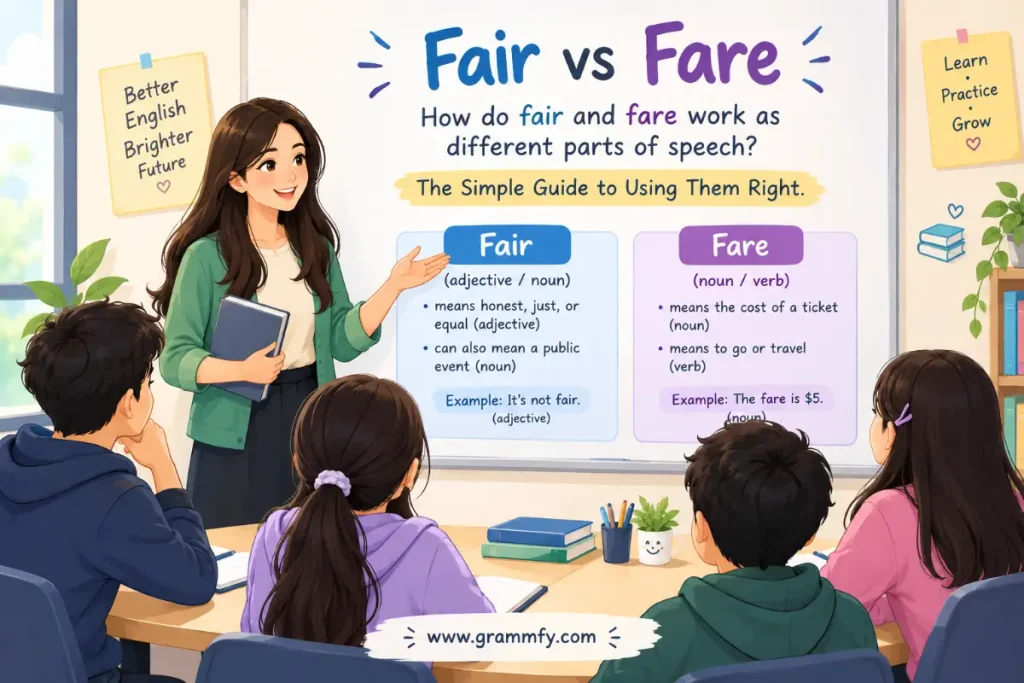
How do fair and fare work as different parts of speech?
The two words can function differently.
Fair as an adjective
That’s a fair decision.
Here, fair describes the decision.
Fair as a noun
We visited the county fair.
Here, fair names an event.
Fare as a noun
The fare was expensive.
Here, fare names a transportation price.
Fare as a verb
She fared well in the competition.
Here, fare describes how she performed or progressed.
This difference can help you identify the correct spelling.
How do you use fair in a resume?
Fair can appear in resumes, but it isn’t always the strongest word.
If you’re describing a performance or skill, words such as competent, strong, proficient, or effective may communicate more useful information.
For example:
Demonstrated fair communication skills.
This sounds weak because fair can mean only moderately good.
A stronger version might be:
Demonstrated strong communication skills.
However, fair can be useful when describing impartial treatment:
Ensured fair and consistent treatment of customer concerns.
That sentence communicates a clear professional quality.
Resume examples
Maintained fair and consistent workplace policies.
Provided fair treatment to customers during dispute resolution.
Used objective criteria to ensure fair evaluations.
Avoid using fair as a vague compliment when a more specific adjective would be stronger.
How do you use fare in a resume?
The transportation meaning of fare may appear in jobs involving travel, transportation, hospitality, or finance.
Examples:
Processed passenger fares and ticket payments.
Managed daily fare collections.
Assisted customers with fare-related questions.
The verb meaning can also work in professional descriptions, although more direct language is usually better.
Instead of:
Fared well in a competitive sales environment.
You could write:
Exceeded sales targets in a competitive environment.
The second version gives the reader more useful information.
Which word works best in an essay?
For an essay, fair is common when discussing justice, equality, rules, or treatment.
Examples:
A fair education system should provide opportunities for all students.
The policy should be fair to both groups.
Fare can appear when discussing transportation or food.
Examples:
Rising bus fares can affect low-income families.
Traditional fare remains an important part of the region’s culture.
The verb fare can also fit formal essays:
Small businesses may fare better when interest rates remain stable.
Choose the word according to its meaning rather than its sound.
Which word works best in texting?
Text messages often use fair more often than fare because everyday conversation frequently involves ideas such as fairness and agreement.
Examples:
That’s fair.
Fair enough.
That’s not fair!
The word fare appears in texting mainly when you’re discussing transportation:
What’s the train fare?
Did you check the bus fare?
Another common texting use is:
How’d you fare on the test?
That is understandable but somewhat more formal than:
How’d you do on the test?
Which word works best in emails?
Both words can be appropriate in emails.
Use fair when discussing:
- Decisions
- Prices
- Treatment
- Rules
- Opportunities
- Negotiations
Example:
I believe this would be a fair solution for both teams.
Use fare when discussing:
- Transportation
- Ticket costs
- Food
- Performance
Example:
Could you confirm the current train fare?
Or:
How did the new service fare during its first month?
The context tells you which spelling belongs in the sentence.
Which word works best in speaking?
Both words sound the same, so the difference doesn’t matter when you’re speaking.
You might say:
That’s fair.
or:
The bus fare is too high.
Listeners understand the intended meaning from context.
The spelling becomes important when you write the sentence.
This is why homophones can be more troublesome in writing than in conversation.
What are 15 correct examples of fair?
Here are examples covering its major meanings.
- The teacher gave every student a fair chance.
- That price seems fair for the quality.
- Both teams received fair treatment.
- The judge tried to remain fair throughout the trial.
- Everyone deserves a fair opportunity.
- We need a fair way to divide the work.
- The weather stayed fair during our vacation.
- She has fair hair and blue eyes.
- The school held a science fair on Friday.
- We bought fresh fruit at the county fair.
- That’s a fair point.
- He received a fair score on the assignment.
- The manager offered a fair solution to the problem.
- Both sides wanted a fair agreement.
- The referee made a fair call.
Notice that fair changes meaning according to context.
What are 15 correct examples of fare?
The following examples cover transportation, food, and performance.
- The bus fare is five dollars.
- I paid the taxi fare with my phone.
- What’s the fare from the airport to downtown?
- Train fares can vary by time of day.
- The airline reduced its fares for the weekend.
- The restaurant serves traditional local fare.
- Seafood is common fare in coastal communities.
- The festival offered international fare.
- How did you fare on the final exam?
- The new team fared well in its first season.
- Small businesses may fare better under the new policy.
- She fared poorly during the difficult interview.
- The company fared better than expected.
- Visitors enjoyed the local fare at the market.
- The subway fare increased this month.
The transportation meaning is the one most learners encounter first.
What are common mistakes with fair vs fare?
Mistake 1: “The bus fair is expensive”
Incorrect:
The bus fair is expensive.
Correct:
The bus fare is expensive.
The price of transportation is a fare.
Mistake 2: “That’s fare”
Incorrect:
That’s fare.
Correct:
That’s fair.
When you mean reasonable or just, use fair.
Mistake 3: “Everyone deserves a fare chance”
Incorrect:
Everyone deserves a fare chance.
Correct:
Everyone deserves a fair chance.
The phrase fair chance means an equal or reasonable opportunity.
Mistake 4: “How did you fair?”
If you’re asking how someone performed, write:
How did you fare?
Here, fare is the verb meaning perform or do.
Mistake 5: “The restaurant serves fair”
Incorrect:
The restaurant serves fair.
Correct:
The restaurant serves fare.
Here, fare means food.
Mistake 6: “We went to the county fare”
Incorrect:
We went to the county fare.
Correct:
We went to the county fair.
The event is a fair.
When should you not use fair?
Don’t use fair when you’re specifically talking about the cost of transportation.
Incorrect:
What’s the fair to the airport?
Correct:
What’s the fare to the airport?
Also avoid fair when you mean food in a formal expression:
The restaurant offers traditional fare.
Not:
The restaurant offers traditional fair.
If you mean performance, use fare:
The company fared well last year.
Not:
The company faired well last year.
When should you not use fare?
Don’t use fare when you mean justice, equality, or reasonableness.
Incorrect:
That’s not fare.
Correct:
That’s not fair.
Don’t use fare for public events:
We went to the county fair.
Not:
We went to the county fare.
When describing light-colored hair or skin, use fair:
She has fair hair.
Not:
She has fare hair.
Fair vs fare for prices: which one is correct?
This depends on what kind of price you’re describing.
Use fare for transportation:
The train fare is $20.
Use fair to describe whether a price is reasonable:
The $20 train fare is fair.
This is an especially useful comparison because both words can appear in the same sentence.
Is the fare fair?
The first fare means transportation cost.
The second fair means reasonable.
That sentence is grammatically correct and can be a useful memory trick.
Fair vs fare in transportation
Transportation provides one of the clearest ways to remember fare.
Use fare for:
- Bus fare
- Train fare
- Taxi fare
- Subway fare
- Airfare
- Ferry fare
- Ride fare
Examples:
The taxi fare was higher than expected.
I checked the airfare before booking the trip.
The spelling fare connects naturally with the idea of traveling.
A related word is airfare, which is normally written as one word in American English.
Fair vs fare in food
Use fare when describing food, especially a type or style of food.
Examples:
The restaurant offers Italian fare.
Traditional fare is served during the festival.
Local fare attracts many visitors.
The word often sounds more polished than simply saying food.
In everyday conversation, however, most people will simply say:
The restaurant serves great food.
Both are correct; fare has a more specific stylistic feel.
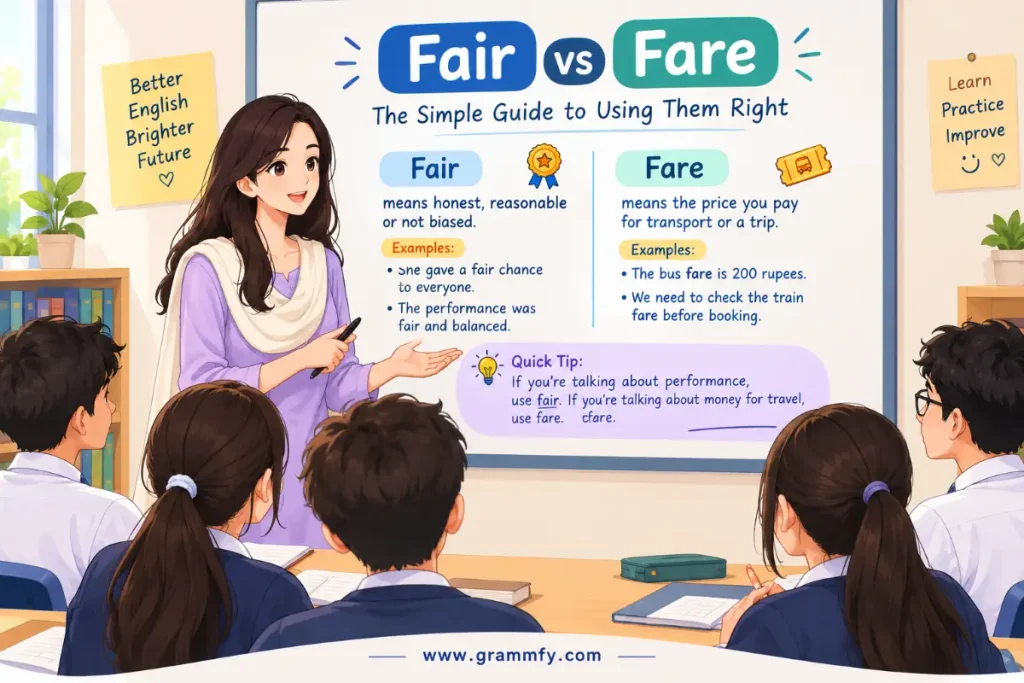
Fair vs fare when talking about performance
Use fare as a verb.
Examples:
How did you fare in the interview?
The students fared well on the test.
The company fared poorly during the downturn.
This meaning is especially common in phrases such as:
- fare well
- fare poorly
- fare better
- fare worse
- fare badly
The expression fare well means to perform or progress successfully.
Fair vs fare in idioms and common expressions
- Fair enough
Fair enough means “that seems reasonable” or “I accept your point.”
Example:
“I can’t stay late tonight.”
“Fair enough.”
Fair and square
This means honestly and according to the rules.
They won the game fair and square.
Fair play
This means honest and proper behavior in a competition or situation.
The coach always encourages fair play.
Fair chance
This means a reasonable or equal opportunity.
Give her a fair chance.
Fair share
This means a reasonable portion.
Everyone should do their fair share of the work.
Fare well
This means to do well or succeed.
I hope you fare well in your new position.
The expression can also sound old-fashioned in farewells, as in:
Farewell.
That word is related to fare rather than fair.
What is the difference between fair and just?
Fair and just are close synonyms when they mean reasonable or morally right.
| Fair | Just |
|---|---|
| Very common | Slightly more formal |
| Broad everyday use | Strong connection to morality or law |
| Fair treatment | Just punishment |
| Fair decision | Just ruling |
Example:
The teacher made a fair decision.
The judge made a just ruling.
Both suggest correctness, but just can sound more formal or morally focused.
What is the difference between fair and equal?
These words overlap, but they aren’t identical.
Equal means the same in amount, status, treatment, or opportunity.
Fair means reasonable or just.
Something can be fair without being exactly equal.
For example, a teacher might give different students different amounts of help based on their needs. The treatment isn’t identical, but it could still be fair.
Compare:
| Fair | Equal |
|---|---|
| Reasonable or just | The same |
| Focuses on justice | Focuses on sameness |
| Fair treatment | Equal treatment |
| Fair opportunity | Equal opportunity |
The distinction matters in discussions about education, employment, law, and public policy.
What is the difference between fair and reasonable?
These words are often interchangeable when discussing decisions or prices.
That’s a fair price.
That’s a reasonable price.
Both mean the price isn’t excessive.
However, fair can carry a stronger sense of justice or equal treatment.
The manager made a fair decision.
This can suggest that everyone was treated properly.
The manager made a reasonable decision.
This focuses more on whether the decision makes sense.
What is the difference between fare and fee?
These words can both involve money, but their uses differ.
Fare usually refers to the price of transportation.
The bus fare is $3.
Fee usually refers to a charge for a service or privilege.
The doctor charged a consultation fee.
Compare:
| Fare | Fee |
|---|---|
| Transportation price | Service or administrative charge |
| Bus fare | Application fee |
| Taxi fare | Membership fee |
| Train fare | Tuition fee |
This distinction can be especially useful in travel and business writing.
What is the difference between fare and price?
Price is the general amount charged for something.
Fare is a more specific term often used for transportation.
The price of the laptop is $900.
The train fare is $25.
You could describe a transportation fare as a price, but fare is more precise.
What is the difference between fair and good?
Fair can sometimes mean moderately good, but it usually doesn’t mean excellent.
If someone asks:
How was your exam?
You might answer:
It was fair.
That can mean it was acceptable or reasonably good.
Good is generally more positive:
It was good.
Depending on context, fair may sound like a middle-level evaluation.
A useful scale could be:
poor → fair → good → very good → excellent
This isn’t a strict rule, but it’s a helpful way to understand one meaning of fair.
Are fair vs fare different in British and American English?
The core distinction is the same in both American and British English.
Both varieties use:
- fair for reasonable, equal, attractive, or an event
- fare for transportation prices, food, and performance
One regional spelling detail is worth knowing:
Airfare is common in American English.
British English often uses air fare or simply airfare, depending on style and context.
The pronunciation remains the same in standard usage.
There is no major US-versus-UK grammar rule that changes the basic difference between these two words.
Why is “fare” used for food?
The food meaning of fare developed from the idea of what is provided or served.
Modern English often uses it to describe a particular kind of food, especially in descriptive or formal writing.
Examples:
Traditional American fare.
Local seafood fare.
Vegetarian fare.
Fine Italian fare.
In everyday conversation, food is usually simpler.
You might write:
The restaurant serves traditional Italian food.
Or:
The restaurant serves traditional Italian fare.
The second sentence has a more polished or descriptive tone.
Why does “fare” mean “perform”?
The verb comes from older English uses connected with how someone travels, proceeds, or gets along.
That idea developed into the modern sense of how someone performs in a situation.
For example:
How did you fare?
literally asks how you did or how things went.
This meaning is still useful today, particularly in formal writing:
The new product fared well in the market.
Students fared better after receiving additional instruction.
In casual conversation, do is often more natural.
What are the best choices by context?
For a resume
Use fair when discussing impartial treatment.
Ensured fair and consistent customer service practices.
Use fare when discussing transportation payments.
Processed passenger fares and ticket transactions.
For an essay
Use fair for justice and equality.
A fair system should give students equal opportunities.
Use fare for transportation, food, or formal discussion of performance.
Rising fares can make public transportation less accessible.
For texting
Use fair for agreement or reasonableness.
Fair enough.
Use fare for transportation.
What’s the bus fare?
For email
Use fair for negotiations and decisions.
I think this is a fair solution.
Use fare for travel costs.
Could you confirm the current fare?
For speaking
Both words sound alike, so pronunciation doesn’t help. Use the meaning to choose the spelling when you later write the sentence.
How can you remember the difference between Fair vs Fare?
Try these memory tricks.
Trick 1: Fare = transportation
Think:
F = Fare = Flight, Ferry, or freeway travel
Examples:
- airfare
- bus fare
- train fare
- taxi fare
Trick 2: Fair = equal
Think:
Fair = equal and reasonable
Examples:
- fair chance
- fair price
- fair treatment
- fair decision
Trick 3: Ask “Am I paying?”
If you’re discussing money paid for transportation, choose fare.
How much is the train fare?
Trick 4: Ask “Is it reasonable?”
If you’re judging whether something is reasonable or just, choose fair.
Is that a fair price?
The phrase “Is the fare fair?” is an excellent way to practice both spellings.
What are some tricky sentences using both words?
Sometimes both words can appear together.
The bus fare is fair.
Here, fare means transportation cost, while fair means reasonable.
Another example:
We think the airfare is fair.
The first word refers to the cost of a flight.
The second describes whether that cost is reasonable.
One more:
The restaurant offers fair prices and traditional fare.
Here:
- fair prices = reasonable prices
- traditional fare = traditional food
These examples show why context matters.
What are common phrases with fair?
Here are useful expressions to remember:
- fair chance
- fair treatment
- fair price
- fair decision
- fair game
- fair play
- fair point
- fair enough
- fair share
- fair warning
- fair competition
- fair value
- fair deal
- fair judgment
- fair trade
- fair and square
Examples:
That’s a fair point.
Everyone deserves a fair chance.
We all need to do our fair share.
Fair enough. I understand your argument.
What are common phrases with fare?
Useful expressions include:
- bus fare
- train fare
- taxi fare
- subway fare
- air fare / airfare
- ferry fare
- fare increase
- fare reduction
- fare collection
- traditional fare
- local fare
- fare well
- fare better
- fare poorly
Examples:
The subway fare increased last month.
Local fare is available at the market.
How did you fare in the competition?
What are the best alternatives when you don’t want to use fair?
If fair feels repetitive, choose a synonym based on your intended meaning.
- For justice:
- just
- equitable
- impartial
- unbiased
- For reasonable:
- reasonable
- acceptable
- sensible
- decent
- For equal:
- equal
- balanced
- even-handed
- For moderately good:
- adequate
- acceptable
- decent
- satisfactory
- For an event:
- festival
- exhibition
- market
- show
Don’t replace fair automatically. First identify which meaning you intend.
What are the best alternatives when you don’t want to use fare?
To transportation:
- price
- cost
- charge
- rate
- ticket price
For food:
- food
- cuisine
- dishes
- meals
- offerings
For performance:
- do
- perform
- progress
- manage
- succeed
Examples:
The transportation cost increased.
The restaurant serves local cuisine.
The students performed well.
These alternatives can make your writing more direct.
What are the antonyms of fair?
The opposite of fair depends on its meaning.
| Fair meaning | Possible opposite |
|---|---|
| Just | Unjust |
| Equal | Unequal |
| Reasonable | Unreasonable |
| Impartial | Biased |
| Honest | Dishonest |
| Acceptable | Unacceptable |
| Attractive/pleasant | Unattractive/unpleasant |
Examples:
The decision was fair. → The decision was unjust.
The rules were fair. → The rules were unfair.
The price was fair. → The price was unreasonable.
The most common general opposite is unfair.
Does fare have a direct antonym?
Not one universal antonym.
For transportation cost, a contrasting idea might be:
- free transportation
- no charge
- complimentary travel
For food, an opposite isn’t normally needed.
To the verb fare, you can use words such as:
- fail
- struggle
- perform poorly
- do badly
Example:
The team fared well.
Opposite:
The team fared poorly.
What should you check before choosing fair vs fare?
Ask yourself one quick question:
What does the word mean in this sentence?
If it means:
- reasonable → fair
- equal → fair
- just → fair
- attractive/light-colored → fair
- public event → fair
- transportation cost → fare
- food → fare
- perform/progress → fare
This method is much more reliable than trying to remember how the words sound.
Quick comparison table
| Meaning | Correct word | Example |
|---|---|---|
| Reasonable | Fair | That’s a fair price. |
| Equal | Fair | Everyone deserves fair treatment. |
| Just | Fair | The decision was fair. |
| Light-colored | Fair | She has fair hair. |
| Public event | Fair | We visited the state fair. |
| Transportation cost | Fare | The train fare is high. |
| Food | Fare | They serve local fare. |
| Perform/progress | Fare | She fared well. |
Quick tips for choosing the right word
Keep these rules handy:
- Fair means reasonable, equal, or just.
- Fair can describe light colors or attractive features.
- Fair can be a public event.
- Fare usually means transportation cost.
- Fare can mean food or cuisine.
- Fare can mean perform or progress.
- Think fare = travel when discussing transportation.
- Think fair = equal when discussing justice.
- Remember that both words sound alike.
- Check the meaning before checking the spelling.
- Use reasonable when you mean a fair price.
- Use fare when discussing a bus, train, taxi, flight, or ferry price.
- Use fare for traditional food in formal descriptions.
- Use fare in expressions such as “fare well” and “fare better.”
- Use fair enough when accepting a reasonable point.
- Use fair and square for honest competition.
A final memory sentence can bring everything together:
The fare was fair.
The transportation price was reasonable.
Conclusion
The difference between Fair vs Fare becomes much easier when you connect each spelling with its main meaning. Fair describes something reasonable, equal, just, acceptable, or sometimes light-colored. It can also refer to an event such as a county or science fair. Fare, on the other hand, commonly means the cost of transportation, such as a bus or train fare. It can also describe food or explain how someone performed, as in “She fared well.” Because both words sound alike, listening won’t help you choose the spelling. Instead, focus on the meaning of the sentence. If you’re talking about justice or reasonableness, think fair. If you’re talking about travel costs, food, or performance, think fare. With that simple distinction, you’ll avoid most spelling mistakes.
Frequently Asked Questions
What is the difference between fair and fare?
Fair usually means reasonable, equal, or just, while fare commonly means transportation cost. Fare can also mean food or how someone performs.
Is it bus fare or bus fair?
The correct expression is bus fare because fare means the price paid for transportation. For example, “The bus fare is $3.”
Is “that’s fair” or “that’s fare” correct?
“That’s fair” is correct when you mean something is reasonable or acceptable. Fare would not work in this expression.
What’s another way to say fair?
Depending on the meaning, alternatives include reasonable, just, equal, impartial, balanced, equitable, and unbiased.
How do you use fare as a verb?
Use fare to describe how someone or something performs or progresses. For example, “The new business fared well during its first year.”
Does fare mean food?
Yes. Fare can mean food, especially a particular type or style of food. For example, “The restaurant serves traditional local fare.”
Is fair and fare a homophone pair?
Yes. Fair and fare are homophones because they have the same pronunciation in many English varieties but different spellings and meanings.
