
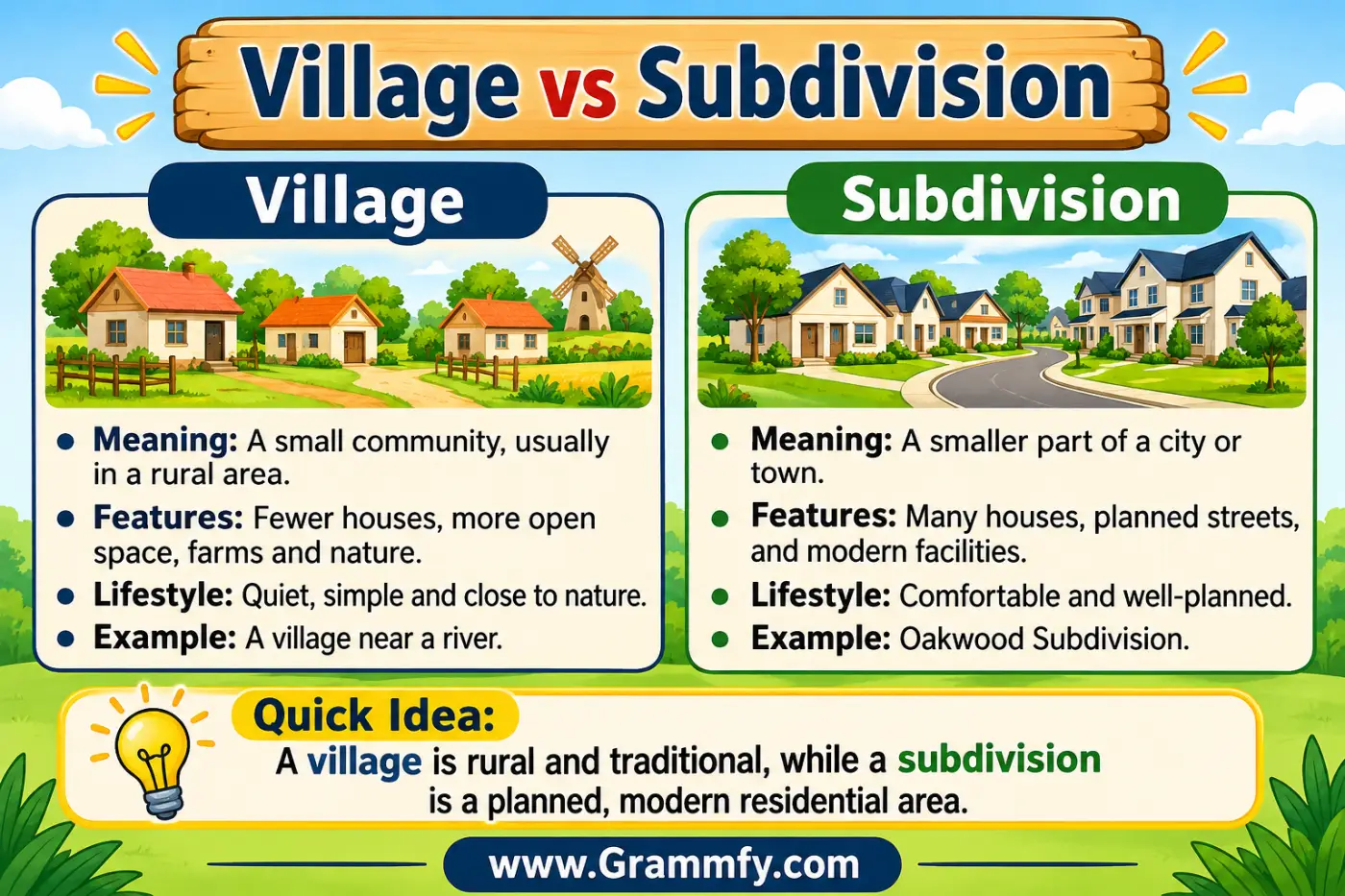
Imagine you’re writing an email about where someone lives. You might describe their home as being in a village or a residential subdivision. Both terms relate to places where people live, but they don’t describe exactly the same thing. Understanding Village vs Subdivision helps you choose the right expression when discussing communities, neighborhoods, property, and residential developments.
A village is generally a small community where people live together, often in a rural or semi-rural area. A subdivision, particularly in American English, is an area of land divided into smaller lots for residential or other development. It usually contains houses, streets, and separate properties.
Quick Answer: A village is a community or settlement, while a subdivision is a section of land divided into smaller properties, often for housing. A village describes a type of place or community; a subdivision describes how land is organized and developed.
These terms can sometimes describe the same general location, but their meanings depend on geography, local government, and property development. For example, a subdivision can be located inside a village, town, or city without becoming a separate municipality.
If you’re unsure about these similar-looking words, check out the difference between channel and Chanel to understand their meanings and use each one correctly.
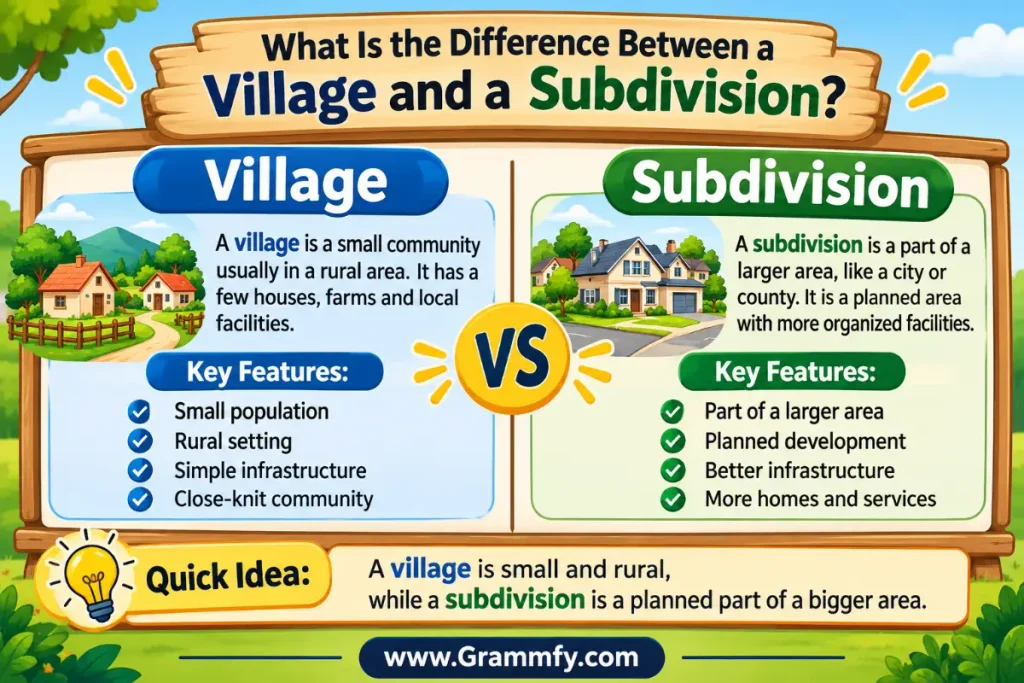
What Is the Difference Between a Village and a Subdivision?
The main difference is that a village refers to a community, whereas a subdivision refers to a division of land into smaller sections or lots.
What does village mean?
A village is a small settlement or community where people live relatively close to one another. It is traditionally associated with rural areas, although villages can also exist near or within larger urban regions.
A typical village may include:
- Houses and residential buildings.
- Local shops and small businesses.
- Schools and community centers.
- Churches or other community buildings.
- Parks, gardens, or shared outdoor spaces.
- Roads connecting homes and nearby settlements.
- Farms or open land surrounding the residential area.
The people living in a village are called villagers.
Villages often develop around shared facilities, local traditions, transportation routes, or agricultural activities. Some have existed for hundreds of years, while others have grown into modern residential communities.
Example: My grandparents live in a peaceful village surrounded by farms and green fields.
In the United States, the word can also have a formal governmental meaning. Some states recognize villages as incorporated municipalities with their own local governments. However, the legal requirements and responsibilities differ from state to state.
Therefore, a village doesn’t always have to be a tiny rural settlement. Its official status depends on local law.
What does subdivision mean?
A subdivision is an area of land that has been divided into smaller lots, parcels, or sections. In residential real estate, developers commonly use this process to create separate properties for houses or other buildings.
A residential subdivision may include:
- Individual residential lots.
- Single-family houses.
- Internal roads and sidewalks.
- Driveways and parking areas.
- Shared green spaces.
- Drainage and utility systems.
- Parks or recreational facilities.
- Community entrances or security features.
Developers usually plan the layout before selling individual properties. Depending on local regulations, the development may require an approved subdivision map, infrastructure improvements, and other permissions.
Example: My family recently purchased a house in a new residential subdivision near the city.
Unlike a village, a subdivision doesn’t automatically represent a separate community or municipality. It is primarily a land-use and property-development concept.
Some subdivisions have homeowners’ associations, shared facilities, and community rules. Others simply consist of individually owned lots along a network of streets.
Village vs Subdivision: A quick comparison
The following table highlights their most important differences.
| Feature | Village | Subdivision |
|---|---|---|
| Basic meaning | A small settlement or community | Land divided into smaller lots |
| Main focus | People and community | Property and land organization |
| Typical location | Rural, semi-rural, or urban | Residential or developing areas |
| Development | Can grow naturally over time | Often planned and approved |
| Government status | May be an incorporated municipality | Not automatically a municipality |
| Population | Can vary considerably | Depends on the number of lots and homes |
| Housing | Traditional or modern homes | Often homes built on separate lots |
| Infrastructure | May develop gradually | Often planned as part of development |
| Ownership | Individual and community properties | Separate lots or shared property |
| Community facilities | May include schools, shops, and public buildings | May include parks and shared facilities |
| Common use | Describing a settlement | Describing a land development |
| Example | A village near a river | A subdivision outside a city |
The important distinction: A village is identified by its community or settlement character. A subdivision is identified by the way a property or tract of land has been divided.
Where Do the Words Village vs Subdivision Come From?
Understanding word origins makes it easier to remember why these expressions have different meanings.
What is the origin of village?
The word village entered English through Old French village, which was connected to Latin villaticum and villa.
The Latin word villa referred to a country house, farm, or estate. Over time, related forms developed associations with groups of houses and settlements.
By the late 14th century, English speakers were using village to describe a collection of houses larger than a hamlet but smaller than a town.
Its meaning gradually expanded to include the people living in such a settlement and the community they formed.
Today, the word can describe:
- A small rural settlement.
- The people who live in that settlement.
- A legally recognized municipality in certain places.
- A community or district within a larger urban area.
The historical connection to country houses and farms explains why the word is traditionally associated with rural life.
What is the origin of subdivision?
The word subdivision comes from the combination of two parts:
- Sub-: A prefix meaning under, below, or further.
- Division: The act of separating something into smaller parts.
The word appeared in English during the early 15th century, initially referring to the process of dividing something into smaller sections.
By the mid-15th century, it could also refer to a portion created through division.
Its specific real estate meaning developed much later. By the 19th century, the word was being used for land divided into smaller lots for development.
Today, it commonly describes residential land developments, property divisions, and smaller sections within a larger area.
How do their origins help you remember the difference?
Their histories provide a simple memory aid.
| Word | Historical connection | Modern meaning |
|---|---|---|
| Village | Country house, farm, and settlement | A community or small settlement |
| Subdivision | Dividing something into smaller parts | Land divided into smaller lots |
Think about the original ideas:
- A village developed around the idea of a group of homes and a community.
- A subdivision developed around the idea of dividing a larger area into smaller sections.
This distinction remains useful when writing about geography, neighborhoods, and real estate.
What Words Can You Use Instead of Village vs Subdivision?
Neither word has a perfect replacement in every situation. Their alternatives depend on whether you’re discussing a community, a residential area, or a property development.
For example, hamlet may replace village in some rural contexts, but housing estate may be more suitable when discussing a planned residential development.
The following vocabulary list includes 28 useful alternatives and related expressions.
These words are grouped by tone and usage. Some are close synonyms, while others describe related types of places or developments.
1. What are simple alternatives to village vs subdivision?
Simple expressions work well in everyday conversations, basic explanations, and educational writing.
| Word | Meaning | Tone | Example |
|---|---|---|---|
| Community | People living in the same area | Simple | Our community has a small public park. |
| Settlement | A place where people establish homes | Simple | The settlement grew near the river. |
| Neighborhood | A local residential area | Simple | She lives in a quiet neighborhood. |
| Small town | A populated place smaller than a city | Simple | My uncle moved to a small town. |
| Residential area | A place mainly used for housing | Simple | The residential area is close to the school. |
| Housing area | An area containing homes | Simple | They purchased a house in a new housing area. |
| Group of homes | Several houses located together | Simple | A group of homes stands near the lake. |
For example, settlement is broader than village. It can describe a community of almost any size, while neighborhood can refer to an area within a much larger city.
2. What are everyday alternatives to village vs subdivision?
Everyday vocabulary provides more specific descriptions of communities and residential developments.
| Word | Meaning | Tone | Example |
|---|---|---|---|
| Hamlet | A very small settlement, usually rural | Everyday | The hamlet has only a few houses. |
| Rural community | A community located in the countryside | Everyday | The rural community depends on farming. |
| Locality | A particular place or area | Everyday | This locality has several small shops. |
| Village center | The central area of a village | Everyday | The village center becomes busy on weekends. |
| Housing development | An area developed for residential use | Everyday | A new housing development is opening nearby. |
| Residential development | A project involving residential buildings | Everyday | The residential development includes several parks. |
| Housing estate | A planned residential area, often with multiple homes | Everyday | They moved into a modern housing estate. |
| Planned community | A community designed with a coordinated layout | Everyday | The planned community has shared recreational areas. |
3. What are formal alternatives to village vs subdivision?
Formal vocabulary is useful in academic essays, planning documents, property descriptions, government reports, and professional writing.
| Word | Meaning | Tone | Example |
|---|---|---|---|
| Incorporated municipality | A legally established local government area | Formal | The incorporated municipality provides public services. |
| Unincorporated settlement | A community without its own municipal incorporation | Formal | The unincorporated settlement receives county services. |
| Residential subdivision | Land divided into lots for housing | Formal | The residential subdivision requires planning approval. |
| Land subdivision | The process of dividing land into separate parcels | Formal | Land subdivision requires a registered plan. |
| Platted development | A development shown on an approved or recorded plat | Formal | The platted development contains 80 residential lots. |
| Residential tract | A defined area of land intended for residential use | Formal | The residential tract is suitable for new construction. |
| Parcel | A defined piece of land | Formal | Each parcel has a separate property record. |
For instance, an incorporated municipality has a governmental identity, whereas a parcel is a specific piece of land. Neither should be used as a direct replacement for the other without checking the context.
4. What are informal or slang alternatives?
Casual expressions are useful in conversations, text messages, and informal descriptions.
However, some of these phrases are regional rather than universally recognized slang.
| Word or phrase | Meaning | Tone | Example |
|---|---|---|---|
| The neighborhood | The local residential area | Informal | Everyone in the neighborhood knows each other. |
| The new development | A recently built residential area | Informal | My friend just moved into the new development. |
| The estate | A residential estate, especially in British usage | Informal | Their house is on the new estate. |
| The burbs | An informal term for the suburbs | Slang | They moved out to the burbs. |
| The village | A familiar local name for a village community | Informal | We’re meeting at the village later. |
| The development | A residential project or developed area | Informal | My cousin bought a house in the development. |
| Our part of town | The local area where someone lives | Informal | Our part of town is getting busier. |
One important distinction: the burbs means the suburbs, not necessarily a subdivision. Similarly, the estate may refer to a residential development in British English, but it doesn’t always describe the legal process of dividing land.
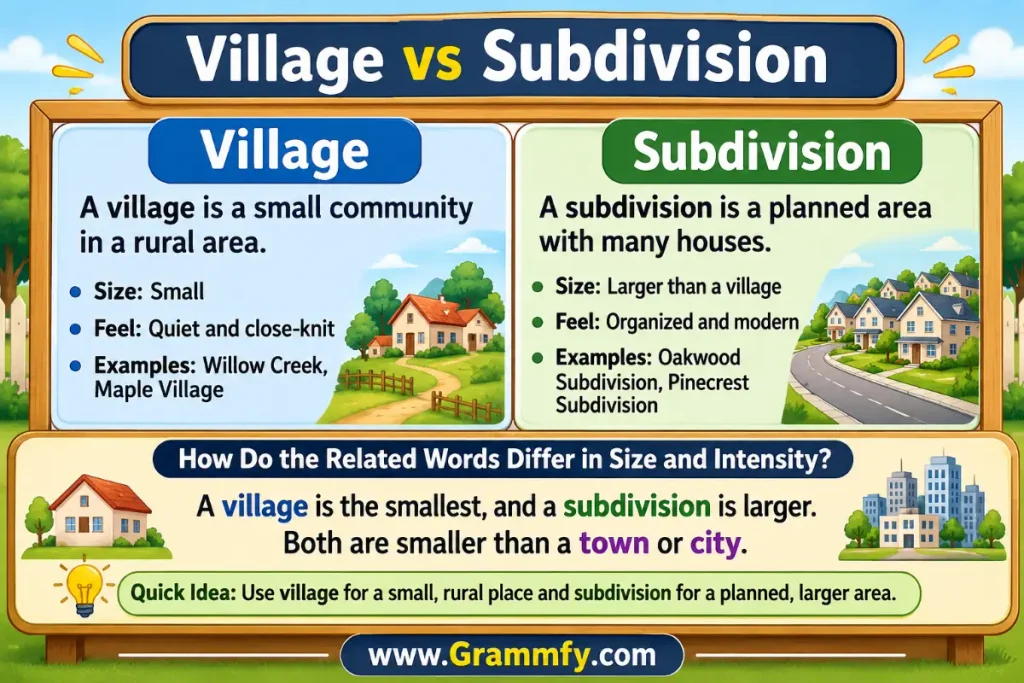
How Do the Related Words Differ in Size and Intensity?
However, there isn’t one universal ranking. A village doesn’t always have fewer residents than a subdivision, and a large subdivision may contain more homes than a small village.
It’s more useful to compare the terms according to what they describe.
What words describe a settlement from smallest to largest?
The following sequence provides a general idea of settlement size.
| General scale | Term | Description |
|---|---|---|
| 1 | Isolated dwelling | One home away from other homes |
| 2 | Hamlet | A very small settlement |
| 3 | Village | A small community or settlement |
| 4 | Small town | A larger settlement with more services |
| 5 | Town | A more developed population center |
| 6 | City | A larger urban settlement or legally designated city |
Some places use different population thresholds, while others determine municipal status through legal requirements rather than size alone.
For example, a village in one American state might have a larger population than a city in another state.
What terms describe residential development from small to large?
Residential developments can also differ in size and complexity.
| Development type | General meaning |
|---|---|
| Single residential lot | One individual property |
| Small residential development | A limited number of developed properties |
| Residential subdivision | Multiple lots created from a larger property |
| Housing estate | A planned residential area |
| Master-planned community | A larger development with coordinated housing and shared facilities |
| Planned town | A settlement developed through a broader planning process |
These descriptions aren’t official size categories.
A residential subdivision may be small or extensive. Likewise, a master-planned community may include several subdivisions, commercial areas, schools, and recreational spaces.
Which term sounds stronger or more specific?
The choice depends on the information you want to communicate.
- Use hamlet when emphasizing a very small settlement.
- Use village when describing a small community.
- Use town when discussing a more developed population center.
- Use residential development when discussing a housing project.
- Use subdivision when the division of land into individual lots matters.
- Use master-planned community when describing a coordinated development with multiple facilities.
Don’t choose a term simply because it sounds more impressive. Accuracy matters more than formality.
What Parts of Speech Are Village vs Subdivision?
Understanding the grammatical roles of these words helps you use them correctly in sentences.
Both words are primarily nouns, although village can also work as an adjective in compound expressions.
Is village a noun or an adjective?
Village is primarily a countable noun.
It refers to a settlement or the people living there.
Examples:
- The village is surrounded by green hills.
- Several villages are located along the river.
- Our village has a small public library.
The word can also function as an attributive noun, meaning it appears before another noun to describe it.
Examples include:
- Village school
- Village market
- Village center
- Village community
- Village life
In these expressions, village describes the type of school, market, center, community, or life being discussed.
You can also use the derived adjective village-like.
Example: The building has a charming, village-like appearance.
Is subdivision a noun or a verb?
Subdivision is a noun.
It describes either the act of dividing something into smaller parts or the resulting section.
Examples:
- The subdivision contains 45 residential lots.
- The city approved the subdivision last month.
- Land subdivision requires careful planning.
The related verb is subdivide.
Examples:
- The developer plans to subdivide the property.
- They decided to subdivide the large tract of land.
- The owner subdivided the property into smaller parcels.
The word subdivided can also function as an adjective or past participle.
Example: The subdivided land is ready for individual ownership.
What are the common word forms?
| Base word | Part of speech | Related form | Example |
|---|---|---|---|
| Village | Noun | Villager | Every villager attended the meeting. |
| Village | Noun | Villages | Several villages surround the lake. |
| Village | Attributive noun | Village school | The village school needs repairs. |
| Village | Derived adjective | Village-like | The area has a village-like atmosphere. |
| Subdivision | Noun | Subdivisions | The city has approved two subdivisions. |
| Subdivide | Verb | Subdivided | The owner subdivided the land. |
| Subdivide | Verb | Subdividing | They are subdividing the property. |
| Subdivided | Adjective/participle | Subdivided land | The subdivided land has separate titles. |
One common grammatical mistake is treating subdivision as the action word.
Remember:
- Correct: The developer will subdivide the land.
- Correct: The subdivision contains new houses.
- Incorrect: The developer will subdivision the land.
Use subdivide for the action and subdivision for the noun.
How Are Village vs Subdivision Used in the US and UK?
English-speaking countries don’t always use these words in exactly the same way.
The distinction is particularly important in American and British English because the everyday names for residential developments can differ.
How is village used in American English?
In American English, village can describe a small rural community or a legally incorporated municipality.
The legal meaning varies by state.
American examples:
- My parents live in a small village in New York.
- The village council approved the new park.
- Their village has its own local services.
In everyday American conversation, the word can also describe a small residential community without implying a particular legal status.
How is subdivision used in American English?
In the United States, subdivision is a common real estate and planning term.
It generally refers to dividing a larger property into separate lots for sale, ownership, or development.
The exact legal definition can vary.
For example, Washington State law generally distinguishes subdivisions from short subdivisions based on the number of lots involved. Other states use different definitions and thresholds. Washington State Legislative Information+1
Common American expressions include:
- Residential subdivision
- New subdivision
- Planned subdivision
- Subdivision development
- Subdivision map
- Subdivision lot
Example: The developer submitted a subdivision plan to the local planning department.
In American neighborhoods, residents may casually use subdivision to refer to the entire residential area rather than the legal process that created it.
What is the British English alternative to subdivision?
In British English, housing estate is often the more familiar everyday term for a planned residential area.
A housing estate generally refers to a group of homes arranged within a planned residential development.
British examples:
- They bought a house on a new housing estate.
- The housing estate has a playground and several shops.
- Our school is close to a large residential estate.
The word subdivision still exists in British English, especially when discussing the legal or technical division of land.
However, it isn’t always the most natural everyday expression for a neighborhood of newly built houses.
What should you remember about regional usage?
| Region | Common usage |
|---|---|
| United States | Village and residential subdivision |
| United Kingdom | Village and housing estate |
| Australia | Village and residential estate; subdivision for land division |
| Canada | Village and subdivision, depending on location and context |
| Philippines | Village can refer to a gated residential community |
| New Zealand | Village and subdivision, with local housing terminology |
In Australia, for example, land subdivision is used for creating separate property titles and lots. The resulting residential area may be called an estate. NSW Land Services+1
The main lesson is to consider your audience. American readers may recognize subdivision immediately, while British readers may find housing estate more natural in an everyday residential context.
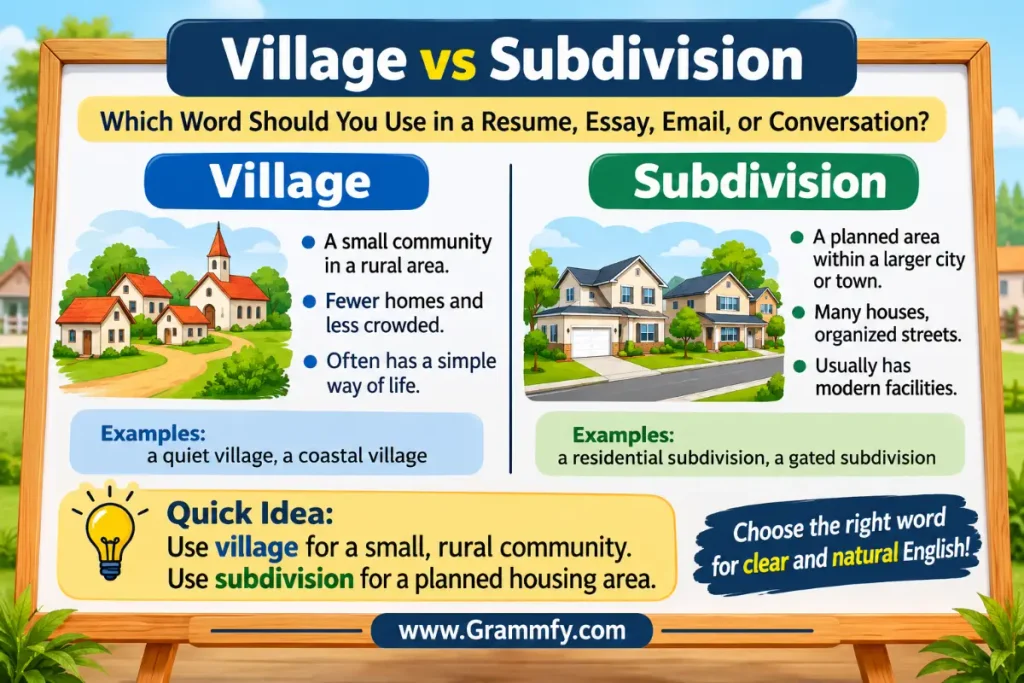
Which Word Should You Use in a Resume, Essay, Email, or Conversation?
The best choice depends on the subject of your writing.
A village and a subdivision aren’t interchangeable descriptions, so think about the actual place before choosing either word.
Which word should you use in a resume?
For a resume, accuracy and professional clarity are important.
If you’re describing your residential location, use the official community or neighborhood name whenever possible.
Use village when:
- Your home is in a recognized village.
- You’re describing a rural community.
- Your address officially identifies a village.
Use subdivision when:
- You’re identifying a residential development.
- The subdivision name is part of your address.
- You’re describing a property-development project as part of your professional experience.
Examples:
- Residential Address: Green Valley Village, New York.
- Property Development Experience: Managed residential planning for a 60-lot subdivision.
Avoid using a general term when the official location name is available.
Which word should you use in an academic essay?
An academic essay should use precise geographical and planning terminology.
Choose village when discussing settlement patterns, rural populations, community life, or local traditions.
Choose subdivision when discussing urban expansion, land ownership, property development, or residential planning.
Examples:
- The village developed around an agricultural economy.
- Residential subdivision has contributed to the expansion of the surrounding city.
- Modern villages may contain both traditional homes and newly developed residential areas.
When comparing population patterns, explain whether you’re referring to a legally recognized municipality, a statistical settlement, or a residential development.
That extra detail makes your argument more accurate.
Which word should you use in a text message?
Text messages usually need simple and natural language.
Use whichever expression describes the location correctly.
Examples:
- I live in a small village outside the city.
- Our new house is in a residential subdivision.
- The subdivision has a nice playground.
- My village is about 20 minutes from downtown.
If the other person already knows the place, you can use its familiar name.
There’s no need to use technical property terminology in a casual message unless the discussion is about real estate.
Which word should you use in a professional email?
In professional emails, the subject of your message should determine your vocabulary.
Use village when discussing a community or its residents.
Use subdivision when discussing property boundaries, land development, construction, or planning approval.
Examples:
- The village administration has scheduled a community meeting.
- The proposed subdivision requires additional drainage improvements.
- Residents of the village have requested better road access.
- The planning department is reviewing the subdivision application.
When writing to a government office or property developer, use the official terminology in the relevant documents.
Which word sounds more natural when speaking?
In everyday speech, choose the term that people in your area normally use.
For example, an American speaker might say:
“My brother bought a house in a new subdivision.”
A British speaker might say:
“My brother bought a house on a new housing estate.”
Someone discussing a rural community might say:
“My grandparents still live in a small village.”
The goal is to communicate the correct idea without making the sentence unnecessarily complicated.
What Are 14 Original Examples of Village vs Subdivision in Real Situations?
The following sentences cover family life, education, real estate, travel, government, and community development.
Examples using village
1. Family life: My grandparents have lived in the same village for more than 40 years.
2. Education: The village school provides education to children from nearby communities.
3. Travel: We visited a beautiful village during our weekend trip.
4. Community: Everyone in the village contributed money to repair the local playground.
5. Geography: The village sits between two mountains and a flowing river.
6. Government: The village council organized a public meeting about road improvements.
7. Business: A small grocery store recently opened in the center of the village.
8. Culture: Traditional festivals bring villagers together every summer.
These examples show that village works when discussing a settlement, its location, its residents, or its shared activities.
Examples using subdivision
9. Real estate: The developer plans to build 75 houses in the new subdivision.
10. Property ownership: Every homeowner in the subdivision owns an individual residential lot.
11. Construction: The company completed the first phase of the subdivision last month.
12. Infrastructure: New sidewalks and streetlights have improved the subdivision.
13. Planning: The city rejected the subdivision proposal because it did not meet local requirements.
14. Family housing: We chose this subdivision because it offers larger yards and quieter streets.
Notice how these sentences focus on property, development, ownership, and residential planning.
Can both words appear in the same sentence?
Yes. A village can contain a subdivision, so both words can appear naturally together.
Here are some additional examples:
- The new subdivision is located on the eastern side of the village.
- Several modern subdivisions have been developed near the historic village center.
- The village has expanded as new residential subdivisions have attracted families.
These examples demonstrate that the two terms can describe different aspects of the same geographical location.
Village vs Hamlet: What’s the Difference?
A village and a hamlet are both types of settlements, but they usually differ in size and the facilities they contain.
A hamlet is generally a very small settlement with fewer homes and fewer community services than a typical village.
A village is usually larger and may have schools, shops, community buildings, or other shared facilities.
| Feature | Village | Hamlet |
|---|---|---|
| General size | Small settlement | Very small settlement |
| Population | Varies | Usually smaller |
| Homes | Several groups of houses | Often only a few houses |
| Facilities | May have schools and shops | Often has few or no facilities |
| Community | More developed local community | Smaller residential group |
| Common location | Rural or semi-rural areas | Rural countryside |
Village example: The village has a school, a grocery store, and a community hall.
Hamlet example: The hamlet consists of six houses along a country road.
The distinction isn’t based on one universal population number. Local history, settlement patterns, and regional definitions also matter.
Which should you choose? Use hamlet when describing a particularly small settlement. Choose village for a somewhat larger or more established community.
Subdivision vs Neighborhood: What’s the Difference?
These two expressions are closely related in everyday speech, but they have different meanings.
A subdivision describes land divided into separate properties, often through a planned development process.
A neighborhood describes a local area where people live and interact. It can be based on geography, community identity, or shared characteristics.
| Feature | Subdivision | Neighborhood |
|---|---|---|
| Main meaning | Divided land or residential development | Local residential area |
| Focus | Property layout | Community and location |
| Planning | Often formally planned | May develop naturally |
| Boundaries | May have recorded property boundaries | Can have informal boundaries |
| Ownership | Contains separate properties | Contains properties of different types |
| Facilities | May have shared development facilities | May have local businesses and public services |
| Size | Depends on the development | Varies considerably |
Consider this example:
A city has a neighborhood called Oak Park. Within that neighborhood, there may be three separate residential subdivisions.
The entire neighborhood can include older houses, apartment buildings, shops, and newer developments.
Therefore, a subdivision may form part of a neighborhood, but a neighborhood doesn’t have to be a subdivision.
Which should you choose? Use subdivision when the property-development structure matters. Use neighborhood when discussing the broader residential community.
Subdivision vs Housing Estate: Are They the Same?
A subdivision and a housing estate can refer to similar residential areas, but their usage differs by region and context.
A subdivision is closely connected to the legal and physical division of land into smaller properties.
A housing estate generally describes a planned group of residential properties.
In American English, subdivision is common in property descriptions. In British English, housing estate is a familiar term for a planned residential area.
| Feature | Subdivision | Housing estate |
|---|---|---|
| Main emphasis | Division of land | Residential development |
| Common usage | American English | British English |
| Planning | Involves land division | Involves planned housing |
| Properties | Individual lots or parcels | Groups of houses or residential units |
| Shared facilities | May be included | May be included |
| Legal meaning | Can have a specific planning definition | Depends on local context |
For example:
- American: They bought a home in a new subdivision.
- British: They bought a home on a new housing estate.
The expressions overlap in many situations, but they aren’t perfect legal equivalents.
What Are the Common Mistakes When Using Village vs Subdivision?
Although both terms relate to residential places, several mistakes can create confusion.
1. Assuming every village is a municipality
Not every place called a village has its own government.
Some villages are formally incorporated municipalities, while others are informal settlements or statistical places.
Incorrect assumption: Every village has an elected village council.
Better understanding: Governmental status depends on the laws and administrative system of the relevant location.
2. Assuming every subdivision is gated
A residential subdivision doesn’t automatically have security gates, guards, or restricted access.
Some subdivisions have controlled entrances, but many are ordinary residential developments with public streets.
Incorrect assumption: Every subdivision is a gated community.
Better understanding: Gated access is a design or management feature, not an essential part of the meaning of subdivision.
3. Using village and neighborhood as identical terms
A neighborhood may exist within a city, village, or suburb.
A village, however, generally refers to a settlement or a place with a recognized community identity.
Incorrect: The city has 20 villages when you actually mean 20 informal neighborhoods.
Better: The city has 20 distinct neighborhoods.
Use village when the area is genuinely recognized or understood as a village.
4. Thinking a subdivision is always outside a city
A subdivision doesn’t have to be located in the countryside.
It may be developed within city boundaries, near a town, or in an unincorporated area.
Example: The city approved a new residential subdivision near downtown.
This is perfectly reasonable because land development can take place in urban as well as rural areas.
5. Assuming a village must have a small population
Although villages are traditionally smaller than towns, population size alone doesn’t determine their official status everywhere.
Therefore, don’t rely on population alone when describing a place’s legal status.
6. Confusing subdivision with a government subdivision
The word subdivision has several meanings.
It can describe:
- A division of land.
- A smaller section of a larger organization.
- A category within a classification system.
- A smaller administrative division.
For example, a county subdivision is a geographical or governmental statistical concept. It doesn’t necessarily mean a residential housing development.
Always consider the subject of the sentence.
7. Treating subdivision as a synonym for house
A subdivision is an area containing separate properties, not one individual house.
Incorrect: We purchased a subdivision near the lake.
Better: We purchased a house in a subdivision near the lake.
This small grammatical difference makes the intended meaning much clearer.
8. Assuming all residential developments have the same facilities
Some subdivisions contain parks, sidewalks, playgrounds, and shared amenities. Others provide only the basic residential layout.
A village may also have more community facilities than a subdivision.
Don’t assume that either term guarantees schools, hospitals, shops, or recreational areas.
9. Using subdivision when discussing community traditions
A subdivision can have a strong community identity, but the word itself doesn’t describe traditions or local culture.
Less natural: The subdivision celebrates its traditional village festival.
Clearer: Residents of the community celebrate their annual festival.
The second sentence focuses on the people rather than the land-development arrangement.
10. Assuming the terms cannot overlap
This is one of the most important mistakes to avoid.
A village can contain several subdivisions, and a subdivision can be developed near an existing village.
The terms describe different aspects of a place, so their meanings don’t have to exclude each other.
What Are the Antonyms of Village vs Subdivision?
Neither village nor subdivision has one exact opposite.
Their conceptual opposites depend on the meaning you’re trying to contrast.
What is the opposite of village?
If you’re discussing settlement size, possible contrasts include:
- City
- Metropolis
- Large urban center
- Megacity
A village is generally smaller than these places in ordinary geographical descriptions.
However, these aren’t strict antonyms because a village and a city are both types of settlements.
If you’re contrasting a populated community with an isolated place, you might use:
- Isolated dwelling
- Remote homestead
- Uninhabited area
What is the opposite of subdivision?
For land development, the most useful opposite concepts are:
- Undivided land
- Single parcel
- Unsubdivided property
- Consolidated tract
For example:
- Subdivided property: The land has been separated into 20 individual lots.
- Undivided property: The land remains one larger parcel.
These expressions describe different property arrangements rather than dictionary antonyms.
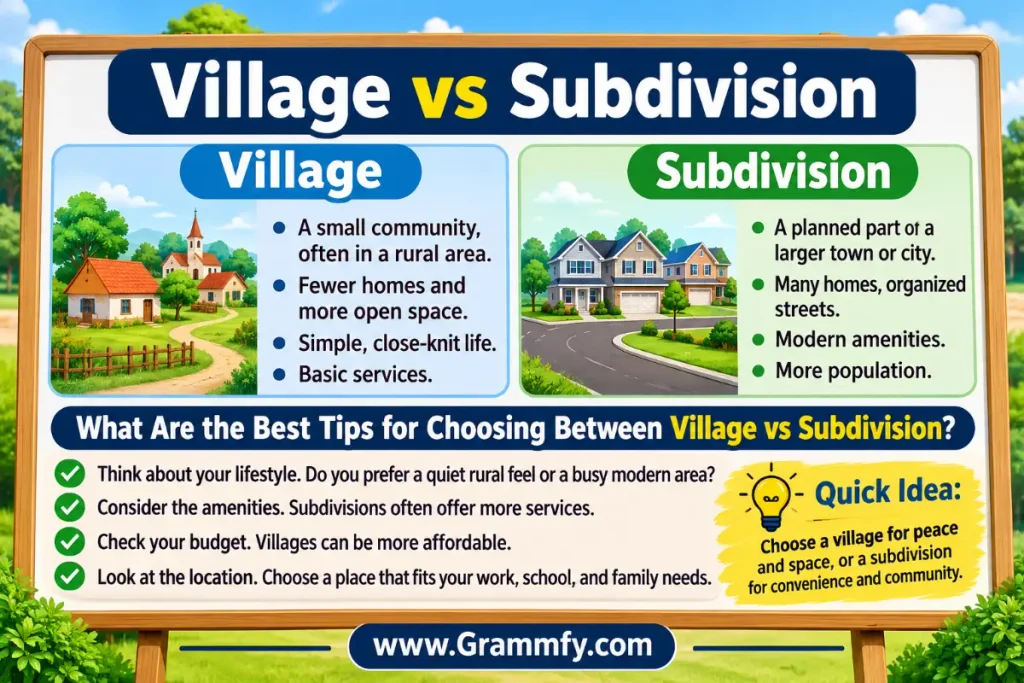
What Are the Best Tips for Choosing Between Village vs Subdivision?
Use these practical tips to avoid confusion.
1. Ask whether you’re describing people or property
If your sentence focuses on residents, community life, local traditions, or a settlement, village may be appropriate.
If it focuses on land ownership, property boundaries, or development, subdivision is usually more suitable.
Example:
- The village organized a cultural festival.
- The subdivision received approval for additional residential lots.
2. Consider the geographical setting
A village is traditionally associated with a rural or semi-rural settlement.
A subdivision can exist in a rural, suburban, or urban area.
However, don’t assume that every village is rural or that every subdivision is suburban.
3. Check the official name
Some communities include words such as Village, Estates, or Subdivision in their official names.
If you’re writing an address, property description, or government document, check the recognized name instead of guessing.
4. Think about the development process
A village may grow over many years through gradual settlement.
A subdivision is generally created through a process of dividing land into separate lots.
This difference is especially useful in essays about urban growth and land planning.
5. Choose vocabulary for your audience
American readers are generally familiar with subdivision in residential property contexts.
British readers may find housing estate more familiar when discussing a planned residential area.
Choose regional vocabulary that sounds natural to your readers.
6. Don’t rely on population alone
Population size doesn’t always determine whether a place is officially called a village.
Likewise, the number of houses in a subdivision doesn’t automatically give it municipal status.
Look at its geographical and legal identity.
7. Remember that one place can have both descriptions
A village can contain a subdivision without the two becoming the same thing.
This is a simple but powerful way to understand their relationship.
8. Read the whole sentence before choosing
The correct word should fit the meaning of the complete sentence.
For example:
- We visited a beautiful village during our vacation.
- We visited a new subdivision to look at available houses.
Both sentences describe residential places, but they communicate different ideas.
Conclusion: Understanding the Difference Clearly
Understanding Village vs Subdivision comes down to recognizing what each term describes. A village is a settlement or community where people live, while a subdivision is an area of land divided into smaller lots, often for residential development. Although both can describe places containing houses, they aren’t interchangeable. A village may include several residential developments, and a subdivision may exist within a larger village, town, or city. When writing about community life, traditions, or rural settlements, choose village. For property boundaries, land development, and residential planning, choose subdivision. Always consider the local meaning and your audience before making a choice.
Frequently Asked Questions
1. Is a village the same as a subdivision?
No, a village is a community or settlement, while a subdivision is land divided into smaller properties. A village can contain one or more subdivisions.
2. Can a subdivision be considered a village?
Not automatically. A subdivision may develop a strong community identity, but that doesn’t make it a legally recognized village or municipality.
3. Is a subdivision bigger than a village?
There is no fixed size comparison. A subdivision may contain a few houses or hundreds of properties, while a village can have a much larger population.
4. What’s another word for a residential subdivision?
Common alternatives include housing development, residential development, housing estate, planned community, and residential tract. The best choice depends on the country and the context.
5. What is the difference between a village and a neighborhood?
A village is a type of settlement or community, whereas a neighborhood is a local area within a larger settlement. A village can contain several neighborhoods.
6. Is a housing estate the same as a subdivision?
They can describe similar residential developments, but their usage differs. Subdivision is particularly common in American real estate terminology, while housing estate is common in British English.
7. Can a village have its own local government?
Yes. Some villages, particularly in the United States, are incorporated municipalities with their own local governments. Their legal powers and responsibilities depend on state law.

Tylerbrooks is a US-based English grammar writer and contributor at Grammfy. He writes helpful articles about grammar, spelling, commonly confused words, and vocabulary. His goal is to explain English topics in simple language with clear examples and practical tips. Through his articles, he helps readers improve their writing and everyday English skills.