
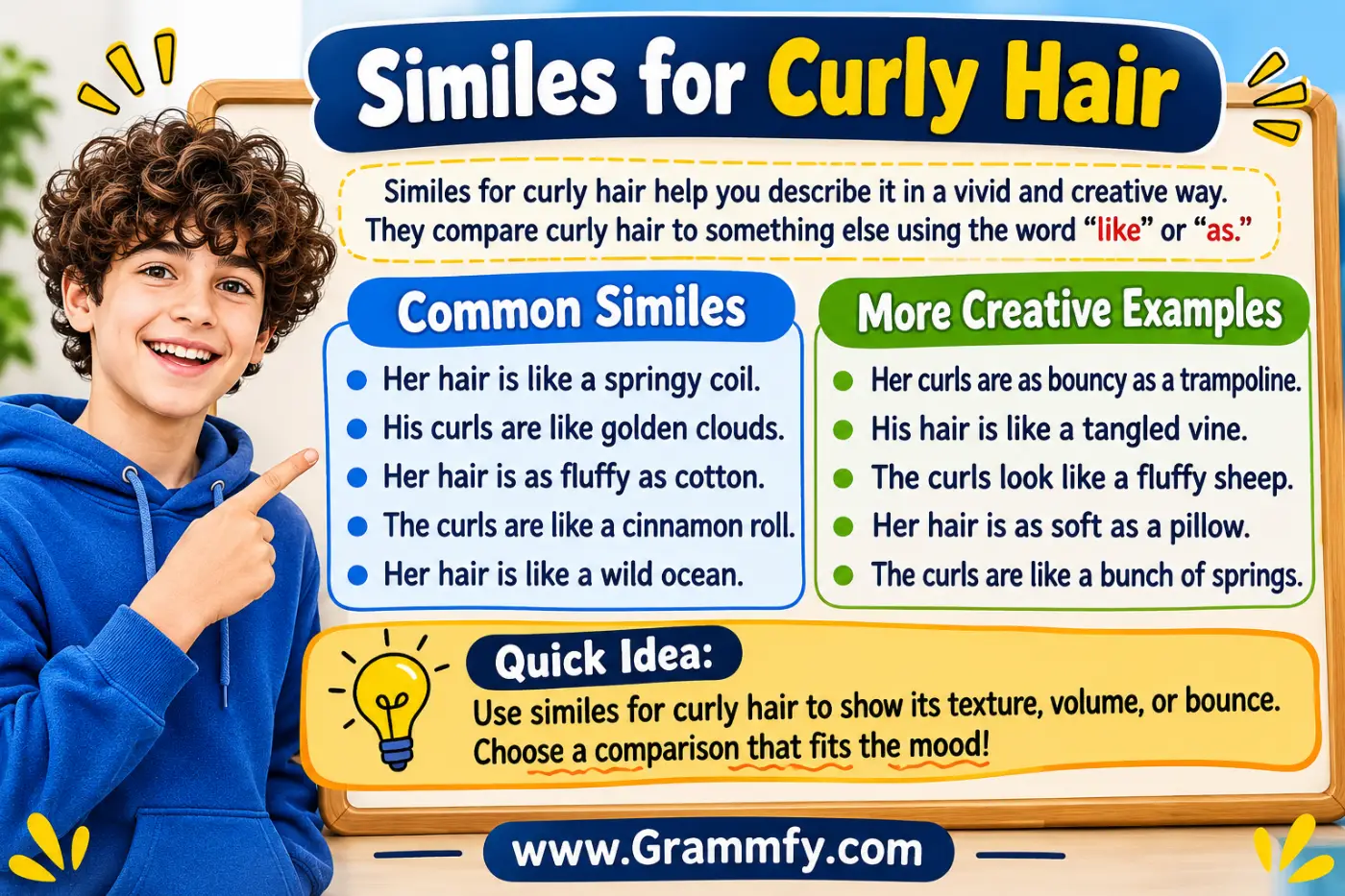
Curly hair can look like a spring, a fluffy cloud, or a beautiful crown. When you describe curls in a story, school essay, poem, or social media caption, the right comparison can help readers picture them clearly. Instead of saying someone has beautiful curls, you can compare their hair to something familiar and make the description more lively. Similes for Curly Hair compare curls to familiar things using words such as “like” or “as“.
- ” For example, “Her hair bounced like a spring” describes curls that move with energy, while “His curls were as soft as cotton” highlights their texture.
The best comparison depends on the kind of curls you want to describe. Tight ringlets, loose waves, thick coils, and fluffy curls can each create a different impression. Some comparisons sound playful, while others feel poetic, romantic, or natural.
Below, you’ll find more than 35 examples with meanings, original sentences, and practical tips. You’ll also learn how to choose a comparison that fits your character, writing style, or everyday conversation.
Need a more vivid way to describe earth similes? Explore our guide to creative the earth similes and examples for fresh ideas and examples.
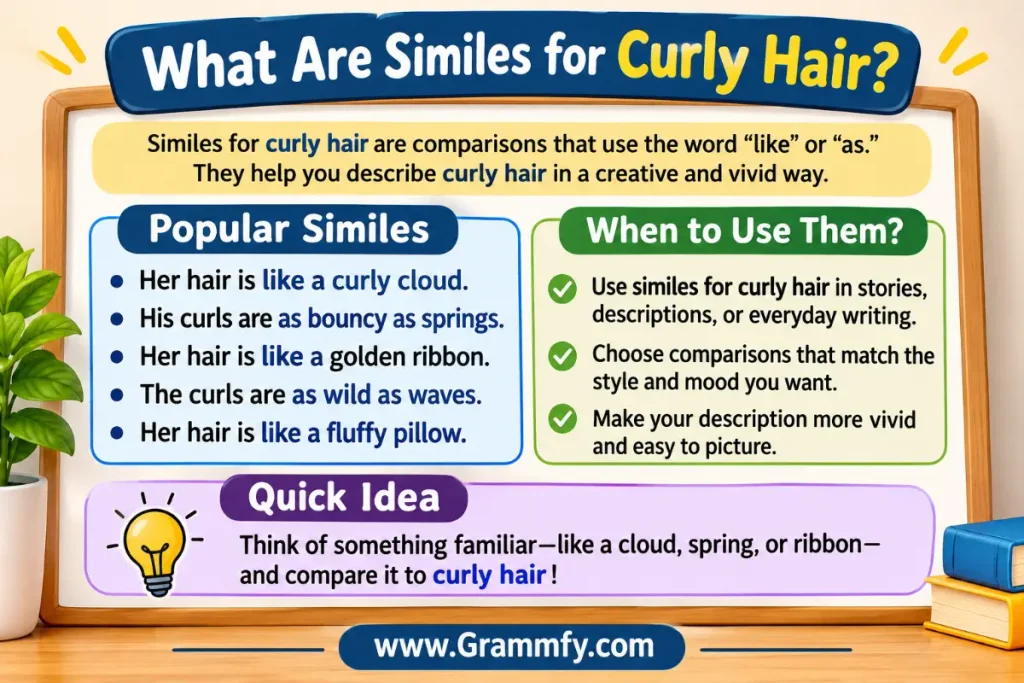
What Are Similes for Curly Hair?
Similes for curly hair are comparisons that describe the shape, texture, movement, or appearance of curls. They usually use “like” or “as” to connect curly hair with something readers already know.
For example:
- Her curls bounced like springs.
- His hair looked like a fluffy cloud.
- The little girl’s ringlets were as golden as spun sunlight.
Each comparison highlights a different feature. Springs suggest movement, clouds suggest softness and volume, and sunlight suggests a bright color or glow.
What Is the Difference Between a Simile and a Regular Description?
A regular description tells readers what something looks like. A simile helps them imagine it through a comparison.
| Regular description | Simile | What changes? |
|---|---|---|
| Her hair was curly. | Her hair curled like a corkscrew. | The curls become easier to picture. |
| His hair was thick. | His curls formed a fluffy cloud around his head. | The reader imagines volume and softness. |
| Her curls moved when she walked. | Her curls bounced like springs with every step. | The movement feels more lively. |
| His hair was dark and shiny. | His curls gleamed like polished obsidian. | The description feels more vivid and formal. |
A good simile adds a useful detail instead of simply making a sentence longer.
35+ Best Similes for Curly Hair With Meanings
These examples cover different curl patterns, textures, colors, and moods. Some are suitable for young children’s stories, while others work better in poems, novels, essays, or captions.
Similes for Bouncy Curly Hair
Use these comparisons when curls move, spring back, or seem full of energy.
| Simile | Meaning | Example sentence |
|---|---|---|
| 1. Curls like springs | Hair that bounces back into shape | Her curls bounced like springs as she ran across the playground. |
| 2. Hair like a Slinky | Flexible curls that stretch and bounce | His hair moved like a Slinky whenever he nodded his head. |
| 3. Ringlets like coiled ribbons | Neat, rounded curls with a spiral shape | Ringlets like coiled ribbons framed her smiling face. |
| 4. Curls like tiny whirlwinds | Lively curls that seem to move in different directions | Tiny whirlwinds of curls surrounded the boy’s forehead. |
| 5. Hair that dances like a jumping rope | Curls that swing and move with energy | Her hair danced like a jumping rope while she skipped down the path. |
| 6. Curls like bouncing balls | Springy curls that move up and down | His curls bounced like rubber balls after he removed his hat. |
These comparisons are especially useful for active scenes. They help readers imagine how curls respond to walking, running, dancing, or turning the head.
Similes for Soft and Fluffy Curly Hair
Choose these when you want to emphasize softness, fullness, or a gentle appearance.
| Simile | Meaning | Example sentence |
|---|---|---|
| 7. Hair like a fluffy cloud | Soft-looking, full hair | Her fluffy curls looked like a cloud resting above her shoulders. |
| 8. Curls as soft as cotton | Hair that appears gentle and soft | The baby’s curls were as soft as cotton. |
| 9. Hair like a feather pillow | Hair that looks airy and cushioned | His thick curls resembled a feather pillow around his head. |
| 10. Curls like dandelion fluff | Fine, airy curls with a light appearance | The child’s pale curls looked like dandelion fluff in the breeze. |
| 11. Hair like a soft wool blanket | Dense curls with a cozy appearance | Her hair formed a soft wool blanket around her head. |
| 12. Curls like floating bubbles | Light, rounded curls that create a playful effect | Small curls framed his face like floating bubbles. |
Writing tip: Softness is not the same as curl shape. A cloud comparison suggests volume, while cotton suggests texture. Pick the one that matches the detail you want readers to notice.
Similes for Tight Curls and Coils
These examples highlight spiral shapes and closely packed curls.
| Simile | Meaning | Example sentence |
|---|---|---|
| 13. Curls like corkscrews | Tight, twisting spiral curls | Her corkscrew curls framed her face in perfect little spirals. |
| 14. Hair like a coiled spring | Compact curls with a springy shape | His hair formed tight coils like a coiled spring. |
| 15. Ringlets like tiny spirals | Small, clearly defined curls | Golden ringlets fell across her forehead like tiny spirals. |
| 16. Curls like winding staircases | Long curls that twist around themselves | Her long curls looked like winding staircases of dark hair. |
| 17. Hair like a field of curled ribbons | Many separate curls with curved shapes | A field of curled ribbons seemed to surround her head. |
| 18. Coils like little question marks | Curves that bend into rounded shapes | Each coil looked like a little question mark beside his temple. |
These similes can help readers picture specific curl patterns. They work best when the comparison matches the actual shape of the hair rather than relying on a general statement that it is curly.
Similes for Thick and Voluminous Curly Hair
Use these when the main feature is fullness, height, or a wide silhouette.
| Simile | Meaning | Example sentence |
|---|---|---|
| 19. Hair like a fluffy halo | Full curls that form a rounded shape | Her curls formed a fluffy halo around her face. |
| 20. Curls like a blooming flower | Hair that spreads outward in a rounded, layered shape | Her hair opened like a blooming flower in the morning light. |
| 21. Hair like a lion’s mane | Thick, full hair with a bold appearance | His thick curls spread around his head like a lion’s mane. |
| 22. Curls like a tangled forest | Dense curls with many overlapping shapes | A tangled forest of curls covered the top of his head. |
| 23. Hair like a crown of clouds | Full curls arranged around the head | She wore her natural curls like a crown of clouds. |
| 24. Curls like a soft mountain range | Large curls that rise and fall in layers | Her hair formed a soft mountain range above her shoulders. |
A comparison such as “a lion’s mane” can suggest boldness and volume. A “crown of clouds” sounds softer and more imaginative. Choose the mood that fits your character.
Similes for Shiny or Colorful Curly Hair
These comparisons focus on light, color, and visual detail.
| Simile | Meaning | Example sentence |
|---|---|---|
| 25. Curls like golden threads | Golden-colored curls | Golden curls fell around her cheeks like fine threads. |
| 26. Hair like polished bronze | Reddish-brown hair with a warm shine | His bronze-colored curls shone like polished metal. |
| 27. Curls like dark chocolate ribbons | Deep brown curls with a rich appearance | Dark curls wound around her shoulders like chocolate ribbons. |
| 28. Hair like sunlit waves | Curls that catch the light | Her hair glowed like sunlit waves beside the window. |
| 29. Curls like copper wire | Defined reddish curls with a metallic color impression | Copper-colored curls twisted around his forehead like fine wire. |
| 30. Hair like midnight silk | Dark hair with a smooth, glossy appearance | Her curls looked like midnight silk under the moonlight. |
Color-based similes can add atmosphere to a scene, but they should not replace every other detail. If color is unimportant to the moment, focus on movement, shape, or texture instead.
Funny and Playful Similes for Curly Hair
These comparisons suit lighthearted stories, friendly jokes, and playful captions.
| Simile | Meaning | Example sentence |
|---|---|---|
| 31. Hair like a plate of curly noodles | A playful image of many twisting curls | After the rain, his hair looked like a plate of curly noodles. |
| 32. Curls like a bowl of springs | Many small, bouncy curls | Her head looked like a bowl of springs after she took off her cap. |
| 33. Hair like a fuzzy pom-pom | A round, fluffy hairstyle | His short curls formed a fuzzy pom-pom on top of his head. |
| 34. Curls like a pile of tangled phone cords | Twisted curls that overlap | Her curls looked like tangled phone cords after a windy walk. |
| 35. Hair like a cartoon cloud | Extra-full curls with a fun shape | His cartoon-cloud hair made his classmates smile. |
| 36. Curls like curly fries | Short, tight curls with a spiral shape | The toddler’s little curls looked like curly fries. |
Funny descriptions work best when the person being described would find them amusing, too. Avoid comparisons that could make someone feel embarrassed about a feature they cannot easily change.
More Creative Similes for Curly Hair
Sometimes a familiar comparison does not capture the exact image you want. These additional ideas can help with poems, fictional characters, and descriptive writing.
| Simile | Best for | Example |
|---|---|---|
| Curls like ocean waves | Loose, flowing curls | Her curls rolled over her shoulders like ocean waves. |
| Hair like a basket of spirals | Many defined curls | A basket of spirals framed his cheerful face. |
| Curls like twisted vines | Long curls that wind together | Her hair wound around her shoulders like twisted vines. |
| Hair like a galaxy of spirals | A creative, imaginative description | Every curl seemed like a tiny galaxy of spirals. |
| Curls like a spring garden | Lively, varied curls | Her curls reminded me of a spring garden full of movement. |
| Hair like a cluster of grapes | Rounded curls gathered together | Small curls clustered together like grapes on a vine. |
| Curls like question marks in the breeze | Loose curls that bend and move | Question-mark curls danced in the breeze around his ears. |
| Hair like a woven basket | Dense curls that overlap | Her curls formed a pattern like a woven basket. |
The strongest image is usually the one that gives the reader one clear idea. Avoid stacking several unrelated comparisons into a single sentence.
What Makes a Good Simile for Curly Hair?
A useful simile connects one noticeable feature of hair to a familiar object, movement, or scene. It should be easy to picture and appropriate for the situation.
Consider these three descriptions:
- Shape: Her curls twisted like corkscrews.
- Movement: His curls bounced like springs.
- Volume: Her hair spread like a fluffy cloud.
Each sentence focuses on a different feature. That makes the description clear.
Match the Simile to the Curl Pattern
Not all curls look alike. Some form loose loops, while others create small, tight coils. A comparison should reflect the pattern you are describing.
| Curl pattern | Similes that may fit | Why they work |
|---|---|---|
| Loose curls | Ocean waves, curved ribbons | They suggest gentle curves and movement. |
| Defined ringlets | Corkscrews, coiled ribbons | They emphasize spiral shapes. |
| Tight coils | Small springs, tiny spirals | They suggest compact, repeating curves. |
| Thick curls | Cloud crown, lion’s mane | They highlight fullness. |
| Short curls | Curly fries, fuzzy pom-pom | They create a compact, playful image. |
| Long curls | Winding vines, flowing ribbons | They suggest length and movement. |
These are writing comparisons, not strict descriptions of curl types. Hair can have more than one pattern, and a single hairstyle may combine several textures.
Think About the Feeling You Want to Create
A simile does more than describe appearance. It can also shape the reader’s feelings about a character.
| Intended feeling | Possible comparison | Example |
|---|---|---|
| Playful | Curls like bouncing balls | His curls bounced like little balls as he laughed. |
| Gentle | Hair like a soft cloud | Her curls rested like a soft cloud around her face. |
| Bold | Hair like a lion’s mane | He entered the room with curls like a lion’s mane. |
| Romantic | Curls like silk ribbons | Her curls fell like silk ribbons beside her cheeks. |
| Magical | Hair like a crown of stars | Her dark curls sparkled like a crown of stars in the light. |
| Funny | Hair like curly noodles | His curls looked like curly noodles after his nap. |
For a formal essay, choose a clear, restrained comparison. A fantasy story can support more imaginative language, while a text message may need only a few words.
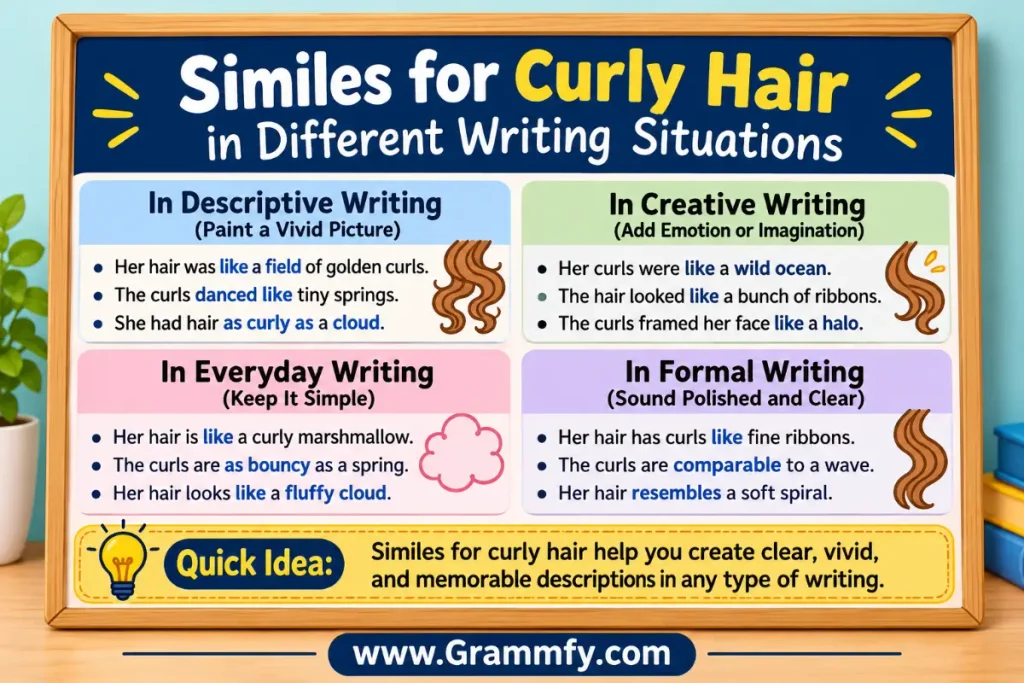
Similes for Curly Hair in Different Writing Situations
The best comparison depends on where you plan to use it. A school assignment, a character profile, a social media caption, and a professional description all have different needs.
What Simile Should You Use in a School Essay?
In a school essay, choose a simile that is clear, relevant, and easy to explain. Avoid using several comparisons in one sentence.
Good examples include:
- Her curls bounced like springs as she ran toward the school gate.
- His hair formed a fluffy cloud around his head.
- The girl’s ringlets curled like tiny ribbons beside her face.
Why these work: Each sentence describes one feature. Readers do not need to guess what the writer means.
If your assignment asks you to identify a simile, look for a comparison that uses “like” or “as” in a figurative way. In “Her curls were like springs,” the hair is not made of metal. The sentence compares the way the curls behave with the way springs bounce.
What Simile Works Best in a Story?
Stories often need descriptions that reveal something about a character or setting. Choose a comparison that fits the action taking place.
For example:
- As Maya hurried through the garden, her curls bounced like springs.
- A gust of wind lifted Daniel’s curls like a cloud breaking apart.
- Under the porch light, Leila’s dark ringlets shone like polished ribbons.
These sentences connect hair to movement or lighting. That makes the detail part of the scene instead of an unrelated description.
A useful rule is to describe a character’s hair when something makes it noticeable. A gust of wind, a sudden turn, a change in light, or a character’s gesture can create a natural moment for the simile.
What Simile Is Best for a Poem?
Poetry allows more imaginative comparisons, especially when the hair reflects a mood or theme.
Try examples such as:
- Her curls were a garden of spirals in the morning sun.
- Like tiny waves, her ringlets moved with every breath of wind.
- Her dark curls flowed like midnight rivers across her shoulders.
These comparisons have a more lyrical tone. However, a poetic simile should still make sense within the poem. If the poem focuses on the sea, waves may support its central image. If it focuses on nature, flowers, vines, or clouds may fit better.
What Simile Should You Use in a Text Message?
A text message usually benefits from a short, friendly comparison. You do not need a long poetic sentence to compliment someone’s curls.
Examples:
- Your curls bounce like springs!
- Your hair looks like a cloud today.
- Those ringlets are like little spirals.
- Your curls look amazing in the sunlight.
- Your hair has such a fun, bouncy shape.
When complimenting someone, focus on what you genuinely like. A simple and sincere message often sounds more natural than an elaborate comparison.
What Simile Works in an Email or Formal Description?
Most professional emails do not need figurative descriptions of someone’s hair. If you are writing a character description, an event report, or a creative assignment, keep the comparison respectful and precise.
For example:
- Her shoulder-length curls formed a soft halo around her face.
- His short ringlets curved neatly along his hairline.
- The performer’s copper curls caught the stage lights.
These descriptions give useful visual information without sounding overly casual. In a workplace email unrelated to appearance, it is usually better to leave the comparison out entirely.
15+ Original Example Sentences Using Curly Hair Similes
The following sentences show how to use comparisons naturally in everyday scenes. They include different ages, settings, and moods so you can adapt them to your own writing.
- At school: Ava’s curls bounced like springs as she hurried to class.
- At the beach: The salty breeze moved her ringlets like little ocean waves.
- At a birthday party: His hair looked like a fluffy cloud beneath the colorful party hat.
- During a family photo: Her golden curls framed her face like ribbons on a gift.
- In the rain: After the shower, his curls twisted like tiny corkscrews.
- At the park: The toddler’s short curls bounced like little balls as she climbed the steps.
- At a wedding: Her dark ringlets shone like polished silk beneath the lights.
- In a classroom story: The young wizard’s hair rose around his head like a storm cloud.
- During a dance: Her curls swung like coiled ribbons with every turn.
- On a windy morning: The breeze scattered his curls like leaves moving across a path.
- In a portrait: Her copper ringlets looked like fine wires glowing in the afternoon sun.
- At a family picnic: His thick curls formed a soft halo above his forehead.
- In a fantasy novel: The queen wore her silver curls like a crown woven from moonlight.
- During a game: The boy’s curls bounced like springs each time he jumped for the ball.
- In a funny scene: After his nap, his hair resembled a bowl of curly noodles.
- At a school concert: The singer’s dark curls shone like midnight silk under the spotlight.
- In a garden: Her loose curls twisted like vines around her shoulders.
- During a morning walk: Sunlight touched his curls like gold dust.
How Can You Make These Sentences Your Own?
Start with one feature, then choose an image that matches it.
- For movement: Think of springs, bouncing balls, or dancing ribbons.
- For shape: Think of spirals, corkscrews, or winding vines.
- For volume: Think of clouds, halos, or a lion’s mane.
- For color: Think of bronze, chocolate, copper, or gold.
- For a playful mood: Think of curly noodles or a fuzzy pom-pom.
Change the setting or action to make the sentence fit your own character. For example, “Her curls bounced like springs as she ran” could become “Her curls bounced like springs as she raced down the hallway.”
Simile vs. Metaphor for Curly Hair: What’s the Difference?
A simile compares two things using words such as “like” or “as.” A metaphor describes one thing as another without using those comparison words.
| Simile | Metaphor | Difference |
|---|---|---|
| Her curls were like springs. | Her curls were springs. | The simile makes the comparison explicit. |
| His hair looked like a cloud. | His hair was a cloud. | The metaphor makes the image more direct. |
| Her ringlets moved like ribbons. | Her ringlets were ribbons. | The metaphor sounds more figurative. |
| His curls shone like bronze. | His curls were bronze. | The metaphor gives the hair a stronger symbolic quality. |
A simile is often easier for young readers to understand because it clearly signals a comparison. A metaphor can sound more dramatic or poetic, but it may also be less precise.
Which One Should You Use?
Choose a simile when you want to make the comparison obvious:
– Her curls bounced like springs.
Choose a metaphor when you want a stronger, more direct image:
– Her curls were a spring garden.
Neither form is automatically better. Use the one that fits your purpose and the tone of your writing.
Curly Hair Similes vs. Descriptive Adjectives
Sometimes a simple adjective is more effective than a simile. Descriptive words can give readers quick information, while comparisons create a more visual image.
| Adjective | Simile | Best use |
|---|---|---|
| Bouncy | Her curls bounced like springs. | Showing movement |
| Fluffy | Her hair looked like a fluffy cloud. | Creating a visual image |
| Shiny | Her curls gleamed like polished bronze. | Describing reflected light |
| Tight | Her curls twisted like corkscrews. | Showing curl shape |
| Thick | Her hair spread like a lion’s mane. | Emphasizing volume |
| Soft | Her curls felt as soft as cotton. | Describing texture |
| Long | Her curls flowed like ribbons. | Showing length and movement |
Use adjectives when you need a concise description. Choose a simile when the image adds something useful to the scene.
For example, “She had thick, dark curls” gives readers basic information. “Her thick, dark curls framed her face like a midnight cloud” creates a stronger visual impression. The second version is useful when the hair matters to the scene; the first may be better when it does not.
Common Mistakes When Writing Similes for Curly Hair
A simile should make your meaning clearer. Some comparisons become distracting when they are too complicated, inaccurate, or repeated too often.
1. Using Too Many Comparisons in One Sentence
Weak example: Her curls were like springs, clouds, ribbons, and flowers.
The reader receives several different images without knowing which one matters most.
Better: Her curls bounced like springs whenever she laughed.
One clear comparison is usually enough.
2. Choosing an Image That Does Not Match the Hair
A comparison should reflect the feature you want to describe. “Curls like ocean waves” may fit loose, flowing curls, but it may not describe short, tightly coiled hair very well.
Better: Match the image to the actual pattern. Use corkscrews for spiral curls, springs for bounce, and clouds for volume.
These are flexible writing choices rather than strict rules. Creative writing can use surprising comparisons, but the reader should still understand the intended effect.
3. Confusing Texture With Shape
“Soft as cotton” describes how hair feels or appears to feel. “Curled like a corkscrew” describes its shape.
If you want to emphasize both, use separate details:
Her curls formed tiny corkscrews and felt soft beneath her fingers.
This sentence describes shape and texture without forcing both ideas into one comparison.
4. Making Every Description Overly Fancy
A sentence does not become better just because it contains unusual imagery.
Overwritten: Her magnificent curls spiraled like a thousand celestial ribbons dancing through the eternal heavens.
Simpler: Her curls spiraled like ribbons in the breeze.
The shorter version gives readers a clear image without slowing down the scene.
5. Repeating the Same Simile
If you describe a character’s hair as a cloud in every paragraph, the image quickly loses its effect.
Instead, vary the detail according to the scene. You might describe the hair’s shape in one paragraph, its movement in another, and its color when the lighting changes.
Do not add a new simile to every sentence, though. Plain descriptions help figurative language stand out.
6. Using Humor That Could Sound Insulting
A comparison to noodles or tangled cords can be funny in the right setting. It can also sound unkind if the person being described is sensitive about their hair.
Consider the relationship between the characters and the purpose of the scene. A playful comparison should make the moment warmer or funnier, not make a person feel small.
7. Using “Like” or “As” Without Making a Real Comparison
Not every sentence containing “like” or “as” is a simile.
- “She likes her curly hair.” This is not a simile.
- “Her curls bounced like springs.” This is a simile.
- “Her hair was as soft as cotton.” This is a simile.
The comparison must connect two things to create a figurative image.
When Should You Avoid a Simile for Curly Hair?
A simile is helpful when you want to create a picture in the reader’s mind. It is less useful when the situation calls for plain, direct information.
Avoid unnecessary figurative language in:
- Professional profiles: Describe relevant details clearly rather than adding poetic comparisons.
- Scientific or technical writing: Use accurate terms for hair structure and texture.
- Short factual reports: Include only details that matter to the purpose.
- Sensitive conversations: Avoid playful comparisons if they might embarrass someone.
- Scenes already full of imagery: Let the reader focus on the main action.
For example, a character profile might simply say, “She has long, tightly curled brown hair.” That sentence is clear and practical. A novel might benefit from “Her brown curls twisted like ribbons in the afternoon breeze.”
The best choice depends on what the reader needs to know.
Antonyms and Contrasting Descriptions for Curly Hair
Similes do not have direct antonyms in the same way that ordinary adjectives do. However, you can contrast curly hair with straight, smooth, or sleek hair to create a clearer image.
| Curly-hair description | Contrasting description | Difference |
|---|---|---|
| Curls like corkscrews | Hair straight as a ruler | Spiral shape vs. straight shape |
| Hair like a fluffy cloud | Hair sleek as glass | Full appearance vs. smooth appearance |
| Curls bouncing like springs | Hair lying flat as a sheet | Springy movement vs. little movement |
| Hair like a tangled forest | Hair smooth as satin | Many overlapping curves vs. a sleek appearance |
| Curls like winding vines | Hair falling straight like a ribbon | Twisting shape vs. straight length |
These are descriptive contrasts, not judgments about which hairstyle is better. Curly, wavy, coiled, and straight hair can all be described positively.
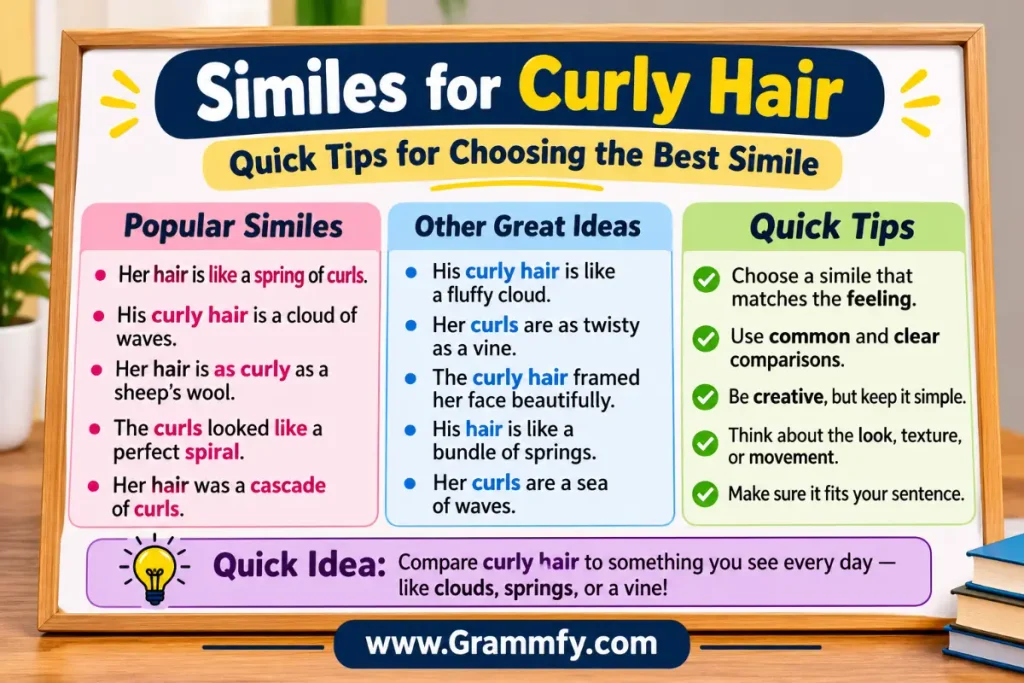
Quick Tips for Choosing the Best Simile
Use this checklist whenever you need a comparison for a story, essay, poem, or caption.
- Identify the feature. Decide whether you are describing shape, softness, volume, color, or movement.
- Pick a familiar image. Springs, clouds, ribbons, vines, and waves are easy to picture.
- Match the tone. A playful caption may suit a funny comparison, while a formal essay needs something more restrained.
- Keep it clear. Avoid combining several unrelated images in one sentence.
- Use precise details. A small, tight spiral is different from a long, loose curl.
- Read the sentence aloud. If the comparison sounds awkward, simplify it.
- Avoid stereotypes. Do not assume a person’s personality based on their hair texture.
- Use figurative language selectively. One memorable comparison can have more impact than five ordinary ones.
A Simple Formula for Creating Your Own Simile
You can build an original comparison in three steps:
- Name the feature: Her curls are tight.
- Choose a matching image: A corkscrew has a tight spiral.
- Write the comparison: Her curls twisted like tiny corkscrews.
Try the same method with other features:
- Feature: Bouncy curls. Image: Springs. Sentence: Her curls bounced like springs when she skipped.
- Feature: Full hair. Image: A cloud. Sentence: His curls formed a fluffy cloud around his head.
- Feature: Long curls. Image: Ribbons. Sentence: Her long curls flowed like ribbons down her back.
- Feature: Shiny curls. Image: Bronze. Sentence: Her copper curls gleamed like polished bronze.
This approach helps you create descriptions that fit your subject instead of relying on the same examples every time.
Conclusion
The best Similes for Curly Hair make a reader picture a specific feature, whether it is a springy ringlet, a soft cloud of curls, or a shiny spiral catching the sunlight. Start by deciding what you want to describe: shape, texture, movement, volume, or color. Then choose a familiar image that matches that detail.
In playful writing, compare curls to bouncing springs or curly noodles. To create a softer image, try clouds, cotton, or ribbons. Poems and stories also allow more imaginative comparisons, as long as the image remains clear. Add one concrete curl comparisonVary the repeated comparison language You do not need to make every sentence poetic. One well-chosen simile can bring a character to life and make your writing more memorable. Experiment with the examples above, adjust them to your own style, and choose the comparison that feels most natural.
Frequently Asked Questions
What are some good similes for curly hair?
Good examples include “curls like springs,” “hair like a fluffy cloud,” and “ringlets like corkscrews.” Each one highlights a different feature, such as movement, volume, or shape.
What is a simile for bouncy curls?
“Her curls bounced like springs” is a simple simile for bouncy curls. It compares the hair’s movement to the way a spring returns to its shape.
What is a simile for soft curly hair?
“Her curls were as soft as cotton” describes hair that appears gentle and soft. You can also compare fluffy curls to a cloud when you want to emphasize volume.
How do I describe curly hair in a creative story?
Describe one noticeable feature and connect it to a familiar image. For example, “His tight curls twisted like tiny corkscrews” gives readers a clear picture of the curl pattern.
What’s another way to say someone’s curly hair looks beautiful?
You could say, “Her curls shone like golden ribbons” or “His curls framed his face like a soft halo.” Choose a comparison that reflects the hair’s actual color, shape, or movement.
Can I use funny similes for curly hair?
Yes, playful comparisons such as “curls like curly fries” can work in lighthearted writing. Make sure the joke suits the situation and does not embarrass the person being described.
What is the difference between a simile and a metaphor for curly hair?
A simile uses “like” or “as” to make a comparison, as in “Her curls bounced like springs.” A metaphor makes the comparison directly, as in “Her curls were springs.”

Tylerbrooks is a US-based English grammar writer and contributor at Grammfy. He writes helpful articles about grammar, spelling, commonly confused words, and vocabulary. His goal is to explain English topics in simple language with clear examples and practical tips. Through his articles, he helps readers improve their writing and everyday English skills.